The Human/Technology
Tension
The new solutions that address this
emerging workplace reality
Issue 66
Exploring workplace
research, insights and
trends
360.steelcase.com
Resilient Real Estate:
Space as an adaptive system
Healthcare: Time for
Change
Making every moment count
Q
The thirst for innovation has never been stronger and
organizations everywhere are pursuing every possible
way to amplify their innovation quotient.
Most organizations unknowingly overlook a crucial
success factor: the role of physical space. Work-
places that are intelligently designed to bring people
together in a fluid process—virtually as well as
physically—have unprecedented power to propel
innovation in today’s global economy.
By working in collaboration with leading think
tanks, closely observing innovation at powerhouse
companies and conducting intense primary research
in its own facilities, Steelcase is able to shed new light
on the behaviors that drive 21st-century innovation
and how workplaces can be intentionally designed
to amplify it.
about this issue
| Issue 66 | 360.steelcase.com4 360.steelcase.com | Issue 66 | 5
Search “Steelcase 360 Magazine” on the newstand.
Compatible with iPad. Requires iOS 3.2 or later.
Find the “Steelcase 360”
app for free on iTunes
10Resilient Real Estate
Tough times don’t last, but resilient
companies do. In fact, they flourish
when others wilt. An innovative real
estate strategy sets the stage for a
resilient company.
360 Magazine is published by Steelcase Inc. All rights reserved. 13 -0000214 Copyright 2013. Design by Plural, in collaboration with Steelcase.
Material in this publication may not be reproduced in any form unless you really want to help people love how they work—just ask us first, okay?
Amplify Your Innovation
Quotient: The New I.Q.
I.Q. takes on a new definition as or-
ganizations everywhere are pursuing
every possible way to amplify their
innovation quotient. Most unknowing-
ly overlook a crucial success factor:
physical space. Workplaces that are
intelligently designed to bring people
together—virtually as well as phys-
ically—have unprecedented power
to propel innovation in today’s glob-
al economy.
Join the conversation
Connect with Steelcase
via social media and let
us know what you’re
thinking. Or email
us at 360magazine@
steelcase.com
Search “Steelcase 360
Magazine” on the Newstand.
Compatible with iPad.
Requires iOS 3.2 or later.
28
74Healthcare: Time for Change
Making every moment count.
Exploring workplace re-
search, insights
and trends
360.steelcase.com
360 on the ipad
facebook.com/steelcase
youtube.com/steelcasetv
twitter.com/steelcase
Departments
4 Perspectives
26 Trends 360
56 Insight-Led
Solutions
116 Sustainability
Spotlight
104 Learning
Curve
128 Leadership
Moment
130 Atoms  Bits
6 QA with Andrew
Zolli
Author, thought leader
and consultant Andrew
Zolli explains why
resilience is what every
company needs,
especially now.
18 Work Hospitality
Workspring helps com-
panies rethink their real
estate footprint.
106 10x10
From reducing AIDS to
achieving world peace,
10x10 is committed to
improving the world
through education, one
girl at a time.
70	Rethinking Think®
Even a breakthrough
product can become
better.
120 Small Companies,
Big Ideas
Entrepreneurial wisdom
valuable to a company of
any size.
96 How Technology is
Changing Education
Make way for the
MOOCs and other
forms of cyberschooling
that are bringing radical
transformation to every
level of education.
82	Reports from the
Nomadic Fringe
New research from
Coalesse sheds light
on nomadic work
habits.
58 Designing for the Human/
Technology Tension
Technology is changing everything
about the ways we work. Read how
new solutions are helping workers ad-
dress the tension this is causing in the
workplace.
Contents
| Issue 66 | 360.steelcase.com6 360.steelcase.com | Issue 66 | 7
Perspectives
Meet some of the people
who contributed information
and ideas to this issue.
▲ Martin Oberhäuser
and Sebastian Struch
oberhaeuser.info
The founder of the design studio oberhaeuser.info in
Hamburg, Martin Oberhäuser, together with graphic
designer Sebastian Struch, created the infograph­ics
that illustrate our feature “Amplifying Innovation”
and Trends360. He has a passion for complex data
visualization and informa­tion design, which he says
should always be easy to use and also fun to look
at. Sebastian works as an independent designer
in different disciplines. Besides information design,
his fields of activity are also corporate and packag-
ing design. Good design should always be able to
touch you, he says.
▲ Allison Arieff
Freelance writer, The New York Times
Allison Arieff applied her perspective as a journalist
to write about Steelcase’s latest product innova-
tions. Based in San Francisco, she is an editor and
content strategist for the urban planning and policy
think tank SPUR, and is also a regular contributor to
The New York Times, Wired, Design and other publi-
cations. A former book editor, from 2006-2008 she
was senior content lead for IDEO.
▲ Chris Congdon and Gale Moutrey
Steelcase
Chris Congdon and Gale Moutrey are passionate
advocates for the idea that organizations can become
more resilient and actually amplify their performance
by being very intentional about the places where
they bring people together to work. Congdon is
director of research communications and editor of
360 Magazine and Moutrey is vice president, brand
communications. They collaborate with leading
organizations to help them rethink the strategic role
of their physical environment.
“At the very heart of an organization lies its purpose
—its reason for being—and it can activate that purpose
by fusing together its strategy, brand and culture,”
says Moutrey. “Creating the right places can make this
visible to the people who work there, and help bring
an organization’s purpose to life,” adds Congdon.
“These ‘right places’ are diverse ecosystems
of work destinations—places where people want to
be because they perform better when they are there.”
▲ Shujan Bertrand
Coalesse
With 13 years of experience as an industrial designer
and strategist, Shujan Bertrand is working with
Steelcase’s Coalesse group to translate user insights
into new products that support creative workers at
home as well as in workplaces. Having led design
strategy projects for Samsung, Microsoft, Fujitsu,
Procter  Gamble and other leading consumer
brands, she’s an experienced innovator whose phi-
losophy is to use insights to provoke new thinking
that ultimately results in designs that evoke strong
emotional responses.
▲ Cherie Johnson, James Ludwig,
and Allan Smith
Steelcase
Cherie Johnson, James Ludwig and Allan Smith
share a conviction: good experiences and outcomes
result from user-centered design that’s based on
careful observational research. As the design man-
ager for Steelcase’s new innovation center, Johnson
worked closely throughout the project with Ludwig
and Smith, whose teams would be moving into the
space. Johnson has a bachelor’s degree in interior
design and gained nearly 15 years of experience at
a large architectural firm before joining Steelcase. An
architect and designer, Ludwig lived and worked in
Berlin before joining Steelcase in 1999. Smith’s ac-
ademic training combines business and art history,
and his 20-year career with Steelcase includes a re-
cent three-year assignment in France.
Ritu Bajaj, Patricia Kammer, and
Frank Graziano
Steelcase WorkSpace Futures Researchers
To understand the behaviors of creative collaboration
and innovation, Steelcase WorkSpace Futures
researchers Ritu Bajaj, Frank Graziano and Patricia
Kammer worked for several years, braiding what
they learned into game-changing insights and a
cohesive set of principles that informed the design
of Steelcase’s new innovation center. Bajaj, who was
an architect in India and holds a master’s degree in
human-centered product design, applied her exper-
tise in ethnographic techniques to lead an experience
pilot in a full-scale prototype of the center. Graziano,
who holds an undergraduate degree in design and
a master’s degree in fine arts, led strategic investi-
gations into innovation at leading companies and the
d.school at Stanford University. With a degree in inte-
rior design, Kammer conducted benchmarking and
primary research, and she played a key role in synthe-
sizing the team’s findings into design programming.
Crises seems to be more frequent today. Is that why
resilience is such a hot topic?
Yes, absolutely. Consider that in 2012 alone we had a
heat wave that melted the tarmac under airplanes in
Washington, D.C.; half the country declared a federal
emergency due to the largest drought in a century;
the largest blackout in history left one in nine people
on Earth (all in India) in the dark; and super storm Sandy
—all influenced by a warming climate.
This kind of permanent and intrinsic volatility is becoming
the new normal. And not only are we experiencing
more disruptions, but their consequences are be-
coming harder to predict. That’s because the world is
connected in ways we can scarcely imagine: climate,
energy, the financial, social and political systems are
all interlinked and hard to observe. And worse, we
have all sorts of natural cognitive blindness when it
comes to disruptive change. Our brains are trained
to attend to certain forms of change but not others,
which is why we are constantly surprised that our
models are not as nuanced as the world we live in.
When you combine complexity, interconnectivity and
blindness, tie the systems together and stress them
all, you get these volatile spikes, or crises.
What’s the impact on individuals and organizations?
Obviously, these kinds of spikes to the system—the
financial crisis, droughts, food shortages, hurricanes,
etc.—are costly. The last year for which we have data,
2011, was the most expensive year for natural disas-
ters in human history and 2012 will likely top it. But
that’s really just the beginning.There are also indirect
costs: the increasing costs of insurance and the in-
creasing difficulty of long-term planning. And then you
have things like the psychic stresses—on our peo-
ple, which can be less visible but no less damaging.
Give us an example of organizational resilience.
When Katrina hit the Gulf Coast, people’s homes
were literally under water. They lost their possessions,
money, identification, everything. One of the most
important regional banks, Hancock Bank, lost 90
of their 115 branches and their headquarters was
decimated.The electricity was out, computers weren’t
working and their offices were flooded, but the bank
came up with an ingenious response:
“Innovation and
resilience are closely
related.”
Hurricanes. Droughts. Recessions. Network crashes. Geopolitical
conflicts. The order of the day seems to be disruption and crisis.
That’s why it’s critical for companies to be resilient, says Andrew
Zolli, co-author of “Resilience: Why Things Bounce Back,” a book
about why some organizations fall apart in the face of disruption
while others flourish. Resilient organizations don’t rely on any single
plan for the future; they’re agile, cooperative and responsive. Amid
change they don’t just survive, they thrive. What builds resilience?
Empowered middle management and helping the company’s
social networks grow like kudzu, for starters.
Zolli is executive director and curator of PopTech, an influential global
innovation network that explores key forces influencing the future
and develops new approaches to the world’s toughest challenges.
He’s helped companies such as Nike, American Express and GE
to understand the evolving global operating environment and how
to excel in an increasingly precarious world.
QA With
Andrew
Zolli
| Issue 66 | 360.steelcase.com8 360.steelcase.com | Issue 66 | 9
“There’s tremendous power in
the physical environment
to help build trust, cooperation
and resilient behavior.”
How does the organization develop ad hoc solutions?
Not like you might think. The cliché of leadership in a
crisis is either the square-jawed visionary CEO at the
top or the street activist/external agitator. Yet when
disruption occurs it’s hard for people to issue top-
down commands because they don’t have good
situational awareness, while people on the front lines
lack a broad, systemic view. The real strength in a
resilient organization comes from the organization’s
middle management.
If the middle is strongly connected and there’s
cultural permission to be improvisational, they can
use their shared values and mission to get creative
and respond to a crisis. They don’t have to check with
the top. There are no rules, so they invent them as
they go along. And they can do extraordinary things.
The Hancock Bank employees understood the bank
was about helping people achieve their financial
goals. The board and CEO didn’t decide to set up
those tables and tents. The empowered middle,
fueled by creativity and improvisation, came up with
that solution.
They set up tents and card tables as offices, and
offered anyone who needed it—customers and
noncustomers alike—$200 in cash on the spot. No
ID, no problem. It was a radical act of trust in the
communities they serve. In the first few weeks after
the storm, Hancock loaned out $50 million in cash in
this manner. And what was the result? 99.6% of the
loans were repaid, and net assets at the bank grew
by $1.4 billion dollars in the 90 days after the storm,
as people moved their money over to the bank. This
is the kind of adaptive, flexible response that defines
a resilient enterprise —and it didn’t come from the
corner office. It came from the middle management,
who understood and were motivated by the values
of the institution.
Where does that kind of resilience come from?
Resilience has lots of correlates. First and foremost,
we see it in organizations with tight cultures but loose
tactics. These are companies that have a culture of
continuous, modest risk-taking and are flexible and
adaptive to circumstances.
Interestingly, these aren’t always places where people
all think the same way—indeed, most are companies
that tolerate a lot of cognitive diversity. They have peo-
ple who think about the world in different ways, who
think about the same problem, with the same facts,
but from different perspectives.
Another critical aspect of organizational resilience is
trust: People have to be ready to believe in one another
and cooperate when things go wrong. Resilience
is what we call adhocratic—it involves lots of little
collaborations between many different actors; rarely is
it driven by some top-down plan. So you find it in orga-
nizations with a lot of trust, diversity and collaboration.
People are mobile and organizations are often
widely dispersed. How do you get widely dispersed
people to work together?
There was a famous study done in the 1970s about
how people find jobs through networking. Most peo-
ple found new employment not from people they knew,
but from people they knew who in turn knew someone
else. That’s called a “weak tie”: someone you know
through someone else. Researchers also found
that most people found novelty through these weak
connections, whether it was looking for a new job
or new information. So if you’re looking for new in-
formation, having a lot of weak-tie—the kinds of ties
we have through social media—is really helpful. But
if you’re trying to produce and synthesize new work
or new products, you actually need intimate, strong-
tie connections.
The best teams are small groups of people who have
close ties with each other, and each of those people
individually have large weak tie networks. They keep
in touch with widely disparate ideas and different
ways of thinking. They’re exposed to new ideas and
information constantly, which they then bring to the
table to share with their small, strong-tie colleagues.
It makes each of them a better collaborator to have
a large weak-tie network. Twitter is a good example
of a technology that helps people maintain and use
a large weak-tie network. Later, when you need to
work more closely together, you meet in person, use
the telephone or a videoconference for higher band-
width to develop a strong-tie with the person you’re
collaborating with.
The trick is to pick the right spaces for the right kinds
of work. Say we’re going to design a new product.
If we’re on the team, we have to have really strong
ties and connections together. Most effective teams
are small groups of strong-tie folks who themselves
have very large weak-tie networks—people who know
their team members well, and have a lot of sources of
information, insight and inspiration.
Some companies recently decided to bring home-
based employees back into the office. What does
this mean for distributed work?
Companies are realizing that people need time to
work face-to-face, that they can’t work apart all the
time. Many companies are realizing this and to some
extent they are re-urbanizing, recognizing the huge
value of face-to-face communication, that people
need to work together. Our cognitive processes are
designed for human interaction.
°
How can you build that kind of collaboration when
the organization isn't facing a catastrophe?
The ability to withstand disruption is mostly a by-
product of decisions made when things are calm. We
see resilience emerging from four basic capacities.
The first is the ability to build regenerative capacity
when things are going well. This is measured by
the health of an organization’s culture, its levels of
appropriate risk tolerance, the strength of its internal
and external social networks, the physical and mental
health of its people, its embrace of diversity, its adapt-
ability and its level of trust. This self-renewing capacity
is the single most important aspect of resilience, and
it’s proactive, not reactive.
The second aspect of resilience is the ability to
listen for change, to sense impending disruptions.
This means listening for weak signals, things that are
on the edge today but might be major disruptors soon.
It also means interpreting those signals, rehearsing
for various forms of change and embracing scenario-
based thinking.
The third aspect is the ways we respond to disruption,
unlocking the kind of adhocratic, improvisational
response we discussed.
Finally, consider learning and transformation, taking
the lessons of response and reshaping the kinds of
capacity-building we’re doing, and the ways we’re
listening for future changes. Resilience isn’t found
in doing one of these things well—it’s found in doing
all of them well.
Can a company’s physical space influence resilience?
Absolutely. There’s tremendous power in the physical
environment to help build trust, cooperation and
resilient behavior. Humans are social, and the natural
environment is our preferred environment. We also
like to be near places where we’re by ourselves in the
context of other people. When people are in these
environments, their cortisol levels drop and their pro-
social and trust behaviors increase.
Yet so many offices put people in the interior of the
building, away from the natural environment and
daylight. Soul-crushing cubicleville. They take away
every aspect of a human’s preferred environment.
However, there’s an enormous performance and
resilience benefit that comes from working in an
environment that’s physically designed to mimic the
environments to which we have innate, low stress
reactions.
To build trust and cooperation, change the places
where you want people to engage in trusting behaviors.
Put them in environments that naturally unlock those
behaviors, places where they’re less stressed, less
fearful and more at ease.
| Issue 66 | 360.steelcase.com10 360.steelcase.com | Issue 66 | 11
| Issue 66 | 360.steelcase.com12 360.steelcase.com | Issue 66 | 13
Resilient
Real
Estate:Space as
an adaptive
system
By Chris Congdon
and
Gale Moutrey
Amongst the whirlwind of volatility that seems to
spin from one crisis to the next, business leaders
are looking for new skills and strategies that will help
their organizations thrive in the new global economy.
At the same time, in this era of unprecedented
complexity, the study of resilience has emerged in
which scientists, economists, government leaders
and psychologists are working to understand how
systems, organizations and people can adapt to
stay fit within an environment of constant change.
In his new book, “Resilience, Why Things Bounce
Back,” author Andrew Zolli draws from ecology and
sociology to consider resilience “as the capacity
of a system, enterprise, or a person to maintain its
core purpose and integrity in the face of dramatically
changed circumstances.” Zolli suggests that “If we
cannot control the volatile tides of change, we can
learn to build better boats.”
The notion of resilience is generally talked about in
terms of economies, markets, ecosystems or people,
but rarely in conjunction with organizational real
estate. Leading real estate professionals consider
how to create greater flexibility in their portfolios,
but many overlook how they might better leverage
these assets by developing strategies designed
for resilience. At Steelcase we asked ourselves
how the concept of resilience could be applied to
the creation of the places where people within an
organization come together. Could we construct a
strategy designed to leverage today’s complexities
and embrace the speed in which circumstances
change? Could real estate become an adaptive
system to better support an organization’s strategy,
brand and culture by shifting fluidly while remaining
economically viable? Could we develop that “better
boat” through real estate? In each case, we believe
the answer is yes.
a sustainable approach
Researchers define resilience as the ability to adapt
to changed circumstances while continuing to
maintain core purpose and integrity. Exploring and
applying some of the principles of resilience provides
a framework for real estate strategies to achieve this
adaptive capacity.
When a real estate strategy embraces these ideas,
it can create a more sustainable approach that is
not only capable of withstanding volatile economic
conditions, but also help builds trust and cooperation—
what Zolli terms “people’s ability to collaborate
when it counts.” It creates real estate that can help
augment the interactions of people at work and build
resilient workplace communities through strong social
networks based on trust, that can flourish even in the
most challenging situations.
To date, in an effort to respond to rapidly changing
conditions, organizations have implemented
alternative work strategies (AWS) such as teleworking,
hotelling and mobile working. These have been
implemented as a way to limit real estate costs
while supporting organizational objectives, such as
work-life balance for employees or reducing carbon
footprints. The idea behind AWS was pioneered by
IBM in 1989, but it’s only in the last five years that most
companies—80% according to one recent study—
took hold of it as a means of reducing real estate costs
and supporting a more mobile workforce.
Overall, AWS reduced the size of real estate portfolios
about 6-10%, according to CoreNet Global. While a
broad implementation of alternative work strategies
might have reduced portfolios further, currently
only about one-fifth of employees are engaged in
alternative work programs. And some companies that
have implemented AWS as a space-cutting strategy
often leave real estate idling: 11% of workers who
use alternative workspaces still have an assigned
workspace.
AWS has resulted in modest reductions in real estate
portfolios, but there is a steady shift happening.
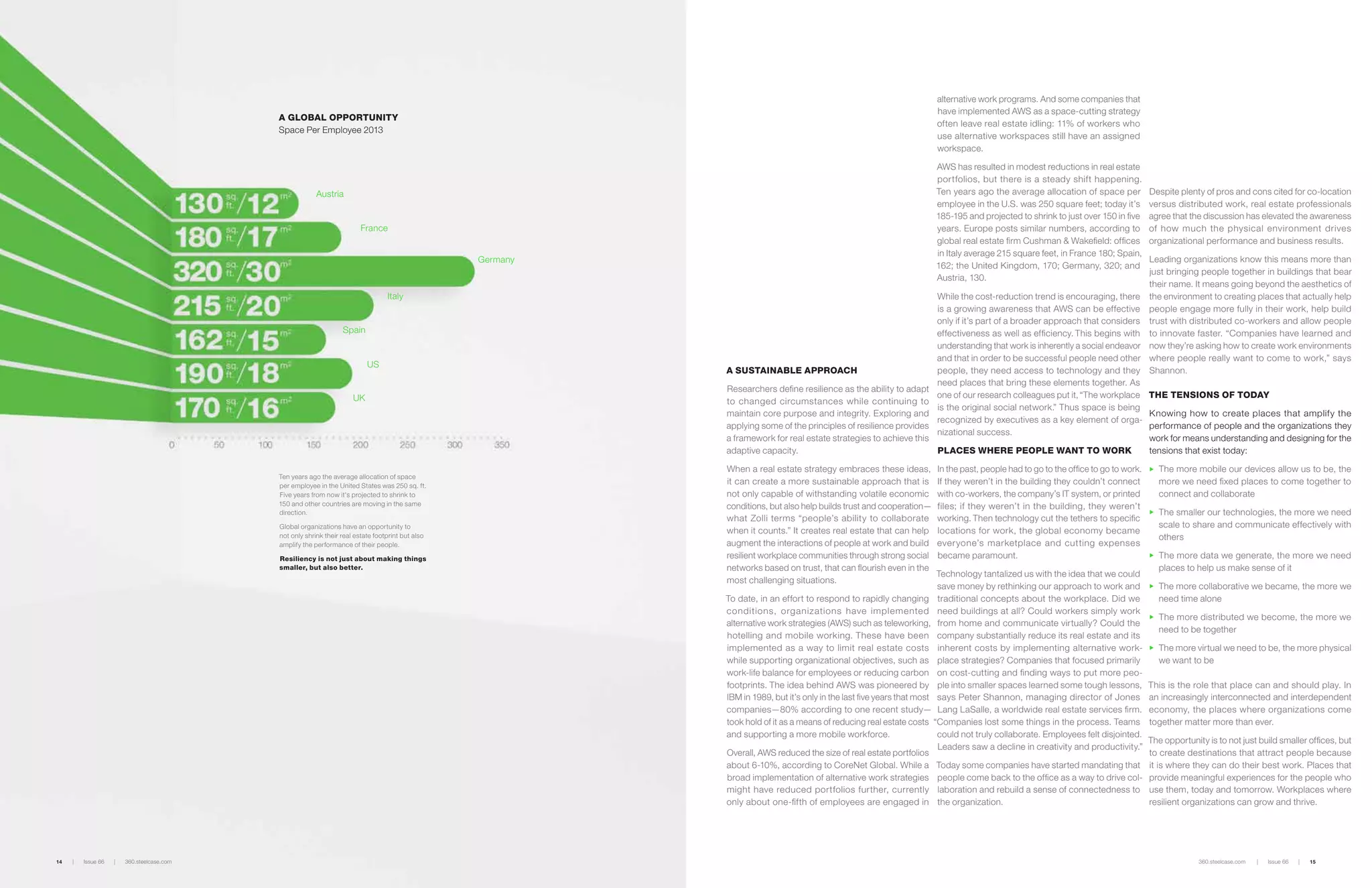
Ten years ago the average allocation of space per
employee in the U.S. was 250 square feet; today it’s
185-195 and projected to shrink to just over 150 in five
years. Europe posts similar numbers, according to
global real estate firm Cushman  Wakefield: offices
in Italy average 215 square feet, in France 180; Spain,
162; the United Kingdom, 170; Germany, 320; and
Austria, 130.
While the cost-reduction trend is encouraging, there
is a growing awareness that AWS can be effective
only if it’s part of a broader approach that considers
effectiveness as well as efficiency. This begins with
understanding that work is inherently a social endeavor
and that in order to be successful people need other
people, they need access to technology and they
need places that bring these elements together. As
one of our research colleagues put it, “The workplace
is the original social network.” Thus space is being
recognized by executives as a key element of orga-
nizational success.
Places where people want to work
In the past, people had to go to the office to go to work.
If they weren’t in the building they couldn’t connect
with co-workers, the company’s IT system, or printed
files; if they weren’t in the building, they weren’t
working. Then technology cut the tethers to specific
locations for work, the global economy became
everyone’s marketplace and cutting expenses
became paramount.
Technology tantalized us with the idea that we could
save money by rethinking our approach to work and
traditional concepts about the workplace. Did we
need buildings at all? Could workers simply work
from home and communicate virtually? Could the
company substantially reduce its real estate and its
inherent costs by implementing alternative work-
place strategies? Companies that focused primarily
on cost-cutting and finding ways to put more peo-
ple into smaller spaces learned some tough lessons,
says Peter Shannon, managing director of Jones
Lang LaSalle, a worldwide real estate services firm.
“Companies lost some things in the process. Teams
could not truly collaborate. Employees felt disjointed.
Leaders saw a decline in creativity and productivity.”
Today some companies have started mandating that
people come back to the office as a way to drive col-
laboration and rebuild a sense of connectedness to
the organization.
Despite plenty of pros and cons cited for co-location
versus distributed work, real estate professionals
agree that the discussion has elevated the awareness
of how much the physical environment drives
organizational performance and business results.
Leading organizations know this means more than
just bringing people together in buildings that bear
their name. It means going beyond the aesthetics of
the environment to creating places that actually help
people engage more fully in their work, help build
trust with distributed co-workers and allow people
to innovate faster. “Companies have learned and
now they’re asking how to create work environments
where people really want to come to work,” says
Shannon.
The tensions of today
Knowing how to create places that amplify the
performance of people and the organizations they
work for means understanding and designing for the
tensions that exist today:
	 The more mobile our devices allow us to be, the
	 more we need fixed places to come together to
	 connect and collaborate
	 The smaller our technologies, the more we need
	 scale to share and communicate effectively with
	others
	 The more data we generate, the more we need
	 places to help us make sense of it
	 The more collaborative we became, the more we
	 need time alone
	 The more distributed we become, the more we
	 need to be together
	 The more virtual we need to be, the more physical
	 we want to be
This is the role that place can and should play. In
an increasingly interconnected and interdependent
economy, the places where organizations come
together matter more than ever.
The opportunity is to not just build smaller offices, but
to create destinations that attract people because
it is where they can do their best work. Places that
provide meaningful experiences for the people who
use them, today and tomorrow. Workplaces where
resilient organizations can grow and thrive.
Ten years ago the average allocation of space
per employee in the United States was 250 sq. ft.
Five years from now it's projected to shrink to
150 and other countries are moving in the same
direction.
Global organizations have an opportunity to
not only shrink their real estate footprint but also
amplify the performance of their people.
Resiliency is not just about making things
smaller, but also better.
US
Austria
France
Germany
Italy
Spain
UK
A Global Opportunity
Space Per Employee 2013
| Issue 66 | 360.steelcase.com14 360.steelcase.com | Issue 66 | 15
| Issue 66 | 360.steelcase.com16 360.steelcase.com | Issue 66 | 17
Resilient places are designed for maximum per-
formance. Every square foot contributes to the
effectiveness of the people working there. This
understanding caused us to question convention-
al thinking about real estate and why the focus
is primarily on the horizontal plane and rarely on
the vertical.
Through further research and development, we have
explored how vertical real estate can expand the role
of walls beyond boundary and division to become
vehicles for communication, collaboration and
concentration—the elements essential for augmenting
human interaction. We believe the vertical plane is a
foundational element in creating an interconnected
workplace and can be the underpinning of resilient
real estate when it’s designed for intelligence as much
as for function.
#2 Modularity
There are certain structural features of resilient
systems that allow them to ensure continuity by
dynamically reorganizing when circumstances
require it. “While these systems may appear outwardly
complex, they often have simpler internal modular
structure with components that plug into one another,
much like Lego blocks,” writes Zolli. “This modularity
allows a system to be reconfigured on the fly when
disruption strikes, prevents failures in one part of the
system from cascading through the large whole, and
ensures that the system can scale up or scale down
when the time is right.”
A resilient real estate strategy mimics this principle
when it has been intentionally designed to create a
balance of spaces equipped for individual work and
group work, some which are owned by individuals
and teams and some which are shared. The ability
for users to self-select places where they can be
most effective allows the overall space to address
the shifting needs of the organization.
In terms of the physical properties of resilient spaces,
modularity integrates interior architecture, furniture
and technology to allow for easy configuration and
adaptation as required to support the types of spaces
organizations need at any stage, especially during
times of rapid change and disruption.
As the needs of users shift and external factors
impact business conditions, these spaces remain vital
because they are capable of morphing and evolving
as required, without increasing the overall footprint
and operational costs.
The Elements
of a Resilient Real
Estate Strategy
Clustering
Design the physical environment to help bring a
diverse range of people, resources, tools and ideas
into close proximity with each other, while achieving
the right level of density—not too sparsely populated
or overcrowded.
Clustering promotes the cross-pollination of people,
ideas and experiences through places that bring
them together. These places are designed to
augment people’s interactions, whether working
side-by-side or across continents.
Modularity
Create places with a modular structure, using inte-
grated interior architecture, furniture and technology
components that can be easily reconfigured and
enhanced when business needs change, especially
during times of rapid growth or disruption.
Modularity requires an intentional design that
balances spaces equipped for individual work and
group work, some which are owned by individuals
and teams and some which are shared. The ability
for users to self-select places where they can be
most effective allows the overall space to address
the shifting needs of the organization.
Feedback Loops
A feedback loop for the physical environment allows
organizations to learn what is working or not, to
modify the workplace and continue to iterate and
evolve. This means developing a diverse system of
quantitative and qualitative data that can alert the
organization to the need for gradual or rapid change.
By also employing the concepts of clustering and
modularity, the feedback loop allows an organization
to rapidly and dynamically reconfigure its spaces
and avoid business disruption.
Through our ongoing design research about the
behavior of people at work, we know that choice
and control over where and how people work is
fundamental to satisfaction and engagement. Places
that support the various modes of work in ways that
consider physical, social and cognitive wellbeing help
people be most effective at what they do.
Based on this understanding,we developed a concept
that we deploy in our own spaces as well as with our
customers: the interconnected workplace. It promotes
choice and control over the places people work within
an overall ecosystem of spaces with three key features:
	Palette of Place: a range of owned and shared
spaces designed for both individual work and
team work
	Palette of Posture: spaces designed to sup-
port movement
	Palette of Presence: spaces that support mixed
presence experiences, both physical and virtual,
and analog and digital information-sharing
This concept leads to workplaces that allow people
to choose where and how they want to work, or as
we call it, “best place”: the ideal place, anywhere on
campus, based on the type of work that needs to be
done and the environment required to be successful.
The result is a global ecosystem of spaces designed
to augment the interactions of people, while reducing
the company’s overall real estate footprint and costs.
This approach allows an organization to do more with
less and challenges the company to leverage today’s
complexities to rethink rather than merely shrink real
estate. The return it yields can impact the bottom line
in ways that transcend cost-cutting since resilient
real estate invests in the key asset of any organiza-
tion: its people.
constructing a resilient real
estate strategy
Three principles from the study of resiliency form the
framework we've developed for creating real estate
that fluidly adapts to to ever-changing circumstances
and an evolving organization, while continuing to
serve the company’s mission.
#1 Clustering
Zolli writes that “resilience is often enhanced by the
right kind of clustering—bringing resources into close
proximity with one another...a special kind of clustering,
one whose hallmark is density and diversity—of talent,
resources, tools, models and ideas.”
A resilient real estate strategy is one that embraces
this principle as a foundational element and promotes
the cross-pollination of people, ideas and experiences
through places that bring them together. These places
are designed to augment their interactions, whether
working alone or in teams, side-by-side or across
the globe.
Such places enhance both the quality and quantity of
human interaction when they are equipped with the
tools and experiences that matter most—quick and
easy access to colleagues, the tools people need to
do their jobs and the technologies that amplify their
performance.
#3 Feedback Loops
“From economies to ecosystems, virtually all resilient
systems employ tight feedback mechanisms
to determine when an abrupt change or critical
threshold is nearing,” Zolli writes. “We are soaking in
a world of sensors and the feedback data that these
sensors produce are a powerful tool for managing
systems performance and amplifying their resilience
–particularly when those data are correlated with data
from other such systems.”
Real estate executives and the teams they work with
need to apply this same thinking to make sure they
employ feedback mechanisms that offer regular,
ongoing feedback that can signal when change is
required or critical issues need to be addressed.
“The business cycle is so dynamic and elastic. The
environment changes and you can’t always predict
where the business needs to go, so you have to
increase your capability to respond. Flexibility is
so much more important in real estate now,” says
Shannon of JLL.
While collecting and analyzing feedback that informs
global real estate strategies can seem daunting,
there are a number of ways to capture the data. The
spaces themselves should provide organizations
with feedback that can help inform their real estate
strategies. Advanced scheduling systems integrated
into individual and group spaces can track space
utilization with real-time analytics that measure and
report reservation patterns, lighting, temperature, etc.
The PricewaterhouseCoopers real estate group
closely monitors workplace performance data for
each of its member-owned firms by tracking when
staff members access PwC’s network, check-in to
the hotelling system from digital devices or use an
access card. Data is captured daily and segmented
by lines of services (tax advisory, assurance, etc.)
and types of employees (partners, directors, staff).
“Detail is key,” says Steve Adams, PwC’s director of
workplace strategy in the U.S. “Who is coming in the
office? Are people taking advantage of our mobility
programs?”
Each month, updated workplace performance
information is made available via an internal web-
based dashboard and document repository for PwC’s
senior leaders and partners who manage markets
and facilities. It shows who’s following hotelling
protocol in their office, conference room usage, even
how other firms are responding based on their client
list, where they’re located and their mix of business.
“If you don’t have this information to manage your
workplace it’s like running a business without a
balance sheet. It’s essential to understanding how
our office environments are working,” says Adams.
(For another innovative way to measure workspace
performance, see Moneyball for Business on the
opposite page).
Like every balance sheet, workplace performance
data reveal only part of the story. Adams says that,
like most organizations involved in the knowledge
economy, “our people are our product. They’re the
ones who serve our clients, so we want to make
sure they have the best workplace experience
possible.” This experience translates into support
for mobile workers and a workplace that attracts and
engages talent, communicates the company brand,
and supports the relationship-building that sustains
collaboration, trust and company culture.
Workplace surveys can be an effective way for organi-
zations to monitor and measure the experiences their
people are having at work. Steelcase offers a wide
range of workplace surveys to our clients, providing
feedback data on mobility, collaboration, worker sat-
isfaction and other measures. We use these surveys
to measure the effectiveness of our own global real
estate portfolio.
Resilient Organizations
A company’s people and its real estate are its two
greatest expenses—and its greatest resources. The
two are irrevocably intertwined. Real estate can and
should do more to create value for the organization by
amplifying the performance of people at work. Therein
lies its greatest value to the company.
In a world that seems to leap from one crisis to the next,
resilience can make the difference between success
and failure for an individual, a group, a company. “We
can design—and redesign—organizations, institutions
and systems to better absorb disruption, operate
under a wider variety of conditions and shift more
fluidly from one circumstance to the next” notes Zolli.
A resilient real estate strategy, based on the principles
of clustering, modularity and feedback, helps create
strong communities of people in the workplace. It
allows them to be more adaptive to change, more
able to respond quickly and decisively to a changing
global marketplace, and collaborate and cooperate
more effectively. Steeped in trust, these people are
more agile, innovative, and ultimately more resilient.
And resilient people lie at the heart of a resilient
organization.
°
Using big data to develop better workplaces
Moneyball
for
Business
“Since much of the value that a company produces
comes out of the interactions that people have with
each other, it’s critical to know the kinds of spaces
that best support interactions.”
Lathop’s team works with Sociometrics Solutions,
a firm begun by people from MIT Media Lab, an
organization with which Steelcase has had a working
relationship for many years. Sociometrics developed
the sensors and the software that analyzes the
collected data.
Ben Waber, Sociometrics CEO, likens the work to
how baseball teams switched from using intuition and
observation in player evaluations to using detailed
statistics, a game-changing idea featured in the movie
“Moneyball.” “We’re applying Moneyball to business.
We’re taking what’s been a very qualitative process
for a long time and using data to inform and drive
decisions.
“If you ask people, for example, who they talked to
yesterday, their responses will be about 30% accurate.
They’ll respond with the people they know best, or
who they like. People aren’t being dishonest, they just
don't remember that kind of detail. By tracking their
interactions, we get very fine-grain, accurate data.”
Individuals are not identified; people are linked to
teams and only aggregate data is analyzed. Individual
information is kept confidential.
“At the end of the day, this information gives us the
ability to fine-tune our designs and applications like
never before,” says Lathrop.
185-195 square feet. That’s the typical amount of
space allocated for a knowledge worker in the U.S.
today. Five years from now it will be 150 square feet,
according to CoreNet. At Steelcase’s global head-
quarters, the current average is 155.
“While this is almost 30 square feet less than it was
two years ago, the more important question is,
how well do these spaces support communication
and collaboration? How well will they adapt to new
technology, new work processes? How resilient will
they be over time? These are difficult questions for
any company to answer,” says Dave Lathrop, director
of WorkSpace Futures and strategy at Steelcase.
But the company is using new research methods to
gauge workplace performance, and the results we’re
seeing are more accurate, detailed and nuanced than
ever,” says Lathrop.
For example, the research reveals that conversations in
the morning are more process-related conversations,
with more informal interaction happening in the later
afternoon, even though both take place in the same
location. Lathrop believe “people hit the ground
running and are task-focused in the morning. As
projects peak and wind up, there’s more back-and-
forth discussion, more sharing of what happened and
discussion of results.”
In the new workplace people are communicating
more, both face-to-face and via email, video and text,
with colleagues located farther away on the floor. “We
believe that since these people have worked together
for some years, they know others nearby but need
to connect with people located further away,” says
Lathrop.
To provide such detailed data, employees wear
sensors (about the size of a company ID badge) that
record detailed information about their movements
and conversations over a period of weeks: body
movements, the energy level of conversations, where
they’re located in the work environment, what spaces
they use and the interactions they have. By analyzing
this data, we can track how information flows around
the company, the diversity of connections, what
workspaces are being used the most, how connected
or disconnected people are, how they relate to others
on their team and similar information,” says Lathrop.
| Issue 66 | 360.steelcase.com18 360.steelcase.com | Issue 66 | 19
Hospitality
enhanced business environment on the fourth floor
of Chicago’s historic Inland Steel Building can’t help
but transform their view of the traditional office. This
pioneering venture of Steelcase alters that perspective
with an inviting, diverse work space that will help
companies re-think their real estate footprint, appeal
to an increasingly mobile work force, and provide
project teams with inspiring space to collaborate.
Visitors to the Workspring
| Issue 66 | 360.steelcase.com22 360.steelcase.com | Issue 66 | 23
The fully hosted, 10,000-square-foot Workspring at
30 W. Monroe St. in the heart of Chicago’s Central
Loop—a destination now considered the flagship of
the Workspring brand—offers a palette of technology-
infused studios and task-oriented spaces geared
toward stimulating an optimum work experience for
groups and individuals on an as-needed basis.
John Malnor, vice president of growth initiatives for
Steelcase, calls it “charismatic” space.
In much the same way that an upper-echelon fitness
club offers members the latest equipment, comforts
and personal services as needed, Workspring em-
braces the philosophy of “collaborative consumption,”
a business model gaining momentum based on the
concept of sharing rather than owning resources.
It’s an attractive option for companies that don’t have
the real estate—or the financial resources for expansion
—to host group and team meetings, as well as for
off-site staff, satellite employees and independent
professionals seeking premium office space in which
to work and meet clients.
And it offers businesses refreshing and invigorating
space away from the everyday office to tackle critical
projects within a tailored setting that places a high
priority on gracious hosting, equipped with the
latest tools and ergonomic seating. Workspring’s
“work hospitality” aspires to fulfill every need—from
whiteboards, paper and supplies to nutritional food
and snacks—thus nurturing quality results.
“When you walk in, people know your name, you feel
like you’re important, you feel cared for and, hopefully,
when you leave, you’re healthier than when you came
in,” Malnor says. “We want to make everything evoke
curiosity and interest. We want it to be so good, it’s
like the caffeine in Starbucks. You feel a craving for it.”
“Workspring embraces the philosophy of
collaborative consumption, a business
model gaining momentum based on the
concept of sharing rather than owning
resources.”
The seeds of Workspring date back to 2006, when
Steelcase researchers documented two significant
workplace trends: fast-emerging technologies with
bandwidth expansion that allow people “to work from
everywhere” using mobile devices and increasingly
complex business problems that require multiple
perspectives and group collaboration.
Greiner recognized that changes in business
economics and a tougher competitive environment
also required the company to find ways to “generate
more value in the eyes of our customers.”
Inspired in part by books such as “The Experience
Economy” by B. Joseph Pine II and James H. Gilmore,
which emphasizes the importance of client experi-
ences in stimulating economic growth, Greiner led
researchers to “create an experience of work that
would be more highly valued” by Steelcase customers.
“The future is not just about the stuff we make. It’s
about the experience we create.”
The team spent two years researching and developing
what would become Workspring. The first site—the
5,000-square-foot 12 East Ohio building in Chicago’s
River North Neighborhood—opened in the fall of
2008, focused primarily on the team collaboration
and group meetings market.
The much larger 30 W. Monroe location opened in
January 2013 with a broader array of work space
options that Malnor says leverage “all the tools that
Steelcase has developed over the years.”
WorkSpring’s “work hospitality” aspires
to fulfill every need—from whiteboards, paper
and supplies to nutritional food and
snacks—thus nurturing quality results.
Ultimately, that means heightening the work expe-
rience: Workspring echoes the service of a five-star
hotel for corporate coworking members and those
using suites for group sessions. It offers everything
from secure wireless Internet access, personal
lockers and favorite beverages to high-definition
videoconferencing.
“How can we be there to help you when you need us,
but never bother you when you don’t?” Malnor says of
the concierge-style service. “We want to help people
do their best work.”
“Customers are not focusing on the individual furniture.
They see that as part of what created the compel-
ling experience. Where we lead in the marketplace
is our knowledge of work. We know how to create a
great experience,” says mark Greiner, chief experi-
ence officer for Steelcase.
Steelcase has partnered with Marriott Hotels to develop
a Workspring within the Redmond Marriott Town
Center outside Seattle, Washington, a 6,000-square-
foot facility designed for business travelers and
those seeking collaborative environments for small
meetings.
Frank Graziano, principal Steelcase researcher in
Business Concept Development for WorkSpace
Futures, sees unlimited potential in hotel partner-
ships. “We helped paint an opportunity landscape
for them,” he says. “Could they be the new workplace
10 or 15 years from now? This is the first step in us
collectively trying to serve that market. It will take a
little while for that to develop.”
| Issue 66 | 360.steelcase.com24 360.steelcase.com | Issue 66 | 25
It targets four distinct markets: corporate cowork-
ing for individuals, group and collaborative meetings,
extended projects and social events, all of which
benefit from natural light amid a “free-flowing, feel-
good organic space,” says Danielle Galmore, director
of New Business Development for Steelcase and
managing director of Workspring. The site boasts a
“forum” for coworking, a “library” for quiet personal
tasks and “heads-down contemplative” work, focus
booths, seven styles of collaborative studios with
seating at different postures, exchange spaces
between studios for breakout sessions and private
areas for phone conversations.
With the world rapidly “untethering people from the
office,” Greiner says Workspring offers a dynamic
new alternative. “It’s all about groups working in a
very mobile society.”
And that work is happening in an economic climate
that has more companies eyeing collaborative
consumption when it comes to real estate, a high-
capital fixed asset. As Greiner puts it: “It’s allowing
companies to say, ‘Why do I need to buy something
when I can share it when I need it?’”
Malnor says the prime Chicago location of the 30 W.
Monroe Workspring—chosen for its vibrancy, historic
status, structural beauty and access to transpor-
tation, restaurants and other services—makes it
highly attractive.
“In this place, for less money than you would rent the
smallest office possible in Chicago, you can sit in
the corner window office, you can go into a private
office, you can have a meeting with a team, you can
host 40 people for a day. You can sit quietly or you
can sit with a group,” he says. “You can choose your
level of engagement and you can choose the type
of work space you want. Very few small companies
or large companies offer you that kind of solution.”
Sprawling conference rooms maintained by many
companies, for instance, sit idle much of the time.
Workspring allows employers to get access to “the
best technology, the best space, the best furniture
and the best location,” but only when necessary, says
Greiner, noting Workspring also has appeal as a green
initiative. “It says the money they do spend for space-
related expenses is optimized: I’m spending it when
I need it, where I need it.”
And for off-site employees and independent pro-
fessionals, Workspring offers high-performance,
connected space away from the home or hotel room.
At 30 W. Monroe, Workspring’s service menu for
individuals offers a monthly membership for unlimited
dailyaccess,alimitedplanforuptofivefulldaysamonth,
or a day pass. Studios with flexible configurations
can be rented for group sessions for half-days or full
days; groups can arrange exclusive use of secure,
lockable project suites for long-term tasks lasting
weeks or months. Workspring also hosts corporate
social events, presentations and educational pro-
grams, with arrangements for special catering as
needed.
For off-site employees and independent
professionals, Workspring offers
high-performance, connected space
away from the home or hotel room.
Workspring provides access to the best
technology, such as media:scape—integrated
technologies designed to help people
connect and collaborate more effectively.
The Workspring experience starts from the moment
one arrives. Trained staff members greet visitors, who
can review the day’s latest news on a Workspring-
provided iPad as they stroll in and enjoy a cup of
coffee or a nutritional breakfast.
“You notice when you walk in, you walk into the kitchen,”
Malnor says. “Where does everybody gather when
they come to your home? Everybody gathers in the
kitchen. There’s a human thing about sharing bread
together. It’s just a core human, social thing.
“Someone looks up and smiles and says welcome.
We’ll know if you have a peanut allergy or if you like
cream with your coffee or you prefer a latte versus
a cappuccino. We’ll know which window seat you
like. We’ll know more about you than probably most
of your co-workers ever knew because we’re look-
ing at everything you do and thinking of how we can
make your day better.”
That means offering healthy, light food, locker space
for boots, backpacks and jackets, supplies as diverse
as recyclable markers, disinfectant wipes, lint rollers
and power cords. Security is paramount with card-
key access and individual security cameras. Special
precautions are taken for corporate clients seeking
privacy for meetings about product launches and
confidential matters.
Workspring is mostly about ensuring workers’ well-
being, a pillar of the brand. Consequently, Workspring
pays attention to detail with subtle environmental
touches. Designers of the window-rich space
ensured users would “always have a nice sightline or
a nice view in the space,” Malnor says. “As you walk
around this space, you’ll notice that everywhere you
look, you’ll get an outside view where you get natural
light. And almost everywhere has something that’s
alive and green and beautiful. These are little touches
that bring a kind of humanity to the space.”
Graziano of WorkSpace Futures says the research
team “worked hard to develop a very experiential
offering” for Workspring that focused on gracious
hosting to serve clients with “a degree of presence,
subtlety, humility and kindness without interfering with
their work.” The inviting atmosphere ranges from a
pale blue “Workspring color” on some walls to induce
“a nice respite for the mind” to felt-covered hangers
that don’t rattle in lockers. Graziano calls them “little
micromoments” that add up: “It’s the set of elements
that create an experience, a set of intangibles, that
collectively are integrated into a very nice feeling for
those who come to visit.”
“With the world rapidly untethering
people from the office, Workspring
offers a dynamic new alternative.
It’s all about groups working in a
very mobile society.”
| Issue 66 | 360.steelcase.com26 360.steelcase.com | Issue 66 | 27
The proof is in clients’ reactions: surveys show customer
satisfaction with Workspring is extraordinarily high,
scoring an average of 5 out of 5 in recommending
Workspring to others. “They come back because of
that high hospitality,” says Galmore, who analyzed
and helped develop Workspring’s brand and service
model. “As the world has gotten more do-it-yourself,
people appreciate it when they’ve got a group that
will do it for you. They gravitate toward the fact that
we have this highly-hosted experience.”
Workspring also gives cost-conscious clients access
to cutting-edge technological resources and tools
such as media:scape, and high-definition video-
conferenceing.
With its holistic approach and contemporary design,
the Workspring experience caters to a broad range
of players in the marketplace. It lets small startup
companies “elevate their game in terms of the space
they have,” giving them an elegant environment to
“make the pitch for their million-dollar proposal and
the client never sees the garage they’re working
out of,” Malnor says. It also fills a niche need when
“the coffee shop is too loud and too public, and the
office is too non-social, non-exciting, non-exhilarating.
This is a middle ground. It’s more private and more
exciting than an office.”
In the end, Greiner says, the appeal of Workspring
is in the experience, one that clients find exhilarating
in a work environment that transcends the typical.
“Customers are saying, ‘Don’t just give me the ingre-
dients for a great cake or even the recipe.’ More and
more of them are saying,‘Why don’t you just bake the
cake for me?’ That’s what Workspring is: the cake.”
Malnor sees it as the next chapter in the company’s
history of enhancing and advancing the way we work.
“We’re building on the shoulders of 100 years of work
that Steelcase has done,” he says. “It’s a logical
extension of the Steelcase vision.”
°
“In this place, for less money
than you would rent the smallest
office possible in Chicago, you
can sit in the corner window
office, you can go into a private
office, you can have a meeting
with a team, you can host 40
people for a day.”
Workspring is an attractive option for companies
that don’t have the real estate—or the financial
resources for expansion—to host group and team
meetings, as well as for off-site staff, satellite
employees and independent professionals seeking
premium office space in which to work and
meet clients.
Workspring transforms the traditional
view of the office by providing a
diverse range of work settings that help
companies rethink their real estate
footprint and appeal to an increasingly
mobile work force.
That sort of experience piqued the interest of leading
innovation and design consulting firm IDEO of Palo
Alto, Calif., which has historic ties to Steelcase. The
company, instrumental in developing milestones such
as Apple’s first mouse and the Steelcase Leap chair,
is partnering with Steelcase on a Workspring®
pilot
in a building on its California campus.
Envisioned as a custom-suited facility that will “fit
the character” of Palo Alto, Malnor calls it an “in-
market prototype” that will serve IDEO and its clients,
along with other customers. “It’s going to be a very
interesting space, informal and creative, a California
Workspring,” Malnor offers.
The Chicago and California sites spotlight another
dire need satisfied by Workspring-enabled buildings:
“Developers everywhere are struggling to fill their
buildings,” Greiner says. “It’s another big opportunity
to put in something like a Workspring as a benefit of
the space.”
Tenants of Chicago’s Inland Steel Building, for example,
not only benefit from the convenience and proximity of
Workspring, but from special pricing for membership
and use of the studios. It’s an enhancement of building
space that can induce tenants to stay longer and
even pay more for their leases.
“I think we have a strong appetite to see how far this
could go. I’d like to see a global footprint,” says Galmore,
who sees potential for extending and evolving
the Workspring service model across platforms,
through franchises, affiliates and partnerships with
building owners and other businesses. “All the parts and
pieces have come together in this really great puzzle.”
| Issue 66 | 360.steelcase.com28 360.steelcase.com | Issue 66 | 29
What Workers Want
Trends 360
Basics ACCESS
Get the Basics Right
natural light
great views
air quality
access to casual spaces
level of lighting
sustainability practices
right furniture and tools
adjustability of furniture
appropriate temperature
Quick and Easy Access to
relevant information
right technology
people who help me do my job
unplanned or impromptu meetings
scheduled/formal meetings
private, quiet places
ability to display work
support sharing and
exchanging ideas
display work in progress
informal conversations
3xEmployees who feel their workplace
“basics” are done right and have
access to people and technology are
3x more likely to feel their workplace
helps them to be engaged.
My workplace
helps me engage to
make effective + informed decisions
create new ideas
learn from my peers and leaders
communicate with others
ENGAGEMENT
The ONLY major
difference in work styles
across age is that
GenY is twice
as likely to use
headphones
to achieve privacy
or concentration.
46%
collaborators
54%
individual
workers
80%
of their time is
spent with
individual work
of their overall
time is spent
collaborating
with one other
person
23%
of their overall
time is spent
collaborating
with three
to six people
24%
61%
of their overall
time is spent
collaborating
29,000respondants
Access to
technology
12%
Physical
Discomfort
13%
Finding a place
to meet
11%
Distraction in or
near the work area
25%
Looking for or
putting away files
14%
Finding the people
to meet with
12%
Travel to and
from buildings
13%
Time an average
employee
loses every day
86min
91min
92min
98min
If not satisfied with
physical environment
If not satisfied with
access to tools and
spaces
If not satisfied with
ability to engage
Steelcase recently completed a study based on
surveys over a four-year period measuring employee
satisfaction, mobility and collaboration. These
surveys asked nearly 30,000 participants to measure
30 workplace attributes. Their collective responses
provide a telling snapshot of what workers want, need
and expect from the workplace.
30
workplace
attributes
30
thousand
participants
08-12
survey
duration
Work is more mobile and global than ever before,
and happens around the clock. While some organi-
zations have wondered if they even need a physical
workplace anymore, forward-thinking companies
have found that people need places that bring them
together with other people and with their information.
A recent synthesis of Steelcase Workplace Surveys,
conducted with over 265 organizations, found key
insights about what workers want from their offices.
People want to do their best work, so how can we
leverage the workplace to inspire and engage
employees?
29%
25%
generative
activites
informal unstructured
collaboration
46%
formal
structured
meetings20%
33%
12%
21%
14%
Workforce
population
breakdown by
generation
How time
is spent
collaborating
People of diverse ages may have more similar workstyles
than you think. What’s important to employees is
cross-generational. There are few differences in where
work occurs, or how time is lost or spent at work.
Age does
not
matter
Collaboration +
individual work
Employees who are dissatisfied with key workplace factors
lose more time per day than the average.
lost time
Both individual and collaborative work need to be properly
supported in the workplace. Different types of collaboration
require different enviornments and tools.
Gen X
Gen YOver 65
Under 20
Boomers
| Issue 66 | 360.steelcase.com30 360.steelcase.com | Issue 66 | 31
Innovate or die. In 1997 American business writer
Tom Peters coined this famous phrase. It was true
then and rings even more true now. For CEOs world-
wide it’s obvious: Innovation is critically important to
an organization’s success, and it is imperative that it
remains a key corporate strategy.
To move beyond survival and actually thrive, lead-
ing organizations know that innovation is the way to
supercharge an organization and shift it to growth.
In fact, 33% of global business leaders rank “the
innovation of new products and services” as their
companies’ top focus in the next three years, accord-
ing to a recent study by McKinsey. But the reality
these organizations confront, notes McKinsey, is
that innovation faces ongoing challenges, such as
increasing global competition, short-term priorities,
and the need to integrate it into key organizational
objectives. As a result it remains elusive, and leading
organizations are looking to uncover every possible
way to boost their I.Q.—i.e., their innovation quotient.
IBM’s recent Global CEO Study found that 69%
of leaders believe they need to look outside their
own organizations to prime the innovation pump.
“Companies in all sorts of industries and markets are
struggling to understand innovation, and looking for
ways to drive more disruptive thinking,” says Sara
Armbruster, vice president, Steelcase WorkSpace
Futures and corporate strategy. “External partners
can be a catalyst for new ideas, but organizations
also need to build an internal culture of innovation.”
Amplify
Your
Innovation
Quotient:The New i.q.
| Issue 66 | 360.steelcase.com32
As organizations seek to amp up their innovation
quotient their biggest challenge is more likely infor-
mation overload rather than a dearth of data on the
process itself. There are over 55,000 books on the
subject listed on Amazon, written by innovation gurus
such as Clayton Christensen, Chip Heath, Tom Kelley,
Larry Keeley and Roger Martin. Articles, speakers,
consultants and workshops abound. Little wonder
leaders feel daunted by the prospect of develop-
ing the right strategy to increase their
innovation.
Despite the plethora of information about
the how, what and why of innovation,
one topic that gets far less attention is
where.
“Many organizations overlook the
connection between the physical
environment and innovation,” notes
Armbruster. “But space matters. It shapes the
behavior of people, and creates the ‘stage’ on which
innovation can be propelled.”
“Innovation is a physical activity,” notes James Ludwig,
Steelcase vice president of global design. “It’s de-
pendent on human interaction, exploration and
experimentation. That means the places that bring
people together, physically and virtually, are critical
to innovation outcomes.”
As a result of the synthesis of over 15 years of multi-
disciplinary global studies, Steelcase has found that
the physical environment has the power to augment–
or undermine—the human interactions essential for
success.
Sir Ken Robinson, an internationally recognized
leader in the development of creativity, innovation and
human resources in education and business, agrees.
He asserts that culture is a driving force of innova-
tion and everyone in the organization needs to be
involved. “If you want a culture of innovation, there are
certain conditions for it,” Robinson says. “The culture
of an organization is about habits and habitats—
creating a habitat where people feel their ideas are
welcomed, empowered and rewarded, and creating
a physical environment that develops new ideas.”
Steelcase researchers, designers and marketing
professionals explored these habits and habitats in
a series of in-depth explorations. They also collab-
orated with leading think tanks to study innovation
as the driving force of the 21st century from multiple
perspectives. Partnering with the Berlage Institute
in Rotterdam, they explored how physical environ-
ments can augment creative thinking. The company
also conducted primary research in its corporate
development center by staging a range of behav-
ioral prototypes in which real working spaces were
built out and employee behaviors were observed and
evaluated using a variety of ethnographic techniques.
Additionally, the team benchmarked six powerhouse
organizations—Apple, Nike, IDEO, Stanford d. school,
Nokia and Gravity Tank—top brands known around
the world as leading innovators.
The Steelcase team studied a variety of innovation
models, from internally focused to external partner-
ships. Throughout these diverse explorations they
observed that most organizations approached inno-
vation spaces with the bias that teams need to work
in the same physical space. “That was a key takeaway
from our studies—other organizations had defaulted
to the position that innovation can happen in only
one place, with co-located teams,” notes Steelcase
Director of Design Cherie Johnson. “But our experi-
ence at Steelcase has been quite different: We feel
that in a global economy, ideas get even better when
we have a team that is not only diverse professionally
or ethnically, but also geographically. People who
come to the innovation process immersed in the
sights and sounds of other cultures bring a deeper
layer of insight to the problem at hand.”
The team went on to challenge the conventional belief
that innovation happens almost exclusively among
teams working in the same location. Instead, they
embraced a belief that the physical environment can
be designed to bring global teams together, and with
greater results. “We think of our global teams as
nodes on an innovation network,” observes Steelcase
Vice President of Marketing Allan Smith. “The phys-
ical environment can be designed to enhance the
capabilities of each node, regardless of location.”
Ultimately, an intentionally designed workplace can
amplify the performance of individuals, teams and the
global enterprise, and lead to sustained innovation.
“Space matters. It
shapes the behavior
of people and
creates the ‘stage’ on
which innovation
can be propelled.”
Sara Armbruster,
Vice President,
Steelcase WorkSpace
Futures and
Corporate Strategy
“IDEAS GET EVEN
BETTER WHEN WE HAVE
A TEAM THAT IS NOT
ONLY DIVERSE
PROFESSIONALLY OR
ETHNICALLY, BUT ALSO
GEOGRAPHICALLY.”
Innovation: A Physical Activity
360.steelcase.com | Issue 66 | 35
In the synthesis of its research, the Steelcase team
identified five overarching insights about the physical
nature of innovation and the human behaviors that
foster it:
Innovation is a direct result of creative collab-
oration. Creative collaboration is about forging
something new—an innovation—and requires a
team with a wide range of professions, diverse back-
grounds and experiences whose economic function
is to create new ideas, new technologies or creative
content. Human interaction drives creative collabo-
ration, and the physical environment has the power
to augment and enhance those interactions, mak-
ing them more valuable.
“Creative collaboration is a high-order process that
helps foster innovation, and collaboration is about
creating a shared mind,” says Frank Graziano, part
of the Steelcase team exploring innovation.
Innovation is ultimately about learning, and it’s pre-
dominately a social process. People learn by working
with others in a variety of capacities, and co-creating
new things together is the highest form of learning
and the highest form of collaboration.
Innovation requires a connection between soci-
ology and technology. Technology is a powerful
configuring force in the ways we work because we
use it to drive information and knowledge. When it
becomes unobtrusive and intuitive for users, tech-
nology allows people to share information equally
and democratically, improve transparency and more
rapidly gain a shared understanding and alignment.
“In the past we thought of technology as a way to free
us up for more leisure time,” notes Ludwig. “Today,
instead of it freeing us from work, it’s freeing us to
work. It enables people to do more, and frees us
up to think big.”
Innovation is a team sport that, paradoxically,
requires focused individual work to fuel collec-
tive creativity. With so much focus on the social
aspects of innovation, organizations sometimes for-
get about the power of individual, concentrated work.
In order to be a strong contributor to a team, individ-
uals need the time and place to think and let ideas
germinate. Physical environments that foster inno-
vation provide a balance or both WE spaces that
support creative collaboration as well as I spaces
that support individual, focused work.
“As we began to understand the rituals of collabora-
tion, we saw that contemplation and collaboration
are codependent,” explains Graziano.
Collaboration today is both physical and virtual.
To truly take advantage of the diverse backgrounds
and experiences of a distributed team interactions
should be real-time for the team to be most engaged
and productive. It’s not just about passing work back
and forth between time zones to take advantage of
time differences and speed up development. Creative
collaboration requires trust, which is built by team-
mates working together in real-time. The challenge
is to eliminate “presence disparity”—those moments
that occur when communication and collaboration
are drastically reduced during conference calls or
in poorly designed videoconference experiences.
Creative, generative collaboration happens in
small groups. It often takes place in one-on-one or
three-person subsets of the larger team. Even the
larger team size should be carefully managed. The
trick is to get the right set of skills and inclusion on
the team, without weighing it down.
“It’s important to balance diversity and scale. While
a diverse set of experiences and skills is important,
teams that are too large choke on their own com-
plexities,” says Graziano. “We have a general rule
of thumb for the ideal team size—6-8 people—and
we’re also big believers in the power of dyads and
three-person teams. We say, go for the most diver-
sity you can get with the smallest scale.”
Insights on Innovation
The desire to innovate is universal across busi-
ness and industries, and, in many ways it’s become
the critical issue of our time. One important idea
Steelcase has embraced is that innovation is a sys-
tem, not a linear process. You can’t just come up
with a good idea and pass it over to another team
to keep it moving forward. Innovation is more like
a complex adaptive system that’s based on rela-
tionships, patterns and iteration. All of the pieces
of this system interact and connect with one an-
other, sometimes in unpredictable ways, and we
believe that the physical environment is one node
on a global innovation system.
A really important attribute of innovation spaces
is to encourage cross-pollination, sharing of ideas
and making thinking visible across different disci-
plines in the system. Sometimes people get really
passionate about an insight or project and they’re
so focused on their content that it’s hard to step
back and say, “How do I share this? How do I make
this visible? How do I get other people equally pas-
sionate and excited about these rich insights?”
Because, no matter how important the idea might
be, if we can’t interact within the system, commu-
nicate and help other people engage around those
insights, then innovation can’t happen.
For an innovation system to flourish, people need
to live in their content and be immersed in it. So we
intentionally create spaces that that make it easy
for people to swim and play in their own content,
as well as content that may be evolving around
them. Because a system can be unpredictable,
An Innovation System
you never know where connections may occur,
or where there’s a really interesting question that
one person is working on that might spark an
idea in someone from a different discipline who’s
working on a totally different issue. It may seem
like a paradox, but we want to be very intentional
about designing spaces that create serendipity—
unplanned interactions, so people will understand
their own content but also have a larger sense of
the whole.
Many organizations struggle to figure out how to
bring the right people together in their innovation
process. Our bias is that a system is healthier when
it is diverse, and so we are committed to bringing
global teams together in spaces that are enabled
with human-centered technologies, that minimize
distance. Gender, ethnic and professional diversity
are all important. But geographic diversity allows
a team to connect with an even greater range of
experiences and insights. That ultimately makes
the innovation system stronger and better able to
respond and adapt to a changing world.
Sara Armbruster.
Vice President Steelcase
WorkSpace Futures
and Corporate Strategy
After years of extensive research Steelcase em-
barked on creating its own innovation center.
Armbruster, along with co-sponsors Ludwig and
Smith welcomed their teams to a former man-
ufacturing facility, which was reimagined and
redesigned to reflect the insights gleaned from
their research.
The adaptive reuse of an underutilized manufactur-
ing space is a metaphor for the changes Steelcase
and other legacy industries have faced. “In the in-
dustrial revolution, one of the signs of corporate
pride was the number of smokestacks rising from
its buildings. Today it’s the number of new ideas,”
notes Ludwig. “It’s ironic that innovation in man-
ufacturing enabled us to free up this space for a
different kind of innovation.”
The creation of a new innovation center was driven
by the organization’s need to effectively compete in
an interconnected and interdepen-
dent world. “Like every other mature
industry we have a business need
to accelerate innovation,” explains
Smith. “We need to generate more
creative ideas faster and bring them
to market quickly. We decided we
needed a physical destination that
would foster the behaviors of an innovation culture
and engage top talent in the process.”
“It was very intentional that we had just celebrated
our 100 year anniversary,” explains Ludwig, “and
we asked ourselves, what will be the parameters
for innovation in the next 100 years? ”
“Innovation is a core business strategy for us,”adds
Armbruster. “We are asking people to embrace
behaviors that lead to innovation, and that is hard
work, especially in a globally integrated enterprise
when teams who need to work together are not all
“we needed a physical
destination that
would foster the
behaviors of an
innovation culture.”
located in the same place. It's important to balance
the social aspects of innovation with the spatial
and informational. The 325,000-square-foot/
30 200 meters squared space is home to 267 people
at the company’s Global Headquarters in Grand
Rapids, Mich., and also serves teams who are dis-
tributed around the globe. “Another key business
strategy is to become a more globally integrat-
ed enterprise which means we have to leverage
our talent around the world. We need our spaces
to enable distributed teams to collaborate in real
time, adds Smith.
| Issue 66 | 360.steelcase.com36 360.steelcase.com | Issue 66 | 37
From
Smokestacks
to Ideas
360.steelcase.com | Issue 66 | 39
Creating
an innovation
center
Research and Synthesis
Design Criteria
An Innovation Center Typology
1.	 Has your space been designed to
help employees better understand
the organization’s strategy, brand
and culture?
2.	 Have you identified the key behaviors
employees need to adopt to propel
innovation?
3.	 Have you designated a specific area
for your innovation projects and
teams?
4.	 Have you developed a global ecosys-
tem of spaces that teams can use to
promote innovation?
5.	 Do you have a feedback mechanism
that signals the need for modification
and adaptation?
6.	 Does your space intentionally pro-
mote cross-pollination of diverse
people and ideas?
7.	 Does your space help build trust
among global teams by allowing
them to connect quickly and easily?
8.	 Are your collaboration spaces
equipped with intuitive technology
that makes it easy to display and
share information with others?
9.	 Does your space make it easy and
comfortable for remote team mem-
bers to participate fully in work
sessions?
10. Do your video conferencing configu-
rations allow remote team members
to see content in the room and on
the walls, and to hear everyone in the
room equally?
11.	Are there informal areas to video
chat with 1-2 team mates from other
locations?
12. Do you have the right balance of
spaces for concentration and spaces
for creative collaboration?
13.	Do you have a range of spaces
from which people can choose
to work based on their preferred
work style or the tasks they need to
accomplish?
14.	Does your workplace offer project
rooms that teams can configure
for their own needs and own for the
duration of the project?
15.	Are there a sufficient number of col-
laboration spaces for small groups
of 2-3 people?
16.	Do you offer a wide range of posture
options so employees can sit, stand,
perch or walk throughout the day?
17.	Are you fully leveraging your vertical
real estate as a vehicle for commu-
nication, both analog and digital?
18.	Can your vertical real estate adapt to
the cycle of your innovation projects?
19.	Do your collaboration spaces offer
a balance of acoustical privacy with
visual transparency?
20.	Do your collaboration spaces mini-
mize presence ‘disparity’ for remote
participants?
21.	Do your informal areas allow em-
ployees to toggle between work,
socialization or respite?
What is Your Organization’s
Innovation Quotient?
21 key questions you need
to ask.
Open/Secure
How could the new space support the need for
transparency while balancing the need to incubate
very fragile ideas in their infancy?
Work/Socialize
Could the space create an atmosphere that is both
highly productive and active in the pursuit of inno-
vation while fostering social interactions that help
develop trust?
Content/Objects
Does the space help concepts and ideas become
visible and tangible to others? How can it also sup-
port three-dimensional prototypes and artifacts?
My home /Our home
How can space enable a shift from thinking about
“home bases” assigned to individuals to the idea of
“homes for projects”?
Team work/My work
What’s the best way to bring people together and
help them connect, and balance that with the needs
of individuals to contemplate and concentrate on
their focused work? How can the space support
individuals to transition easily between team and
private zones?
See me/Hear me
How can we create a positive experience for both
physical and virtual presence in the space? Can
we allow people to see and be seen, hear and be
heard regardless of where they are working? Can
we provide contextual awareness for remote par-
ticipants and equal access to technology controls?
Human /Technology
How can the environment leverage technology to
augment and enhance human interactions?
Design Criteria
The team identified a number of tensions and com-
plexities the space needed to address. They asked
themselves a series of strategic questions that would
steer their design direction:
Research and Synthesis
Steelcase researchers studied the process
and the role space plays in innovation that led to
the development of design criteria.
An Innovation Center Typology
As a result a new typology focusing on individual
and collaborative work was developed which clearly
communicated the expected behaviors.
Technical Professional Hub
Benching workstations provide a shared home for
engineers, many of whom are assigned to multi-
ple project teams. Having a setting where it’s easy
to exchange technical information and knowledge
with others in the same profession allow workers
to drill deep into each other’s expertise, increasing
the likelihood that specialized insights get applied
broadly across multiple projects in different prod-
uct categories.
Strategy Rooms
The design and marketing teams each have a strate-
gy room that functions a lot like a clubhouse or den.
It’s an intimate, shared place to meet and keep in-
formation that’s particular to each discipline. These
rooms are well equipped for whiteboarding, informa-
tion displays and videoconferencing.
Mobile Neighborhoods  Enclaves
Open-plan neighborhoods and 16 enclosed enclaves,
all conveniently adjacent to project studios, provide
individual or small group spaces for workers away
from the activity of the project studios. Each enclave
is equipped for collaboration via videoconferencing,
online chats and digital file sharing. The behavioral
prototype proved that enclaves without these tools
simply don’t get used.
Exploration Shop  Prototype Studio
Because rapid iteration of ideas is fundamental to
innovation, product prototyping areas are directly
adjacent to the product studios and visible through
glass walls. This is where early concepts can be
quickly roughed out from scratch. In the adjacent
prototyping studio, ideas are turned into models.
Transparency and proximity help teams develop trust
and early alignment.
Guest Interaction Rooms
Separate, closed rooms, right outside the innova-
tion center, allow teams to host external partners,
customers and designers and engage them in the in-
novation process. This allows ideas to incubate inside
the innovation center, and then be shared externally
when appropriate. These spaces can be adapted to
support a range of experiences. These rooms also
have videoconferencing capabilities to support vir-
tual presence of remote teammates.
Front Porch
Just outside the project studios , front porches serve
as touchdown spots where small groups or individu-
als can step away for focused work, while still being
visually accessible to the team. A technology screen
integrated in each front porch provides constantly-
streaming data about the project, so anyone can get
acclimated quickly before entering the studio.
Neighborhood Café
Socialization and respite are the priorities of this large
communal zone for refreshment and informal engage-
ment. Whether coming here to chat with a coworker
or relax and think, this place recognizes the human
side of work, including the importance of building the
social trust that’s the currency of successful collabo-
ration. Workers can enjoy the seasons, either in front
of the fireplace or on the adjacent outdoor patio in the
summer. Distributed teammates can join the conver-
sation with telepresence at the media bar.
Labs
While project studio ownership rotates after a proj-
ect ends, three specialized areas within the space
are permanently assigned to teams who serve as
consultants to the project teams, but typically aren’t
assigned to one. A variety of furniture applications
within each area supports a range of work process-
es and postures.
design
crit
eri
a
founda
tional
resea
rch
process
internalresearch/
programming
How does
Steelcase
innovate?
benchmarking
space modelling
interviews
observation
visual narratives
journey maps
typologiesbig
ques
tion
A new approach for thinking
about innovation spaces
How can the collabo-
rative activities and
team cohesion of
globally distributed
product development
teams be supported?
experience
prototypes
40%
project
zones
17%
labs
2%
links
21%
communal
ressources
20%
neighborhoods
How can
we make
ourselves
better
through
space?
secondary
research
interviewsobservation
bench-
marking
1
3
2
4
Prototype
1
Prototype
2
rapid
iteration
rapid
iteration
defining
work group
Model spaces test
how environment
and technology
concepts interplay
with day-to-day
interactions
Team work/
My work
Human/
Technology
My home/
Our home
Open/
Secure
See me/
Hear me
Work/
Socialize
Content/
Objects
1
2
34
5
6
detailed information
Lab Guest
Interaction
Room
Project
Studios
Front
Porch
Exploration
Shop
Strategy
Room
Project
Studios
Front
Porch
Mobile
Neighborhood
Enclaves
Lab
Prototype
Studios
Lab Technical
Professional
Hub
Mobile
Neighborhood
Enclaves
Innovation
Theater
Neighborhood
Cafe
SHARED
OWNED
WEI
Resource
Center
Guest
Interaction
Rooms
| Issue 66 | 360.steelcase.com44 360.steelcase.com | Issue 66 | 45
To drive growth and leverage the strength of a glob-
ally integrated organization, it was critical that the
team solved for new ways of working, Steelcase
knew it could develop more innovative ideas if it
effectively engaged a diverse group of thinkers,
located around the world. The new innovation cen-
ter needed to consider the needs of employees who
were joining the team virtually and try to minimize or
eliminate any disparity they might experience. All of
the key ingredients of global creative collaboration
needed to be thought through, from IT
systems to organizational culture.
“We approached the project from a
user-centered perspective on what we
need as an organization that will help
us innovate,” explains Patricia Kammer, one of the
researchers on the project. “A big question was how
do we design space in a way that will encourage
cross-pollination, sharing of ideas and making
thinking visible across different disciplines?”
“From the start, this project was about connecting
our global network. The new space would be just
one node on a larger network,” says Kammer. “We
needed to make distance evaporate.”
Today 75% of Steelcase’s product development
projects are global, with design studios in Europe,
Asia and North America, plus external partners.
John Small, Steelcase’s director of design in Europe,
and John Hamilton, Steelcase’s design director for
Asia Pacific, lead multi-national teams—French,
Global Collaboration:
Erasing Distance.
Members from Steelcase’s
globally distributed WorkSpace
Futures team use telepresence
in the Insights Lab daily to
collaborate with colleagues
globally.
“We needed
to make distance
evaporate.”
German, Spanish, American and Chinese team
members work in collaboration with each other
as well as the research and marketing teams . It’s
important to put everyone on a project team “in
the same room” virtually whenever needed, notes
Small. Team interactions also increase the likeli-
hood that individuals will reach out to each other
directly to solve problems. Teams are in touch daily
via telepresence as well as through other technol-
ogy tools to collaborate. “Distance shouldn’t be
considered a barrier,” Hamilton says.
| Issue 66 | 360.steelcase.com46 360.steelcase.com | Issue 66 | 47
The new innovation center offers a range of spaces
that people can choose from, depending on the type
of work they need to do throughout the day, and en-
courages them to move throughout the space rather
than stay in one place. Everything is transparent: glass
walls allow workers to see their ideas progress from
concept to reality. Walls have become the new work-
surface, and information lives on vertical planes where
everyone can see it. Areas for respite, both indoors
and outdoors, allow employees to get away with-
out going away. The space tells workers that it is ok
to stand, lean, perch, lounge or work in any posture
that is comfortable and helps them to stay energized
and focused. The environment encourages people to
experiment and try new things.
“We wanted to have a place where we could make
and break things,” says Ludwig, not entirely tongue-
in-cheek. “We wanted to help move ideas from the
computer screen to prototypes as quickly as possi-
ble. Design is a very physical process.”
“The space is not overly prescribed,” says Johnson,
whose design team partnered with Shimoda Design
group for the interior architecture. “Forces of change
happen over time. This is a simple architecture that
gives humans access to natural light, daylight views,
the simplicity of a raised floor that has modular power
and under-floor air delivery. It’s a simple floor plate
designed for evolution, so we can adapt it and allow
the building to ‘learn’ with the people who use it.”
A Palette of Place,
Posture and Presence
Open plan collaboration areas (adjacent
to the Professional Hub) are well
equipped with whiteboards and technology
tools, such as media:scape, allow the
industrial design team to easily connect
and collaborate.
The Mobile Neighborhood provides
both individual and small group
spaces for workers away from the
activity of the Project Studios.
| Issue 66 | 360.steelcase.com48 360.steelcase.com | Issue 66 | 49
A total of 16 Enclaves are adjacent
to the Project Studios and
equiped for collaboration via video
conference equipment,
online chats and digital file sharing.
Workstations in the
Professional Hub allow
the easy exchange
of technical information
and knowledge.
Benching workstations in the
Professional Hub provide
home bases for the engineers
and industrial design team.
As the team considered how to best support a cul-
ture of innovation, one of the paradigms they needed
to shift was to move from thinking about home bases
for individuals to homes for project teams. This meant
they focused on spaces that would support team-
based work, flanked by front porches to support
individuals and small groups and back
alleys where work moves from con-
cept to reality. The project studios, at
the heart of the center, were allocated
40% of the overall footprint and are the
places that product development teams
call home.
The studios have been carefully planned
to support remote team members as
well as those who are physically pres-
ent. “During the behavioral prototype stage, we
saw that people tend to behave in a very forced and
formal way during telepresence meetings. They sit up
very straight, as if they’re TV news anchors, and are
reluctant to move,” explains Ritu Bajaj, a Steelcase
researcher. “Having a variety of applications in the
room, such as café tables and lounge settings,
enhances informality, which makes for much better
collaborative experiences.”
Every studio features videoconferencing in a multi-
screen format, which assures people can see each
other and their content. The room supports differ-
ent configurations and views, including close-up and
one-on-one exchanges where gestures and facial
expressions transmit clearly, improving understand-
ing and contextual awareness. The studio layout
assures everyone can be on camera during video-
conferences, and ceiling-mounted speakers ensure
audio clarity. There are zones in the studios where
workers can break away from active collaboration
but stay nearby to rejoin as needed.
Homes for Project Teams
| Issue 66 | 360.steelcase.com50 360.steelcase.com | Issue 66 | 51
“In the past, if
people were at their
desk working, they
were considered
PRODUCTIVE. NOW THE
PROJECT STUDIO
IS WHERE MOST OF THE
WORK HAPPENs.”
The Front Porch area outside each
Project Studio serves as a touchdown
space for these members of the
Integrated Technology team. Screens
provide constantly streaming data
about the project.
Project studios are configured in a variety of sizes—
small, medium and large. The research confirmed
that small teams don’t work well in large rooms:
There’s too much distance between people and
walls. This is an issue because the vertical plane
is important for communicating and displaying
information. Information persistence—analog and
digital—facilitates understanding and creates all-
important team memory.
As team members carry more of their information on
small, mobile devices, the vertical planes needed
to become zones that host technology to support
large-scale display so teams can gather around the
content, understand it together and build on it. When
teams are working this close to these vertical planes,
acoustical privacy becomes critical. And as projects
are completed and new teams form, it was important
that the vertical planes could be easily reconfigured
for different size spaces.
All of the spaces offer a palette of posture—standing,
lounging, perching and walking. This is particularly
important during very long telepresence sessions,
which can be energy-draining. Steelcase research-
ers observed “video fatigue” as a common malady
among distributed teams and found spaces that
encourage movement and a variety of postures could
help ease the pain.
Because different teams work in different ways, each
has the opportunity to select from a variety of furni-
ture applications when they move into a studio. In this
way, they can configure the space to their activities,
preferences and tools, celebrating their processes
and claiming the spaces as theirs for the duration.
Because the studios are elastic and continuously
evolving spaces, when the next team moves in, they
can choose what’s best for them.
Designers like to think with their hands, so prototypes
populate the entire innovation center. Prototypes give
ideas physicality, so each project studio has ample
space to stage, debate and store pieces, parts and
even whole models. Teams can literally put things
together and pull them apart to move ideas forward.
“We’ve seen project spaces that are so pristine that
they discourage the ad hoc nature of creativity,” says
Kammer. “Innovation through creative collaboration,
if done authentically, is a visually and even socially
messy process.”
| Issue 66 | 360.steelcase.com52 360.steelcase.com | Issue 66 | 53
The innovation center includes 13 Project
Studios of varying sizes. Each Project Studio is
a smart space which seamlessly integrates
architecture, furniture and technology to support
both physical and remote participants. The
vertical plane hosts technology tools to support
large scale display so all teams members can
easily see and access content.
The Back Alley provides a
space where work moves from
concept to reality.
The innovation center, like all Steelcase spaces, is a
working prototype, in which the organization imple-
ments its latest ideas, learns what works and what
doesn’t, and modifies the space accordingly. It’s an
iterative process that is at the heart of design think-
ing, and the very act of innovation itself. This space
is designed to iterate and allow learning, which is the
essential ingredient for innovation. Over the coming
years, as workers live and work in this new space, as
new technologies emerge and are adopted, the inno-
vation center’s agile design will also adapt.
A principle that will remain constant throughout any
future evolutions is that innovation is dependent on
human interactions. The physical environment has
the power to augment those interactions that are es-
sential for innovation, and will be increasingly global
as distance gradually evaporates. Places will serve
as the stage that brings together an organization’s
strategy, brand and culture and makes them tangible
and actionable for employees. Intentionally designed
places can amplify the performance of individuals,
teams and the entire enterprise.
°
An iterative process
| Issue 66 | 360.steelcase.com54 360.steelcase.com | Issue 66 | 55
“As workers live and
work in this new
space, as new
technologies emerge,
the innovation
center’s agile design
will also adapt.”Cherie Johnson,
Director of Design
7 Habits of Innovation
Reach out to foster connections
and meaningful relationships both
inside and outside of the company.
Inspiration, opportunities and partner-
ships can come from anywhere; they
feed your intellectual appetites and
assemble a more dynamic community.
So, spark some interesting and
even provocative discussions by
inviting more diverse voices into your
conversations. Mix it up—great ideas
can come from unexpected places!
Get ideas out of your head—make
them visible! Write it, doodle it, hack
it, build it, act it out, make a video,
whatever. Ideas are useful only to the
extent that they can be shared, eval-
uated and built on by others. If you
have trouble finding a way to express
or visualize your idea, team up with
someone who can help you get your
ideas out in the open.
Learn, rinse, repeat. Don’t wait to try
and get everything right the first time.
Even if something doesn’t work as
expected, we still learn from it. Rapid
prototypes gradually grow your
understanding of the big problems
that we’re trying to solve, piece by
piece. And the more things you try
out, the more you learn—faster!
We are all explorers of ideas, and we
need to uncover the edges of what
we already know so that we’re able
to step into new territories. So roll up
your sleeves, get dirty and take risks
to venture into the unknown! Covering
a lot of ground quickly will help you
uncover the most exciting opportu-
nities to take further.
Raise central
questions
Fail faster to
succeed sooner
Be an
optimist
Make others
successful
Share and
co-create
Make ideas
visible
Enthusiasm is contagious. We all
share an innate optimism in the very
work that we’re doing; our collective
efforts create solutions that can
improve people’s lives and build a
healthier world. Openly embrace this
enthusiasm, and listen to constructive
criticism—it makes ideas stronger,
and doing so also gets others excited
about what you’re creating together.
A great measure of your success is
how well you have made others suc-
cessful. Build an environment of trust
and respect around you. Recognize
your colleagues, encourage their con-
tributions and build on their ideas.
Celebrate courage, and create more
opportunities for the people around
you to shine.
Be observers,
listeners, and
learners
Ask big questions, and then start
digging in. It can be intimidating to
work in uncharted territory without
familiar paths to follow, or with no
right or wrong answers. But accept
this ambiguity as a part of your pro-
cess and go with it. Question your
assumptions and ask crazy, lofty
questions… then explore these
mysteries by breaking them down
into focused pursuits.
In preparation for their move into Steelcase’s new
innovation center, a cross-discipline team
developed a manifesto of sorts for new residents.
The aim: accelerating insights to innovation.
| Issue 66 | 360.steelcase.com56 360.steelcase.com | Issue 66 | 57
Innovation requires more than just the right culture,
process or tools; it takes the right space to boost
and sustain teams over time and across distance.
Steelcase researchers and designers have found
there are distinct behaviors that drive innovation,
and the physical environment can be designed to
augment human interaction and foster those behaviors.
That’s why we created Project Studios—a set of
active arenas where co-located and distributed
teams engage for hours at a time.
Each Project Studio is a smart space that seamlessly
integrates architecture, furniture, and technology
product platforms. These spaces are designed as
malleable tools to be shaped and continually learned
from, and our platforms are designed to evolve and
keep pace to host new technologies and user needs
in the future.
Project Studios include a front porch, center arena,
and back alley. Each zone translates observational
research and insights into a dynamic spatial expe-
rience. These high-performance spaces welcome
and inform users when they arrive, support how they
assemble and array information along horizontal and
vertical planes, enable aside conversations between
team members when needed, and allow people to
adjourn without disrupting others.
How to plan project studios that support co-located  distributed teams:
Adjourn: a setting for
impromptu social interactions,
e.g. exchanging next steps
or schedules; large-scale space
division supports personal 
group storage needs; place to
bring in physical prototypes
Assemble: allows all participants
to contribute, extract and evolve
ideas equally.
Stool-height tables encourage
movement during long meetings
and allow for smooth transitions
when on and off video
Wall configurations and materials
provide visual access with
glass while maintaining acoustical
separation between settings
How to choose the right project studio for your team:
2. Your spaces are:
3. Your contents are:
Forces at Work: Short-term appropriation
sharing property vs. owning—for short periods
of time
Forces at Work: Physical-virtual braiding
physical + virtual content, space and time become
seamless­ly intertwined
Owned
Physical
Shared
Digital
Devices
Forces at Work: physical-
virtual braiding, amplified
intelligence, human interface,
presence disparity, BYOD,
voice and data access
Community  Culture
Forces at Work: demographics,
distributed workers and content,
best place, co-working, colleague
and social networking
Networks  Data
Forces at Work: mixed
presence, information access
and storage, collective
intelligence, individual control,
context aware computing
Work
Forces at Work: short-term
appropriation, well-being,
location diversity, work-life
balance, contingent and knowl-
edge workers, cocooning
Aside: supports short-term
tasks and small group
collaboration in close proximity
to the center arena
Arrive: a billboard presents current
project status to help teams transition
before meeting; consider a video
“wormhole” to connect with distributed
team members for social exchanges
prior to meeting
Array: abundant analog  digital
vertical display surfaces help teams
think “out loud” while generating
a shared mind.
Assemble: a stage for
co-located  distributed teams
to experience physical content
together, e.g. prototypes
food, refreshments, and
personal belongings area
supports social behaviors that
build trust among teams
Planning Principles:
1. Your teams are:
Forces at Work: Mixed presence
simultaneous co-located + distributed presence of
people, places, objects and information
Networks  Data Work
Co-located Distributed
Devices
Community
 Culture
Work
Work
To learn more about
Project Studios and their
impact on innovation:
steelcase.com/projectstudios
Associated Trend Categories
| Issue 66 | 360.steelcase.com58 360.steelcase.com | Issue 66 | 59
Insight-led Solutions
Front Porch Center Arena Back Alley
| Issue 66 | 360.steelcase.com60 360.steelcase.com | Issue 66 | 61
I was invited to Steelcase earlier this year to preview
some of the company’s new innovative solutions and
learn what they’ve been doing to address the chang-
ing nature of work. It’s obvious how dizzyingly-fast
technological changes have completely changed
the ways we work.Today we’re working with multiple
devices that have changed not only our work styles,
but even our postures. Smaller devices are causing us
to seek larger-scale places to share our information.
And as video capabilities are ubiquitous in our tech-
nologies, video is rapidly becoming a dominate form
of communication. Today we even use technology
to locate the people we need to work with. At one
time many would have concluded that the ease and
ubiquity of the cellphone pointed to a future where
the office would be obsolete. If everything could be
done in the palm of your hand, from anywhere at any
time, why did you need an office at all?
Mobility is indeed ubiquitous but not in the way many
thought it would be. People can—and do—work from
anywhere but they still come to the office. Recently
business leaders have been asking their people to
spend more time at the office, recognizing the work-
place is where real collaboration and innovation occur.
But what the office has to do now is very different from
before because people are not working the way they
used to. Everything from the way they sit to the tools
they use have changed. The workplace should no
longer be based solely on—or designed around—rank
and hierarchy. And at a time when business leaders
are questioning how do you engage people and drive
innovation, designing spaces as a destination where
people want to be becomes more important than ever.
That was affirmed in my mind the minute I walked into
Steelcase’s WorkCafé in their global headquarters
building. Formerly the company’s cafeteria space,
WorkCafé is an on-site third place that integrates
working, dining and networking in a welcoming,
inspiring and wired environment where employees
can choose how and where they work. The space was
bustling with people—all there for different reasons:
to meet with others, socialize, grab some food or
just work alone.
“This is what workers want and need,” says Dave
Lathrop, Steelcase’s director of Research  Strategy.
“People have been empowered to own much greater
chunks of the decisions about their work life and this is
having a whole raft of effects on the work experience.”
The WorkCafe demonstrates how Steelcase continues
to think about space differently to empower and
engage people at work. They use a human-centered
design approach that allows them to understand user
behavior and explore, ideate and create the best
solutions that help to amplify the performance of
people, teams and the organizations they work for.
It seems obvious—design products with the intended
user in mind—but just as form doesn’t always follow
function, too often products are designed without
adequate regard for who will be using them and how.
Instead—unfortunately—design often forces the user
to change natural behaviors to use the product.
With human-centered design, it’s all about the needs
of the user. Steelcase works to understand people
holistically in their natural environment. Their needs,
wants and aspirations are a focus at all stages of
Steelcase’s design and development cycle. A passion
for building things with intrinsic value is entrenched in
the culture. Says Steelcase’s anthropologist Donna
Flynn, a leader in the WorkSpace Futures team,
“Human-centered design is not just a methodology;
it’s a mindset. It’s not just a single team that’s focused
on the user. It’s pervasive across the organization.”
Take technology. It’s the leading driver of change
in nearly all aspects of our lives and certainly in the
ways in which we work today. To keep pace with
that change and get out in front of it, Steelcase is
not only looking at what people are doing today but
what they’ll be doing in the future. Says Flynn, “We’re
always trying to think about the ‘far’ horizon. The
things around us change and those things drive
change over time. But our core humanness doesn’t
change over time. So Steelcase looks at how tech-
nology is evolving, for example, the way people sit
and move and the different postures we assume.”
“We’re all learning together. All of these things are
unfolding in front of us—that drives our innovation,”
says Lathrop.“In the end, you have to design with the
understanding of what people do in the fullest sense.”
And that’s exactly what Steelcase aims to do with
everything it creates. The solutions Steelcase asked
me to view have been designed to help organiza-
tions create destinations that will augment human
interactions. Steelcase believes you can create
these destinations by creating what they call an
Interconnected Workplace: one that offers workers
choice and control over where and how people work
for both individual and team work; a range of settings
that support various workstyles; a range of solutions
that encourage movement and various postures;
and environments that address the needs of both
co-located and distributed teams.
The editors of 360 Magazine invited
Allison Arieff, former editor-in-chief and
founding senior editor of Dwell, con-
tent strategist for the urban planning
and policy think tank SPUR and a con-
tributing columnist for The New York
Times, to visit our Global Headquarters
and view new solutions designed to
address the tension between humans
and technology in the workplace.
by
Allison
Arieff
Tension
Designing for the
Human
/Technology
Not so very long ago, ergonomists advocated
for one primary posture in relation to a desktop
computer. But nowadays our “computers” are not
limited to the desktop. We have work power in our
tablets and phones so that we are no longer tied
to a monitor on a desk.
It’s not just our gadgets that are different: We look
at our tablets and phones differently than when we
look at the desk monitor and this introduces more
working postures. The interfaces of the tablets and
phones are smaller and the devices
are typically held in our hands or laid
on a surface. The devices allow us to
separate ourselves from the desk and
change position…but they’ve also
dramatically changed the “correct”
posture for working.
“What has not changed is the need
for us to adopt healthy postures,”
explains ergonomist Carol Stuart-
Buttle who has been involved in Steelcase’s user
research. “Providing an environment that gives
the opportunity to be in a comfortable, supportive
position helps make that a possibility.”
So if we’re not working the way we used to—our
tasks are different, our technology radically trans-
formed—what about our chairs? Until now, they’ve
stayed pretty much the same. They may look better,
they may even be more environmentally responsible
but they’re no longer designed for the way we
work—and sit—today.
“What if we could
design a chair
that would encourage
motion rather
than forcing the body
to hold a pose?”
Gesture™
This is something I’ve certainly experienced. As a
writer, I spend a lot of time in front of a computer
screen and have increasingly felt the ill effects of
sitting in the wrong chair. Finding an ideal ergo-
nomic state is no easy undertaking—I am always
wondering: is my computer monitor positioned
correctly? Are my wrists properly supported as I
type? Am I slouching?
I saw how my concerns could be addressed when I
had the chance to experience Steelcase’s Gesture,
a new sitting experience designed to address the
impact of new technologies on the human body
and the physiology of work. Whether I was on the
phone, texting, or typing or sitting up straight or
(I’ll admit it—I do it) slouching, the chair responded
to the movement of my body. I was supported even
when reclining. The chair is designed to put less
stress on the body. I felt supported no matter what
task I was doing. I got the sense that this chair
was a system, just as my body is a system, both
with parts that work in concert to achieve optimum
effect. When I sat down and felt the lower back
support I’d been lacking for decades in any num-
ber of “iconic” office chairs, my first thought was
“why didn’t anyone think of this before?”
Two-and-half years ago, Steelcase assessed the
seating options it offered, says General Manager
of Steelcase’s Seating Group, Ken Tameling. “Our
initial take had more of a bias that “the world does
not need another chair,” he explained. And so the
company decided to commission a major posture
study to help determine whether changes in work
and technology necessitated a rethinking of the
chair or not.
| Issue 66 | 360.steelcase.com62 360.steelcase.com | Issue 66 | 63
The Swipe
The Draw
The Multi-DeviceThe Trance
The Smart Lean
The Strunch
The Cocoon The Take it in
The Text
Global Posture
Study
The human body—my human body—doesn't want
to be in one posture all day, it wants to move—and
should. We’ve all read the studies. Sitting for long
periods is terrible for us, with adverse effects on
everything from heart health to life expectancy.
But what if a chair could counteract some of those
negative affects?
Steelcase undertook a rigorous and wide-ranging
Global Posture Study to answer this question. The
study, like all Steelcase research projects, follows
six key steps: to understand its users, observe their
behavior, synthesize findings, realize ideas, proto-
type concepts, and finally, measure performance.
The posture study acknowledged that technology
is the single greatest force driving the changes in
the way we work, live and behave. However, while
technology continues to advance, no one has
designed for the impact of these technologies
on the human body, or for the physiology of how
work happens today. This presented a tremendous
opportunity for Steelcase: The sitting experience
had changed with technology but the chair hadn’t
changed along with it.
One major finding of the posture study, which
included 2,000 people in 11 countries around the
globe, was that a wide range of postures were
being used, fully nine of which had emerged as a
result of newer technologies. Most surprising, and
unsettling, says Tameling was that many of these
postures, including the nine, had people in pain.
People were not being supported appropriately
in these postures—they were “making do”. The
research affirmed that the world did in fact need
another chair but one that was fundamentally
rethought.
The user research also indicated “extreme sizes
on the rise.” Observational and medical research
showed an increase in the both very small and large
people in the workforce. The diversity of body types
seen in the workplace is occurring just as many
companies seek to optimize their real estate, which
typically means smaller individual workstations.
So the question here became ‘how can a seating
solution work for a higher percentage of smaller as
well as larger people in a smaller footprint?
Also revealed in user research were clear differences
in postures by generation. Gen Y often used a deeper
recline than the other generations, for example.
Accordingly, a new chair would need to support a
deeper recline than had traditionally been done while
also allowing the user to be engaged with their tech-
nology. “The body follows the eyes, so if the eyes
look down at our devices, then the body hunches
over,” explains Tameling. “We needed to determine
how to best support this while allowing people
to sit in a range of healthy postures—including
the deep recline-without slouching or hunching.”
Finally, the posture study showed that people are
using a wider range of spaces, and are in meetings
longer than ever. The challenge was: how to create
a new sitting experience that could work in a variety
of spaces and be easily adjusted for the next user,
who often would be very different physiologically
from the previous user?
“The user research—in particular the results of the
posture study—was the key driver for the creation
of Gesture,” explains Tameling. “It led us to ask
some key questions: ‘What if we could design a
chair that would encourage motion rather than
forcing the body to hold a pose? What if we could
design a chair that augments our experience with
technology rather than gets in the way of it? Simply
put, why not create a chair as advanced as today’s
technology?’”
For more information about Gesture, see the
Product Guide, pg. 132.
| Issue 66 | 360.steelcase.com64 360.steelcase.com | Issue 66 | 65
The workplace has become a real workhorse. It’s no
longer just a place where people go to do their job.
It’s constantly evolving, reacting and responding
to its occupants. It’s getting denser. It is being
used for more hours in the day by more people in
increasingly differentiated ways. It can’t just be a
place where work gets done, it must also optimize
real estate; enhance collaboration; attract, engage
and develop employees; build brand and culture;
and support wellbeing.
That’s a tall order, and many of the tools in the
traditional workspace design arsenal may not be
up to the task. Take perhaps the most seemingly
mundane and often overlooked
asset: the wall. What does a wall do?
What is it for? It divides. It’s often
blank, often stubborn. And it’s static.
It’s an integral part of any building
but is it living up to its full potential?
Steelcase wondered, What if a wall
could do more? What if it could be
as flexible and dynamic as the work cultures its
meant to support? What if it could express brand
identity while also providing acoustical privacy?
As people collaborate more, what if walls become
the new worksurface?
“The vertical plane is underutilized real estate in
most offices,” says Allan Smith. “Many people drive
smart cars in which they can display content on
a screen with only a gesture. Then they come to
offices where the walls are dumb by comparison.
Looking to the future we see much more intelli-
gence integrated into the vertical plane.”
Enter V.I.A. (Vertical Intelligent Architecture),
which not only defines space but redefines the
role vertical real estate plays in the workplace.
“There is no product more essential to creating an
interconnected workplace than V.I.A.,” explains
Brian McCourt, sales director, architectural
products. “It helps to think about the workplace
as an ecosystem, or a palette of places...which is
simply a range of diverse spaces. These spaces
serve different purposes, support different activities
and provide different tools. The importance of the
ecosystem is that it allows people to move freely
from completely private spaces such as an enclave,
to semi-private spaces such as a project team
room, to completely open spaces like a WorkCafe.
This freedom is necessary so people can work with
right levels of privacy, access to technology, and
proximity to others.”
V.I.A. helps improve the quality of interactions
because it offers true acoustical privacy, allowing
people to work without disruption or worrying
about disrupting others. Technology integrated into
V.I.A. also augments interactions by making it easy
for teams to move their information from personal
devices up onto a large scale display, helping them
to build a shared understanding of their content.
V.I.A. provides a sense of permanence with the
speed and design flexibility of a relocatable wall.
Walls aren’t going away—they’re just being asked
to do more things.
“Clearly what we are seeing is a shift in the way
people will communicate, collaborate and use
technology in the future,” says McCourt. “In
the future there will be three primary types of
technology: this includes powerful handheld
devices, cloud computing, and large scale
architectural displays. Thanks to the efforts of
companies such as Microsoft, Dow Corning,
Oblong and Cisco we will have intelligent rooms
that will self-configure themselves around people,
technology and process.”
“Imagine walking into a room which recognizes
who you are by your mobile device, configures the
room to your lighting and temperature preferences,
pulls your information off the cloud (because that is
where your data will reside in the future), and allows
you to begin collaborating with others. By simply
using an interface such as gesturing you will be
able to display and control your information on the
architecture. Now many of these technologies do
exist today in one form or another... however, it’s not
too far in the distance when they all come together
to create these intelligent rooms,” says McCourt.
Technology-enabled architecture will be required
to support intelligent rooms. In the future walls will
not just define private offices... but rather define
“private experiences”, explains McCourt. These
experiences will be around videoconferencing,
technology, collaboration and privacy. So clearly
there will need to be a shift in the planning
pendulum to provide more choice around levels
of privacy for both teams and individuals in the
future. In this rapidly evolving scenario, the vertical
plane doesn’t just divide one space from another;
it will now create new spaces and new surfaces. It
will support data sharing, technology and furniture.
What’s most exciting about V.I.A. is not just what
it can offer today but that it’s been created to
anticipate future needs. Technology, as we all know,
changes fast. This is a product designed to accept
new technology as it evolves: “future-flexibility ” is
built-in. Soon, gesture-recognition will be available,
for example, and one can only imagine the myriad
other possibilities on the horizon.
For more information about V.I.A., see the Product
Guide, pg. 138.
“What if A Wall could
be as flexible
and dynamic as the
work cultures
its meant to support?”
V.I.A.™
Vertical Intelligent
Architecture
Product Innovation
| Issue 66 | 360.steelcase.com66 360.steelcase.com | Issue 66 | 67
media:scape®
TeamStudio™
Kiosk™
Virtual Puck™
“If we could make the experience more natural
feeling, we could make poeple more productive,”
explains Sadler.
At its core, media:scape allows distributed teams
to instantly share and co-create content. A variety
of well-considered features make this happen:
The iconic PUCK™
—an integral feature—allows
several people to easily share their ideas, video
and research as they work. This physical PUCK
was also transformed into a virtual app that puts
the user in control of not only content sharing, but
also sound and lighting. The new additions to the
media:scape family, TeamStudio and the Kiosk,
have been designed to help people be focused on
their work, not the tools.
media:scape has also been wildly successful in
addressing “presence disparity.” That’s a terrific
term for describing how most of us currently feel
when beamed in for a group meeting from afar.
“These solutions bring to the real (and virtual)
table the things that make in-person meetings
so valuable—an ability to read facial expressions,
body language and other visual cues,” says Sadler.
“We’re doing everything to make people more
psychologically comfortable so they’re engaged in
what they’re doing—not worrying about the details.”
For more information about media:scape
TeamStudio, kiosk and Virtual PUCK., see the
Product Guide, pgs. 142-145.
Competitive advantage has its roots in individuals—
in particular making sure those individuals are
connected. As companies expand their global reach
they’re turning to video to enrich connections. In
fact, companies are experiencing a 70 % increase
each year in video traffic—an unimaginable statistic
just a couple of years ago. And as many as 62 %
of employees regularly work alongside people in
different time zones and geographies. This is really
changing the way people interact.
Steelcase’s media:scape with HDVC is uniquely
positioned to facilitate collaboration between
employees and help create the essential social and
cultural bonds they need. After all, collaboration
is about more than shared space—it’s about
connections. The increasing use of video is
facilitating better working relationships across
time zones, latitudes and culture differences.
While video may help to decrease the amount of
travel necessary for employees, its even greater
benefit is in how it aids in building relationships
between them.
“Companies say ‘we’re investing in video so we
can make decisions faster’, says Steelcase’s
Scott Sadler (who, mentions as an aside that he’s
already been on video four times that day). As
appealing as video is, it has presented particular
challenges, creating reticence for some. Concerns
about making the technology work or even worrying
how they look on screen may be enough to distract
people or even deter some from videoconferencing
at all. These obstacles had to be overcome.
Product Innovation
We’ve entered an era of global enterprise. In a
way, that’s nothing new—we’ve moved a dazzling
array of things—from spices to textiles to oil—
from one country to the next for centuries. That
period of moving commodities expanded when the
digitization of information facilitated international
economic integration. Now we’re entering a new
phase of global enterprise that has ventured
beyond the moving of stuff and of capital. Today,
it’s the social enterprise that’s becoming global.
“People in China collaborate with colleagues
in the United States, in France. To be effective,
companies now need to build not just their
business but cross-cultural bonds,”
explains Lathrop. “As a result, new
issues emerge: how to deal with time
zones, culture, language, innuendo
and intent? Work is largely social,
and new organizational patterns are
starting to form. It’s not about moving
money or data, it’s about forming new
social structures and relationships so a company
can behave as one integrated enterprise.”
The media:scape family of solutions exemplifies
Steelcase’s response to the need to be a globally
integrated enterprise. “We believe that video
conferencing will become one of the dominant
forms of communication within the workplace,”
says Lathrop. “It’s already happening.”
“It’s about forming
new social structures
and relationships
so a company can behave
as one enterprise.”
| Issue 66 | 360.steelcase.com68 360.steelcase.com | Issue 66 | 69
“Our beds are empty two-thirds of the time. Our
living rooms are empty seven-eighths of the
time.
Our office buildings are empty one-half of
the time. It’s time we gave this some thought.”
—R. Buckminster Fuller
Though Fuller’s quote is decades old, his concerns
couldn’t be more of the moment. There’s been an
increasing awareness of how much more efficiently
space can be used. Indeed, in business today,
real estate optimization is key to performance:
companies are shrinking square footage and
densifying their spaces, allowing them to spend
less money on real estate and optimize the space
they already have, often using proprietary
technology like Steelcase’s RoomWizard,
which allows them to track how much time
collaboration spaces are being used.
Steelcase’s user-centered design approach
revealed that workers are more mobile than
ever and many no longer need to own their
own desk or private office. Researchers were also
surprised to learn that some of those workers might
spend up to 30 minutes a day searching for space
to collaborate. RoomWizard solved that problem
with an integrated system that works with a variety
of calendar software in real time. When workers
find an open space, they can reserve it and can
get to work right away. The success of this room-
scheduling technology was immediately apparent.
Now, the simple-to-use touchscreen interface that
helped revolutionize meeting space management
is available for individual workspaces with the
introduction of TagWizard. Inspired by the
success of RoomWizard and by the reality that
more workers are mobile and fewer are tied to a
desk—in fact, almost 35% of the global workforce
is mobile. TagWizard is a first-of-its kind device that
allows anyone to log into a corporate reservation
application and reserve a spot. Mobile workers
can “tag” a space on demand.
Behind the scenes, TagWizard collects information
about facilities, providing facility managers with
complete information on real estate utilization and
wellbeing factors such as temperature and lighting
levels. Not only is the space smarter, healthier and
more efficient so are the employees working in it.
°
For more information about TagWizard, see the
Product Guide, pg. 146.
“The success of
this room-scheduling
technology
was immediately
apparent.”
TAGWIZARD™
| Issue 66 | 360.steelcase.com70 360.steelcase.com | Issue 66 | 71
Behind every successful innovation is another
innovation just waiting to happen, whether it’s an
improvement to what already exists or the invention
of something entirely new. Either way, innovation
is all about solving problems and offering new
choices—second nature to designers.
“Designers never really stop designing,” says Bruce
Smith, Steelcase director of global design. “We are
guilty of constantly thinking how an experience
can be better, because we know that even great
ones can be improved. We’re always assessing
the 'rightness’ of what we see, always looking for
opportunities to improve it. And that’s the value that
design brings to life.”
RE
THINKING
THINK®
This ingrained habit of design thinking led the
Steelcase team to start asking, “Could Think be even
better?” soon after this distinctive Steelcase seating
product, designed in collaboration with Oliver Loew,
was launched in 2004.
Think was quickly lauded as an exciting, breakthrough
innovation. It became Steelcase’s most globally
successful product and, as the first Cradle-to-Cradle
certified product on the planet, it
created a higher sustainability
standard across industries.
But, as designers who don’t
stop designing, the Steelcase
Design Studio team continued
to think about ways to improve
upon its success, engaging the
engineering and marketing teams
early on in a collaborative approach that’s typical for
the Steelcase product development process.
“Time passes, and our sense of what is relevant,
meaningful and appropriate shifts,” Smith explains.
“A lot has changed since 2004. Workers are more
mobile, Think is now being used in a range of settings,
and customer expectations for office furniture continue
to rise. Meanwhile, we’ve learned about new materials,
new molding technologies, new performance
capabilities. We’ve gained eight more years of
experience, and we’ve become more innovative as a
company. All of this creates tremendous opportunities.”
Because design thinking begins and ends with
understanding users, feedback from the hundreds
of thousands of Think users throughout the world
provided valuable insights. They delivered stories back
to the design team about what they loved as well as
what they thought could be tweaked, thereby defining
and framing the improvement opportunities ahead.
Then, about two years ago the team began in earnest
to generate ideas, analyze possibilities and move into
rapid prototyping to test concepts of a new design
for Think, working again in collaboration with Loew.
Steelcase recently unveiled the result of this extensive
redesign effort: a new, improved Think. In many ways,
it still has the familiar Think look, but the only parts
exempt from the redesign were the casters. The 2004
Think has been completely repackaged as a higher-
performing, sleeker and smarter chair.
“it’s more refined
and elegant.
We’ve taken all that
innovation, all
that intelligence,
and made it
something better.”
Probably the most visibly noticeable change is the
back. Instead of 20 independent flexors, the new
Think has 15 uniquely shaped flexors that are linked
together, part of its new Integrated Liveback®
System
designed to conform to users like never before. The
entire back is just three parts—a frame, linked flexors
and a dual-energy lumbar—that work together in a
very intelligent system of ergonomic support.
“We’ve coordinated the relationships to bring sup-
port where needed and freedom when needed,”
says Smith. “It’s a unique solution that expresses its
capability with character.”
Another noteworthy performance improvement is an
advanced weight-activated mechanism that means
better support for reclining, and the seat cushion has
been redesigned with adaptive bolstering for better
comfort.
Many other improvements are smaller, but no less
significant. For example, stainless steel accents add
sophistication, and adjustments are more integrated
and easier than ever to use. The back and seat edges
are more comfortable, the backrest is slightly taller
and more tapered, and the arm design is more robust.
The new Think has even fewer parts for faster disas-
sembly and easier recycling. Even more important
for sustainability, its improved durability, versatility
and timeless appeal point to a longer life in a vari-
ety of office settings, from individual workstations
to group settings such as conferencing areas and
training rooms.
“I think of the 2004 Think as a teenager, full of great
capability and promise in its own right,” Smith says.
“Now the teenager is a grownup, more refined and
elegant. We’ve taken all that innovation, all that
intelligence, and made it something even better.”
Seeing its relaunch as a rite of passage, the Steelcase
team seems almost ready to stop redesigning Think—
at least for now.
°
| Issue 66 | 360.steelcase.com74 360.steelcase.com | Issue 66 | 75
Making Every
Moment Meaningful
Healthcare
The healthcare industry is in radical transition.
Rising costs and unacceptably poor outcomes
are causing healthcare leaders to shift from an
illness-based system to a wellness-driven model.
New technologies, new processes and higher
expectations of both patients and practitioners is
challenging healthcare norms to adapt and improve.
The need for radical innovation has never been
more critical.
A study of the journey of patients, conducted
by a team of Nurture researchers, uncovered a
significant opportunity for improving the healthcare
experience. They observed how much time people
spent waiting: waiting for direction, waiting for
consultation, waiting for results. They saw people
waiting and wasting the currency of our era: time.
| Issue 66 | 360.steelcase.com78 360.steelcase.com | Issue 66 | 79
The researchers saw this waiting happen repeatedly
in spaces that offered little more than rows of
armchairs squeezed into tight and dehumanizing
formations.
They saw patients and their families awaiting critical
information, anxious because they were in locations
that were out of the sightline of the caregiver.
They saw people unable to perform focused activities
or access medical information, and little or no
emphasis on privacy, making technology accessibile
or providing comfort. And they saw no opportunity
for people to connect with family members and
caregivers in a private and respectful manner.
More often than not, patients and loved ones were
placed in a holding pattern while they waited. In
essence, time stood still. No thought or insight was
given to how people might potentially spend their
valuable time. The result was, and continues to be,
a frustrating experience for the patient, and a lost
opportunity for the provider.
“The fault lies in the fact that these transitional spaces,
commonly called waiting areas, are geared towards
a bygone era,” explains Rob Heitmeier, general
manager, Nurture. “Smart phones, tablets and other
emerging platforms allow people to do more things,
from more places than ever before, and this has
shifted user behavior significantly. Our expectation
is that we can be productive and engaged from
anywhere.”
Because of these rapidly evolving technologies, our
daily experiences are no longer tethered by time and
space. Yet countless healthcare organizations seem
unaware of how space, technology and information
can converge to create new user opportunities. They
are unaware of how the very space they occupy can
enable people to get the most out of every minute
they spend there. They are unaware that their space
can make every moment meaningful.
One Patient’s Journey
Key Moments
Arrive at the ER
and immediately
enter triage
Transitions Moments
Key Moments
ER staff confirms
a broken arm
and requests X-rays
Prep and surgery
First post-surgery
checkup confirms a
good result…so far
Physical therapy
appointments to ensure
full range of movement
Final checkup brings
good news: patient can
play soccer next year
Time
Intensity
High
Low
16-year-old breaks
her arm playing soccer.
Ambulance ride
to emergency.
There are transitionary moments
between key touch points in a patient’s
journey. Steelcase research identified
opportunities where space could create
a better experience through a more
meaningful use of time.
| Issue 66 | 360.steelcase.com80 360.steelcase.com | Issue 66 | 81
So how do you make every moment count?
The key lies in understanding user behavior—the
patterns of behavior from which insight-inspired
design can emerge. The patterns the Nurture team
uncovered led them to think about the transitional
spaces in a healthcare facility in a new and more
thoughtful way.
The team observed that whether it’s for five minutes or
five hours, people of all sizes and physical conditions
naturally seek comfort. It was also clear that people
want choice and control over where and how they
spend their time.
From a spatial perspective, this can be solved by
providing multiple settings within a given space:
offering areas for consulting with a physician, areas
for watching instructional videos, areas for perching
while awaiting key information, and areas for relaxing
or even sleeping.
They observed very practical concerns, such as the
need for a place for personal belongings in clear
view and within easy reach. As well, everyone was
looking for ways to connect—to other people and to
technology. Another important observation—spaces
were not flexible enough to accommodate family
gatherings.
It was also clear that privacy was a major concern
for people—spaces that provided enough privacy to
share information comfortably and stress-free, but
not so that individuals felt isolated.
According to the Centers for Medicare  Medicaid
Services (CMS), “Patients and their families are
essential partners in the effort to improve the
quality and safety of care. Their participation as
active members of their own healthcare team is
an essential component of making care safer and
reducing admissions.”
“We’re finding that connections with other people,
information and technology also plays a role,” says
Heitmeier. “And the process of getting better is no
longer soley confined to clinical spaces.”
It was with all of these dynamics in mind—comfort,
posture, sightlines, privacy and connection with both
technology and people—that the Nurture research
team embraced the challenge of how to design
for spaces that make the transitional moments of
patients ones that engage them and do not waste
their time.
These insights served as building blocks for Regard™
,
a solution that gives people greater control over
their transitional experiences. Spaces equipped
with Regard provide patients, loved ones and
practitioners with the ability to engage privately
and comfortably and it allows for easier check-ins.
Integrated education based media settings promote
self-learning.
“It’s exciting to think about common spaces in ways
that go beyond aesthetics,” says Alan Rheault,
director of industrial design for Nurture. Ultimately
we’re looking to solve for a broad array of experiences
that have the potential to happen within these areas.”
With Regard, the transitions people experience can
be restorative, calming or productive. Gone are
the rows of armchairs that discourage privacy and
communication. In their place are areas that allow
people to connect, relax and absorb information.
For those wanting to connect electronically, outlets
are situated beside both seats and surfaces, and
essential in all of these scenarios is the idea of
choice—that the user dictates the experience rather
than the space.
While research and insights behind it resulted from
a deep understanding of healthcare environments
and conditions, the solutions Regard offers are
equally applicable to education and corporate
environments. Any organization eager to reclaim
dormant real estate such as hallways, libraries and
third spaces into connective hubs where groups can
gather and collaborate can apply Regard to turn these
transitional spaces into meaningful places.
“For us, it goes back to giving people the respect they
deserve, whether it be in healthcare, education or
business,” says Rheault. “There will always be those
moments of transition and we recognized the need
to find ways to make those moments more fulfilling.”
It’s time to make every moment count.
°
“The process of
getting better is no
longer confined
to clinical spaces.”
To create more meaningful use
of time, healthcare spaces should
support the need for privacy,
comfort and emotional wellbeing.
Rob Heitmeier, Gen­eral Manager, Nurture
Regard
™
for healthcare.
Regard is the result of user based research that revealed the
opportunity to enhance the experience of both patients and
providers by turning transitional spaces into meaningful places.
Comfort. Choice. Connection.
Supports eyes to informationProvides intimacyProvides physical and
emotional comfort
Supports user desire for
separation between strangers
Supports productive waiting
Supports connection
nurture.com/regard
R e p o r t s Fr o m
The Nomadic
Fringe
Mobile computing technologies have
enabled knowledge workers to work any-
where at anytime. And millions of us are
doing it. But it isn’t always easy. Nomadic
workers often put up with discomfort
and inconvenience. That’s why Coalesse,
a Steelcase company, decided to study
mobile workers and better understand the
issues they experience every day.
“We are looking for behavior
patterns that suggest new
platform typologies for product
development—to turn real
needs into need­ed solutions.”
Inspiration. Every day.
In 2010, to find out how work nomads were handling
work at home and peek behind the curtain, Coalesse
did something unusual: it followed people into their
homes. Emily Ulrich, Coalesse’s senior researcher
at that time, conducted observational research in
the homes, offices, and other places the New York
City and San Francisco Bay area study participants
worked.
What Ulrich confirmed and reported in a Coalesse
report titled “Untethered” [see 360 Magazine,
Issue 62] was that mobile technologies have
indeed untethered work from desks and offices.
Time-pressed knowledge workers are working
anywhere they choose. And because availability and
responsiveness are so important in business, a back-
and-forth toggling between life and work happens
constantly for many people.
Home Alone
Naturally, toggling comes with stresses. The people
Ulrich studied are experiencing this radical change
in a lonely way, unsupported ergonomically or
emotionally, working long hours on mobile devices
at dining tables, on couches, and, in more than a few
cases, in bed late at night. According to International
Data Corporation (IDC) there are now 1.2 billion
mobile workers worldwide. In the United States,
says IDC, almost 120 million workers are mobile,
representing 75.5% of the total workforce. (Japan
is next with almost 50 million mobile workers; 74.5%
of its workforce).
Since 2010, things have only become more intense
for mobile workers as technology has continued
to advance and designing spaces that support
mobile workers has become more complex. Most
people are connected throughout the day to multiple
clouds through smartphones, tablets, and laptops.
And because networking and social media options
have expanded so dramatically, so too has the time
commitment to manage them.
Shujan Bertrand, a researcher and designer at
Coalesse, knew she was onto something when
dozens of micro-blogging entries began flooding in
from bedrooms, kitchens, cars, offices, hotels, airport
lounges, co-working cafés, coffee shops, subway
trains, sidewalks and waiting rooms. The participants
in her study wanted to tell her what it’s really like to
be a nomadic worker.
“Social breakfast in the cafe. Some like it public,
others private. Headphones included. Food +
people + content = the right creative equation.”
“Very typical ‘office’ day. Sitting at ‘my’ spot at our
non-assigned bench in San Francisco. Prepping
for my Asia trip—heading to Tokyo on Friday.
Network is spotty… May head to Starbucks if
this doesn’t improve!”
“Needed to step away to get some work done…
need for a change of scenery... gloomy day and
our space isn’t the most inspiring.”
As part of an innovative, on-the-ground research
campaign, Bertrand asked Silicon Valley’s creative
knowledge workers to track their workdays using the
Tumblr micro-blogging app. The blog entries were
private, candid and loaded with insights. For a week,
the participants issued a stream of consciousness.
Some were calling on clients. Some were on business
trips. Others were at home trying to juggle kids and
work. Everyone was looking closely at how they deal
with the day-to-day balancing act of distributed work.
The Question is: WHY?
“We all know that technology is rapidly changing
the way many people live and work,” says Bertrand.
“Coalesse wants to support these mobile workers
with inspiring product experiences. We believe the
only way to accomplish this is to capture insights
about their needs.”
| Issue 66 | 360.steelcase.com86 360.steelcase.com | Issue 66 | 87
“Not having a
particular working
space is more
time consuming…”
Pinning Down the Nomads
The hard part of nomadic research is, of course,
pinning down the nomads. Observing people in
offices is fairly straightforward. Watching moving
targets is not.
Therein lies the necessity for a micro-blogging
methodology. The Tumblr smartphone app is an
easy way to blog in short bursts from your phone
and upload pictures or video clips in seconds. Having
creative people watch themselves, photograph
their surroundings, and comment candidly on their
situations offers fascinating gems of insight.
Among Bertrand’s bloggers were: a senior manager
in workplace transformation with Accenture, a
product design consultant, a graphic designer, an
associate partner at IDEO, a global client liaison
at Steelcase, a product marketer, an independent
furniture designer, a senior design director at a
communications agency, a sales consultant and an
illustrator. They were a mix of global travellers, local
commuters, and home-based workers. Bertrand
describes them as “creative knowledge workers.”
More senior. More distributed. More on-demand.
The goal was to track their work habits as they moved
throughout their days. Bertrand wanted to find out,
“Where and how work was being done in first, second,
and third places? Tracking pain and pleasure points
throughout days, nights, weekends, and during
travel. How do individuals transition between
personal, collaborative and social work? What do
they need and desire to work anywhere, anytime?
What behaviors create new questions and insights?”
Mobile Isn’t Mainstream
Yet two stark contradictions remain. Mobile work out-
side the office is still not a mainstream consideration.
And research is scarce on connecting the habits and
needs of mobile workers with the technology trends
that are driving changes in the workplace.
According to Primo Orpilla, a principal of Studio O+A,
a San Francisco-based alternative officing’ firm that
has designed spaces for Facebook and Evernote
among many others, “There’s a real need to grasp
the needs of the ‘other workplace’—the transitory
spaces, the hallways, the break areas, the landscape
outside the building, the coffee shop down the street.
People can work anywhere these days so there are
many opportunities to capture that work or to create
that interesting space. But not enough people are
thinking about it.”
Coalesse has been giving it a lot of thought. Bob
Arko, the company’s creative director, says there is
a vacuum to fill. “Architects and designers are not
typically commissioned to do this kind of research
and they rely on the major manufacturers for a more
comprehensive perspective on workplace trends.
At Coalesse, we are extending our own research
focus beyond the traditional work environment and
attempting to understand work behaviors in the
context of people’s broader lives, including most
recently the increasingly nomadic nature of work.”
Crossing Over
For Coalesse exploring nomadic work habits is like
crossing a boundary. In fact, the term “crossover” has
become a foundational concept. It suggests products
and solutions that are location-agnostic, serving the
multiple needs of nomadic workers wherever they
choose to be.
Exploring those needs, says Bertrand, is how you
seed great design. “We are looking for behavior
patterns that suggest new platform typologies for
product development—to turn real needs into needed
solutions.”
Bertrand began her research with interviews, talking
extensively about nomadic work with Google, Oracle,
Facebook, Square, Accenture, IDEO, Studio O+A,
Worktech, International Contemporary Furniture Fair
(ICFF) and the Institute of Design at Stanford, as well
as co-working pioneers The Hub, The Grind, WeWork
and NextSpace.
“Working on the
dinner table
can be quite
challenging and
needs constant
shifting.”
“Yesterday
I worked
in four different
spaces.”
“Second bed in
hotel serves as work
surface, work
in process suitcase,
and dresser top”
Messages from the Edge
Insights from the volunteers tumbled in for a week:
| Issue 66 | 360.steelcase.com88 360.steelcase.com | Issue 66 | 89
Noticing the Commonplace
Many of the bloggers found the methodical process of
pausing, observing and describing their surroundings
or habits put them in tune with compromises and
discomforts they normally overlooked.
“Following the chronology of it,” says one nomadic
sales professional who participated in the study, “you
really start to be aware of the technology limitations.
One obvious opportunity is to create ‘the right product
to support the hardware interface.’”
Abby Levine, a senior manager in the Accenture
Real Estate Solutions Practice, travels relentlessly
(more than 200,000 miles a year). “The world doesn’t
generally accommodate mobile working, even at
places that say they do, like Starbucks. Give me
a place where I can get online, where I don’t have
to scramble around trying to figure out where I can
plug in,” she says.
Another participant, a home-based designer and
artist who regularly visits clients’ offices, noticed
that the vibe of different office environments affects
how she feels about working there. “I began noticing
how important it is for me to feel inspired. It affects
the quality of my workday. At home I can create
that inspiration, and you find it in the more creative
office environments, but other spaces can feel almost
depressing, physically and socially.”
After the digital dust settled, Bertrand distilled her
interviews and blogging streams into a map of
patterns. She produced a comprehensive report
titled, “Nomadic Work Landscape Design Research”
that spans 111 pages in a detailed slide deck.
Did anything surprise her?
“It was validating and extended Emily’s ‘live/work’
research of two years ago. By combining what we
know about today’s nomadic work behaviors and
emerging technology trends we will begin to identify
how we can create new work experiences. We see
the opportunity to innovate in the gaps between how
difficult conditions are for nomadic workers and how
much easier it could be.”
“The imperative,” says Bertrand, “is to create new
experiences and bring inspiration into people’s lives.
It starts by making their lives easier. The slightest
gesture in hosting goes a long way for a nomad.”
Three formal product-development approaches
have emerged from the Coalesse research: Inspiring
Destinations, Optimizing Mobility and Cultivating
the Senses.
| Issue 66 | 360.steelcase.com90 360.steelcase.com | Issue 66 | 91
1
The bottom-line question when it comes to accom-
modating nomads, says Bertrand, is, “How do we
host what you might call ‘high-quality, touch-down
experiences’? How do you create that sense of, ‘Wow.
This is a place I’m going to come back to.’”
Coalesse has uncovered a number of important con-
siderations. They include the creation of dynamic,
configurable spaces, “self-assembly” options and
choices that provide a variety of work experiences
like open and social spaces for extroverted people
and collaborative work, or closed and private spaces
for more introverted people and private work. In fact,
because of the intensity of digital work and the desire
for greater personal interaction and more effective
virtual interaction between work teams these days,
organizations are creating a “vibe” and fostering in-
spiring cultures that turn into great work experiences.
For example, for heads-down private work, it might
be an alcove or or a lounge chair with a canopy. For
collaboration, perhaps a setting of cushioned chairs
and low tables with nearby power receptacles.
This year, Coalesse introduced a new product line—
Lagunitas—that exemplifies the high-quality, touch-
down experience. A configurable sectional series
from Milan-based designer Toan Nguyen, it can
be customized for collaborative work, socializing or
personal work. Lagunitas evokes a “third-place” vibe
in the style of a coffee shop booth or café seating
with built-in power.
Lagunitas is a space defining
lounge and table collection
that can create a ‘third place’
anywhere.
Inspiring Destinations;
Improving
Touch-Down
| Issue 66 | 360.steelcase.com92 360.steelcase.com | Issue 66 | 93
2
Optimizing
Mobility:
Hosting Tools Too
Free Stand is a portable
and foldable worksurface
for mobile devices.
3
Bertrand says workspaces and work experiences for
nomads are better when they please the senses. A
recurrent observation that runs through her research
is discomfort brought on by relentless compromises
in physical posture due to screens and information
overload.
Her suggestions include: a “pallete of digital postures,”
the right lighting and acoustic qualities for video
communication, utilization of outdoor spaces, and
generally what Bertrand refers to as a “sensorial
orchestration of products that inspire and motivate
creativity and innovation.”
Comfortable productivity is expressed in the recently
introduced Massaud Work Lounge for Coalesse by
designer Jean-Marie Massaud. A wide, embracing
swivel lounge inspired by a first-class airline seat, it
is paired with an ottoman that opens for storage. The
distinctive work-related features of the Work Lounge
are a pivoting tablet arm that integrates with the chair
and a privacy canopy.
Cultivating the Senses:
Physical  Emotional
Comfort
“Optimizing mobility,” says Bertrand, “is the platform
where we really start to see interaction between
product and human behaviors… ‘Temporality’ is
important. People want to feel like they temporarily
own a space.” It might be as simple as a dock or stand
to put your digital tool near a conveniently placed
power outlet (access to power and data seem to be
the top concerns of nomadic workers). It might be
a product that has “curated touch-down qualities”.
“For example,” says Bertrand,“there are not many office
chairs or side tables or lounge settings that say,‘This
is where your tools can temporarily be supported
with digital docking postures. This is where your bag
can be safe.’”
Her strategies for optimizing mobility include offering
ways to quickly personalize a space; temporary
storage; shared collaboration tools like whiteboards
and Post-It-friendly walls; and accommodating
postures, both of mobile workers (relaxed or perched
over a keyboard) and of their tools (varying heights
and angles). Overall, the strategy is to offer options
by having the right selection of products available for
productive mobility, wherever people choose to work.
Anticipation, Bertrand believes, should be the frame
of mind for designing inviting spaces for nomads.
Start by admitting that mobile workers are showing
up and deserve accommodation. Then imagine their
transitions and requirements. Make it easier and less
time-consuming for them to touch down, work and
leave. Augment the flow.
An example from Coalesse, introduced last year, is
Free Stand, a portable and foldable laptop or tablet
stand that offers a quick, easy place to work. What
makes Free Stand distinct from similar products is
its ability to collapse in seconds, so work at home
can disappear when it’s time to relax.
Massaud Work Lounge with
height adjustable pivoting tablet
and storage ottoman.
| Issue 66 | 360.steelcase.com94 360.steelcase.com | Issue 66 | 95
Creating at the Intersection
Arko calls Bertrand’s research report a “lens” to
fresh insights and opportunities. His team has
begun an exercise they are informally calling “Digital
Postures,” examining the most evident intersections
of Bertrand’s three themes—where multiple nomadic
needs cross over—in the hope of devising life-easing
solutions.
But where does this research and these insights
about mobility fit in the larger world of workplace
furniture and space design?
Arko says it’s a slow dawning. “A fairly conventional
vision of the office workplace still dominates for many
organizations,” he says. “Our job is to look at the
changing behaviors and inspire new approaches
that can serve these evolving needs.”
Adapting to the Future
Orpilla points to the hospitality industry where mobile
workers are a major customer segment. He says there
are now hotel lobbies with free Wi-Fi and comfortable
workstations close to food and drink. “Hotels are
beginning to understand that part of their business
needs to be addressed.”
“Our corporate projects tend to resemble hospitality
with the lobby vibe or the restaurant vibe or the coffee
vibe. These days, some people work in those spaces
more than they work at their desk,” says Orpilla.
Historically, Orpilla has seldom worked outside of
Silicon Valley. “Now, we’re getting inquiries from
the Midwest,” says Orpilla. “People see these really
cool incubators that produce these rock star tech
types who after a couple of years strike it rich. We’ve
created some of those incubators for the best and
the brightest. There’s starting to be interest across
the country in how to duplicate that.”
Bertrand has no doubt about the opportunities that
lay ahead. “If you look in Silicon Valley, you see how
people are creating and playing with new technology,
how it supports them at work and at home, how it
enables people to be free to work where and when
they want. It’s hard not to see that as the future.”
°
| Issue 66 | 360.steelcase.com96
That’s one of many examples of how technology is
reshaping education around the world. From the
rapid proliferation of massive open online courses, or
MOOCs, to the widespread use of mobile devices that
support a variety of “blended learning” models (part
online, part bricks-and-mortar based), technology is
creating new challenges and many new opportunities
for educational institutions of all types, from early
education to universities.
“ . As educators begin to rethink the learning
experience, we believe it will be important to also
reshape educational spaces to support this evolution,”
says Andrew Kim, a Steelcase WorkSpace Futures
researcher and a member of the Steelcase Education
Solutions team that has been investigating the spatial
implications of learning and technology. So far, the
study has involved observing and interviewing
students and teachers at 20 schools.
Among the fastest-growing and irreversible trends
at all levels of education: increasing use of laptops,
When a Stanford University professor
offered a free online course in artificial
intelligence in 2011, he had no idea
that the experiment would attract
160,000 students from 190 countries
and generate a wave of publicity.
tablets and other mobile devices. Many primary
schools now provide every student with a laptop or
tablet. At colleges and universities, many undergrads
now own tablets as well as laptops. Always interested
in the advantages of portability, a growing number
are also now asking for content delivered to their
smart phones.
As recently as a few years ago, mobile devices
were used almost exclusively as only a souped-
up substitute for conventional tools like handouts,
transparencies for overhead projectors, books, paper
and pens. Today, however, these technologies are
beginning to transform how instruction and learning
actually take place.
Teachers are using technology to replace old models
of standardized, rote learning and creating more
personalized, self-directed experiences for their
students. There’s more multi-device synchronization
with software that supports multiuser collaboration
and more support for virtual conversations, both
within and beyond a classroom. And more students
and teachers are creating their own digital content,
including animations and videos.
HOW
TECHNOLOGY
IS
CHANGING
EDUCATION
| Issue 66 | 360.steelcase.com98 360.steelcase.com | Issue 66 | 99
Much of the information that only teachers possessed
in the past is now available to students online, chal-
lenging the old model of teachers presenting content
and students absorbing it. As a result, educators are
now leveraging technology to create a different role
for themselves in their classrooms. Instead of using
class time to spoon-feed information, technology is
helping them use their time with students to advance
problem-solving, communication and collaboration—
exactly the type of higher-order skills that leading
education specialists say should be the goals of
education for today’s world.
“More and more, classrooms are becoming places
where knowledge is created versus consumed by
students,” says Kim. “As students start to have more
control over what they use to help them learn, you
need to have spaces that support more creative or
generative activities. This means more mobility inside
and outside of classrooms, as well as new kinds
of learning spaces that support varying individual
activities and rates of learning. Providing a palette
of place, posture and presence—i.e., virtual as well
as face-to-face interactions—is as important in
educational spaces as it is in workplaces, for many
of the same reasons. In fact, schools are beginning
to leapfrog corporations in the use of mobile devices
and many are facing the related challenges head on.”
As the tsunami of technology trends washes over
education, some things have managed to stay the
same. For example, students and teachers haven’t
abandoned analog materials—and aren’t expected
to anytime soon. They continue to use whiteboards,
paper and notebooks to capture and visualize
thought processes, and will continue to need spaces
designed to support the parallel use of analog and
digital tools.
Cell Phone
Desktop
Smartphone
Laptop+83%
+554.5%
-48%
2004 2006 2008 2010 2012
Tablet
E-Reader
PDA
Percentage
of
Students
“What’s interesting is
that as learning is
becoming more virtual,
the virtual activities
are actually becoming
more physical. One
might say virtual and
physical are meeting
in the middle.”
Andrew Kim,
Steelcase WorkSpace Futures
0%
20
40
60
80
Longitudinal Trends
in Undergraduate
Technology Ownership
2004 - 2012
Source:
Educause Center for Applied Research
| Issue 66 | 360.steelcase.com100 360.steelcase.com | Issue 66 | 101
Within all levels of education, learning is now occurring
both remotely and onsite through blended learning
programs that combine online and face-to-face
interaction. Just one of many examples is the flipped
classroom model in which students access content
online outside the classroom as their homework and
then apply this new knowledge in the classroom
by engaging in active learning practices, such as
discussion or group work.
Blended learning can cut costs, which makes it
popular in today’s challenging economy. There are
also early signals from several studies that suggest
giving students more control over how they access
information can be more effective than all face-to-
face or all virtual learning.
“What’s interesting is that as learning is becoming
more virtual, the virtual activities are actually
becoming more physical. You might say the virtual
and the physical are meeting in the middle,” says
Kim. “In many instances, you have different subjects
happening all in one room, and multiple teachers
acting as tutors and motivators to give directed
support. It’s shoulder-to-shoulder, even closer than
face-to-face.”
Blending
Worlds
“The best places for
education will
bring people, technology
and space together
in innovative ways.”
| Issue 66 | 360.steelcase.com102 360.steelcase.com | Issue 66 | 103
online learning is
here to stay
Technology inclusion in lesson delivery
is becoming the norm
Because blended learning changes the role of the
educator to become more of a facilitator and coach,
there’s a growing use of para-educators who work
alongside teachers to manage online learning and
help with classroom activities. There are also spatial
implications. Classrooms designed for a teacher at
the front of the room may now need to concurrently
support self-directed work at computers as well
as collaborative projects. In the United States, for
example, even some kindergarten classes now have
a separate zone for individual online work within the
classroom. Other schools are dramatically reducing
the amount of space allotted for classrooms, instead
creating large open areas for self-directed learning.
Colleges and universities, while embracing various
forms of online learning, are also looking for ways
to build student-teacher engagement and monitor
performance. With MOOCs, in particular, approaches
are still experimental. Despite online discussion
forums, many students still seek face time with their
professors and each other. The MOOC platforms are
meeting this need by making it easier for students
to meet through online social networking portals,
grouped by geographical proximity.
Teachers have always been very aware that schools
engender social learning as well as cognitive learning,
and so the search for adding physicality to cyber
schooling continues. For example, one MOOC
professor announces “office hours” at a coffee shop
in his destination city whenever he travels for students
who want to meet in person. Some community
colleges are now creating blended courses using
MOOC content, with the MOOC providing the online
experience and the community college picking up the
offline experience of professors interacting in person
with students.
Even as learning becomes more virtual, the impor-
tance of teachers and bricks-and-mortar places
are expected to remain valuable components in the
educational equation, says Kim. “As we continue our
research, it’s clear that the best places for education
will bring people, technology and space together in
innovative ways. If you think of classrooms as places
where knowledge gets created instead of consumed,
they have similarities to innovation studios where
flexibility is built in and it’s easy to switch between
individual work and collaboration. More than ever,
we’re seeing the need for classrooms to become highly
flexible spaces that support the new behaviors of
learning that are the direct result of new technologies.”
As rapid development occurs in previously
underdeveloped nations and new technologies impact
the way that knowledge is transferred and embodied,
education is becoming even more valuable and valued
throughout the world, and the quest continues
to refine both its processes and the places where
it occurs.
°
secondary school teachers in
France believe that in the
past two years they have been
using more technology in
the classroom than ever before.
79%
education and learning appli-
cations have been built for the
iPad and 1.5 million iPads are
currently in use in educational
institutions and schools.
20k160kstudents enrolled in a massively
open online course (MOOC)
offered by Stanford in 2011.
Source: Inside Higher Ed, 2012
of students in the U.S. have
taken online classes.
65%
| Issue 66 | 360.steelcase.com104 360.steelcase.com | Issue 66 | 105
It’s really not a new idea. As long ago as 1916, leading
educational reformer John Dewey referred to inter-
action as the defining component of education that
occurs when students transform information into
knowledge with personal application and value.
Fast-forward to today’s world: Award-winning and
widely-quoted educator and author A. W. (Tony)
Bates says that interactivity should be the primary
criteria for selecting media for educational delivery.
Professor Terry Anderson, the keynote speaker at
the 2012 Next Generation Learning Conference,
contends that deep and meaningful learning can
be developed if at least one form of interaction is at
very high levels: student–teacher, student-student,
student-content. Steelcase believes you need to add
student-environment to this model.
Clearly the critical role of interaction in supportiing and
even defining education has long been recognized.
At Steelcase Education Solutions we use the term
“active learning”, and we’re continuing the journey
of discovery by studying this engagement factor from
a variety of perspectives.
Interaction/engagement/active learning is becoming
embedded into pedagogy as a critical teaching and
learning strategy. Active educators are working hard
to generate active learning all over the world.
But there is a problem. Often, the classroom envi-
ronment is a barrier. When pedagogy moves from a
passive-learning format, “sit and get,” to an active
one, the design of the space in a row-by-column
seating arrangement, packed as tightly as possible,
doesn’t support the need or the intent. It takes more
square feet or meters per-person to move. To move
from a transmission of knowledge model to include
immersive interactivity and engagement, space mat-
ters more than ever before.
Beyond the need to interact with their teachers and
each other, today’s learners need to interact with
tools, especially those that Professor Anderson
describes as “net centric.” The research we’re
doing at Steelcase is delving deeply into the spatial
Steelcase
Education
Solutions’
Engagement
Model
Student
to
content
s­­—c
to
instructor
s—i
to
Environment
s—e
to
student
s—s
implications of active learning and these new tools.
And a paradigm shift is emerging. We believe it is the
first wave of educational change.
Within Steelcase Education Solutions, we view learning
as an ecosystem where space, technology and peda-
gogy converge. In the convergence is active learning.
Technology and space are tools that should be spe-
cifically developed to support the pedagogy and user
behaviors of active learning.
Each institution is different. The march for change
is different. With that said, it is appropriate—indeed,
we believe vital—for each institution to put a stake
in the ground and say, “Here is where we are on this
journey of change, and in five years here is where we
want to be in terms of active learning.” Armed with a
vision for the near future, constituents from informa-
tion technology, facilities and academic professional
development can come together, develop a road map,
and chart incremental change with tangible tasks
and assigned ownership for completion. The slow-
moving tortoise will not win this race.
We truly learn by doing. Engagement is about learn-
ing, not just a transfer of knowledge. Going forward,
it’s important to look at the picture holistically, design
for behaviors and be ready for change.
°
About the author
Whether as a designer, instructor
or administrator, I’ve spent years
researching educational environ-
ments and have seen the insides
of more classrooms than I can
count. My passion, and my job,
is helping people understand the
behaviors that come from differ-
ent environments, and creating
classrooms that truly support
new ways of teaching and
learning. Email your ideas and
questions to lscottwe@steelcase.
com or on twitter to Lennie_SW@
twitter.com.
At Steelcase Education Solutions, we set out to do far more than simply update the classroom.
Our goal was to rethink. Reinvent. Re-envision learning spaces. So we spent some time in
them—hundreds of them. Listening. Observing. Talking to the people who know them best.
We immersed ourselves in the way information is presented, absorbed and processed.
How seats are arranged and technology is implemented. How communication and collaboration
work. All so we can make learning more engaging, more empowering, more inspiring.
For today, and years of tomorrows.
www.steelcase.com/educationsolutions
Insight-inspired
learning spaces.
Learning spaces reimagined.
| Issue 66 | 360.steelcase.com106
A New Learning Curve
Ideas on planning and designing learning
spaces from Lennie Scott-Webber,
Ph.D., Director of Education Environments
for Steelcase Education Solutions
Learning By Doing
A campaign
that’s dedicated
to changing
the world by
educating girls.
Haiti
More than 66 million. That’s the estimated num-
ber of girls in today’s world who don’t go to school.
And yet, there’s overwhelming evidence that edu-
cating a girl can break cycles of poverty in just one
generation and create a wide ripple of positive change,
says a group of award-winning journalists at the
Documentary Group and Vulcan Productions. Last
year, in partnership with Intel, they launched 10x10,
a global campaign to educate and empower girls.
Removing barriers to girls’ education—such as early
and forced marriage, domestic slavery, sex trafficking,
gender violence and discrimination, lack of access to
healthcare, school fees—means not only a better life
for girls, but a safer, healthier, more prosperous and
more sustainable world for all, says Holly Gordon, the
executive director and executive producer of 10x10.
Gordon’s earlier career included 12 years at ABC
News as a producer and booker for the major news
broadcasts “World News Tonight with Peter Jennings,”
“Good Morning America,” “20/20” and “Primetime” as
well as a stint with New York’s Tribeca Film Festival.
“It’s not about educating girls because they’re better
than boys,” she explains, “it’s just about what happens
when you educate a girl. And it just so happens that
girls are behind in almost every developing country
in the world today.”
More than anything, facts drove her involvement
in 10x10, Gordon says. “Once I heard the data and
decided to dig into the research behind the premise
that educating girls can change the world, it seemed
like a ‘duh’ moment: Why aren’t we doing this on a
scale because the outcome is so significant?
“When you educate a girl, she becomes a mother
who’s more likely to immunize her children, to avoid
contracting HIV/AIDS, to marry later, to have fewer
children, to have children later so she doesn’t fall into
the challenges of young delivery…. When a girl stays
in school for four more years, her income grows by
20%. And she’s more likely than a man to reinvest
her income in her family…so down the line you see
growth in GDP. Educating girls is good for economic
prosperity. And then on the civil society and stability
side of it, research has found in countries where
women have an equal voice in public society, the
societies are more stable…So that’s a ramification
for world peace.”
Rather than relying on conventional methods to tell the
story, the 10x10 team devised an innovative strategy
centered on social media, the Web and, as its center-
piece, a feature film. To meet the challenges of finding a
critical-mass audience, they decided to self-distribute
the film through a unique method of on-demand
crowdsourcing, putting the power to screen their
movie in the hands of anyone who wanted to bring
it to their community. As Gordon describes it, “it’s
a really interesting experiment around journalism for
social change.”
“As a journalist, the old recipe for success was to
get your story on the front page of The New York
Times and everything will change after that,” she
says. “That’s no longer true. The New York Times is
a great place to be, but you’re not going to change
the world with just one story on the front page of one
newspaper. You need ubiquity, and in the old days
you wanted exclusivity. So how could we use the
process of making this film to create a ubiquitous
conversation about the value of girls?”
360.steelcase.com | Issue 66 | 111
More than
66 million.
That is
the estimated
number of
girls who
do not go to
school.
| Issue 66 | 360.steelcase.com112
Showing at a theater near you?
The film “Girl Rising” premiered in March 2013. Directed
by Academy Award nominee Richard E. Robbins, it
tells the stories of nine unforgettable girls born into
unforgiving circumstances. Like Sokha, an orphan
who rises from a life in the garbage dump in Phnom
Penh, Cambodia to become a star student and an
accomplished dancer. Like Suma, who writes songs
that helped her endure forced servitude in Nepal
and today crusades to free others. Like Ruksana, an
Indian “pavement-dweller” whose father sacrifices his
own basic needs for his daughter’s dreams.
Each girl is paired with a renowned writer from her
native country, and celebrated actresses such as
Anne Hathaway and Meryl Streep narrate their stories.
Using a website, Gathr.us, anyone can take action
to bring “Girl Rising” to a screening venue nearby.
Simply register, request a theater location, date and
time, and then use the toolkit 10x10 has created to
invite people you know. Once enough people have
reserved tickets, the screening is confirmed.
Knowing that just changing minds with “Girl Rising”
wasn’t enough, 10x10 created the Fund for Girls’
Education. Donations are directed to nonprofit part-
ners: A New Day Cambodia, CARE, Partners in Health,
Plan International USA, Room to Read, United Nations
Foundation/Girl Up, and World Vision, all leading
organizations with proven track records of providing
life-saving services to girls.
To date, there has been a groundswell of interest and
support for “Girl Rising” with about 1,800 requests for
screenings and 70,000 tickets sold. Regal Cinemas
signed up for an exclusive, weeklong run in its 169 the-
aters nationwide this past April. It will play to its largest
potential audience ever when CNN Films broadcasts
it on June 16. Looking ahead, 10x10 is now planning
for distribution beyond the United States.
“I gave at the office.”
Businesses have been an important audience
for 10x10, through financial support and open-
ing up workplace channels for promoting the film.
Advertisements for “Girl Rising” and the opportu-
nity to donate to the fund are shown on employees’
computers at approximately 60 leading corporations.
“I think businesses have a huge role to play in so-
cial change and in positive outcomes in the world…”
says Gordon. “Especially in the developing world,
businesses have a really important place in terms of
leverage and clout because they create revenue and
employment, and those things pay for infrastructure….
Businesses fuel society and because of that they have
influence and connectivity that sometimes a nonprof-
it organization alone doesn’t have. And, in the case
of a company like Steelcase, they have international
reach. So it’s yet another way to reach across bor-
ders and to share understanding.”
Going for the widest possible distribution is all in sup-
port of the cause that Gordon says is “the highest
returning investment you can make in the developing
world today.” Educating girls creates a more sustain-
able world in terms of health, economic and social
stability, she emphasizes. What’s more, educated
women are also good for the environment. For ex-
ample, they’re more likely to use clean-burning fuels
and produce less waste.
“The first action that anyone can take after they read
this article is to see the film, to meet the girls to get a
better understanding of the impact that girls’ educa-
tion has on society,” she urges. “And then to choose
what to do with that information.”
°
Learn more about 10x10 and “Girl Rising,” including how to
schedule a screening, at 10x10act.org/
| Issue 66 | 360.steelcase.com114 360.steelcase.com | Issue 66 | 115
See the Movie
Using the website Gathr.us, anyone can
take action to bring “Girl Rising” to a
screening venue nearby. Simply register,
request a theater location, date and
time, and then use the toolkit 10x10 has
created to invite people you know.
Once enough people have reserved tickets,
the screening will be confirmed.
In countries
where women
have an equal
voice in public
society, the
societies are
more stable.
360.steelcase.com | Issue 66 | 117
In an increasingly interconnected world, there’s growing awareness
that protecting natural resources and enhancing people’s lives is
core to the future of the human race as well as a company’s ability
to survive and thrive in a changing, challenging world.
“Steelcase was founded on the belief that business is a human
enterprise—and, as a part of that, a company devoted to sustainable
business practices,” says Jim Hackett, CEO. “There are many
opportunities that offer a time for a company to reflect, recharge
and refocus. We took the opportunity of our 100th anniversary to
do just that—to reflect on our sustainability accomplishments and
dream big about the future.”
Earlier this year, Steelcase released its most comprehensive
corporate sustainability report ever. Steelcase is one of only 40%
of the companies globally that voluntarily reports its environmental
and social impacts every year. Titled, “+Promise,” Steelcase’s
report documents the company’s global environmental and social
practices throughout the world in the context of promises made to
customers, partners, communities, employees and the environment.
It also documents the new promises the company is making and
how it will fulfill these through enhanced governance practices.
This year’s online report includes a Global Reporting Initiative (GRI)
Index, which reports on more than 120 key performance indicators
in 10 categories that range from product responsibility to labor
practices and human rights.
Browsing the report, readers can learn about Steelcase’s
sustainability efforts through stories about Steelcase people
worldwide who are transforming the future. Just one example
from Europe: Rather than waiting for a new international standard
to be released, Steelcase partnered with the leading environmental
life cycle assessment company Quantis and other corporate
leaders to build a global water footprinting methodology, using
the company’s products as a case study. Why participate? Because
water conservation is more important than ever, and the tools
for managing and measuring water need to significantly improve.
By evaluating the future integration of water criteria into life cycle
assessments, Steelcase can create new guidelines for upcoming
product development projects.
“We also plan to expand our sustainability practice and reporting
capabilities to capture metrics for additional areas and refine existing
metrics for global accuracy,” says Angela Nahikian, director of
Global Environmental Sustainability. “We are taking an intentional
step forward, working to elevate sustainability as a lens for
innovation on a global scale.”
Beyond Steelcase’s operational performance reflected in the stories
in the report, the company acknowledges that helping customers
achieve their sustainability goals is one of the greatest opportunities
for delivering large-scale value and impact.
By sharing research-based insights and offering innovative products
and solutions, Steelcase can help organizations get the most out of
their real estate while also supporting their employee’s performance
and wellbeing. The results are worth the effort: an efficient real
estate footprint means less unnecessary construction, less energy
used and fewer greenhouse gas emissions. Most important, it
empowers workers to do their best work.
“We believe we can harness the power of our actions and assets to
make enduring positive change. Our commitment to sustainable
practices ensures we contribute to the social, economic and
environmental conditions that allow people to reach their full
potential,” says Hackett. “Our sustainability initiatives not only
benefit the communities where we live and work, they also advance
the fitness of our company. They are a motivating force in driving
innovation and transformation.”
°
Explore the report at csr.steelcase.com/
Promises Made, Promises Kept,
New Promises:
Corporate Sustainability Report Tracks
Progress, Shares Vision
Steelcase joins Microsoft,
Coca-Cola, Chevron,
General Mills and others in
2013 Business Roundtable
Sustainability Report
This spring Steelcase was included in
Business Roundtable’s 2013 sustain-
ability report, “Create, Grow, Sustain:
How Companies Are Doing Well by
Doing Good.” Released in April, the
report features narratives from 147
CEOs at world-leading companies
who discuss how their companies are
improving the quality of life for millions
of people around the world through
their sustainability efforts. In addition
to Steelcase, invited participants
include Microsoft, Coca-Cola, Chevron,
General Mills, Johnson Controls, SAP,
Xerox and other well-known and
respected organizations across a
diversity of industries.
“Providing workplace environments
to the world’s leading organizations,
Steelcase is uniquely positioned for
large-scale impact,” Steelcase CEO
Jim Hackett states in the report. “We
are proud of what we’ve accomplished
within our company, but our greatest
potential for impact is helping custom-
ers achieve their sustainable business
objectives. The work we do with our
customers and insights gained from
research drive innovation and improve
performance.”
Environmental
Impact
Reductions
Between Calendar Year 2006
and 2011
of electricity
purchased from
renewable
energy credits in
offices in Paris
and Strasbourg,
France
25% of electricity use in the U.S.
Other
Noteworthy
Metrics
54%reduction
water
consumption
53%reduction
voc
emissions
37%reduction
greenhouse Gas
emissions
23%reduction
waste +
materials
recycled
5,361
Hoursemployee
volunteer service
donated globally
$4.7
Milliondonated
By Steelcase and The Steelcase Foundation
to support communities
Looking forward, the company
plans to reduce its global environmental
footprint by another 25% by 2020.
100%
| Issue 66 | 360.steelcase.com118 360.steelcase.com | Issue 66 | 119
Sustainability Spotlight
NeoCon, 2013.
Every big company was a small company once.
What does it take for some small companies to
grow and excel over time? turnstone, the Steelcase
brand inspired by entrepreneurs, has discovered
unique ways that successful small companies
operate. These insights are worth sharing with
leaders of any company, big or small.
“Small companies have different DNA than big
companies,” says Kevin Kuske, general manager,
turnstone. “Understanding these differences can
help other small companies succeed and even
teach large companies a few things, too.”
Goodsmiths, a small company in Des Moines,
Iowa is a very good example. They built an online
marketplace where arts and crafts makers sell their
wares in virtual stores to customers across North
America.Afterlittlemorethanayear,Goodsmiths.com
has 5,000 stores for makers and traffic and sales
are booming.
It isn’t just the steep growth curve that sets
Goodsmiths apart, it’s how they achieved it. “When
you have to compete with bigger companies with
far greater resources, more brand recognition
and greater awareness with both customers
and potential employees, you have to think and
work differently. Goodsmiths knows this. The way
they’re heavily involved and invested in their local
community, how they let their unique personality
as a company shine through and how they’re
passionate about their craft, these are key to their
success,” says Kuske.
The little guys make a big difference in the overall
economy. Small businesses (fewer than 100
employees) represent more than 99% of employers
and provide 60% to 80% of net new jobs annually.
In the United States they produce as much as 13
to 14 times more patents than big firms, according
to Entrepreneur.com. The U.S. Small Business
Association says small businesses collectively
produce over $6 trillion in gross domestic product
each year, which on its own would be the third
highest of any country in the world.
The story is similar in Europe, too. Small and
medium size enterprises (SMEs, 90 or fewer
employees) outside the financial sector account
for 99% of businesses and two out of every three
jobs, according to Eurostat, the statistical office of
the E.U. In addition, 85% of net new jobs in the E.U.
between 2002 and 2010 were created by SMEs.
Regular road trips by turnstone employees and
the in-depth studies conducted by the Steelcase
WorkSpace Futures research and design group
show there are seven key ways great small firms
operate differently than large companies (see pg.
122). Two of these differentiating ideas—embracing
their local communities and taking their unique
personalities public—are explored here.
Small
Companies,
Big Ideas
| Issue 66 | 360.steelcase.com122 360.steelcase.com | Issue 66 | 123
Community matters
An Internet company with online stores that
represent makers all over the U.S. and Canada,
Goodsmiths’ team of 11 employees is also actively
engaged in the local community. They’re located
in Valley Junction, a historic section of Des Moines
that boasts the largest collection of independent
businesses in the city, including art galleries and
handcrafted goods stores, the types of businesses
that use Goodsmiths.com. “It gives us a connection,
a base in a part of town that’s all about handmade,
creative goods, just like the shops on our site,” says
Riane Menardi, whose job title is community builder.
“Grounding your company in the community gives
everyone a sense of belonging. It’s part of the vision
of successful small companies to be part of a larger
purpose, and it connects the company with the
pool of talent, customers and resources locally,”
notes Kuske.
Goodsmiths regularly hosts or participates in
community events such as book launch parties,
networking events with other startup businesses,
and partner events with professional organizations
such as AIGA. “We often bring people into our office,
whether we're hosting an event ourselves or just
hanging out at our place afterwards. Developers
who work remotely stop by to work in our office
for an afternoon. It's really open to anyone in the
community,” says Menardi. Their workplace clearly
represents the Goodsmiths brand and culture to all
visitors now, thanks to a $20,000 office makeovers,
one of five such winners in turnstone’s Culture@
Work in the Heartland contest.
Goodsmith’s new workplace clearly represents
its brand and culture to all visitors now,
thanks to a $20,000 office makeover, one of
five such winners in turnstone’s
Culture@Work in the Heartland contest.
“Grounding your company
in the community
gives everyone a sense
of belonging.”
Riane Menardi, community builder, Goodsmiths
What makes successful
small companies so special?
Research by turnstone and the Steelcase
WorkSpace Futures group identified
characteristics of small companies that
help them excel despite more limited
resources and having to compete in the
same pool for talent and customers
as their larger brethren. Small companies
with outsized success were found to
share seven common characteristics:
Their personality comes through
They have the freedom to be themselves
There is passion for their craft
A sense of community makes them part
of something bigger
As a team, they have fun together
They have a choice of how and where
they want to work
They take time to connect
| Issue 66 | 360.steelcase.com124 360.steelcase.com | Issue 66 | 125
Show your personality
Small companies look to express themselves
and often encourage their people to do the same.
CarbonSix, another Culture@Work in the Heartland
makeover recipient, is a small market research
firm in Chicago recently spun off from a larger
company, Leo J. Shapiro  Associates. With a
dozen employees plus a few interns, CarbonSix
uses their new space to help define the personality
of the newly independent firm, and separate it from
their parent company located just one floor away.
“We’re not a typical research firm in some ways,
and that’s part of what makes us successful,” says
CarbonSix President, Margaret Mueller, Ph.D.
“We have several Ph.D.s and master's degrees on
staff, but everyone has a personality and style in
addition to their education. That’s uncommon in our
business because it can be difficult to find super
bright, analytical Ph.D.s who are also engaging and
gregarious, have high energy and fit in well. We are
in the client services business and there is a lot of
personality that goes into it.”
The firm encourages employees to pursue outside
interests and calls out their exploits in staff bios
on their website. Mueller, for example, had a “one-
day snowboarding career that ended in a broken
wrist,” while director Ankit Makim was “possibly the
only New York Yankees fan studying International
Finance in Vienna.” It’s revealing and fun, but how
does it help CarbonSix?
By building the firm’s unique identify, according to
Mueller. “We have a really eclectic group and that’s
important. We want interesting people here who
see the world through different lenses and bring
different perspectives to client problems. Some
people are very systematic and methodical, oth-
ers are a little more abstract at the way they look
at things. All of that helps our client’s learnings.”
The research company positions itself as an
explorer, says Mueller. “Our clients are looking
for people who are constantly curious, always
exploring the world, not feeling satisfied with the
answer. There’s got to be something else—that’s
what we do. We like people who ask, ‘What’s going
on here? What’s the problem?’ We recruit for this
explorer personality and we continue to promote
it both inside and outside work.
“For example, when one of my colleagues and I went
to Philadelphia, we had just an hour-and-a-half of
free time. We did the power tour of Philadelphia:
Ben Franklin’s grave, the Liberty Bell and a Philly
cheese steak. It was fantastic. What’s the point of
flying off to Philadelphia to do research without
exploring?”
CarbonSix’s distinct culture and personality also
help the firm attract the best candidates, too.
“People have left other firms to come to CarbonSix
because of how we work. This isn’t a big firm where
the partners hold all the client relationships. We’re a
small company and we have our junior people work
directly with our clients as much as possible. The
quicker the client sees them as the trusted person
to lead the work, the more they develop and the
more we can keep growing,” says Mueller.
“A big part of our positioning
and brand identity is this
explorer identity, and that’s
very much what our clients
are looking for.”
Margaret Mueller, president, CarbonSix
“You really want your space to reflect who you are.
You want clients to walk into the space and think,
‘Hey, this is really cool. I’m working with smart,
interesting people.’ Everyone wants to feel good
about the firm they hired, and your office can
reinforce that feeling.” says CarbonSix President
Margaret Mueller.
Space reveals the real company
Both CarbonSix and Goodsmiths use their
workplace to reinforce the special characteristics
of their companies. Handmade window treatments
fit the Goodsmiths office’s floor-to-ceiling windows
and goods created by employees are displayed on
the walls and shelves. The drywall in CarbonSix’s
office is being removed to expose the retro brick
walls underneath, inspired in part by winning the
turnstone office makeover and also, no doubt, by
their explorer personality. Both firms built offices
that emphasize open communication and frequent
collaboration.
Space reinforces what makes each firm unique.
“You really want your space to reflect who you
are,” says Mueller. “You want clients to walk into
the space and think, ‘Hey, this is really cool. I’m
working with smart, interesting people.’ Everyone
wants to feel good about the firm they hired, and
your office can reinforce that feeling.”
Embracing the community and communicating
their personality are just two of the ways small
companies work differently than larger companies.
When you’re competing for the same talent and
customers as the big guys but your resources
are much more limited, you find unique ways, as
Goodsmiths and CarbonSix have, to succeed.
Good advice no matter what the current size of
your company may be.
For more insights from turnstone’s research of
small companies, see “Small Companies Are
Just Like Big Companies...Only Different” in “360
Magazine” Issue 63.
°
| Issue 66 | 360.steelcase.com126 360.steelcase.com | Issue 66 | 127
| Issue 66 | 360.steelcase.com130
Leadership Moment
It would be hard to find a company more at ease
working across borders than Artexis Group. The
company manages events, exhibit halls and trade
shows across diverse industries and locations: food
in Columbia, maintenance in Germany, lab equipment
in Switzerland, autos in Poland, industrial tech in
Singapore, etc. More than 2.5 million people visited
an Artexis event last year.
Global strategy, local implementation
Artexis constantly bridges global and local
perspectives. “Commercial activities (selling booths,
attracting visitors, etc.) are accomplished at the local
level, while marketing, research and development
strategy are worked out at the international level.
Group managers are natives of the different regions
where we work. By sharing local experiences through
our central offices and disseminating our ideas, values
and methodology, we assure the consistency of the
organization. This makes internal communication
essential, so we’ve developed a range of ways
to facilitate cross-border collaboration, from a
sophisticated intranet platform to regular formal and
informal meetings in our offices, which are designed
to foster open and frequent communication.”
The culture of Artexis Group, says Everard, “is built
on our values—efficiency, creativity, commitment,
results-driven, team spirit, environmental awareness,
integrity and having fun—and our culture becomes
a coherent factor. The challenge is more often in
implementing business processes. We try to be as
coherent as possible by sharing common practices
but it’s wrong to force them on to a local opera-
tion when they conflict with local practices, whether
they’re social, cultural or intellectual. Selling prac-
tices, for example, are different in Latin, German
or Scandinavian countries, so the solution is to be
uncompromising when it comes to values and open
minded about implementation.
Open attitudes and offices
“Our business and our creativity rely on continually
questioning and confronting our point of view, and
our office environment reflects that approach. Our
new Brussels office is located close to the airport and
with direct access to major roads. It’s an environment
that welcomes colleagues coming in daily from other
locations. Areas for networking and chatting, such as
hallways, canteens and kitchens, are broad, central
and pleasant. We have a lot of meeting spaces, with
open areas and hotelling workspaces for those who
travel between the group headquarters and our three
offices in Ghent, Antwerp and Namur. Flexibility is
important, so our office furniture can be easily
rearranged to create different workspaces when
we need them.”
Having employees of different generations on staff
presents no challenges, says Everard. “I don’t
believe they work intrinsically in different ways.
This may be because of our emphasis on internal
communication. Our people are all individuals and
they work together smoothly because they consider
each other’s differences, and they communicate
constantly. The open nature of our work environment
helps, too. My own office is fundamentally the same
as my colleagues’. I have a glass door and it’s open
most of time.
Nothing can replace ‘being there’
“Most employers probably underestimate the value of
an office as an attractor. We’re a ‘people company’
and our double-digit growth rate depends on
attracting, developing and retaining talented and
motivated people. The exhibition and trade show
industry is often associated with cold exhibition halls,
logistics, etc. People don’t expect an office like ours
with a high level of design, comfort and innovation, so
our new work environment has become a resource
for attracting talent to our company.
“Our offices are like our events and exhibitions busi-
ness. Much of the communication is accomplished
virtually, but it’s not quite the same as being there.
That’s why people attend trade shows and events,
and why our offices are open, transparent and built
for constant interaction and communication.”
°
ERIC EVERARD
Chairman and founder, Artexis Group
Event organizer and exhibition hall manager Artexis
Group, the parent company of Artexis Belgium,
Artexis Nordic and easyFairs, operates in 15 countries
from its base in Belgium. Everard was recently named
Manager of the Year for 2012 by business magazine
Trends-Tendances.
artexisgroup.com
360 spoke with Artexis Chairman and Founder
Eric Everard who shared with us how his
Belgium-based multinational company uses its
corporate headquarters to successfully manage
business internationally.
©2013 Steelcase Inc. All rights reserved. Trademarks used herein are the property of Steelcase Inc. or of their respective owners.
| Issue 66 | 360.steelcase.com132 360.steelcase.com | Issue 66 | 133
Steelcase employees Sylvain Girardeau (Ukraine,
Belarus and Baltic countries) and Doncho
Penchev (Kazakhstan) recently participated in
the 4L Trophy, a humanitarian rally with Renault 4
cars. Their objective: drive across the Moroccan
desert to provide children withw school supplies.
Thousands of participants deliver close to 80 tons
of school furniture in Morocco after driving 6,000
km from departure sites in Bordeaux and Paris.
The two-man team crossed France, Spain and
Morocco in a 27-year-old 4L Renault car, driving
more than 6,500 km in 10 days!
From France to
Morocco:
a humanitarian race
Atoms + Bits
The Steelcase Culture Code research has found its
way into the May issue of Harvard Business Review.
The article, “Vision Statement: How Culture Shapes
the Office” explores why organizations should
consider the larger cultural contexts in their work
environments to help them work better globally.
“More businesses than ever are global and that
means people have the opportunity to work with
others from all over the world,” says Catherine Gall,
research director, Steelcase WorkSpace Futures.
“We’ve been hosting events in cities like New York,
Shanghai, London, Paris, Köln and Madrid, to help
our customers and designers better understand
how to leverage what we’ve learned about culture
and the workplace to provide effective work
environments in a global business world.”
To learn more about Culture Code or how you can
attend a seminar, contact your local Steelcase
sales office.
Culture Code
hits the stands
in HBR
Everyone is talking about the findings of the recent
Steelcase Global Posture Study, which discovered
nine new postures that are a result of new technol-
ogies and new workplace behaviors.
Media around the world, including The Wall Street
Journal, The Economist, Bloomberg Business
Week, The Atlantic, Gizmodo , Mashable, El Pais,
Huffington Post France, Spiegel, Die Karriere Bibel,
Forbes China, GQ China and Online Nigeria, have
run stories on how these new postures are not prop-
erly supported by current office chairs and when not
adequately addressed, these postures can cause
pain, discomfort and long-term injuries for workers.
The new Steelcase Gesture chair and, inspired by
studying the movement of the human body and
created to address these postures and the ways
people work today.
Global
Posture Study
goes viral
Design4Next, a new Steelcase competition,
challenges students to rethink the office for the
new economy, today and tomorrow and design
the “NEXT” office. All entries must be received by
November 25th and semifinalists will be announced
December 16th. Five semi-finalists will be invited to
Steelcase University in early 2014 where the winner
will be announced. The Grand Prize Winner will
receive $1,000. The winning school will also receive
a $1,000 contribution to their design program or
charity of choice. The Fall 2013 competition is open
to junior and senior students at North American
CIDA accredited schools. For more information
on contest details or registration: design4next@
steelcase.com.
Calling all design
students
Fortune Magazine has recognized Steelcase Inc.
as one of its 2013 “Most Admired Companies” in
the Home Equipment, Furnishings industry sector.
This year, Steelcase is ranked in the fourth position,
and is joined by notable brands such as Whirlpool
and Tupperware brands, among others.
In the Fortune survey of executives that ultimately
determine the “Most Admired Companies”
rankings, Steelcase’s highest scores came in the
social responsibility, people management, global
competitiveness and quality of management
categories. Social responsibility has been a
key focus for Steelcase. The company recently
released its 2012 Corporate Social Responsibility
Report, titled +Promise, which details its efforts
to incorporate responsible business practices from
2006 through 2011.
One of 2013’s
“Most Admired
Companies”
DESIGN4NEXT
Vision Statement
How Culture
shapes the
office
Organizational culture differs from
country to country, but how does that
affect the way offices are arranged?
Researchers at Steelcase, the office
furniture company, have identified
six dimensions of workplace culture
that shape an office’s social dynamics.
By evaluating the trade-offs inherent
in each, firms can design spaces
that help employees operate more
effectively. Here are highlights from
Steelcase’s five-year, 11-country study.
HBR Reprint F1305Z
In Russia, teamwork is empha-
sized within groups, but depart-
ments are highly segregated in
distinct spaces. Employees have
little access to executives.
In italy, most firms have assertive,
competitive corporate cultures. Visible
symbols of hierarchy, such as private
offices, are important. Collaboration
spaces tend to be no-frills.
In the u.s., being fast, flexible,
and innovative is important.
Spaces should allow for quick
toggling between individual
and group work.
In the u.s., eliminating the
cubicle in favor of flexible work
environments lets employees
choose the space that best suits
their current task.
The BRitish are at ease with
unstructured, unpredictable
situations and prefer work spaces
that promote sharing, mobility,
and creative thinking.
Christine Congdon is the director of global
research communications and Catherine Gall
is director of workspace futures at Steelcase.
by Christine Congdon and Catherine Gall
China MoRoCCo
india
FRanCe
In low-context GeRMany, communica-
tion is expected to be honest and straight-
forward. How a message is delivered is
less important. Here, office spaces should
be outfitted with whiteboards and other
information-sharing tools.
autoCRatiC
mInImal
COmmunICaTIOn and
COllaBORaTIOn
aCROSS lEVElS OF
pOwER
individualist
SElF-RElIanCE and
auTOnOmy aRE
HIgHly ValuEd
MasCuline
aCHIEVEmEnT
and COmpETITIOn
dOmInaTE
THE CulTuRE
toleRant oF
unCeRtainty
CHallEngES
aRE TaCklEd aS
THEy COmE
shoRt teRM
FOCuS IS On FaST
RETuRnS and
On mInImIZIng
InVESTmEnTS
low Context
a dIRECT and ExplICIT
appROaCH IS kEy
TO COOpERaTIOn
BETwEEn IndIVIdualS
COpyRIgHT © 2013 HaRVaRd BuSInESS SCHOOl puBlISHIng CORpORaTIOn. all RIgHTS RESERVEd.2 Harvard Business Review may 2013
idea watCH
In high-context China, tools such
as video conferencing allow par-
ticipants in virtual meetings to see
visual cues such as where people
are seated and their body language,
building deeper understanding.
spain italy u.s.
netheRlands
GeRMany
In GReat BRitain, leaders’
work spaces are accessible,
inviting interaction among
employees at all levels and
expediting decision making.
In China, where supervisors
exert more control and guidance,
alternative spaces are a new
concept. Employees are com-
fortable with densely arranged
workstations.
dutCh organizations generally
feature more fluid spaces that
encourage equality and reflect
a focus on well-being.
In spain, workers tend to be careful
about sharing information and make
big changes only after deliberation.
accordingly, the design of spaces
should reflect their intended use.
In China, spaces embody a
company’s history, values, and
rituals. Executive offices are
important symbols of tradition,
order, and long-term stability.
Consultative
EmplOyEES
paRTICIpaTE In
dECISIOn makIng and
TakE InITIaTIVE
ColleCtivist
gROup COHESIOn and
COOpERaTIOn TakE
pRIORITy
FeMinine
COOpERaTIOn and
HaRmOny aRE
HIgHly ValuEd
seCuRity
oRiented
FOCuS IS On
dETaIlEd pROCESSES
and STRuCTuRE
lonG teRM
EmpHaSIS IS On
InVESTmEnT and
COmpany lOngEVITy
hiGh Context
IndIRECT
COmmunICaTIOn and
unSpOkEn SIgnalS
aRE ESSEnTIal
In BuIldIng
undERSTandIng
In China, india, Russia, and MoRoCCo,
firms share a high tolerance for density and
are extremely hierarchical. many employ-
ers optimize their office layouts by reducing
workers’ space and giving managers and
executives plenty of room.
In FRanCe, spain, and italy, where space
allocation is more egalitarian, firms tend to
optimize by reducing the size of both private
offices and open work spaces. Firms there
are beginning to explore alternative loca-
tions, such as coworking facilities and satel-
lite offices, to address overcrowding.
In the u.s., uK, GeRMany, and the neth-
eRlands, spaces reflect a progressive view
of work, with all levels of employees sharing
spaces. at the same time, workers don’t like
to feel crowded, which has led to the liberal
use of “hotel” spaces and telecommuting.
Patterns for optimizing
Real estate
designing workspaces to suit the
local culture fosters trust and pro-
ductivity—and builds competitive
advantage.
nO
COwORkIng
SpaCE
ExECuTIVES
ExECuTIVES
managERS
managERS wORkERS
EmplOyEES
SOmE
COwORkIng
SpaCE
alTERnaTIVE
wORkSpaCES
ExECuTIVES
managERS
EmplOyEES
COwORkIngOFF-SITE
FOR aRTIClE REpRInTS Call 800-988-0886 OR 617-783-7500, OR VISIT HBR.oRG
may 2013 Harvard Business Review 3
buildinganinterconnectedworkplace
productguide
gesture™
SEATING
Technology is the single greatest force driving
the changes in the way we work, live and behave.
The new, multiple devices we deploy throughout
our work day allow us to flow between tasks
fluidly and frequently.
Gesture is the first chair designed to support our
interactions with today’s technologies. Inspired
by the movement of the human body. Created
for the way we work today.
AVAILABLE
North america FALL 2013
EuropE, Middle east  africa EARLY 2014
asia pacific EARLY 2014
SEATING
product Guide
ARCHITECTURE
product Guide
ARCHITECTURE
product Guide
We didn't start with a chair design.
We started by looking at the
movements of the body. Like the
human body, Gesture is designed
as a system of interfaces.
Want to learn more about GESTURE?
Visit steelcase.com/gesture
SEATING
product Guideproduct Guide
The Core Interface
Our body is a system in which our “seats” backs
and legs are synchronized in movement. Like
the human body, Gesture’s back and seat are
connected and move as a synchronized system
that creates a tailored fit, moving with each user
to provide continuous and persistent core support.
The Limb Interface
Gesture’s arm moves like the human arm, which
helps people to get closer to their work and
supports their arms and shoulders, no matter the
device they are using, and no matter the size of
the individual. Gesture’s arms are mounted behind
the hip to support a wider range of postures and
people, and also so that the chair takes up a smaller
footprint overall than traditional chairs.
The Seat Interface
Gesture’s seat uses Adaptive Bolstering (air
channels in the foam) that responds differently to
large and small users to provide consistent comfort
for everyone.
The contoured seat distributes weight to make it
comfortable longer. It is flexible at the perimeter
to allow a range of postures without pinching or
cutting off circulation. The seat depth control is
responsive, and makes it easy to “fine tune” so
people are less likely to perch on the edge of their
chairs.
ARCHITECTURE
product Guide
ARCHITECTURE
product Guide
SEATING
product Guideproduct Guide
think®
SEATING
When Think was launched in 2004, it was em-
braced around the world as a breakthrough
innovation. Now this multi-function chair has
been completely redesigned from the casters up
with new materials, new technologies and new
performance capabilities, including a new intelli-
gent Integrated Liveback System that conforms
to users like never before. With even fewer parts
for even simpler disassembly and recycling, it
still has the familiar Think look completely re-
packaged as a higher-performing, sleeker and
smarter chair.
Available
North america EARLY 2014
europe, middle east  africa EARLY 2014
asia pacific EARLY 2014
Want to learn more about THINK?
Visit steelcase.com/think
ARCHITECTURE
product Guide
ARCHITECTURE
product Guideproduct Guideproduct Guide
V.I.A.
Architectural Walls
V.I.A. not only defines space, but redefines the
role vertical real estate plays in an interconnected
workplace. V.I.A augments human interaction
by providing true acoustical privacy and hosting
technology. It provides a sense of permanence
with the speed and design flexibility of a relo-
catable wall, allowing the creation of a range of
applications.
A collaboration between Claudio Bellini and the
Steelcase Design Studio, the visuals and design
of V.I.A. offer an elegant and timeless design.
AVAILABLE
North america FALL 2013
acoustic Performance
V.I.A. creates a new benchmark around true
acoustical privacy. Focused workspaces can be
adjacent to dynamic collaborative team spaces
without noise disturbance issues. V.I.A. is engi-
neered with a unique acoustical intelligence; all
frames, skins and every junction is manufactured
with full acoustical seals.
PLATFORM FOR THE FUTURE
V.I.A. not only allows you to realize your design
vision today, but its embedded intelligence pro-
vides a platform for the future. With V.I.A. it’s easy
to make small changes or large changes, providing
a sense of permanence with flexibility for evolving
business needs and emerging technologies.
DESIGN FREEDOM
V.I.A. provides consistent and predictable visual
detailing giving architects the freedom to express
their vision using a broad range of materials and wall
typologies to create different spaces without having
to compromise on vision or worry about the details.
This includes both dimensional consistency whether
in the horizontal or vertical orientation, planarity
amongst surfaces, and mitered edge detailing.
V.I.A. is developed with EnvisionIT, the design
flexibility from Steelcase that enables parametric
products to easily be planned and ordered by
selecting desired attributes, simplifying the entire
process from specification through installation.
EnvisionIt removes the many boundaries to creativity
typically imposed by “fixed” sizes and provides you
with the ability to express your own vision.
PRECISION ENGINEERED
Precision engineering drives the consistent visual
detailing of V.I.A. The intelligent precision frame and
mechanical skin attachment brackets are designed
to properly align skins—this happens to minimize
installation time and reduces dependency on the
installer’s skill level.
Want to learn more ABOUT V.I.A.?
Visit steelcase.com/VIA
ARCHITECTURE
product Guide
MEDIA:SCAPE®
TEAMSTUDIO™
media:scape®
TeamStudio™
amplifies the condi-
tions for innovation by augmenting the quality and
quantity of interactions in the places where teams
come together to work. Local and distributed
teams can engage using analog and digital tools
in a seamless, easy and equal way. The result is a
destination that fosters trust, facilitates collabo-
ration and speeds innovation.
TeamStudio is a comprehensive application
for active project teams, that considers social
dynamics for both the near side and the far side
video participants, working equally as well when
the camera is on or off. It’s perfect for hosting a
large team brainstorming session, and can just as
easily support small breakout sessions
AVAILABLE
North america FALL 2013
EuropE, Middle east  africa EARLY 2014
asia pacific EARLY 2014
Want to learn more about MEDIA:SCAPE TEAMSTUDIO?
Visit steelcase.com/teamstudio
TECHNOLOGY
product Guide
TECHNOLOGY
product Guide
MEDIA:SCAPE®
kiosk™
media:scape kiosk is optimized for the ways col-
laboration happens today. Embedded media:scape
technology lets participants easily share their infor-
mation with others. Integrated lighting and audio
controls help participants “see-and-be-seen”
while also “hearing-and-being-heard.” Camera
angles capture the participants while minimizing
the surrounding area. The result is an improved
user experience that increases focus and the level
of engagement, in a highly efficient footprint that
optimizes real estate.
AVAILABLE
North america FALL 2013
EuropE, Middle east  africa EARLY 2014
asia pacific EARLY 2014
Want to learn more about media:scape KIOSK?
Visit steelcase.com/kiosk
MEDIA:SCAPE®
VIRTUAL PUCK™
media:scape Virtual PUCK is the perfect wireless
companion for any media:scape solution.
The new APP unlike traditional wireless sharing
technology does not require complicated IP
addresses or a dedicated platform.
Simply open the app, connect to media:scape
virtually, and wirelessly share your content via any
media:scape display. Available for both Mac and
PC laptops with additional devices coming soon.
AVAILABLE
North america Fall 2013
EuropE, Middle east  africa EARLY 2014
asia pacific EARLY 2014
Want to learn more about VIRTUAL PUCK:
Visit steelcase.com/virtualpuck
Tagwizard™
space reservation system
TagWizard is a free-address scheduling system
that makes space easy to find, reserve, and mea-
sure. Mobile workers can “tag” a space on demand,
from their computer or mobile device.
Unlike other scheduling systems, TagWizard allows
instant check-in with the swipe of a badge or the
touch of a finger; it collects information about uti-
lization and wellbeing factors using an optional
analytics package; and it provides IT managers
the tools they need to efficiently deploy, manage,
support and update the system.
AVAILABLE
North america FALL 2013
EuropE, Middle east  africa
asia pacific EARLY 2014
Want to learn more about TAGWIZARD?
Visit steelcase.com/TagWizard
SURFACES
product Guide
Global Palette
steelcase
surfaces
Global Palette, from Steelcase, makes it simpler
for design professionals to deliver aesthetic
consistency around the world—even if their clients’
furniture selection varies from region to region.
Born from global surveys and color trend mapping,
this selection of textiles, paints, laminates and
melamines has been designed to complement one
another—delivering choices without the complexity.
AVAILABLE
North america NOW
EuropE, Middle east  africa NOW
asia pacific NOW
WANT TO LEARN MORE ABOUT GLOBAL PALETTE?
Visit steelcase.com/globalpalette
Textiles
A deliberate range of textures, patterns, colors and
price options make up the Global Palette of textiles.
Each color and pattern were specifically chosen based
on global acceptance and relevance to mul- tiple re-
gions around the globe.
Paints
Paint is the foundation of materials choice within the
Global Palette. To ensure a balanced and complete
offering, color family, value, range, neutrality and glob-
al trends were considered. The result is an offering
with a broad range of creative choice that is beauti-
ful, efficient, intuitive and easy-to-order.
360.steelcase.com

360 magazine issue66

  • 1.
    The Human/Technology Tension The newsolutions that address this emerging workplace reality Issue 66 Exploring workplace research, insights and trends 360.steelcase.com Resilient Real Estate: Space as an adaptive system Healthcare: Time for Change Making every moment count Q
  • 2.
    The thirst forinnovation has never been stronger and organizations everywhere are pursuing every possible way to amplify their innovation quotient. Most organizations unknowingly overlook a crucial success factor: the role of physical space. Work- places that are intelligently designed to bring people together in a fluid process—virtually as well as physically—have unprecedented power to propel innovation in today’s global economy. By working in collaboration with leading think tanks, closely observing innovation at powerhouse companies and conducting intense primary research in its own facilities, Steelcase is able to shed new light on the behaviors that drive 21st-century innovation and how workplaces can be intentionally designed to amplify it. about this issue
  • 3.
    | Issue 66| 360.steelcase.com4 360.steelcase.com | Issue 66 | 5 Search “Steelcase 360 Magazine” on the newstand. Compatible with iPad. Requires iOS 3.2 or later. Find the “Steelcase 360” app for free on iTunes 10Resilient Real Estate Tough times don’t last, but resilient companies do. In fact, they flourish when others wilt. An innovative real estate strategy sets the stage for a resilient company. 360 Magazine is published by Steelcase Inc. All rights reserved. 13 -0000214 Copyright 2013. Design by Plural, in collaboration with Steelcase. Material in this publication may not be reproduced in any form unless you really want to help people love how they work—just ask us first, okay? Amplify Your Innovation Quotient: The New I.Q. I.Q. takes on a new definition as or- ganizations everywhere are pursuing every possible way to amplify their innovation quotient. Most unknowing- ly overlook a crucial success factor: physical space. Workplaces that are intelligently designed to bring people together—virtually as well as phys- ically—have unprecedented power to propel innovation in today’s glob- al economy. Join the conversation Connect with Steelcase via social media and let us know what you’re thinking. Or email us at 360magazine@ steelcase.com Search “Steelcase 360 Magazine” on the Newstand. Compatible with iPad. Requires iOS 3.2 or later. 28 74Healthcare: Time for Change Making every moment count. Exploring workplace re- search, insights and trends 360.steelcase.com 360 on the ipad facebook.com/steelcase youtube.com/steelcasetv twitter.com/steelcase Departments 4 Perspectives 26 Trends 360 56 Insight-Led Solutions 116 Sustainability Spotlight 104 Learning Curve 128 Leadership Moment 130 Atoms Bits 6 QA with Andrew Zolli Author, thought leader and consultant Andrew Zolli explains why resilience is what every company needs, especially now. 18 Work Hospitality Workspring helps com- panies rethink their real estate footprint. 106 10x10 From reducing AIDS to achieving world peace, 10x10 is committed to improving the world through education, one girl at a time. 70 Rethinking Think® Even a breakthrough product can become better. 120 Small Companies, Big Ideas Entrepreneurial wisdom valuable to a company of any size. 96 How Technology is Changing Education Make way for the MOOCs and other forms of cyberschooling that are bringing radical transformation to every level of education. 82 Reports from the Nomadic Fringe New research from Coalesse sheds light on nomadic work habits. 58 Designing for the Human/ Technology Tension Technology is changing everything about the ways we work. Read how new solutions are helping workers ad- dress the tension this is causing in the workplace. Contents
  • 4.
    | Issue 66| 360.steelcase.com6 360.steelcase.com | Issue 66 | 7 Perspectives Meet some of the people who contributed information and ideas to this issue. ▲ Martin Oberhäuser and Sebastian Struch oberhaeuser.info The founder of the design studio oberhaeuser.info in Hamburg, Martin Oberhäuser, together with graphic designer Sebastian Struch, created the infograph­ics that illustrate our feature “Amplifying Innovation” and Trends360. He has a passion for complex data visualization and informa­tion design, which he says should always be easy to use and also fun to look at. Sebastian works as an independent designer in different disciplines. Besides information design, his fields of activity are also corporate and packag- ing design. Good design should always be able to touch you, he says. ▲ Allison Arieff Freelance writer, The New York Times Allison Arieff applied her perspective as a journalist to write about Steelcase’s latest product innova- tions. Based in San Francisco, she is an editor and content strategist for the urban planning and policy think tank SPUR, and is also a regular contributor to The New York Times, Wired, Design and other publi- cations. A former book editor, from 2006-2008 she was senior content lead for IDEO. ▲ Chris Congdon and Gale Moutrey Steelcase Chris Congdon and Gale Moutrey are passionate advocates for the idea that organizations can become more resilient and actually amplify their performance by being very intentional about the places where they bring people together to work. Congdon is director of research communications and editor of 360 Magazine and Moutrey is vice president, brand communications. They collaborate with leading organizations to help them rethink the strategic role of their physical environment. “At the very heart of an organization lies its purpose —its reason for being—and it can activate that purpose by fusing together its strategy, brand and culture,” says Moutrey. “Creating the right places can make this visible to the people who work there, and help bring an organization’s purpose to life,” adds Congdon. “These ‘right places’ are diverse ecosystems of work destinations—places where people want to be because they perform better when they are there.” ▲ Shujan Bertrand Coalesse With 13 years of experience as an industrial designer and strategist, Shujan Bertrand is working with Steelcase’s Coalesse group to translate user insights into new products that support creative workers at home as well as in workplaces. Having led design strategy projects for Samsung, Microsoft, Fujitsu, Procter Gamble and other leading consumer brands, she’s an experienced innovator whose phi- losophy is to use insights to provoke new thinking that ultimately results in designs that evoke strong emotional responses. ▲ Cherie Johnson, James Ludwig, and Allan Smith Steelcase Cherie Johnson, James Ludwig and Allan Smith share a conviction: good experiences and outcomes result from user-centered design that’s based on careful observational research. As the design man- ager for Steelcase’s new innovation center, Johnson worked closely throughout the project with Ludwig and Smith, whose teams would be moving into the space. Johnson has a bachelor’s degree in interior design and gained nearly 15 years of experience at a large architectural firm before joining Steelcase. An architect and designer, Ludwig lived and worked in Berlin before joining Steelcase in 1999. Smith’s ac- ademic training combines business and art history, and his 20-year career with Steelcase includes a re- cent three-year assignment in France. Ritu Bajaj, Patricia Kammer, and Frank Graziano Steelcase WorkSpace Futures Researchers To understand the behaviors of creative collaboration and innovation, Steelcase WorkSpace Futures researchers Ritu Bajaj, Frank Graziano and Patricia Kammer worked for several years, braiding what they learned into game-changing insights and a cohesive set of principles that informed the design of Steelcase’s new innovation center. Bajaj, who was an architect in India and holds a master’s degree in human-centered product design, applied her exper- tise in ethnographic techniques to lead an experience pilot in a full-scale prototype of the center. Graziano, who holds an undergraduate degree in design and a master’s degree in fine arts, led strategic investi- gations into innovation at leading companies and the d.school at Stanford University. With a degree in inte- rior design, Kammer conducted benchmarking and primary research, and she played a key role in synthe- sizing the team’s findings into design programming.
  • 5.
    Crises seems tobe more frequent today. Is that why resilience is such a hot topic? Yes, absolutely. Consider that in 2012 alone we had a heat wave that melted the tarmac under airplanes in Washington, D.C.; half the country declared a federal emergency due to the largest drought in a century; the largest blackout in history left one in nine people on Earth (all in India) in the dark; and super storm Sandy —all influenced by a warming climate. This kind of permanent and intrinsic volatility is becoming the new normal. And not only are we experiencing more disruptions, but their consequences are be- coming harder to predict. That’s because the world is connected in ways we can scarcely imagine: climate, energy, the financial, social and political systems are all interlinked and hard to observe. And worse, we have all sorts of natural cognitive blindness when it comes to disruptive change. Our brains are trained to attend to certain forms of change but not others, which is why we are constantly surprised that our models are not as nuanced as the world we live in. When you combine complexity, interconnectivity and blindness, tie the systems together and stress them all, you get these volatile spikes, or crises. What’s the impact on individuals and organizations? Obviously, these kinds of spikes to the system—the financial crisis, droughts, food shortages, hurricanes, etc.—are costly. The last year for which we have data, 2011, was the most expensive year for natural disas- ters in human history and 2012 will likely top it. But that’s really just the beginning.There are also indirect costs: the increasing costs of insurance and the in- creasing difficulty of long-term planning. And then you have things like the psychic stresses—on our peo- ple, which can be less visible but no less damaging. Give us an example of organizational resilience. When Katrina hit the Gulf Coast, people’s homes were literally under water. They lost their possessions, money, identification, everything. One of the most important regional banks, Hancock Bank, lost 90 of their 115 branches and their headquarters was decimated.The electricity was out, computers weren’t working and their offices were flooded, but the bank came up with an ingenious response: “Innovation and resilience are closely related.” Hurricanes. Droughts. Recessions. Network crashes. Geopolitical conflicts. The order of the day seems to be disruption and crisis. That’s why it’s critical for companies to be resilient, says Andrew Zolli, co-author of “Resilience: Why Things Bounce Back,” a book about why some organizations fall apart in the face of disruption while others flourish. Resilient organizations don’t rely on any single plan for the future; they’re agile, cooperative and responsive. Amid change they don’t just survive, they thrive. What builds resilience? Empowered middle management and helping the company’s social networks grow like kudzu, for starters. Zolli is executive director and curator of PopTech, an influential global innovation network that explores key forces influencing the future and develops new approaches to the world’s toughest challenges. He’s helped companies such as Nike, American Express and GE to understand the evolving global operating environment and how to excel in an increasingly precarious world. QA With Andrew Zolli | Issue 66 | 360.steelcase.com8 360.steelcase.com | Issue 66 | 9
  • 6.
    “There’s tremendous powerin the physical environment to help build trust, cooperation and resilient behavior.” How does the organization develop ad hoc solutions? Not like you might think. The cliché of leadership in a crisis is either the square-jawed visionary CEO at the top or the street activist/external agitator. Yet when disruption occurs it’s hard for people to issue top- down commands because they don’t have good situational awareness, while people on the front lines lack a broad, systemic view. The real strength in a resilient organization comes from the organization’s middle management. If the middle is strongly connected and there’s cultural permission to be improvisational, they can use their shared values and mission to get creative and respond to a crisis. They don’t have to check with the top. There are no rules, so they invent them as they go along. And they can do extraordinary things. The Hancock Bank employees understood the bank was about helping people achieve their financial goals. The board and CEO didn’t decide to set up those tables and tents. The empowered middle, fueled by creativity and improvisation, came up with that solution. They set up tents and card tables as offices, and offered anyone who needed it—customers and noncustomers alike—$200 in cash on the spot. No ID, no problem. It was a radical act of trust in the communities they serve. In the first few weeks after the storm, Hancock loaned out $50 million in cash in this manner. And what was the result? 99.6% of the loans were repaid, and net assets at the bank grew by $1.4 billion dollars in the 90 days after the storm, as people moved their money over to the bank. This is the kind of adaptive, flexible response that defines a resilient enterprise —and it didn’t come from the corner office. It came from the middle management, who understood and were motivated by the values of the institution. Where does that kind of resilience come from? Resilience has lots of correlates. First and foremost, we see it in organizations with tight cultures but loose tactics. These are companies that have a culture of continuous, modest risk-taking and are flexible and adaptive to circumstances. Interestingly, these aren’t always places where people all think the same way—indeed, most are companies that tolerate a lot of cognitive diversity. They have peo- ple who think about the world in different ways, who think about the same problem, with the same facts, but from different perspectives. Another critical aspect of organizational resilience is trust: People have to be ready to believe in one another and cooperate when things go wrong. Resilience is what we call adhocratic—it involves lots of little collaborations between many different actors; rarely is it driven by some top-down plan. So you find it in orga- nizations with a lot of trust, diversity and collaboration. People are mobile and organizations are often widely dispersed. How do you get widely dispersed people to work together? There was a famous study done in the 1970s about how people find jobs through networking. Most peo- ple found new employment not from people they knew, but from people they knew who in turn knew someone else. That’s called a “weak tie”: someone you know through someone else. Researchers also found that most people found novelty through these weak connections, whether it was looking for a new job or new information. So if you’re looking for new in- formation, having a lot of weak-tie—the kinds of ties we have through social media—is really helpful. But if you’re trying to produce and synthesize new work or new products, you actually need intimate, strong- tie connections. The best teams are small groups of people who have close ties with each other, and each of those people individually have large weak tie networks. They keep in touch with widely disparate ideas and different ways of thinking. They’re exposed to new ideas and information constantly, which they then bring to the table to share with their small, strong-tie colleagues. It makes each of them a better collaborator to have a large weak-tie network. Twitter is a good example of a technology that helps people maintain and use a large weak-tie network. Later, when you need to work more closely together, you meet in person, use the telephone or a videoconference for higher band- width to develop a strong-tie with the person you’re collaborating with. The trick is to pick the right spaces for the right kinds of work. Say we’re going to design a new product. If we’re on the team, we have to have really strong ties and connections together. Most effective teams are small groups of strong-tie folks who themselves have very large weak-tie networks—people who know their team members well, and have a lot of sources of information, insight and inspiration. Some companies recently decided to bring home- based employees back into the office. What does this mean for distributed work? Companies are realizing that people need time to work face-to-face, that they can’t work apart all the time. Many companies are realizing this and to some extent they are re-urbanizing, recognizing the huge value of face-to-face communication, that people need to work together. Our cognitive processes are designed for human interaction. ° How can you build that kind of collaboration when the organization isn't facing a catastrophe? The ability to withstand disruption is mostly a by- product of decisions made when things are calm. We see resilience emerging from four basic capacities. The first is the ability to build regenerative capacity when things are going well. This is measured by the health of an organization’s culture, its levels of appropriate risk tolerance, the strength of its internal and external social networks, the physical and mental health of its people, its embrace of diversity, its adapt- ability and its level of trust. This self-renewing capacity is the single most important aspect of resilience, and it’s proactive, not reactive. The second aspect of resilience is the ability to listen for change, to sense impending disruptions. This means listening for weak signals, things that are on the edge today but might be major disruptors soon. It also means interpreting those signals, rehearsing for various forms of change and embracing scenario- based thinking. The third aspect is the ways we respond to disruption, unlocking the kind of adhocratic, improvisational response we discussed. Finally, consider learning and transformation, taking the lessons of response and reshaping the kinds of capacity-building we’re doing, and the ways we’re listening for future changes. Resilience isn’t found in doing one of these things well—it’s found in doing all of them well. Can a company’s physical space influence resilience? Absolutely. There’s tremendous power in the physical environment to help build trust, cooperation and resilient behavior. Humans are social, and the natural environment is our preferred environment. We also like to be near places where we’re by ourselves in the context of other people. When people are in these environments, their cortisol levels drop and their pro- social and trust behaviors increase. Yet so many offices put people in the interior of the building, away from the natural environment and daylight. Soul-crushing cubicleville. They take away every aspect of a human’s preferred environment. However, there’s an enormous performance and resilience benefit that comes from working in an environment that’s physically designed to mimic the environments to which we have innate, low stress reactions. To build trust and cooperation, change the places where you want people to engage in trusting behaviors. Put them in environments that naturally unlock those behaviors, places where they’re less stressed, less fearful and more at ease. | Issue 66 | 360.steelcase.com10 360.steelcase.com | Issue 66 | 11
  • 7.
    | Issue 66| 360.steelcase.com12 360.steelcase.com | Issue 66 | 13 Resilient Real Estate:Space as an adaptive system By Chris Congdon and Gale Moutrey Amongst the whirlwind of volatility that seems to spin from one crisis to the next, business leaders are looking for new skills and strategies that will help their organizations thrive in the new global economy. At the same time, in this era of unprecedented complexity, the study of resilience has emerged in which scientists, economists, government leaders and psychologists are working to understand how systems, organizations and people can adapt to stay fit within an environment of constant change. In his new book, “Resilience, Why Things Bounce Back,” author Andrew Zolli draws from ecology and sociology to consider resilience “as the capacity of a system, enterprise, or a person to maintain its core purpose and integrity in the face of dramatically changed circumstances.” Zolli suggests that “If we cannot control the volatile tides of change, we can learn to build better boats.” The notion of resilience is generally talked about in terms of economies, markets, ecosystems or people, but rarely in conjunction with organizational real estate. Leading real estate professionals consider how to create greater flexibility in their portfolios, but many overlook how they might better leverage these assets by developing strategies designed for resilience. At Steelcase we asked ourselves how the concept of resilience could be applied to the creation of the places where people within an organization come together. Could we construct a strategy designed to leverage today’s complexities and embrace the speed in which circumstances change? Could real estate become an adaptive system to better support an organization’s strategy, brand and culture by shifting fluidly while remaining economically viable? Could we develop that “better boat” through real estate? In each case, we believe the answer is yes.
  • 8.
    a sustainable approach Researchersdefine resilience as the ability to adapt to changed circumstances while continuing to maintain core purpose and integrity. Exploring and applying some of the principles of resilience provides a framework for real estate strategies to achieve this adaptive capacity. When a real estate strategy embraces these ideas, it can create a more sustainable approach that is not only capable of withstanding volatile economic conditions, but also help builds trust and cooperation— what Zolli terms “people’s ability to collaborate when it counts.” It creates real estate that can help augment the interactions of people at work and build resilient workplace communities through strong social networks based on trust, that can flourish even in the most challenging situations. To date, in an effort to respond to rapidly changing conditions, organizations have implemented alternative work strategies (AWS) such as teleworking, hotelling and mobile working. These have been implemented as a way to limit real estate costs while supporting organizational objectives, such as work-life balance for employees or reducing carbon footprints. The idea behind AWS was pioneered by IBM in 1989, but it’s only in the last five years that most companies—80% according to one recent study— took hold of it as a means of reducing real estate costs and supporting a more mobile workforce. Overall, AWS reduced the size of real estate portfolios about 6-10%, according to CoreNet Global. While a broad implementation of alternative work strategies might have reduced portfolios further, currently only about one-fifth of employees are engaged in alternative work programs. And some companies that have implemented AWS as a space-cutting strategy often leave real estate idling: 11% of workers who use alternative workspaces still have an assigned workspace. AWS has resulted in modest reductions in real estate portfolios, but there is a steady shift happening. Ten years ago the average allocation of space per employee in the U.S. was 250 square feet; today it’s 185-195 and projected to shrink to just over 150 in five years. Europe posts similar numbers, according to global real estate firm Cushman Wakefield: offices in Italy average 215 square feet, in France 180; Spain, 162; the United Kingdom, 170; Germany, 320; and Austria, 130. While the cost-reduction trend is encouraging, there is a growing awareness that AWS can be effective only if it’s part of a broader approach that considers effectiveness as well as efficiency. This begins with understanding that work is inherently a social endeavor and that in order to be successful people need other people, they need access to technology and they need places that bring these elements together. As one of our research colleagues put it, “The workplace is the original social network.” Thus space is being recognized by executives as a key element of orga- nizational success. Places where people want to work In the past, people had to go to the office to go to work. If they weren’t in the building they couldn’t connect with co-workers, the company’s IT system, or printed files; if they weren’t in the building, they weren’t working. Then technology cut the tethers to specific locations for work, the global economy became everyone’s marketplace and cutting expenses became paramount. Technology tantalized us with the idea that we could save money by rethinking our approach to work and traditional concepts about the workplace. Did we need buildings at all? Could workers simply work from home and communicate virtually? Could the company substantially reduce its real estate and its inherent costs by implementing alternative work- place strategies? Companies that focused primarily on cost-cutting and finding ways to put more peo- ple into smaller spaces learned some tough lessons, says Peter Shannon, managing director of Jones Lang LaSalle, a worldwide real estate services firm. “Companies lost some things in the process. Teams could not truly collaborate. Employees felt disjointed. Leaders saw a decline in creativity and productivity.” Today some companies have started mandating that people come back to the office as a way to drive col- laboration and rebuild a sense of connectedness to the organization. Despite plenty of pros and cons cited for co-location versus distributed work, real estate professionals agree that the discussion has elevated the awareness of how much the physical environment drives organizational performance and business results. Leading organizations know this means more than just bringing people together in buildings that bear their name. It means going beyond the aesthetics of the environment to creating places that actually help people engage more fully in their work, help build trust with distributed co-workers and allow people to innovate faster. “Companies have learned and now they’re asking how to create work environments where people really want to come to work,” says Shannon. The tensions of today Knowing how to create places that amplify the performance of people and the organizations they work for means understanding and designing for the tensions that exist today:  The more mobile our devices allow us to be, the more we need fixed places to come together to connect and collaborate  The smaller our technologies, the more we need scale to share and communicate effectively with others  The more data we generate, the more we need places to help us make sense of it  The more collaborative we became, the more we need time alone  The more distributed we become, the more we need to be together  The more virtual we need to be, the more physical we want to be This is the role that place can and should play. In an increasingly interconnected and interdependent economy, the places where organizations come together matter more than ever. The opportunity is to not just build smaller offices, but to create destinations that attract people because it is where they can do their best work. Places that provide meaningful experiences for the people who use them, today and tomorrow. Workplaces where resilient organizations can grow and thrive. Ten years ago the average allocation of space per employee in the United States was 250 sq. ft. Five years from now it's projected to shrink to 150 and other countries are moving in the same direction. Global organizations have an opportunity to not only shrink their real estate footprint but also amplify the performance of their people. Resiliency is not just about making things smaller, but also better. US Austria France Germany Italy Spain UK A Global Opportunity Space Per Employee 2013 | Issue 66 | 360.steelcase.com14 360.steelcase.com | Issue 66 | 15
  • 9.
    | Issue 66| 360.steelcase.com16 360.steelcase.com | Issue 66 | 17 Resilient places are designed for maximum per- formance. Every square foot contributes to the effectiveness of the people working there. This understanding caused us to question convention- al thinking about real estate and why the focus is primarily on the horizontal plane and rarely on the vertical. Through further research and development, we have explored how vertical real estate can expand the role of walls beyond boundary and division to become vehicles for communication, collaboration and concentration—the elements essential for augmenting human interaction. We believe the vertical plane is a foundational element in creating an interconnected workplace and can be the underpinning of resilient real estate when it’s designed for intelligence as much as for function. #2 Modularity There are certain structural features of resilient systems that allow them to ensure continuity by dynamically reorganizing when circumstances require it. “While these systems may appear outwardly complex, they often have simpler internal modular structure with components that plug into one another, much like Lego blocks,” writes Zolli. “This modularity allows a system to be reconfigured on the fly when disruption strikes, prevents failures in one part of the system from cascading through the large whole, and ensures that the system can scale up or scale down when the time is right.” A resilient real estate strategy mimics this principle when it has been intentionally designed to create a balance of spaces equipped for individual work and group work, some which are owned by individuals and teams and some which are shared. The ability for users to self-select places where they can be most effective allows the overall space to address the shifting needs of the organization. In terms of the physical properties of resilient spaces, modularity integrates interior architecture, furniture and technology to allow for easy configuration and adaptation as required to support the types of spaces organizations need at any stage, especially during times of rapid change and disruption. As the needs of users shift and external factors impact business conditions, these spaces remain vital because they are capable of morphing and evolving as required, without increasing the overall footprint and operational costs. The Elements of a Resilient Real Estate Strategy Clustering Design the physical environment to help bring a diverse range of people, resources, tools and ideas into close proximity with each other, while achieving the right level of density—not too sparsely populated or overcrowded. Clustering promotes the cross-pollination of people, ideas and experiences through places that bring them together. These places are designed to augment people’s interactions, whether working side-by-side or across continents. Modularity Create places with a modular structure, using inte- grated interior architecture, furniture and technology components that can be easily reconfigured and enhanced when business needs change, especially during times of rapid growth or disruption. Modularity requires an intentional design that balances spaces equipped for individual work and group work, some which are owned by individuals and teams and some which are shared. The ability for users to self-select places where they can be most effective allows the overall space to address the shifting needs of the organization. Feedback Loops A feedback loop for the physical environment allows organizations to learn what is working or not, to modify the workplace and continue to iterate and evolve. This means developing a diverse system of quantitative and qualitative data that can alert the organization to the need for gradual or rapid change. By also employing the concepts of clustering and modularity, the feedback loop allows an organization to rapidly and dynamically reconfigure its spaces and avoid business disruption. Through our ongoing design research about the behavior of people at work, we know that choice and control over where and how people work is fundamental to satisfaction and engagement. Places that support the various modes of work in ways that consider physical, social and cognitive wellbeing help people be most effective at what they do. Based on this understanding,we developed a concept that we deploy in our own spaces as well as with our customers: the interconnected workplace. It promotes choice and control over the places people work within an overall ecosystem of spaces with three key features:  Palette of Place: a range of owned and shared spaces designed for both individual work and team work  Palette of Posture: spaces designed to sup- port movement  Palette of Presence: spaces that support mixed presence experiences, both physical and virtual, and analog and digital information-sharing This concept leads to workplaces that allow people to choose where and how they want to work, or as we call it, “best place”: the ideal place, anywhere on campus, based on the type of work that needs to be done and the environment required to be successful. The result is a global ecosystem of spaces designed to augment the interactions of people, while reducing the company’s overall real estate footprint and costs. This approach allows an organization to do more with less and challenges the company to leverage today’s complexities to rethink rather than merely shrink real estate. The return it yields can impact the bottom line in ways that transcend cost-cutting since resilient real estate invests in the key asset of any organiza- tion: its people. constructing a resilient real estate strategy Three principles from the study of resiliency form the framework we've developed for creating real estate that fluidly adapts to to ever-changing circumstances and an evolving organization, while continuing to serve the company’s mission. #1 Clustering Zolli writes that “resilience is often enhanced by the right kind of clustering—bringing resources into close proximity with one another...a special kind of clustering, one whose hallmark is density and diversity—of talent, resources, tools, models and ideas.” A resilient real estate strategy is one that embraces this principle as a foundational element and promotes the cross-pollination of people, ideas and experiences through places that bring them together. These places are designed to augment their interactions, whether working alone or in teams, side-by-side or across the globe. Such places enhance both the quality and quantity of human interaction when they are equipped with the tools and experiences that matter most—quick and easy access to colleagues, the tools people need to do their jobs and the technologies that amplify their performance.
  • 10.
    #3 Feedback Loops “Fromeconomies to ecosystems, virtually all resilient systems employ tight feedback mechanisms to determine when an abrupt change or critical threshold is nearing,” Zolli writes. “We are soaking in a world of sensors and the feedback data that these sensors produce are a powerful tool for managing systems performance and amplifying their resilience –particularly when those data are correlated with data from other such systems.” Real estate executives and the teams they work with need to apply this same thinking to make sure they employ feedback mechanisms that offer regular, ongoing feedback that can signal when change is required or critical issues need to be addressed. “The business cycle is so dynamic and elastic. The environment changes and you can’t always predict where the business needs to go, so you have to increase your capability to respond. Flexibility is so much more important in real estate now,” says Shannon of JLL. While collecting and analyzing feedback that informs global real estate strategies can seem daunting, there are a number of ways to capture the data. The spaces themselves should provide organizations with feedback that can help inform their real estate strategies. Advanced scheduling systems integrated into individual and group spaces can track space utilization with real-time analytics that measure and report reservation patterns, lighting, temperature, etc. The PricewaterhouseCoopers real estate group closely monitors workplace performance data for each of its member-owned firms by tracking when staff members access PwC’s network, check-in to the hotelling system from digital devices or use an access card. Data is captured daily and segmented by lines of services (tax advisory, assurance, etc.) and types of employees (partners, directors, staff). “Detail is key,” says Steve Adams, PwC’s director of workplace strategy in the U.S. “Who is coming in the office? Are people taking advantage of our mobility programs?” Each month, updated workplace performance information is made available via an internal web- based dashboard and document repository for PwC’s senior leaders and partners who manage markets and facilities. It shows who’s following hotelling protocol in their office, conference room usage, even how other firms are responding based on their client list, where they’re located and their mix of business. “If you don’t have this information to manage your workplace it’s like running a business without a balance sheet. It’s essential to understanding how our office environments are working,” says Adams. (For another innovative way to measure workspace performance, see Moneyball for Business on the opposite page). Like every balance sheet, workplace performance data reveal only part of the story. Adams says that, like most organizations involved in the knowledge economy, “our people are our product. They’re the ones who serve our clients, so we want to make sure they have the best workplace experience possible.” This experience translates into support for mobile workers and a workplace that attracts and engages talent, communicates the company brand, and supports the relationship-building that sustains collaboration, trust and company culture. Workplace surveys can be an effective way for organi- zations to monitor and measure the experiences their people are having at work. Steelcase offers a wide range of workplace surveys to our clients, providing feedback data on mobility, collaboration, worker sat- isfaction and other measures. We use these surveys to measure the effectiveness of our own global real estate portfolio. Resilient Organizations A company’s people and its real estate are its two greatest expenses—and its greatest resources. The two are irrevocably intertwined. Real estate can and should do more to create value for the organization by amplifying the performance of people at work. Therein lies its greatest value to the company. In a world that seems to leap from one crisis to the next, resilience can make the difference between success and failure for an individual, a group, a company. “We can design—and redesign—organizations, institutions and systems to better absorb disruption, operate under a wider variety of conditions and shift more fluidly from one circumstance to the next” notes Zolli. A resilient real estate strategy, based on the principles of clustering, modularity and feedback, helps create strong communities of people in the workplace. It allows them to be more adaptive to change, more able to respond quickly and decisively to a changing global marketplace, and collaborate and cooperate more effectively. Steeped in trust, these people are more agile, innovative, and ultimately more resilient. And resilient people lie at the heart of a resilient organization. ° Using big data to develop better workplaces Moneyball for Business “Since much of the value that a company produces comes out of the interactions that people have with each other, it’s critical to know the kinds of spaces that best support interactions.” Lathop’s team works with Sociometrics Solutions, a firm begun by people from MIT Media Lab, an organization with which Steelcase has had a working relationship for many years. Sociometrics developed the sensors and the software that analyzes the collected data. Ben Waber, Sociometrics CEO, likens the work to how baseball teams switched from using intuition and observation in player evaluations to using detailed statistics, a game-changing idea featured in the movie “Moneyball.” “We’re applying Moneyball to business. We’re taking what’s been a very qualitative process for a long time and using data to inform and drive decisions. “If you ask people, for example, who they talked to yesterday, their responses will be about 30% accurate. They’ll respond with the people they know best, or who they like. People aren’t being dishonest, they just don't remember that kind of detail. By tracking their interactions, we get very fine-grain, accurate data.” Individuals are not identified; people are linked to teams and only aggregate data is analyzed. Individual information is kept confidential. “At the end of the day, this information gives us the ability to fine-tune our designs and applications like never before,” says Lathrop. 185-195 square feet. That’s the typical amount of space allocated for a knowledge worker in the U.S. today. Five years from now it will be 150 square feet, according to CoreNet. At Steelcase’s global head- quarters, the current average is 155. “While this is almost 30 square feet less than it was two years ago, the more important question is, how well do these spaces support communication and collaboration? How well will they adapt to new technology, new work processes? How resilient will they be over time? These are difficult questions for any company to answer,” says Dave Lathrop, director of WorkSpace Futures and strategy at Steelcase. But the company is using new research methods to gauge workplace performance, and the results we’re seeing are more accurate, detailed and nuanced than ever,” says Lathrop. For example, the research reveals that conversations in the morning are more process-related conversations, with more informal interaction happening in the later afternoon, even though both take place in the same location. Lathrop believe “people hit the ground running and are task-focused in the morning. As projects peak and wind up, there’s more back-and- forth discussion, more sharing of what happened and discussion of results.” In the new workplace people are communicating more, both face-to-face and via email, video and text, with colleagues located farther away on the floor. “We believe that since these people have worked together for some years, they know others nearby but need to connect with people located further away,” says Lathrop. To provide such detailed data, employees wear sensors (about the size of a company ID badge) that record detailed information about their movements and conversations over a period of weeks: body movements, the energy level of conversations, where they’re located in the work environment, what spaces they use and the interactions they have. By analyzing this data, we can track how information flows around the company, the diversity of connections, what workspaces are being used the most, how connected or disconnected people are, how they relate to others on their team and similar information,” says Lathrop. | Issue 66 | 360.steelcase.com18 360.steelcase.com | Issue 66 | 19
  • 11.
    Hospitality enhanced business environmenton the fourth floor of Chicago’s historic Inland Steel Building can’t help but transform their view of the traditional office. This pioneering venture of Steelcase alters that perspective with an inviting, diverse work space that will help companies re-think their real estate footprint, appeal to an increasingly mobile work force, and provide project teams with inspiring space to collaborate. Visitors to the Workspring
  • 12.
    | Issue 66| 360.steelcase.com22 360.steelcase.com | Issue 66 | 23 The fully hosted, 10,000-square-foot Workspring at 30 W. Monroe St. in the heart of Chicago’s Central Loop—a destination now considered the flagship of the Workspring brand—offers a palette of technology- infused studios and task-oriented spaces geared toward stimulating an optimum work experience for groups and individuals on an as-needed basis. John Malnor, vice president of growth initiatives for Steelcase, calls it “charismatic” space. In much the same way that an upper-echelon fitness club offers members the latest equipment, comforts and personal services as needed, Workspring em- braces the philosophy of “collaborative consumption,” a business model gaining momentum based on the concept of sharing rather than owning resources. It’s an attractive option for companies that don’t have the real estate—or the financial resources for expansion —to host group and team meetings, as well as for off-site staff, satellite employees and independent professionals seeking premium office space in which to work and meet clients. And it offers businesses refreshing and invigorating space away from the everyday office to tackle critical projects within a tailored setting that places a high priority on gracious hosting, equipped with the latest tools and ergonomic seating. Workspring’s “work hospitality” aspires to fulfill every need—from whiteboards, paper and supplies to nutritional food and snacks—thus nurturing quality results. “When you walk in, people know your name, you feel like you’re important, you feel cared for and, hopefully, when you leave, you’re healthier than when you came in,” Malnor says. “We want to make everything evoke curiosity and interest. We want it to be so good, it’s like the caffeine in Starbucks. You feel a craving for it.” “Workspring embraces the philosophy of collaborative consumption, a business model gaining momentum based on the concept of sharing rather than owning resources.” The seeds of Workspring date back to 2006, when Steelcase researchers documented two significant workplace trends: fast-emerging technologies with bandwidth expansion that allow people “to work from everywhere” using mobile devices and increasingly complex business problems that require multiple perspectives and group collaboration. Greiner recognized that changes in business economics and a tougher competitive environment also required the company to find ways to “generate more value in the eyes of our customers.” Inspired in part by books such as “The Experience Economy” by B. Joseph Pine II and James H. Gilmore, which emphasizes the importance of client experi- ences in stimulating economic growth, Greiner led researchers to “create an experience of work that would be more highly valued” by Steelcase customers. “The future is not just about the stuff we make. It’s about the experience we create.” The team spent two years researching and developing what would become Workspring. The first site—the 5,000-square-foot 12 East Ohio building in Chicago’s River North Neighborhood—opened in the fall of 2008, focused primarily on the team collaboration and group meetings market. The much larger 30 W. Monroe location opened in January 2013 with a broader array of work space options that Malnor says leverage “all the tools that Steelcase has developed over the years.” WorkSpring’s “work hospitality” aspires to fulfill every need—from whiteboards, paper and supplies to nutritional food and snacks—thus nurturing quality results. Ultimately, that means heightening the work expe- rience: Workspring echoes the service of a five-star hotel for corporate coworking members and those using suites for group sessions. It offers everything from secure wireless Internet access, personal lockers and favorite beverages to high-definition videoconferencing. “How can we be there to help you when you need us, but never bother you when you don’t?” Malnor says of the concierge-style service. “We want to help people do their best work.” “Customers are not focusing on the individual furniture. They see that as part of what created the compel- ling experience. Where we lead in the marketplace is our knowledge of work. We know how to create a great experience,” says mark Greiner, chief experi- ence officer for Steelcase. Steelcase has partnered with Marriott Hotels to develop a Workspring within the Redmond Marriott Town Center outside Seattle, Washington, a 6,000-square- foot facility designed for business travelers and those seeking collaborative environments for small meetings. Frank Graziano, principal Steelcase researcher in Business Concept Development for WorkSpace Futures, sees unlimited potential in hotel partner- ships. “We helped paint an opportunity landscape for them,” he says. “Could they be the new workplace 10 or 15 years from now? This is the first step in us collectively trying to serve that market. It will take a little while for that to develop.”
  • 13.
    | Issue 66| 360.steelcase.com24 360.steelcase.com | Issue 66 | 25 It targets four distinct markets: corporate cowork- ing for individuals, group and collaborative meetings, extended projects and social events, all of which benefit from natural light amid a “free-flowing, feel- good organic space,” says Danielle Galmore, director of New Business Development for Steelcase and managing director of Workspring. The site boasts a “forum” for coworking, a “library” for quiet personal tasks and “heads-down contemplative” work, focus booths, seven styles of collaborative studios with seating at different postures, exchange spaces between studios for breakout sessions and private areas for phone conversations. With the world rapidly “untethering people from the office,” Greiner says Workspring offers a dynamic new alternative. “It’s all about groups working in a very mobile society.” And that work is happening in an economic climate that has more companies eyeing collaborative consumption when it comes to real estate, a high- capital fixed asset. As Greiner puts it: “It’s allowing companies to say, ‘Why do I need to buy something when I can share it when I need it?’” Malnor says the prime Chicago location of the 30 W. Monroe Workspring—chosen for its vibrancy, historic status, structural beauty and access to transpor- tation, restaurants and other services—makes it highly attractive. “In this place, for less money than you would rent the smallest office possible in Chicago, you can sit in the corner window office, you can go into a private office, you can have a meeting with a team, you can host 40 people for a day. You can sit quietly or you can sit with a group,” he says. “You can choose your level of engagement and you can choose the type of work space you want. Very few small companies or large companies offer you that kind of solution.” Sprawling conference rooms maintained by many companies, for instance, sit idle much of the time. Workspring allows employers to get access to “the best technology, the best space, the best furniture and the best location,” but only when necessary, says Greiner, noting Workspring also has appeal as a green initiative. “It says the money they do spend for space- related expenses is optimized: I’m spending it when I need it, where I need it.” And for off-site employees and independent pro- fessionals, Workspring offers high-performance, connected space away from the home or hotel room. At 30 W. Monroe, Workspring’s service menu for individuals offers a monthly membership for unlimited dailyaccess,alimitedplanforuptofivefulldaysamonth, or a day pass. Studios with flexible configurations can be rented for group sessions for half-days or full days; groups can arrange exclusive use of secure, lockable project suites for long-term tasks lasting weeks or months. Workspring also hosts corporate social events, presentations and educational pro- grams, with arrangements for special catering as needed. For off-site employees and independent professionals, Workspring offers high-performance, connected space away from the home or hotel room. Workspring provides access to the best technology, such as media:scape—integrated technologies designed to help people connect and collaborate more effectively. The Workspring experience starts from the moment one arrives. Trained staff members greet visitors, who can review the day’s latest news on a Workspring- provided iPad as they stroll in and enjoy a cup of coffee or a nutritional breakfast. “You notice when you walk in, you walk into the kitchen,” Malnor says. “Where does everybody gather when they come to your home? Everybody gathers in the kitchen. There’s a human thing about sharing bread together. It’s just a core human, social thing. “Someone looks up and smiles and says welcome. We’ll know if you have a peanut allergy or if you like cream with your coffee or you prefer a latte versus a cappuccino. We’ll know which window seat you like. We’ll know more about you than probably most of your co-workers ever knew because we’re look- ing at everything you do and thinking of how we can make your day better.” That means offering healthy, light food, locker space for boots, backpacks and jackets, supplies as diverse as recyclable markers, disinfectant wipes, lint rollers and power cords. Security is paramount with card- key access and individual security cameras. Special precautions are taken for corporate clients seeking privacy for meetings about product launches and confidential matters. Workspring is mostly about ensuring workers’ well- being, a pillar of the brand. Consequently, Workspring pays attention to detail with subtle environmental touches. Designers of the window-rich space ensured users would “always have a nice sightline or a nice view in the space,” Malnor says. “As you walk around this space, you’ll notice that everywhere you look, you’ll get an outside view where you get natural light. And almost everywhere has something that’s alive and green and beautiful. These are little touches that bring a kind of humanity to the space.” Graziano of WorkSpace Futures says the research team “worked hard to develop a very experiential offering” for Workspring that focused on gracious hosting to serve clients with “a degree of presence, subtlety, humility and kindness without interfering with their work.” The inviting atmosphere ranges from a pale blue “Workspring color” on some walls to induce “a nice respite for the mind” to felt-covered hangers that don’t rattle in lockers. Graziano calls them “little micromoments” that add up: “It’s the set of elements that create an experience, a set of intangibles, that collectively are integrated into a very nice feeling for those who come to visit.” “With the world rapidly untethering people from the office, Workspring offers a dynamic new alternative. It’s all about groups working in a very mobile society.”
  • 14.
    | Issue 66| 360.steelcase.com26 360.steelcase.com | Issue 66 | 27 The proof is in clients’ reactions: surveys show customer satisfaction with Workspring is extraordinarily high, scoring an average of 5 out of 5 in recommending Workspring to others. “They come back because of that high hospitality,” says Galmore, who analyzed and helped develop Workspring’s brand and service model. “As the world has gotten more do-it-yourself, people appreciate it when they’ve got a group that will do it for you. They gravitate toward the fact that we have this highly-hosted experience.” Workspring also gives cost-conscious clients access to cutting-edge technological resources and tools such as media:scape, and high-definition video- conferenceing. With its holistic approach and contemporary design, the Workspring experience caters to a broad range of players in the marketplace. It lets small startup companies “elevate their game in terms of the space they have,” giving them an elegant environment to “make the pitch for their million-dollar proposal and the client never sees the garage they’re working out of,” Malnor says. It also fills a niche need when “the coffee shop is too loud and too public, and the office is too non-social, non-exciting, non-exhilarating. This is a middle ground. It’s more private and more exciting than an office.” In the end, Greiner says, the appeal of Workspring is in the experience, one that clients find exhilarating in a work environment that transcends the typical. “Customers are saying, ‘Don’t just give me the ingre- dients for a great cake or even the recipe.’ More and more of them are saying,‘Why don’t you just bake the cake for me?’ That’s what Workspring is: the cake.” Malnor sees it as the next chapter in the company’s history of enhancing and advancing the way we work. “We’re building on the shoulders of 100 years of work that Steelcase has done,” he says. “It’s a logical extension of the Steelcase vision.” ° “In this place, for less money than you would rent the smallest office possible in Chicago, you can sit in the corner window office, you can go into a private office, you can have a meeting with a team, you can host 40 people for a day.” Workspring is an attractive option for companies that don’t have the real estate—or the financial resources for expansion—to host group and team meetings, as well as for off-site staff, satellite employees and independent professionals seeking premium office space in which to work and meet clients. Workspring transforms the traditional view of the office by providing a diverse range of work settings that help companies rethink their real estate footprint and appeal to an increasingly mobile work force. That sort of experience piqued the interest of leading innovation and design consulting firm IDEO of Palo Alto, Calif., which has historic ties to Steelcase. The company, instrumental in developing milestones such as Apple’s first mouse and the Steelcase Leap chair, is partnering with Steelcase on a Workspring® pilot in a building on its California campus. Envisioned as a custom-suited facility that will “fit the character” of Palo Alto, Malnor calls it an “in- market prototype” that will serve IDEO and its clients, along with other customers. “It’s going to be a very interesting space, informal and creative, a California Workspring,” Malnor offers. The Chicago and California sites spotlight another dire need satisfied by Workspring-enabled buildings: “Developers everywhere are struggling to fill their buildings,” Greiner says. “It’s another big opportunity to put in something like a Workspring as a benefit of the space.” Tenants of Chicago’s Inland Steel Building, for example, not only benefit from the convenience and proximity of Workspring, but from special pricing for membership and use of the studios. It’s an enhancement of building space that can induce tenants to stay longer and even pay more for their leases. “I think we have a strong appetite to see how far this could go. I’d like to see a global footprint,” says Galmore, who sees potential for extending and evolving the Workspring service model across platforms, through franchises, affiliates and partnerships with building owners and other businesses. “All the parts and pieces have come together in this really great puzzle.”
  • 15.
    | Issue 66| 360.steelcase.com28 360.steelcase.com | Issue 66 | 29 What Workers Want Trends 360 Basics ACCESS Get the Basics Right natural light great views air quality access to casual spaces level of lighting sustainability practices right furniture and tools adjustability of furniture appropriate temperature Quick and Easy Access to relevant information right technology people who help me do my job unplanned or impromptu meetings scheduled/formal meetings private, quiet places ability to display work support sharing and exchanging ideas display work in progress informal conversations 3xEmployees who feel their workplace “basics” are done right and have access to people and technology are 3x more likely to feel their workplace helps them to be engaged. My workplace helps me engage to make effective + informed decisions create new ideas learn from my peers and leaders communicate with others ENGAGEMENT The ONLY major difference in work styles across age is that GenY is twice as likely to use headphones to achieve privacy or concentration. 46% collaborators 54% individual workers 80% of their time is spent with individual work of their overall time is spent collaborating with one other person 23% of their overall time is spent collaborating with three to six people 24% 61% of their overall time is spent collaborating 29,000respondants Access to technology 12% Physical Discomfort 13% Finding a place to meet 11% Distraction in or near the work area 25% Looking for or putting away files 14% Finding the people to meet with 12% Travel to and from buildings 13% Time an average employee loses every day 86min 91min 92min 98min If not satisfied with physical environment If not satisfied with access to tools and spaces If not satisfied with ability to engage Steelcase recently completed a study based on surveys over a four-year period measuring employee satisfaction, mobility and collaboration. These surveys asked nearly 30,000 participants to measure 30 workplace attributes. Their collective responses provide a telling snapshot of what workers want, need and expect from the workplace. 30 workplace attributes 30 thousand participants 08-12 survey duration Work is more mobile and global than ever before, and happens around the clock. While some organi- zations have wondered if they even need a physical workplace anymore, forward-thinking companies have found that people need places that bring them together with other people and with their information. A recent synthesis of Steelcase Workplace Surveys, conducted with over 265 organizations, found key insights about what workers want from their offices. People want to do their best work, so how can we leverage the workplace to inspire and engage employees? 29% 25% generative activites informal unstructured collaboration 46% formal structured meetings20% 33% 12% 21% 14% Workforce population breakdown by generation How time is spent collaborating People of diverse ages may have more similar workstyles than you think. What’s important to employees is cross-generational. There are few differences in where work occurs, or how time is lost or spent at work. Age does not matter Collaboration + individual work Employees who are dissatisfied with key workplace factors lose more time per day than the average. lost time Both individual and collaborative work need to be properly supported in the workplace. Different types of collaboration require different enviornments and tools. Gen X Gen YOver 65 Under 20 Boomers
  • 16.
    | Issue 66| 360.steelcase.com30 360.steelcase.com | Issue 66 | 31 Innovate or die. In 1997 American business writer Tom Peters coined this famous phrase. It was true then and rings even more true now. For CEOs world- wide it’s obvious: Innovation is critically important to an organization’s success, and it is imperative that it remains a key corporate strategy. To move beyond survival and actually thrive, lead- ing organizations know that innovation is the way to supercharge an organization and shift it to growth. In fact, 33% of global business leaders rank “the innovation of new products and services” as their companies’ top focus in the next three years, accord- ing to a recent study by McKinsey. But the reality these organizations confront, notes McKinsey, is that innovation faces ongoing challenges, such as increasing global competition, short-term priorities, and the need to integrate it into key organizational objectives. As a result it remains elusive, and leading organizations are looking to uncover every possible way to boost their I.Q.—i.e., their innovation quotient. IBM’s recent Global CEO Study found that 69% of leaders believe they need to look outside their own organizations to prime the innovation pump. “Companies in all sorts of industries and markets are struggling to understand innovation, and looking for ways to drive more disruptive thinking,” says Sara Armbruster, vice president, Steelcase WorkSpace Futures and corporate strategy. “External partners can be a catalyst for new ideas, but organizations also need to build an internal culture of innovation.” Amplify Your Innovation Quotient:The New i.q.
  • 17.
    | Issue 66| 360.steelcase.com32 As organizations seek to amp up their innovation quotient their biggest challenge is more likely infor- mation overload rather than a dearth of data on the process itself. There are over 55,000 books on the subject listed on Amazon, written by innovation gurus such as Clayton Christensen, Chip Heath, Tom Kelley, Larry Keeley and Roger Martin. Articles, speakers, consultants and workshops abound. Little wonder leaders feel daunted by the prospect of develop- ing the right strategy to increase their innovation. Despite the plethora of information about the how, what and why of innovation, one topic that gets far less attention is where. “Many organizations overlook the connection between the physical environment and innovation,” notes Armbruster. “But space matters. It shapes the behavior of people, and creates the ‘stage’ on which innovation can be propelled.” “Innovation is a physical activity,” notes James Ludwig, Steelcase vice president of global design. “It’s de- pendent on human interaction, exploration and experimentation. That means the places that bring people together, physically and virtually, are critical to innovation outcomes.” As a result of the synthesis of over 15 years of multi- disciplinary global studies, Steelcase has found that the physical environment has the power to augment– or undermine—the human interactions essential for success. Sir Ken Robinson, an internationally recognized leader in the development of creativity, innovation and human resources in education and business, agrees. He asserts that culture is a driving force of innova- tion and everyone in the organization needs to be involved. “If you want a culture of innovation, there are certain conditions for it,” Robinson says. “The culture of an organization is about habits and habitats— creating a habitat where people feel their ideas are welcomed, empowered and rewarded, and creating a physical environment that develops new ideas.” Steelcase researchers, designers and marketing professionals explored these habits and habitats in a series of in-depth explorations. They also collab- orated with leading think tanks to study innovation as the driving force of the 21st century from multiple perspectives. Partnering with the Berlage Institute in Rotterdam, they explored how physical environ- ments can augment creative thinking. The company also conducted primary research in its corporate development center by staging a range of behav- ioral prototypes in which real working spaces were built out and employee behaviors were observed and evaluated using a variety of ethnographic techniques. Additionally, the team benchmarked six powerhouse organizations—Apple, Nike, IDEO, Stanford d. school, Nokia and Gravity Tank—top brands known around the world as leading innovators. The Steelcase team studied a variety of innovation models, from internally focused to external partner- ships. Throughout these diverse explorations they observed that most organizations approached inno- vation spaces with the bias that teams need to work in the same physical space. “That was a key takeaway from our studies—other organizations had defaulted to the position that innovation can happen in only one place, with co-located teams,” notes Steelcase Director of Design Cherie Johnson. “But our experi- ence at Steelcase has been quite different: We feel that in a global economy, ideas get even better when we have a team that is not only diverse professionally or ethnically, but also geographically. People who come to the innovation process immersed in the sights and sounds of other cultures bring a deeper layer of insight to the problem at hand.” The team went on to challenge the conventional belief that innovation happens almost exclusively among teams working in the same location. Instead, they embraced a belief that the physical environment can be designed to bring global teams together, and with greater results. “We think of our global teams as nodes on an innovation network,” observes Steelcase Vice President of Marketing Allan Smith. “The phys- ical environment can be designed to enhance the capabilities of each node, regardless of location.” Ultimately, an intentionally designed workplace can amplify the performance of individuals, teams and the global enterprise, and lead to sustained innovation. “Space matters. It shapes the behavior of people and creates the ‘stage’ on which innovation can be propelled.” Sara Armbruster, Vice President, Steelcase WorkSpace Futures and Corporate Strategy “IDEAS GET EVEN BETTER WHEN WE HAVE A TEAM THAT IS NOT ONLY DIVERSE PROFESSIONALLY OR ETHNICALLY, BUT ALSO GEOGRAPHICALLY.” Innovation: A Physical Activity
  • 18.
    360.steelcase.com | Issue66 | 35 In the synthesis of its research, the Steelcase team identified five overarching insights about the physical nature of innovation and the human behaviors that foster it: Innovation is a direct result of creative collab- oration. Creative collaboration is about forging something new—an innovation—and requires a team with a wide range of professions, diverse back- grounds and experiences whose economic function is to create new ideas, new technologies or creative content. Human interaction drives creative collabo- ration, and the physical environment has the power to augment and enhance those interactions, mak- ing them more valuable. “Creative collaboration is a high-order process that helps foster innovation, and collaboration is about creating a shared mind,” says Frank Graziano, part of the Steelcase team exploring innovation. Innovation is ultimately about learning, and it’s pre- dominately a social process. People learn by working with others in a variety of capacities, and co-creating new things together is the highest form of learning and the highest form of collaboration. Innovation requires a connection between soci- ology and technology. Technology is a powerful configuring force in the ways we work because we use it to drive information and knowledge. When it becomes unobtrusive and intuitive for users, tech- nology allows people to share information equally and democratically, improve transparency and more rapidly gain a shared understanding and alignment. “In the past we thought of technology as a way to free us up for more leisure time,” notes Ludwig. “Today, instead of it freeing us from work, it’s freeing us to work. It enables people to do more, and frees us up to think big.” Innovation is a team sport that, paradoxically, requires focused individual work to fuel collec- tive creativity. With so much focus on the social aspects of innovation, organizations sometimes for- get about the power of individual, concentrated work. In order to be a strong contributor to a team, individ- uals need the time and place to think and let ideas germinate. Physical environments that foster inno- vation provide a balance or both WE spaces that support creative collaboration as well as I spaces that support individual, focused work. “As we began to understand the rituals of collabora- tion, we saw that contemplation and collaboration are codependent,” explains Graziano. Collaboration today is both physical and virtual. To truly take advantage of the diverse backgrounds and experiences of a distributed team interactions should be real-time for the team to be most engaged and productive. It’s not just about passing work back and forth between time zones to take advantage of time differences and speed up development. Creative collaboration requires trust, which is built by team- mates working together in real-time. The challenge is to eliminate “presence disparity”—those moments that occur when communication and collaboration are drastically reduced during conference calls or in poorly designed videoconference experiences. Creative, generative collaboration happens in small groups. It often takes place in one-on-one or three-person subsets of the larger team. Even the larger team size should be carefully managed. The trick is to get the right set of skills and inclusion on the team, without weighing it down. “It’s important to balance diversity and scale. While a diverse set of experiences and skills is important, teams that are too large choke on their own com- plexities,” says Graziano. “We have a general rule of thumb for the ideal team size—6-8 people—and we’re also big believers in the power of dyads and three-person teams. We say, go for the most diver- sity you can get with the smallest scale.” Insights on Innovation The desire to innovate is universal across busi- ness and industries, and, in many ways it’s become the critical issue of our time. One important idea Steelcase has embraced is that innovation is a sys- tem, not a linear process. You can’t just come up with a good idea and pass it over to another team to keep it moving forward. Innovation is more like a complex adaptive system that’s based on rela- tionships, patterns and iteration. All of the pieces of this system interact and connect with one an- other, sometimes in unpredictable ways, and we believe that the physical environment is one node on a global innovation system. A really important attribute of innovation spaces is to encourage cross-pollination, sharing of ideas and making thinking visible across different disci- plines in the system. Sometimes people get really passionate about an insight or project and they’re so focused on their content that it’s hard to step back and say, “How do I share this? How do I make this visible? How do I get other people equally pas- sionate and excited about these rich insights?” Because, no matter how important the idea might be, if we can’t interact within the system, commu- nicate and help other people engage around those insights, then innovation can’t happen. For an innovation system to flourish, people need to live in their content and be immersed in it. So we intentionally create spaces that that make it easy for people to swim and play in their own content, as well as content that may be evolving around them. Because a system can be unpredictable, An Innovation System you never know where connections may occur, or where there’s a really interesting question that one person is working on that might spark an idea in someone from a different discipline who’s working on a totally different issue. It may seem like a paradox, but we want to be very intentional about designing spaces that create serendipity— unplanned interactions, so people will understand their own content but also have a larger sense of the whole. Many organizations struggle to figure out how to bring the right people together in their innovation process. Our bias is that a system is healthier when it is diverse, and so we are committed to bringing global teams together in spaces that are enabled with human-centered technologies, that minimize distance. Gender, ethnic and professional diversity are all important. But geographic diversity allows a team to connect with an even greater range of experiences and insights. That ultimately makes the innovation system stronger and better able to respond and adapt to a changing world. Sara Armbruster. Vice President Steelcase WorkSpace Futures and Corporate Strategy
  • 19.
    After years ofextensive research Steelcase em- barked on creating its own innovation center. Armbruster, along with co-sponsors Ludwig and Smith welcomed their teams to a former man- ufacturing facility, which was reimagined and redesigned to reflect the insights gleaned from their research. The adaptive reuse of an underutilized manufactur- ing space is a metaphor for the changes Steelcase and other legacy industries have faced. “In the in- dustrial revolution, one of the signs of corporate pride was the number of smokestacks rising from its buildings. Today it’s the number of new ideas,” notes Ludwig. “It’s ironic that innovation in man- ufacturing enabled us to free up this space for a different kind of innovation.” The creation of a new innovation center was driven by the organization’s need to effectively compete in an interconnected and interdepen- dent world. “Like every other mature industry we have a business need to accelerate innovation,” explains Smith. “We need to generate more creative ideas faster and bring them to market quickly. We decided we needed a physical destination that would foster the behaviors of an innovation culture and engage top talent in the process.” “It was very intentional that we had just celebrated our 100 year anniversary,” explains Ludwig, “and we asked ourselves, what will be the parameters for innovation in the next 100 years? ” “Innovation is a core business strategy for us,”adds Armbruster. “We are asking people to embrace behaviors that lead to innovation, and that is hard work, especially in a globally integrated enterprise when teams who need to work together are not all “we needed a physical destination that would foster the behaviors of an innovation culture.” located in the same place. It's important to balance the social aspects of innovation with the spatial and informational. The 325,000-square-foot/ 30 200 meters squared space is home to 267 people at the company’s Global Headquarters in Grand Rapids, Mich., and also serves teams who are dis- tributed around the globe. “Another key business strategy is to become a more globally integrat- ed enterprise which means we have to leverage our talent around the world. We need our spaces to enable distributed teams to collaborate in real time, adds Smith. | Issue 66 | 360.steelcase.com36 360.steelcase.com | Issue 66 | 37 From Smokestacks to Ideas
  • 20.
    360.steelcase.com | Issue66 | 39 Creating an innovation center Research and Synthesis Design Criteria An Innovation Center Typology 1. Has your space been designed to help employees better understand the organization’s strategy, brand and culture? 2. Have you identified the key behaviors employees need to adopt to propel innovation? 3. Have you designated a specific area for your innovation projects and teams? 4. Have you developed a global ecosys- tem of spaces that teams can use to promote innovation? 5. Do you have a feedback mechanism that signals the need for modification and adaptation? 6. Does your space intentionally pro- mote cross-pollination of diverse people and ideas? 7. Does your space help build trust among global teams by allowing them to connect quickly and easily? 8. Are your collaboration spaces equipped with intuitive technology that makes it easy to display and share information with others? 9. Does your space make it easy and comfortable for remote team mem- bers to participate fully in work sessions? 10. Do your video conferencing configu- rations allow remote team members to see content in the room and on the walls, and to hear everyone in the room equally? 11. Are there informal areas to video chat with 1-2 team mates from other locations? 12. Do you have the right balance of spaces for concentration and spaces for creative collaboration? 13. Do you have a range of spaces from which people can choose to work based on their preferred work style or the tasks they need to accomplish? 14. Does your workplace offer project rooms that teams can configure for their own needs and own for the duration of the project? 15. Are there a sufficient number of col- laboration spaces for small groups of 2-3 people? 16. Do you offer a wide range of posture options so employees can sit, stand, perch or walk throughout the day? 17. Are you fully leveraging your vertical real estate as a vehicle for commu- nication, both analog and digital? 18. Can your vertical real estate adapt to the cycle of your innovation projects? 19. Do your collaboration spaces offer a balance of acoustical privacy with visual transparency? 20. Do your collaboration spaces mini- mize presence ‘disparity’ for remote participants? 21. Do your informal areas allow em- ployees to toggle between work, socialization or respite? What is Your Organization’s Innovation Quotient? 21 key questions you need to ask.
  • 21.
    Open/Secure How could thenew space support the need for transparency while balancing the need to incubate very fragile ideas in their infancy? Work/Socialize Could the space create an atmosphere that is both highly productive and active in the pursuit of inno- vation while fostering social interactions that help develop trust? Content/Objects Does the space help concepts and ideas become visible and tangible to others? How can it also sup- port three-dimensional prototypes and artifacts? My home /Our home How can space enable a shift from thinking about “home bases” assigned to individuals to the idea of “homes for projects”? Team work/My work What’s the best way to bring people together and help them connect, and balance that with the needs of individuals to contemplate and concentrate on their focused work? How can the space support individuals to transition easily between team and private zones? See me/Hear me How can we create a positive experience for both physical and virtual presence in the space? Can we allow people to see and be seen, hear and be heard regardless of where they are working? Can we provide contextual awareness for remote par- ticipants and equal access to technology controls? Human /Technology How can the environment leverage technology to augment and enhance human interactions? Design Criteria The team identified a number of tensions and com- plexities the space needed to address. They asked themselves a series of strategic questions that would steer their design direction: Research and Synthesis Steelcase researchers studied the process and the role space plays in innovation that led to the development of design criteria. An Innovation Center Typology As a result a new typology focusing on individual and collaborative work was developed which clearly communicated the expected behaviors. Technical Professional Hub Benching workstations provide a shared home for engineers, many of whom are assigned to multi- ple project teams. Having a setting where it’s easy to exchange technical information and knowledge with others in the same profession allow workers to drill deep into each other’s expertise, increasing the likelihood that specialized insights get applied broadly across multiple projects in different prod- uct categories. Strategy Rooms The design and marketing teams each have a strate- gy room that functions a lot like a clubhouse or den. It’s an intimate, shared place to meet and keep in- formation that’s particular to each discipline. These rooms are well equipped for whiteboarding, informa- tion displays and videoconferencing. Mobile Neighborhoods Enclaves Open-plan neighborhoods and 16 enclosed enclaves, all conveniently adjacent to project studios, provide individual or small group spaces for workers away from the activity of the project studios. Each enclave is equipped for collaboration via videoconferencing, online chats and digital file sharing. The behavioral prototype proved that enclaves without these tools simply don’t get used. Exploration Shop Prototype Studio Because rapid iteration of ideas is fundamental to innovation, product prototyping areas are directly adjacent to the product studios and visible through glass walls. This is where early concepts can be quickly roughed out from scratch. In the adjacent prototyping studio, ideas are turned into models. Transparency and proximity help teams develop trust and early alignment. Guest Interaction Rooms Separate, closed rooms, right outside the innova- tion center, allow teams to host external partners, customers and designers and engage them in the in- novation process. This allows ideas to incubate inside the innovation center, and then be shared externally when appropriate. These spaces can be adapted to support a range of experiences. These rooms also have videoconferencing capabilities to support vir- tual presence of remote teammates. Front Porch Just outside the project studios , front porches serve as touchdown spots where small groups or individu- als can step away for focused work, while still being visually accessible to the team. A technology screen integrated in each front porch provides constantly- streaming data about the project, so anyone can get acclimated quickly before entering the studio. Neighborhood Café Socialization and respite are the priorities of this large communal zone for refreshment and informal engage- ment. Whether coming here to chat with a coworker or relax and think, this place recognizes the human side of work, including the importance of building the social trust that’s the currency of successful collabo- ration. Workers can enjoy the seasons, either in front of the fireplace or on the adjacent outdoor patio in the summer. Distributed teammates can join the conver- sation with telepresence at the media bar. Labs While project studio ownership rotates after a proj- ect ends, three specialized areas within the space are permanently assigned to teams who serve as consultants to the project teams, but typically aren’t assigned to one. A variety of furniture applications within each area supports a range of work process- es and postures. design crit eri a founda tional resea rch process internalresearch/ programming How does Steelcase innovate? benchmarking space modelling interviews observation visual narratives journey maps typologiesbig ques tion A new approach for thinking about innovation spaces How can the collabo- rative activities and team cohesion of globally distributed product development teams be supported? experience prototypes 40% project zones 17% labs 2% links 21% communal ressources 20% neighborhoods How can we make ourselves better through space? secondary research interviewsobservation bench- marking 1 3 2 4 Prototype 1 Prototype 2 rapid iteration rapid iteration defining work group Model spaces test how environment and technology concepts interplay with day-to-day interactions Team work/ My work Human/ Technology My home/ Our home Open/ Secure See me/ Hear me Work/ Socialize Content/ Objects 1 2 34 5 6 detailed information Lab Guest Interaction Room Project Studios Front Porch Exploration Shop Strategy Room Project Studios Front Porch Mobile Neighborhood Enclaves Lab Prototype Studios Lab Technical Professional Hub Mobile Neighborhood Enclaves Innovation Theater Neighborhood Cafe SHARED OWNED WEI Resource Center Guest Interaction Rooms
  • 22.
    | Issue 66| 360.steelcase.com44 360.steelcase.com | Issue 66 | 45 To drive growth and leverage the strength of a glob- ally integrated organization, it was critical that the team solved for new ways of working, Steelcase knew it could develop more innovative ideas if it effectively engaged a diverse group of thinkers, located around the world. The new innovation cen- ter needed to consider the needs of employees who were joining the team virtually and try to minimize or eliminate any disparity they might experience. All of the key ingredients of global creative collaboration needed to be thought through, from IT systems to organizational culture. “We approached the project from a user-centered perspective on what we need as an organization that will help us innovate,” explains Patricia Kammer, one of the researchers on the project. “A big question was how do we design space in a way that will encourage cross-pollination, sharing of ideas and making thinking visible across different disciplines?” “From the start, this project was about connecting our global network. The new space would be just one node on a larger network,” says Kammer. “We needed to make distance evaporate.” Today 75% of Steelcase’s product development projects are global, with design studios in Europe, Asia and North America, plus external partners. John Small, Steelcase’s director of design in Europe, and John Hamilton, Steelcase’s design director for Asia Pacific, lead multi-national teams—French, Global Collaboration: Erasing Distance. Members from Steelcase’s globally distributed WorkSpace Futures team use telepresence in the Insights Lab daily to collaborate with colleagues globally. “We needed to make distance evaporate.” German, Spanish, American and Chinese team members work in collaboration with each other as well as the research and marketing teams . It’s important to put everyone on a project team “in the same room” virtually whenever needed, notes Small. Team interactions also increase the likeli- hood that individuals will reach out to each other directly to solve problems. Teams are in touch daily via telepresence as well as through other technol- ogy tools to collaborate. “Distance shouldn’t be considered a barrier,” Hamilton says.
  • 23.
    | Issue 66| 360.steelcase.com46 360.steelcase.com | Issue 66 | 47 The new innovation center offers a range of spaces that people can choose from, depending on the type of work they need to do throughout the day, and en- courages them to move throughout the space rather than stay in one place. Everything is transparent: glass walls allow workers to see their ideas progress from concept to reality. Walls have become the new work- surface, and information lives on vertical planes where everyone can see it. Areas for respite, both indoors and outdoors, allow employees to get away with- out going away. The space tells workers that it is ok to stand, lean, perch, lounge or work in any posture that is comfortable and helps them to stay energized and focused. The environment encourages people to experiment and try new things. “We wanted to have a place where we could make and break things,” says Ludwig, not entirely tongue- in-cheek. “We wanted to help move ideas from the computer screen to prototypes as quickly as possi- ble. Design is a very physical process.” “The space is not overly prescribed,” says Johnson, whose design team partnered with Shimoda Design group for the interior architecture. “Forces of change happen over time. This is a simple architecture that gives humans access to natural light, daylight views, the simplicity of a raised floor that has modular power and under-floor air delivery. It’s a simple floor plate designed for evolution, so we can adapt it and allow the building to ‘learn’ with the people who use it.” A Palette of Place, Posture and Presence Open plan collaboration areas (adjacent to the Professional Hub) are well equipped with whiteboards and technology tools, such as media:scape, allow the industrial design team to easily connect and collaborate.
  • 24.
    The Mobile Neighborhoodprovides both individual and small group spaces for workers away from the activity of the Project Studios. | Issue 66 | 360.steelcase.com48 360.steelcase.com | Issue 66 | 49 A total of 16 Enclaves are adjacent to the Project Studios and equiped for collaboration via video conference equipment, online chats and digital file sharing. Workstations in the Professional Hub allow the easy exchange of technical information and knowledge. Benching workstations in the Professional Hub provide home bases for the engineers and industrial design team.
  • 25.
    As the teamconsidered how to best support a cul- ture of innovation, one of the paradigms they needed to shift was to move from thinking about home bases for individuals to homes for project teams. This meant they focused on spaces that would support team- based work, flanked by front porches to support individuals and small groups and back alleys where work moves from con- cept to reality. The project studios, at the heart of the center, were allocated 40% of the overall footprint and are the places that product development teams call home. The studios have been carefully planned to support remote team members as well as those who are physically pres- ent. “During the behavioral prototype stage, we saw that people tend to behave in a very forced and formal way during telepresence meetings. They sit up very straight, as if they’re TV news anchors, and are reluctant to move,” explains Ritu Bajaj, a Steelcase researcher. “Having a variety of applications in the room, such as café tables and lounge settings, enhances informality, which makes for much better collaborative experiences.” Every studio features videoconferencing in a multi- screen format, which assures people can see each other and their content. The room supports differ- ent configurations and views, including close-up and one-on-one exchanges where gestures and facial expressions transmit clearly, improving understand- ing and contextual awareness. The studio layout assures everyone can be on camera during video- conferences, and ceiling-mounted speakers ensure audio clarity. There are zones in the studios where workers can break away from active collaboration but stay nearby to rejoin as needed. Homes for Project Teams | Issue 66 | 360.steelcase.com50 360.steelcase.com | Issue 66 | 51 “In the past, if people were at their desk working, they were considered PRODUCTIVE. NOW THE PROJECT STUDIO IS WHERE MOST OF THE WORK HAPPENs.” The Front Porch area outside each Project Studio serves as a touchdown space for these members of the Integrated Technology team. Screens provide constantly streaming data about the project.
  • 26.
    Project studios areconfigured in a variety of sizes— small, medium and large. The research confirmed that small teams don’t work well in large rooms: There’s too much distance between people and walls. This is an issue because the vertical plane is important for communicating and displaying information. Information persistence—analog and digital—facilitates understanding and creates all- important team memory. As team members carry more of their information on small, mobile devices, the vertical planes needed to become zones that host technology to support large-scale display so teams can gather around the content, understand it together and build on it. When teams are working this close to these vertical planes, acoustical privacy becomes critical. And as projects are completed and new teams form, it was important that the vertical planes could be easily reconfigured for different size spaces. All of the spaces offer a palette of posture—standing, lounging, perching and walking. This is particularly important during very long telepresence sessions, which can be energy-draining. Steelcase research- ers observed “video fatigue” as a common malady among distributed teams and found spaces that encourage movement and a variety of postures could help ease the pain. Because different teams work in different ways, each has the opportunity to select from a variety of furni- ture applications when they move into a studio. In this way, they can configure the space to their activities, preferences and tools, celebrating their processes and claiming the spaces as theirs for the duration. Because the studios are elastic and continuously evolving spaces, when the next team moves in, they can choose what’s best for them. Designers like to think with their hands, so prototypes populate the entire innovation center. Prototypes give ideas physicality, so each project studio has ample space to stage, debate and store pieces, parts and even whole models. Teams can literally put things together and pull them apart to move ideas forward. “We’ve seen project spaces that are so pristine that they discourage the ad hoc nature of creativity,” says Kammer. “Innovation through creative collaboration, if done authentically, is a visually and even socially messy process.” | Issue 66 | 360.steelcase.com52 360.steelcase.com | Issue 66 | 53 The innovation center includes 13 Project Studios of varying sizes. Each Project Studio is a smart space which seamlessly integrates architecture, furniture and technology to support both physical and remote participants. The vertical plane hosts technology tools to support large scale display so all teams members can easily see and access content. The Back Alley provides a space where work moves from concept to reality.
  • 27.
    The innovation center,like all Steelcase spaces, is a working prototype, in which the organization imple- ments its latest ideas, learns what works and what doesn’t, and modifies the space accordingly. It’s an iterative process that is at the heart of design think- ing, and the very act of innovation itself. This space is designed to iterate and allow learning, which is the essential ingredient for innovation. Over the coming years, as workers live and work in this new space, as new technologies emerge and are adopted, the inno- vation center’s agile design will also adapt. A principle that will remain constant throughout any future evolutions is that innovation is dependent on human interactions. The physical environment has the power to augment those interactions that are es- sential for innovation, and will be increasingly global as distance gradually evaporates. Places will serve as the stage that brings together an organization’s strategy, brand and culture and makes them tangible and actionable for employees. Intentionally designed places can amplify the performance of individuals, teams and the entire enterprise. ° An iterative process | Issue 66 | 360.steelcase.com54 360.steelcase.com | Issue 66 | 55 “As workers live and work in this new space, as new technologies emerge, the innovation center’s agile design will also adapt.”Cherie Johnson, Director of Design
  • 28.
    7 Habits ofInnovation Reach out to foster connections and meaningful relationships both inside and outside of the company. Inspiration, opportunities and partner- ships can come from anywhere; they feed your intellectual appetites and assemble a more dynamic community. So, spark some interesting and even provocative discussions by inviting more diverse voices into your conversations. Mix it up—great ideas can come from unexpected places! Get ideas out of your head—make them visible! Write it, doodle it, hack it, build it, act it out, make a video, whatever. Ideas are useful only to the extent that they can be shared, eval- uated and built on by others. If you have trouble finding a way to express or visualize your idea, team up with someone who can help you get your ideas out in the open. Learn, rinse, repeat. Don’t wait to try and get everything right the first time. Even if something doesn’t work as expected, we still learn from it. Rapid prototypes gradually grow your understanding of the big problems that we’re trying to solve, piece by piece. And the more things you try out, the more you learn—faster! We are all explorers of ideas, and we need to uncover the edges of what we already know so that we’re able to step into new territories. So roll up your sleeves, get dirty and take risks to venture into the unknown! Covering a lot of ground quickly will help you uncover the most exciting opportu- nities to take further. Raise central questions Fail faster to succeed sooner Be an optimist Make others successful Share and co-create Make ideas visible Enthusiasm is contagious. We all share an innate optimism in the very work that we’re doing; our collective efforts create solutions that can improve people’s lives and build a healthier world. Openly embrace this enthusiasm, and listen to constructive criticism—it makes ideas stronger, and doing so also gets others excited about what you’re creating together. A great measure of your success is how well you have made others suc- cessful. Build an environment of trust and respect around you. Recognize your colleagues, encourage their con- tributions and build on their ideas. Celebrate courage, and create more opportunities for the people around you to shine. Be observers, listeners, and learners Ask big questions, and then start digging in. It can be intimidating to work in uncharted territory without familiar paths to follow, or with no right or wrong answers. But accept this ambiguity as a part of your pro- cess and go with it. Question your assumptions and ask crazy, lofty questions… then explore these mysteries by breaking them down into focused pursuits. In preparation for their move into Steelcase’s new innovation center, a cross-discipline team developed a manifesto of sorts for new residents. The aim: accelerating insights to innovation. | Issue 66 | 360.steelcase.com56 360.steelcase.com | Issue 66 | 57
  • 29.
    Innovation requires morethan just the right culture, process or tools; it takes the right space to boost and sustain teams over time and across distance. Steelcase researchers and designers have found there are distinct behaviors that drive innovation, and the physical environment can be designed to augment human interaction and foster those behaviors. That’s why we created Project Studios—a set of active arenas where co-located and distributed teams engage for hours at a time. Each Project Studio is a smart space that seamlessly integrates architecture, furniture, and technology product platforms. These spaces are designed as malleable tools to be shaped and continually learned from, and our platforms are designed to evolve and keep pace to host new technologies and user needs in the future. Project Studios include a front porch, center arena, and back alley. Each zone translates observational research and insights into a dynamic spatial expe- rience. These high-performance spaces welcome and inform users when they arrive, support how they assemble and array information along horizontal and vertical planes, enable aside conversations between team members when needed, and allow people to adjourn without disrupting others. How to plan project studios that support co-located distributed teams: Adjourn: a setting for impromptu social interactions, e.g. exchanging next steps or schedules; large-scale space division supports personal group storage needs; place to bring in physical prototypes Assemble: allows all participants to contribute, extract and evolve ideas equally. Stool-height tables encourage movement during long meetings and allow for smooth transitions when on and off video Wall configurations and materials provide visual access with glass while maintaining acoustical separation between settings How to choose the right project studio for your team: 2. Your spaces are: 3. Your contents are: Forces at Work: Short-term appropriation sharing property vs. owning—for short periods of time Forces at Work: Physical-virtual braiding physical + virtual content, space and time become seamless­ly intertwined Owned Physical Shared Digital Devices Forces at Work: physical- virtual braiding, amplified intelligence, human interface, presence disparity, BYOD, voice and data access Community Culture Forces at Work: demographics, distributed workers and content, best place, co-working, colleague and social networking Networks Data Forces at Work: mixed presence, information access and storage, collective intelligence, individual control, context aware computing Work Forces at Work: short-term appropriation, well-being, location diversity, work-life balance, contingent and knowl- edge workers, cocooning Aside: supports short-term tasks and small group collaboration in close proximity to the center arena Arrive: a billboard presents current project status to help teams transition before meeting; consider a video “wormhole” to connect with distributed team members for social exchanges prior to meeting Array: abundant analog digital vertical display surfaces help teams think “out loud” while generating a shared mind. Assemble: a stage for co-located distributed teams to experience physical content together, e.g. prototypes food, refreshments, and personal belongings area supports social behaviors that build trust among teams Planning Principles: 1. Your teams are: Forces at Work: Mixed presence simultaneous co-located + distributed presence of people, places, objects and information Networks Data Work Co-located Distributed Devices Community Culture Work Work To learn more about Project Studios and their impact on innovation: steelcase.com/projectstudios Associated Trend Categories | Issue 66 | 360.steelcase.com58 360.steelcase.com | Issue 66 | 59 Insight-led Solutions Front Porch Center Arena Back Alley
  • 30.
    | Issue 66| 360.steelcase.com60 360.steelcase.com | Issue 66 | 61 I was invited to Steelcase earlier this year to preview some of the company’s new innovative solutions and learn what they’ve been doing to address the chang- ing nature of work. It’s obvious how dizzyingly-fast technological changes have completely changed the ways we work.Today we’re working with multiple devices that have changed not only our work styles, but even our postures. Smaller devices are causing us to seek larger-scale places to share our information. And as video capabilities are ubiquitous in our tech- nologies, video is rapidly becoming a dominate form of communication. Today we even use technology to locate the people we need to work with. At one time many would have concluded that the ease and ubiquity of the cellphone pointed to a future where the office would be obsolete. If everything could be done in the palm of your hand, from anywhere at any time, why did you need an office at all? Mobility is indeed ubiquitous but not in the way many thought it would be. People can—and do—work from anywhere but they still come to the office. Recently business leaders have been asking their people to spend more time at the office, recognizing the work- place is where real collaboration and innovation occur. But what the office has to do now is very different from before because people are not working the way they used to. Everything from the way they sit to the tools they use have changed. The workplace should no longer be based solely on—or designed around—rank and hierarchy. And at a time when business leaders are questioning how do you engage people and drive innovation, designing spaces as a destination where people want to be becomes more important than ever. That was affirmed in my mind the minute I walked into Steelcase’s WorkCafé in their global headquarters building. Formerly the company’s cafeteria space, WorkCafé is an on-site third place that integrates working, dining and networking in a welcoming, inspiring and wired environment where employees can choose how and where they work. The space was bustling with people—all there for different reasons: to meet with others, socialize, grab some food or just work alone. “This is what workers want and need,” says Dave Lathrop, Steelcase’s director of Research Strategy. “People have been empowered to own much greater chunks of the decisions about their work life and this is having a whole raft of effects on the work experience.” The WorkCafe demonstrates how Steelcase continues to think about space differently to empower and engage people at work. They use a human-centered design approach that allows them to understand user behavior and explore, ideate and create the best solutions that help to amplify the performance of people, teams and the organizations they work for. It seems obvious—design products with the intended user in mind—but just as form doesn’t always follow function, too often products are designed without adequate regard for who will be using them and how. Instead—unfortunately—design often forces the user to change natural behaviors to use the product. With human-centered design, it’s all about the needs of the user. Steelcase works to understand people holistically in their natural environment. Their needs, wants and aspirations are a focus at all stages of Steelcase’s design and development cycle. A passion for building things with intrinsic value is entrenched in the culture. Says Steelcase’s anthropologist Donna Flynn, a leader in the WorkSpace Futures team, “Human-centered design is not just a methodology; it’s a mindset. It’s not just a single team that’s focused on the user. It’s pervasive across the organization.” Take technology. It’s the leading driver of change in nearly all aspects of our lives and certainly in the ways in which we work today. To keep pace with that change and get out in front of it, Steelcase is not only looking at what people are doing today but what they’ll be doing in the future. Says Flynn, “We’re always trying to think about the ‘far’ horizon. The things around us change and those things drive change over time. But our core humanness doesn’t change over time. So Steelcase looks at how tech- nology is evolving, for example, the way people sit and move and the different postures we assume.” “We’re all learning together. All of these things are unfolding in front of us—that drives our innovation,” says Lathrop.“In the end, you have to design with the understanding of what people do in the fullest sense.” And that’s exactly what Steelcase aims to do with everything it creates. The solutions Steelcase asked me to view have been designed to help organiza- tions create destinations that will augment human interactions. Steelcase believes you can create these destinations by creating what they call an Interconnected Workplace: one that offers workers choice and control over where and how people work for both individual and team work; a range of settings that support various workstyles; a range of solutions that encourage movement and various postures; and environments that address the needs of both co-located and distributed teams. The editors of 360 Magazine invited Allison Arieff, former editor-in-chief and founding senior editor of Dwell, con- tent strategist for the urban planning and policy think tank SPUR and a con- tributing columnist for The New York Times, to visit our Global Headquarters and view new solutions designed to address the tension between humans and technology in the workplace. by Allison Arieff Tension Designing for the Human /Technology
  • 31.
    Not so verylong ago, ergonomists advocated for one primary posture in relation to a desktop computer. But nowadays our “computers” are not limited to the desktop. We have work power in our tablets and phones so that we are no longer tied to a monitor on a desk. It’s not just our gadgets that are different: We look at our tablets and phones differently than when we look at the desk monitor and this introduces more working postures. The interfaces of the tablets and phones are smaller and the devices are typically held in our hands or laid on a surface. The devices allow us to separate ourselves from the desk and change position…but they’ve also dramatically changed the “correct” posture for working. “What has not changed is the need for us to adopt healthy postures,” explains ergonomist Carol Stuart- Buttle who has been involved in Steelcase’s user research. “Providing an environment that gives the opportunity to be in a comfortable, supportive position helps make that a possibility.” So if we’re not working the way we used to—our tasks are different, our technology radically trans- formed—what about our chairs? Until now, they’ve stayed pretty much the same. They may look better, they may even be more environmentally responsible but they’re no longer designed for the way we work—and sit—today. “What if we could design a chair that would encourage motion rather than forcing the body to hold a pose?” Gesture™ This is something I’ve certainly experienced. As a writer, I spend a lot of time in front of a computer screen and have increasingly felt the ill effects of sitting in the wrong chair. Finding an ideal ergo- nomic state is no easy undertaking—I am always wondering: is my computer monitor positioned correctly? Are my wrists properly supported as I type? Am I slouching? I saw how my concerns could be addressed when I had the chance to experience Steelcase’s Gesture, a new sitting experience designed to address the impact of new technologies on the human body and the physiology of work. Whether I was on the phone, texting, or typing or sitting up straight or (I’ll admit it—I do it) slouching, the chair responded to the movement of my body. I was supported even when reclining. The chair is designed to put less stress on the body. I felt supported no matter what task I was doing. I got the sense that this chair was a system, just as my body is a system, both with parts that work in concert to achieve optimum effect. When I sat down and felt the lower back support I’d been lacking for decades in any num- ber of “iconic” office chairs, my first thought was “why didn’t anyone think of this before?” Two-and-half years ago, Steelcase assessed the seating options it offered, says General Manager of Steelcase’s Seating Group, Ken Tameling. “Our initial take had more of a bias that “the world does not need another chair,” he explained. And so the company decided to commission a major posture study to help determine whether changes in work and technology necessitated a rethinking of the chair or not. | Issue 66 | 360.steelcase.com62 360.steelcase.com | Issue 66 | 63
  • 32.
    The Swipe The Draw TheMulti-DeviceThe Trance The Smart Lean The Strunch The Cocoon The Take it in The Text Global Posture Study The human body—my human body—doesn't want to be in one posture all day, it wants to move—and should. We’ve all read the studies. Sitting for long periods is terrible for us, with adverse effects on everything from heart health to life expectancy. But what if a chair could counteract some of those negative affects? Steelcase undertook a rigorous and wide-ranging Global Posture Study to answer this question. The study, like all Steelcase research projects, follows six key steps: to understand its users, observe their behavior, synthesize findings, realize ideas, proto- type concepts, and finally, measure performance. The posture study acknowledged that technology is the single greatest force driving the changes in the way we work, live and behave. However, while technology continues to advance, no one has designed for the impact of these technologies on the human body, or for the physiology of how work happens today. This presented a tremendous opportunity for Steelcase: The sitting experience had changed with technology but the chair hadn’t changed along with it. One major finding of the posture study, which included 2,000 people in 11 countries around the globe, was that a wide range of postures were being used, fully nine of which had emerged as a result of newer technologies. Most surprising, and unsettling, says Tameling was that many of these postures, including the nine, had people in pain. People were not being supported appropriately in these postures—they were “making do”. The research affirmed that the world did in fact need another chair but one that was fundamentally rethought. The user research also indicated “extreme sizes on the rise.” Observational and medical research showed an increase in the both very small and large people in the workforce. The diversity of body types seen in the workplace is occurring just as many companies seek to optimize their real estate, which typically means smaller individual workstations. So the question here became ‘how can a seating solution work for a higher percentage of smaller as well as larger people in a smaller footprint? Also revealed in user research were clear differences in postures by generation. Gen Y often used a deeper recline than the other generations, for example. Accordingly, a new chair would need to support a deeper recline than had traditionally been done while also allowing the user to be engaged with their tech- nology. “The body follows the eyes, so if the eyes look down at our devices, then the body hunches over,” explains Tameling. “We needed to determine how to best support this while allowing people to sit in a range of healthy postures—including the deep recline-without slouching or hunching.” Finally, the posture study showed that people are using a wider range of spaces, and are in meetings longer than ever. The challenge was: how to create a new sitting experience that could work in a variety of spaces and be easily adjusted for the next user, who often would be very different physiologically from the previous user? “The user research—in particular the results of the posture study—was the key driver for the creation of Gesture,” explains Tameling. “It led us to ask some key questions: ‘What if we could design a chair that would encourage motion rather than forcing the body to hold a pose? What if we could design a chair that augments our experience with technology rather than gets in the way of it? Simply put, why not create a chair as advanced as today’s technology?’” For more information about Gesture, see the Product Guide, pg. 132. | Issue 66 | 360.steelcase.com64 360.steelcase.com | Issue 66 | 65
  • 33.
    The workplace hasbecome a real workhorse. It’s no longer just a place where people go to do their job. It’s constantly evolving, reacting and responding to its occupants. It’s getting denser. It is being used for more hours in the day by more people in increasingly differentiated ways. It can’t just be a place where work gets done, it must also optimize real estate; enhance collaboration; attract, engage and develop employees; build brand and culture; and support wellbeing. That’s a tall order, and many of the tools in the traditional workspace design arsenal may not be up to the task. Take perhaps the most seemingly mundane and often overlooked asset: the wall. What does a wall do? What is it for? It divides. It’s often blank, often stubborn. And it’s static. It’s an integral part of any building but is it living up to its full potential? Steelcase wondered, What if a wall could do more? What if it could be as flexible and dynamic as the work cultures its meant to support? What if it could express brand identity while also providing acoustical privacy? As people collaborate more, what if walls become the new worksurface? “The vertical plane is underutilized real estate in most offices,” says Allan Smith. “Many people drive smart cars in which they can display content on a screen with only a gesture. Then they come to offices where the walls are dumb by comparison. Looking to the future we see much more intelli- gence integrated into the vertical plane.” Enter V.I.A. (Vertical Intelligent Architecture), which not only defines space but redefines the role vertical real estate plays in the workplace. “There is no product more essential to creating an interconnected workplace than V.I.A.,” explains Brian McCourt, sales director, architectural products. “It helps to think about the workplace as an ecosystem, or a palette of places...which is simply a range of diverse spaces. These spaces serve different purposes, support different activities and provide different tools. The importance of the ecosystem is that it allows people to move freely from completely private spaces such as an enclave, to semi-private spaces such as a project team room, to completely open spaces like a WorkCafe. This freedom is necessary so people can work with right levels of privacy, access to technology, and proximity to others.” V.I.A. helps improve the quality of interactions because it offers true acoustical privacy, allowing people to work without disruption or worrying about disrupting others. Technology integrated into V.I.A. also augments interactions by making it easy for teams to move their information from personal devices up onto a large scale display, helping them to build a shared understanding of their content. V.I.A. provides a sense of permanence with the speed and design flexibility of a relocatable wall. Walls aren’t going away—they’re just being asked to do more things. “Clearly what we are seeing is a shift in the way people will communicate, collaborate and use technology in the future,” says McCourt. “In the future there will be three primary types of technology: this includes powerful handheld devices, cloud computing, and large scale architectural displays. Thanks to the efforts of companies such as Microsoft, Dow Corning, Oblong and Cisco we will have intelligent rooms that will self-configure themselves around people, technology and process.” “Imagine walking into a room which recognizes who you are by your mobile device, configures the room to your lighting and temperature preferences, pulls your information off the cloud (because that is where your data will reside in the future), and allows you to begin collaborating with others. By simply using an interface such as gesturing you will be able to display and control your information on the architecture. Now many of these technologies do exist today in one form or another... however, it’s not too far in the distance when they all come together to create these intelligent rooms,” says McCourt. Technology-enabled architecture will be required to support intelligent rooms. In the future walls will not just define private offices... but rather define “private experiences”, explains McCourt. These experiences will be around videoconferencing, technology, collaboration and privacy. So clearly there will need to be a shift in the planning pendulum to provide more choice around levels of privacy for both teams and individuals in the future. In this rapidly evolving scenario, the vertical plane doesn’t just divide one space from another; it will now create new spaces and new surfaces. It will support data sharing, technology and furniture. What’s most exciting about V.I.A. is not just what it can offer today but that it’s been created to anticipate future needs. Technology, as we all know, changes fast. This is a product designed to accept new technology as it evolves: “future-flexibility ” is built-in. Soon, gesture-recognition will be available, for example, and one can only imagine the myriad other possibilities on the horizon. For more information about V.I.A., see the Product Guide, pg. 138. “What if A Wall could be as flexible and dynamic as the work cultures its meant to support?” V.I.A.™ Vertical Intelligent Architecture Product Innovation | Issue 66 | 360.steelcase.com66 360.steelcase.com | Issue 66 | 67
  • 34.
    media:scape® TeamStudio™ Kiosk™ Virtual Puck™ “If wecould make the experience more natural feeling, we could make poeple more productive,” explains Sadler. At its core, media:scape allows distributed teams to instantly share and co-create content. A variety of well-considered features make this happen: The iconic PUCK™ —an integral feature—allows several people to easily share their ideas, video and research as they work. This physical PUCK was also transformed into a virtual app that puts the user in control of not only content sharing, but also sound and lighting. The new additions to the media:scape family, TeamStudio and the Kiosk, have been designed to help people be focused on their work, not the tools. media:scape has also been wildly successful in addressing “presence disparity.” That’s a terrific term for describing how most of us currently feel when beamed in for a group meeting from afar. “These solutions bring to the real (and virtual) table the things that make in-person meetings so valuable—an ability to read facial expressions, body language and other visual cues,” says Sadler. “We’re doing everything to make people more psychologically comfortable so they’re engaged in what they’re doing—not worrying about the details.” For more information about media:scape TeamStudio, kiosk and Virtual PUCK., see the Product Guide, pgs. 142-145. Competitive advantage has its roots in individuals— in particular making sure those individuals are connected. As companies expand their global reach they’re turning to video to enrich connections. In fact, companies are experiencing a 70 % increase each year in video traffic—an unimaginable statistic just a couple of years ago. And as many as 62 % of employees regularly work alongside people in different time zones and geographies. This is really changing the way people interact. Steelcase’s media:scape with HDVC is uniquely positioned to facilitate collaboration between employees and help create the essential social and cultural bonds they need. After all, collaboration is about more than shared space—it’s about connections. The increasing use of video is facilitating better working relationships across time zones, latitudes and culture differences. While video may help to decrease the amount of travel necessary for employees, its even greater benefit is in how it aids in building relationships between them. “Companies say ‘we’re investing in video so we can make decisions faster’, says Steelcase’s Scott Sadler (who, mentions as an aside that he’s already been on video four times that day). As appealing as video is, it has presented particular challenges, creating reticence for some. Concerns about making the technology work or even worrying how they look on screen may be enough to distract people or even deter some from videoconferencing at all. These obstacles had to be overcome. Product Innovation We’ve entered an era of global enterprise. In a way, that’s nothing new—we’ve moved a dazzling array of things—from spices to textiles to oil— from one country to the next for centuries. That period of moving commodities expanded when the digitization of information facilitated international economic integration. Now we’re entering a new phase of global enterprise that has ventured beyond the moving of stuff and of capital. Today, it’s the social enterprise that’s becoming global. “People in China collaborate with colleagues in the United States, in France. To be effective, companies now need to build not just their business but cross-cultural bonds,” explains Lathrop. “As a result, new issues emerge: how to deal with time zones, culture, language, innuendo and intent? Work is largely social, and new organizational patterns are starting to form. It’s not about moving money or data, it’s about forming new social structures and relationships so a company can behave as one integrated enterprise.” The media:scape family of solutions exemplifies Steelcase’s response to the need to be a globally integrated enterprise. “We believe that video conferencing will become one of the dominant forms of communication within the workplace,” says Lathrop. “It’s already happening.” “It’s about forming new social structures and relationships so a company can behave as one enterprise.” | Issue 66 | 360.steelcase.com68 360.steelcase.com | Issue 66 | 69
  • 35.
    “Our beds areempty two-thirds of the time. Our living rooms are empty seven-eighths of the time.
Our office buildings are empty one-half of the time. It’s time we gave this some thought.” —R. Buckminster Fuller Though Fuller’s quote is decades old, his concerns couldn’t be more of the moment. There’s been an increasing awareness of how much more efficiently space can be used. Indeed, in business today, real estate optimization is key to performance: companies are shrinking square footage and densifying their spaces, allowing them to spend less money on real estate and optimize the space they already have, often using proprietary technology like Steelcase’s RoomWizard, which allows them to track how much time collaboration spaces are being used. Steelcase’s user-centered design approach revealed that workers are more mobile than ever and many no longer need to own their own desk or private office. Researchers were also surprised to learn that some of those workers might spend up to 30 minutes a day searching for space to collaborate. RoomWizard solved that problem with an integrated system that works with a variety of calendar software in real time. When workers find an open space, they can reserve it and can get to work right away. The success of this room- scheduling technology was immediately apparent. Now, the simple-to-use touchscreen interface that helped revolutionize meeting space management is available for individual workspaces with the introduction of TagWizard. Inspired by the success of RoomWizard and by the reality that more workers are mobile and fewer are tied to a desk—in fact, almost 35% of the global workforce is mobile. TagWizard is a first-of-its kind device that allows anyone to log into a corporate reservation application and reserve a spot. Mobile workers can “tag” a space on demand. Behind the scenes, TagWizard collects information about facilities, providing facility managers with complete information on real estate utilization and wellbeing factors such as temperature and lighting levels. Not only is the space smarter, healthier and more efficient so are the employees working in it. ° For more information about TagWizard, see the Product Guide, pg. 146. “The success of this room-scheduling technology was immediately apparent.” TAGWIZARD™ | Issue 66 | 360.steelcase.com70 360.steelcase.com | Issue 66 | 71
  • 36.
    Behind every successfulinnovation is another innovation just waiting to happen, whether it’s an improvement to what already exists or the invention of something entirely new. Either way, innovation is all about solving problems and offering new choices—second nature to designers. “Designers never really stop designing,” says Bruce Smith, Steelcase director of global design. “We are guilty of constantly thinking how an experience can be better, because we know that even great ones can be improved. We’re always assessing the 'rightness’ of what we see, always looking for opportunities to improve it. And that’s the value that design brings to life.” RE THINKING THINK®
  • 37.
    This ingrained habitof design thinking led the Steelcase team to start asking, “Could Think be even better?” soon after this distinctive Steelcase seating product, designed in collaboration with Oliver Loew, was launched in 2004. Think was quickly lauded as an exciting, breakthrough innovation. It became Steelcase’s most globally successful product and, as the first Cradle-to-Cradle certified product on the planet, it created a higher sustainability standard across industries. But, as designers who don’t stop designing, the Steelcase Design Studio team continued to think about ways to improve upon its success, engaging the engineering and marketing teams early on in a collaborative approach that’s typical for the Steelcase product development process. “Time passes, and our sense of what is relevant, meaningful and appropriate shifts,” Smith explains. “A lot has changed since 2004. Workers are more mobile, Think is now being used in a range of settings, and customer expectations for office furniture continue to rise. Meanwhile, we’ve learned about new materials, new molding technologies, new performance capabilities. We’ve gained eight more years of experience, and we’ve become more innovative as a company. All of this creates tremendous opportunities.” Because design thinking begins and ends with understanding users, feedback from the hundreds of thousands of Think users throughout the world provided valuable insights. They delivered stories back to the design team about what they loved as well as what they thought could be tweaked, thereby defining and framing the improvement opportunities ahead. Then, about two years ago the team began in earnest to generate ideas, analyze possibilities and move into rapid prototyping to test concepts of a new design for Think, working again in collaboration with Loew. Steelcase recently unveiled the result of this extensive redesign effort: a new, improved Think. In many ways, it still has the familiar Think look, but the only parts exempt from the redesign were the casters. The 2004 Think has been completely repackaged as a higher- performing, sleeker and smarter chair. “it’s more refined and elegant. We’ve taken all that innovation, all that intelligence, and made it something better.” Probably the most visibly noticeable change is the back. Instead of 20 independent flexors, the new Think has 15 uniquely shaped flexors that are linked together, part of its new Integrated Liveback® System designed to conform to users like never before. The entire back is just three parts—a frame, linked flexors and a dual-energy lumbar—that work together in a very intelligent system of ergonomic support. “We’ve coordinated the relationships to bring sup- port where needed and freedom when needed,” says Smith. “It’s a unique solution that expresses its capability with character.” Another noteworthy performance improvement is an advanced weight-activated mechanism that means better support for reclining, and the seat cushion has been redesigned with adaptive bolstering for better comfort. Many other improvements are smaller, but no less significant. For example, stainless steel accents add sophistication, and adjustments are more integrated and easier than ever to use. The back and seat edges are more comfortable, the backrest is slightly taller and more tapered, and the arm design is more robust. The new Think has even fewer parts for faster disas- sembly and easier recycling. Even more important for sustainability, its improved durability, versatility and timeless appeal point to a longer life in a vari- ety of office settings, from individual workstations to group settings such as conferencing areas and training rooms. “I think of the 2004 Think as a teenager, full of great capability and promise in its own right,” Smith says. “Now the teenager is a grownup, more refined and elegant. We’ve taken all that innovation, all that intelligence, and made it something even better.” Seeing its relaunch as a rite of passage, the Steelcase team seems almost ready to stop redesigning Think— at least for now. ° | Issue 66 | 360.steelcase.com74 360.steelcase.com | Issue 66 | 75
  • 38.
    Making Every Moment Meaningful Healthcare Thehealthcare industry is in radical transition. Rising costs and unacceptably poor outcomes are causing healthcare leaders to shift from an illness-based system to a wellness-driven model. New technologies, new processes and higher expectations of both patients and practitioners is challenging healthcare norms to adapt and improve. The need for radical innovation has never been more critical. A study of the journey of patients, conducted by a team of Nurture researchers, uncovered a significant opportunity for improving the healthcare experience. They observed how much time people spent waiting: waiting for direction, waiting for consultation, waiting for results. They saw people waiting and wasting the currency of our era: time.
  • 39.
    | Issue 66| 360.steelcase.com78 360.steelcase.com | Issue 66 | 79 The researchers saw this waiting happen repeatedly in spaces that offered little more than rows of armchairs squeezed into tight and dehumanizing formations. They saw patients and their families awaiting critical information, anxious because they were in locations that were out of the sightline of the caregiver. They saw people unable to perform focused activities or access medical information, and little or no emphasis on privacy, making technology accessibile or providing comfort. And they saw no opportunity for people to connect with family members and caregivers in a private and respectful manner. More often than not, patients and loved ones were placed in a holding pattern while they waited. In essence, time stood still. No thought or insight was given to how people might potentially spend their valuable time. The result was, and continues to be, a frustrating experience for the patient, and a lost opportunity for the provider. “The fault lies in the fact that these transitional spaces, commonly called waiting areas, are geared towards a bygone era,” explains Rob Heitmeier, general manager, Nurture. “Smart phones, tablets and other emerging platforms allow people to do more things, from more places than ever before, and this has shifted user behavior significantly. Our expectation is that we can be productive and engaged from anywhere.” Because of these rapidly evolving technologies, our daily experiences are no longer tethered by time and space. Yet countless healthcare organizations seem unaware of how space, technology and information can converge to create new user opportunities. They are unaware of how the very space they occupy can enable people to get the most out of every minute they spend there. They are unaware that their space can make every moment meaningful. One Patient’s Journey Key Moments Arrive at the ER and immediately enter triage Transitions Moments Key Moments ER staff confirms a broken arm and requests X-rays Prep and surgery First post-surgery checkup confirms a good result…so far Physical therapy appointments to ensure full range of movement Final checkup brings good news: patient can play soccer next year Time Intensity High Low 16-year-old breaks her arm playing soccer. Ambulance ride to emergency. There are transitionary moments between key touch points in a patient’s journey. Steelcase research identified opportunities where space could create a better experience through a more meaningful use of time.
  • 40.
    | Issue 66| 360.steelcase.com80 360.steelcase.com | Issue 66 | 81 So how do you make every moment count? The key lies in understanding user behavior—the patterns of behavior from which insight-inspired design can emerge. The patterns the Nurture team uncovered led them to think about the transitional spaces in a healthcare facility in a new and more thoughtful way. The team observed that whether it’s for five minutes or five hours, people of all sizes and physical conditions naturally seek comfort. It was also clear that people want choice and control over where and how they spend their time. From a spatial perspective, this can be solved by providing multiple settings within a given space: offering areas for consulting with a physician, areas for watching instructional videos, areas for perching while awaiting key information, and areas for relaxing or even sleeping. They observed very practical concerns, such as the need for a place for personal belongings in clear view and within easy reach. As well, everyone was looking for ways to connect—to other people and to technology. Another important observation—spaces were not flexible enough to accommodate family gatherings. It was also clear that privacy was a major concern for people—spaces that provided enough privacy to share information comfortably and stress-free, but not so that individuals felt isolated. According to the Centers for Medicare Medicaid Services (CMS), “Patients and their families are essential partners in the effort to improve the quality and safety of care. Their participation as active members of their own healthcare team is an essential component of making care safer and reducing admissions.” “We’re finding that connections with other people, information and technology also plays a role,” says Heitmeier. “And the process of getting better is no longer soley confined to clinical spaces.” It was with all of these dynamics in mind—comfort, posture, sightlines, privacy and connection with both technology and people—that the Nurture research team embraced the challenge of how to design for spaces that make the transitional moments of patients ones that engage them and do not waste their time. These insights served as building blocks for Regard™ , a solution that gives people greater control over their transitional experiences. Spaces equipped with Regard provide patients, loved ones and practitioners with the ability to engage privately and comfortably and it allows for easier check-ins. Integrated education based media settings promote self-learning. “It’s exciting to think about common spaces in ways that go beyond aesthetics,” says Alan Rheault, director of industrial design for Nurture. Ultimately we’re looking to solve for a broad array of experiences that have the potential to happen within these areas.” With Regard, the transitions people experience can be restorative, calming or productive. Gone are the rows of armchairs that discourage privacy and communication. In their place are areas that allow people to connect, relax and absorb information. For those wanting to connect electronically, outlets are situated beside both seats and surfaces, and essential in all of these scenarios is the idea of choice—that the user dictates the experience rather than the space. While research and insights behind it resulted from a deep understanding of healthcare environments and conditions, the solutions Regard offers are equally applicable to education and corporate environments. Any organization eager to reclaim dormant real estate such as hallways, libraries and third spaces into connective hubs where groups can gather and collaborate can apply Regard to turn these transitional spaces into meaningful places. “For us, it goes back to giving people the respect they deserve, whether it be in healthcare, education or business,” says Rheault. “There will always be those moments of transition and we recognized the need to find ways to make those moments more fulfilling.” It’s time to make every moment count. ° “The process of getting better is no longer confined to clinical spaces.” To create more meaningful use of time, healthcare spaces should support the need for privacy, comfort and emotional wellbeing. Rob Heitmeier, Gen­eral Manager, Nurture
  • 41.
    Regard ™ for healthcare. Regard isthe result of user based research that revealed the opportunity to enhance the experience of both patients and providers by turning transitional spaces into meaningful places. Comfort. Choice. Connection. Supports eyes to informationProvides intimacyProvides physical and emotional comfort Supports user desire for separation between strangers Supports productive waiting Supports connection nurture.com/regard
  • 42.
    R e po r t s Fr o m The Nomadic Fringe Mobile computing technologies have enabled knowledge workers to work any- where at anytime. And millions of us are doing it. But it isn’t always easy. Nomadic workers often put up with discomfort and inconvenience. That’s why Coalesse, a Steelcase company, decided to study mobile workers and better understand the issues they experience every day.
  • 43.
    “We are lookingfor behavior patterns that suggest new platform typologies for product development—to turn real needs into need­ed solutions.” Inspiration. Every day. In 2010, to find out how work nomads were handling work at home and peek behind the curtain, Coalesse did something unusual: it followed people into their homes. Emily Ulrich, Coalesse’s senior researcher at that time, conducted observational research in the homes, offices, and other places the New York City and San Francisco Bay area study participants worked. What Ulrich confirmed and reported in a Coalesse report titled “Untethered” [see 360 Magazine, Issue 62] was that mobile technologies have indeed untethered work from desks and offices. Time-pressed knowledge workers are working anywhere they choose. And because availability and responsiveness are so important in business, a back- and-forth toggling between life and work happens constantly for many people. Home Alone Naturally, toggling comes with stresses. The people Ulrich studied are experiencing this radical change in a lonely way, unsupported ergonomically or emotionally, working long hours on mobile devices at dining tables, on couches, and, in more than a few cases, in bed late at night. According to International Data Corporation (IDC) there are now 1.2 billion mobile workers worldwide. In the United States, says IDC, almost 120 million workers are mobile, representing 75.5% of the total workforce. (Japan is next with almost 50 million mobile workers; 74.5% of its workforce). Since 2010, things have only become more intense for mobile workers as technology has continued to advance and designing spaces that support mobile workers has become more complex. Most people are connected throughout the day to multiple clouds through smartphones, tablets, and laptops. And because networking and social media options have expanded so dramatically, so too has the time commitment to manage them. Shujan Bertrand, a researcher and designer at Coalesse, knew she was onto something when dozens of micro-blogging entries began flooding in from bedrooms, kitchens, cars, offices, hotels, airport lounges, co-working cafés, coffee shops, subway trains, sidewalks and waiting rooms. The participants in her study wanted to tell her what it’s really like to be a nomadic worker. “Social breakfast in the cafe. Some like it public, others private. Headphones included. Food + people + content = the right creative equation.” “Very typical ‘office’ day. Sitting at ‘my’ spot at our non-assigned bench in San Francisco. Prepping for my Asia trip—heading to Tokyo on Friday. Network is spotty… May head to Starbucks if this doesn’t improve!” “Needed to step away to get some work done… need for a change of scenery... gloomy day and our space isn’t the most inspiring.” As part of an innovative, on-the-ground research campaign, Bertrand asked Silicon Valley’s creative knowledge workers to track their workdays using the Tumblr micro-blogging app. The blog entries were private, candid and loaded with insights. For a week, the participants issued a stream of consciousness. Some were calling on clients. Some were on business trips. Others were at home trying to juggle kids and work. Everyone was looking closely at how they deal with the day-to-day balancing act of distributed work. The Question is: WHY? “We all know that technology is rapidly changing the way many people live and work,” says Bertrand. “Coalesse wants to support these mobile workers with inspiring product experiences. We believe the only way to accomplish this is to capture insights about their needs.” | Issue 66 | 360.steelcase.com86 360.steelcase.com | Issue 66 | 87
  • 44.
    “Not having a particularworking space is more time consuming…” Pinning Down the Nomads The hard part of nomadic research is, of course, pinning down the nomads. Observing people in offices is fairly straightforward. Watching moving targets is not. Therein lies the necessity for a micro-blogging methodology. The Tumblr smartphone app is an easy way to blog in short bursts from your phone and upload pictures or video clips in seconds. Having creative people watch themselves, photograph their surroundings, and comment candidly on their situations offers fascinating gems of insight. Among Bertrand’s bloggers were: a senior manager in workplace transformation with Accenture, a product design consultant, a graphic designer, an associate partner at IDEO, a global client liaison at Steelcase, a product marketer, an independent furniture designer, a senior design director at a communications agency, a sales consultant and an illustrator. They were a mix of global travellers, local commuters, and home-based workers. Bertrand describes them as “creative knowledge workers.” More senior. More distributed. More on-demand. The goal was to track their work habits as they moved throughout their days. Bertrand wanted to find out, “Where and how work was being done in first, second, and third places? Tracking pain and pleasure points throughout days, nights, weekends, and during travel. How do individuals transition between personal, collaborative and social work? What do they need and desire to work anywhere, anytime? What behaviors create new questions and insights?” Mobile Isn’t Mainstream Yet two stark contradictions remain. Mobile work out- side the office is still not a mainstream consideration. And research is scarce on connecting the habits and needs of mobile workers with the technology trends that are driving changes in the workplace. According to Primo Orpilla, a principal of Studio O+A, a San Francisco-based alternative officing’ firm that has designed spaces for Facebook and Evernote among many others, “There’s a real need to grasp the needs of the ‘other workplace’—the transitory spaces, the hallways, the break areas, the landscape outside the building, the coffee shop down the street. People can work anywhere these days so there are many opportunities to capture that work or to create that interesting space. But not enough people are thinking about it.” Coalesse has been giving it a lot of thought. Bob Arko, the company’s creative director, says there is a vacuum to fill. “Architects and designers are not typically commissioned to do this kind of research and they rely on the major manufacturers for a more comprehensive perspective on workplace trends. At Coalesse, we are extending our own research focus beyond the traditional work environment and attempting to understand work behaviors in the context of people’s broader lives, including most recently the increasingly nomadic nature of work.” Crossing Over For Coalesse exploring nomadic work habits is like crossing a boundary. In fact, the term “crossover” has become a foundational concept. It suggests products and solutions that are location-agnostic, serving the multiple needs of nomadic workers wherever they choose to be. Exploring those needs, says Bertrand, is how you seed great design. “We are looking for behavior patterns that suggest new platform typologies for product development—to turn real needs into needed solutions.” Bertrand began her research with interviews, talking extensively about nomadic work with Google, Oracle, Facebook, Square, Accenture, IDEO, Studio O+A, Worktech, International Contemporary Furniture Fair (ICFF) and the Institute of Design at Stanford, as well as co-working pioneers The Hub, The Grind, WeWork and NextSpace. “Working on the dinner table can be quite challenging and needs constant shifting.” “Yesterday I worked in four different spaces.” “Second bed in hotel serves as work surface, work in process suitcase, and dresser top” Messages from the Edge Insights from the volunteers tumbled in for a week: | Issue 66 | 360.steelcase.com88 360.steelcase.com | Issue 66 | 89
  • 45.
    Noticing the Commonplace Manyof the bloggers found the methodical process of pausing, observing and describing their surroundings or habits put them in tune with compromises and discomforts they normally overlooked. “Following the chronology of it,” says one nomadic sales professional who participated in the study, “you really start to be aware of the technology limitations. One obvious opportunity is to create ‘the right product to support the hardware interface.’” Abby Levine, a senior manager in the Accenture Real Estate Solutions Practice, travels relentlessly (more than 200,000 miles a year). “The world doesn’t generally accommodate mobile working, even at places that say they do, like Starbucks. Give me a place where I can get online, where I don’t have to scramble around trying to figure out where I can plug in,” she says. Another participant, a home-based designer and artist who regularly visits clients’ offices, noticed that the vibe of different office environments affects how she feels about working there. “I began noticing how important it is for me to feel inspired. It affects the quality of my workday. At home I can create that inspiration, and you find it in the more creative office environments, but other spaces can feel almost depressing, physically and socially.” After the digital dust settled, Bertrand distilled her interviews and blogging streams into a map of patterns. She produced a comprehensive report titled, “Nomadic Work Landscape Design Research” that spans 111 pages in a detailed slide deck. Did anything surprise her? “It was validating and extended Emily’s ‘live/work’ research of two years ago. By combining what we know about today’s nomadic work behaviors and emerging technology trends we will begin to identify how we can create new work experiences. We see the opportunity to innovate in the gaps between how difficult conditions are for nomadic workers and how much easier it could be.” “The imperative,” says Bertrand, “is to create new experiences and bring inspiration into people’s lives. It starts by making their lives easier. The slightest gesture in hosting goes a long way for a nomad.” Three formal product-development approaches have emerged from the Coalesse research: Inspiring Destinations, Optimizing Mobility and Cultivating the Senses. | Issue 66 | 360.steelcase.com90 360.steelcase.com | Issue 66 | 91
  • 46.
    1 The bottom-line questionwhen it comes to accom- modating nomads, says Bertrand, is, “How do we host what you might call ‘high-quality, touch-down experiences’? How do you create that sense of, ‘Wow. This is a place I’m going to come back to.’” Coalesse has uncovered a number of important con- siderations. They include the creation of dynamic, configurable spaces, “self-assembly” options and choices that provide a variety of work experiences like open and social spaces for extroverted people and collaborative work, or closed and private spaces for more introverted people and private work. In fact, because of the intensity of digital work and the desire for greater personal interaction and more effective virtual interaction between work teams these days, organizations are creating a “vibe” and fostering in- spiring cultures that turn into great work experiences. For example, for heads-down private work, it might be an alcove or or a lounge chair with a canopy. For collaboration, perhaps a setting of cushioned chairs and low tables with nearby power receptacles. This year, Coalesse introduced a new product line— Lagunitas—that exemplifies the high-quality, touch- down experience. A configurable sectional series from Milan-based designer Toan Nguyen, it can be customized for collaborative work, socializing or personal work. Lagunitas evokes a “third-place” vibe in the style of a coffee shop booth or café seating with built-in power. Lagunitas is a space defining lounge and table collection that can create a ‘third place’ anywhere. Inspiring Destinations; Improving Touch-Down | Issue 66 | 360.steelcase.com92 360.steelcase.com | Issue 66 | 93
  • 47.
    2 Optimizing Mobility: Hosting Tools Too FreeStand is a portable and foldable worksurface for mobile devices. 3 Bertrand says workspaces and work experiences for nomads are better when they please the senses. A recurrent observation that runs through her research is discomfort brought on by relentless compromises in physical posture due to screens and information overload. Her suggestions include: a “pallete of digital postures,” the right lighting and acoustic qualities for video communication, utilization of outdoor spaces, and generally what Bertrand refers to as a “sensorial orchestration of products that inspire and motivate creativity and innovation.” Comfortable productivity is expressed in the recently introduced Massaud Work Lounge for Coalesse by designer Jean-Marie Massaud. A wide, embracing swivel lounge inspired by a first-class airline seat, it is paired with an ottoman that opens for storage. The distinctive work-related features of the Work Lounge are a pivoting tablet arm that integrates with the chair and a privacy canopy. Cultivating the Senses: Physical Emotional Comfort “Optimizing mobility,” says Bertrand, “is the platform where we really start to see interaction between product and human behaviors… ‘Temporality’ is important. People want to feel like they temporarily own a space.” It might be as simple as a dock or stand to put your digital tool near a conveniently placed power outlet (access to power and data seem to be the top concerns of nomadic workers). It might be a product that has “curated touch-down qualities”. “For example,” says Bertrand,“there are not many office chairs or side tables or lounge settings that say,‘This is where your tools can temporarily be supported with digital docking postures. This is where your bag can be safe.’” Her strategies for optimizing mobility include offering ways to quickly personalize a space; temporary storage; shared collaboration tools like whiteboards and Post-It-friendly walls; and accommodating postures, both of mobile workers (relaxed or perched over a keyboard) and of their tools (varying heights and angles). Overall, the strategy is to offer options by having the right selection of products available for productive mobility, wherever people choose to work. Anticipation, Bertrand believes, should be the frame of mind for designing inviting spaces for nomads. Start by admitting that mobile workers are showing up and deserve accommodation. Then imagine their transitions and requirements. Make it easier and less time-consuming for them to touch down, work and leave. Augment the flow. An example from Coalesse, introduced last year, is Free Stand, a portable and foldable laptop or tablet stand that offers a quick, easy place to work. What makes Free Stand distinct from similar products is its ability to collapse in seconds, so work at home can disappear when it’s time to relax. Massaud Work Lounge with height adjustable pivoting tablet and storage ottoman. | Issue 66 | 360.steelcase.com94 360.steelcase.com | Issue 66 | 95
  • 48.
    Creating at theIntersection Arko calls Bertrand’s research report a “lens” to fresh insights and opportunities. His team has begun an exercise they are informally calling “Digital Postures,” examining the most evident intersections of Bertrand’s three themes—where multiple nomadic needs cross over—in the hope of devising life-easing solutions. But where does this research and these insights about mobility fit in the larger world of workplace furniture and space design? Arko says it’s a slow dawning. “A fairly conventional vision of the office workplace still dominates for many organizations,” he says. “Our job is to look at the changing behaviors and inspire new approaches that can serve these evolving needs.” Adapting to the Future Orpilla points to the hospitality industry where mobile workers are a major customer segment. He says there are now hotel lobbies with free Wi-Fi and comfortable workstations close to food and drink. “Hotels are beginning to understand that part of their business needs to be addressed.” “Our corporate projects tend to resemble hospitality with the lobby vibe or the restaurant vibe or the coffee vibe. These days, some people work in those spaces more than they work at their desk,” says Orpilla. Historically, Orpilla has seldom worked outside of Silicon Valley. “Now, we’re getting inquiries from the Midwest,” says Orpilla. “People see these really cool incubators that produce these rock star tech types who after a couple of years strike it rich. We’ve created some of those incubators for the best and the brightest. There’s starting to be interest across the country in how to duplicate that.” Bertrand has no doubt about the opportunities that lay ahead. “If you look in Silicon Valley, you see how people are creating and playing with new technology, how it supports them at work and at home, how it enables people to be free to work where and when they want. It’s hard not to see that as the future.” ° | Issue 66 | 360.steelcase.com96
  • 49.
    That’s one ofmany examples of how technology is reshaping education around the world. From the rapid proliferation of massive open online courses, or MOOCs, to the widespread use of mobile devices that support a variety of “blended learning” models (part online, part bricks-and-mortar based), technology is creating new challenges and many new opportunities for educational institutions of all types, from early education to universities. “ . As educators begin to rethink the learning experience, we believe it will be important to also reshape educational spaces to support this evolution,” says Andrew Kim, a Steelcase WorkSpace Futures researcher and a member of the Steelcase Education Solutions team that has been investigating the spatial implications of learning and technology. So far, the study has involved observing and interviewing students and teachers at 20 schools. Among the fastest-growing and irreversible trends at all levels of education: increasing use of laptops, When a Stanford University professor offered a free online course in artificial intelligence in 2011, he had no idea that the experiment would attract 160,000 students from 190 countries and generate a wave of publicity. tablets and other mobile devices. Many primary schools now provide every student with a laptop or tablet. At colleges and universities, many undergrads now own tablets as well as laptops. Always interested in the advantages of portability, a growing number are also now asking for content delivered to their smart phones. As recently as a few years ago, mobile devices were used almost exclusively as only a souped- up substitute for conventional tools like handouts, transparencies for overhead projectors, books, paper and pens. Today, however, these technologies are beginning to transform how instruction and learning actually take place. Teachers are using technology to replace old models of standardized, rote learning and creating more personalized, self-directed experiences for their students. There’s more multi-device synchronization with software that supports multiuser collaboration and more support for virtual conversations, both within and beyond a classroom. And more students and teachers are creating their own digital content, including animations and videos. HOW TECHNOLOGY IS CHANGING EDUCATION | Issue 66 | 360.steelcase.com98 360.steelcase.com | Issue 66 | 99
  • 50.
    Much of theinformation that only teachers possessed in the past is now available to students online, chal- lenging the old model of teachers presenting content and students absorbing it. As a result, educators are now leveraging technology to create a different role for themselves in their classrooms. Instead of using class time to spoon-feed information, technology is helping them use their time with students to advance problem-solving, communication and collaboration— exactly the type of higher-order skills that leading education specialists say should be the goals of education for today’s world. “More and more, classrooms are becoming places where knowledge is created versus consumed by students,” says Kim. “As students start to have more control over what they use to help them learn, you need to have spaces that support more creative or generative activities. This means more mobility inside and outside of classrooms, as well as new kinds of learning spaces that support varying individual activities and rates of learning. Providing a palette of place, posture and presence—i.e., virtual as well as face-to-face interactions—is as important in educational spaces as it is in workplaces, for many of the same reasons. In fact, schools are beginning to leapfrog corporations in the use of mobile devices and many are facing the related challenges head on.” As the tsunami of technology trends washes over education, some things have managed to stay the same. For example, students and teachers haven’t abandoned analog materials—and aren’t expected to anytime soon. They continue to use whiteboards, paper and notebooks to capture and visualize thought processes, and will continue to need spaces designed to support the parallel use of analog and digital tools. Cell Phone Desktop Smartphone Laptop+83% +554.5% -48% 2004 2006 2008 2010 2012 Tablet E-Reader PDA Percentage of Students “What’s interesting is that as learning is becoming more virtual, the virtual activities are actually becoming more physical. One might say virtual and physical are meeting in the middle.” Andrew Kim, Steelcase WorkSpace Futures 0% 20 40 60 80 Longitudinal Trends in Undergraduate Technology Ownership 2004 - 2012 Source: Educause Center for Applied Research | Issue 66 | 360.steelcase.com100 360.steelcase.com | Issue 66 | 101
  • 51.
    Within all levelsof education, learning is now occurring both remotely and onsite through blended learning programs that combine online and face-to-face interaction. Just one of many examples is the flipped classroom model in which students access content online outside the classroom as their homework and then apply this new knowledge in the classroom by engaging in active learning practices, such as discussion or group work. Blended learning can cut costs, which makes it popular in today’s challenging economy. There are also early signals from several studies that suggest giving students more control over how they access information can be more effective than all face-to- face or all virtual learning. “What’s interesting is that as learning is becoming more virtual, the virtual activities are actually becoming more physical. You might say the virtual and the physical are meeting in the middle,” says Kim. “In many instances, you have different subjects happening all in one room, and multiple teachers acting as tutors and motivators to give directed support. It’s shoulder-to-shoulder, even closer than face-to-face.” Blending Worlds “The best places for education will bring people, technology and space together in innovative ways.” | Issue 66 | 360.steelcase.com102 360.steelcase.com | Issue 66 | 103
  • 52.
    online learning is hereto stay Technology inclusion in lesson delivery is becoming the norm Because blended learning changes the role of the educator to become more of a facilitator and coach, there’s a growing use of para-educators who work alongside teachers to manage online learning and help with classroom activities. There are also spatial implications. Classrooms designed for a teacher at the front of the room may now need to concurrently support self-directed work at computers as well as collaborative projects. In the United States, for example, even some kindergarten classes now have a separate zone for individual online work within the classroom. Other schools are dramatically reducing the amount of space allotted for classrooms, instead creating large open areas for self-directed learning. Colleges and universities, while embracing various forms of online learning, are also looking for ways to build student-teacher engagement and monitor performance. With MOOCs, in particular, approaches are still experimental. Despite online discussion forums, many students still seek face time with their professors and each other. The MOOC platforms are meeting this need by making it easier for students to meet through online social networking portals, grouped by geographical proximity. Teachers have always been very aware that schools engender social learning as well as cognitive learning, and so the search for adding physicality to cyber schooling continues. For example, one MOOC professor announces “office hours” at a coffee shop in his destination city whenever he travels for students who want to meet in person. Some community colleges are now creating blended courses using MOOC content, with the MOOC providing the online experience and the community college picking up the offline experience of professors interacting in person with students. Even as learning becomes more virtual, the impor- tance of teachers and bricks-and-mortar places are expected to remain valuable components in the educational equation, says Kim. “As we continue our research, it’s clear that the best places for education will bring people, technology and space together in innovative ways. If you think of classrooms as places where knowledge gets created instead of consumed, they have similarities to innovation studios where flexibility is built in and it’s easy to switch between individual work and collaboration. More than ever, we’re seeing the need for classrooms to become highly flexible spaces that support the new behaviors of learning that are the direct result of new technologies.” As rapid development occurs in previously underdeveloped nations and new technologies impact the way that knowledge is transferred and embodied, education is becoming even more valuable and valued throughout the world, and the quest continues to refine both its processes and the places where it occurs. ° secondary school teachers in France believe that in the past two years they have been using more technology in the classroom than ever before. 79% education and learning appli- cations have been built for the iPad and 1.5 million iPads are currently in use in educational institutions and schools. 20k160kstudents enrolled in a massively open online course (MOOC) offered by Stanford in 2011. Source: Inside Higher Ed, 2012 of students in the U.S. have taken online classes. 65% | Issue 66 | 360.steelcase.com104 360.steelcase.com | Issue 66 | 105
  • 53.
    It’s really nota new idea. As long ago as 1916, leading educational reformer John Dewey referred to inter- action as the defining component of education that occurs when students transform information into knowledge with personal application and value. Fast-forward to today’s world: Award-winning and widely-quoted educator and author A. W. (Tony) Bates says that interactivity should be the primary criteria for selecting media for educational delivery. Professor Terry Anderson, the keynote speaker at the 2012 Next Generation Learning Conference, contends that deep and meaningful learning can be developed if at least one form of interaction is at very high levels: student–teacher, student-student, student-content. Steelcase believes you need to add student-environment to this model. Clearly the critical role of interaction in supportiing and even defining education has long been recognized. At Steelcase Education Solutions we use the term “active learning”, and we’re continuing the journey of discovery by studying this engagement factor from a variety of perspectives. Interaction/engagement/active learning is becoming embedded into pedagogy as a critical teaching and learning strategy. Active educators are working hard to generate active learning all over the world. But there is a problem. Often, the classroom envi- ronment is a barrier. When pedagogy moves from a passive-learning format, “sit and get,” to an active one, the design of the space in a row-by-column seating arrangement, packed as tightly as possible, doesn’t support the need or the intent. It takes more square feet or meters per-person to move. To move from a transmission of knowledge model to include immersive interactivity and engagement, space mat- ters more than ever before. Beyond the need to interact with their teachers and each other, today’s learners need to interact with tools, especially those that Professor Anderson describes as “net centric.” The research we’re doing at Steelcase is delving deeply into the spatial Steelcase Education Solutions’ Engagement Model Student to content s­­—c to instructor s—i to Environment s—e to student s—s implications of active learning and these new tools. And a paradigm shift is emerging. We believe it is the first wave of educational change. Within Steelcase Education Solutions, we view learning as an ecosystem where space, technology and peda- gogy converge. In the convergence is active learning. Technology and space are tools that should be spe- cifically developed to support the pedagogy and user behaviors of active learning. Each institution is different. The march for change is different. With that said, it is appropriate—indeed, we believe vital—for each institution to put a stake in the ground and say, “Here is where we are on this journey of change, and in five years here is where we want to be in terms of active learning.” Armed with a vision for the near future, constituents from informa- tion technology, facilities and academic professional development can come together, develop a road map, and chart incremental change with tangible tasks and assigned ownership for completion. The slow- moving tortoise will not win this race. We truly learn by doing. Engagement is about learn- ing, not just a transfer of knowledge. Going forward, it’s important to look at the picture holistically, design for behaviors and be ready for change. ° About the author Whether as a designer, instructor or administrator, I’ve spent years researching educational environ- ments and have seen the insides of more classrooms than I can count. My passion, and my job, is helping people understand the behaviors that come from differ- ent environments, and creating classrooms that truly support new ways of teaching and learning. Email your ideas and questions to lscottwe@steelcase. com or on twitter to Lennie_SW@ twitter.com. At Steelcase Education Solutions, we set out to do far more than simply update the classroom. Our goal was to rethink. Reinvent. Re-envision learning spaces. So we spent some time in them—hundreds of them. Listening. Observing. Talking to the people who know them best. We immersed ourselves in the way information is presented, absorbed and processed. How seats are arranged and technology is implemented. How communication and collaboration work. All so we can make learning more engaging, more empowering, more inspiring. For today, and years of tomorrows. www.steelcase.com/educationsolutions Insight-inspired learning spaces. Learning spaces reimagined. | Issue 66 | 360.steelcase.com106 A New Learning Curve Ideas on planning and designing learning spaces from Lennie Scott-Webber, Ph.D., Director of Education Environments for Steelcase Education Solutions Learning By Doing
  • 54.
    A campaign that’s dedicated tochanging the world by educating girls.
  • 55.
    Haiti More than 66million. That’s the estimated num- ber of girls in today’s world who don’t go to school. And yet, there’s overwhelming evidence that edu- cating a girl can break cycles of poverty in just one generation and create a wide ripple of positive change, says a group of award-winning journalists at the Documentary Group and Vulcan Productions. Last year, in partnership with Intel, they launched 10x10, a global campaign to educate and empower girls. Removing barriers to girls’ education—such as early and forced marriage, domestic slavery, sex trafficking, gender violence and discrimination, lack of access to healthcare, school fees—means not only a better life for girls, but a safer, healthier, more prosperous and more sustainable world for all, says Holly Gordon, the executive director and executive producer of 10x10. Gordon’s earlier career included 12 years at ABC News as a producer and booker for the major news broadcasts “World News Tonight with Peter Jennings,” “Good Morning America,” “20/20” and “Primetime” as well as a stint with New York’s Tribeca Film Festival. “It’s not about educating girls because they’re better than boys,” she explains, “it’s just about what happens when you educate a girl. And it just so happens that girls are behind in almost every developing country in the world today.” More than anything, facts drove her involvement in 10x10, Gordon says. “Once I heard the data and decided to dig into the research behind the premise that educating girls can change the world, it seemed like a ‘duh’ moment: Why aren’t we doing this on a scale because the outcome is so significant? “When you educate a girl, she becomes a mother who’s more likely to immunize her children, to avoid contracting HIV/AIDS, to marry later, to have fewer children, to have children later so she doesn’t fall into the challenges of young delivery…. When a girl stays in school for four more years, her income grows by 20%. And she’s more likely than a man to reinvest her income in her family…so down the line you see growth in GDP. Educating girls is good for economic prosperity. And then on the civil society and stability side of it, research has found in countries where women have an equal voice in public society, the societies are more stable…So that’s a ramification for world peace.” Rather than relying on conventional methods to tell the story, the 10x10 team devised an innovative strategy centered on social media, the Web and, as its center- piece, a feature film. To meet the challenges of finding a critical-mass audience, they decided to self-distribute the film through a unique method of on-demand crowdsourcing, putting the power to screen their movie in the hands of anyone who wanted to bring it to their community. As Gordon describes it, “it’s a really interesting experiment around journalism for social change.” “As a journalist, the old recipe for success was to get your story on the front page of The New York Times and everything will change after that,” she says. “That’s no longer true. The New York Times is a great place to be, but you’re not going to change the world with just one story on the front page of one newspaper. You need ubiquity, and in the old days you wanted exclusivity. So how could we use the process of making this film to create a ubiquitous conversation about the value of girls?” 360.steelcase.com | Issue 66 | 111
  • 56.
    More than 66 million. Thatis the estimated number of girls who do not go to school. | Issue 66 | 360.steelcase.com112
  • 57.
    Showing at atheater near you? The film “Girl Rising” premiered in March 2013. Directed by Academy Award nominee Richard E. Robbins, it tells the stories of nine unforgettable girls born into unforgiving circumstances. Like Sokha, an orphan who rises from a life in the garbage dump in Phnom Penh, Cambodia to become a star student and an accomplished dancer. Like Suma, who writes songs that helped her endure forced servitude in Nepal and today crusades to free others. Like Ruksana, an Indian “pavement-dweller” whose father sacrifices his own basic needs for his daughter’s dreams. Each girl is paired with a renowned writer from her native country, and celebrated actresses such as Anne Hathaway and Meryl Streep narrate their stories. Using a website, Gathr.us, anyone can take action to bring “Girl Rising” to a screening venue nearby. Simply register, request a theater location, date and time, and then use the toolkit 10x10 has created to invite people you know. Once enough people have reserved tickets, the screening is confirmed. Knowing that just changing minds with “Girl Rising” wasn’t enough, 10x10 created the Fund for Girls’ Education. Donations are directed to nonprofit part- ners: A New Day Cambodia, CARE, Partners in Health, Plan International USA, Room to Read, United Nations Foundation/Girl Up, and World Vision, all leading organizations with proven track records of providing life-saving services to girls. To date, there has been a groundswell of interest and support for “Girl Rising” with about 1,800 requests for screenings and 70,000 tickets sold. Regal Cinemas signed up for an exclusive, weeklong run in its 169 the- aters nationwide this past April. It will play to its largest potential audience ever when CNN Films broadcasts it on June 16. Looking ahead, 10x10 is now planning for distribution beyond the United States. “I gave at the office.” Businesses have been an important audience for 10x10, through financial support and open- ing up workplace channels for promoting the film. Advertisements for “Girl Rising” and the opportu- nity to donate to the fund are shown on employees’ computers at approximately 60 leading corporations. “I think businesses have a huge role to play in so- cial change and in positive outcomes in the world…” says Gordon. “Especially in the developing world, businesses have a really important place in terms of leverage and clout because they create revenue and employment, and those things pay for infrastructure…. Businesses fuel society and because of that they have influence and connectivity that sometimes a nonprof- it organization alone doesn’t have. And, in the case of a company like Steelcase, they have international reach. So it’s yet another way to reach across bor- ders and to share understanding.” Going for the widest possible distribution is all in sup- port of the cause that Gordon says is “the highest returning investment you can make in the developing world today.” Educating girls creates a more sustain- able world in terms of health, economic and social stability, she emphasizes. What’s more, educated women are also good for the environment. For ex- ample, they’re more likely to use clean-burning fuels and produce less waste. “The first action that anyone can take after they read this article is to see the film, to meet the girls to get a better understanding of the impact that girls’ educa- tion has on society,” she urges. “And then to choose what to do with that information.” ° Learn more about 10x10 and “Girl Rising,” including how to schedule a screening, at 10x10act.org/ | Issue 66 | 360.steelcase.com114 360.steelcase.com | Issue 66 | 115 See the Movie Using the website Gathr.us, anyone can take action to bring “Girl Rising” to a screening venue nearby. Simply register, request a theater location, date and time, and then use the toolkit 10x10 has created to invite people you know. Once enough people have reserved tickets, the screening will be confirmed.
  • 58.
    In countries where women havean equal voice in public society, the societies are more stable. 360.steelcase.com | Issue 66 | 117
  • 59.
    In an increasinglyinterconnected world, there’s growing awareness that protecting natural resources and enhancing people’s lives is core to the future of the human race as well as a company’s ability to survive and thrive in a changing, challenging world. “Steelcase was founded on the belief that business is a human enterprise—and, as a part of that, a company devoted to sustainable business practices,” says Jim Hackett, CEO. “There are many opportunities that offer a time for a company to reflect, recharge and refocus. We took the opportunity of our 100th anniversary to do just that—to reflect on our sustainability accomplishments and dream big about the future.” Earlier this year, Steelcase released its most comprehensive corporate sustainability report ever. Steelcase is one of only 40% of the companies globally that voluntarily reports its environmental and social impacts every year. Titled, “+Promise,” Steelcase’s report documents the company’s global environmental and social practices throughout the world in the context of promises made to customers, partners, communities, employees and the environment. It also documents the new promises the company is making and how it will fulfill these through enhanced governance practices. This year’s online report includes a Global Reporting Initiative (GRI) Index, which reports on more than 120 key performance indicators in 10 categories that range from product responsibility to labor practices and human rights. Browsing the report, readers can learn about Steelcase’s sustainability efforts through stories about Steelcase people worldwide who are transforming the future. Just one example from Europe: Rather than waiting for a new international standard to be released, Steelcase partnered with the leading environmental life cycle assessment company Quantis and other corporate leaders to build a global water footprinting methodology, using the company’s products as a case study. Why participate? Because water conservation is more important than ever, and the tools for managing and measuring water need to significantly improve. By evaluating the future integration of water criteria into life cycle assessments, Steelcase can create new guidelines for upcoming product development projects. “We also plan to expand our sustainability practice and reporting capabilities to capture metrics for additional areas and refine existing metrics for global accuracy,” says Angela Nahikian, director of Global Environmental Sustainability. “We are taking an intentional step forward, working to elevate sustainability as a lens for innovation on a global scale.” Beyond Steelcase’s operational performance reflected in the stories in the report, the company acknowledges that helping customers achieve their sustainability goals is one of the greatest opportunities for delivering large-scale value and impact. By sharing research-based insights and offering innovative products and solutions, Steelcase can help organizations get the most out of their real estate while also supporting their employee’s performance and wellbeing. The results are worth the effort: an efficient real estate footprint means less unnecessary construction, less energy used and fewer greenhouse gas emissions. Most important, it empowers workers to do their best work. “We believe we can harness the power of our actions and assets to make enduring positive change. Our commitment to sustainable practices ensures we contribute to the social, economic and environmental conditions that allow people to reach their full potential,” says Hackett. “Our sustainability initiatives not only benefit the communities where we live and work, they also advance the fitness of our company. They are a motivating force in driving innovation and transformation.” ° Explore the report at csr.steelcase.com/ Promises Made, Promises Kept, New Promises: Corporate Sustainability Report Tracks Progress, Shares Vision Steelcase joins Microsoft, Coca-Cola, Chevron, General Mills and others in 2013 Business Roundtable Sustainability Report This spring Steelcase was included in Business Roundtable’s 2013 sustain- ability report, “Create, Grow, Sustain: How Companies Are Doing Well by Doing Good.” Released in April, the report features narratives from 147 CEOs at world-leading companies who discuss how their companies are improving the quality of life for millions of people around the world through their sustainability efforts. In addition to Steelcase, invited participants include Microsoft, Coca-Cola, Chevron, General Mills, Johnson Controls, SAP, Xerox and other well-known and respected organizations across a diversity of industries. “Providing workplace environments to the world’s leading organizations, Steelcase is uniquely positioned for large-scale impact,” Steelcase CEO Jim Hackett states in the report. “We are proud of what we’ve accomplished within our company, but our greatest potential for impact is helping custom- ers achieve their sustainable business objectives. The work we do with our customers and insights gained from research drive innovation and improve performance.” Environmental Impact Reductions Between Calendar Year 2006 and 2011 of electricity purchased from renewable energy credits in offices in Paris and Strasbourg, France 25% of electricity use in the U.S. Other Noteworthy Metrics 54%reduction water consumption 53%reduction voc emissions 37%reduction greenhouse Gas emissions 23%reduction waste + materials recycled 5,361 Hoursemployee volunteer service donated globally $4.7 Milliondonated By Steelcase and The Steelcase Foundation to support communities Looking forward, the company plans to reduce its global environmental footprint by another 25% by 2020. 100% | Issue 66 | 360.steelcase.com118 360.steelcase.com | Issue 66 | 119 Sustainability Spotlight
  • 60.
  • 61.
    Every big companywas a small company once. What does it take for some small companies to grow and excel over time? turnstone, the Steelcase brand inspired by entrepreneurs, has discovered unique ways that successful small companies operate. These insights are worth sharing with leaders of any company, big or small. “Small companies have different DNA than big companies,” says Kevin Kuske, general manager, turnstone. “Understanding these differences can help other small companies succeed and even teach large companies a few things, too.” Goodsmiths, a small company in Des Moines, Iowa is a very good example. They built an online marketplace where arts and crafts makers sell their wares in virtual stores to customers across North America.Afterlittlemorethanayear,Goodsmiths.com has 5,000 stores for makers and traffic and sales are booming. It isn’t just the steep growth curve that sets Goodsmiths apart, it’s how they achieved it. “When you have to compete with bigger companies with far greater resources, more brand recognition and greater awareness with both customers and potential employees, you have to think and work differently. Goodsmiths knows this. The way they’re heavily involved and invested in their local community, how they let their unique personality as a company shine through and how they’re passionate about their craft, these are key to their success,” says Kuske. The little guys make a big difference in the overall economy. Small businesses (fewer than 100 employees) represent more than 99% of employers and provide 60% to 80% of net new jobs annually. In the United States they produce as much as 13 to 14 times more patents than big firms, according to Entrepreneur.com. The U.S. Small Business Association says small businesses collectively produce over $6 trillion in gross domestic product each year, which on its own would be the third highest of any country in the world. The story is similar in Europe, too. Small and medium size enterprises (SMEs, 90 or fewer employees) outside the financial sector account for 99% of businesses and two out of every three jobs, according to Eurostat, the statistical office of the E.U. In addition, 85% of net new jobs in the E.U. between 2002 and 2010 were created by SMEs. Regular road trips by turnstone employees and the in-depth studies conducted by the Steelcase WorkSpace Futures research and design group show there are seven key ways great small firms operate differently than large companies (see pg. 122). Two of these differentiating ideas—embracing their local communities and taking their unique personalities public—are explored here. Small Companies, Big Ideas | Issue 66 | 360.steelcase.com122 360.steelcase.com | Issue 66 | 123
  • 62.
    Community matters An Internetcompany with online stores that represent makers all over the U.S. and Canada, Goodsmiths’ team of 11 employees is also actively engaged in the local community. They’re located in Valley Junction, a historic section of Des Moines that boasts the largest collection of independent businesses in the city, including art galleries and handcrafted goods stores, the types of businesses that use Goodsmiths.com. “It gives us a connection, a base in a part of town that’s all about handmade, creative goods, just like the shops on our site,” says Riane Menardi, whose job title is community builder. “Grounding your company in the community gives everyone a sense of belonging. It’s part of the vision of successful small companies to be part of a larger purpose, and it connects the company with the pool of talent, customers and resources locally,” notes Kuske. Goodsmiths regularly hosts or participates in community events such as book launch parties, networking events with other startup businesses, and partner events with professional organizations such as AIGA. “We often bring people into our office, whether we're hosting an event ourselves or just hanging out at our place afterwards. Developers who work remotely stop by to work in our office for an afternoon. It's really open to anyone in the community,” says Menardi. Their workplace clearly represents the Goodsmiths brand and culture to all visitors now, thanks to a $20,000 office makeovers, one of five such winners in turnstone’s Culture@ Work in the Heartland contest. Goodsmith’s new workplace clearly represents its brand and culture to all visitors now, thanks to a $20,000 office makeover, one of five such winners in turnstone’s Culture@Work in the Heartland contest. “Grounding your company in the community gives everyone a sense of belonging.” Riane Menardi, community builder, Goodsmiths What makes successful small companies so special? Research by turnstone and the Steelcase WorkSpace Futures group identified characteristics of small companies that help them excel despite more limited resources and having to compete in the same pool for talent and customers as their larger brethren. Small companies with outsized success were found to share seven common characteristics: Their personality comes through They have the freedom to be themselves There is passion for their craft A sense of community makes them part of something bigger As a team, they have fun together They have a choice of how and where they want to work They take time to connect | Issue 66 | 360.steelcase.com124 360.steelcase.com | Issue 66 | 125
  • 63.
    Show your personality Smallcompanies look to express themselves and often encourage their people to do the same. CarbonSix, another Culture@Work in the Heartland makeover recipient, is a small market research firm in Chicago recently spun off from a larger company, Leo J. Shapiro Associates. With a dozen employees plus a few interns, CarbonSix uses their new space to help define the personality of the newly independent firm, and separate it from their parent company located just one floor away. “We’re not a typical research firm in some ways, and that’s part of what makes us successful,” says CarbonSix President, Margaret Mueller, Ph.D. “We have several Ph.D.s and master's degrees on staff, but everyone has a personality and style in addition to their education. That’s uncommon in our business because it can be difficult to find super bright, analytical Ph.D.s who are also engaging and gregarious, have high energy and fit in well. We are in the client services business and there is a lot of personality that goes into it.” The firm encourages employees to pursue outside interests and calls out their exploits in staff bios on their website. Mueller, for example, had a “one- day snowboarding career that ended in a broken wrist,” while director Ankit Makim was “possibly the only New York Yankees fan studying International Finance in Vienna.” It’s revealing and fun, but how does it help CarbonSix? By building the firm’s unique identify, according to Mueller. “We have a really eclectic group and that’s important. We want interesting people here who see the world through different lenses and bring different perspectives to client problems. Some people are very systematic and methodical, oth- ers are a little more abstract at the way they look at things. All of that helps our client’s learnings.” The research company positions itself as an explorer, says Mueller. “Our clients are looking for people who are constantly curious, always exploring the world, not feeling satisfied with the answer. There’s got to be something else—that’s what we do. We like people who ask, ‘What’s going on here? What’s the problem?’ We recruit for this explorer personality and we continue to promote it both inside and outside work. “For example, when one of my colleagues and I went to Philadelphia, we had just an hour-and-a-half of free time. We did the power tour of Philadelphia: Ben Franklin’s grave, the Liberty Bell and a Philly cheese steak. It was fantastic. What’s the point of flying off to Philadelphia to do research without exploring?” CarbonSix’s distinct culture and personality also help the firm attract the best candidates, too. “People have left other firms to come to CarbonSix because of how we work. This isn’t a big firm where the partners hold all the client relationships. We’re a small company and we have our junior people work directly with our clients as much as possible. The quicker the client sees them as the trusted person to lead the work, the more they develop and the more we can keep growing,” says Mueller. “A big part of our positioning and brand identity is this explorer identity, and that’s very much what our clients are looking for.” Margaret Mueller, president, CarbonSix “You really want your space to reflect who you are. You want clients to walk into the space and think, ‘Hey, this is really cool. I’m working with smart, interesting people.’ Everyone wants to feel good about the firm they hired, and your office can reinforce that feeling.” says CarbonSix President Margaret Mueller. Space reveals the real company Both CarbonSix and Goodsmiths use their workplace to reinforce the special characteristics of their companies. Handmade window treatments fit the Goodsmiths office’s floor-to-ceiling windows and goods created by employees are displayed on the walls and shelves. The drywall in CarbonSix’s office is being removed to expose the retro brick walls underneath, inspired in part by winning the turnstone office makeover and also, no doubt, by their explorer personality. Both firms built offices that emphasize open communication and frequent collaboration. Space reinforces what makes each firm unique. “You really want your space to reflect who you are,” says Mueller. “You want clients to walk into the space and think, ‘Hey, this is really cool. I’m working with smart, interesting people.’ Everyone wants to feel good about the firm they hired, and your office can reinforce that feeling.” Embracing the community and communicating their personality are just two of the ways small companies work differently than larger companies. When you’re competing for the same talent and customers as the big guys but your resources are much more limited, you find unique ways, as Goodsmiths and CarbonSix have, to succeed. Good advice no matter what the current size of your company may be. For more insights from turnstone’s research of small companies, see “Small Companies Are Just Like Big Companies...Only Different” in “360 Magazine” Issue 63. ° | Issue 66 | 360.steelcase.com126 360.steelcase.com | Issue 66 | 127
  • 65.
    | Issue 66| 360.steelcase.com130 Leadership Moment It would be hard to find a company more at ease working across borders than Artexis Group. The company manages events, exhibit halls and trade shows across diverse industries and locations: food in Columbia, maintenance in Germany, lab equipment in Switzerland, autos in Poland, industrial tech in Singapore, etc. More than 2.5 million people visited an Artexis event last year. Global strategy, local implementation Artexis constantly bridges global and local perspectives. “Commercial activities (selling booths, attracting visitors, etc.) are accomplished at the local level, while marketing, research and development strategy are worked out at the international level. Group managers are natives of the different regions where we work. By sharing local experiences through our central offices and disseminating our ideas, values and methodology, we assure the consistency of the organization. This makes internal communication essential, so we’ve developed a range of ways to facilitate cross-border collaboration, from a sophisticated intranet platform to regular formal and informal meetings in our offices, which are designed to foster open and frequent communication.” The culture of Artexis Group, says Everard, “is built on our values—efficiency, creativity, commitment, results-driven, team spirit, environmental awareness, integrity and having fun—and our culture becomes a coherent factor. The challenge is more often in implementing business processes. We try to be as coherent as possible by sharing common practices but it’s wrong to force them on to a local opera- tion when they conflict with local practices, whether they’re social, cultural or intellectual. Selling prac- tices, for example, are different in Latin, German or Scandinavian countries, so the solution is to be uncompromising when it comes to values and open minded about implementation. Open attitudes and offices “Our business and our creativity rely on continually questioning and confronting our point of view, and our office environment reflects that approach. Our new Brussels office is located close to the airport and with direct access to major roads. It’s an environment that welcomes colleagues coming in daily from other locations. Areas for networking and chatting, such as hallways, canteens and kitchens, are broad, central and pleasant. We have a lot of meeting spaces, with open areas and hotelling workspaces for those who travel between the group headquarters and our three offices in Ghent, Antwerp and Namur. Flexibility is important, so our office furniture can be easily rearranged to create different workspaces when we need them.” Having employees of different generations on staff presents no challenges, says Everard. “I don’t believe they work intrinsically in different ways. This may be because of our emphasis on internal communication. Our people are all individuals and they work together smoothly because they consider each other’s differences, and they communicate constantly. The open nature of our work environment helps, too. My own office is fundamentally the same as my colleagues’. I have a glass door and it’s open most of time. Nothing can replace ‘being there’ “Most employers probably underestimate the value of an office as an attractor. We’re a ‘people company’ and our double-digit growth rate depends on attracting, developing and retaining talented and motivated people. The exhibition and trade show industry is often associated with cold exhibition halls, logistics, etc. People don’t expect an office like ours with a high level of design, comfort and innovation, so our new work environment has become a resource for attracting talent to our company. “Our offices are like our events and exhibitions busi- ness. Much of the communication is accomplished virtually, but it’s not quite the same as being there. That’s why people attend trade shows and events, and why our offices are open, transparent and built for constant interaction and communication.” ° ERIC EVERARD Chairman and founder, Artexis Group Event organizer and exhibition hall manager Artexis Group, the parent company of Artexis Belgium, Artexis Nordic and easyFairs, operates in 15 countries from its base in Belgium. Everard was recently named Manager of the Year for 2012 by business magazine Trends-Tendances. artexisgroup.com 360 spoke with Artexis Chairman and Founder Eric Everard who shared with us how his Belgium-based multinational company uses its corporate headquarters to successfully manage business internationally.
  • 66.
    ©2013 Steelcase Inc.All rights reserved. Trademarks used herein are the property of Steelcase Inc. or of their respective owners. | Issue 66 | 360.steelcase.com132 360.steelcase.com | Issue 66 | 133 Steelcase employees Sylvain Girardeau (Ukraine, Belarus and Baltic countries) and Doncho Penchev (Kazakhstan) recently participated in the 4L Trophy, a humanitarian rally with Renault 4 cars. Their objective: drive across the Moroccan desert to provide children withw school supplies. Thousands of participants deliver close to 80 tons of school furniture in Morocco after driving 6,000 km from departure sites in Bordeaux and Paris. The two-man team crossed France, Spain and Morocco in a 27-year-old 4L Renault car, driving more than 6,500 km in 10 days! From France to Morocco: a humanitarian race Atoms + Bits The Steelcase Culture Code research has found its way into the May issue of Harvard Business Review. The article, “Vision Statement: How Culture Shapes the Office” explores why organizations should consider the larger cultural contexts in their work environments to help them work better globally. “More businesses than ever are global and that means people have the opportunity to work with others from all over the world,” says Catherine Gall, research director, Steelcase WorkSpace Futures. “We’ve been hosting events in cities like New York, Shanghai, London, Paris, Köln and Madrid, to help our customers and designers better understand how to leverage what we’ve learned about culture and the workplace to provide effective work environments in a global business world.” To learn more about Culture Code or how you can attend a seminar, contact your local Steelcase sales office. Culture Code hits the stands in HBR Everyone is talking about the findings of the recent Steelcase Global Posture Study, which discovered nine new postures that are a result of new technol- ogies and new workplace behaviors. Media around the world, including The Wall Street Journal, The Economist, Bloomberg Business Week, The Atlantic, Gizmodo , Mashable, El Pais, Huffington Post France, Spiegel, Die Karriere Bibel, Forbes China, GQ China and Online Nigeria, have run stories on how these new postures are not prop- erly supported by current office chairs and when not adequately addressed, these postures can cause pain, discomfort and long-term injuries for workers. The new Steelcase Gesture chair and, inspired by studying the movement of the human body and created to address these postures and the ways people work today. Global Posture Study goes viral Design4Next, a new Steelcase competition, challenges students to rethink the office for the new economy, today and tomorrow and design the “NEXT” office. All entries must be received by November 25th and semifinalists will be announced December 16th. Five semi-finalists will be invited to Steelcase University in early 2014 where the winner will be announced. The Grand Prize Winner will receive $1,000. The winning school will also receive a $1,000 contribution to their design program or charity of choice. The Fall 2013 competition is open to junior and senior students at North American CIDA accredited schools. For more information on contest details or registration: design4next@ steelcase.com. Calling all design students Fortune Magazine has recognized Steelcase Inc. as one of its 2013 “Most Admired Companies” in the Home Equipment, Furnishings industry sector. This year, Steelcase is ranked in the fourth position, and is joined by notable brands such as Whirlpool and Tupperware brands, among others. In the Fortune survey of executives that ultimately determine the “Most Admired Companies” rankings, Steelcase’s highest scores came in the social responsibility, people management, global competitiveness and quality of management categories. Social responsibility has been a key focus for Steelcase. The company recently released its 2012 Corporate Social Responsibility Report, titled +Promise, which details its efforts to incorporate responsible business practices from 2006 through 2011. One of 2013’s “Most Admired Companies” DESIGN4NEXT Vision Statement How Culture shapes the office Organizational culture differs from country to country, but how does that affect the way offices are arranged? Researchers at Steelcase, the office furniture company, have identified six dimensions of workplace culture that shape an office’s social dynamics. By evaluating the trade-offs inherent in each, firms can design spaces that help employees operate more effectively. Here are highlights from Steelcase’s five-year, 11-country study. HBR Reprint F1305Z In Russia, teamwork is empha- sized within groups, but depart- ments are highly segregated in distinct spaces. Employees have little access to executives. In italy, most firms have assertive, competitive corporate cultures. Visible symbols of hierarchy, such as private offices, are important. Collaboration spaces tend to be no-frills. In the u.s., being fast, flexible, and innovative is important. Spaces should allow for quick toggling between individual and group work. In the u.s., eliminating the cubicle in favor of flexible work environments lets employees choose the space that best suits their current task. The BRitish are at ease with unstructured, unpredictable situations and prefer work spaces that promote sharing, mobility, and creative thinking. Christine Congdon is the director of global research communications and Catherine Gall is director of workspace futures at Steelcase. by Christine Congdon and Catherine Gall China MoRoCCo india FRanCe In low-context GeRMany, communica- tion is expected to be honest and straight- forward. How a message is delivered is less important. Here, office spaces should be outfitted with whiteboards and other information-sharing tools. autoCRatiC mInImal COmmunICaTIOn and COllaBORaTIOn aCROSS lEVElS OF pOwER individualist SElF-RElIanCE and auTOnOmy aRE HIgHly ValuEd MasCuline aCHIEVEmEnT and COmpETITIOn dOmInaTE THE CulTuRE toleRant oF unCeRtainty CHallEngES aRE TaCklEd aS THEy COmE shoRt teRM FOCuS IS On FaST RETuRnS and On mInImIZIng InVESTmEnTS low Context a dIRECT and ExplICIT appROaCH IS kEy TO COOpERaTIOn BETwEEn IndIVIdualS COpyRIgHT © 2013 HaRVaRd BuSInESS SCHOOl puBlISHIng CORpORaTIOn. all RIgHTS RESERVEd.2 Harvard Business Review may 2013 idea watCH In high-context China, tools such as video conferencing allow par- ticipants in virtual meetings to see visual cues such as where people are seated and their body language, building deeper understanding. spain italy u.s. netheRlands GeRMany In GReat BRitain, leaders’ work spaces are accessible, inviting interaction among employees at all levels and expediting decision making. In China, where supervisors exert more control and guidance, alternative spaces are a new concept. Employees are com- fortable with densely arranged workstations. dutCh organizations generally feature more fluid spaces that encourage equality and reflect a focus on well-being. In spain, workers tend to be careful about sharing information and make big changes only after deliberation. accordingly, the design of spaces should reflect their intended use. In China, spaces embody a company’s history, values, and rituals. Executive offices are important symbols of tradition, order, and long-term stability. Consultative EmplOyEES paRTICIpaTE In dECISIOn makIng and TakE InITIaTIVE ColleCtivist gROup COHESIOn and COOpERaTIOn TakE pRIORITy FeMinine COOpERaTIOn and HaRmOny aRE HIgHly ValuEd seCuRity oRiented FOCuS IS On dETaIlEd pROCESSES and STRuCTuRE lonG teRM EmpHaSIS IS On InVESTmEnT and COmpany lOngEVITy hiGh Context IndIRECT COmmunICaTIOn and unSpOkEn SIgnalS aRE ESSEnTIal In BuIldIng undERSTandIng In China, india, Russia, and MoRoCCo, firms share a high tolerance for density and are extremely hierarchical. many employ- ers optimize their office layouts by reducing workers’ space and giving managers and executives plenty of room. In FRanCe, spain, and italy, where space allocation is more egalitarian, firms tend to optimize by reducing the size of both private offices and open work spaces. Firms there are beginning to explore alternative loca- tions, such as coworking facilities and satel- lite offices, to address overcrowding. In the u.s., uK, GeRMany, and the neth- eRlands, spaces reflect a progressive view of work, with all levels of employees sharing spaces. at the same time, workers don’t like to feel crowded, which has led to the liberal use of “hotel” spaces and telecommuting. Patterns for optimizing Real estate designing workspaces to suit the local culture fosters trust and pro- ductivity—and builds competitive advantage. nO COwORkIng SpaCE ExECuTIVES ExECuTIVES managERS managERS wORkERS EmplOyEES SOmE COwORkIng SpaCE alTERnaTIVE wORkSpaCES ExECuTIVES managERS EmplOyEES COwORkIngOFF-SITE FOR aRTIClE REpRInTS Call 800-988-0886 OR 617-783-7500, OR VISIT HBR.oRG may 2013 Harvard Business Review 3
  • 67.
    buildinganinterconnectedworkplace productguide gesture™ SEATING Technology is thesingle greatest force driving the changes in the way we work, live and behave. The new, multiple devices we deploy throughout our work day allow us to flow between tasks fluidly and frequently. Gesture is the first chair designed to support our interactions with today’s technologies. Inspired by the movement of the human body. Created for the way we work today. AVAILABLE North america FALL 2013 EuropE, Middle east africa EARLY 2014 asia pacific EARLY 2014 SEATING product Guide
  • 68.
    ARCHITECTURE product Guide ARCHITECTURE product Guide Wedidn't start with a chair design. We started by looking at the movements of the body. Like the human body, Gesture is designed as a system of interfaces. Want to learn more about GESTURE? Visit steelcase.com/gesture SEATING product Guideproduct Guide The Core Interface Our body is a system in which our “seats” backs and legs are synchronized in movement. Like the human body, Gesture’s back and seat are connected and move as a synchronized system that creates a tailored fit, moving with each user to provide continuous and persistent core support. The Limb Interface Gesture’s arm moves like the human arm, which helps people to get closer to their work and supports their arms and shoulders, no matter the device they are using, and no matter the size of the individual. Gesture’s arms are mounted behind the hip to support a wider range of postures and people, and also so that the chair takes up a smaller footprint overall than traditional chairs. The Seat Interface Gesture’s seat uses Adaptive Bolstering (air channels in the foam) that responds differently to large and small users to provide consistent comfort for everyone. The contoured seat distributes weight to make it comfortable longer. It is flexible at the perimeter to allow a range of postures without pinching or cutting off circulation. The seat depth control is responsive, and makes it easy to “fine tune” so people are less likely to perch on the edge of their chairs.
  • 69.
    ARCHITECTURE product Guide ARCHITECTURE product Guide SEATING productGuideproduct Guide think® SEATING When Think was launched in 2004, it was em- braced around the world as a breakthrough innovation. Now this multi-function chair has been completely redesigned from the casters up with new materials, new technologies and new performance capabilities, including a new intelli- gent Integrated Liveback System that conforms to users like never before. With even fewer parts for even simpler disassembly and recycling, it still has the familiar Think look completely re- packaged as a higher-performing, sleeker and smarter chair. Available North america EARLY 2014 europe, middle east africa EARLY 2014 asia pacific EARLY 2014 Want to learn more about THINK? Visit steelcase.com/think
  • 70.
    ARCHITECTURE product Guide ARCHITECTURE product GuideproductGuideproduct Guide V.I.A. Architectural Walls V.I.A. not only defines space, but redefines the role vertical real estate plays in an interconnected workplace. V.I.A augments human interaction by providing true acoustical privacy and hosting technology. It provides a sense of permanence with the speed and design flexibility of a relo- catable wall, allowing the creation of a range of applications. A collaboration between Claudio Bellini and the Steelcase Design Studio, the visuals and design of V.I.A. offer an elegant and timeless design. AVAILABLE North america FALL 2013
  • 71.
    acoustic Performance V.I.A. createsa new benchmark around true acoustical privacy. Focused workspaces can be adjacent to dynamic collaborative team spaces without noise disturbance issues. V.I.A. is engi- neered with a unique acoustical intelligence; all frames, skins and every junction is manufactured with full acoustical seals. PLATFORM FOR THE FUTURE V.I.A. not only allows you to realize your design vision today, but its embedded intelligence pro- vides a platform for the future. With V.I.A. it’s easy to make small changes or large changes, providing a sense of permanence with flexibility for evolving business needs and emerging technologies. DESIGN FREEDOM V.I.A. provides consistent and predictable visual detailing giving architects the freedom to express their vision using a broad range of materials and wall typologies to create different spaces without having to compromise on vision or worry about the details. This includes both dimensional consistency whether in the horizontal or vertical orientation, planarity amongst surfaces, and mitered edge detailing. V.I.A. is developed with EnvisionIT, the design flexibility from Steelcase that enables parametric products to easily be planned and ordered by selecting desired attributes, simplifying the entire process from specification through installation. EnvisionIt removes the many boundaries to creativity typically imposed by “fixed” sizes and provides you with the ability to express your own vision. PRECISION ENGINEERED Precision engineering drives the consistent visual detailing of V.I.A. The intelligent precision frame and mechanical skin attachment brackets are designed to properly align skins—this happens to minimize installation time and reduces dependency on the installer’s skill level. Want to learn more ABOUT V.I.A.? Visit steelcase.com/VIA ARCHITECTURE product Guide
  • 72.
    MEDIA:SCAPE® TEAMSTUDIO™ media:scape® TeamStudio™ amplifies the condi- tionsfor innovation by augmenting the quality and quantity of interactions in the places where teams come together to work. Local and distributed teams can engage using analog and digital tools in a seamless, easy and equal way. The result is a destination that fosters trust, facilitates collabo- ration and speeds innovation. TeamStudio is a comprehensive application for active project teams, that considers social dynamics for both the near side and the far side video participants, working equally as well when the camera is on or off. It’s perfect for hosting a large team brainstorming session, and can just as easily support small breakout sessions AVAILABLE North america FALL 2013 EuropE, Middle east africa EARLY 2014 asia pacific EARLY 2014 Want to learn more about MEDIA:SCAPE TEAMSTUDIO? Visit steelcase.com/teamstudio TECHNOLOGY product Guide
  • 73.
    TECHNOLOGY product Guide MEDIA:SCAPE® kiosk™ media:scape kioskis optimized for the ways col- laboration happens today. Embedded media:scape technology lets participants easily share their infor- mation with others. Integrated lighting and audio controls help participants “see-and-be-seen” while also “hearing-and-being-heard.” Camera angles capture the participants while minimizing the surrounding area. The result is an improved user experience that increases focus and the level of engagement, in a highly efficient footprint that optimizes real estate. AVAILABLE North america FALL 2013 EuropE, Middle east africa EARLY 2014 asia pacific EARLY 2014 Want to learn more about media:scape KIOSK? Visit steelcase.com/kiosk MEDIA:SCAPE® VIRTUAL PUCK™ media:scape Virtual PUCK is the perfect wireless companion for any media:scape solution. The new APP unlike traditional wireless sharing technology does not require complicated IP addresses or a dedicated platform. Simply open the app, connect to media:scape virtually, and wirelessly share your content via any media:scape display. Available for both Mac and PC laptops with additional devices coming soon. AVAILABLE North america Fall 2013 EuropE, Middle east africa EARLY 2014 asia pacific EARLY 2014 Want to learn more about VIRTUAL PUCK: Visit steelcase.com/virtualpuck
  • 74.
    Tagwizard™ space reservation system TagWizardis a free-address scheduling system that makes space easy to find, reserve, and mea- sure. Mobile workers can “tag” a space on demand, from their computer or mobile device. Unlike other scheduling systems, TagWizard allows instant check-in with the swipe of a badge or the touch of a finger; it collects information about uti- lization and wellbeing factors using an optional analytics package; and it provides IT managers the tools they need to efficiently deploy, manage, support and update the system. AVAILABLE North america FALL 2013 EuropE, Middle east africa asia pacific EARLY 2014 Want to learn more about TAGWIZARD? Visit steelcase.com/TagWizard
  • 75.
    SURFACES product Guide Global Palette steelcase surfaces GlobalPalette, from Steelcase, makes it simpler for design professionals to deliver aesthetic consistency around the world—even if their clients’ furniture selection varies from region to region. Born from global surveys and color trend mapping, this selection of textiles, paints, laminates and melamines has been designed to complement one another—delivering choices without the complexity. AVAILABLE North america NOW EuropE, Middle east africa NOW asia pacific NOW WANT TO LEARN MORE ABOUT GLOBAL PALETTE? Visit steelcase.com/globalpalette Textiles A deliberate range of textures, patterns, colors and price options make up the Global Palette of textiles. Each color and pattern were specifically chosen based on global acceptance and relevance to mul- tiple re- gions around the globe. Paints Paint is the foundation of materials choice within the Global Palette. To ensure a balanced and complete offering, color family, value, range, neutrality and glob- al trends were considered. The result is an offering with a broad range of creative choice that is beauti- ful, efficient, intuitive and easy-to-order.
  • 76.