©
Outline
✓Basic measurement
✓Aeronautical engineering concepts
Propulsion and power generation
Aerodynamic structure analysis
Stability and controls
Material and structure
✓Astronautical engineering concepts
Propulsion and power generation
Aerodynamics structure analysis
Stability and controls
Material and structure
✓Facts and world records
Copyright © Ethiopian space science society
DESIGN PROCESS
✓ Propulsion
✓ Aerodynamics
✓ Stability and Control
✓ Materials and Structures
1 Mac = 1234.8 km/h = 343 m/s
✓Subsonic M < 0.8
✓Transonic 0.8 < M < 1.3
✓Sonic M = 1
✓Supersonic 1.3 < M < 5
✓Hypersonic 5 < M < 10
✓Hypervelocity M > 10
MACH-NUMBER REGIMES
AEROSPACE ENGINEERING
Aeronautics is a science dealing with the operation of aircraft.
Copyright © Ethiopian space science society
Astronautics is a science dealing with traveling into space beyond the earth's atmosphere.
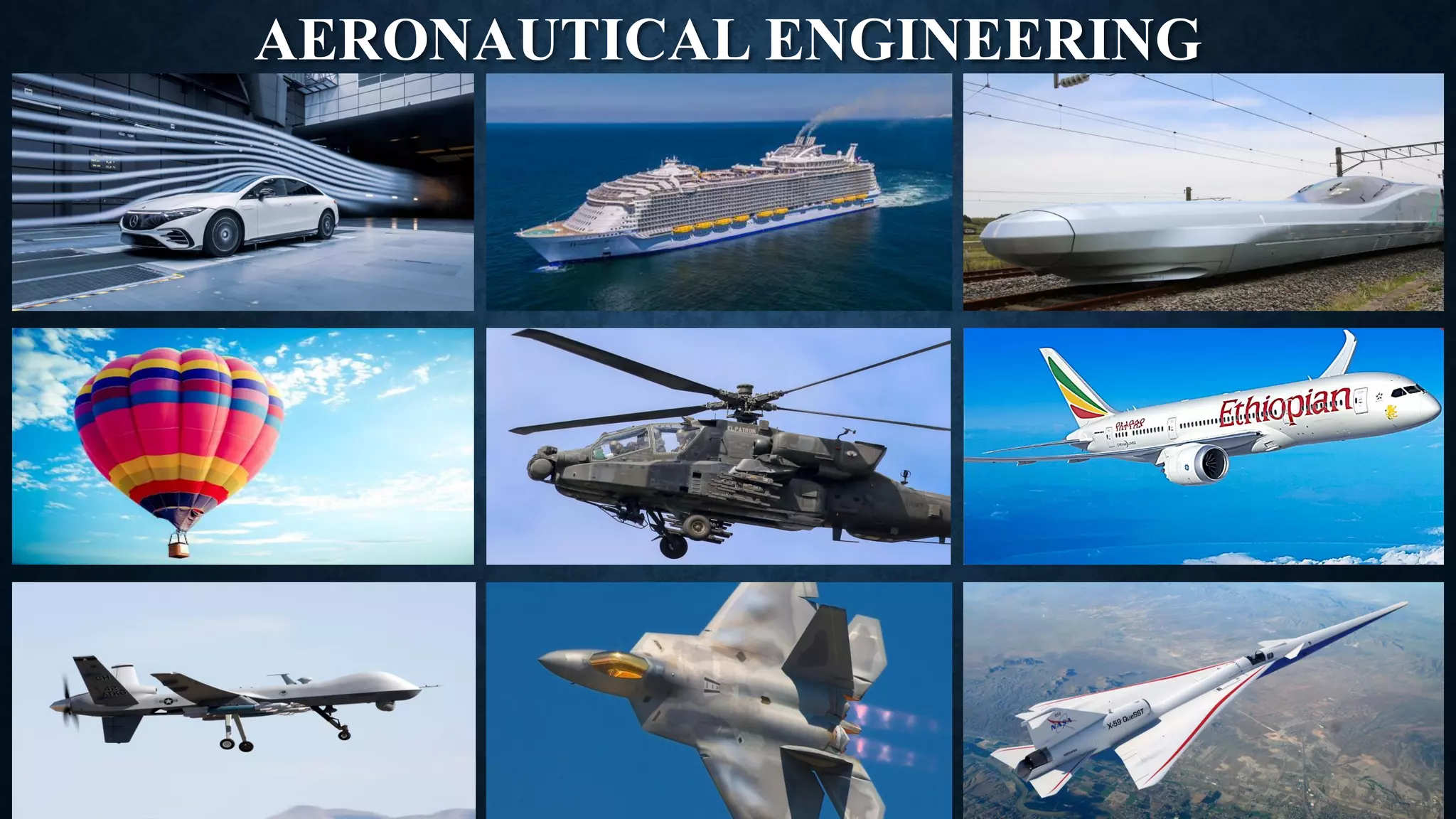
AERONAUTICAL ENGINEERING
PROPULSION
Design Process
is the study of how to design an engine that will provide the thrust that is needed for a plane to take off and fly
through the air. The engine provides the power for the airplane. The study of propulsion is what leads the engineers
determine the right kind of engine and the right amount of power that a plane will need
Engine
INTERNAL COMBUSTION ENGINE (IC ENGINE)
It is a heat engine in which the combustion
of a fuel occurs with an oxidizer (usually
air) in a combustion chamber that is an
integral part of the working fluid flow
circuit.
4 basic processes
✓Intake
✓Compression
✓combustion (power stroke)
✓exhaust
Diesel engines is the pressure is so great 16:1 or 1613 kpa 16*atmospheric pressure that the temperature becomes
high enough to ignite the fuel without a spark plug
INTERNAL COMBUSTION ENGINE (IC ENGINE)
It is a heat engine in which the combustion
of a fuel occurs with an oxidizer (usually
air) in a combustion chamber that is an
integral part of the working fluid flow
circuit.
4 basic processes
✓Intake
✓Compression
✓combustion (power stroke)
✓exhaust
Diesel engines is the pressure is so great 16:1 or 1613 kpa 16*atmospheric pressure that the temperature becomes
high enough to ignite the fuel without a spark plug
INTERNAL COMBUSTION ENGINE (IC ENGINE)
What are the main parts of an engine?
✓Engine block
✓Pistons
✓Cylinder head
✓Crankshaft
✓Camshaft
✓Valves
✓Oil pan
1 Electrical system, 2 Fuel system, 3 Ignition system, 4 Cooling and Lubrication system, 5 Other
, transmission, electrical system, cooling and lubrication system
COOLING SYSTEM
The major components of
the cooling system are
✓Water pump
✓Freeze plugs
✓Thermostat
✓Radiator
✓Cooling fans
✓Heater core
✓Pressure cap
✓Overflow tank
✓Hoses
is used to control the temperature of internal combustion engine parts to prevent overheating and to maintain all
operating dimensions, clearances, and alignment by circulating coolant, oil and a fan.
ELECTRICAL SYSTEM
The Three main parts of any
vehicle's electrical system;
✓Battery
✓Alternator
✓Starter
Battery to start a car and keep it running
The starter and the alternator specifically draw power from the battery to start the engine.
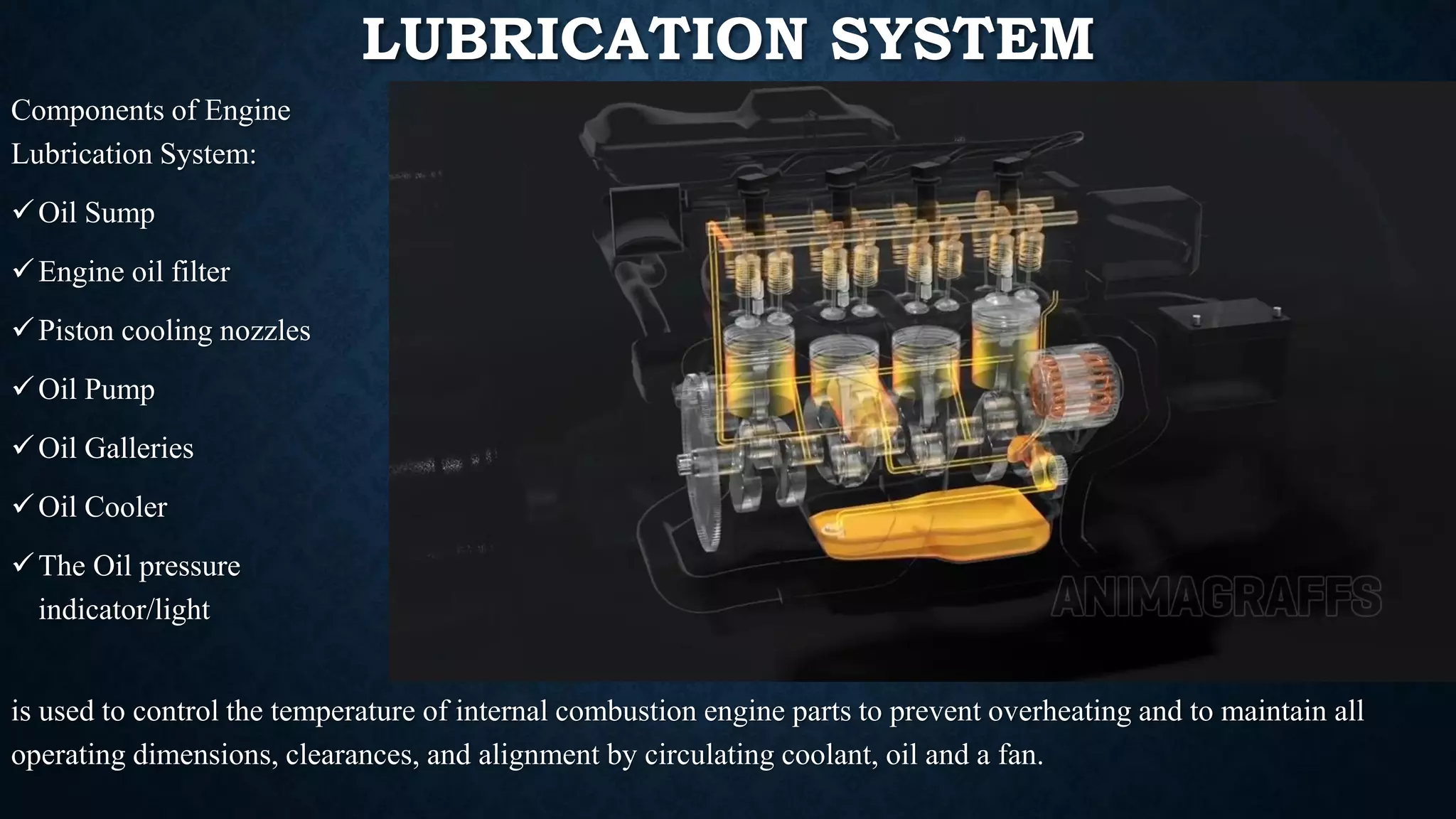
LUBRICATION SYSTEM
is used to control the temperature of internal combustion engine parts to prevent overheating and to maintain all
operating dimensions, clearances, and alignment by circulating coolant, oil and a fan.
Components of Engine
Lubrication System:
✓Oil Sump
✓Engine oil filter
✓Piston cooling nozzles
✓Oil Pump
✓Oil Galleries
✓Oil Cooler
✓The Oil pressure
indicator/light
FUEL SYSTEM
The fuel system is made
up of the
✓Fuel tank
✓Pump
✓Filter
✓Injectors or
Carburetor
It is responsible for delivering fuel to the engine as needed. Each component must perform flawlessly to achieve
expected vehicle performance and reliability.
IGNITION SYSTEM
The Four main parts of any SI vehicle’s ignition system;
✓Battery
✓Ignition coil
✓Distributer
✓Spark plug
Compression ignition CI Diesel engines ignite the fuel-air
mixture by the heat of compression and do not need a
spark. They usually have glowplugs that preheat the
combustion chamber to allow starting in cold weather
Ignition system generates a spark or heats an electrode to a high temperature to ignite a fuel-air mixture in spark
ignition
OTHER SYSTEMS
Other types of system
on a vehicle
✓Power train system
✓Lighting system
✓Steering system
✓Electronic control
system
Air Craft
Engine
Reciprocating Engine
RECIPROCATING ENGINE COMBUSTION
An aircraft piston engine, also
commonly referred to as a
reciprocating engine or "recip",
is an internal combustion
engine that uses one or more
reciprocating pistons to
convert pressure into a
rotational motion. The aircraft
piston engine operates on the
same principles as the engines
found in most automobiles.
RECIPROCATING ENGINE CONTROL
Piston airplanes have one or
more piston-powered engines
connected a propeller to
provide thrust to move the
aircraft on the ground and
through the air. Piston-
powered aircraft most
commonly use 100 octane
low-leaded fuel and fly at
altitudes below 4.57km.
RECIPROCATING PROPELLER
converts rotary motion from
an engine or other power
source into a swirling
slipstream which pushes the
propeller forwards or
backwards.
Air Craft
Engine
Turbo jet Engine
COMBUSTION
AERODYNAMICS
is the study of how air flows around the airplane. By studying the way air flows around the plane the engineers can
define the shape of the plane. The wings, the tail, and the main body or fuselage of the plane all affect the way the air
will move around the plane.
AUTOMOTIVE AERODYNAMICS
is the study of the aerodynamics of road vehicles. Its main
goals are reducing drag and wind noise, minimizing noise
emission, and preventing undesired lift forces and other
causes of aerodynamic instability at high speeds. Air is
also considered a fluid in this case. For some classes of
racing vehicles, it may also be important to produce
downforce to improve traction and thus cornering abilities.
FUNDAMENTAL FORCE OF FLIGHT
The Four Forces of Flight
Thrust is a force that moves an aircraft
in the direction of the motion. It is
created with a propeller, jet engine, or
rocket. Air is pulled in and then
pushed out in an opposite direction.
One example is a household fan.
Drag is the force that acts opposite to
the direction of motion. It tends to
slow an object. Drag is caused by
friction and differences in air pressure.
An example is putting your hand out
of a moving car window and feeling it
pull back.
Weight is the force caused by gravity.
Lift is the force that holds an airplane
in the air. The wings create most of
the lift used by airplanes.
FUNDAMENTAL FORCE OF FLIGHT
Thin airfoil theory is a
straightforward hypothesis of
airfoils that relates angle of
attack to lift for an
incompressible and inviscid flow
past an airfoil. Thin airfoil
theory is a straightforward
hypothesis of airfoils that relates
angle of attack to lift for an
incompressible and inviscid flow
past an airfoil.
FUNDAMENTAL FORCE OF FLIGHT
Thin airfoil theory is a
straightforward hypothesis of
airfoils that relates angle of
attack to lift for an
incompressible and inviscid flow
past an airfoil. Thin airfoil
theory is a straightforward
hypothesis of airfoils that relates
angle of attack to lift for an
incompressible and inviscid flow
past an airfoil.
LIFT EQUATION
Lift =
𝟏
𝟐
𝝆𝒗𝟐
𝒔𝑪𝑳
• 𝝆= Density
• 𝒗= speed
• 𝒔= Surface area
• 𝑪𝑳= Coefficient of lift
• A= wing area
• q= dynamic pressure
𝑪𝑳 =
𝑳
𝒒 𝒙 𝑨
SUPERSONIC TRAVEL
Sonic boom MiG-25 3.3M Blackbird
The boom is not deadly but it can cause some severe damage to the body and hearing if you happen to be at the exact
spot of the boom. The boom can and has caused a lot if damage to homes in the past, thus the restriction for such
flights over populated areas.
STABILITY AND CONTROL
is the study of how to control the speed, direction, altitude and other conditions that affect how a plane flies. The
engineers� design the controls that are needed in order to fly and instruments are provided for the pilot in the cockpit
of the plane. The pilot uses these instruments to control the stability of the plane during flight.
YAW, ROLL AND PITCH MOTION
WHAT ARE ROLL, PITCH, AND YAW?
Imagine three lines running through an airplane and intersecting at right angles at the airplane’s center of gravity.
✓Rotation around the front-to-back axis is called roll.
✓Rotation around the side-to-side axis is called pitch.
✓Rotation around the vertical axis is called yaw.
FUNDAMENTAL VEHICLE AERODYNAMICS
Factors affecting air flow. Four properties
of air affect the way in which it flows past
an object:
viscosity, density, compressibility, and
temperature. ...
✓Laminar and turbulent flow. ...
✓Skin friction and pressure drag. ...
✓Airfoil. ...
✓Induced drag. ...
✓Stability and control. ...
✓Supersonic flight.
MATERIALS AND STRUCTURES
is the study of what materials are to be used on the plane and in the engine and how those materials make the plane
strong enough to fly effectively. The choice of materials that are used to make the fuselage wings, tail and engine will
affect the strength and stability of the plane. Many airplane materials are now made out of composites, materials that
are stronger than most metals and are lightweight.
• Compression, decrease in volume of any object or substance resulting from applied stress.
• Tension the actual force applied the actual amount of elongation at some tension.
• The load that imparts the turning moment or the torque.
• Bending load rating is the stiffness of the conductor casing….
Carbon fibers
are fibers about 5 to 10 micrometers in diameter and composed mostly of carbon atoms.[citation needed] Carbon
fibers have several advantages including high stiffness, high tensile strength, low weight to strength ratio, high
chemical resistance, high temperature tolerance and low thermal expansion.[1] These properties have made carbon
fiber very popular in aerospace, civil engineering, military, and motorsports, along with other competition sports.
However, they are relatively expensive when compared with similar fibers, such as glass fiber, basalt fibers, or plastic
fibers
SPEED
By type of vehicle
Category Speed (km/h)
Land speed record 1,227.985
Wheel-driven 737.794
Piston-driven 722.204
Motorcycle 605.698
Diesel-powered 563.998
Electric-powered 550.627
By type of Rail vehicles
Category Speed (km/h)
Rocket sled 10,326
Maglev rocket sled 1,019
By type of Aircraft
Category Speed (km/h)
Unmanned aerial vehicle 21,245
rocket-powered aircraft 7,270
Manned air-breathing craft 3,530
Propeller-driven aircraft 870
Helicopter2 400.87
By type of Watercraft
Category Speed (km/h)
Water speed record 275.98
Propeller-driven watercraft 226.78
Wind-powered watercraft 65.45
1 km/h= 0.000809848 mac
1 mac = 1234.8 km/h = 343 m/s
GRAVITY AND ESCAPE VELOCITY
𝑮=6.67x10⁻¹¹ Nm2/kg2
Mass= 5.9722x1024 kg Mean Radius= 6.371x10⁶ m
Gravity = 9.81 m/s2 Escape speed= 11.2 km/s
Earth
𝐸𝑠𝑐𝑎𝑝𝑒 𝑣𝑒𝑙𝑜𝑐𝑖𝑡𝑦 =
2𝐺𝑀
𝑟
𝐺𝑟𝑎𝑣𝑖𝑡𝑦 =
𝐺𝑀
𝑟2
ASTRONAUTICAL ENGINEERING
PROPULSION
Design Process
is the study of how to design an engine that will provide the thrust that is needed for a plane to take off and fly
through the air. The engine provides the power for the airplane. The study of propulsion is what leads the engineers
determine the right kind of engine and the right amount of power that a plane will need
Solid Propellant
Engine
Booster
SOLID-PROPELLANT ROCKET
• A solid fuel-oxidizer mixture (propellant) is packed into
the rocket, with a cylindrical hole in the middle.
• An igniter combusts the surface of the propellant.
• The cylindrical hole in the propellant acts as a combustion
chamber.
Fuels used in solid propellants include asphalts, waxes, oils, plastics, metals, rubbers, resins, salt and sugar.
Oxidizers for solid propellants come from two general sources: the organic (the source of nitrocellulose and
nitroglycerin) and the inorganic (the source of chemicals such as sodium nitrate and potassium perchlorate).
SOLID-PROPELLANT ROCKET
All rockets used some form of solid or powdered propellant up until the 20th century, when liquid-propellant rockets
offered more efficient and controllable alternatives. Solid rockets are still used today in military armaments
worldwide, model rockets, solid rocket boosters and on larger applications for their simplicity and reliability
Simple
less costly
very reliable
Uncontrollable
Boosters for the space shuttle system
Submarine-launched ballistic missiles
Minuteman intercontinental ballistic missiles
First three stages of the MX missile
Liquid Propellant
Engine
Cryogenic
LIQUID-PROPELLANT ROCKET
A simplified parts of a liquid-propellant
rocket.
• Liquid rocket fuel.
• Oxidizer.
• Pumps carry the fuel and oxidizer.
• The combustion chamber mixes and
burns the two liquids.
• The gas put off by the reaction passes
through the “throat”, which aligns all the
gases produced in the right direction.
• Exhaust exits the rocket.
In a liquid rocket, stored fuel and stored oxidizer are pumped into a combustion chamber where they are mixed and
burned. The combustion produces great amounts of exhaust gas at high temperature and pressure. The hot exhaust is
passed through a nozzle which accelerates the flow.
Fuel and a source of oxygen, called an
oxidizer, are mixed and exploded in a
combustion chamber.
The combustion produces hot exhaust
which is passed through a nozzle to
accelerate the flow and produce thrust.
LIQUID-PROPELLANT ROCKET CYCLES
A simplified parts of a liquid-propellant
rocket.
1. Liquid rocket fuel.
2. Oxidizer.
3. Pumps carry the fuel and oxidizer.
4. The combustion chamber mixes and
burns the two liquids.
5. The gas put off by the reaction passes
through the “throat”, which aligns all
the gases produced in the right
direction.
6. Exhaust exits the rocket.
In a liquid rocket, stored fuel and stored oxidizer are pumped into a combustion chamber where they are mixed and
burned. The combustion produces great amounts of exhaust gas at high temperature and pressure. The hot exhaust is
passed through a nozzle which accelerates the flow.
CRYOGENIC
ROCKET ENGINE
STAGING
Stages of a Rocket Launch
1. Primary Stage. The primary stage of
a rocket is the first rocket engine to
engage, providing the initial thrust to
send the rocket skyward. ...
2. Secondary Stage. After the primary
stage has fallen away, the next rocket
engine engages to continue the
rocket on its trajectory. ...
3. Payload.
Most modern rockets rotate, or gimbal, the nozzle to produce the control torque. In a gimbaled thrust system, the
exhaust nozzle of the rocket can be swiveled from side to side. As the nozzle is moved, the direction of the thrust is
changed relative to the center of gravity of the rocket.
AERODYNAMICS
is the study of how air flows around the airplane. By studying the way air flows around the plane the engineers can
define the shape of the plane. The wings, the tail, and the main body or fuselage of the plane all affect the way the air
will move around the plane.
STABILITY AND CONTROL
is the study of how to control the speed, direction, altitude and other conditions that affect how a plane flies. The
engineers� design the controls that are needed in order to fly and instruments are provided for the pilot in the cockpit
of the plane. The pilot uses these instruments to control the stability of the plane during flight.
MATERIALS AND STRUCTURES
is the study of what materials are to be used on the plane and in the engine and how those materials make the plane
strong enough to fly effectively. The choice of materials that are used to make the fuselage wings, tail and engine will
affect the strength and stability of the plane. Many airplane materials are now made out of composites, materials that
are stronger than most metals and are lightweight.
SPACECRAFT
Category Speed (km/h) lunch to
• Mars atmospheric 27,000 Mars Pathfinder (unmanned)
• Reentry 39,897 Apollo 10 CSM Charlie Brown (manned)
• Reentry 46,100 Stardust (unmanned)
• Escape 58,536 New Horizons (unmanned)
• Closed orbit of Saturn 122,000 Cassini (unmanned)
• Jupiter atmospheric entry 173,736 Galileo (unmanned)
• Jupiter orbit insertion 209,000 Juno (unmanned)
• Perihelion 252,792 To the Sun (unmanned) 204.7 mac
• Parker solar probe 692,000 To the Sun (unmanned) 564.8 mac
Speed of light 1,080,000,000 km/h (300,000 km/s)
874,636 mac
1 km/h= 0.000809848 mac
1 mac = 1234.8 km/h = 343 m/s
Vitz
130km/h = 0.1061186 mac
ESCAPE SPEED ON DIFFERENT PLANET
✓Mercury = 15,480 km/h
✓Venus = 37,080 km/h = 30 Mach
✓Earth = 40,680 km/h = 33 Mach
✓Moon = 8,280 km/h = 8.2 Mach
✓Mars = 18,000 km/h = 14.7 Mach
✓Jupiter = 216,000 km/h =176.4 Mach
✓Saturn = 129,600 km/h = 105.8 Mach
✓Uranus = 79,200 km/h = 64.7 Mach
✓Neptune = 86,400 km/h =70.6 Mach
Fastest speed
✓ Sun periapsis = 532,000km/h (parker solar probe)
✓ Earth escape = 58,536 km/h (new horizon)
✓ Earth entry = 46,100 km/h (stardust)
✓ Earth entry (crewed) = 39,897 km/h (apollo 10 CSM)
✓ Mars entry = 27,000 km/h (mars pathfinder)
✓ Jupiter (orbit insertion) = 209,000km/h (Juno)
✓ Jupiter entry = 173,736km/h (Galileo)
✓ Saturn periapsis = 122,000 km/h (Cassini)
1 mac = 1234.8 km/h = 343 m/s
Copyright © Ethiopian space science society Copyright © Ethiocosmos

AEROSPACE ENGINEERING Humanity is changing vision of the cosmos Presenter: Haileyesus Wondwossen.pdf

  • 1.
  • 2.
    Outline ✓Basic measurement ✓Aeronautical engineeringconcepts Propulsion and power generation Aerodynamic structure analysis Stability and controls Material and structure ✓Astronautical engineering concepts Propulsion and power generation Aerodynamics structure analysis Stability and controls Material and structure ✓Facts and world records Copyright © Ethiopian space science society
  • 3.
    DESIGN PROCESS ✓ Propulsion ✓Aerodynamics ✓ Stability and Control ✓ Materials and Structures 1 Mac = 1234.8 km/h = 343 m/s ✓Subsonic M < 0.8 ✓Transonic 0.8 < M < 1.3 ✓Sonic M = 1 ✓Supersonic 1.3 < M < 5 ✓Hypersonic 5 < M < 10 ✓Hypervelocity M > 10 MACH-NUMBER REGIMES
  • 4.
    AEROSPACE ENGINEERING Aeronautics isa science dealing with the operation of aircraft. Copyright © Ethiopian space science society Astronautics is a science dealing with traveling into space beyond the earth's atmosphere.
  • 5.
  • 6.
    PROPULSION Design Process is thestudy of how to design an engine that will provide the thrust that is needed for a plane to take off and fly through the air. The engine provides the power for the airplane. The study of propulsion is what leads the engineers determine the right kind of engine and the right amount of power that a plane will need
  • 7.
  • 8.
    INTERNAL COMBUSTION ENGINE(IC ENGINE) It is a heat engine in which the combustion of a fuel occurs with an oxidizer (usually air) in a combustion chamber that is an integral part of the working fluid flow circuit. 4 basic processes ✓Intake ✓Compression ✓combustion (power stroke) ✓exhaust Diesel engines is the pressure is so great 16:1 or 1613 kpa 16*atmospheric pressure that the temperature becomes high enough to ignite the fuel without a spark plug
  • 9.
    INTERNAL COMBUSTION ENGINE(IC ENGINE) It is a heat engine in which the combustion of a fuel occurs with an oxidizer (usually air) in a combustion chamber that is an integral part of the working fluid flow circuit. 4 basic processes ✓Intake ✓Compression ✓combustion (power stroke) ✓exhaust Diesel engines is the pressure is so great 16:1 or 1613 kpa 16*atmospheric pressure that the temperature becomes high enough to ignite the fuel without a spark plug
  • 10.
    INTERNAL COMBUSTION ENGINE(IC ENGINE) What are the main parts of an engine? ✓Engine block ✓Pistons ✓Cylinder head ✓Crankshaft ✓Camshaft ✓Valves ✓Oil pan 1 Electrical system, 2 Fuel system, 3 Ignition system, 4 Cooling and Lubrication system, 5 Other , transmission, electrical system, cooling and lubrication system
  • 11.
    COOLING SYSTEM The majorcomponents of the cooling system are ✓Water pump ✓Freeze plugs ✓Thermostat ✓Radiator ✓Cooling fans ✓Heater core ✓Pressure cap ✓Overflow tank ✓Hoses is used to control the temperature of internal combustion engine parts to prevent overheating and to maintain all operating dimensions, clearances, and alignment by circulating coolant, oil and a fan.
  • 12.
    ELECTRICAL SYSTEM The Threemain parts of any vehicle's electrical system; ✓Battery ✓Alternator ✓Starter Battery to start a car and keep it running The starter and the alternator specifically draw power from the battery to start the engine.
  • 13.
    LUBRICATION SYSTEM is usedto control the temperature of internal combustion engine parts to prevent overheating and to maintain all operating dimensions, clearances, and alignment by circulating coolant, oil and a fan. Components of Engine Lubrication System: ✓Oil Sump ✓Engine oil filter ✓Piston cooling nozzles ✓Oil Pump ✓Oil Galleries ✓Oil Cooler ✓The Oil pressure indicator/light
  • 14.
    FUEL SYSTEM The fuelsystem is made up of the ✓Fuel tank ✓Pump ✓Filter ✓Injectors or Carburetor It is responsible for delivering fuel to the engine as needed. Each component must perform flawlessly to achieve expected vehicle performance and reliability.
  • 15.
    IGNITION SYSTEM The Fourmain parts of any SI vehicle’s ignition system; ✓Battery ✓Ignition coil ✓Distributer ✓Spark plug Compression ignition CI Diesel engines ignite the fuel-air mixture by the heat of compression and do not need a spark. They usually have glowplugs that preheat the combustion chamber to allow starting in cold weather Ignition system generates a spark or heats an electrode to a high temperature to ignite a fuel-air mixture in spark ignition
  • 16.
    OTHER SYSTEMS Other typesof system on a vehicle ✓Power train system ✓Lighting system ✓Steering system ✓Electronic control system
  • 17.
  • 18.
    RECIPROCATING ENGINE COMBUSTION Anaircraft piston engine, also commonly referred to as a reciprocating engine or "recip", is an internal combustion engine that uses one or more reciprocating pistons to convert pressure into a rotational motion. The aircraft piston engine operates on the same principles as the engines found in most automobiles.
  • 19.
    RECIPROCATING ENGINE CONTROL Pistonairplanes have one or more piston-powered engines connected a propeller to provide thrust to move the aircraft on the ground and through the air. Piston- powered aircraft most commonly use 100 octane low-leaded fuel and fly at altitudes below 4.57km.
  • 20.
    RECIPROCATING PROPELLER converts rotarymotion from an engine or other power source into a swirling slipstream which pushes the propeller forwards or backwards.
  • 21.
  • 23.
  • 24.
    AERODYNAMICS is the studyof how air flows around the airplane. By studying the way air flows around the plane the engineers can define the shape of the plane. The wings, the tail, and the main body or fuselage of the plane all affect the way the air will move around the plane.
  • 25.
    AUTOMOTIVE AERODYNAMICS is thestudy of the aerodynamics of road vehicles. Its main goals are reducing drag and wind noise, minimizing noise emission, and preventing undesired lift forces and other causes of aerodynamic instability at high speeds. Air is also considered a fluid in this case. For some classes of racing vehicles, it may also be important to produce downforce to improve traction and thus cornering abilities.
  • 26.
    FUNDAMENTAL FORCE OFFLIGHT The Four Forces of Flight Thrust is a force that moves an aircraft in the direction of the motion. It is created with a propeller, jet engine, or rocket. Air is pulled in and then pushed out in an opposite direction. One example is a household fan. Drag is the force that acts opposite to the direction of motion. It tends to slow an object. Drag is caused by friction and differences in air pressure. An example is putting your hand out of a moving car window and feeling it pull back. Weight is the force caused by gravity. Lift is the force that holds an airplane in the air. The wings create most of the lift used by airplanes.
  • 27.
    FUNDAMENTAL FORCE OFFLIGHT Thin airfoil theory is a straightforward hypothesis of airfoils that relates angle of attack to lift for an incompressible and inviscid flow past an airfoil. Thin airfoil theory is a straightforward hypothesis of airfoils that relates angle of attack to lift for an incompressible and inviscid flow past an airfoil.
  • 28.
    FUNDAMENTAL FORCE OFFLIGHT Thin airfoil theory is a straightforward hypothesis of airfoils that relates angle of attack to lift for an incompressible and inviscid flow past an airfoil. Thin airfoil theory is a straightforward hypothesis of airfoils that relates angle of attack to lift for an incompressible and inviscid flow past an airfoil.
  • 29.
    LIFT EQUATION Lift = 𝟏 𝟐 𝝆𝒗𝟐 𝒔𝑪𝑳 •𝝆= Density • 𝒗= speed • 𝒔= Surface area • 𝑪𝑳= Coefficient of lift • A= wing area • q= dynamic pressure 𝑪𝑳 = 𝑳 𝒒 𝒙 𝑨
  • 30.
    SUPERSONIC TRAVEL Sonic boomMiG-25 3.3M Blackbird The boom is not deadly but it can cause some severe damage to the body and hearing if you happen to be at the exact spot of the boom. The boom can and has caused a lot if damage to homes in the past, thus the restriction for such flights over populated areas.
  • 31.
    STABILITY AND CONTROL isthe study of how to control the speed, direction, altitude and other conditions that affect how a plane flies. The engineers� design the controls that are needed in order to fly and instruments are provided for the pilot in the cockpit of the plane. The pilot uses these instruments to control the stability of the plane during flight.
  • 32.
    YAW, ROLL ANDPITCH MOTION WHAT ARE ROLL, PITCH, AND YAW? Imagine three lines running through an airplane and intersecting at right angles at the airplane’s center of gravity. ✓Rotation around the front-to-back axis is called roll. ✓Rotation around the side-to-side axis is called pitch. ✓Rotation around the vertical axis is called yaw.
  • 33.
    FUNDAMENTAL VEHICLE AERODYNAMICS Factorsaffecting air flow. Four properties of air affect the way in which it flows past an object: viscosity, density, compressibility, and temperature. ... ✓Laminar and turbulent flow. ... ✓Skin friction and pressure drag. ... ✓Airfoil. ... ✓Induced drag. ... ✓Stability and control. ... ✓Supersonic flight.
  • 34.
    MATERIALS AND STRUCTURES isthe study of what materials are to be used on the plane and in the engine and how those materials make the plane strong enough to fly effectively. The choice of materials that are used to make the fuselage wings, tail and engine will affect the strength and stability of the plane. Many airplane materials are now made out of composites, materials that are stronger than most metals and are lightweight.
  • 35.
    • Compression, decreasein volume of any object or substance resulting from applied stress. • Tension the actual force applied the actual amount of elongation at some tension. • The load that imparts the turning moment or the torque. • Bending load rating is the stiffness of the conductor casing….
  • 36.
    Carbon fibers are fibersabout 5 to 10 micrometers in diameter and composed mostly of carbon atoms.[citation needed] Carbon fibers have several advantages including high stiffness, high tensile strength, low weight to strength ratio, high chemical resistance, high temperature tolerance and low thermal expansion.[1] These properties have made carbon fiber very popular in aerospace, civil engineering, military, and motorsports, along with other competition sports. However, they are relatively expensive when compared with similar fibers, such as glass fiber, basalt fibers, or plastic fibers
  • 37.
    SPEED By type ofvehicle Category Speed (km/h) Land speed record 1,227.985 Wheel-driven 737.794 Piston-driven 722.204 Motorcycle 605.698 Diesel-powered 563.998 Electric-powered 550.627 By type of Rail vehicles Category Speed (km/h) Rocket sled 10,326 Maglev rocket sled 1,019 By type of Aircraft Category Speed (km/h) Unmanned aerial vehicle 21,245 rocket-powered aircraft 7,270 Manned air-breathing craft 3,530 Propeller-driven aircraft 870 Helicopter2 400.87 By type of Watercraft Category Speed (km/h) Water speed record 275.98 Propeller-driven watercraft 226.78 Wind-powered watercraft 65.45 1 km/h= 0.000809848 mac 1 mac = 1234.8 km/h = 343 m/s
  • 38.
    GRAVITY AND ESCAPEVELOCITY 𝑮=6.67x10⁻¹¹ Nm2/kg2 Mass= 5.9722x1024 kg Mean Radius= 6.371x10⁶ m Gravity = 9.81 m/s2 Escape speed= 11.2 km/s Earth 𝐸𝑠𝑐𝑎𝑝𝑒 𝑣𝑒𝑙𝑜𝑐𝑖𝑡𝑦 = 2𝐺𝑀 𝑟 𝐺𝑟𝑎𝑣𝑖𝑡𝑦 = 𝐺𝑀 𝑟2
  • 39.
  • 40.
    PROPULSION Design Process is thestudy of how to design an engine that will provide the thrust that is needed for a plane to take off and fly through the air. The engine provides the power for the airplane. The study of propulsion is what leads the engineers determine the right kind of engine and the right amount of power that a plane will need
  • 41.
  • 42.
    SOLID-PROPELLANT ROCKET • Asolid fuel-oxidizer mixture (propellant) is packed into the rocket, with a cylindrical hole in the middle. • An igniter combusts the surface of the propellant. • The cylindrical hole in the propellant acts as a combustion chamber. Fuels used in solid propellants include asphalts, waxes, oils, plastics, metals, rubbers, resins, salt and sugar. Oxidizers for solid propellants come from two general sources: the organic (the source of nitrocellulose and nitroglycerin) and the inorganic (the source of chemicals such as sodium nitrate and potassium perchlorate).
  • 43.
    SOLID-PROPELLANT ROCKET All rocketsused some form of solid or powdered propellant up until the 20th century, when liquid-propellant rockets offered more efficient and controllable alternatives. Solid rockets are still used today in military armaments worldwide, model rockets, solid rocket boosters and on larger applications for their simplicity and reliability Simple less costly very reliable Uncontrollable Boosters for the space shuttle system Submarine-launched ballistic missiles Minuteman intercontinental ballistic missiles First three stages of the MX missile
  • 44.
  • 45.
    LIQUID-PROPELLANT ROCKET A simplifiedparts of a liquid-propellant rocket. • Liquid rocket fuel. • Oxidizer. • Pumps carry the fuel and oxidizer. • The combustion chamber mixes and burns the two liquids. • The gas put off by the reaction passes through the “throat”, which aligns all the gases produced in the right direction. • Exhaust exits the rocket. In a liquid rocket, stored fuel and stored oxidizer are pumped into a combustion chamber where they are mixed and burned. The combustion produces great amounts of exhaust gas at high temperature and pressure. The hot exhaust is passed through a nozzle which accelerates the flow. Fuel and a source of oxygen, called an oxidizer, are mixed and exploded in a combustion chamber. The combustion produces hot exhaust which is passed through a nozzle to accelerate the flow and produce thrust.
  • 46.
    LIQUID-PROPELLANT ROCKET CYCLES Asimplified parts of a liquid-propellant rocket. 1. Liquid rocket fuel. 2. Oxidizer. 3. Pumps carry the fuel and oxidizer. 4. The combustion chamber mixes and burns the two liquids. 5. The gas put off by the reaction passes through the “throat”, which aligns all the gases produced in the right direction. 6. Exhaust exits the rocket. In a liquid rocket, stored fuel and stored oxidizer are pumped into a combustion chamber where they are mixed and burned. The combustion produces great amounts of exhaust gas at high temperature and pressure. The hot exhaust is passed through a nozzle which accelerates the flow.
  • 47.
  • 49.
    STAGING Stages of aRocket Launch 1. Primary Stage. The primary stage of a rocket is the first rocket engine to engage, providing the initial thrust to send the rocket skyward. ... 2. Secondary Stage. After the primary stage has fallen away, the next rocket engine engages to continue the rocket on its trajectory. ... 3. Payload. Most modern rockets rotate, or gimbal, the nozzle to produce the control torque. In a gimbaled thrust system, the exhaust nozzle of the rocket can be swiveled from side to side. As the nozzle is moved, the direction of the thrust is changed relative to the center of gravity of the rocket.
  • 50.
    AERODYNAMICS is the studyof how air flows around the airplane. By studying the way air flows around the plane the engineers can define the shape of the plane. The wings, the tail, and the main body or fuselage of the plane all affect the way the air will move around the plane.
  • 51.
    STABILITY AND CONTROL isthe study of how to control the speed, direction, altitude and other conditions that affect how a plane flies. The engineers� design the controls that are needed in order to fly and instruments are provided for the pilot in the cockpit of the plane. The pilot uses these instruments to control the stability of the plane during flight.
  • 52.
    MATERIALS AND STRUCTURES isthe study of what materials are to be used on the plane and in the engine and how those materials make the plane strong enough to fly effectively. The choice of materials that are used to make the fuselage wings, tail and engine will affect the strength and stability of the plane. Many airplane materials are now made out of composites, materials that are stronger than most metals and are lightweight.
  • 53.
    SPACECRAFT Category Speed (km/h)lunch to • Mars atmospheric 27,000 Mars Pathfinder (unmanned) • Reentry 39,897 Apollo 10 CSM Charlie Brown (manned) • Reentry 46,100 Stardust (unmanned) • Escape 58,536 New Horizons (unmanned) • Closed orbit of Saturn 122,000 Cassini (unmanned) • Jupiter atmospheric entry 173,736 Galileo (unmanned) • Jupiter orbit insertion 209,000 Juno (unmanned) • Perihelion 252,792 To the Sun (unmanned) 204.7 mac • Parker solar probe 692,000 To the Sun (unmanned) 564.8 mac Speed of light 1,080,000,000 km/h (300,000 km/s) 874,636 mac 1 km/h= 0.000809848 mac 1 mac = 1234.8 km/h = 343 m/s Vitz 130km/h = 0.1061186 mac
  • 54.
    ESCAPE SPEED ONDIFFERENT PLANET ✓Mercury = 15,480 km/h ✓Venus = 37,080 km/h = 30 Mach ✓Earth = 40,680 km/h = 33 Mach ✓Moon = 8,280 km/h = 8.2 Mach ✓Mars = 18,000 km/h = 14.7 Mach ✓Jupiter = 216,000 km/h =176.4 Mach ✓Saturn = 129,600 km/h = 105.8 Mach ✓Uranus = 79,200 km/h = 64.7 Mach ✓Neptune = 86,400 km/h =70.6 Mach Fastest speed ✓ Sun periapsis = 532,000km/h (parker solar probe) ✓ Earth escape = 58,536 km/h (new horizon) ✓ Earth entry = 46,100 km/h (stardust) ✓ Earth entry (crewed) = 39,897 km/h (apollo 10 CSM) ✓ Mars entry = 27,000 km/h (mars pathfinder) ✓ Jupiter (orbit insertion) = 209,000km/h (Juno) ✓ Jupiter entry = 173,736km/h (Galileo) ✓ Saturn periapsis = 122,000 km/h (Cassini) 1 mac = 1234.8 km/h = 343 m/s
  • 56.
    Copyright © Ethiopianspace science society Copyright © Ethiocosmos