VIPIN ADLAK
REGULATORY AFFAIRS
BHARAT PARENTERALS LTD,
VADODARA
An Abbreviated New Drug Application (ANDA)
contains data which when submitted to FDA's
CDER, Office of Generic Drugs, provides for the
review and ultimate approval of a generic drug
product.
Once approved, an applicant may manufacture
and market the generic drug product to provide a
safe, effective, low cost alternative to the public.
 All approved products, both innovator and generic,
are listed in FDA's Approved Drug Products with
Therapeutic Equivalence Evaluations (Orange
ANDA
2
INNOVATOR VS GENERICS
S.N. PARAMETERS INNOVATOR DRUG GENERIC DRUG
1. Active ingredients Same
Same
2. Safety & efficacy Same
Same
3. Quality & strength Same
Same
4. Performance and standards Same
Same
5. Costs/prescription Highly expensive
Less expensive
6. FDA inspection of
manufacturing facilities Yes
Yes
7. FDA reviews reports of
adverse reactions Yes
Yes
8. FDA reviews drug labeling Yes
No
9. Extensive research and
3
Generic Drug Approval
 In 1970 FDA established the ANDA as a mechanism
for the review and approval of generic versions.
 Before 1978, generic product applicants were
required to submit complete safety and efficacy through
clinical trials.
 Post 1978, applicants were required to submit
published reports of such trials documenting safety and
efficacy.
Neither of these approaches was considered
satisfactory and so originated Hatch Waxman Act on
1984.
4
Indispensability Grounds
For Generics
Contain the same active ingredients as the innovator drug
(inactive ingredients may vary).
Must be identical in strength, dosage form, and route of
administration.
Must have same use/indications.
Must be bioequivalent.
Must have same batch requirements for Identity, Safety &
Purity.
5
Commonly known as “Drug Price Competition & Patent
Term Restoration Act” of 1984.
“The Hatch-Waxman Act is an act dealing with the
approval of generic drugs and associated conditions for
getting their approval from FDA, market exclusivity, rights
of exclusivity, patent term extension and Orange Book
Listing.”Necessitated By :
1. Absence of Generic drug manufacturing.
2. Cumbersome regulatory procedures.
3. Patients were denied the option of cheaper drugs.
Hatch-Waxman Act
6
1. Maintaining list of patents which would be infringed.
2. Only Bioavailability studies and not clinical trials
needed for approval.
3. Para I, II, III and IV certifications.
4. Data exclusivity period for New Molecular Entities.
5. Extension of the original patent term.
6. The “Bolar” Provision.
General Provisions of the Act
7
Recent additions to the Hatch-Waxman
Act
Under the “Medicare Prescription Drug and
Modernization Act”, 2003:
1.Non-extension of the 30-month period.
2.Time limit for informing patent owner.
3.Provision for allowing declaratory judgment.
4.Benefit of exclusivity for several ANDAs filed on
same day allowed.
8
ANDA CERTIFICATION
CLAUSES
PARAGR
APH I
PARAGR
APH II
PARAGR
APH III
PARAGR
APH IV
9
PARA-I
Required patent
information has
not been filed.
FDA may approve
generics
immediately, one
or more applicants
may enter.
PARA-II
Patent has expired
FDA may approve
generics
immediately, one
or more applicants
may enter.
10
PARA-III
Patent not expired,
will be expired on a
specific date.
FDA may approved
ANDA effective on
the date of
expiration, one or
more applicant may
enter.
PARA-IV
Patent is invalid or
non infringed by
generic applicant.
Generic applicant file
notice to patent
holder.
11
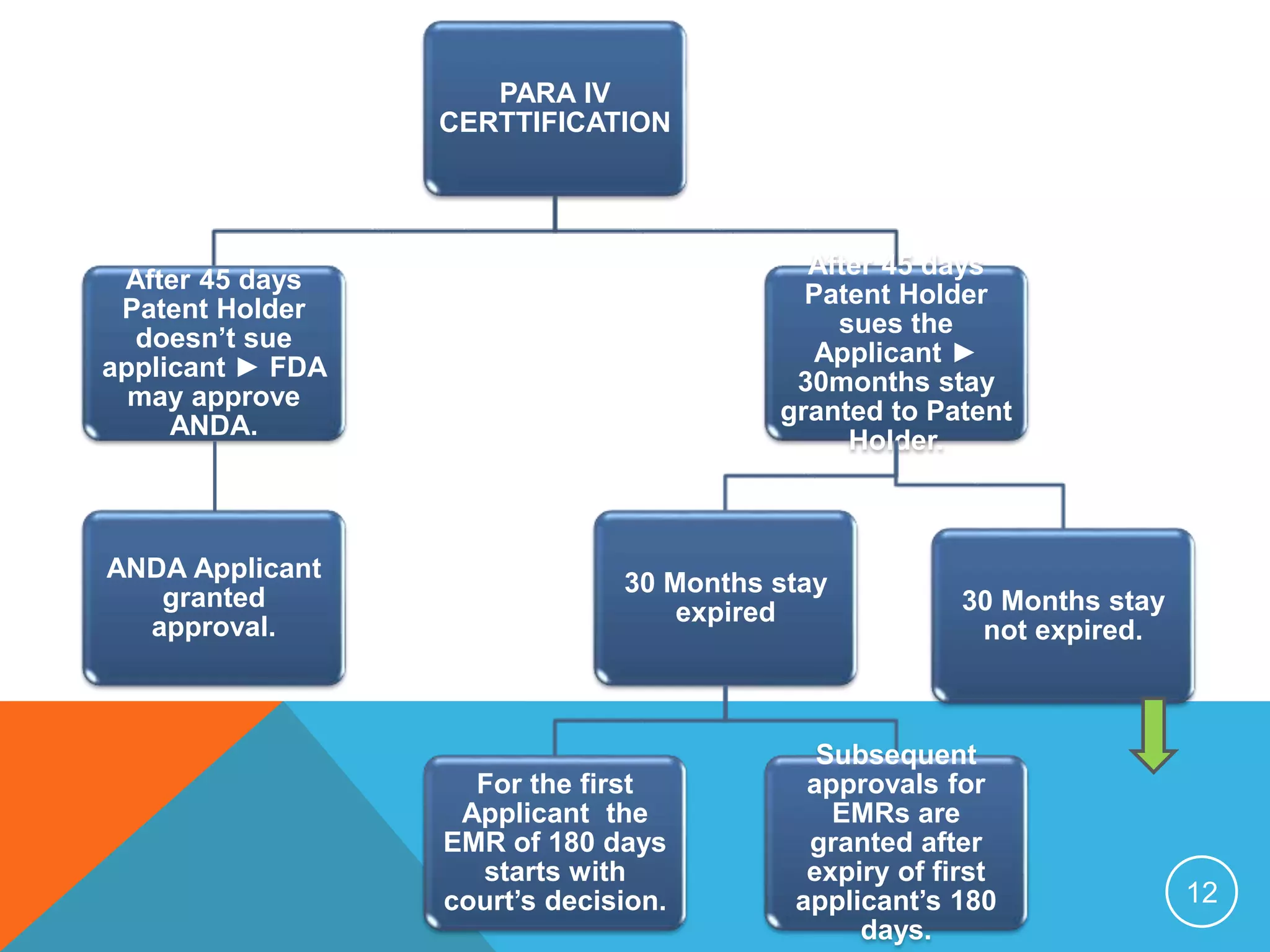
PARA IV
CERTTIFICATION
After 45 days
Patent Holder
doesn’t sue
applicant ► FDA
may approve
ANDA.
ANDA Applicant
granted
approval.
After 45 days
Patent Holder
sues the
Applicant ►
30months stay
granted to Patent
Holder.
30 Months stay
expired
For the first
Applicant the
EMR of 180 days
starts with
court’s decision.
Subsequent
approvals for
EMRs are
granted after
expiry of first
applicant’s 180
days.
30 Months stay
not expired.
12
30 Months stay not
expired
If judgement’s in
favour of Patent
Holder ► FDA can
not approve ANDA
untill patent expiry.
No entry occurs
untill Patent Expiry.
Judgement favouring
ANDA ► EMR of 180
days begins for first
applicant.
First Applicant
enters, subsequent
applicants enter only
after expiry of EMR
for the First
Applicant.
13
APPLICANT
ANDA
ACCEPTABLE &
COMPLETE
REFUSE TO FILE-
LETTER ISSUED
B.E. REVIEW
REQUEST FOR PLANT
INSPECTION
CHEMISTRY/MICRO
REVIEW
LABELING REVIEW
NOT APPLICABLE
LETTER
ANDA APPROVED
B.E. DEFICIENCY LETTER
APPROVAL DEFERRED PENDING
SATISFACTORY RESULTS
PREAPPROVAL INSPECTION
ACCEPTENCE
B.E. REVIEW ACCEPTABLE
CHEMISTRY/LABELING
REVIEW ACCEPTABLE
YES
YES
YES
NO
NO
NO
NO
ANDA REVIEW PROCESS
14
MODULE 1
MODULE 3 MODULE 4 MODULE 5
Regional
Admin.
Information
Quality
Overall
summa
ry
Non
Clinical
overviewNon Clinical
Summary
Clinica
l
Overvi
ew
Clinical
Summary
Quality Non
Clinical
Report
Clinical
Report
The CTD Triangle
15
MODULES IN A CTD
MODULE I: Administrative and Prescribing Information
1.Table of Contents.
2.Includes data of Administrative Documents entailing:
Patent Information on patented product.
Patent Certifications.
Debarment certification.
3. Prescribing information like Package and container labels,
packaging inserts, patient leaflets, etc.
4. Labelling Comparison between Innovator and Generic
drug.
16
MODULE II: SUMMARIES AND OVERVIEWS
1. Table of Contents.
2. Introduction to Summary Documents.
3. Overviews and Summaries: Module II should contain
documents like:
 M4Q: The CTD- quality
 M4S: The CTD- safety
 M4E: The CTD- efficacyMODULE III: information on product quality
1. Table of Content.
2. Body of Data.
3. Literature Reference.
17
MODULE IV: NON CLINICAL STUDY REPORTS
Not required in ANDA Filing.
MODULE V: CLINICAL STUDY REPORTS
1. Table of Contents.
2. Study Reports including Case Report Forms and
Case Report Tabulations.
18
RECOMMENDATIONS FOR e-CTD
1. PDF Files with version 3.0 of Acrobat Reader
2. Use of Embedded fonts in the Portable Document
Format
3. A Print area of 8.5 inches by 11 inches and margin of 1
inches is ensured on sides.
4. Scanned Documents should be avoided as Source
Documents.
5. Hypertexts can be indicated by Blue-Texts or by
rectangles using thin lines. 19
6. Numbering on the PDF and Documents should be
included as same.
7. Security or Passwords should not be included.
8. Full Indexes should be included.
9. Electronic Signatures may be added, Procedures
are being employed for archival of the same.
20
BIOEQUIVALENCE
A Generic drug is considered to be bioequivalent to
Brand drug if:
Rate & extent of absorption do not show a significant
difference from RLD.
Two drugs are said to be Bioequivalent if their
Bioavailability after administration in same dose are
similar to a degree that there effects, with respect to
safety & efficacy can be expected to be the same.
21
NDA REQUIREMENT ANDA
REQUIREMENT
NDA Vs ANDA Review Process
22
First-Time Generic Drug
Approvals - July 2011
Generic Drug
Name
Generic
Manufacturer
Brand Name Approval Date
FONDAPARINUX
SODIUM
INJECTION
DR. REDDY'S
LABORATORIE
S LIMITED
ARIXTRA
INJECTION
7/11/2011
ALFUZOSIN
HYDROCHLORI
DE EXTENDED-
RELEASE
TABLETS
TEVA
PHARMACEUTI
CALS USA
UROXATRAL
EXTENDED-
RELEASE
TABLETS
7/18/2011
ALFUZOSIN
HYDROCHLORI
DE EXTENDED-
RELEASE
TABLETS
SUN PHARMA
GLOBAL FZE
UROXATRAL
EXTENDED-
RELEASE
TABLETS
7/18/2011
PARICALCITOL SANDOZ ZEMPLAR 7/27/2011 23
24
25
26
27
28
29
30
31
32
33
34
35
36
37
38
39
THANK YOU
40

ANDA Filling Process

  • 1.
    VIPIN ADLAK REGULATORY AFFAIRS BHARATPARENTERALS LTD, VADODARA
  • 2.
    An Abbreviated NewDrug Application (ANDA) contains data which when submitted to FDA's CDER, Office of Generic Drugs, provides for the review and ultimate approval of a generic drug product. Once approved, an applicant may manufacture and market the generic drug product to provide a safe, effective, low cost alternative to the public.  All approved products, both innovator and generic, are listed in FDA's Approved Drug Products with Therapeutic Equivalence Evaluations (Orange ANDA 2
  • 3.
    INNOVATOR VS GENERICS S.N.PARAMETERS INNOVATOR DRUG GENERIC DRUG 1. Active ingredients Same Same 2. Safety & efficacy Same Same 3. Quality & strength Same Same 4. Performance and standards Same Same 5. Costs/prescription Highly expensive Less expensive 6. FDA inspection of manufacturing facilities Yes Yes 7. FDA reviews reports of adverse reactions Yes Yes 8. FDA reviews drug labeling Yes No 9. Extensive research and 3
  • 4.
    Generic Drug Approval In 1970 FDA established the ANDA as a mechanism for the review and approval of generic versions.  Before 1978, generic product applicants were required to submit complete safety and efficacy through clinical trials.  Post 1978, applicants were required to submit published reports of such trials documenting safety and efficacy. Neither of these approaches was considered satisfactory and so originated Hatch Waxman Act on 1984. 4
  • 5.
    Indispensability Grounds For Generics Containthe same active ingredients as the innovator drug (inactive ingredients may vary). Must be identical in strength, dosage form, and route of administration. Must have same use/indications. Must be bioequivalent. Must have same batch requirements for Identity, Safety & Purity. 5
  • 6.
    Commonly known as“Drug Price Competition & Patent Term Restoration Act” of 1984. “The Hatch-Waxman Act is an act dealing with the approval of generic drugs and associated conditions for getting their approval from FDA, market exclusivity, rights of exclusivity, patent term extension and Orange Book Listing.”Necessitated By : 1. Absence of Generic drug manufacturing. 2. Cumbersome regulatory procedures. 3. Patients were denied the option of cheaper drugs. Hatch-Waxman Act 6
  • 7.
    1. Maintaining listof patents which would be infringed. 2. Only Bioavailability studies and not clinical trials needed for approval. 3. Para I, II, III and IV certifications. 4. Data exclusivity period for New Molecular Entities. 5. Extension of the original patent term. 6. The “Bolar” Provision. General Provisions of the Act 7
  • 8.
    Recent additions tothe Hatch-Waxman Act Under the “Medicare Prescription Drug and Modernization Act”, 2003: 1.Non-extension of the 30-month period. 2.Time limit for informing patent owner. 3.Provision for allowing declaratory judgment. 4.Benefit of exclusivity for several ANDAs filed on same day allowed. 8
  • 9.
    ANDA CERTIFICATION CLAUSES PARAGR APH I PARAGR APHII PARAGR APH III PARAGR APH IV 9
  • 10.
    PARA-I Required patent information has notbeen filed. FDA may approve generics immediately, one or more applicants may enter. PARA-II Patent has expired FDA may approve generics immediately, one or more applicants may enter. 10
  • 11.
    PARA-III Patent not expired, willbe expired on a specific date. FDA may approved ANDA effective on the date of expiration, one or more applicant may enter. PARA-IV Patent is invalid or non infringed by generic applicant. Generic applicant file notice to patent holder. 11
  • 12.
    PARA IV CERTTIFICATION After 45days Patent Holder doesn’t sue applicant ► FDA may approve ANDA. ANDA Applicant granted approval. After 45 days Patent Holder sues the Applicant ► 30months stay granted to Patent Holder. 30 Months stay expired For the first Applicant the EMR of 180 days starts with court’s decision. Subsequent approvals for EMRs are granted after expiry of first applicant’s 180 days. 30 Months stay not expired. 12
  • 13.
    30 Months staynot expired If judgement’s in favour of Patent Holder ► FDA can not approve ANDA untill patent expiry. No entry occurs untill Patent Expiry. Judgement favouring ANDA ► EMR of 180 days begins for first applicant. First Applicant enters, subsequent applicants enter only after expiry of EMR for the First Applicant. 13
  • 14.
    APPLICANT ANDA ACCEPTABLE & COMPLETE REFUSE TOFILE- LETTER ISSUED B.E. REVIEW REQUEST FOR PLANT INSPECTION CHEMISTRY/MICRO REVIEW LABELING REVIEW NOT APPLICABLE LETTER ANDA APPROVED B.E. DEFICIENCY LETTER APPROVAL DEFERRED PENDING SATISFACTORY RESULTS PREAPPROVAL INSPECTION ACCEPTENCE B.E. REVIEW ACCEPTABLE CHEMISTRY/LABELING REVIEW ACCEPTABLE YES YES YES NO NO NO NO ANDA REVIEW PROCESS 14
  • 15.
    MODULE 1 MODULE 3MODULE 4 MODULE 5 Regional Admin. Information Quality Overall summa ry Non Clinical overviewNon Clinical Summary Clinica l Overvi ew Clinical Summary Quality Non Clinical Report Clinical Report The CTD Triangle 15
  • 16.
    MODULES IN ACTD MODULE I: Administrative and Prescribing Information 1.Table of Contents. 2.Includes data of Administrative Documents entailing: Patent Information on patented product. Patent Certifications. Debarment certification. 3. Prescribing information like Package and container labels, packaging inserts, patient leaflets, etc. 4. Labelling Comparison between Innovator and Generic drug. 16
  • 17.
    MODULE II: SUMMARIESAND OVERVIEWS 1. Table of Contents. 2. Introduction to Summary Documents. 3. Overviews and Summaries: Module II should contain documents like:  M4Q: The CTD- quality  M4S: The CTD- safety  M4E: The CTD- efficacyMODULE III: information on product quality 1. Table of Content. 2. Body of Data. 3. Literature Reference. 17
  • 18.
    MODULE IV: NONCLINICAL STUDY REPORTS Not required in ANDA Filing. MODULE V: CLINICAL STUDY REPORTS 1. Table of Contents. 2. Study Reports including Case Report Forms and Case Report Tabulations. 18
  • 19.
    RECOMMENDATIONS FOR e-CTD 1.PDF Files with version 3.0 of Acrobat Reader 2. Use of Embedded fonts in the Portable Document Format 3. A Print area of 8.5 inches by 11 inches and margin of 1 inches is ensured on sides. 4. Scanned Documents should be avoided as Source Documents. 5. Hypertexts can be indicated by Blue-Texts or by rectangles using thin lines. 19
  • 20.
    6. Numbering onthe PDF and Documents should be included as same. 7. Security or Passwords should not be included. 8. Full Indexes should be included. 9. Electronic Signatures may be added, Procedures are being employed for archival of the same. 20
  • 21.
    BIOEQUIVALENCE A Generic drugis considered to be bioequivalent to Brand drug if: Rate & extent of absorption do not show a significant difference from RLD. Two drugs are said to be Bioequivalent if their Bioavailability after administration in same dose are similar to a degree that there effects, with respect to safety & efficacy can be expected to be the same. 21
  • 22.
    NDA REQUIREMENT ANDA REQUIREMENT NDAVs ANDA Review Process 22
  • 23.
    First-Time Generic Drug Approvals- July 2011 Generic Drug Name Generic Manufacturer Brand Name Approval Date FONDAPARINUX SODIUM INJECTION DR. REDDY'S LABORATORIE S LIMITED ARIXTRA INJECTION 7/11/2011 ALFUZOSIN HYDROCHLORI DE EXTENDED- RELEASE TABLETS TEVA PHARMACEUTI CALS USA UROXATRAL EXTENDED- RELEASE TABLETS 7/18/2011 ALFUZOSIN HYDROCHLORI DE EXTENDED- RELEASE TABLETS SUN PHARMA GLOBAL FZE UROXATRAL EXTENDED- RELEASE TABLETS 7/18/2011 PARICALCITOL SANDOZ ZEMPLAR 7/27/2011 23
  • 24.
  • 25.
  • 26.
  • 27.
  • 28.
  • 29.
  • 30.
  • 31.
  • 32.
  • 33.
  • 34.
  • 35.
  • 36.
  • 37.
  • 38.
  • 39.
  • 40.

Editor's Notes

  • #3 Generic drug applications are termed "abbreviated" because they are generally not required to include preclinical (animal) and clinical (human) data to establish safety and effectiveness.  Instead, generic applicants must scientifically demonstrate that their product is bioequivalent (i.e., performs in the same manner as the innovator drug).  One way scientists demonstrate bioequivalence is to measure the time it takes the generic drug to reach the bloodstream in 24 to 36 healthy, volunteers.  This gives them the rate of absorption, or bioavailability, of the generic drug, which they can then compare to that of the innovator drug.  The generic version must deliver the same amount of active ingredients into a patient's bloodstream in the same amount of time as the innovator drug.