Assessment item 3
Demonstration of
Scientific Knowledge
Luke Burgess-sci102
Student Number: 11539636
Due Date:06/06/2014
For decades, scientists have been
determined to discover whether there
are other forms of life within our solar
system through use of telescopes,
satellites and probes being sent to
voyage into the darkest parts of
space.
The various technologies used in the
21st century have led to astounding
discoveries within our solar system
and beyond, which leads to endless
possibilities.
Within recent years, there has
been several discoveries of
‘exoplanets’- which have been
located outside our solar system,
which display particular
characteristics of being able to
sustain life for even microbial
organic life forms.
But before their discovery, some
planets within out solar system
were considered to have held life
during one point in their existence
Mars is recognised as the
fourth planet from the Sun,
being identified to
astronomers by its bright rust
colour due to the minerals
located within the loose and
dust covering the surface
being rich in iron-based
minerals.
The geology of the planet
Mars shows a cold thin
atmosphere made up of
approximately 95% Carbon
Dioxide, while the rest of the
atmosphere is comprised of
nitrogen (2.7%) and argon
(1.3%).
In comparison with Earth,
Mars shares similar orbital
characteristics due to the axis
of the planet tilting much like
Earth, leading to certain
amounts of sunlight reaching
certain parts of the planet
during its year, giving the
planet seasons.
However, due to the planet’s
elliptical orbit, it experiences
harsher seasons when
particular hemispheres are
facing the Sun, including
short, hot summers and
short, cold winters.
Martian Meteorites:
Host for life?
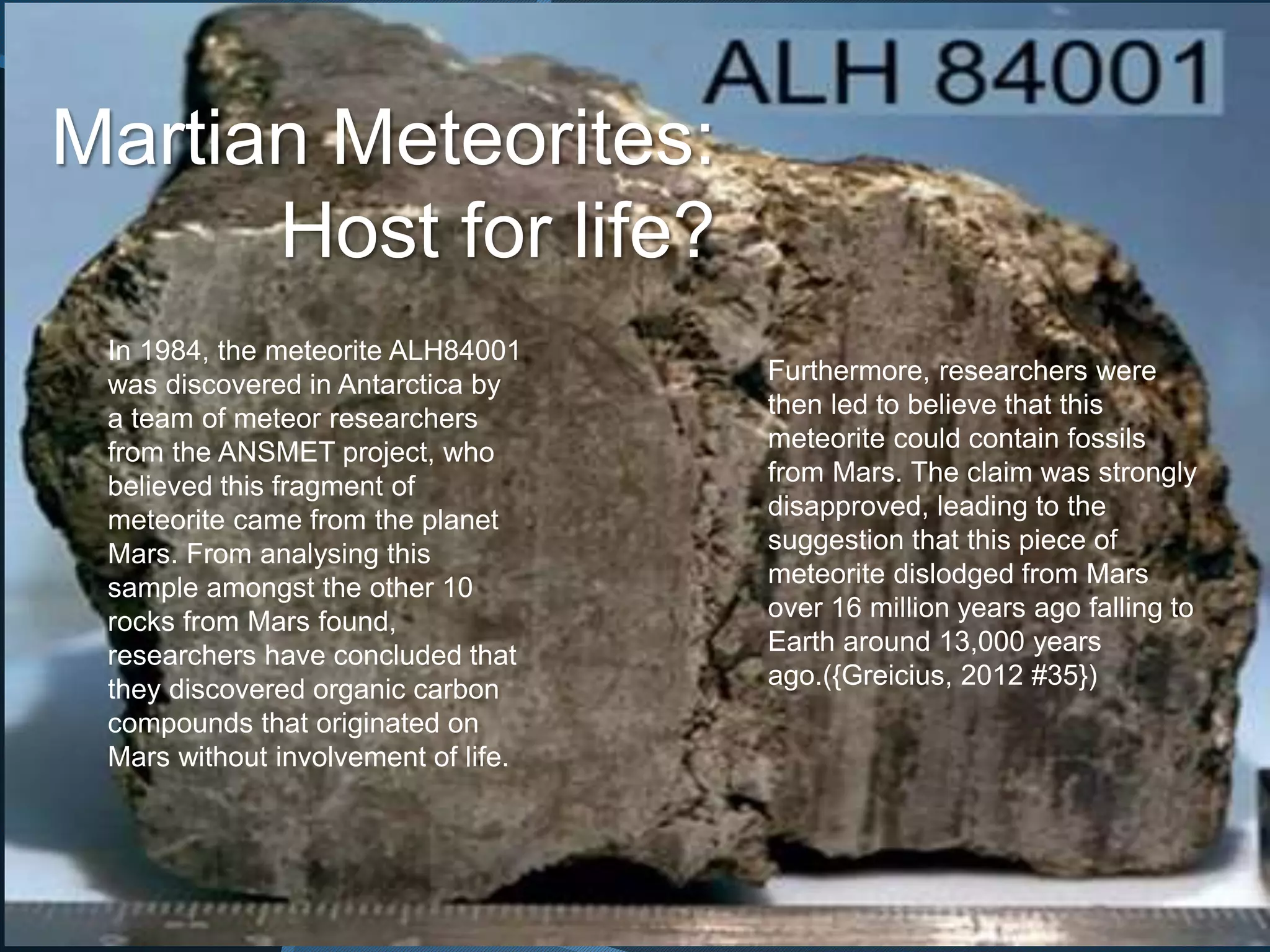
In 1984, the meteorite ALH84001
was discovered in Antarctica by
a team of meteor researchers
from the ANSMET project, who
believed this fragment of
meteorite came from the planet
Mars. From analysing this
sample amongst the other 10
rocks from Mars found,
researchers have concluded that
they discovered organic carbon
compounds that originated on
Mars without involvement of life.
Furthermore, researchers were
then led to believe that this
meteorite could contain fossils
from Mars. The claim was strongly
disapproved, leading to the
suggestion that this piece of
meteorite dislodged from Mars
over 16 million years ago falling to
Earth around 13,000 years
ago.({Greicius, 2012 #35})
After years of scientific
research, as far it has been
determined, the surface of Mars
is inhospitable to forms of life as
we currently know. Due to the
atmosphere being made up of
mostly carbon dioxide, while the
rest of the atmosphere
compromises of argon and
nitrogen, which is similar to
Earth’s atmosphere.
The overall problem
that the planet Mars
holds is that due to the
atmosphere itself, the
planet wouldn’t be able
to sustain it for too long
due to its small size
according to scientists.
In order to discover more about
our neighbouring planet Mars,
NASA has voyaged into space
with probes such as the Curiosity
rover, launched in 2011, taking
over the responsibilities of its
predecessors, the Spirit and
Opportunity rovers. It successfully
landed in 2012, relaying
information back towards Earth
ever since. In 2014, NASA plans
to send the MAVEN orbiter to
address key questions about
Mars’ climate, understanding the
nature of the planet itself.
The ISRO has also launched
it’s own interplanetary
spacecraft back in 2013, being
a technology presentation,
carrying 15 kilograms of
scientific instruments that will
help analyse the planet, also
relaying its results back to
Earth.
Besides Mars, the planet Jupiter and
Saturn and its moons Europa and Titan
have been suggested to once have held
life due to their composition. The moon
Europa is Jupiter’s sixth- closest moon,
having its surface covered in ice, while
also having a icy crust being severely
fractured, indicated by its curved, linear
bands from images on its surface.
Europa’s density allows scientists to
conclude that it has a layer of ice water,
while liquid water could exist due to
possibility of internal tidal heating from
its gravitational relationship with the
planet and its other moons.
Jupiter’s largest moon Titan has
also been suggested to have held
life due to its ammonia/methane
chemistry within the atmosphere;
a essential component in the
synthesis of ‘amino acids’,
leading to the possibility that
primitive forms of life may exist
on this moon, however it’s
unlikely due to the temperature
being extremely cold.
Scientists have discovered that
underneath the icy surface of
Saturn’s moon Enceladus, there
is a watery ocean that could
potentially harbour life. This
discovery was made possible by
NASA’s Nassini Spacecraft,
which had been monitoring
gravitational anomalies over the
course of 10 years.
The moon keeps the water from
freezing by warming tidal forces,
that is generated by the gravity of
the giant gas planets. This
suggests that small microbial
organic life forms may be able to
survive on the surface of the moon
Enceladus. From the research, it’s
conclusive that a large body of
water is causing the anomaly
when scientists realised
something denser than ice was
giving the readings.
Within recent years, there has
been a major breakthrough in
the discovery of planets that
exist outside our solar system,
being defined as ‘exoplanets’. In
addition, some exoplanets have
been recognised to be similar
sizes to Earth, and some even
being super-sized in comparison
to our own planet.
To discover more
exoplanets within our
universe, scientists have
developed a space
telescope which has a
specific role in locating
‘exoplanets’, gathering
critical information on the
characteristics of the
planet/s itself. It’s called
the Kepler Space
Telescope.
The Kepler Space
Telescope:
In 2009, NASA launched the Kepler
Space Telescope into space to locate
and record information on exoplanets
that were located outside the solar
system, the Milky Way.
The main focus of the Kepler
Space Telescope is to also
discover Earth sized planets within
our solar system as well as outside
the solar system and determine
how many planets are located
amongst the billions of stars within
the universe.
Kepler-186 and the
Solar System:
In the above diagram, this model
of the Kepler-186 system shows a
five planet system which is
measured to be 500 light years
away from Earth, in a constellation
called Cygnus.
From the diagram, it shows
that these planets orbit a ‘M
dwarf’- a star that is
recognised as being half the
size and mass of our Sun.
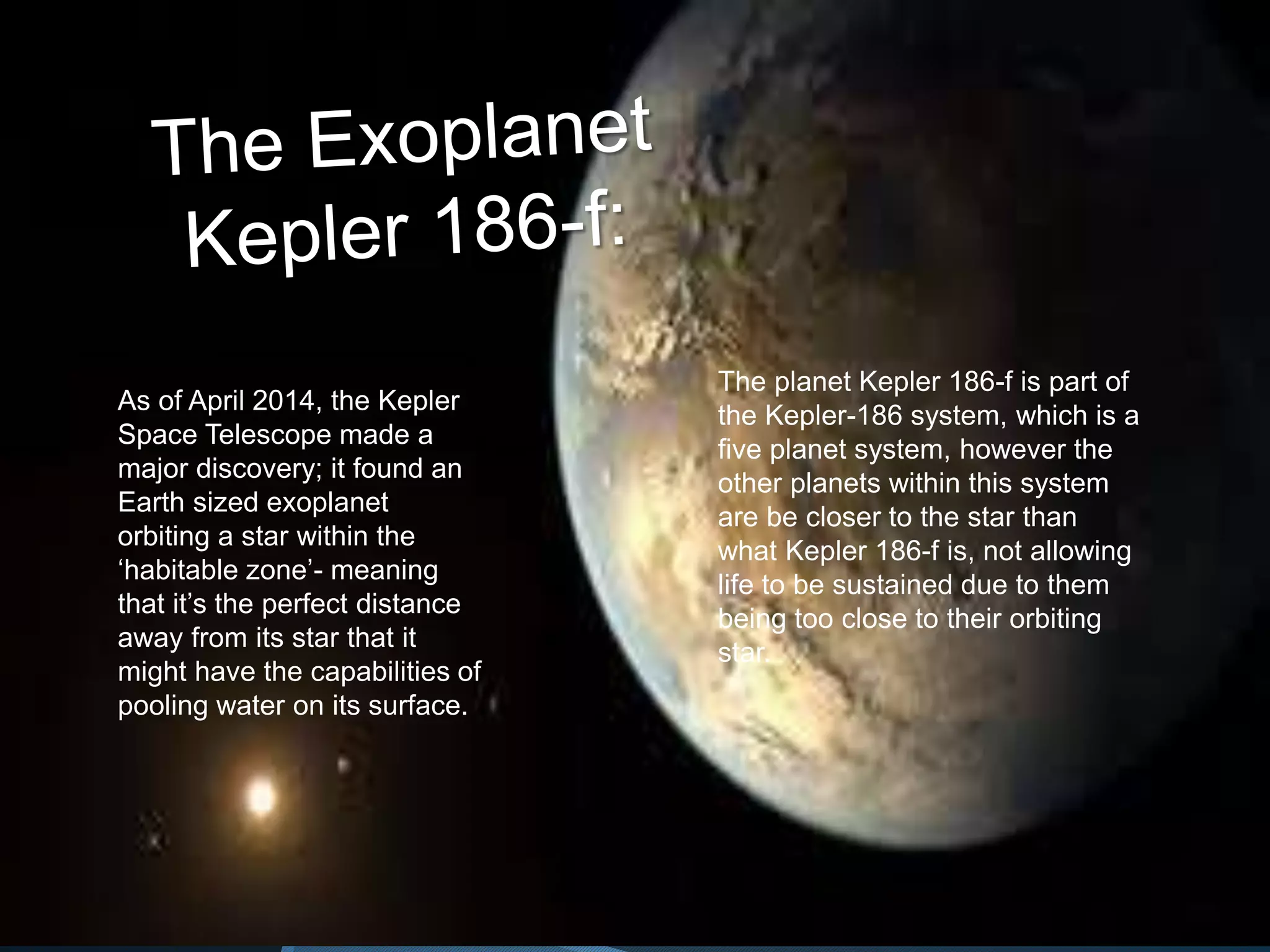
As of April 2014, the Kepler
Space Telescope made a
major discovery; it found an
Earth sized exoplanet
orbiting a star within the
‘habitable zone’- meaning
that it’s the perfect distance
away from its star that it
might have the capabilities of
pooling water on its surface.
The planet Kepler 186-f is part of
the Kepler-186 system, which is a
five planet system, however the
other planets within this system
are be closer to the star than
what Kepler 186-f is, not allowing
life to be sustained due to them
being too close to their orbiting
star.
Astronomers have now discovered a
new rocky planet, being identified as a
‘Mega Earth’, due to it being 17 times
the mass of Earth. It is suggested that
Kepler 10-c formed 11 billion years
ago, being created less than 3 billion
years after the universe began.
The Kepler Space Telescope has
also analysed that this ‘Mega
Earth is 560 light years away
from Earth, orbiting its star very
close, suggesting that life can’t
exist on this planet, while the
gravity is about twice of what
Earth’s gravity is.
From the conclusive research into life on other planets,
including exoplanets as well as planets within our solar
system, the search for life continues due to the evidence that
suggests life exists outside our own planet being somewhat
inconclusive. However, from analysing certain planets’
moons such as Saturn, including Europa and Enceladus,
they have provided results about how there is the possibility
of life to be sustained outside Earth due to the discovery of
water on these orbiting moons, which allows scientists to
continue having hope in discovering some form of life out in
space.

Assig3sci102

  • 1.
    Assessment item 3 Demonstrationof Scientific Knowledge Luke Burgess-sci102 Student Number: 11539636 Due Date:06/06/2014
  • 2.
    For decades, scientistshave been determined to discover whether there are other forms of life within our solar system through use of telescopes, satellites and probes being sent to voyage into the darkest parts of space. The various technologies used in the 21st century have led to astounding discoveries within our solar system and beyond, which leads to endless possibilities. Within recent years, there has been several discoveries of ‘exoplanets’- which have been located outside our solar system, which display particular characteristics of being able to sustain life for even microbial organic life forms. But before their discovery, some planets within out solar system were considered to have held life during one point in their existence
  • 3.
    Mars is recognisedas the fourth planet from the Sun, being identified to astronomers by its bright rust colour due to the minerals located within the loose and dust covering the surface being rich in iron-based minerals. The geology of the planet Mars shows a cold thin atmosphere made up of approximately 95% Carbon Dioxide, while the rest of the atmosphere is comprised of nitrogen (2.7%) and argon (1.3%). In comparison with Earth, Mars shares similar orbital characteristics due to the axis of the planet tilting much like Earth, leading to certain amounts of sunlight reaching certain parts of the planet during its year, giving the planet seasons. However, due to the planet’s elliptical orbit, it experiences harsher seasons when particular hemispheres are facing the Sun, including short, hot summers and short, cold winters.
  • 4.
    Martian Meteorites: Host forlife? In 1984, the meteorite ALH84001 was discovered in Antarctica by a team of meteor researchers from the ANSMET project, who believed this fragment of meteorite came from the planet Mars. From analysing this sample amongst the other 10 rocks from Mars found, researchers have concluded that they discovered organic carbon compounds that originated on Mars without involvement of life. Furthermore, researchers were then led to believe that this meteorite could contain fossils from Mars. The claim was strongly disapproved, leading to the suggestion that this piece of meteorite dislodged from Mars over 16 million years ago falling to Earth around 13,000 years ago.({Greicius, 2012 #35})
  • 5.
    After years ofscientific research, as far it has been determined, the surface of Mars is inhospitable to forms of life as we currently know. Due to the atmosphere being made up of mostly carbon dioxide, while the rest of the atmosphere compromises of argon and nitrogen, which is similar to Earth’s atmosphere. The overall problem that the planet Mars holds is that due to the atmosphere itself, the planet wouldn’t be able to sustain it for too long due to its small size according to scientists.
  • 6.
    In order todiscover more about our neighbouring planet Mars, NASA has voyaged into space with probes such as the Curiosity rover, launched in 2011, taking over the responsibilities of its predecessors, the Spirit and Opportunity rovers. It successfully landed in 2012, relaying information back towards Earth ever since. In 2014, NASA plans to send the MAVEN orbiter to address key questions about Mars’ climate, understanding the nature of the planet itself. The ISRO has also launched it’s own interplanetary spacecraft back in 2013, being a technology presentation, carrying 15 kilograms of scientific instruments that will help analyse the planet, also relaying its results back to Earth.
  • 7.
    Besides Mars, theplanet Jupiter and Saturn and its moons Europa and Titan have been suggested to once have held life due to their composition. The moon Europa is Jupiter’s sixth- closest moon, having its surface covered in ice, while also having a icy crust being severely fractured, indicated by its curved, linear bands from images on its surface. Europa’s density allows scientists to conclude that it has a layer of ice water, while liquid water could exist due to possibility of internal tidal heating from its gravitational relationship with the planet and its other moons. Jupiter’s largest moon Titan has also been suggested to have held life due to its ammonia/methane chemistry within the atmosphere; a essential component in the synthesis of ‘amino acids’, leading to the possibility that primitive forms of life may exist on this moon, however it’s unlikely due to the temperature being extremely cold.
  • 8.
    Scientists have discoveredthat underneath the icy surface of Saturn’s moon Enceladus, there is a watery ocean that could potentially harbour life. This discovery was made possible by NASA’s Nassini Spacecraft, which had been monitoring gravitational anomalies over the course of 10 years. The moon keeps the water from freezing by warming tidal forces, that is generated by the gravity of the giant gas planets. This suggests that small microbial organic life forms may be able to survive on the surface of the moon Enceladus. From the research, it’s conclusive that a large body of water is causing the anomaly when scientists realised something denser than ice was giving the readings.
  • 9.
    Within recent years,there has been a major breakthrough in the discovery of planets that exist outside our solar system, being defined as ‘exoplanets’. In addition, some exoplanets have been recognised to be similar sizes to Earth, and some even being super-sized in comparison to our own planet. To discover more exoplanets within our universe, scientists have developed a space telescope which has a specific role in locating ‘exoplanets’, gathering critical information on the characteristics of the planet/s itself. It’s called the Kepler Space Telescope.
  • 10.
    The Kepler Space Telescope: In2009, NASA launched the Kepler Space Telescope into space to locate and record information on exoplanets that were located outside the solar system, the Milky Way. The main focus of the Kepler Space Telescope is to also discover Earth sized planets within our solar system as well as outside the solar system and determine how many planets are located amongst the billions of stars within the universe.
  • 11.
    Kepler-186 and the SolarSystem: In the above diagram, this model of the Kepler-186 system shows a five planet system which is measured to be 500 light years away from Earth, in a constellation called Cygnus. From the diagram, it shows that these planets orbit a ‘M dwarf’- a star that is recognised as being half the size and mass of our Sun.
  • 12.
    As of April2014, the Kepler Space Telescope made a major discovery; it found an Earth sized exoplanet orbiting a star within the ‘habitable zone’- meaning that it’s the perfect distance away from its star that it might have the capabilities of pooling water on its surface. The planet Kepler 186-f is part of the Kepler-186 system, which is a five planet system, however the other planets within this system are be closer to the star than what Kepler 186-f is, not allowing life to be sustained due to them being too close to their orbiting star.
  • 13.
    Astronomers have nowdiscovered a new rocky planet, being identified as a ‘Mega Earth’, due to it being 17 times the mass of Earth. It is suggested that Kepler 10-c formed 11 billion years ago, being created less than 3 billion years after the universe began. The Kepler Space Telescope has also analysed that this ‘Mega Earth is 560 light years away from Earth, orbiting its star very close, suggesting that life can’t exist on this planet, while the gravity is about twice of what Earth’s gravity is.
  • 14.
    From the conclusiveresearch into life on other planets, including exoplanets as well as planets within our solar system, the search for life continues due to the evidence that suggests life exists outside our own planet being somewhat inconclusive. However, from analysing certain planets’ moons such as Saturn, including Europa and Enceladus, they have provided results about how there is the possibility of life to be sustained outside Earth due to the discovery of water on these orbiting moons, which allows scientists to continue having hope in discovering some form of life out in space.