Atelectasis
Collapse
Adapted from 黃立果學長的 CXR 教學
吳文碩 醫師
Wen-Shuo Wu, M.D.
台北榮民總醫院胸腔部
陽明大學醫學系 兼任講師
本學期 CXR 教學進度表
 2015.03.10 Normal CXR
2015.03.17 Atelectasis/Collapse
2015.03.24 休假一次 PGY大會
 2015.03.31 Alveolar Consolidation
 2015.04.07 Solitary Pulmonary Nodule and Mass
 2015.04.14 Multiple Pulmonary Nodules and Masses
 2015.04.21 Cavitary and Cystic Lesions
 2015.04.28 Interstitial Pattern/Diffuse Lung Diseases
 2015.05.05 Mediastinal and Hilar Lesions part I
 2015.05.12 Mediastinal and Hilar Lesions part I
 2015.05.19 Cardiovascular disease
 2015.05.26 Chest Wall, Diaphragm, and Pleural Lesions
 2015.06.02 CXR in ICU
基本功
品質
姿勢
資訊
判
讀
前
解剖學
病灶
多樣性
判
讀
解剖學
Lines
and
Stripes
系統性的判讀
每個人可以建立自己的讀片順序
蕭主任游泳姿勢說
1. 胸廓及其外軟組織
2. 橫膈及腹部器官
3. 縱膈
4. 大氣道
5. 肺門
6. 肺區(肺裂、肺紋及支氣管分支)
Felson: There Are Many Lung Lesions
1. T(thorax):胸廓及其外軟組織
2. A(abdomen):橫膈及腹部器官
3. M(mediastinum):縱膈,含大氣道和肺門
4. L(單側肺區):肺裂、肺紋及支氣管分支
5. L(兩側肺區左右比較)
Apex
Large Airway
Retrocardiac
Lung Bases
盲
點
DIRECT SIGNS
INDIRECT SIGNS
SILHOUETTE
SIGN
Increased opacity
Displacement of
interlobar fissures
Bronchovascular
crowding
Hilar displacement
Obscured heart or
diaphragm borders
Diaphragm elevation
Displacement of mediastinal
structures
Compensatory hyperexpansion
Narrowing of intercostal
spaces
Juxtaphrenic peak (JP sign)
Direct Signs Indirect Signs
S1 Apical
S2 Posterior
S4 Medial
S5 Lateral
S1 Apical
S2 Posterior
S3 Anterior
S10 posterior
S6 Superior
S9 Lateral
S8 Anaterior
右肺前 後
左肺
S1+2 Apicoposterior
S3 Anterior
S3 Superior
S3 Inferior
S6 Superior
S7+S8
Anterior-medial
S9 LateralS10 Posterior
前 後
M-A
A
P
S
P L
S
M
The Anatomy of Lower Lobes of Lung
M-A-L-P
L
Propeller-like configuration of the major fissures
RadioGraphics 2001; 21:861–874
Right Upper Lobe
Right Middle Lobe
Right Lower Lobe
Left Upper Lobe
Left Lower Lobe
Silhouette sign
判斷silhouette sign的重要landmarks
RML-RB5
Lingular-LB5
RLL
LLL
RUL-RB3
LUL-LB3
LUL-LB1+2
LLL
Silhouette Sign Locations
阻塞
結疤
壓力
Resorption/Obstructive Atelectasis
Causes of central airway obstruction
Neoplasm
Lung cancer (most common cause)
Metastatic cancer(腎細胞癌、乳癌、黑色素瘤、鼻咽喉癌), lymphoma
Less frequent: broncholith, bronchial stenosis; bronchial carcinoid,
lipoma, granuloma)
Foreign body; mucus plugs
Stricture
Endobronchial TB, inflammation (TB, sarcoidosis)
External compression
LAP, mass, aneurysm, cardiomegaly ( especially LAE )
Peripheral airway obstruction
Subsegmental:又叫做 discoid (plate-like)
atelectasis
Horizontal or oblique line in middle or lower lung
Negative bronchoscopy exam
Opacity is less uniform (containing gas)
Resorption/Obstructive Atelectasis
Causes of peripheral airway obstruction
Mucus plug
 AE COPD, asthma, emphysema, BO
Diaphragm
 手術 Severe chest or abdominal pain
 CNS depressants use
Inflammatory
Bronchopneumonia
Bronchitis
Bronchiectasis
Resorption/Obstructive Atelectasis
Relaxation Atelectasis
肺內或肺外
space-occupying lesion
Lung tumor
Pneumothorax  Bulla
Pleural effusion
hemothorax, malignant/benign
Diaphragmatic hernia
Pleural masses
Metastasis Mesothelioma
Pneumothorax
Adhesive Atelectasis
Mechanism surfactant deficiency
Causes
ARDS, smoke inhalation
RDS of newborn (prototype)
Pulmonary thromboembolism.
CXR: subsegmental atelectasis + pleural effusion
Clinical symptoms and signs
Cicatrization Atelectasis
肺組織間質中發生纖維化或是瘢痕(scar)引
起肺泡無法正常膨脹,可分局部性及廣泛性。
局部性結痂性肺萎陷 肺結核 放射性肺炎
廣泛性結痂性肺萎陷
塵肺症(pneumoconiosis)
原發性肺纖維化 (Idiopathic
pulmonary fibrosis)
常合併有traction bronchiectasis
Signs of Atelectasis
Acute atelectasis
anatomic structure位移為主
Chronic atelectasis
compensatory hyperinflation
Increased opacity
Displacement of
interlobar fissures
Bronchovascular
crowding
Hilar displacement
Obscured heart or
diaphragm borders
Diaphragm elevation
Displacement of mediastinal
structures
Compensatory hyperexpansion
Narrowing of intercostal
spaces
Juxtaphrenic peak (JP sign)
Direct Signs Indirect Signs
Hilar Displacement
Upper lobe collapse elevated
Lower lobe collapse depressed
RML or lingular division collpase
no change
Diaphragm Elevation
lower lobe collapse (volume↑)
Lung collapse, subpulmonic effusion
Diaphragm eventration, paralysis
Abdominal hernia, abdominal mass
Indirect Sign
Mediastinal structure deviation
Trachea, Heart
Narrowing of intercostal space
More frequently encountered in children
Mainly in acute atelectasis
Juxtaphrenic peak (JP) sign:
Upper lobe collapse, esp. R’t side
Stretching of the
inferior pulmonary ligament
Increased
opacity
Fissure
displacement
Trachea
deviation
Hilum
elevation
Narrowing
of ICS
Compensatory
hyperonflation
Lobar Collapse
 RUL collapse
 RML collapse
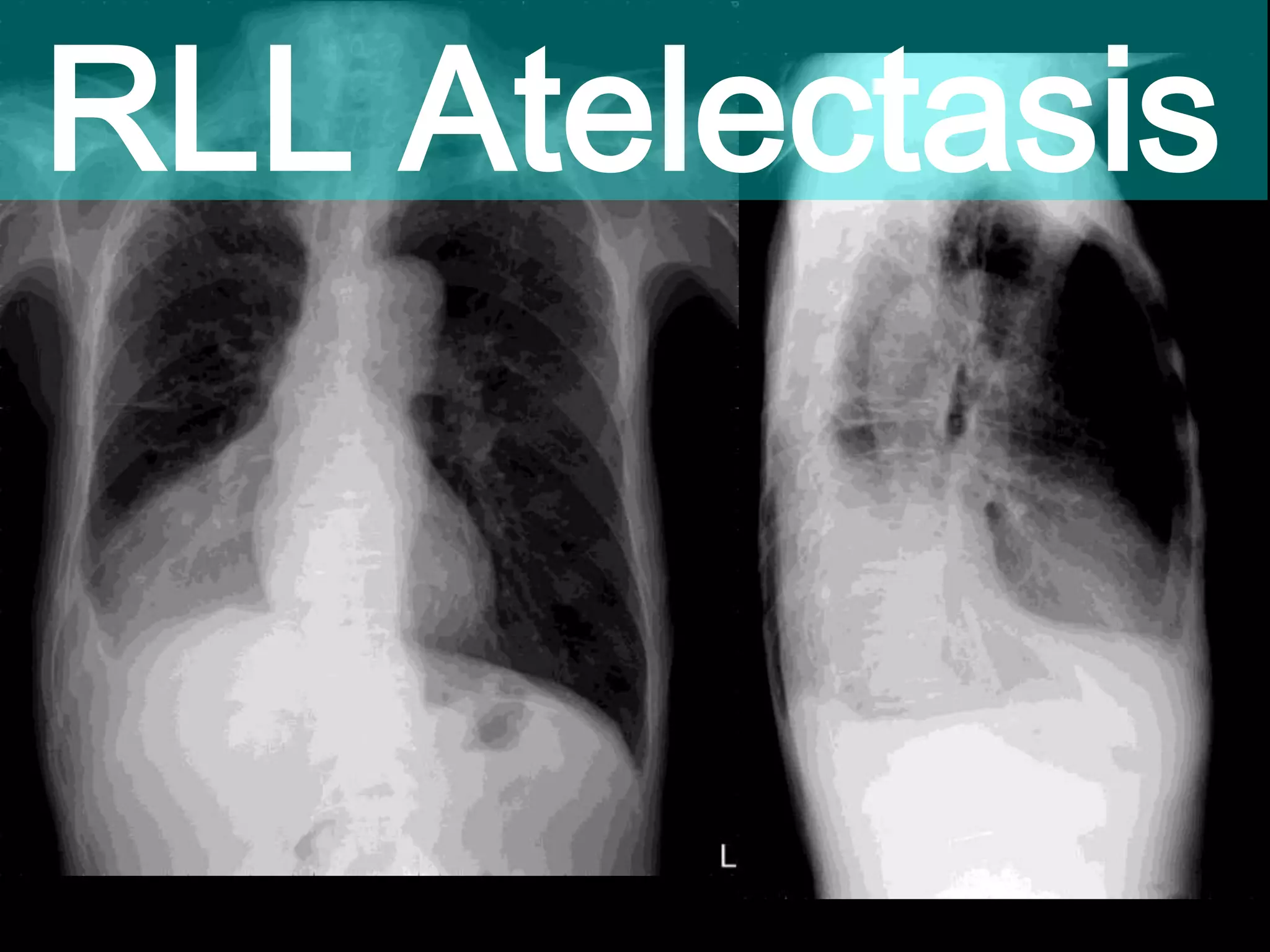
 RLL collapse
 Bilobar collapse
(RML+RLL)
 LUL collapse
Upper division collapse
Lingular lobe collapse
 LLL collapse
 Lingular division
+ LLL collapse
必
背
RUL Collapse: PA view
Elevation of minor fissure
Complete RUL collapse:
widening of the superior mediastinum
Indirect sign (hilum elevation) may be
evident
Specific signs of RUL collapse
Reverse S sign
J-P sign
RUL Collapse Lateral view
Minor fissure
Shift upward
Superior half of the major fissure
Shift forward
Nearly complete
RUL collapse
Complete
RUL Collapse
Reverse S Sign of Golden
On in PA view of
RUL collapse + R’t hilar tumor
Bronchogenic cancer, mediastinal
tumor, or enlarged LAP.
The upper part:
The elevated minor fissure
The lower part:
The tumor mass responsible for
collapse.
Golden
Reverse
S sign
Reverse S sign of Golden
RUL collapse with
central tumor
RML Collapse: PA view
R’t lower heart border 不清楚
Maybe a faint shadow on the PA view
Lordotic view is helpful
Relatively small shrinkage in volume
Usually no indirect signs
RML Collapse Lateral view
Easier identification
Minor Fissure:
Inferior displacement
Lower part of the major fissure:
Anterior shift
Minor fissure
Major
fissure
Right Middle Lobe Collapse
RML Collapse
RML Collapse
RML Collapse – Lordotic View
Image of Disease of the CHEST, Armstrong P. 3rd edition
RML
atelectasis
Pectus
excavatum
sternum
RLL Collapse PA view
R’t heart border is visible
Inferior and medial shift of
the major fissure
Upper triangle sign
Minor fissure
Major
fissure
RLL Collapse
RLL Atelectasis
RLL Collapse
UpToDate: Radiologic patterns of lobar atelectasis
Upper triangle sign
Collapse of Upper Division of LUL
Similar to RUL collapse
Obscured aortic arch
LUL upper division atelectasis
Lingual
Lobe
Collapse
類似RML
Collapse
Left Upper Lobe Collapse
LUL
Atelectasis
Luftsichel
sign
Luftsichel sign (LUL collaspe)
(Luft = air; sichel = crescent)
Aortic Knob
Superior segment
of LLL LB6
hyperinflation
produces a crescent
of lucency along the
mediastinum and
aortic knuckle.
LUL collapse
Loss of aortic
knob shadow
Loss of upper portion
of L’t heart border
Ground-glass shadow
on left upper lung field
Forward
displacement
of major fissure
LUL collapse
LUL collapse
陳X秀珍 35710895
96/10/15
LLL collapse
Increased opacity
Diaphragm shadow disappear
D-aorta border disappear
Flat waist sign
Top-of-knob sign
LLL collapse
Major
fissure
Left Lower Lobe Atelectasis
LLL atelectasis
Flat waist sign (LLL collapse)
 平腰徵
 正常左邊的心臟邊緣
成凹陷狀,而當
severe LLL collapse
時,除了mediastinal
shift之外,心臟還會
作輕微的right
anterior oblique
rotation (leftward
rotation),以致於左
側心臟的normal
concavity消失,因而
呈平坦狀。
Left lower lobe collapse
LLL collapse
Top-of-the-knob sign
當severe LLL collapse
時,anterior junctional
line會向左位移,在left
upper mediastinum可
見一條幾乎垂直的
vertical interface,會跨
過aortic knob
UpToDate: Radiologic patterns of lobar atelectasis
Multilobar Atelectasis
RML + RLL
RUL + RML
Less common
RUL + RLL
Very rare
Lingular + LLL
Total collapse
Bilobar Collapse RML + RLL
Cause: obstruction in RIMB
P-A view
R’t lower heart border
R’t hemidiaphragm
Lat view
R’t hemidiaphragm
IVC
RML + RLL Collapse
陳x亨 3580033-0 97/03/10
SCLC with RIMB obstruction
RLL collapse vs. Bi-lobar collapse
RLL collapse Bi-lobar collapse
Still visible R’t
lower heart border
Lingular Division
LLL Collapse
RML + RLL
bilobar collapse
Total lung collapse
Causes:
Obstruction: tumor, foreign body, sputum
Total pneumonectomy
D/D with massive pleural effusion
Massive effusion:
Volume expansion
Mediastinum(trachea) shift to contralateral side
Total collapse:
Volume reduction
Thoracic cage retraction
ICS narrowing
Mediastinum(trachea) shift to the same side
Total Lung Collapse,
Left
Massive Pleural
Effusion, L’t
s/p pneumonectomy
Right lung
herniation
Esophageal ca with left main bronchus metastasis, total left atelectasis
Discoid atelectasis
 A: R/O linear scars or subsegmental collapse
 B: CXR taken 48 hrs later, confirm the diagnosis of
subsegmental atelectasis
Discoid Atelectasis
Discoid atelectasis showing
typical band-like shadow
Image of Disease of the CHEST, Armstrong P. 3rd edition
Round Atelectasis
Passive atelectasis
due to PE
Infolding of
visceral pleura
Fibrinous parietal
pleural adhesion
maintain the infolding
and tilting lung
當pleural effusion吸
收後,collapsed
lung會re-expand,
除了round
atelectasis處
Pleuropulmonary fibrosis
with organization and
contraction
Round Atelectasis
Round Atelectasis
Round Atelectasis
Mass like density
Pleural based
Base of lungs
Blunting of costophrenic angle
Pleural thickening
Pulmonary vasculature curving into the
density
Esophageal surgical clips.
Round atelectasis
Image of Disease of the CHEST, Armstrong P. 3rd edition
Comet tail sign
Round atelectasis
Comet tail sign
Image of Disease of the CHEST, Armstrong P. 3rd edition
Are you ready?
LLL Atelectasis
•Inhomogeneous
cardiac density
•Left hilum pulled
down
•Non-visualization
of left diaphragm
•Triangular
retrocardiac
atelectatic LLL
LLL Atelectasis
•Loss of left
diaphragmatic
silhouette in PA
view
LUL Atelectasis
•Hazy density over
left upper lung
field
•Loss of left heart
silhouette
•Tracheal shift to
left
LUL Atelectasis
A: Forward movement of
oblique fissure
C: Atelectatic LUL
B: Herniated right lung
RUL Atelectasis
1. Density in the right upper lung field
2. Right hilum pulled up
3. Smaller right hemithorax
RUL Atelectasis
RML + RLL atelectasis
RLL Atelectasis
LUL Atelectasis
1.Mediastinal shift to left
2.Density left upper lung field
3.Loss of aortic knob and left hilar
silhouettes
4.Compensatory hyperinflation of
right lung
RML Collapse
Neck
LAP
Loss of R’t heart border
TB adenitis with RML collapse

Atelectasis and collapse in CXR