MADE BY –
RAVI GAUTAM,PRIYADARSHAN(BUDDHISM)
TARUN SAINI,PANKAJ NAGPAL(JAINISM)
- 12th ARTS
BUDDHISM
BUDDHISM
Origins
Around 530 BC a young prince named
Siddhartha Gautama challenged the ideas
of the Brahmin priests and created a new
world religion .
Born in 563 BC into the warrior
caste
He lived in luxury in his family’s
palaces and never experienced
pain, suffering, or death
He married a beautiful woman
and they had a son.
One day while riding in his chariot outside the palace
walls, Gautama saw a sick man, an old man, and a
dead man.
He realized that life was an endless cycle of pain and that the only way
to escape that cycle was to seek wisdom
He left his family when he was about 29 and became a homeless
wanderer with five other men who were also seeking wisdom.
Gautama tried to find wisdom through physical suffering and
harsh discipline but instead he gained only pain.
At last, after days of meditating deeply in the shade of a tree, Gautama
felt that the truth had come to him
At this point, he became to known as “The Enlightened One,” or
Buddha.
Four Noble Truths
First Noble Truth: Everything in life is
suffering and sorrow.
Second Noble Truth: The cause of all this pain
is people’s self-centered cravings and desires ---
people seek pleasure that cannot last and that
leads only to rebirth and more suffering.
Third Noble Truth: The way to end all pain
is to end all desires.
Fourth Noble Truth: People can overcome
their desires and attain enlightenment by
following the Eightfold Path.
Noble Eightfold Path
He gave an Eightfold path. According to him the eightfold
path is a way to end suffering.
1. Right view
2. Right intention
3. Right speech
4. Right action
5. Right livelihood
6. Right effort
7. Right mindfulness
8. Right meditation or
concentration
By following the Eightfold Path,
anyone could attain nirvana--
which was the release from all
pain and suffering.
Buddha taught his followers to
treat all living things (humans,
animals, and even insects) with
kindness and love.
Buddha eliminated the caste
system, the rituals associated
with Hinduism, and the
ancient language (Sanskrit)
of the Vedas and
Upanishads.
Concerned with all human
beings---women as well as
men, and lowborn as well as
highborn.
Refuge in the Three Jewels
Three things that Buddhists give
themselves to, and in return look toward
for guidance, in the process known as
taking refuge.
Buddha – example of Buddha
Or more loosely, the wisdom that
understands Dharma, and in this regard
the Buddha represents the perfect wisdom
that sees reality in its true form.
Dharma – teachings/laws as
expounded by Buddha
Sangha – community of those who
will help others attain bodhi
(enlightenment).
The most important symbol in Buddhism is
the Wheel of Life which depicts the cycle of
birth and life.
The eight spokes symbolize the Eightfold
Path.
Buddhist teachings & beliefs were recorded in a
collection called the Tripitaka.
Pali Canon (Tipitaka):
Vinaya Pitaka: dealing with rules
for monks and nuns
Sutta Pitaka: discourses, mostly
ascribed to the Buddha, but some
to disciples
Abhidhamma Pitaka: variously
described as philosophy,
psychology, metaphysics.
Pali Canon is the scripture collection
of the Theraveda Buddhist
tradition.
In Pali language-
Pitaka means basket
tipitaka means three basket.
 Jainism is a way of life and one of the oldest religions
of the world.
 It believes in a cyclical nature of universe. It
discourages superstition and blind faith and
encourages free and rational thinking.
 Jainism lays heavy emphasis on non-violence (ahimsa)
and discipline.
 According to Jain philosophy, all Tirthankaras were
born as human beings but they have attained a state of
perfection or enlightenment through meditation and
self realization. They are the “Gods” of Jains.
 Jains have always practiced non-violence,
vegetarianism, meditation, yoga, and
environmentalism.
•Not to cause harm to any living beings by thoughts,
speech or body
•Non-violence towards all living creatures, in both thought
and action
Non-violence
(Ahimsa)
•Strengthens autonomy of thoughts &
speech, and non-possessiveness
Multiplicity of
Views
(Anekäntväd)
•A complete detachment from people,
places, and material things
Non-Possessiveness
/ Non-Attachment
(Aparigraha)
•To speak the harmless truth only
Truthfulness
(Satya)
•Not to take anything that is not properly
given
Non-Stealing
(Asteya / Achaurya)
 Jainism believes in Godhood but does not believe God to
be the First Cause. God is not a Creator, Preserver or
Destroyer of the universe.
 “God” does not Punish or Reward
 Each person is responsible for improving life by one’s
self-endeavor
 Each person is capable of achieving Godhood
 All Living Beings have Souls & are Equal
 All life is sacred
 Therefore, living in peace & harmony is essential
 Elimination of our Karmas is the Path to Liberation
& Achievement of Godhood
 It requires multiple re-births
 Ultimate Goal of Life
 To be free from all karma
 The principles governing the successions of life cycles
(birth, life, and death) is Karma.
 The Theory of Karma is founded on the simple law of cause
and effect. What we experience now is the result of our own
past action and our future is a function of our own choice
and making.
 Explains the role that karmas play in our lives, how we
accumulate karmas, and how we get rid of them.
 Actions of mind, speech, and body bind us with karma and
our intentions and the passions determine the duration,
strength and the results of the bondage.
 Lord Mahavir - 24th (and final) Tirthankara
 Born on March 30, 599 B.C. (about 2600 years ago) as a
prince in Bihar, India. He attained nirvana in the year
527 B.C. at the age of 72.
 The ultimate objective of his teaching is how one can
attain the total freedom from the cycle of birth, life,
and death, and achieve the permanent blissful state
(known as liberation, nirvana, absolute freedom, or
Moksha.)
 He shaped the present form of Jainism. Lord Mahavir
envisioned men and women to be on equal footing in
the matters of spiritual advancement.
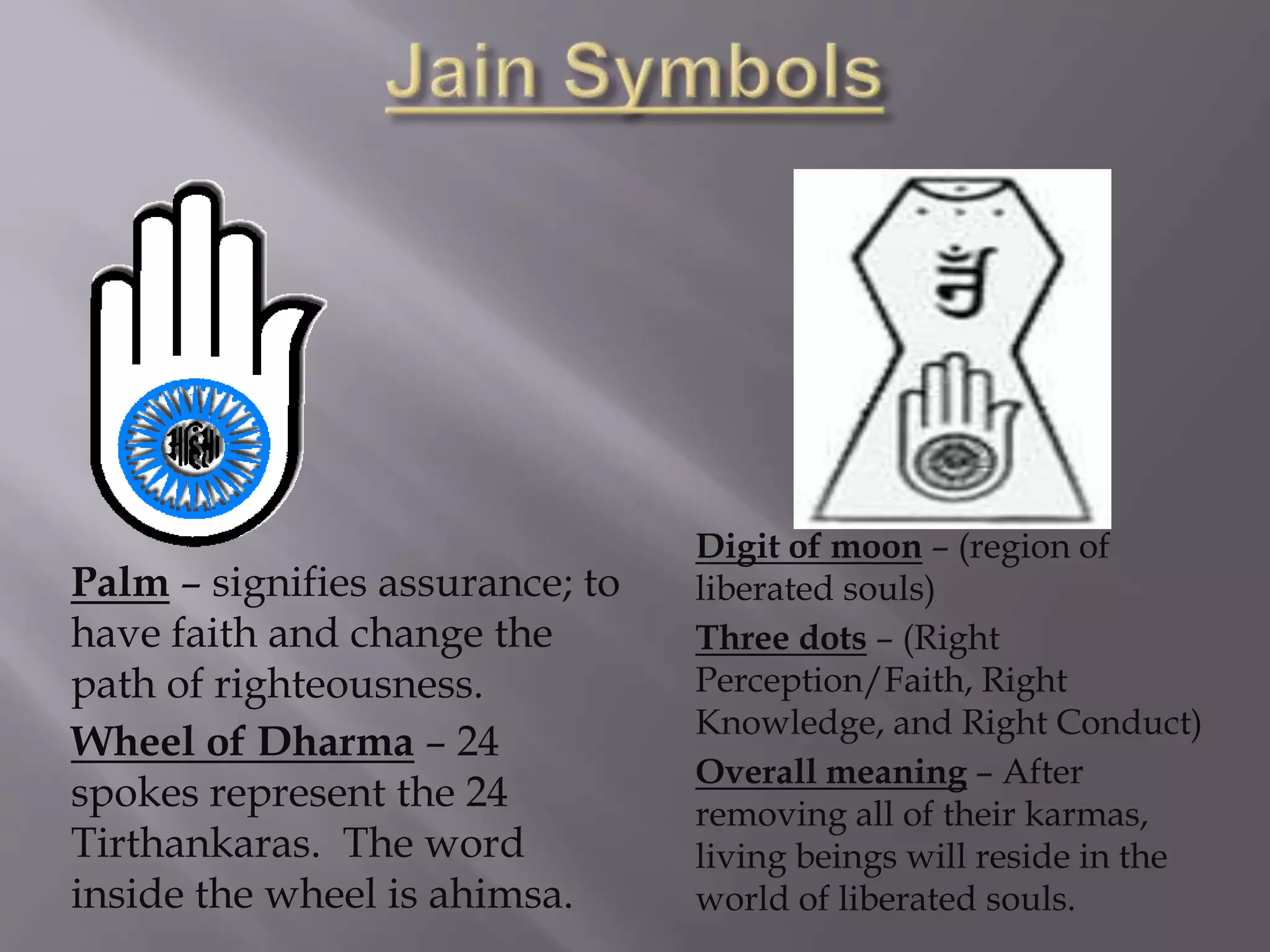
Palm – signifies assurance; to
have faith and change the
path of righteousness.
Wheel of Dharma – 24
spokes represent the 24
Tirthankaras. The word
inside the wheel is ahimsa.
Digit of moon – (region of
liberated souls)
Three dots – (Right
Perception/Faith, Right
Knowledge, and Right Conduct)
Overall meaning – After
removing all of their karmas,
living beings will reside in the
world of liberated souls.
 Mahavir Jayanti – celebration of the
birth of Lord Mahavir
 Paryushan Parva – festival of
forgiveness
 Samvatsari Pratikraman – 3 hour prayer
to ask for forgiveness
 Mahavir Nirvan – celebration at
Diwali/New Year’s per the lunar
calendar
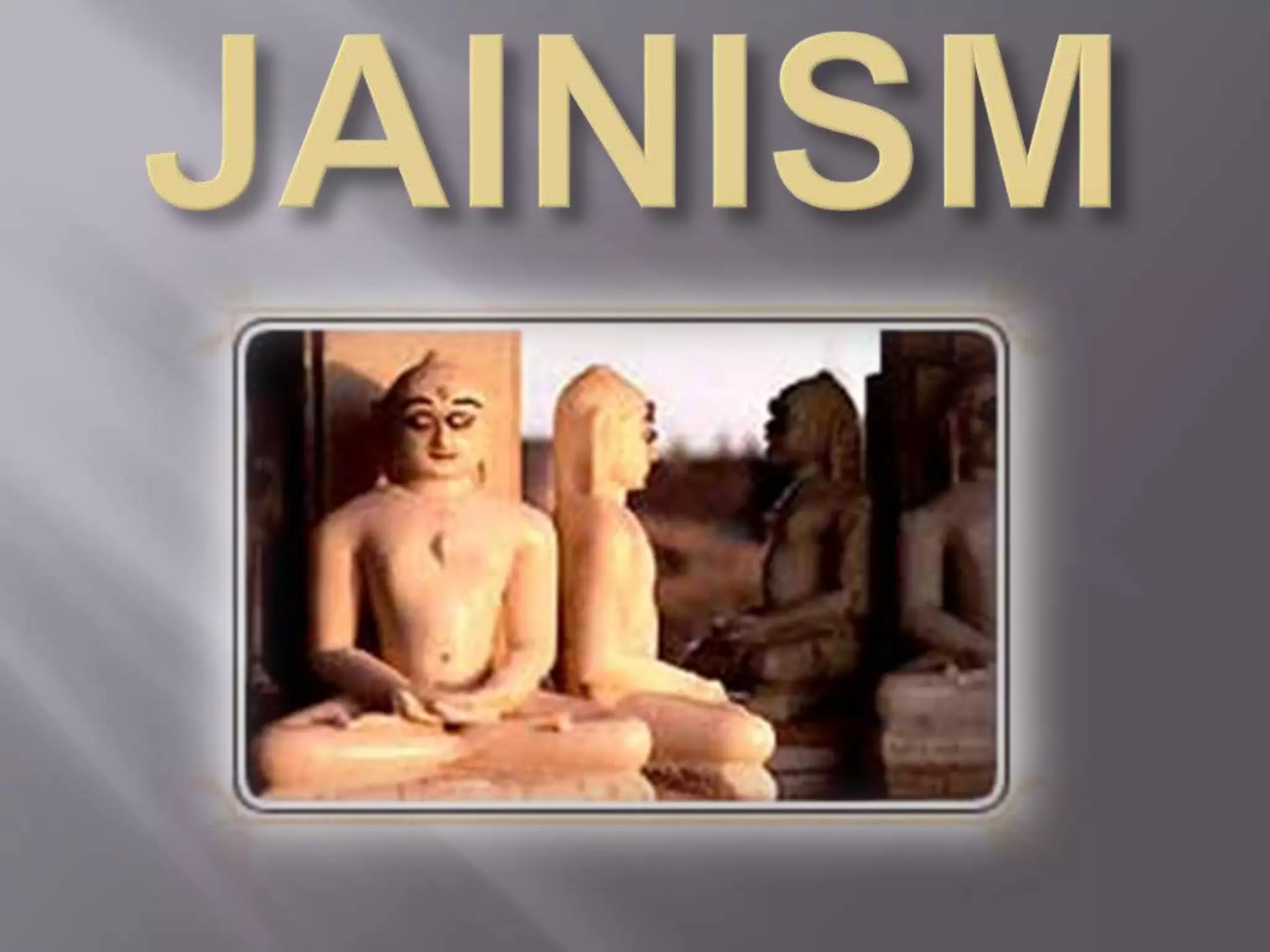
The idols of the 24 Tirthankaras are the same because they represent the quality
and virtues of the Tirthankaras, not the physical body. A unique symbol at the
bottom of each idol differentiates them.
All souls are equal
Non-Violence
Multiplicity of views
Non-possessiveness
Karma
Three jewels: Right Knowledge, Right Faith, Right Conduct
 Code of Conduct for Monks & Nuns (stricter)
 Code for Laymen and Laywomen
 Vegetarianism & Non-Violent Practices
 No Silk, Leather, Animal Products
 Simplicity of Lifestyle, Non-Materialism
 Meditation and Introspection
 Forgiveness is a Moral Doctrine
 Compassion, Charity & Community Service
 Preservation of the Environment
 Jainism is the World’s Only Religion Emphasizing the
Environment
Control anger through forgiveness
Arrogance through humility
Deception through honesty
Greed through contentment
Major emphasis in Jainism is on non-
violence (Ahimsa)
buddhismandjainism-150217002010-conversion-gate02.pdf

buddhismandjainism-150217002010-conversion-gate02.pdf

  • 1.
    MADE BY – RAVIGAUTAM,PRIYADARSHAN(BUDDHISM) TARUN SAINI,PANKAJ NAGPAL(JAINISM) - 12th ARTS
  • 2.
  • 3.
    Origins Around 530 BCa young prince named Siddhartha Gautama challenged the ideas of the Brahmin priests and created a new world religion . Born in 563 BC into the warrior caste He lived in luxury in his family’s palaces and never experienced pain, suffering, or death He married a beautiful woman and they had a son.
  • 4.
    One day whileriding in his chariot outside the palace walls, Gautama saw a sick man, an old man, and a dead man. He realized that life was an endless cycle of pain and that the only way to escape that cycle was to seek wisdom He left his family when he was about 29 and became a homeless wanderer with five other men who were also seeking wisdom.
  • 5.
    Gautama tried tofind wisdom through physical suffering and harsh discipline but instead he gained only pain. At last, after days of meditating deeply in the shade of a tree, Gautama felt that the truth had come to him At this point, he became to known as “The Enlightened One,” or Buddha.
  • 6.
    Four Noble Truths FirstNoble Truth: Everything in life is suffering and sorrow. Second Noble Truth: The cause of all this pain is people’s self-centered cravings and desires --- people seek pleasure that cannot last and that leads only to rebirth and more suffering. Third Noble Truth: The way to end all pain is to end all desires. Fourth Noble Truth: People can overcome their desires and attain enlightenment by following the Eightfold Path.
  • 7.
    Noble Eightfold Path Hegave an Eightfold path. According to him the eightfold path is a way to end suffering. 1. Right view 2. Right intention 3. Right speech 4. Right action 5. Right livelihood 6. Right effort 7. Right mindfulness 8. Right meditation or concentration By following the Eightfold Path, anyone could attain nirvana-- which was the release from all pain and suffering.
  • 8.
    Buddha taught hisfollowers to treat all living things (humans, animals, and even insects) with kindness and love. Buddha eliminated the caste system, the rituals associated with Hinduism, and the ancient language (Sanskrit) of the Vedas and Upanishads. Concerned with all human beings---women as well as men, and lowborn as well as highborn.
  • 9.
    Refuge in theThree Jewels Three things that Buddhists give themselves to, and in return look toward for guidance, in the process known as taking refuge. Buddha – example of Buddha Or more loosely, the wisdom that understands Dharma, and in this regard the Buddha represents the perfect wisdom that sees reality in its true form. Dharma – teachings/laws as expounded by Buddha Sangha – community of those who will help others attain bodhi (enlightenment).
  • 10.
    The most importantsymbol in Buddhism is the Wheel of Life which depicts the cycle of birth and life. The eight spokes symbolize the Eightfold Path. Buddhist teachings & beliefs were recorded in a collection called the Tripitaka.
  • 11.
    Pali Canon (Tipitaka): VinayaPitaka: dealing with rules for monks and nuns Sutta Pitaka: discourses, mostly ascribed to the Buddha, but some to disciples Abhidhamma Pitaka: variously described as philosophy, psychology, metaphysics. Pali Canon is the scripture collection of the Theraveda Buddhist tradition. In Pali language- Pitaka means basket tipitaka means three basket.
  • 15.
     Jainism isa way of life and one of the oldest religions of the world.  It believes in a cyclical nature of universe. It discourages superstition and blind faith and encourages free and rational thinking.  Jainism lays heavy emphasis on non-violence (ahimsa) and discipline.  According to Jain philosophy, all Tirthankaras were born as human beings but they have attained a state of perfection or enlightenment through meditation and self realization. They are the “Gods” of Jains.  Jains have always practiced non-violence, vegetarianism, meditation, yoga, and environmentalism.
  • 16.
    •Not to causeharm to any living beings by thoughts, speech or body •Non-violence towards all living creatures, in both thought and action Non-violence (Ahimsa) •Strengthens autonomy of thoughts & speech, and non-possessiveness Multiplicity of Views (Anekäntväd) •A complete detachment from people, places, and material things Non-Possessiveness / Non-Attachment (Aparigraha) •To speak the harmless truth only Truthfulness (Satya) •Not to take anything that is not properly given Non-Stealing (Asteya / Achaurya)
  • 17.
     Jainism believesin Godhood but does not believe God to be the First Cause. God is not a Creator, Preserver or Destroyer of the universe.  “God” does not Punish or Reward  Each person is responsible for improving life by one’s self-endeavor  Each person is capable of achieving Godhood  All Living Beings have Souls & are Equal  All life is sacred  Therefore, living in peace & harmony is essential  Elimination of our Karmas is the Path to Liberation & Achievement of Godhood  It requires multiple re-births  Ultimate Goal of Life  To be free from all karma
  • 18.
     The principlesgoverning the successions of life cycles (birth, life, and death) is Karma.  The Theory of Karma is founded on the simple law of cause and effect. What we experience now is the result of our own past action and our future is a function of our own choice and making.  Explains the role that karmas play in our lives, how we accumulate karmas, and how we get rid of them.  Actions of mind, speech, and body bind us with karma and our intentions and the passions determine the duration, strength and the results of the bondage.
  • 19.
     Lord Mahavir- 24th (and final) Tirthankara  Born on March 30, 599 B.C. (about 2600 years ago) as a prince in Bihar, India. He attained nirvana in the year 527 B.C. at the age of 72.  The ultimate objective of his teaching is how one can attain the total freedom from the cycle of birth, life, and death, and achieve the permanent blissful state (known as liberation, nirvana, absolute freedom, or Moksha.)  He shaped the present form of Jainism. Lord Mahavir envisioned men and women to be on equal footing in the matters of spiritual advancement.
  • 20.
    Palm – signifiesassurance; to have faith and change the path of righteousness. Wheel of Dharma – 24 spokes represent the 24 Tirthankaras. The word inside the wheel is ahimsa. Digit of moon – (region of liberated souls) Three dots – (Right Perception/Faith, Right Knowledge, and Right Conduct) Overall meaning – After removing all of their karmas, living beings will reside in the world of liberated souls.
  • 21.
     Mahavir Jayanti– celebration of the birth of Lord Mahavir  Paryushan Parva – festival of forgiveness  Samvatsari Pratikraman – 3 hour prayer to ask for forgiveness  Mahavir Nirvan – celebration at Diwali/New Year’s per the lunar calendar
  • 22.
    The idols ofthe 24 Tirthankaras are the same because they represent the quality and virtues of the Tirthankaras, not the physical body. A unique symbol at the bottom of each idol differentiates them.
  • 23.
    All souls areequal Non-Violence Multiplicity of views Non-possessiveness Karma Three jewels: Right Knowledge, Right Faith, Right Conduct
  • 24.
     Code ofConduct for Monks & Nuns (stricter)  Code for Laymen and Laywomen  Vegetarianism & Non-Violent Practices  No Silk, Leather, Animal Products  Simplicity of Lifestyle, Non-Materialism  Meditation and Introspection  Forgiveness is a Moral Doctrine  Compassion, Charity & Community Service  Preservation of the Environment  Jainism is the World’s Only Religion Emphasizing the Environment
  • 25.
    Control anger throughforgiveness Arrogance through humility Deception through honesty Greed through contentment Major emphasis in Jainism is on non- violence (Ahimsa)