Fossil Power Basics
Topics to Discuss Fossil Power Plants Coal & Oil Fired Gas Turbine Simple Cycle Combined Cycle Integrated Gasification Combined Cycle Current Drivers of the Fossil Power Industry Emission Issues Efficiency Issues Scheduled Power Outages New Energy Demands
Fossil Fuel Plant Types Traditional Coal & Oil Fired Plants Gas Turbine Simple Cycle Gas Turbine Combined Cycle Integrated Gasification Combined Cycle (IGCC)
Electricity Production – Fossil Fuels -
Power – How?
Turns Motion into Electricity
Coal Fired Power Plant
 
Coal Fired Power Plant
Creating water pressure Creates Dry Saturated Vapor - Steam Dry Saturated Vapor Expands Through the Turbine Due to loss of Temperature Condensation occurs and then accumulated in the Condenser
Coal Fired Power Plant
Coal Fired Power Plant Systems that utilize Swagelok Products & Services Instrumentation & Controls Steam / Water Sampling Chemical Feed Systems Lube Oil Systems Hydraulic Systems Boiler Feed Water Systems Compressed Air Systems Hydrogen Service – Generator Cooling Seal Oil System Air Quality Monitoring Systems Station Single Line System, Circuit Breakers Fuel Injection System – Wind Box
Coal Fired Power Plants
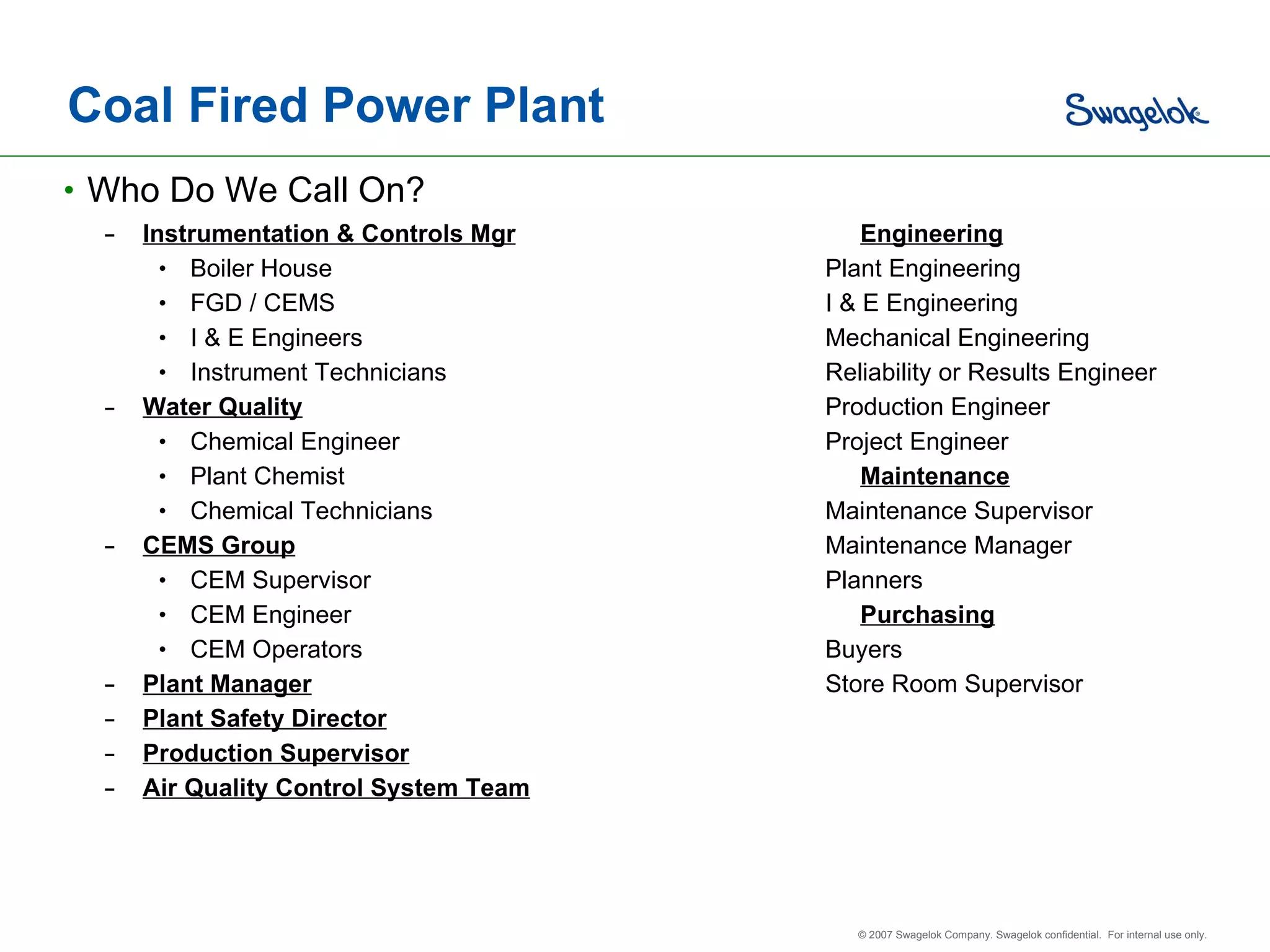
Coal Fired Power Plant Who Do We Call On? Instrumentation & Controls Mgr   Engineering Boiler House Plant Engineering FGD / CEMS I & E Engineering I & E Engineers Mechanical Engineering Instrument Technicians Reliability or Results Engineer Water Quality Production Engineer Chemical Engineer Project Engineer Plant Chemist   Maintenance Chemical Technicians Maintenance Supervisor CEMS Group Maintenance Manager CEM Supervisor Planners CEM Engineer   Purchasing CEM Operators Buyers Plant Manager Store Room Supervisor Plant Safety Director Production Supervisor Air Quality Control System Team
Instrumentation & Controls - Measures: Pressures Temperatures Flow Rate  Levels  Humidity
Instrumentation & Controls -
Instrumentation & Controls
Instrumentation & Controls Instrument Enclosure
Instrument Installation Detail Pressure Transmitter with 2 Valve Manifold - B31.1 Valves
Instrument Installation Detail Pressure Transmitter with 3 Valve Manifold B 31.1 Valves ?
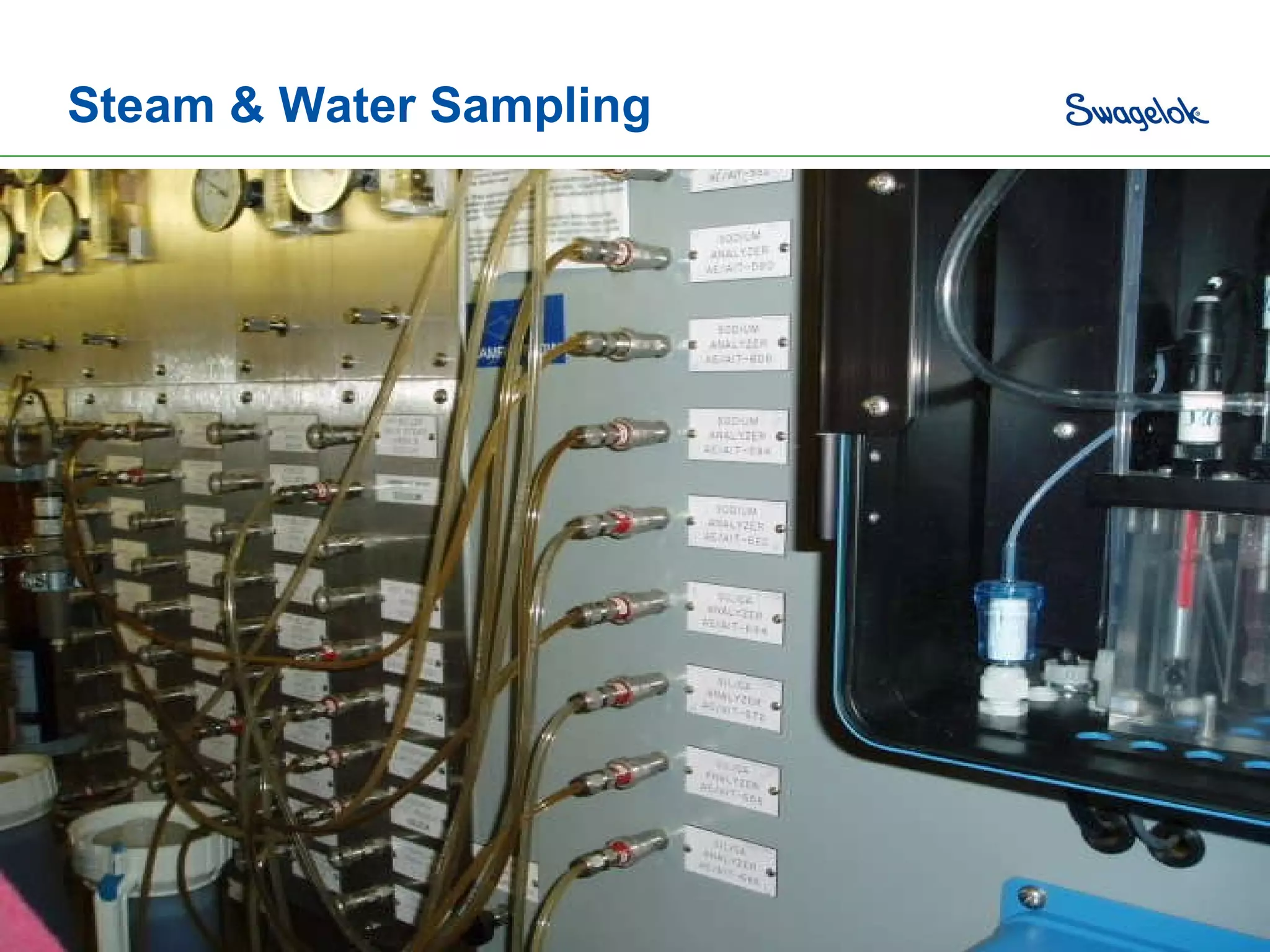
Steam & Water Sampling -
Different Systems in Water Purification Clarifier (sedimentation)  Filters  Softeners  Reverse Osmosis  Demineralizers  Electro dialysis reversal (EDR)
Impurities in Water   Sum of dissolved and suspended solids   Total Solids Cation exchange with hydrogen zeolite.  Chlorination. Deaeration. Corrosion of copper and zinc NH3 Ammonia  Deaeration, sodium sulfite, corrosion inhibitors  Corrosion of waterlines, boilers, exchangers O2 Oxygen Subsidence.  Filtration. Measurement of matter that is unbroken. Deposits in boilers and heat exchangers   Suspended Solids Lime softening and cation exchange. Demineralization. Total dissolved mater.  High concentrations cause problems   Dissolved Solids Aeration. Chlorination. Highly basic ion exchange Corrosion H2S Hydrogen Sulfide Same as Iron Same as Iron Mn Manganese Hot and warm process by magnesium salts, ion exchange, demineralization, RO, or EDR Scale in boiler and cooling water systems SiO2 Silica Demineralization,  Reverse Osmosis, electro dialysis Adds to solids content.  Use to control boiler metal embitterment. NO3 Nitrate Lime and lime soda softening. Acid treatment.  Hydrogen zeolite softening.  Demineralization by ion exchange. Foaming and carryover. Corrosion of condensate lines.  Embrittlement of boiler steel. Bicarbonate, Carbonate and Hydroxide expressed as CaCO3 Alkalinity  Neutralization with alkalis Corrosion Expressed as CaCO3 Free Mineral Acid Coagulation and filtration. Chlorination. Foaming in boilers hinders precipitation methods for iron removal    Colour  Demineralization, R.O., electrodialysis  Adds to solids and adds to corrosive character of water CI Chloride Can be increased by alkalis or decreased by acids Varies as acids or alkalis in water. Natural water is 6-8.   pH Aeration, DA, Neutralization w/ alkalis Corrosion in water, steam, and condensate lines CO2 Carbon Dioxide Softening, Demineralization Scale in exchangers and boilers Calcium & Magnesium  Hardness Coagulation, setting and filtration Cloudy NTU Turbidity Treatment by Difficulties Caused Chemical Formula Component
Scale -  Scale is most active when the impurities are placed in an environment with high temperatures and pressures
Steam & Water Sampling
Steam & Water Sampling Water Sampling
Waters Equipment Co. – Lansdale, PA Back View Front View
Steam & Water Sampling Burkert Switching valves used in Sampling Analysis
Water Sampling Analysis System
Water Sampling System in Lab
Water Sampling System
Steam & Water Sampling
Steam & Water Sampling Sampling System
Steam & Water Sampling
Steam & Water Sampling Sampling System
Steam & Water Sampling
 
Condensate Booster Pumps Condensate Booster Pumps before (all pipe) and after (all Swagelok, no elbows 100% bent tubing).
Water System OEM’s Forbes Marshall – Pune, India Waters Equipment Co. – Lansdale, PA Yokogawa – Bangalore, India Lowe Engineering- West Yorkshire, UK Isa Mannai Technical Services Est – Saudi Arabia Sentry Equipment Co. - Oconomowoc, WI  Jonas, Inc. – Wilmington, DE Eroom Technology – Korea Steam Equipments - Maharashtra, India  Aquatech International Corporation   -Canonsburg, PA Anderson Water Systems – Ontario, Canada Christ Americas – New Britain, CT Ecodyne – Burlington, Ontario, Canada GE Water – Trevose, PA Graver Water Systems – Cranford, NJ Swan Analytical Instruments-Switzerland
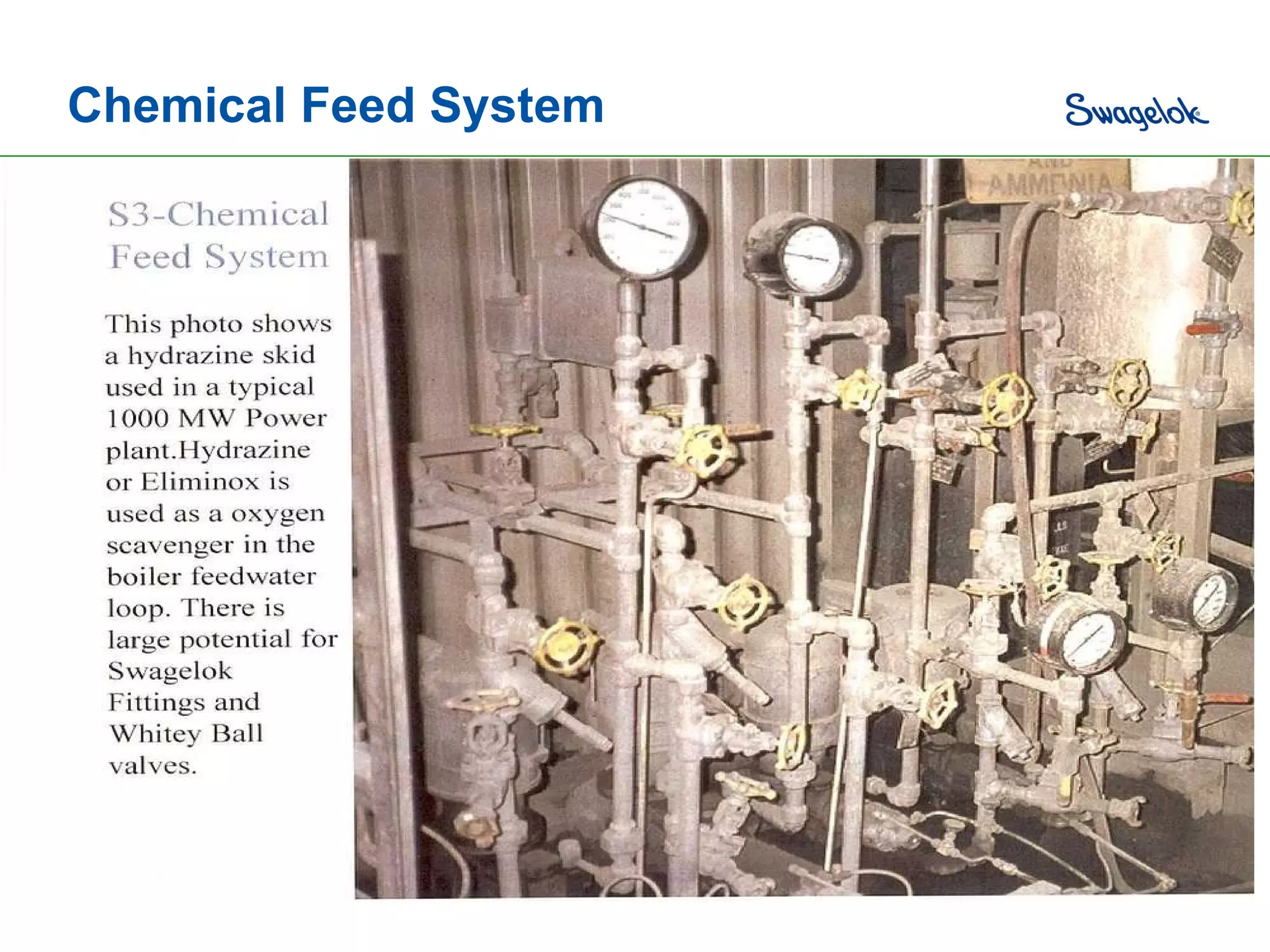
Chemical Feed System
Chemical Feed System Chemicals Used for Boiler Water Treatment Ammonia and sodium hydroxide for PH control Hydrazine for reduction of dissolved oxygen Sodium and phosphates for solids removal Where are they used or Injected in the system Ammonia PH system is normally introduced in the boiler feedwater line at the boiler feed pump discharge. Sodium/phosphate is injected into the boiler drum Water samples are taken at multiple locations in the plant and transported back to the lab normally by ¼” and 3/8” SS tubing. Normal sample locations: 1)Condensate Water 2) Feed Water 3) Boiler Water 4) Steam
Lubrication System - Lubrication  System
Turbine Lube Oil / Small Bore Existing pipe, flanges, etc. Swagelok system, using Bio-Pharm sight glasses with tube extensions.
Electrohydraulic Control System (EHC)
Electrohydraulic Control System System Purpose The function of the EHC system is to supply clean, cool, high pressure hydraulic fluid necessary for turbine valve operation. It is also used for control, trip and overspeed functions. Phosphate ester fluid ( 1600 PSI ) EPRI Document –EHC Tubing/Fittings and Air Piping Application & Maintenance Guide  #1000935
Disadvantages to Conical Seals on EHC Need near perfect tubing alignment Are NOT designed for routine disassembly
Swagelok Customized Fittings (EHC) Nuclear Industry may require some type of action to prevent loosening of the nut due to vibration Some facilities may weld “Lock Tabs”, but this may distort fitting and causes leakage Swagelok can deliver “drill” holes and lock wires
Electrohydraulic Control System (EHC)
Boiler Feedwater System -
Boiler Feedwater System
Compressed Air System -
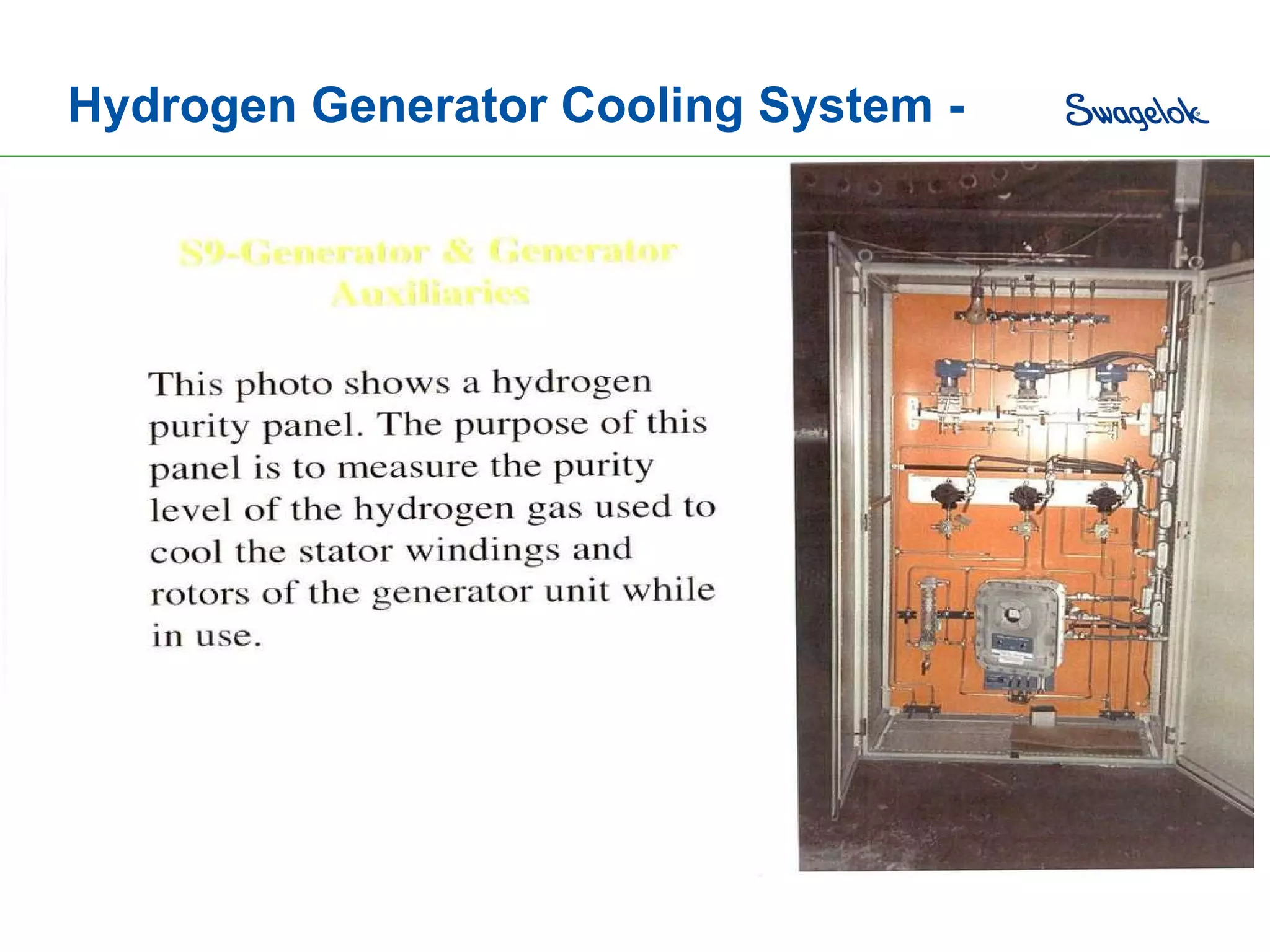
Hydrogen Generator Cooling System
Hydrogen Generator Cooling System -
Hydrogen Generator Cooling System
Continuous Tri-Gas Analyzer for Hydrogen Purity
Praxair Hydrogen System -
Why Hydrogen? Advantages of hydrogen as a cooling medium: High heat transfer coefficient – 40% higher than coefficient of air High thermal conductivity (transmits heat rapidly) Very low density (requires little power to force hydrogen thru the fans. 14 times lighter than air) Reduces dirt and moisture contamination in the unit as a closed gas system and also dampens noise of operation Concerns: Hydrogen is explosive. A mixture of hydrogen and oxygen can be explosive Carbon dioxide is used as an inert buffer gas when hydrogen gas may contact air. IT IS CRITCAL THAT TUBING, FITTINGS, VALVES BE LEAK FREE
Seal Oil System -
Seal Oil System
Circuit Breakers - Circuit breakers use many different types of media to extinguish the electrical arc: Oil Air Blast SF6 – Sulfur hexafluoride Vacuum
SF6 Gas Servicing Cart for Switchgear & Distribution Systems
Windbox Application 840 MW Coal Fired Power Plant 8 Windboxes to all 8 corners Matching the Ratio between air and coal flow  Overfire Air or Fuel Injection System Tubing, Tube Fittings, Valves, Tube Support System, SWS and Training
Windbox Application -  Inside the Wind Box
Windbox Application - Outside of Wind Box
Tubing running from the Windbox to each of the boiler floors
Windbox Application Over 22,000 feet of Welded tubing
Windbox Application
Swagelok Flex Hose
More Flex Hose
Swagelok Manifold
Windbox Application Who to Call on? Engineers Planners I and C Leads Contractors
Combustion Turbines - Simple Cycle  Combined Cycle Integrated Gasification Combined Cycle (IGCC)
GAS TURBINE
Simple Cycle Gas Turbines
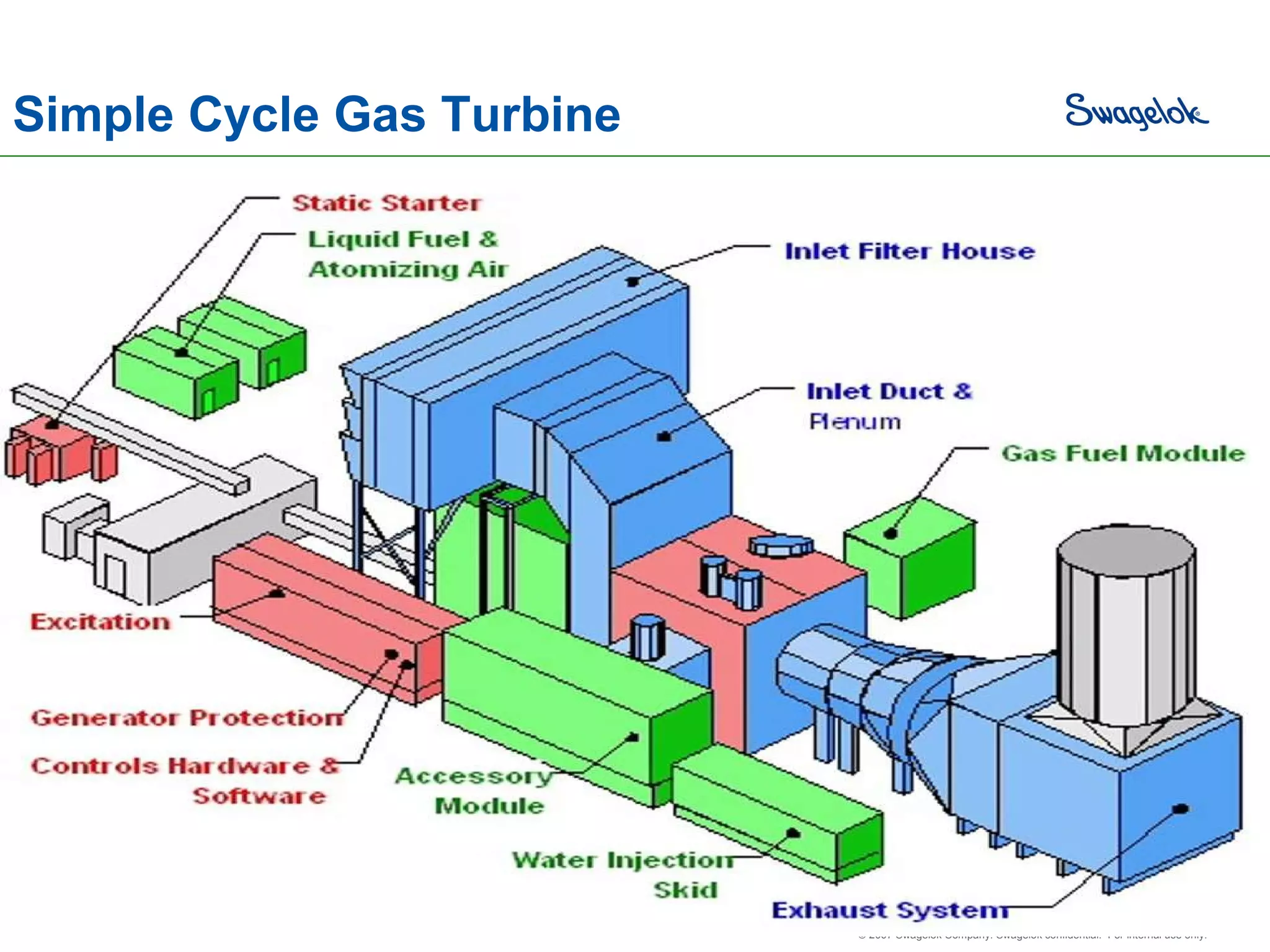
Simple Cycle Gas Turbine Systems Instrumentation Panels “Racks” Fuel Manifold “Ring Header” Lubrication Oil Skid  Hydraulic system LOW NOX Steam Injection System Gas starting system Atomizing Air system Compressor Water Wash system Cooling and Sealing Air system Cooling Water System Fire Protection system Trip Oil systems
Simple Cycle Gas Turbine
Simple Cycle Gas Turbine GE 7FA Gas Turbine
Simple Cycle Gas Turbine GE 7 EA Gas Turbines
Liquid Fuel System Fuel Skid
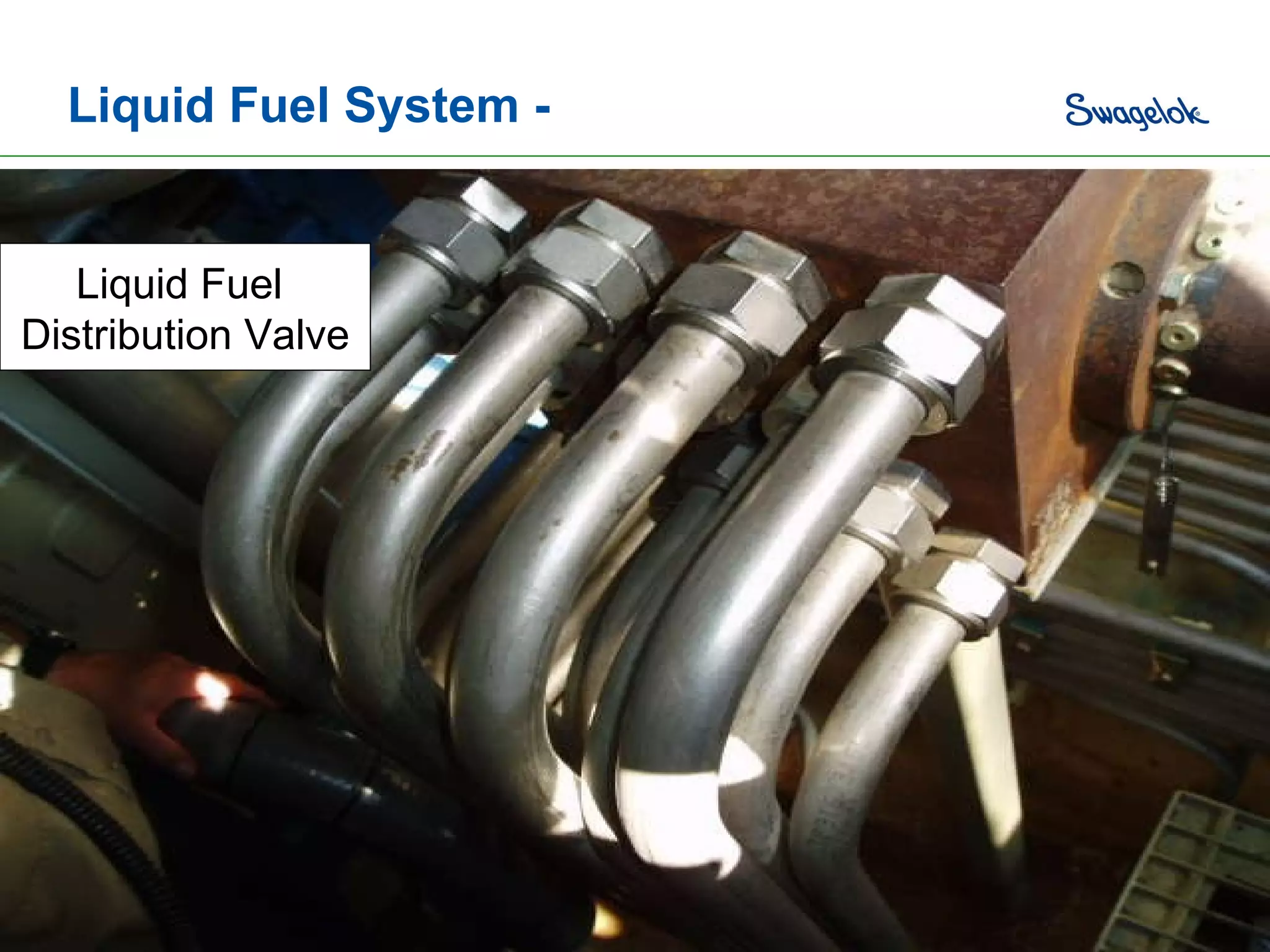
Liquid Fuel System - Liquid Fuel  Distribution Valve
Liquid Fuel System Fuel Lines from Skid to Gas Turbine
Liquid Fuel Systems
Lubrication System - Lubrication Skid
Lubrication System
 
Hydraulic System - Hydraulic Skid
Hydraulic System Hydraulic Skid Note Pressure
Plant Utilities Compressed Air
Turbine Combustion System Combustion Can
Turbine Combustion System
Combined Cycle Gas Turbine
Combined Cycle Gas Turbine 185 MW 110 MW 295 MW
Combined Cycle Gas Turbine Systems Those of a Simple Cycle Gas Turbine Many of a Coal Fired Plant
Combined Cycle Gas Turbine Steam Turbine Heat Recovery Steam Generator Gas Turbine
Combined Cycle Gas Turbine Heat Recovery Steam Generator
Combined Cycle Gas Turbine  Steam Turbine & Generator
Combined Cycle Gas Turbine Steam Blow Down Valves
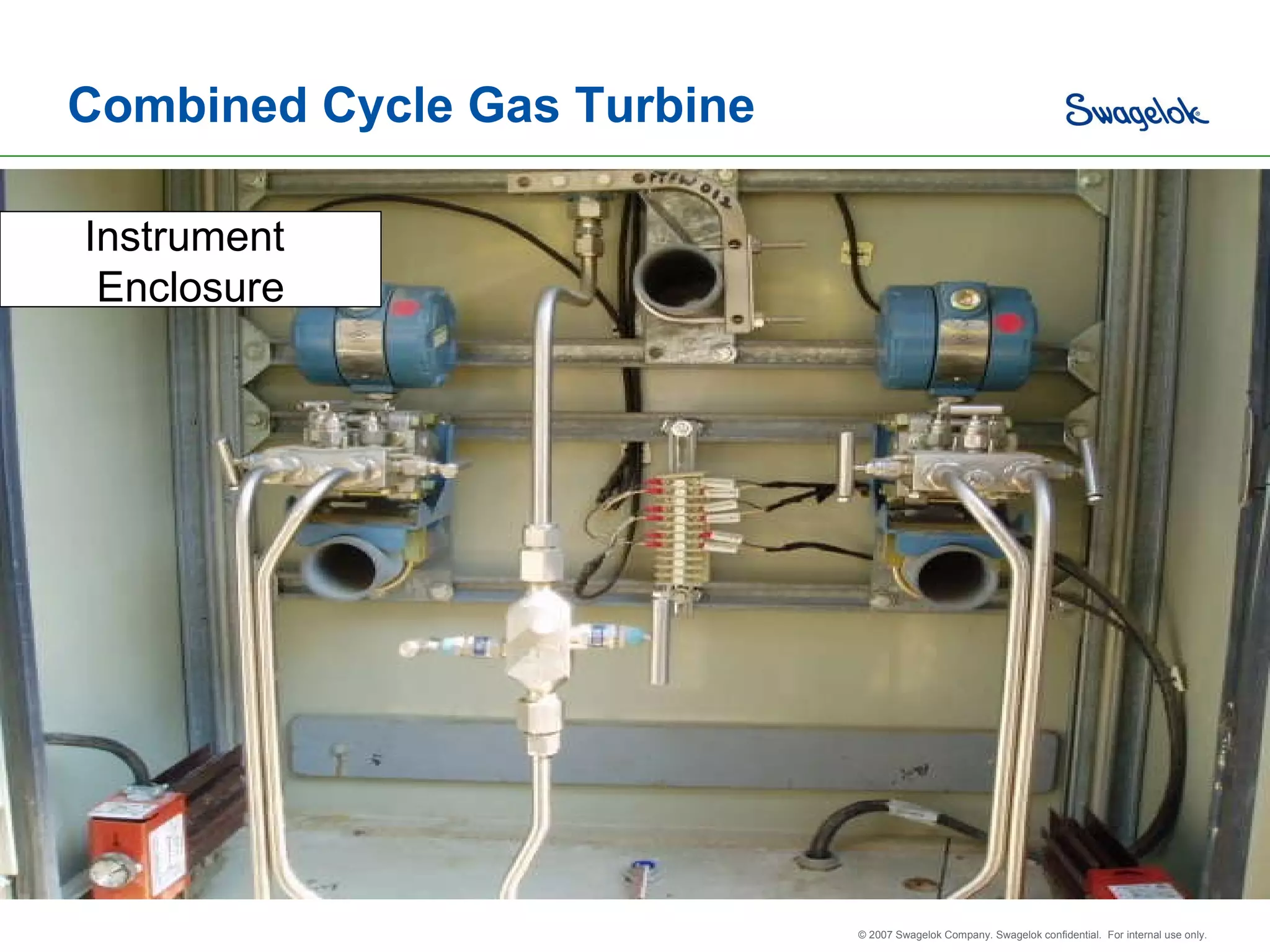
Combined Cycle Gas Turbine Instrument  Enclosure
Combined Cycle Gas Turbine Sampling System
Combined Cycle Gas Turbine
Combined Cycle Gas Turbine Water Sampling System
Combined Cycle Gas Turbine
Chemical Feed System Water Chemical Feed System
Combined Cycle Gas Turbine
IGCC  – Integrated Gasification Combined Cycle
CO2 Sequestration
Drivers in the Power Industry Emissions Controls and Reduction Higher Efficiencies Outages New Energy Demands
Emissions Drivers in US EPA driven mandatory compliance: Clean Air Mercury Rule (CAMR)   U.S. will reduce and regulate mercury from coal fired plants for the first time ever – other countries to follow? Clean Air Interstate Rule (CAIR) Large reductions in SO2 and NOx across 28 eastern states Will drive SCR and scrubber projects
Global Warming and Power “ Coal generated power is the single most largest  contributor to greenhouse gas emissions” The culprits: Sulfur Dioxide (acid rain) Nitrogen Oxide Carbon Monoxide and Dioxide Mercury
Emissions – Global Warming
Emission Rules/Policies/Standards European Commission  http:// ec.europa.eu/environment/index_en.htm Clean Air Interstate Rule (CAIR) California Rule 4306 California Rule 411 Louisiana Title 33 Part III. Chapter 22 MACT for Industrial Boilers & Process Heaters North Carolina Air Regulations Texas Chapter 117 Virginia Air Regulations Clean Air Task Force (CATF)  Environment Canada  www.ec.gc.ca The Asia-Pacific Partnership on Clean Development and Climate  Kyoto Protocol  Clean Development Mechanism (CDM)  Australian Gov’t - CARBON POLLUTION REDUCTION SCHEME
Emissions Issues – Greenhouse Gases What are the Answers? SCR  - Selective Catalytic Reduction SNCR  - Selective Non Catalytic  Reduction Scrubbers –  FGD – Flue Gas Desulphurization
Selective catalytic reduction  ( SCR ) is a means of removing nitrogen oxides, often the most abundant and polluting component in exhaust gases, through a chemical reaction between the exhaust gases, a (reductant) additive, and a catalyst.
SCR Applications: Process Instrumentation Analytical Instrumentation Sampling Systems Small Bore – Supply Feed Lines Lubrication Systems Hydraulic Systems
SCR Addition Dampers
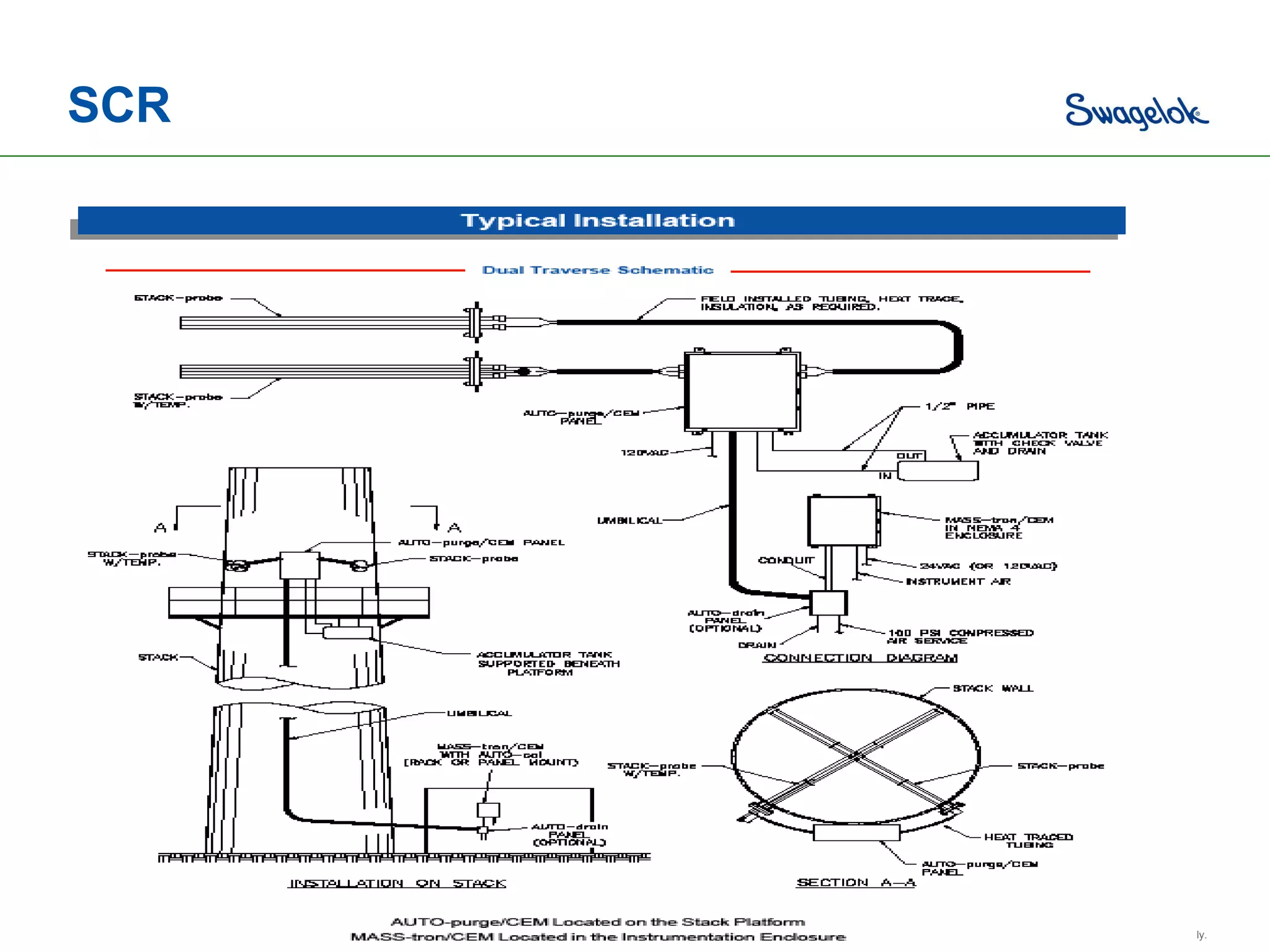
SCR
SCR
SCR
SCR Nox Monitoring
SCR Probes
SCR
SCR
SCR
SCR Ammonia Distribution
SCR SCR Ammonia Control System
SCR Hydraulic Controls for Dampers Swagelok
Selective Non Catalytic Reduction This process involves injecting a nitrogen-containing chemical (ammonia or urea) into the combustion gas stream (in the upper furnace or in the convective section of the boiler) with the chemicals dispersed through nozzles into the flue gases containing NOx,
SNCR  Applications: Urea Injection System Moisture Injection System Control Cabinets Sample Systems
SCNR Control Panels ¾” Tubing Actuated Ball Valves Control Panels for Urea and Water
SCNR Injection Systems Spray Nozzles   Quick Connects
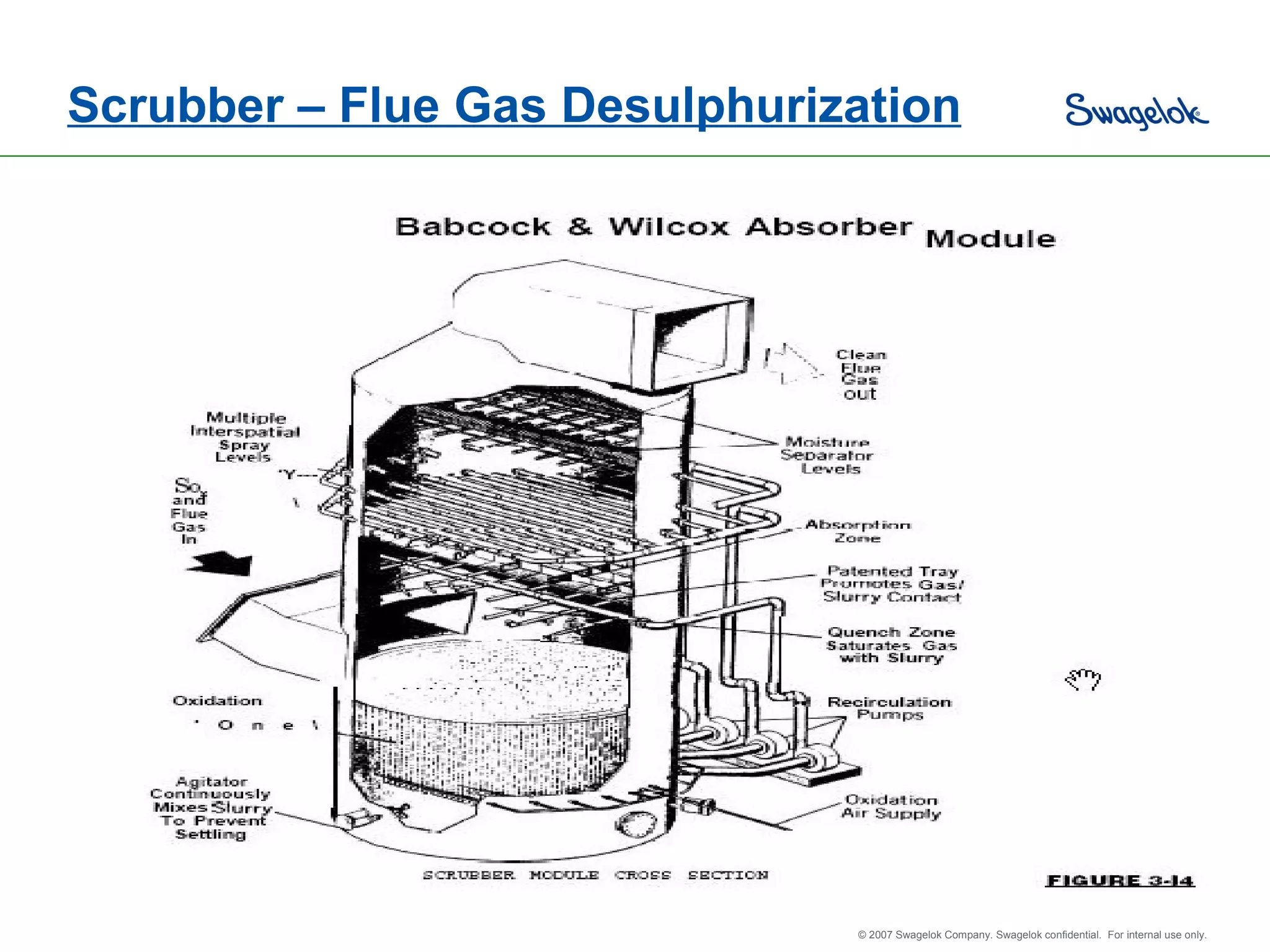
Scrubber – Flue Gas Desulphurization anti-pollution device that uses a liquid or slurry spray to remove acid gases and particulates from municipal waste combustion facility flue gases ;  FGD - Flue Gas Desulphurization
Scrubber – Flue Gas Desulphurization  Applications: Process Instrumentation Analytical Instrumentation Sampling Systems Small Bore – Supply Lines Lubrication Systems Hydraulic Systems
Scrubber – Flue Gas Desulphurization
Scrubber – Flue Gas Desulphurization SCR Scrubber Limestone Preparation & Recovery
Scrubber – Flue Gas Desulphurization Instrument Air Lines-Limestone Preparations
Scrubber – Flue Gas Desulphurization Lubrication for Limestone Ball Mill Crushing System ¾”SS Swagelok System
Scrubber – Flue Gas Desulphurization Lubrication for High Volume Booster Fans
Scrubber – Flue Gas Desulphurization Internal Lubrication Systems
Scrubber – Flue Gas Desulphurization Lubrication Systems
Scrubber – Flue Gas Desulphurization Limestone Vacuum Control System
Scrubber – Flue Gas Desulphurization
Scrubber – Flue Gas Desulphurization Hydraulic Piping for Dampers
Scrubber – Flue Gas Desulphurization Hydraulic Tubing for Dampers
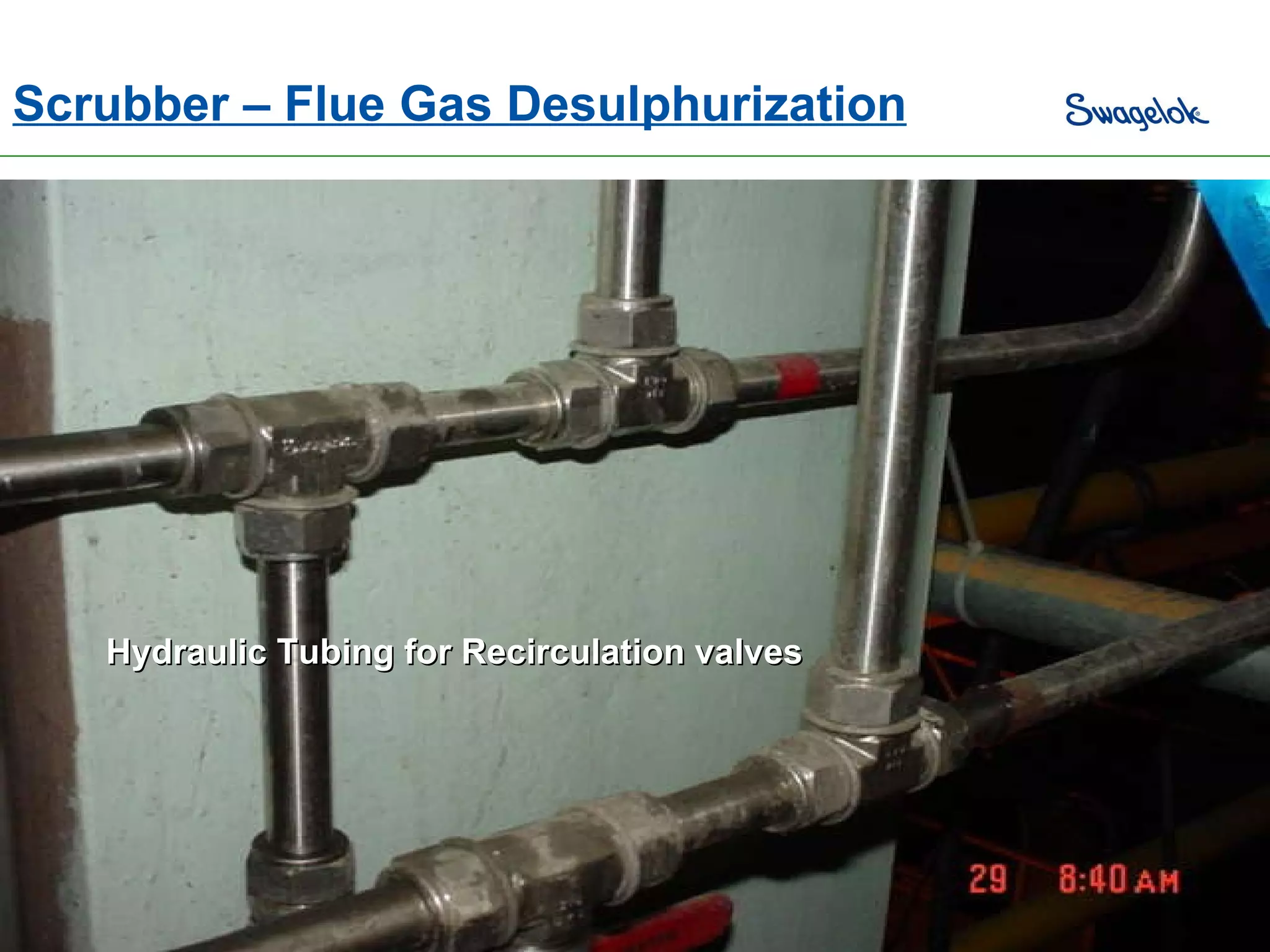
Scrubber – Flue Gas Desulphurization Hydraulic Piping for Recirculation Valves
Scrubber – Flue Gas Desulphurization Hydraulic Tubing for Recirculation valves
CEMS Main Air Header ¾” SS Inside CEMS Shelter
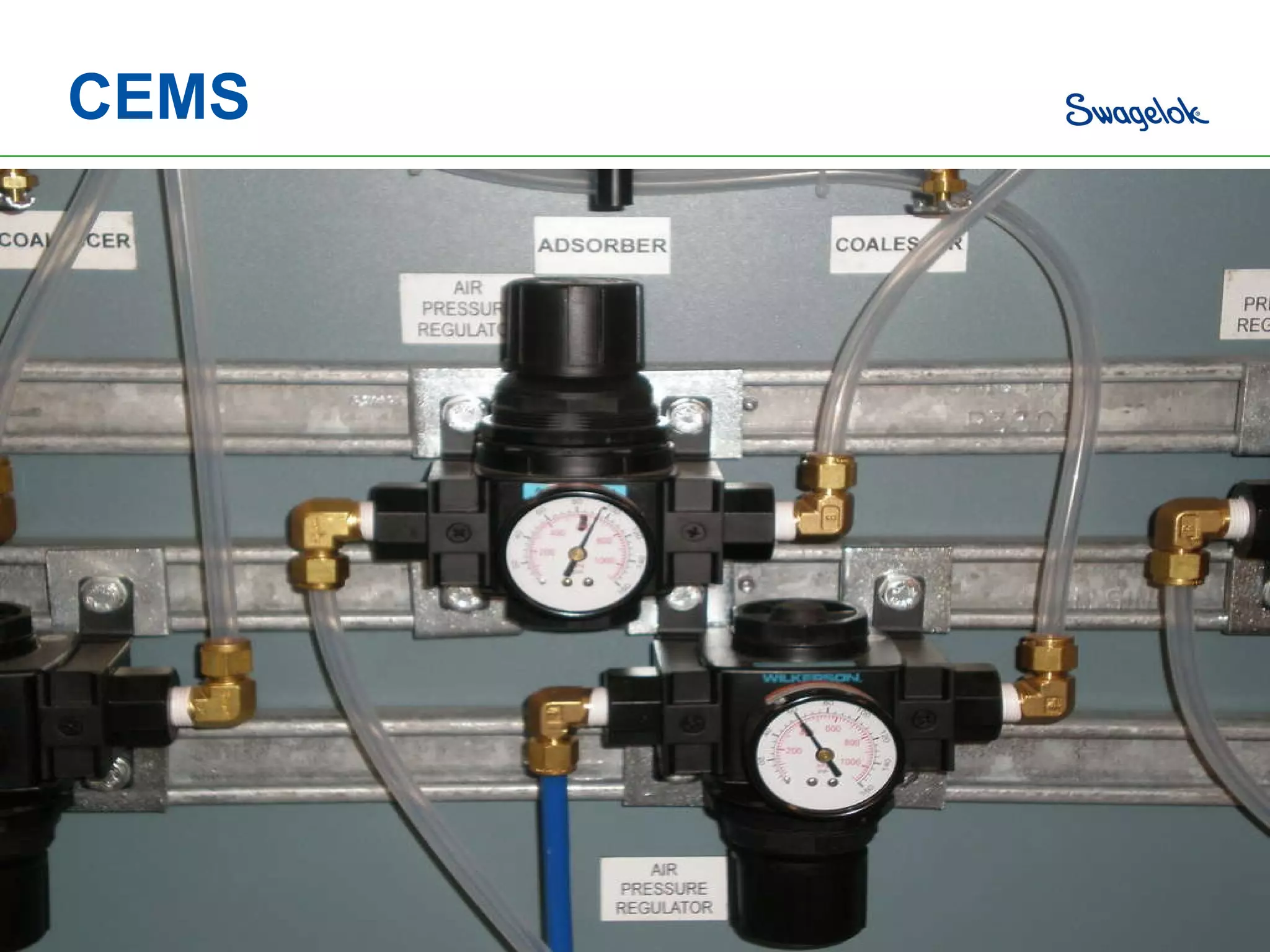
CEMS Air Filtered & Dried 110 PSI
CEMS
CEMS Umbilical cord entering cabinet PFA Tubing-1/4” & 3/8”
CEMS Umbilical Cords entering in CEMS shelter from CEMS platform
CEMS
CEMS Note Umbilical Temp 266 F
CEMS Umbilical entering gas flow monitoring cabinet
CEMS Mercury Probe Box Restek Coated  Swagelok fittings 800 C Temp www.restekcoatings.com
CEMS SO2, NOX, CO2 Box Limited application  Compared to Mercury Box
Emissions Projects Summary What’s it Worth  $ SNCR Project $ 90,000 Scrubber Project $147,000 Scrubber Project $235,000 Scrubber + SCR $354,000 Scrubber Project $200,000
Drivers in the Power Industry Efficiency Demands Why so Important to improve efficiencies: Sub-critical Power Plant 36-38% Supercritical Power Plant 40-45% Ultra critical Power Plant 45-48% Nuclear Plant 34-37% Simple Cycle Gas Turbine Plant 43-45% Combined Cycle Gas Turbine Plant 50-55%
Efficiency Demands How can we support? Demand for Products – High pressure & Temperature Reliable Products – Less Down Time Energy Audits  – Eliminate Waste
What does this mean to Swagelok? More critical and demanding applications – Swagelok strength Applications and processes are redefined offering new opportunities Increased processing and monitoring of greenhouse gases and pollutants increases Swagelok playing field Helps to re-establish Swagelok value proposition in an industry that had been viewed as having been commoditized
Drivers in the Power Industry Outages
Outages – What is our Role? Support with VMI Support with Technical Issues Proactive selling – identify other maintenance Emergency deliveries - after hours availability
 
Drivers in the Power Industry Increase In Energy Demand
Increase In Energy Demand
Potential Swagelok Power Spend $11.2 Billion  6,085 $2.2 Trillion  Total $  4,213,317,990.00  3,807 $  842,663,598,000.00  North America $  468,058.00  194 $  93,611,700.00  South America $  356,260,000.00  87 $  71,252,000,000.00  Middle East $  968,675,931.00  416 $  229,697,944,607.00  Europe $  38,595.00  42 $  7,719,000.00  Middle America $  4,916,839,750.00  1,318 $  983,367,950,000.00  Asia $  131,787,750.00  95 $  26,357,550,000.00  Oceania $  626,265,000.00  126 $  125,253,000,000.00  Africa Swagelok Spend @ .005  # Projects Power Investment   
Central Asia Construction Spend Afghanistan, Bangladesh, Bhutan, India,  Iran, Kazakhstan, Kyrgyzstan, Maldives, Nepal, Pakistan, Sri Lanka, Tajikistan, Turkmenistan, Uzbekistan $374,855,000,000   445   0 0 Tidal $360,000,000 2 Solar $92,982,000,000 155 Hydro $1,307,000,000 11 Wind $750,000,000 3 Biomass $10,253,000,000 21 Natural Gas $904,000,000 4 Oil $214,139,000,000 200 Coal $14,670,000,000 23 Combined Cycle $33,225,000,000 14 Nuclear TIV # of Projects Project Type
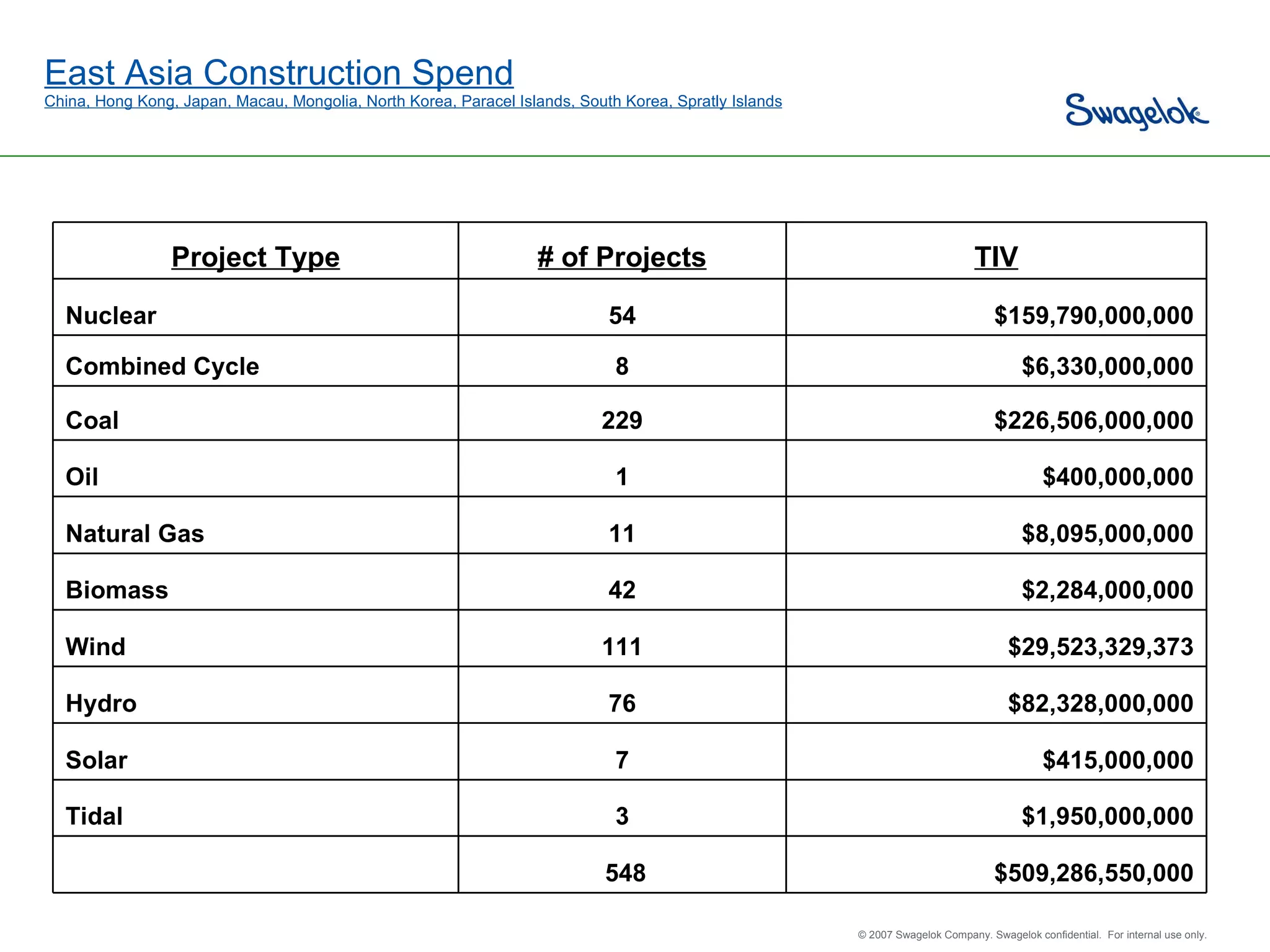
East Asia Construction Spend China, Hong Kong, Japan, Macau, Mongolia, North Korea, Paracel Islands, South Korea, Spratly Islands $509,286,550,000   548   $1,950,000,000 3 Tidal $415,000,000 7 Solar $82,328,000,000 76 Hydro $29,523,329,373 111 Wind $2,284,000,000 42 Biomass $8,095,000,000 11 Natural Gas $400,000,000 1 Oil $226,506,000,000 229 Coal $6,330,000,000 8 Combined Cycle $159,790,000,000 54 Nuclear TIV # of Projects Project Type
Southeast Asia Construction Spend Brunei, Cambodia, Indonesia, Laos, Malaysia, Myanmar, Philippines, Singapore, Thailand, Vietnam $122,630,800,000   220   $1,380,000,000 9 Geothermal 0 0 Solar $31,709,800,000 90 Hydro $573,000,000 7 Wind $480,000,000 1 Biomass $4,166,000,000 11 Natural Gas 0 0 Oil $60,617,000,000 76 Coal $5,690,000,000 13 Combined Cycle $15,050,000,000 5 Nuclear TIV # of Projects Project Type
Central Asia Nuclear (India) KOTA RAJASTHAN 220MW NUCLEAR POWER STATION UNIT #5 ADDITION KOTA RAJASTHAN 220MW NUCLEAR POWER STATION UNIT #6 ADDITION KUNDIAN CHASHMA G-R 300MW NUCLEAR (PWR) UNIT II ADDITION KARWAR KAIGA G-R 220MW NUCLEAR (PHWR) UNIT #4 ADDITION KALPAKKAM 500MW (PFBR) NUCLEAR STATION UNIT #3 ADDITION PABNA ROOPPUR G-R 600MW NUCLEAR POWER STATION BUSHEHR 1000MW NUCLEAR UNIT #1 G-R POWER STATION KUNDIAN CHASHMA III & IV 600MW NUCLEAR POWER STATION ADDITION PUNJAB CHANDIGRAH 1000MW G-R NUCLEAR POWER PLANT KAKRAPAR 1400MW NUCLEAR (PHWR) UNITS 3 & 4 ADDITION TIRUNELVELI KUDANKULAM G-R 2000MW NUCLEAR (PWR) POWER STATION TIRUNEVELI NUCLEAR 2,000MW KUDANKULAM PHASE II NUCLEAR STATION HARYANNA NUCLEAR 2,800MW FATEHABAD G-R POWER STATION RAJAPUR NUCLEAR 3300MW GRASSROOT JAITAPUR NUCLEAR STATION
East Asia Nuclear BAILONG I G-R 2000MW NUCLEAR POWER STATION YANGJIANG G-R PHASE I 2000MW NUCLEAR STATION LIANYUNGANG XUYU I G-R 2000MW NUCLEAR POWER STATION XIANNING 2,000MW HUBEI NUCLEAR PHASE I G-R POWER STATION TAISHAN I GRASSROOT 3500MW NUCLEAR POWER STATION SANMEN PHASE I UNIT #2 1100MW NUCLEAR POWER STATION ADD XIANNING DAFAN I G-R 2000MW NUCLEAR (PWR) POWER STATION HANGZHOU QINSHAN NUCLEAR PLANT 2,000MW IV #6/#7 ADDITION LONGYOU NUCLEAR 2,000MW ZHEXI G-R PHASE I POWER STATION ANHUI 2000MW WUHU NUCLEAR PHASE I G-R POWER STATION FUJIAN 2,000MW SANMING NUCLEAR G-R POWER STATION JIUJIANG NUCLEAR 2,500MW PENGZE PHASE I G-R NUCLEAR STATION LIANYUNGANG NUCLEAR TIANWAN 2,000MW PHASE III ADDITION YIYANG CITY G-R 4000 NUCLEAR POWER PLANT CHIZHOU JIYANG G-R 4000MW NUCLEAR (PWR) POWER STATION KAGOSHIMA NUCLEAR SENDAI PLANT 1,950MW PHASE II EXPANSION YIYANG NUCLEAR 2,000MW TAOHUAJIANG PHASE I G-R STATION KUNGLIAO G-R 2700MW LUNGMEN (ABWR) NUCLEAR STATION HONGYANHE PHASE I GRASSROOT 2000MW NUCLEAR POWER PLANT WUHU BAMAOSHAN PHASE I G-R 2000MW NUCLEAR POWER STATION
East Asia Nuclear cont’d. TAISHAN YAOGU II 2000MW NUCLEAR POWER PLANT ADDITION SHENZHEN LING'AO G-R PHASE II 2000MW NUCLEAR POWER STATION NINGDE II 2000MW NUCLEAR (PWR) POWER STATION ADDITION ULSAN SHIN-KORI G-R 2000MW NUCLEAR POWER STATION HUI'AN II GRASSROOT 2000MW NUCLEAR POWER STATION EXPANSION YANGJIANG G-R PHASE III 2000MW NUCLEAR STATION HAIYONG SHANDONG PHASE 2 2000MW NUCLEAR (LWR) ADDITION LUFENG I G-R 2000MW NUCLEAR (PWR) POWER PLANT YUEYANG XIAOMOSHAN PHASE I 2000MW NUCLEAR POWER STATION HAIYANG SHANDONG G-R 2000MW LWR NUCLEAR POWER PLANT HONGYANHE PHASE II 2000MW NUCLEAR POWER STATION ADDITION HENAN NUCLEAR 2,000MW NANYANG G-R POWER STATION DATANG HUAYIN HUNAN I G-R 2000MW NUCLEAR POWER STATION HUI'AN G-R 2000MW NUCLEAR POWER STATION FUJIAN NUCLEAR G-R 2000MW FUQING POWER STATION QINSHAN II 1300MW NUCLEAR POWER STATION EXPANSION NINGDE I G-R 2000MW NUCLEAR (PWR) POWER STATION SANMEN G-R PHASE I 1000MW NUCLEAR POWER STATION TIANWAN II 2000MW NUCLEAR UNITS 3 & 4 ADDITION YANGJIANG G-R PHASE II 2000MW NUCLEAR POWER STATION
East Asia Nuclear cont’d. WEIHAI G-R 195MW SHIDAO BAY NUCLEAR POWER STATION XIACUN RUSHAN UNIT #2 600MW (PWR) NUCLEAR ADDITION XIACUN RUSHAN G-R 600MW NUCLEAR (PWR) POWER STATION CHONGQING G-R PHASE I 900MW (PWR) NUCLEAR POWER STATION QINSHAN V FANGJIASHAN 700MW (PHWR) UNIT 8 ADDITION SHAOGUAN G-R 1000MW NUCLEAR POWER STATION MUTSU HIGASHIDORI G-R UNIT #1 1380MW ABWR NUCLEAR POWER STATION TSURUGA G-R 1538MW (APWR) UNIT #4 NUCLEAR STATION ADDITION AOMORI G-R NUCLEAR 1,383MW OHMA NUCLEAR POWER STATION TOMARI PHASE III 912MW (LWR) NUCLEAR ADDITION FUKUSHIMA DAIICHI 1380MW (BWR) NUCLEAR UNIT #7 ADDITION TSURUGA G-R 1538MW UNIT #3 (APWR) NUCLEAR STATION ADDITION KYONGJU WOLSONG 950MW UNIT #5 NUCLEAR STATION ADDITION KASHIMA SHIMANE 1373MW NUCLEAR UNIT III ADDITION
Southeast Asia Nuclear LEMAHABANG JAVA-1 MURIA G-R 1000MW NUCLEAR (PWR) POWER STATION NINH THUAN G-R 2000MW NUCLEAR POWER STATION PHAN RANG-NINH PHUOC G-R 2000MW NUCLEAR (VVER-PWR) STATION MOUNT MURIA I G-R 2000MW NUCLEAR POWER STATION PRAN BURI G-R 4000MW THAILAND NUCLEAR POWER STATION
Construction Picture Thru 2017 Construction Sales / MW Traditional Coal & Oil Fired Plants   $500 / MW @ 1000MW = $500,000 Combined Cycle Plants $1,000 / MW @ 400 MW = $400,000 Simple Cycle Plants $100 / MW @ 85 MW = $8,500 Nuclear Plants $1,500 / MW @ 1,600 MW = $2,400,000
Questions?

C:\fakepath\fossil power basics

  • 1.
  • 2.
    Topics to DiscussFossil Power Plants Coal & Oil Fired Gas Turbine Simple Cycle Combined Cycle Integrated Gasification Combined Cycle Current Drivers of the Fossil Power Industry Emission Issues Efficiency Issues Scheduled Power Outages New Energy Demands
  • 3.
    Fossil Fuel PlantTypes Traditional Coal & Oil Fired Plants Gas Turbine Simple Cycle Gas Turbine Combined Cycle Integrated Gasification Combined Cycle (IGCC)
  • 4.
  • 5.
  • 6.
    Turns Motion intoElectricity
  • 7.
  • 8.
  • 9.
  • 10.
  • 11.
  • 12.
  • 13.
    Creating water pressureCreates Dry Saturated Vapor - Steam Dry Saturated Vapor Expands Through the Turbine Due to loss of Temperature Condensation occurs and then accumulated in the Condenser
  • 14.
  • 15.
  • 16.
  • 17.
    Coal Fired PowerPlant Systems that utilize Swagelok Products & Services Instrumentation & Controls Steam / Water Sampling Chemical Feed Systems Lube Oil Systems Hydraulic Systems Boiler Feed Water Systems Compressed Air Systems Hydrogen Service – Generator Cooling Seal Oil System Air Quality Monitoring Systems Station Single Line System, Circuit Breakers Fuel Injection System – Wind Box
  • 18.
  • 19.
    Coal Fired PowerPlant Who Do We Call On? Instrumentation & Controls Mgr Engineering Boiler House Plant Engineering FGD / CEMS I & E Engineering I & E Engineers Mechanical Engineering Instrument Technicians Reliability or Results Engineer Water Quality Production Engineer Chemical Engineer Project Engineer Plant Chemist Maintenance Chemical Technicians Maintenance Supervisor CEMS Group Maintenance Manager CEM Supervisor Planners CEM Engineer Purchasing CEM Operators Buyers Plant Manager Store Room Supervisor Plant Safety Director Production Supervisor Air Quality Control System Team
  • 20.
    Instrumentation & Controls- Measures: Pressures Temperatures Flow Rate Levels Humidity
  • 21.
  • 22.
  • 23.
  • 24.
  • 25.
  • 26.
    Instrumentation & ControlsInstrument Enclosure
  • 27.
    Instrumentation & ControlsInstrument Enclosure
  • 28.
    Instrument Installation DetailPressure Transmitter with 2 Valve Manifold - B31.1 Valves
  • 29.
    Instrument Installation DetailPressure Transmitter with 3 Valve Manifold B 31.1 Valves ?
  • 30.
    Steam & WaterSampling -
  • 31.
    Different Systems inWater Purification Clarifier (sedimentation) Filters Softeners Reverse Osmosis Demineralizers Electro dialysis reversal (EDR)
  • 32.
    Impurities in Water  Sum of dissolved and suspended solids   Total Solids Cation exchange with hydrogen zeolite. Chlorination. Deaeration. Corrosion of copper and zinc NH3 Ammonia Deaeration, sodium sulfite, corrosion inhibitors Corrosion of waterlines, boilers, exchangers O2 Oxygen Subsidence. Filtration. Measurement of matter that is unbroken. Deposits in boilers and heat exchangers   Suspended Solids Lime softening and cation exchange. Demineralization. Total dissolved mater. High concentrations cause problems   Dissolved Solids Aeration. Chlorination. Highly basic ion exchange Corrosion H2S Hydrogen Sulfide Same as Iron Same as Iron Mn Manganese Hot and warm process by magnesium salts, ion exchange, demineralization, RO, or EDR Scale in boiler and cooling water systems SiO2 Silica Demineralization, Reverse Osmosis, electro dialysis Adds to solids content. Use to control boiler metal embitterment. NO3 Nitrate Lime and lime soda softening. Acid treatment. Hydrogen zeolite softening. Demineralization by ion exchange. Foaming and carryover. Corrosion of condensate lines. Embrittlement of boiler steel. Bicarbonate, Carbonate and Hydroxide expressed as CaCO3 Alkalinity Neutralization with alkalis Corrosion Expressed as CaCO3 Free Mineral Acid Coagulation and filtration. Chlorination. Foaming in boilers hinders precipitation methods for iron removal   Colour Demineralization, R.O., electrodialysis Adds to solids and adds to corrosive character of water CI Chloride Can be increased by alkalis or decreased by acids Varies as acids or alkalis in water. Natural water is 6-8.   pH Aeration, DA, Neutralization w/ alkalis Corrosion in water, steam, and condensate lines CO2 Carbon Dioxide Softening, Demineralization Scale in exchangers and boilers Calcium & Magnesium Hardness Coagulation, setting and filtration Cloudy NTU Turbidity Treatment by Difficulties Caused Chemical Formula Component
  • 33.
    Scale - Scale is most active when the impurities are placed in an environment with high temperatures and pressures
  • 34.
    Steam & WaterSampling
  • 35.
    Steam & WaterSampling Water Sampling
  • 36.
    Waters Equipment Co.– Lansdale, PA Back View Front View
  • 37.
    Steam & WaterSampling Burkert Switching valves used in Sampling Analysis
  • 38.
  • 39.
  • 40.
  • 41.
    Steam & WaterSampling
  • 42.
    Steam & WaterSampling Sampling System
  • 43.
    Steam & WaterSampling
  • 44.
    Steam & WaterSampling
  • 45.
    Steam & WaterSampling Sampling System
  • 46.
    Steam & WaterSampling
  • 47.
    Steam & WaterSampling
  • 48.
  • 49.
    Condensate Booster PumpsCondensate Booster Pumps before (all pipe) and after (all Swagelok, no elbows 100% bent tubing).
  • 50.
    Water System OEM’sForbes Marshall – Pune, India Waters Equipment Co. – Lansdale, PA Yokogawa – Bangalore, India Lowe Engineering- West Yorkshire, UK Isa Mannai Technical Services Est – Saudi Arabia Sentry Equipment Co. - Oconomowoc, WI Jonas, Inc. – Wilmington, DE Eroom Technology – Korea Steam Equipments - Maharashtra, India Aquatech International Corporation -Canonsburg, PA Anderson Water Systems – Ontario, Canada Christ Americas – New Britain, CT Ecodyne – Burlington, Ontario, Canada GE Water – Trevose, PA Graver Water Systems – Cranford, NJ Swan Analytical Instruments-Switzerland
  • 51.
  • 52.
    Chemical Feed SystemChemicals Used for Boiler Water Treatment Ammonia and sodium hydroxide for PH control Hydrazine for reduction of dissolved oxygen Sodium and phosphates for solids removal Where are they used or Injected in the system Ammonia PH system is normally introduced in the boiler feedwater line at the boiler feed pump discharge. Sodium/phosphate is injected into the boiler drum Water samples are taken at multiple locations in the plant and transported back to the lab normally by ¼” and 3/8” SS tubing. Normal sample locations: 1)Condensate Water 2) Feed Water 3) Boiler Water 4) Steam
  • 53.
    Lubrication System -Lubrication System
  • 54.
    Lubrication System -Lubrication System
  • 55.
    Turbine Lube Oil/ Small Bore Existing pipe, flanges, etc. Swagelok system, using Bio-Pharm sight glasses with tube extensions.
  • 56.
  • 57.
    Electrohydraulic Control SystemSystem Purpose The function of the EHC system is to supply clean, cool, high pressure hydraulic fluid necessary for turbine valve operation. It is also used for control, trip and overspeed functions. Phosphate ester fluid ( 1600 PSI ) EPRI Document –EHC Tubing/Fittings and Air Piping Application & Maintenance Guide #1000935
  • 58.
    Disadvantages to ConicalSeals on EHC Need near perfect tubing alignment Are NOT designed for routine disassembly
  • 59.
    Swagelok Customized Fittings(EHC) Nuclear Industry may require some type of action to prevent loosening of the nut due to vibration Some facilities may weld “Lock Tabs”, but this may distort fitting and causes leakage Swagelok can deliver “drill” holes and lock wires
  • 60.
  • 61.
  • 62.
  • 63.
  • 64.
  • 65.
  • 66.
  • 67.
  • 68.
    Continuous Tri-Gas Analyzerfor Hydrogen Purity
  • 69.
    Continuous Tri-Gas Analyzerfor Hydrogen Purity
  • 70.
  • 71.
    Why Hydrogen? Advantagesof hydrogen as a cooling medium: High heat transfer coefficient – 40% higher than coefficient of air High thermal conductivity (transmits heat rapidly) Very low density (requires little power to force hydrogen thru the fans. 14 times lighter than air) Reduces dirt and moisture contamination in the unit as a closed gas system and also dampens noise of operation Concerns: Hydrogen is explosive. A mixture of hydrogen and oxygen can be explosive Carbon dioxide is used as an inert buffer gas when hydrogen gas may contact air. IT IS CRITCAL THAT TUBING, FITTINGS, VALVES BE LEAK FREE
  • 72.
  • 73.
  • 74.
    Circuit Breakers -Circuit breakers use many different types of media to extinguish the electrical arc: Oil Air Blast SF6 – Sulfur hexafluoride Vacuum
  • 75.
    SF6 Gas ServicingCart for Switchgear & Distribution Systems
  • 76.
    SF6 Gas ServicingCart for Switchgear & Distribution Systems
  • 77.
    Windbox Application 840MW Coal Fired Power Plant 8 Windboxes to all 8 corners Matching the Ratio between air and coal flow Overfire Air or Fuel Injection System Tubing, Tube Fittings, Valves, Tube Support System, SWS and Training
  • 78.
    Windbox Application - Inside the Wind Box
  • 79.
    Windbox Application -Outside of Wind Box
  • 80.
    Tubing running fromthe Windbox to each of the boiler floors
  • 81.
    Tubing running fromthe Windbox to each of the boiler floors
  • 82.
    Windbox Application Over22,000 feet of Welded tubing
  • 83.
  • 84.
  • 85.
  • 86.
  • 87.
    Windbox Application Whoto Call on? Engineers Planners I and C Leads Contractors
  • 88.
    Combustion Turbines -Simple Cycle Combined Cycle Integrated Gasification Combined Cycle (IGCC)
  • 89.
  • 90.
  • 91.
    Simple Cycle GasTurbine Systems Instrumentation Panels “Racks” Fuel Manifold “Ring Header” Lubrication Oil Skid Hydraulic system LOW NOX Steam Injection System Gas starting system Atomizing Air system Compressor Water Wash system Cooling and Sealing Air system Cooling Water System Fire Protection system Trip Oil systems
  • 92.
  • 93.
    Simple Cycle GasTurbine GE 7FA Gas Turbine
  • 94.
    Simple Cycle GasTurbine GE 7 EA Gas Turbines
  • 95.
  • 96.
    Liquid Fuel System- Liquid Fuel Distribution Valve
  • 97.
    Liquid Fuel SystemFuel Lines from Skid to Gas Turbine
  • 98.
  • 99.
    Lubrication System -Lubrication Skid
  • 100.
  • 101.
  • 102.
    Hydraulic System -Hydraulic Skid
  • 103.
    Hydraulic System HydraulicSkid Note Pressure
  • 104.
  • 105.
  • 106.
  • 107.
  • 108.
  • 109.
    Combined Cycle GasTurbine 185 MW 110 MW 295 MW
  • 110.
    Combined Cycle GasTurbine Systems Those of a Simple Cycle Gas Turbine Many of a Coal Fired Plant
  • 111.
    Combined Cycle GasTurbine Steam Turbine Heat Recovery Steam Generator Gas Turbine
  • 112.
    Combined Cycle GasTurbine Heat Recovery Steam Generator
  • 113.
    Combined Cycle GasTurbine Steam Turbine & Generator
  • 114.
    Combined Cycle GasTurbine Steam Blow Down Valves
  • 115.
    Combined Cycle GasTurbine Instrument Enclosure
  • 116.
    Combined Cycle GasTurbine Sampling System
  • 117.
  • 118.
    Combined Cycle GasTurbine Water Sampling System
  • 119.
  • 120.
  • 121.
  • 122.
    Chemical Feed SystemWater Chemical Feed System
  • 123.
  • 124.
    IGCC –Integrated Gasification Combined Cycle
  • 125.
  • 126.
    Drivers in thePower Industry Emissions Controls and Reduction Higher Efficiencies Outages New Energy Demands
  • 127.
    Emissions Drivers inUS EPA driven mandatory compliance: Clean Air Mercury Rule (CAMR) U.S. will reduce and regulate mercury from coal fired plants for the first time ever – other countries to follow? Clean Air Interstate Rule (CAIR) Large reductions in SO2 and NOx across 28 eastern states Will drive SCR and scrubber projects
  • 128.
    Global Warming andPower “ Coal generated power is the single most largest contributor to greenhouse gas emissions” The culprits: Sulfur Dioxide (acid rain) Nitrogen Oxide Carbon Monoxide and Dioxide Mercury
  • 129.
  • 130.
    Emission Rules/Policies/Standards EuropeanCommission http:// ec.europa.eu/environment/index_en.htm Clean Air Interstate Rule (CAIR) California Rule 4306 California Rule 411 Louisiana Title 33 Part III. Chapter 22 MACT for Industrial Boilers & Process Heaters North Carolina Air Regulations Texas Chapter 117 Virginia Air Regulations Clean Air Task Force (CATF) Environment Canada www.ec.gc.ca The Asia-Pacific Partnership on Clean Development and Climate Kyoto Protocol Clean Development Mechanism (CDM) Australian Gov’t - CARBON POLLUTION REDUCTION SCHEME
  • 131.
    Emissions Issues –Greenhouse Gases What are the Answers? SCR - Selective Catalytic Reduction SNCR - Selective Non Catalytic Reduction Scrubbers – FGD – Flue Gas Desulphurization
  • 132.
    Selective catalytic reduction ( SCR ) is a means of removing nitrogen oxides, often the most abundant and polluting component in exhaust gases, through a chemical reaction between the exhaust gases, a (reductant) additive, and a catalyst.
  • 133.
    SCR Applications: ProcessInstrumentation Analytical Instrumentation Sampling Systems Small Bore – Supply Feed Lines Lubrication Systems Hydraulic Systems
  • 134.
  • 135.
  • 136.
  • 137.
  • 138.
  • 139.
  • 140.
  • 141.
  • 142.
  • 143.
  • 144.
    SCR SCR AmmoniaControl System
  • 145.
    SCR Hydraulic Controlsfor Dampers Swagelok
  • 146.
    Selective Non CatalyticReduction This process involves injecting a nitrogen-containing chemical (ammonia or urea) into the combustion gas stream (in the upper furnace or in the convective section of the boiler) with the chemicals dispersed through nozzles into the flue gases containing NOx,
  • 147.
    SNCR Applications:Urea Injection System Moisture Injection System Control Cabinets Sample Systems
  • 148.
    SCNR Control Panels¾” Tubing Actuated Ball Valves Control Panels for Urea and Water
  • 149.
    SCNR Injection SystemsSpray Nozzles Quick Connects
  • 150.
    Scrubber – FlueGas Desulphurization anti-pollution device that uses a liquid or slurry spray to remove acid gases and particulates from municipal waste combustion facility flue gases ; FGD - Flue Gas Desulphurization
  • 151.
    Scrubber – FlueGas Desulphurization Applications: Process Instrumentation Analytical Instrumentation Sampling Systems Small Bore – Supply Lines Lubrication Systems Hydraulic Systems
  • 152.
    Scrubber – FlueGas Desulphurization
  • 153.
    Scrubber – FlueGas Desulphurization
  • 154.
    Scrubber – FlueGas Desulphurization SCR Scrubber Limestone Preparation & Recovery
  • 155.
    Scrubber – FlueGas Desulphurization Instrument Air Lines-Limestone Preparations
  • 156.
    Scrubber – FlueGas Desulphurization Lubrication for Limestone Ball Mill Crushing System ¾”SS Swagelok System
  • 157.
    Scrubber – FlueGas Desulphurization Lubrication for High Volume Booster Fans
  • 158.
    Scrubber – FlueGas Desulphurization Internal Lubrication Systems
  • 159.
    Scrubber – FlueGas Desulphurization Lubrication Systems
  • 160.
    Scrubber – FlueGas Desulphurization Limestone Vacuum Control System
  • 161.
    Scrubber – FlueGas Desulphurization
  • 162.
    Scrubber – FlueGas Desulphurization
  • 163.
    Scrubber – FlueGas Desulphurization Hydraulic Piping for Dampers
  • 164.
    Scrubber – FlueGas Desulphurization Hydraulic Tubing for Dampers
  • 165.
    Scrubber – FlueGas Desulphurization Hydraulic Piping for Recirculation Valves
  • 166.
    Scrubber – FlueGas Desulphurization Hydraulic Tubing for Recirculation valves
  • 167.
    CEMS Main AirHeader ¾” SS Inside CEMS Shelter
  • 168.
    CEMS Air Filtered& Dried 110 PSI
  • 169.
  • 170.
    CEMS Umbilical cordentering cabinet PFA Tubing-1/4” & 3/8”
  • 171.
    CEMS Umbilical Cordsentering in CEMS shelter from CEMS platform
  • 172.
  • 173.
  • 174.
    CEMS Umbilical enteringgas flow monitoring cabinet
  • 175.
    CEMS Mercury ProbeBox Restek Coated Swagelok fittings 800 C Temp www.restekcoatings.com
  • 176.
    CEMS SO2, NOX,CO2 Box Limited application Compared to Mercury Box
  • 177.
    Emissions Projects SummaryWhat’s it Worth $ SNCR Project $ 90,000 Scrubber Project $147,000 Scrubber Project $235,000 Scrubber + SCR $354,000 Scrubber Project $200,000
  • 178.
    Drivers in thePower Industry Efficiency Demands Why so Important to improve efficiencies: Sub-critical Power Plant 36-38% Supercritical Power Plant 40-45% Ultra critical Power Plant 45-48% Nuclear Plant 34-37% Simple Cycle Gas Turbine Plant 43-45% Combined Cycle Gas Turbine Plant 50-55%
  • 179.
    Efficiency Demands Howcan we support? Demand for Products – High pressure & Temperature Reliable Products – Less Down Time Energy Audits – Eliminate Waste
  • 180.
    What does thismean to Swagelok? More critical and demanding applications – Swagelok strength Applications and processes are redefined offering new opportunities Increased processing and monitoring of greenhouse gases and pollutants increases Swagelok playing field Helps to re-establish Swagelok value proposition in an industry that had been viewed as having been commoditized
  • 181.
    Drivers in thePower Industry Outages
  • 182.
    Outages – Whatis our Role? Support with VMI Support with Technical Issues Proactive selling – identify other maintenance Emergency deliveries - after hours availability
  • 183.
  • 184.
    Drivers in thePower Industry Increase In Energy Demand
  • 185.
  • 186.
  • 187.
    Potential Swagelok PowerSpend $11.2 Billion 6,085 $2.2 Trillion Total $ 4,213,317,990.00 3,807 $ 842,663,598,000.00 North America $ 468,058.00 194 $ 93,611,700.00 South America $ 356,260,000.00 87 $ 71,252,000,000.00 Middle East $ 968,675,931.00 416 $ 229,697,944,607.00 Europe $ 38,595.00 42 $ 7,719,000.00 Middle America $ 4,916,839,750.00 1,318 $ 983,367,950,000.00 Asia $ 131,787,750.00 95 $ 26,357,550,000.00 Oceania $ 626,265,000.00 126 $ 125,253,000,000.00 Africa Swagelok Spend @ .005 # Projects Power Investment  
  • 188.
    Central Asia ConstructionSpend Afghanistan, Bangladesh, Bhutan, India, Iran, Kazakhstan, Kyrgyzstan, Maldives, Nepal, Pakistan, Sri Lanka, Tajikistan, Turkmenistan, Uzbekistan $374,855,000,000   445   0 0 Tidal $360,000,000 2 Solar $92,982,000,000 155 Hydro $1,307,000,000 11 Wind $750,000,000 3 Biomass $10,253,000,000 21 Natural Gas $904,000,000 4 Oil $214,139,000,000 200 Coal $14,670,000,000 23 Combined Cycle $33,225,000,000 14 Nuclear TIV # of Projects Project Type
  • 189.
    East Asia ConstructionSpend China, Hong Kong, Japan, Macau, Mongolia, North Korea, Paracel Islands, South Korea, Spratly Islands $509,286,550,000   548   $1,950,000,000 3 Tidal $415,000,000 7 Solar $82,328,000,000 76 Hydro $29,523,329,373 111 Wind $2,284,000,000 42 Biomass $8,095,000,000 11 Natural Gas $400,000,000 1 Oil $226,506,000,000 229 Coal $6,330,000,000 8 Combined Cycle $159,790,000,000 54 Nuclear TIV # of Projects Project Type
  • 190.
    Southeast Asia ConstructionSpend Brunei, Cambodia, Indonesia, Laos, Malaysia, Myanmar, Philippines, Singapore, Thailand, Vietnam $122,630,800,000   220   $1,380,000,000 9 Geothermal 0 0 Solar $31,709,800,000 90 Hydro $573,000,000 7 Wind $480,000,000 1 Biomass $4,166,000,000 11 Natural Gas 0 0 Oil $60,617,000,000 76 Coal $5,690,000,000 13 Combined Cycle $15,050,000,000 5 Nuclear TIV # of Projects Project Type
  • 191.
    Central Asia Nuclear(India) KOTA RAJASTHAN 220MW NUCLEAR POWER STATION UNIT #5 ADDITION KOTA RAJASTHAN 220MW NUCLEAR POWER STATION UNIT #6 ADDITION KUNDIAN CHASHMA G-R 300MW NUCLEAR (PWR) UNIT II ADDITION KARWAR KAIGA G-R 220MW NUCLEAR (PHWR) UNIT #4 ADDITION KALPAKKAM 500MW (PFBR) NUCLEAR STATION UNIT #3 ADDITION PABNA ROOPPUR G-R 600MW NUCLEAR POWER STATION BUSHEHR 1000MW NUCLEAR UNIT #1 G-R POWER STATION KUNDIAN CHASHMA III & IV 600MW NUCLEAR POWER STATION ADDITION PUNJAB CHANDIGRAH 1000MW G-R NUCLEAR POWER PLANT KAKRAPAR 1400MW NUCLEAR (PHWR) UNITS 3 & 4 ADDITION TIRUNELVELI KUDANKULAM G-R 2000MW NUCLEAR (PWR) POWER STATION TIRUNEVELI NUCLEAR 2,000MW KUDANKULAM PHASE II NUCLEAR STATION HARYANNA NUCLEAR 2,800MW FATEHABAD G-R POWER STATION RAJAPUR NUCLEAR 3300MW GRASSROOT JAITAPUR NUCLEAR STATION
  • 192.
    East Asia NuclearBAILONG I G-R 2000MW NUCLEAR POWER STATION YANGJIANG G-R PHASE I 2000MW NUCLEAR STATION LIANYUNGANG XUYU I G-R 2000MW NUCLEAR POWER STATION XIANNING 2,000MW HUBEI NUCLEAR PHASE I G-R POWER STATION TAISHAN I GRASSROOT 3500MW NUCLEAR POWER STATION SANMEN PHASE I UNIT #2 1100MW NUCLEAR POWER STATION ADD XIANNING DAFAN I G-R 2000MW NUCLEAR (PWR) POWER STATION HANGZHOU QINSHAN NUCLEAR PLANT 2,000MW IV #6/#7 ADDITION LONGYOU NUCLEAR 2,000MW ZHEXI G-R PHASE I POWER STATION ANHUI 2000MW WUHU NUCLEAR PHASE I G-R POWER STATION FUJIAN 2,000MW SANMING NUCLEAR G-R POWER STATION JIUJIANG NUCLEAR 2,500MW PENGZE PHASE I G-R NUCLEAR STATION LIANYUNGANG NUCLEAR TIANWAN 2,000MW PHASE III ADDITION YIYANG CITY G-R 4000 NUCLEAR POWER PLANT CHIZHOU JIYANG G-R 4000MW NUCLEAR (PWR) POWER STATION KAGOSHIMA NUCLEAR SENDAI PLANT 1,950MW PHASE II EXPANSION YIYANG NUCLEAR 2,000MW TAOHUAJIANG PHASE I G-R STATION KUNGLIAO G-R 2700MW LUNGMEN (ABWR) NUCLEAR STATION HONGYANHE PHASE I GRASSROOT 2000MW NUCLEAR POWER PLANT WUHU BAMAOSHAN PHASE I G-R 2000MW NUCLEAR POWER STATION
  • 193.
    East Asia Nuclearcont’d. TAISHAN YAOGU II 2000MW NUCLEAR POWER PLANT ADDITION SHENZHEN LING'AO G-R PHASE II 2000MW NUCLEAR POWER STATION NINGDE II 2000MW NUCLEAR (PWR) POWER STATION ADDITION ULSAN SHIN-KORI G-R 2000MW NUCLEAR POWER STATION HUI'AN II GRASSROOT 2000MW NUCLEAR POWER STATION EXPANSION YANGJIANG G-R PHASE III 2000MW NUCLEAR STATION HAIYONG SHANDONG PHASE 2 2000MW NUCLEAR (LWR) ADDITION LUFENG I G-R 2000MW NUCLEAR (PWR) POWER PLANT YUEYANG XIAOMOSHAN PHASE I 2000MW NUCLEAR POWER STATION HAIYANG SHANDONG G-R 2000MW LWR NUCLEAR POWER PLANT HONGYANHE PHASE II 2000MW NUCLEAR POWER STATION ADDITION HENAN NUCLEAR 2,000MW NANYANG G-R POWER STATION DATANG HUAYIN HUNAN I G-R 2000MW NUCLEAR POWER STATION HUI'AN G-R 2000MW NUCLEAR POWER STATION FUJIAN NUCLEAR G-R 2000MW FUQING POWER STATION QINSHAN II 1300MW NUCLEAR POWER STATION EXPANSION NINGDE I G-R 2000MW NUCLEAR (PWR) POWER STATION SANMEN G-R PHASE I 1000MW NUCLEAR POWER STATION TIANWAN II 2000MW NUCLEAR UNITS 3 & 4 ADDITION YANGJIANG G-R PHASE II 2000MW NUCLEAR POWER STATION
  • 194.
    East Asia Nuclearcont’d. WEIHAI G-R 195MW SHIDAO BAY NUCLEAR POWER STATION XIACUN RUSHAN UNIT #2 600MW (PWR) NUCLEAR ADDITION XIACUN RUSHAN G-R 600MW NUCLEAR (PWR) POWER STATION CHONGQING G-R PHASE I 900MW (PWR) NUCLEAR POWER STATION QINSHAN V FANGJIASHAN 700MW (PHWR) UNIT 8 ADDITION SHAOGUAN G-R 1000MW NUCLEAR POWER STATION MUTSU HIGASHIDORI G-R UNIT #1 1380MW ABWR NUCLEAR POWER STATION TSURUGA G-R 1538MW (APWR) UNIT #4 NUCLEAR STATION ADDITION AOMORI G-R NUCLEAR 1,383MW OHMA NUCLEAR POWER STATION TOMARI PHASE III 912MW (LWR) NUCLEAR ADDITION FUKUSHIMA DAIICHI 1380MW (BWR) NUCLEAR UNIT #7 ADDITION TSURUGA G-R 1538MW UNIT #3 (APWR) NUCLEAR STATION ADDITION KYONGJU WOLSONG 950MW UNIT #5 NUCLEAR STATION ADDITION KASHIMA SHIMANE 1373MW NUCLEAR UNIT III ADDITION
  • 195.
    Southeast Asia NuclearLEMAHABANG JAVA-1 MURIA G-R 1000MW NUCLEAR (PWR) POWER STATION NINH THUAN G-R 2000MW NUCLEAR POWER STATION PHAN RANG-NINH PHUOC G-R 2000MW NUCLEAR (VVER-PWR) STATION MOUNT MURIA I G-R 2000MW NUCLEAR POWER STATION PRAN BURI G-R 4000MW THAILAND NUCLEAR POWER STATION
  • 196.
    Construction Picture Thru2017 Construction Sales / MW Traditional Coal & Oil Fired Plants $500 / MW @ 1000MW = $500,000 Combined Cycle Plants $1,000 / MW @ 400 MW = $400,000 Simple Cycle Plants $100 / MW @ 85 MW = $8,500 Nuclear Plants $1,500 / MW @ 1,600 MW = $2,400,000
  • 197.

Editor's Notes

  • #5 TW/h – Trillion Watt Hours
  • #7 The purpose of a generator is to convert motion into electricity. This wouldn't be possible if it wasn't for one fact: That a wire passing through a magnetic field causes electrons in that wire to move together in one direction. A loop of wire spinning through a magnetic field will create an alternating current. Note: current will flow only if the circuit connected to the generator is complete.A generator consists of some magnets and a wire (usually a very long one that's wrapped to form several coils and known as an armature). A steam engine or some other outside source of motion moves the wire or armature through the magnetic field created by the magnets. In the example to the left, a loop of wire is spinning within a magnetic field. Because it is always moving through the field, a current is sustained. But, because the loop is spinning, it's moving across the field first in one direction and then in the other, which means that the flow of electrons keeps changing. Because the electrons flow first in one direction and in the other, the generator produces an alternating current . One advantage that AC has over DC is that it can easily be "stepped up" or "stepped down" with a transformer. In other words, a transformer can take a low-voltage current and make it a high-voltage current, and vice versa. This comes in handy in transmitting electricity over long distances. Since AC travels more efficiently at high voltages, transformers are used to step up the voltage before the electricity is sent out, and then other transformers are used to step down the voltage for use in homes and businesses.
  • #14 It is named after William John Macquorn Rankine , a Scottish polymath There are four processes in the Rankine cycle, each changing the state of the working fluid. These states are identified by number in the diagram to the right. Process 1-2 : The working fluid is pumped from low to high pressure, as the fluid is a liquid at this stage the pump requires little input energy. Process 2-3 : The high pressure liquid enters a boiler where it is heated at constant pressure by an external heat source to become a dry saturated vapor. Process 3-4 : The dry saturated vapor expands through a turbine , generating power. This decreases the temperature and pressure of the vapor, and some condensation may occur. Process 4-1 : The wet vapor then enters a condenser where it is cooled at a constant pressure and temperature to become a saturated liquid . The pressure and temperature of the condenser is fixed by the temperature of the cooling coils as the fluid is undergoing a phase-change . In an ideal Rankine cycle the pump and turbine would be isentropic , i.e., the pump and turbine would generate no entropy and hence maximize the net work output. Processes 1-2 and 3-4 would be represented by vertical lines on the Ts diagram and more closely resemble that of the Carnot cycle. The Rankine cycle shown here prevents the vapor ending up in the superheat region after the expansion in the turbine [1] , which reduces the energy removed by the condensers.
  • #21 Processes: Pressure, temperature, flow rate, level, and humidity. Because these processes change, they are known as process variables. These processes and process variables are controlled automatically by instrumentation and control equipment Most control instruments that measure process variables are called transmitters. Transmitters are devices that are connected to the process pipeline or equipment in a control loop. Transmitters are mounted on skids or “racks” known as Local Instrument Racks (LIR). Approx 62 racks for this 1000 MW coal fired plant. Each rack contains 10-20 separate transmitters, many of them used as back-ups.
  • #22 Type of Converter Description I/P Current to Pneumatic P/E Pneumatic to Voltage E/P Voltage to Pneumatic I/E Current to Voltage E/I Voltage to Current Sensing Elements Power plants normally use 4 common types of sensing elements Pressure Sensors (pressure gauges, pressure switches, pressure transmitters, and locally mounted controllers and recorders) Temperature Sensors (Thermocouple, RTD, thermostat, IR pyrometer Flow sensors (Differential pressure meters/transmitters, Rota meters, magnetic meters, turbine meters, positive displacement meters,) vortex meters, target meters Level Sensors (locally mounted indicated gauges; level transmitter: differential pressure, displacement, hydrostatic head, nuclear, ultrasonic, radio frequency, locally mounted controllers, level switches, tank gauges
  • #24 Audience I&C Department Mechanical piping Group Panel, Rack, LIR Fabricators
  • #29 Typical approved transmitter for use at a power plant is Rosemont Model 3051 Smart Transmitter with Foundation Fieldbus digital protocol.  For the Shaw supplied pressure transmitters I need a 2-valve manifold rated for 8350 psig @ 380 °F, and for the dp transmitters I need a 3-valve manifold rated for 3890 psig @ 1065 °F.     The root valves that are tapped into the process in closed loop systems are generally required to be welded in accordance with ANSI B31.1 Power Piping Codes The ASME Boiler Code may also apply if the root valves are directly attached to the boiler.
  • #30 90% of the time the Root Valves, the main steam line piping, and the pressure transmitter are supplied by the Boiler Vendor
  • #31 Water Treatment for boiler feed water systems is formulated primarily to remove the impurities that cause: Corrosion – A chemical attack of metal surfaces that leads to a loss of the metal Scale – the Accumulation of impurities on metal surfaces Carryover – Process in which impurities in the boiler water are picked up in the steam and deposited in other locations in the steam distribution system. AVT- All Volatile Treatment – Purpose is to inhibit iron dissolution and thereby minimize corrosion by using deoxygenated high purity water with elevated ph. Oxygen concentration is usually kept below 5 PPM. Operators further decrease oxygen concentration by adding N2H (Hydrazine) Ammonia serves as an analyzing agent PH is between 8.8 and 9.5, depending on feed water metallurgy OT (Oxygenated Treatment) – Most all Super Critical plants use OT. OT uses oxygenated very high purity water. Oxygen, hydrogen peroxide, and air have been used to keep dissolved oxygen levels at 50-150 PPB.
  • #36 Audience Involved: Plant Chemist – Responsible for complete system. Understand the importance of NO leakage and accurate readings Plant Operators – Monitors the instruments and makes required adjustments or changes
  • #40 OEM’s Forbes Marshall – Pune, India Waters Equipment Co. – Lansdale, PA Yokogawa – Bangalore, India Lowe Engineering- West Yorkshire, UK Isa Mannai Technical Services Est – Saudi Arabia Sentry Equipment Co. - Oconomowoc, WI Jonas, Inc. – Wilmington, DE Eroom Technology – Korea Steam Equipments - Maharashtra , India Aquatech International Corporation -Canonsburg, PA Anderson Water Systems – Ontario, Canada Christ Americas – New Britain, CT Ecodyne – Burlington, Ontario, Canada GE Water – Trevose, PA Graver Water Systems – Cranford, NJ Swan Analytical Instruments-Switzerland
  • #52 Inject Ammonia at 250 PSI to over come system pressure
  • #54 Lube oil services 2 main areas: Main turbine shaft seals Large hydraulically actuated valves. These valves include main stop valves, governor or control valves, and the re-heat stop and interface valves. Lube oil Reservoir Holding basin for oil. A single reservoir may service the 2 main lubrication areas Lube Oil Pumps Supply lubricant at the correct pressure, temperature, and flow to the turbine lube oil system. Normally 5 pumps, located in and around the main oil reservoir. During normal operation, a main oil pump and booster pump are in operation. The other pumps are provided for start-up, shutdown, and backup purposes only Main Oil Pump Located on the turbine shaft on the HP side of the turbine, oposite the generator side of the turbine
  • #55 Booster Pumps Supplies oil to the turbine bearings. The number and locations of the bearings depends on the type of turbine/generator. In this system, there are 6 primary bearing locations along the shaft. Other Pumps The remaining pumps include: AC auxiliary pump DC Emergency pump AC turning gear pump
  • #57 Turbine Control Oil System This system regulates the use of oil required for specific turbine rotation speed and generator megawatt output as determined by steam flow. The system uses hydraulic oil to position main stop valves, governor valves, reheat stop valves, and interceptor valves. 2 Methods for turbine speed control (EHC) Electrohydraulic Control (MHC) Mechanical Hydraulic Control Both methods use oil to operate hydraulic actuators. They differ in 2 ways: The EHC method normally has an independent supply of oil for lubrication and uses an electronic governor for detecting turbine shaft revolutions per minute. The MHC method is tied into the bearing lubrication reservoir for its oil supply and uses a flyweight governor to detect shaft RPM. Otherwise, both systems operate according to the same principals
  • #58 Audience: Turbine Manufacturers (GE, Westinghouse, ABB, Solar, etc.) 2) Power Plant Owners I&C Dept. TSI – Turbine Supervisory Dept. Mechanical Maintenance Dept/Millwrights/Mechanics – Lube oil systems Engineering Dept – Specifiers for construction jobs Senior Production Engineers – Handle all projects on site. Results Engineer – Dedicated to making plant more efficient Lube Oil Pumping & Cooling Module Mfg’s Lube Oil Purification Module Mfg Governors, Speed Mfg’s
  • #63 Water Treatment for boiler feed water systems is formulated primarily to remove the impurities that cause: Corrosion – A chemical attack of metal surfaces that leads to a loss of the metal Scale – the Accumulation of impurities on metal surfaces Carryover – Process in which impurities in the boiler water are picked up in the steam and deposited in other locations in the steam distribution system. AVT- All Volatile Treatment – Purpose is to inhibit iron dissolution and thereby minimize corrosion by using deoxygenated high purity water with elevated ph. Oxygen concentration is usually kept below 5 PPM. Operators further decrease oxygen concentration by adding N2H (Hydrazine) Ammonia serves as an analyzing agent PH is between 8.8 and 9.5, depending on feed water metallurgy OT (Oxygenated Treatment) – Most all Super Critical plants use OT. OT uses oxygenated very high purity water. Oxygen, hydrogen peroxide, and air have been used to keep dissolved oxygen levels at 50-150 PPB.
  • #64 Boiler Feedwater Pumps – Use oil for 2 primary support functions: Lubrication oil to the bearings of the turbine shaft at low pressure High pressure hydraulic oil that positions the boiler feedwater turbine governor and stop valves via hydraulic actuators The shaft for the pumps also have bearings that need lubrication. Flow is in a closed loop system and is normally 15 GPM. These pumps have TSI – Turbine Supervisory Instrumentation – Use plug valve or other isolation valves for these sensors Audience Involved: Turbine Mfg’s I&C Dept TSI Dept Mechanical Maint – Lube Oil Systems Engineering Dept Senior Production Engineers Results Engineers Lube Oil OEM’s
  • #65 Compressed Air System Non-Essential Air Essential Air Instrument Air – Cleanest and Most Expensive A. A dewpoint at least 10C below the lowest ambient temperature in which the air supply pumps run B. No dust particles greater than 3 microns C. No more than 1 PPM of oil at 68F at 100 PSI Main air line normally 6-8” Manifold main lines generally 2” Branch lines normally ½” and under Audience: I&C Dept Piping Dept Contractors
  • #67 Hydrogen system – Normally 2” and Under 300 PSI or less Purity of the hydrogen is critical so the gas is sampled continuously. Located next to main generator
  • #71 The speed of the turbine rotor shaft affects the speed of the rotor/magnet. As the speed increases, heat builds up. This heat must be dissipated from the system. The heat generated is cooled by the use of hydrogen gas during operation. Advantages of hydrogen as a cooling medium: High heat transfer coefficient – 40% higher than coefficient of air High thermal conductivity (transmits heat rapidly) Very low density (requires little power to force hydrogen thru the fans. 14 times lighter than air) Reduces dirt and moisture contamination in the unit as a closed gas system and also dampens noise of operation Concerns: Hydrogen is explosive. A mixture of hydrogen and oxygen can be explosive Carbon dioxide is used as an inert buffer gas when hydrogen gas may contact air. IT IS CRITCAL THAT TUBING, FITTINGS, VALVES BE LEAK FREE
  • #73 Generator Gland Seal Oil System Responsible for sealing the generator shaft where it exists from the generator enclosure. The purpose of these seals is to keep hydrogen in the gas tight enclosure for cooling purposes and at the same time, to secure the hydrogen system from in-board leakage of outside air. 2 separate seal oil pumps. The pressure of the air side and the hydrogen side seal oil systems is kept greater than the hydrogen gas pressure in the generator enclosure. Audience Involved: I&C Dept Hydrogen OEM MFG’s Gas Suppliers Maintenance Gland Seal Pump Skid OEM
  • #75 Oil Circuit Breakers – Use oil as the quenching media; at the same time, the oil acts as an insulating media. When the contacts are disconnected, the resulting arc generates intense heat breaking down the oil in its path. Because the gases are highly flammable, the oil must be kept pure and free from oxygen. Air Blast – This method is similar to blowing out a candle to extinguish a flame. Air is used to extinguish an electrical current. SF6- The sulfur hexafluoride as a quenching and insulating media has gained widespread acceptance over the past several years. This inert gas is contained inside a tank under rather high pressure. The tank then encapsulates the electrical switchgear contacts. As the contacts disengage, the SF6 is blown in a cross flow blast to extinguish the arc. SF6 is typically used in a voltage range from 33kV to 400kV. The method of blasting the electrical arc as the contacts retracts is called the “Puffer Principle.” Substations are a prime area where gas-insulated switch gear may be used
  • #89 Basic Cycle: A gas turbine operates by: Continuously drawing in fresh air Compressing this air to a higher pressure Adding and burning fuel in the compressed air to increase its energy level Directing the high pressure high temperature air to an expansion turbine that converts the gas energy to the mechanical energy of a rotating shaft.
  • #90 Accessory systems or skids: Starting system Fuel system 3. Lubrication system 4. Hydraulic system 5. Cooling water system 6. Atomizing air systems 7. Water Injection system for Dri-lownox
  • #93 A simple cycle gas turbine produces continuous power, while the power from an individual engine is intermittent. A Brayton-type engine consists of three components: A gas compressor A mixing chamber An expander Combustion Section The combustion system consists of several liners into which fuel is added and burnt with a portion of the compressed air. The excess compressed air is used to cool the products of combustion to a temperature level usable by the turbine. Fuel is injected into each liner by fuel nozzles that atomize the fuel for good burning. The fuel is ignited initially by electric igniters. Once the fire is started the combustion process is self-sustaining as long as fuel and air are available. Turbine Section The turbine consists of several stages. Each stage is comprised of a stationary row of nozzles where the high energy gases are increased in velocity and directed towards a rotating row of buckets attached to the turbine shaft. The high velocity gases push against the buckets converting the gases kinetic energy into shaft power
  • #96 A simple cycle gas turbine produces continuous power, while the power from an individual engine is intermittent. A Brayton-type engine consists of three components: A gas compressor A mixing chamber An expander Combustion Section The combustion system consists of several liners into which fuel is added and burnt with a portion of the compressed air. The excess compressed air is used to cool the products of combustion to a temperature level usable by the turbine. Fuel is injected into each liner by fuel nozzles that atomize the fuel for good burning. The fuel is ignited initially by electric igniters. Once the fire is started the combustion process is self-sustaining as long as fuel and air are available. Turbine Section The turbine consists of several stages. Each stage is comprised of a stationary row of nozzles where the high energy gases are increased in velocity and directed towards a rotating row of buckets attached to the turbine shaft. The high velocity gases push against the buckets converting the gases kinetic energy into shaft power
  • #97 The gas fuel system is designed to deliver gas fuel to the turbine combustion chambers at the proper pressure and flow rates to meet all of the starting, acceleration, and loading requirements of gas turbine operation. Major Components of gas fuel system: Gas Fuel Strainer Pressure gauges (3) Gas stop ratio valve and control valve Gas fuel trip valve Fuel gas low pressure alarm switch Gaseous fuel vent valve Stop ratio valve-control servovalve Pressure transducers(3) Gas control valve-control servovalve Gas control valve LVDT’s Stop ratio valve LVDT’s Gas fuel servo-hydraulic supply filter Gas fuel supply pressure – 450 PSI
  • #100 A common forced feed lubrication system consists of: Lube reservoir at the base Main lube pump Auxiliary cool down lube pump Pump header pressure control valve Lube fluid heat exchangers Lube filters Bearing header pressure regulator Mist eliminator Pressure 25 PSI
  • #103 Fluid Power, required for operating the control components of the gas turbine fuel system, is provided by the hydraulic supply system. This fluid furnishes the means for opening or resetting of the fuel sop valves., in addition to the variable turbine inlet guide vanes and the hydraulic control and trip devices of the gas turbine. Major system components Main hydraulic supply pump Auxiliary supply pump System filters Accumulator assembly Hydraulic supply manifold assemblies
  • #168 Main Air Line coming in to CEMS Shelter ¾” OD SS CEMS Shelter – The number of shelters differ between plants and the locations differ. Usually have 1 shelter located at the inlet and 1 shelter located at the outlet.. Usually 12 ft x 20 or12 ft x 24 ft Some sites have mercury monitoring shelter by itself Calibration gases located right outside of the shelter The concrete stack is called the shell. Normally about 300-330 ft high. The CEMS platform at this location was at 235 ft. This is where the dilution gas probe and the analyzer boxes are located on the side of the liner. The liner has a capacity of 800 MW, so the size of the plant decides how many liners. This location has 3 liners and they are 30 ft in diameter each. The liner is carbon filled fiberglass. The smoke or emissions is 115 F and is considered cold, wet, and saturated
  • #169 Air is filtered and dried. This air filter panel was designed by this guy at Duke Energy and was built by Shaw Group.
  • #170 Close up view of pressure regulators
  • #171 Umbilical Cord entering into cabinet PFA tubing – ¼” and 3/8” OD sizes
  • #172 Umbilical cord coming from CEMS platform down thru ceiling of CEMS shelter into CEMS cabinets. These Umbilical cords have Approx. 17 PFA tubes inside them. Some are electrically heated. These are continuous runs with NO unions. CEMS platform is 235 ft high, so roughly at least 250 ft run lengths
  • #173 Note Parker Temptrace
  • #174 Note the Umbilical Temperature 266 F Mercury Monitoring System built by Shaw in Knoxville, TN Knoxville, TN 37923-4799 phone 865-690-3211 865-690-3626 Fax Measure Elemental Mercury, water soluble mercury, and then total mercury Mercury sticks to everything. One reason for using PFA tubing
  • #175 Note Umbilical Cord coming in to gas flow monitoring cabinet SS 40 series SS Swagelok fittings
  • #176 Mercury probe on side of liner located 235 ft high Note umbilical cord entering the bottom, which feeds 235 ft below to the CEMS shelter. Temperature in one of the small boxes is 800 C. Use SS Swagelok fittings coated with Restec http://www.restekcoatings.com/restek/templates/restek34a4/Products.asp?param=5004245&ig_id=5254&title=Fittings%2C+Swagelok+%28Treated%29
  • #177 SO2, NOX, and CO2 box on side of liner at 235 ft high This box manufactured by : Universal Analyzers 1701 South Sutro Terrace Carson City, NV 89706 (800) 993-9309 (775) 883-2500 (775) 883-2500 (Carson City/Reno area http://www.universalanalyzers.com/index.htm Note the Umbilical cord entering the bottom and feeds 235 ft below into CEMS shelter Not much application inside this box
  • #178 Audience for Emissions: OEM’s – Often responsible for the entire CEM project. Most of the time, the shelter is built off-site and then the whole system is delivered I&C Dept. Analyzer MFG OEM’s – Performance Specification Test (PST) – They are contracted by EPA to perform independent test and compare to actual readings to see if the CEMS system is functioning properly. www.activeset.org Environmental Departments – Usually at Utility Owner Company Head Quarters Codes and Standards: Driven by Environmental Authorities. In the US, Code of Federal Regulations 40CFR75