Phenylalanine and tyrosine are broken down through several metabolic pathways. Phenylalanine is converted to tyrosine by phenylalanine hydroxylase. Tyrosine is then used to produce melanin, catecholamines, and thyroid hormones. Inborn errors in these pathways can occur. Phenylketonuria results from a deficiency of phenylalanine hydroxylase, causing phenylalanine to accumulate. Other disorders include alkaptonuria, tyrosinemia types I and II, and albinism.
Metabolism of phenylalanine
Describe in brief catabolism of phenyl
alanine .
Add a note on inborn errors of phenyl
alanine metabolism.
Dr. Dhiraj J. Trivedi
2.
Metabolism of phenylalanineand
tyrosine
PHENYLALANINE
TyrosineMelanins
Dopamine
Norepinephrine
Thyroxine,
T3
Epinephrine
Protein
Glucose
Lipid
Catabolism of tyrosine
Tyrosine
P-Hydroxy phenyl
Pyruvate
Homogentisate
Tyrosine
Transaminase
P hydroxyphenyl
pyruvate dioxygenase
Cu2+
α Keto
Glutarate
Glutamate
Ascorbate
Dihydroascorbate
+ CO2 + H2O
Tyrosinemia
type II
Neonatal
tyrosinemia
6.
Catabolism of tyrosine
4-Maleyl
acetoacetate
Homogentisate
Homogentisate
Oxidase Fe+2
O2
Alkaptonuria
Autosomal recessive disorder
Occurrence : 1 in 25, 000
Deficiency : Homogentisate
oxidase
Homogentisate accumulate in
tissue , blood
Excreted in urine
Homogentisate get auto-oxidised
to quinones , which polymerise to
impart black colour.
D-- Black colour urine on
keeping .
Ferric chloride and Silver nitrate
test positive
T-- No treatment
Ochronosis
7.
What is ochronosis
Homogentisateaccumulate in body fluid
and slowly deposited in bone , connective tissue
and other organs.
This condition is called OCHRONOSIS
Bone and connective tissue become black stained
This is thought to be responsible for arthritis in males.
Phenyl ketouria –
Autosomalrecessive type , Common A A metabolic
disorder
Found 1 in 10,000 births
Deficiency of Phenyl alanine hydroxylase enzyme
Result --- Phenyl alanine not converted to Tyrosine
Phenyl ketouria –
Causes-- Accumulation of phenyl Pyruvate , phenyl
lactate, Phenyl acetate and Phenyl acetate glutamate in
blood .
Leads to keto acidosis
Urine contains Phenyl Pyruvate , phenyl lactate and
Phenyl acetate Giving mousy odor to urine.
15.
Phenyl ketouria –
Biochemicalmanifestations --
Mental retardation, Low IQ , neurological symptoms .
Seizures and tremors are characteristic findings
failure of growth and failure to walk or talk
Impaired synthesis of serotonin ( due to PKA)
Defective myelin formation, and hypo melanin
pigmentation
symptoms due to toxic effect of phenyl alanine.
Biopterin deficiency may lead to this disorder (3%)
16.
Phenylketouria –
Diagnosis by--
Ferric chloride test and guthrie test (Bacterial
Bioassay)
Treatment : --
Low phenyl alanine diet,
Tyrosine becomes essential amino acid
Serious patients serotonin and Dopa to restore
catecholamine level
Tyrosine to catecholamine
•Epinephrine,
• Nor epinephrine and
• Dopamine are amine derivatives of
catechol,
• Collectively called as Catecholamines.
Dihydroxylated phenyl ring is
named as catechol
OH
OH
19.
Tyrosine to catecholamine
Tyrosineenters mitochondria
of adrenal medula and CNS
Where it is hydroxylated on 3rd
position To form DOPA
Enzyme is mono-oxygenase type
Tyrosinemia
Albinism
Tyrosine
3,4-dihydroxy phenyl alanine
DOPA
Tyrosine
hydroxylase
O2
H2O
H4 Biopterin
Dihydro
Biopterin
NADH
NAD
Reductase
20.
Tyrosine to catecholamine
DOPApermeate out of mitochondria
And under go decarboxylation in
cytoplasm to form Dopamine.
Active neurotransmitter
3,4-dihydroxy phenyl alanine
DOPA
Dopamine
DOPA
decarboxylase
CO2B6 PO4
21.
Tyrosine to catecholamine
DopamineNor epinephrine
Dopamine
β-hydroxylase
Dopamine is hydroxylated to Nor – epinephrine,
It require Vit C.
Ascorbate Dehydro
ascorbate
H2OO2
In adrenal medulla
22.
Tyrosine to catecholamine
Methylgroup is donated
from SAM to Nor
epinephrine Which forms
epinephrine.
Nor epinephrine
Epinephrine
Methyl
transferase
SAM
SAHC
In adrenal medulla
23.
Tyrosine to Epinephrine
Tyrosine
3,4-dihydroxyphenyl alanine
DOPA
Dopamine Nor epinephrine
Epinephrine
Tyrosine
hydroxylase
DOPA
decarboxylase
Methyl
transferase
O2
CO2
Dopamine
Β-hydroxylase
SAM
SAHC
Biopterin
Ascorbic acid
Adrenal medulla and CNS
24.
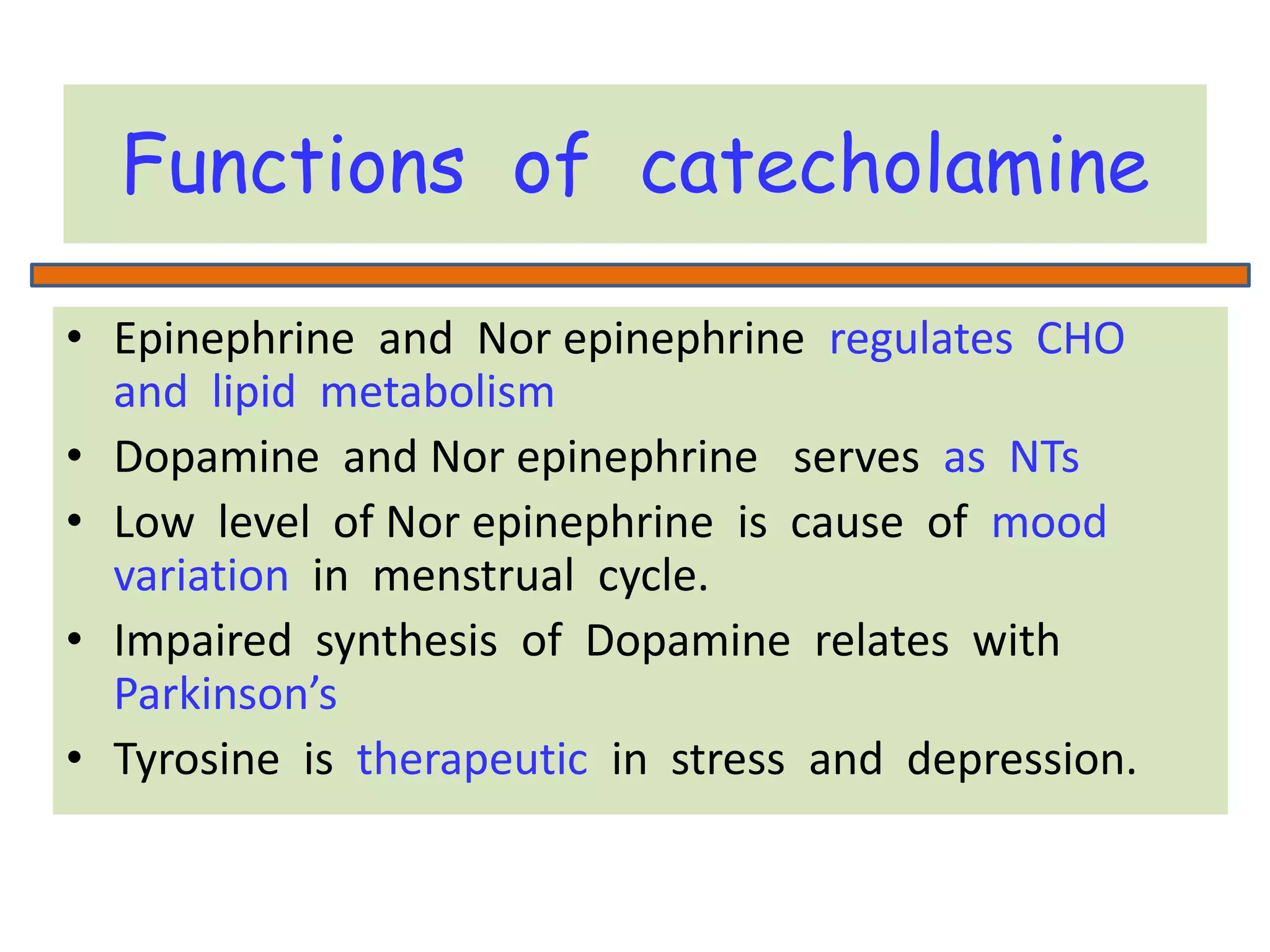
Functions of catecholamine
•Epinephrine and Nor epinephrine regulates CHO
and lipid metabolism
• Dopamine and Nor epinephrine serves as NTs
• Low level of Nor epinephrine is cause of mood
variation in menstrual cycle.
• Impaired synthesis of Dopamine relates with
Parkinson’s
• Tyrosine is therapeutic in stress and depression.
• Amino acidrequired for hormone synthesis.
• Tetra iodo thyronine (Thyroxine) and tri iodo
thyronine (T3) synthesized in thyroid gland.
• Also called as organification of Iodine
• Step 1 is Oxidation of Iodide
• Step 2 Iodination of Tyrosine
• Step 3 Coupling reaction
Tyrosine to Thyroxine and T3