Dr. ANOOP G.C.
Junior Resident in orthopedics
MCH Kozhikkode
Classifications for Legg
Calve Perthes Disease
Dr.Anoop G.C.,JR,Orthopaedics,GMCK
DEFINITION
• PERTHES DISEASE : is a self-limiting
form of osteochondrosis of the femoral capital
epiphysis
• of unknown etiology that develops in children
commonly between the ages of 4 – 12 years
• caused by impaired circulation in the femoral
head
• necrosis of the femoral epiphysis and its
replacement by new bone
• resulting in deformation of the femoral head.
Dr.Anoop G.C.,JR,Orthopaedics,GMCK
HISTORY
 Described first by Waldenstrom in 1909
who mistakenly ascribed it to tuberculosis.
 In 1910 was independently described by
Arthur Legg , U. S. A - February
Jacques Calve , France - July
George Perthes ,Germany - October
 Hence name – “Legg Calve Perthes Disease”
 In 1922 Waldenstrom gave the correct
interpretation and described the stages .
Dr.Anoop G.C.,JR,Orthopaedics,GMCK
LEGG CALVE PERTHES
Dr.Anoop G.C.,JR,Orthopaedics,GMCK
PATHOLOGY
 By Waldenstrom in 1922
 4 stages
based on microscopic
and gross pathology
Paul_Petter_Waldenström
Dr.Anoop G.C.,JR,Orthopaedics,GMCK
Stages
Stage 1 : Incipient or synovitis stage
• Lasts for 1-3 week
• synovium is swollen edematous and
hyperemic
• joint fluid is increased
• Inflammatory cell are notably absent
Dr.Anoop G.C.,JR,Orthopaedics,GMCK
Stages
 Stage 2 : Avascular necrosis
• Lasts for 6 month to 1year
• Significant necrosis of bone
• trabeculae are crushed into minute fragments.
• Absent/pyknotic nuclei in the osteocytes
• No evidence of bone regeneration
• Degenerative changes in the basal layer of
articular cartilage
• Thickened peripheral cartilagenois cells
• Gross contour of femoral head is unchanged
Dr.Anoop G.C.,JR,Orthopaedics,GMCK
Stages
 Stage 3 : Fragmentation or Regeneration
– Lasts for 2- 3 year.
– Dead bone infested with vascular connective
tissue was actively resorbed by osteoclasts
and replaced by newly formed immature
bone.
– Loss of epiphyseal height due to collapse of
bony trabeculae and resorption of fragmented
necrotic bone
Dr.Anoop G.C.,JR,Orthopaedics,GMCK
Stages
 Stage 4 : Healed or Residual Stage
• Normal bone starts replacing necrotic bone.
• Ossific nucleus is deformed assuming
mushroom contour
• Femoral head enlarges, flattens and
subluxate.
Dr.Anoop G.C.,JR,Orthopaedics,GMCK
CLASSIFICATION
• A classification system is needed to
understand natural hitory of LCPD, to predict
functional outcomes and prescribe treatment
• Three categories: those defining the stage of
the disease, those attempting to prognosticate
outcome, and those defining outcome
• All classifications are based on Radiological
appearance
• Both AP and FROG LEG views required
Dr.Anoop G.C.,JR,Orthopaedics,GMCK
RADIOGRAPHY
AP View FROG LEG View
Dr.Anoop G.C.,JR,Orthopaedics,GMCK
CLASSIFICATION
• LEGG
• WALDENSTROM
• GOFF
• CATERALL
• SALTER THOMPSON
• HERRING’S
• ELIZABETHTOWN
• STULBERG
• MOSE
• CE angle
Dr.Anoop G.C.,JR,Orthopaedics,GMCK
Historic
Prognotic
Stage
outcome
HISTORIC CLASSIFICATION
• LEGG
– two types of head
– A “cap” & a “mushroom”(more severe)
• WALDENSTROM
– classified head 3 categories
– Type 1 & 2 with good results
– Type 3 – altered shape leading to restriction of
ROM to only flexion & extension (conical)
• GOFF
– 3 types of head
– Spherical, cap, irregular
Dr.Anoop G.C.,JR,Orthopaedics,GMCK
PROGNOSTIC CLASSIFICATION
• CATERALL
• SALTER THOMPSON
• HERRING’S
Dr.Anoop G.C.,JR,Orthopaedics,GMCK
CATTERALL
• Publihed in 1971
• the first widely accepted
prognostic classification
• Based on extent of
involment of femoral
head.
• IV groups
Dr.Anoop G.C.,JR,Orthopaedics,GMCK
Catterall Group I
25% involvement
No metaphyseal Reaction
No sequestrum
No subchondral fracture lineDr.Anoop G.C.,JR,Orthopaedics,GMCK
Catterall Group II
50% involvement
Sequestrum present - junction Clear
Metaphyseal reaction - antero lateral
Subchondral fracture line - anterior half
Dr.Anoop G.C.,JR,Orthopaedics,GMCK
Catterall Group III
75% involvement
Sequestrum large - junction sclerotic
Metaphyseal reaction - diffuse or antro lateral
Subchondral fracture line - posterior half
Dr.Anoop G.C.,JR,Orthopaedics,GMCK
Catterall Group IV
Whole head involvement
Metaphyseal reaction - central or diffuse
Posterior remodelling present
Dr.Anoop G.C.,JR,Orthopaedics,GMCK
Catterall’s - Head at Risk Signs
• Lateral epiphyseal calcification
• Lateral subluxation
• Gage’s sign
• Cage sign
• Caffey’s or Salter Sign
• Metaphyseal cysts
• Horizontal growth plate
Dr.Anoop G.C.,JR,Orthopaedics,GMCK
Lateral subluxation
Dr.Anoop G.C.,JR,Orthopaedics,GMCK
GAGE’S SIGN
• small osteoporotic segment forming a
translucent V- shaped trough in the lateral
part of the epiphysis
Dr.Anoop G.C.,JR,Orthopaedics,GMCK
CAGE SIGN
• Calcification of the lateral epiphysis
Dr.Anoop G.C.,JR,Orthopaedics,GMCK
Salter’s or Caffey’s sign
• a subchondral # may occur in the anterolateral
aspect of the femoral capital epiphysis. This
produces a crescentic radiolucency known as the
crescent, Salter’s or Caffey’s sign
Dr.Anoop G.C.,JR,Orthopaedics,GMCK
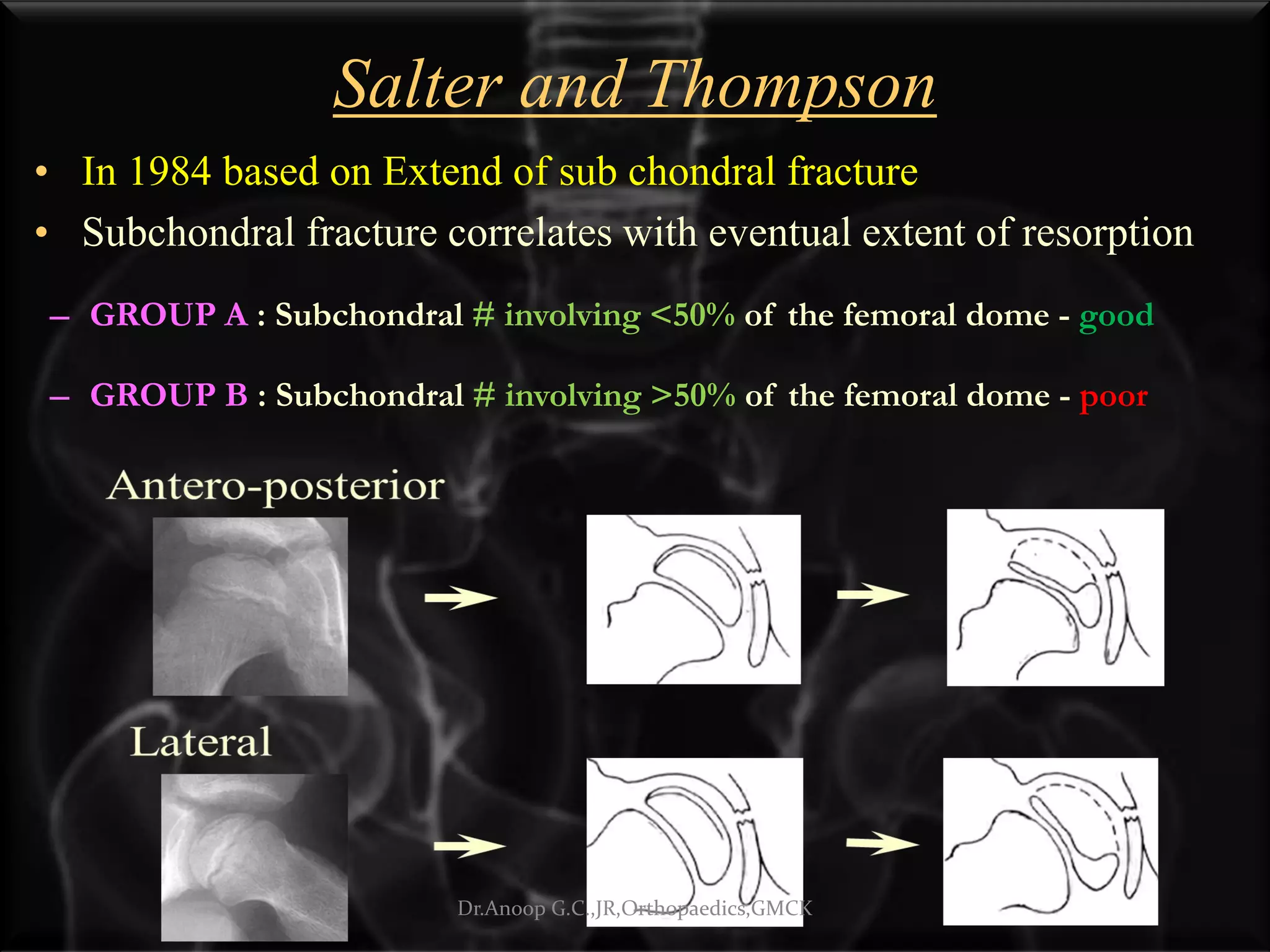
Salter and Thompson
• In 1984 based on Extend of sub chondral fracture
• Subchondral fracture correlates with eventual extent of resorption
– GROUP A : Subchondral # involving <50% of the femoral dome - good
– GROUP B : Subchondral # involving >50% of the femoral dome - poor
Dr.Anoop G.C.,JR,Orthopaedics,GMCK
Herring
• Based on radiographic
changes in lateral portion of
femoral head during
fragmentation stage on AP
view
• The femoral head pillars are
derived by noting the lines
of demarcation between the
central sequestrum and the
remainder of the epiphysis
on the anteroposterior
radiograph
Dr.Anoop G.C.,JR,Orthopaedics,GMCK
Herring
Group A
• Normal Height of lateral
pillar maintained
• Uniformly good
outcome
• No intervention
required
Dr.Anoop G.C.,JR,Orthopaedics,GMCK
Herring
Group B
• > 50% of lateral pillar
height maintained
• Good to intermediate
outcome
• Intervention warranted
Dr.Anoop G.C.,JR,Orthopaedics,GMCK
Herring
Group C
• < 50% of lateral pillar
height maintained
• Poor outcome
• Non surgical treatment
Dr.Anoop G.C.,JR,Orthopaedics,GMCK
CLASSIFICATION DEFINING STAGE
• MODIFIED ELIZABETHTOWN:
– They aid in the timing of intervention and type
of intervention.
– The stages are
• Stage I a & I b
• Stage II a & II b
• Stage III a & III b
• Stage IV
Dr.Anoop G.C.,JR,Orthopaedics,GMCK
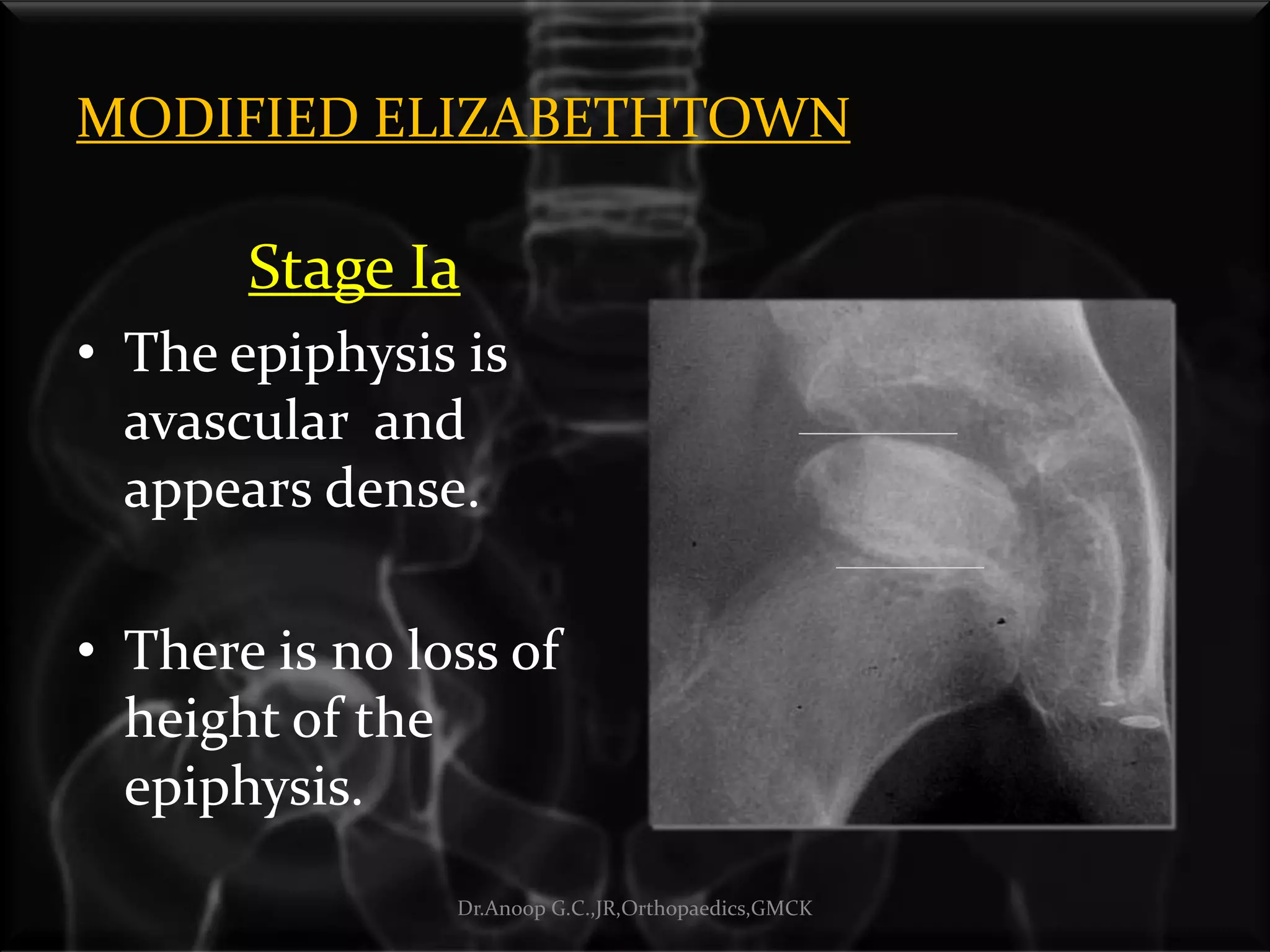
MODIFIED ELIZABETHTOWN
Stage Ia
• The epiphysis is
avascular and
appears dense.
• There is no loss of
height of the
epiphysis.
Dr.Anoop G.C.,JR,Orthopaedics,GMCK
MODIFIED ELIZABETHTOWN
Stage Ib
• There is some loss of
height of the dense
sclerotic epiphysis.
• The epiphysis is in
one piece.
Dr.Anoop G.C.,JR,Orthopaedics,GMCK
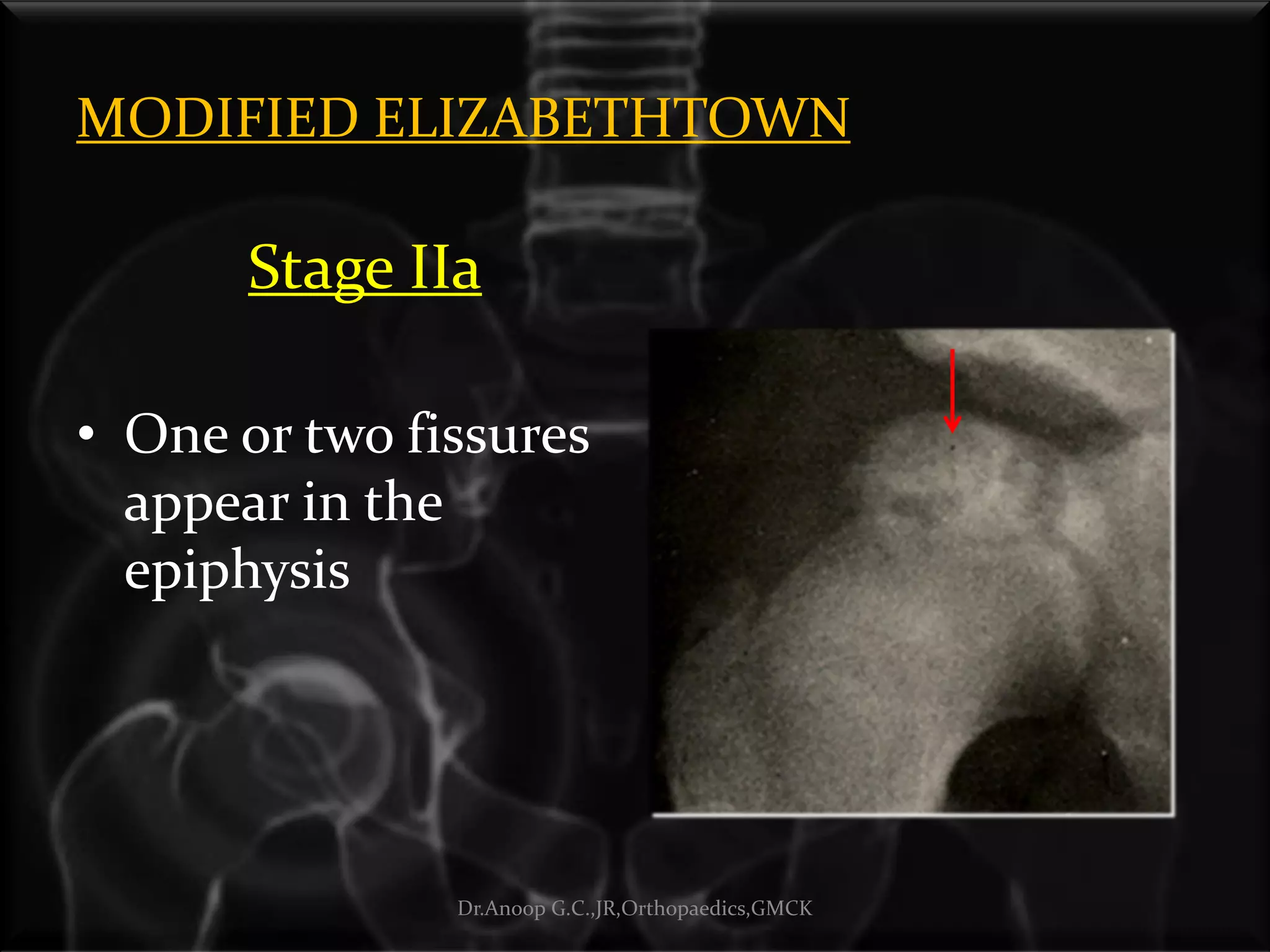
MODIFIED ELIZABETHTOWN
Stage IIa
• One or two fissures
appear in the
epiphysis
Dr.Anoop G.C.,JR,Orthopaedics,GMCK
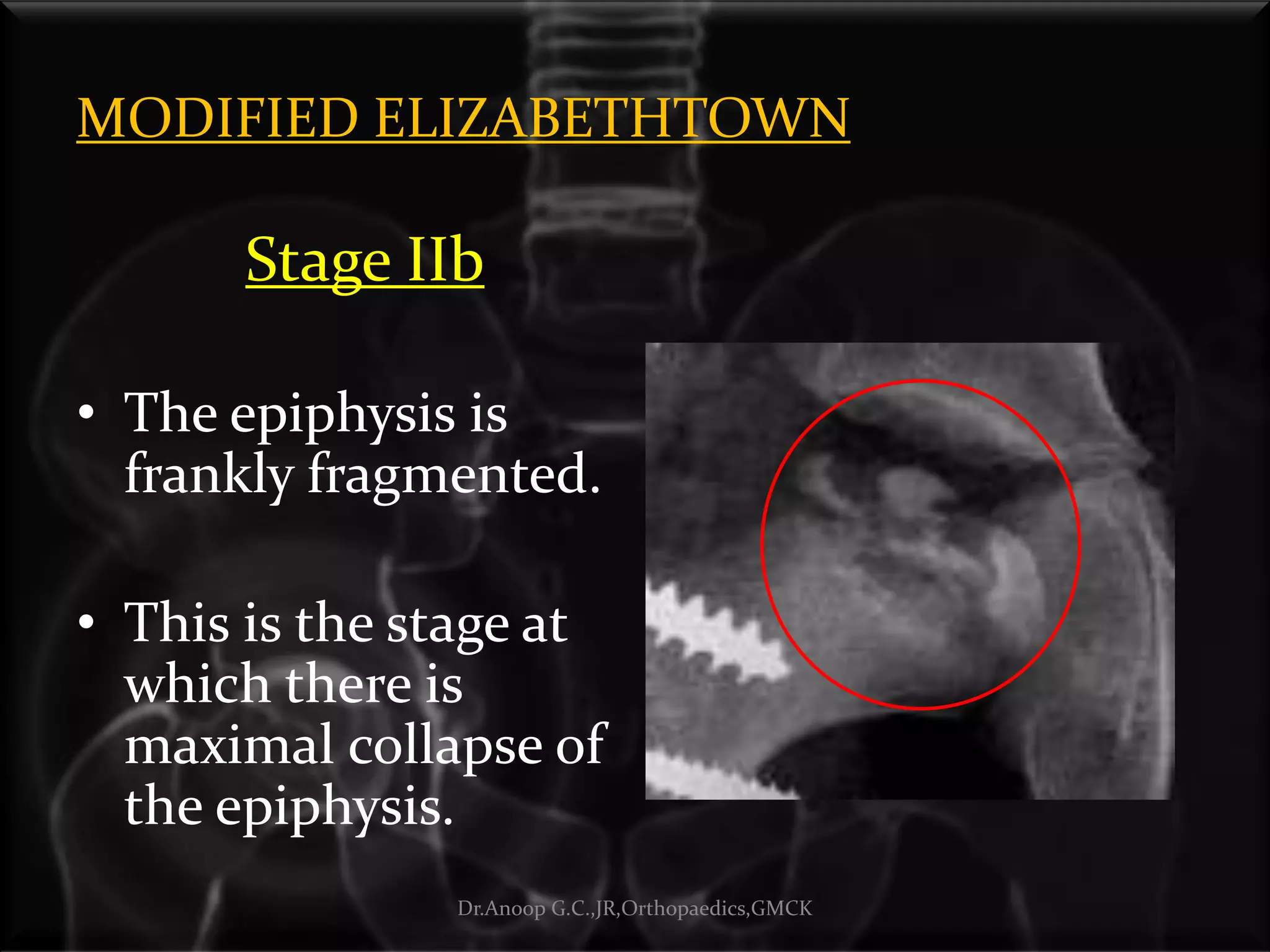
MODIFIED ELIZABETHTOWN
Stage IIb
• The epiphysis is
frankly fragmented.
• This is the stage at
which there is
maximal collapse of
the epiphysis.
Dr.Anoop G.C.,JR,Orthopaedics,GMCK
MODIFIED ELIZABETHTOWN
Stage IIIa
• New bone begins to
form at the periphery
of the avascular
epiphysis.
• This new bone is
immature woven bone
and the texture of this
bone is not normal
Dr.Anoop G.C.,JR,Orthopaedics,GMCK
MODIFIED ELIZABETHTOWN
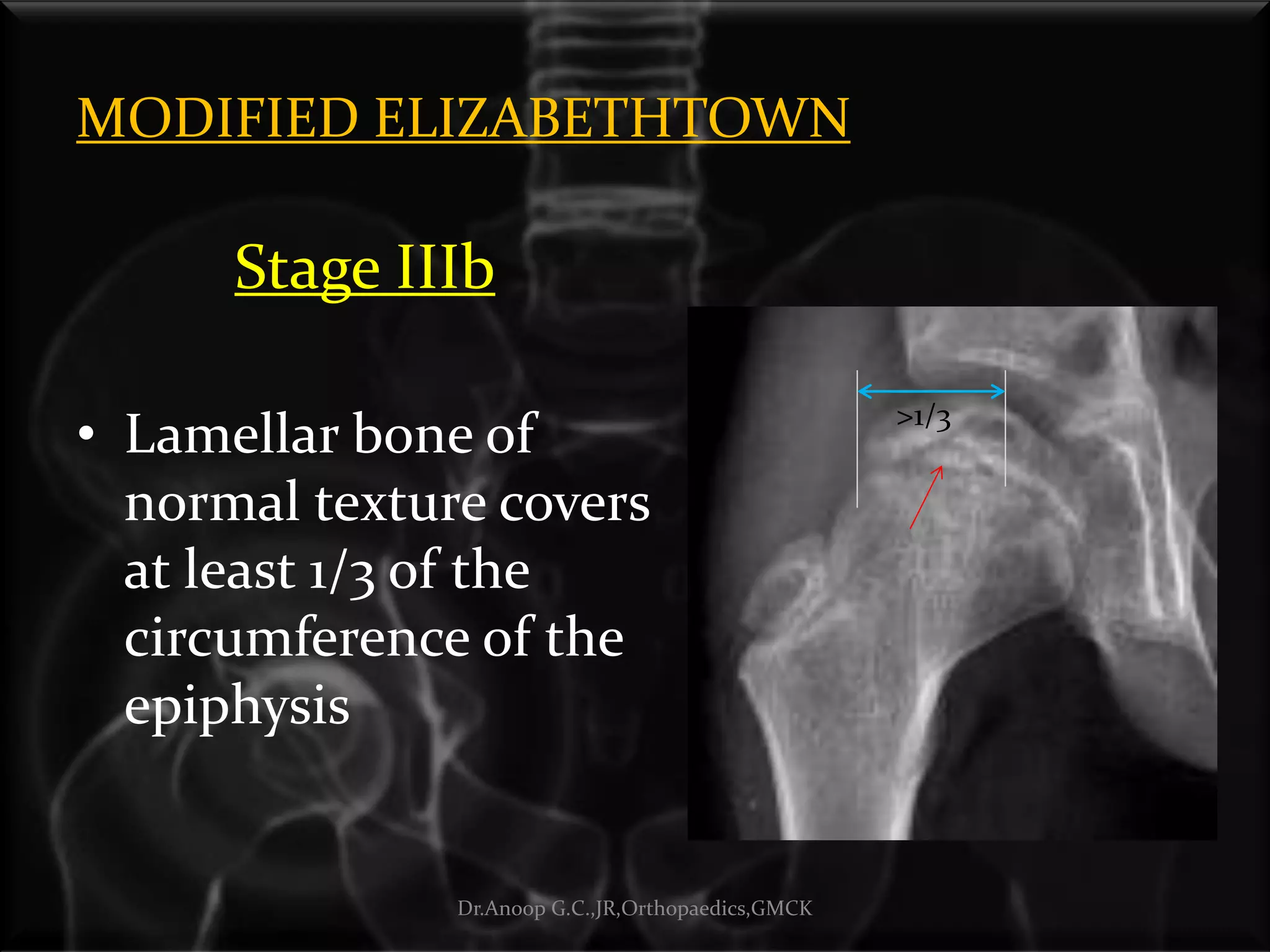
Stage IIIb
• Lamellar bone of
normal texture covers
at least 1/3 of the
circumference of the
epiphysis
Dr.Anoop G.C.,JR,Orthopaedics,GMCK
>1/3
MODIFIED ELIZABETHTOWN
Stage IV
• The process of
revascularisation and
repair is complete.
• There is no evidence
of any avascular bone
in the epiphysis
Dr.Anoop G.C.,JR,Orthopaedics,GMCK
CLASSIFICATION DEFINING OUTCOME
• STULBERG
• MOSE
• CE angle
Dr.Anoop G.C.,JR,Orthopaedics,GMCK
ASSESSMENT OF END RESUTLT
• Assessment of end result is done at 4 years
after onset.
• Based on sphericity and containment of
femoral head.
• Good – no arthritis develops
• Fair – mild to moderate arthritis will
develop in late adulthood
• Poor – severe arthritis will develop before
age of fifty.
Dr.Anoop G.C.,JR,Orthopaedics,GMCK
ASSESSMENT OF END RESUTLT
 SPHERICITY OF HEAD
 MOSE CLASSIFICATION: Based on fitting
of contour of healed femoral head into
template of concentric circles in both AP & Frog
leg lateral views
• Good - < 1 mm
• Fair - < 2 mm
• Poor - > 2 mm
Dr.Anoop G.C.,JR,Orthopaedics,GMCK
STULBERG CLASSIFICATION
• Described in 1981
• Alike MOSE, classification of THE
END RESULTS
• Used to predict the onset of
degenerative joint disease following
LCPD
• Based on size and shape of femoral
head
Dr.Anoop G.C.,JR,Orthopaedics,GMCK
STULBERG CLASSIFICATION
Spherical congruity ( I & II)
Arthritis does not develop
Aspherical congruity (III & IV)
Mild to moderate arthritis mid -late
adulthood
Aspherical incongruity (V)
Severe arthritis before age fifty years.
Dr.Anoop G.C.,JR,Orthopaedics,GMCK
STULBERG CLASSIFICATION
• I – Shape is normal
• II – loss of head
height
– < 2 mm deviation of
concentric circles
• Group I & II –
“Spherical
Congruency”
• Outcome - Good
Dr.Anoop G.C.,JR,Orthopaedics,GMCK
STULBERG CLASSIFICATION
• III – Elliptical
head
– > 2 mm deviation
• IV – Flattened
head, >1 cm of
flattening
• Contour matches
(“Incongrous/Asph
erical congruency”)
• Outcome - Fair
Dr.Anoop G.C.,JR,Orthopaedics,GMCK
STULBERG CLASSIFICATION
• V – Collapsed head,
– Contour mismatch
(“Incongrous/Aspher
ical Incongruency”)
• Outcome - Poor
Dr.Anoop G.C.,JR,Orthopaedics,GMCK
ASSESSMENT OF END RESUTLT
 CONTAINMENT OF HEAD
 CE Angle of Wiberg:
- A line is drawn from center of head C and edge of
acetabulum E called CE line
- The angle between CE
line and vertical
through center of
head is called the CE
angle.
 Good - >20
 Fair- 15-19
 Poor- < 15
E
C
Vertical
Dr.Anoop G.C.,JR,Orthopaedics,GMCK
THANK YOU
Dr.Anoop G.C.,JR,Orthopaedics,GMCK

Classification perthes Disease

  • 1.
    Dr. ANOOP G.C. JuniorResident in orthopedics MCH Kozhikkode Classifications for Legg Calve Perthes Disease Dr.Anoop G.C.,JR,Orthopaedics,GMCK
  • 2.
    DEFINITION • PERTHES DISEASE: is a self-limiting form of osteochondrosis of the femoral capital epiphysis • of unknown etiology that develops in children commonly between the ages of 4 – 12 years • caused by impaired circulation in the femoral head • necrosis of the femoral epiphysis and its replacement by new bone • resulting in deformation of the femoral head. Dr.Anoop G.C.,JR,Orthopaedics,GMCK
  • 3.
    HISTORY  Described firstby Waldenstrom in 1909 who mistakenly ascribed it to tuberculosis.  In 1910 was independently described by Arthur Legg , U. S. A - February Jacques Calve , France - July George Perthes ,Germany - October  Hence name – “Legg Calve Perthes Disease”  In 1922 Waldenstrom gave the correct interpretation and described the stages . Dr.Anoop G.C.,JR,Orthopaedics,GMCK
  • 4.
    LEGG CALVE PERTHES Dr.AnoopG.C.,JR,Orthopaedics,GMCK
  • 5.
    PATHOLOGY  By Waldenstromin 1922  4 stages based on microscopic and gross pathology Paul_Petter_Waldenström Dr.Anoop G.C.,JR,Orthopaedics,GMCK
  • 6.
    Stages Stage 1 :Incipient or synovitis stage • Lasts for 1-3 week • synovium is swollen edematous and hyperemic • joint fluid is increased • Inflammatory cell are notably absent Dr.Anoop G.C.,JR,Orthopaedics,GMCK
  • 7.
    Stages  Stage 2: Avascular necrosis • Lasts for 6 month to 1year • Significant necrosis of bone • trabeculae are crushed into minute fragments. • Absent/pyknotic nuclei in the osteocytes • No evidence of bone regeneration • Degenerative changes in the basal layer of articular cartilage • Thickened peripheral cartilagenois cells • Gross contour of femoral head is unchanged Dr.Anoop G.C.,JR,Orthopaedics,GMCK
  • 8.
    Stages  Stage 3: Fragmentation or Regeneration – Lasts for 2- 3 year. – Dead bone infested with vascular connective tissue was actively resorbed by osteoclasts and replaced by newly formed immature bone. – Loss of epiphyseal height due to collapse of bony trabeculae and resorption of fragmented necrotic bone Dr.Anoop G.C.,JR,Orthopaedics,GMCK
  • 9.
    Stages  Stage 4: Healed or Residual Stage • Normal bone starts replacing necrotic bone. • Ossific nucleus is deformed assuming mushroom contour • Femoral head enlarges, flattens and subluxate. Dr.Anoop G.C.,JR,Orthopaedics,GMCK
  • 10.
    CLASSIFICATION • A classificationsystem is needed to understand natural hitory of LCPD, to predict functional outcomes and prescribe treatment • Three categories: those defining the stage of the disease, those attempting to prognosticate outcome, and those defining outcome • All classifications are based on Radiological appearance • Both AP and FROG LEG views required Dr.Anoop G.C.,JR,Orthopaedics,GMCK
  • 11.
    RADIOGRAPHY AP View FROGLEG View Dr.Anoop G.C.,JR,Orthopaedics,GMCK
  • 12.
    CLASSIFICATION • LEGG • WALDENSTROM •GOFF • CATERALL • SALTER THOMPSON • HERRING’S • ELIZABETHTOWN • STULBERG • MOSE • CE angle Dr.Anoop G.C.,JR,Orthopaedics,GMCK Historic Prognotic Stage outcome
  • 13.
    HISTORIC CLASSIFICATION • LEGG –two types of head – A “cap” & a “mushroom”(more severe) • WALDENSTROM – classified head 3 categories – Type 1 & 2 with good results – Type 3 – altered shape leading to restriction of ROM to only flexion & extension (conical) • GOFF – 3 types of head – Spherical, cap, irregular Dr.Anoop G.C.,JR,Orthopaedics,GMCK
  • 14.
    PROGNOSTIC CLASSIFICATION • CATERALL •SALTER THOMPSON • HERRING’S Dr.Anoop G.C.,JR,Orthopaedics,GMCK
  • 15.
    CATTERALL • Publihed in1971 • the first widely accepted prognostic classification • Based on extent of involment of femoral head. • IV groups Dr.Anoop G.C.,JR,Orthopaedics,GMCK
  • 16.
    Catterall Group I 25%involvement No metaphyseal Reaction No sequestrum No subchondral fracture lineDr.Anoop G.C.,JR,Orthopaedics,GMCK
  • 17.
    Catterall Group II 50%involvement Sequestrum present - junction Clear Metaphyseal reaction - antero lateral Subchondral fracture line - anterior half Dr.Anoop G.C.,JR,Orthopaedics,GMCK
  • 18.
    Catterall Group III 75%involvement Sequestrum large - junction sclerotic Metaphyseal reaction - diffuse or antro lateral Subchondral fracture line - posterior half Dr.Anoop G.C.,JR,Orthopaedics,GMCK
  • 19.
    Catterall Group IV Wholehead involvement Metaphyseal reaction - central or diffuse Posterior remodelling present Dr.Anoop G.C.,JR,Orthopaedics,GMCK
  • 20.
    Catterall’s - Headat Risk Signs • Lateral epiphyseal calcification • Lateral subluxation • Gage’s sign • Cage sign • Caffey’s or Salter Sign • Metaphyseal cysts • Horizontal growth plate Dr.Anoop G.C.,JR,Orthopaedics,GMCK
  • 21.
  • 22.
    GAGE’S SIGN • smallosteoporotic segment forming a translucent V- shaped trough in the lateral part of the epiphysis Dr.Anoop G.C.,JR,Orthopaedics,GMCK
  • 23.
    CAGE SIGN • Calcificationof the lateral epiphysis Dr.Anoop G.C.,JR,Orthopaedics,GMCK
  • 24.
    Salter’s or Caffey’ssign • a subchondral # may occur in the anterolateral aspect of the femoral capital epiphysis. This produces a crescentic radiolucency known as the crescent, Salter’s or Caffey’s sign Dr.Anoop G.C.,JR,Orthopaedics,GMCK
  • 25.
    Salter and Thompson •In 1984 based on Extend of sub chondral fracture • Subchondral fracture correlates with eventual extent of resorption – GROUP A : Subchondral # involving <50% of the femoral dome - good – GROUP B : Subchondral # involving >50% of the femoral dome - poor Dr.Anoop G.C.,JR,Orthopaedics,GMCK
  • 26.
    Herring • Based onradiographic changes in lateral portion of femoral head during fragmentation stage on AP view • The femoral head pillars are derived by noting the lines of demarcation between the central sequestrum and the remainder of the epiphysis on the anteroposterior radiograph Dr.Anoop G.C.,JR,Orthopaedics,GMCK
  • 27.
    Herring Group A • NormalHeight of lateral pillar maintained • Uniformly good outcome • No intervention required Dr.Anoop G.C.,JR,Orthopaedics,GMCK
  • 28.
    Herring Group B • >50% of lateral pillar height maintained • Good to intermediate outcome • Intervention warranted Dr.Anoop G.C.,JR,Orthopaedics,GMCK
  • 29.
    Herring Group C • <50% of lateral pillar height maintained • Poor outcome • Non surgical treatment Dr.Anoop G.C.,JR,Orthopaedics,GMCK
  • 30.
    CLASSIFICATION DEFINING STAGE •MODIFIED ELIZABETHTOWN: – They aid in the timing of intervention and type of intervention. – The stages are • Stage I a & I b • Stage II a & II b • Stage III a & III b • Stage IV Dr.Anoop G.C.,JR,Orthopaedics,GMCK
  • 31.
    MODIFIED ELIZABETHTOWN Stage Ia •The epiphysis is avascular and appears dense. • There is no loss of height of the epiphysis. Dr.Anoop G.C.,JR,Orthopaedics,GMCK
  • 32.
    MODIFIED ELIZABETHTOWN Stage Ib •There is some loss of height of the dense sclerotic epiphysis. • The epiphysis is in one piece. Dr.Anoop G.C.,JR,Orthopaedics,GMCK
  • 33.
    MODIFIED ELIZABETHTOWN Stage IIa •One or two fissures appear in the epiphysis Dr.Anoop G.C.,JR,Orthopaedics,GMCK
  • 34.
    MODIFIED ELIZABETHTOWN Stage IIb •The epiphysis is frankly fragmented. • This is the stage at which there is maximal collapse of the epiphysis. Dr.Anoop G.C.,JR,Orthopaedics,GMCK
  • 35.
    MODIFIED ELIZABETHTOWN Stage IIIa •New bone begins to form at the periphery of the avascular epiphysis. • This new bone is immature woven bone and the texture of this bone is not normal Dr.Anoop G.C.,JR,Orthopaedics,GMCK
  • 36.
    MODIFIED ELIZABETHTOWN Stage IIIb •Lamellar bone of normal texture covers at least 1/3 of the circumference of the epiphysis Dr.Anoop G.C.,JR,Orthopaedics,GMCK >1/3
  • 37.
    MODIFIED ELIZABETHTOWN Stage IV •The process of revascularisation and repair is complete. • There is no evidence of any avascular bone in the epiphysis Dr.Anoop G.C.,JR,Orthopaedics,GMCK
  • 38.
    CLASSIFICATION DEFINING OUTCOME •STULBERG • MOSE • CE angle Dr.Anoop G.C.,JR,Orthopaedics,GMCK
  • 39.
    ASSESSMENT OF ENDRESUTLT • Assessment of end result is done at 4 years after onset. • Based on sphericity and containment of femoral head. • Good – no arthritis develops • Fair – mild to moderate arthritis will develop in late adulthood • Poor – severe arthritis will develop before age of fifty. Dr.Anoop G.C.,JR,Orthopaedics,GMCK
  • 40.
    ASSESSMENT OF ENDRESUTLT  SPHERICITY OF HEAD  MOSE CLASSIFICATION: Based on fitting of contour of healed femoral head into template of concentric circles in both AP & Frog leg lateral views • Good - < 1 mm • Fair - < 2 mm • Poor - > 2 mm Dr.Anoop G.C.,JR,Orthopaedics,GMCK
  • 41.
    STULBERG CLASSIFICATION • Describedin 1981 • Alike MOSE, classification of THE END RESULTS • Used to predict the onset of degenerative joint disease following LCPD • Based on size and shape of femoral head Dr.Anoop G.C.,JR,Orthopaedics,GMCK
  • 42.
    STULBERG CLASSIFICATION Spherical congruity( I & II) Arthritis does not develop Aspherical congruity (III & IV) Mild to moderate arthritis mid -late adulthood Aspherical incongruity (V) Severe arthritis before age fifty years. Dr.Anoop G.C.,JR,Orthopaedics,GMCK
  • 43.
    STULBERG CLASSIFICATION • I– Shape is normal • II – loss of head height – < 2 mm deviation of concentric circles • Group I & II – “Spherical Congruency” • Outcome - Good Dr.Anoop G.C.,JR,Orthopaedics,GMCK
  • 44.
    STULBERG CLASSIFICATION • III– Elliptical head – > 2 mm deviation • IV – Flattened head, >1 cm of flattening • Contour matches (“Incongrous/Asph erical congruency”) • Outcome - Fair Dr.Anoop G.C.,JR,Orthopaedics,GMCK
  • 45.
    STULBERG CLASSIFICATION • V– Collapsed head, – Contour mismatch (“Incongrous/Aspher ical Incongruency”) • Outcome - Poor Dr.Anoop G.C.,JR,Orthopaedics,GMCK
  • 46.
    ASSESSMENT OF ENDRESUTLT  CONTAINMENT OF HEAD  CE Angle of Wiberg: - A line is drawn from center of head C and edge of acetabulum E called CE line - The angle between CE line and vertical through center of head is called the CE angle.  Good - >20  Fair- 15-19  Poor- < 15 E C Vertical Dr.Anoop G.C.,JR,Orthopaedics,GMCK
  • 47.