Speakers: David Sykes Nanotech Materials for Truly Sustainable Construction Founder, NanoNexis; Managing Director, Remington Partners R. J. Brennan, MSC, LEED ®   AP Associate, Director Strategic Workplace, IA Interior Architects President, CoreNet Global Chicago Chapter February 13, 2008
“ The time to start watching how companies are investing in and deploying nanotech won’t come in some distant future . . . that time is  now ! ” Lux Research
Nanotechnology First described 24 years ago Manipulating individual atoms Smaller than “micro”  -  a nanometer is one billionth of a meter A revolution in building materials Important as part of 3BL The “sustainable buildings” initiative High “performance” workplaces
Three Questions: Do you assume “going green” adds to your first cost? Can you name 3 nanotech base building materials? How will nanotech enhance the building stock?
Five Segments Context The revolution in building materials How to integrate nano-materials with business goals  Case study #1: office work environment Current “green” nano-material example: aerogel  Case study #2: Base Building Design Next steps, resources & contacts
1. Context
CRE is a big target 60% of global industrial waste is from the construction and demolition of buildings 60% of electrical use in developed nations is by buildings 40% of total energy consumed is by buildings
What is Nanotechnology? What is it? Nano is Greek for “dwarf” Manipulation of matter < 100nm (1 10,000 th  the size of a bacterium) 80,000X smaller than a human hair Revolution began 47 years ago
Tools are available Global competition  (Asia vs. Europe vs. North America) $10 billion global investment Real, useful products are already here Useful response to global climate change Why now? We can do it!
Old or new? (Damascus 900-1750AD) Arms race? The first crusaders encountered better steel  Wootz steel, developed in India & Sri Lanka ~300 BC  greater strength & flexibility due to carbon nanotubes technique lost ~1750AD
Tipping point was 2000
R & D nano spending in 2004
22 US Federal Agencies... USDA DOD DOE DHS DOJ EPA NASA NIST (DOC NIOSH (DHHS) NIH (DHHS) NSF DIS (DOC) CPSC DOS DOT DOTreas FDA (DHHS) ITC IC NRC TA (DOC) USPTO (DOC)
2006: Seven Program Component Areas Fundamental nano-scale phenomena & processes ($234 mil) Nano-materials ($228 mil) Nano-scale devices and systems ($244 mil) Instrumentation research, metrology, and standards for nano-technology ($71 mil) Nano-manufacturing ($47 mil) Major research facilities & instrumentation acquisition ($148 mil) Societal dimensions ($82 mil) Bi-partisan “ 21 st  Century nano-technology R&D Act” (Public Law 108-153, 2003)
Private Investment In 2005, 1331 companies in 76 industries invested $3.2 billion in nano-technology and sold  $32 billion in products  incorporating nanotechnologies Expect $12 billion private investment by 2008 Example: One of CEO’s top 3 priorities at GE; spent $50 million in 2005 (1.5% of R&D budget)  VC’s have spent $2 billion on 143 known startups Governments & corporations spent 19 times more  Source: Lux Research
Does it Matter to CRE? Yes! You will not get the “green” gains you need energy savings higher performance lower costs unless  you insist that architects, specifiers and contractors look seriously at nano-materials  (see the CoreNet 2010 Report)
2. The Revolution in building science
A quick overview Steel Concrete Glass Gypsum Drywall Fabrics & Carpet Energy/HVAC Filtration Electronics / Sensors Tools  Coatings & Paints Lighting Insulation Put on your running shoes…
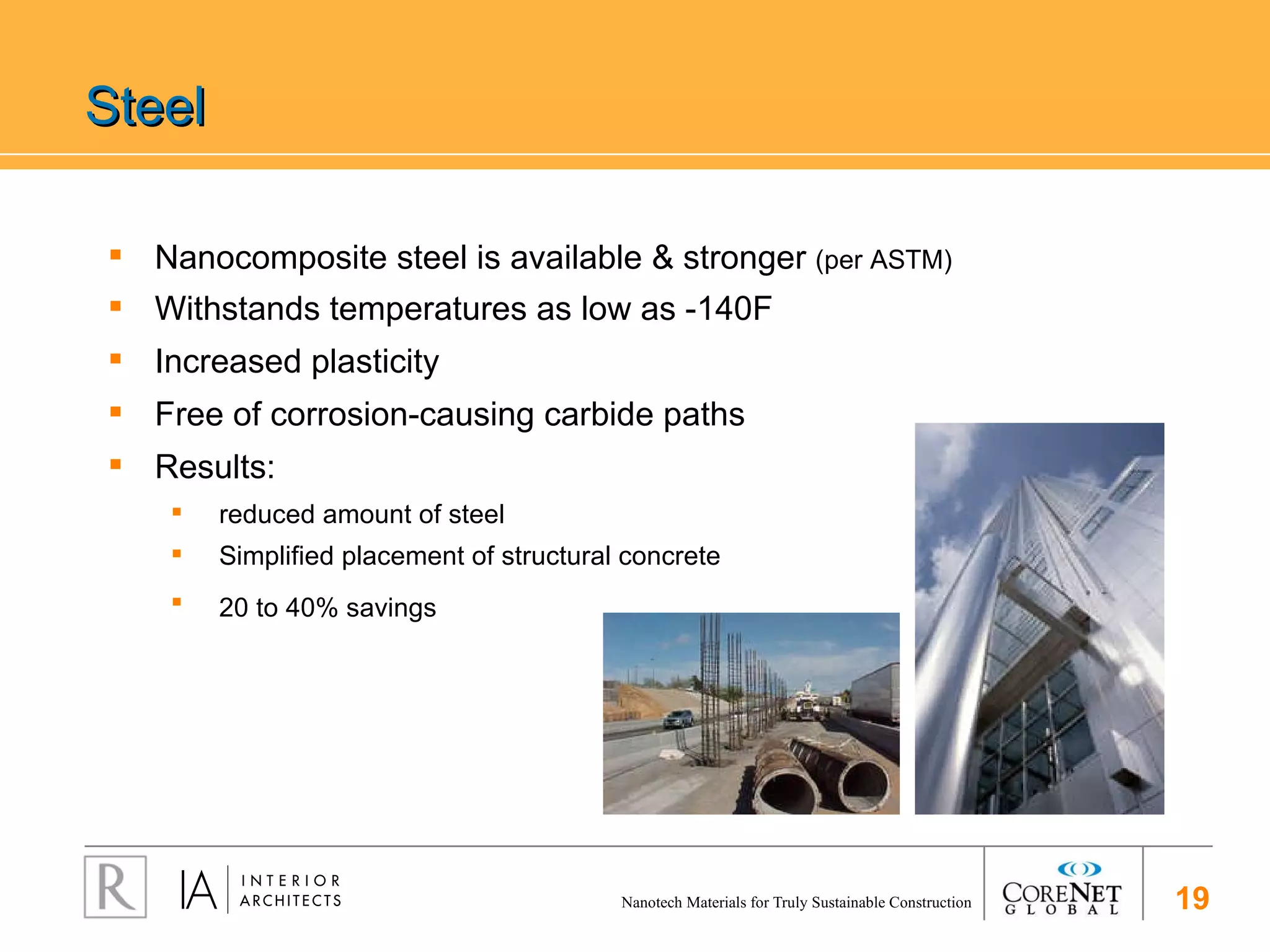
Steel Nanocomposite steel is available & stronger  (per ASTM)  Withstands temperatures as low as -140F   Increased plasticity Free of corrosion-causing carbide paths Results:  reduced amount of steel Simplified placement of structural concrete 20 to 40% savings
Concrete Production of concrete accounts for 8% of total CO 2  emissions worldwide Translucent concrete?  Cool idea by Dutch Architect, Rem Koolhaas
Glass Can block UV & glare  Self-cleaning glass coated (titanium dioxide coating breaks down organic matter
Switchable Glass Switch!!
Gypsum Drywall Nano-drywall is lighter, stronger and water resistant
Fabrics & Carpet Nano-treatments are used on commercial fabrics  Color-fast, stain proof and dirt proof Naturally hydrophobic, no mold or mildew
Energy / HVAC Solar cells infused with nano-technology are thin, flexible and come in rolls so they can be applied as roofing material
Tools Doped Nanophostate Lithium Ion batteries Cordless tools are more powerful than corded!
Coatings & Paints Nano particles enhance physical and aesthetic qualities Hard, durable finish Excellent water resistance Scrub-ability Stain blocking and other properties
LEDs (point source) & OLEDs (sheet) 40% of commercial energy goes to lighting  LED is most efficient, sustainable solution 10X more efficient than incandescent 50,000 - 100,000 hours (vs 10,000) Lighting &quot;No other lighting technology offers so much potential to save energy and enhance the quality of buildings&quot;  U.S. Dept. of Energy
46% average annual growth from 2001-4 HB LED market $4.2 billion in 2006 Growing to $9.9 billion in 2011 Solid-state lighting Big technology push *Examples: Osram, Philips, OptiLED Holdings (Hong Kong)
Solid-state lighting
Insulation Aerogel, a translucent thermal-acoustic insulator Looks like frozen smoke Best insulating solid in the world Weighs only 90 grams per litre Extr emely flexible blankets, beads, sheets The new “plastic”* *Not really—it’s amporphous silica (sand)
How to use these innovations? Steel Concrete Glass Gypsum Drywall Fabrics & Carpet Energy/HVAC Filtration Electronics / Sensors Tools Coatings & Paints Lighting  Insulation
Questions?
3. Integrating new materials with  business goals: a case study
Integrating nano into CRE A  comprehensive  stage-gate method . . .  Three premises: Incremental change is best – limits risk Must solve  real  business problems;  data-driven Teamwork is essential
Nine rules for supporting extensive change Identify  significant needs better solved  by novel materials e.g., “Privacy without walls” is required to comply with Sarbanes Oxley, GLBA, HIPAA, Patriot Act, etc. Look for tax  incentives  & government support Work with authoritative  resources Collaborate  with manufacturers Manage risk – Do  prototyping & testing  outside critical path Secure early  senior executive buy-in
Team well...plan carefully...design thoughtfully Nine rules for supporting extensive change A A C B B C Use an  integrated process   (e.g., IA SmartSpace SM ) Measure results  – quantitative and qualitative Manage change  – communicate E X E C U T I V E  S P O N S O R S H I P
Case Study #1: Solve a real problem Business problem: noise & privacy in open plan offices Privacy & security laws , are  not compatible  with open-office landscapes (intended to encourage teamwork & maximize natural light) How to meet the growing international need for  privacy  without building walls  or abandoning open offices? Leading sources of dissatisfaction  from GSA Post-Occupancy Assessment of Speech Privacy in Offices: People talking nearby……………………….. 92% People talking on the phone………………… 84% People overhearing private conversation….. 82% Sources to which dissatisfaction with acoustics was attributed Presented by Kevin Powell of GSA and Charles Salter and Randy Waldeck of Charles Salter Associates on June 4, 2007, at the 153rd Meeting of the Acoustical Society of America in Salt Lake City, UT
Why Use a Nanomaterial? Conventional materials are  not optimal Need enhanced acoustic value Need thinner material, less bulk Need translucency Need enhanced thermal value Need lighter weight Can a nanomaterial solve the problem? Are there  risks ? Do the enhanced performance characteristics provide  new opportunities ? Where can one locate the materials and manufacturers?
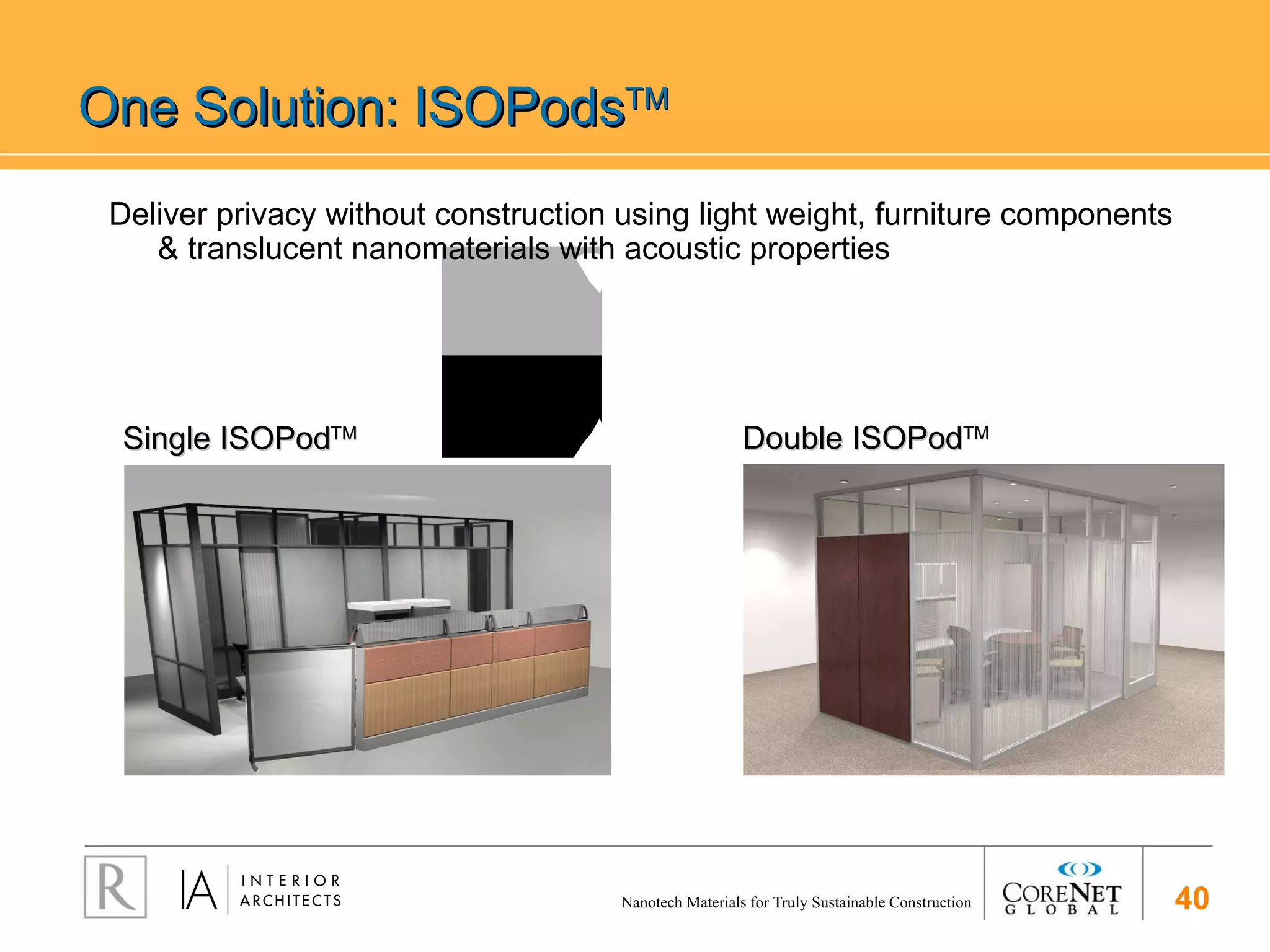
One Solution: ISOPods TM Single ISOPod TM Double ISOPod TM Deliver privacy without construction using light weight, furniture components & translucent nanomaterials with acoustic properties
Installed: flexible, daylight, acoustic
Sound Transmission :  Acoustic Performance Truck Noise   10 db attenuation 40 - 400 HZ sound transmission  loss 2-3/4” FRP Sound pressure level vs. time Fiberglass insulation Nanogel ®
What is a winning approach? Communicate – a  thorough discovery phase  supports business process and enhances individual work styles Understand and document the desired outcomes, assess goals Consider all elements  of the integrated solution – built, cultural, etc. Teamwork is critical –  get the right players ! Client IA Interior Architects (Strategist/Architect) Component Manufacturer NanoNexis (Subject Expert) Supplier of Nanomaterial Assess and communicate the results –  test Make adjustments  – communicate what was changed and why
“So what do I do with all this information?” “ What does it mean to me??” Be  clear on the goal , as well as the risk vs. reward factors, of incorporating new technologies into an initiative If anything goes wrong, it’s always the new stuff! It is up to the Client, not the architects/designers/contractors, to insist on exploring these new technologies!! The bottom line is that nanotech materials can  significantly enhance performance , as well as increasing the &quot;greenness&quot; of any given project . . . Widespread adoption is still some time away USGBC does not yet have an official stance on these materials Manufacturers need direction  on what products to enhance You can help define what will be available!!
Questions?
4. Example of a “green” nano-material: aerogel insulation and glazing
About aerogels Well-known, insulating nano-substance that is translucent and 97% air Nanogel TM*  panels – developed for skylights –  fit ISOPod TM  concept: Lightweight Hydrophobic Highly translucent Thin Superb thermal / acoustic insulator Manufactured as large, rigid panels * Manufactured in Frankfurt by Cabot Corp.
Uses in CRE? Aerogels have multiple uses in interior & exterior construction Green certification? Earn points by incorporating natural daylight as an energy conservation features Earn more points for improved acoustics
Heat, Light, & Noise Noise 50% Sound Reduction Thermal Performance R-20 The insulating value of a 6” stud wall Testing Permanence of performance Non-combustible/ no smoke Mold/mildew resistance Condensation resistance UV Stable
More about Aerogels Nanomaterial known since 1931 Used extensively in aerospace Nanogel TM  is a proprietary form of “aerogel” - skylights - exterior glazing - pipeline insulation - apparel - medical devices
Nanogel used across North America & nine European countries Not an experiment! Cabot is 125 years old, a $2.9 billion public company 21 countries 36 manufacturing sites 8 R&D facilities More about Aerogels
Examples – Skylights
Sports Complex of Souchais, Carquefou, France Owner: City of Carquefou Architect : MA Murail Architectures, Nantes & Paris, France Contractor (façade) : Belliard Case Study #2
Sports Complex 3 sport halls within the complex Wardrobe rooms Club house and meeting room 1 exterior field Parking lot for 250 cars  Total surface : 1.7 hectare Total investment : €2.9MM Goal
Application : a 25mm thick multi-wall polycarbonate sheets façade filled with nano-material  (Total surface of 1450m2) on the whole perimeter of the building (surface of 3360m2). The façade had to meet a thermal insulation value < 2.7 W/m.K The nano-material allows to achieve a value of 0.89 W/m.K Goal
Shaders were not an option : very costly, heavy structure, not in line with the architect’s concept of a smooth building surface  shaders Options
Cost comparison Versus Double-pane Glass Glass, profiles : €300/m²  €435,000 Shaders    €130/m²  €188,500 Total cost   €430/m²  €623,500   Versus PC without nanomaterial Polycarbonate sheets : €100/m²  €145,000 Shaders   €130/m²  €188,500 Total cost   €230/m²  €333,500 Nano-material Solution + Polycarbonate Polycarbonate sheets : €100/m²  €145,000 Nano-material cost :  €67/m²  € 97,000 Total cost   €167/m²  €242,000 Energy savings  €3000/year on lighting   € 2000/year on heating Savings € 263/m²  €381,350 Immediate payback + €5,000/year on energy Savings € 63/m²  €91,500 Immediate payback + €5,000/year on energy Nano-Materials (aerogels) applied to the Building Industry
Results
Natural daylight evenly dispersed inside the building No glare, no shadow, no “light tunnel” issues High comfort level for the players and spectators Results
Questions?
5. Next Steps, resources, contacts
Resources Material Connexion , Beylerian & Dent (Wiley, 2005) Material Architecture , Fernandez (Oxford, 2006) EU Nanoforum Report  (December 2006; nannoforum.org) Transmaterial , Brownell, (Princeton, 2006) Material World   2 , MateriO (Birkhauser, 2006) Extreme Textiles , McQuaid (Princeton, 2005) The Dance of Molecules,  Sargent (Penguin, 2006) The Nanomaterials Handbook,  Gogotsi (CRC, 2006)
“ Because of nanotechnology, we will see more  change in our civilization in the next thirty years  than we did during all of the 20 th  century” - M. Roco, National Science Foundation The future of CRE is here now
A new way of thinking Photocatalytic cement with TiO 2   Self cleaning (Rome, 2003) Removes pollutants in area around building (CO 2 , NO 2 , etc.)
“ The time to start watching how companies are investing in and deploying nanotech won’t come in some distant future . . . that time is  now ! ” Lux Research
Contact Information David M. Sykes – Founder,  NanoNexis, Cambridge, MA [email_address] R. J. Brennan – Associate, Director Strategic Workplace IA Interior Architects, Chicago, IL [email_address]
Questions & Comments What questions & comments does the audience have for the presenters?

Corenet montreal 2_13_08_nanotech_materials

  • 1.
    Speakers: David SykesNanotech Materials for Truly Sustainable Construction Founder, NanoNexis; Managing Director, Remington Partners R. J. Brennan, MSC, LEED ® AP Associate, Director Strategic Workplace, IA Interior Architects President, CoreNet Global Chicago Chapter February 13, 2008
  • 2.
    “ The timeto start watching how companies are investing in and deploying nanotech won’t come in some distant future . . . that time is now ! ” Lux Research
  • 3.
    Nanotechnology First described24 years ago Manipulating individual atoms Smaller than “micro” - a nanometer is one billionth of a meter A revolution in building materials Important as part of 3BL The “sustainable buildings” initiative High “performance” workplaces
  • 4.
    Three Questions: Doyou assume “going green” adds to your first cost? Can you name 3 nanotech base building materials? How will nanotech enhance the building stock?
  • 5.
    Five Segments ContextThe revolution in building materials How to integrate nano-materials with business goals Case study #1: office work environment Current “green” nano-material example: aerogel Case study #2: Base Building Design Next steps, resources & contacts
  • 6.
  • 7.
    CRE is abig target 60% of global industrial waste is from the construction and demolition of buildings 60% of electrical use in developed nations is by buildings 40% of total energy consumed is by buildings
  • 8.
    What is Nanotechnology?What is it? Nano is Greek for “dwarf” Manipulation of matter < 100nm (1 10,000 th the size of a bacterium) 80,000X smaller than a human hair Revolution began 47 years ago
  • 9.
    Tools are availableGlobal competition (Asia vs. Europe vs. North America) $10 billion global investment Real, useful products are already here Useful response to global climate change Why now? We can do it!
  • 10.
    Old or new?(Damascus 900-1750AD) Arms race? The first crusaders encountered better steel Wootz steel, developed in India & Sri Lanka ~300 BC greater strength & flexibility due to carbon nanotubes technique lost ~1750AD
  • 11.
  • 12.
    R & Dnano spending in 2004
  • 13.
    22 US FederalAgencies... USDA DOD DOE DHS DOJ EPA NASA NIST (DOC NIOSH (DHHS) NIH (DHHS) NSF DIS (DOC) CPSC DOS DOT DOTreas FDA (DHHS) ITC IC NRC TA (DOC) USPTO (DOC)
  • 14.
    2006: Seven ProgramComponent Areas Fundamental nano-scale phenomena & processes ($234 mil) Nano-materials ($228 mil) Nano-scale devices and systems ($244 mil) Instrumentation research, metrology, and standards for nano-technology ($71 mil) Nano-manufacturing ($47 mil) Major research facilities & instrumentation acquisition ($148 mil) Societal dimensions ($82 mil) Bi-partisan “ 21 st Century nano-technology R&D Act” (Public Law 108-153, 2003)
  • 15.
    Private Investment In2005, 1331 companies in 76 industries invested $3.2 billion in nano-technology and sold $32 billion in products incorporating nanotechnologies Expect $12 billion private investment by 2008 Example: One of CEO’s top 3 priorities at GE; spent $50 million in 2005 (1.5% of R&D budget) VC’s have spent $2 billion on 143 known startups Governments & corporations spent 19 times more Source: Lux Research
  • 16.
    Does it Matterto CRE? Yes! You will not get the “green” gains you need energy savings higher performance lower costs unless you insist that architects, specifiers and contractors look seriously at nano-materials (see the CoreNet 2010 Report)
  • 17.
    2. The Revolutionin building science
  • 18.
    A quick overviewSteel Concrete Glass Gypsum Drywall Fabrics & Carpet Energy/HVAC Filtration Electronics / Sensors Tools Coatings & Paints Lighting Insulation Put on your running shoes…
  • 19.
    Steel Nanocomposite steelis available & stronger (per ASTM) Withstands temperatures as low as -140F Increased plasticity Free of corrosion-causing carbide paths Results: reduced amount of steel Simplified placement of structural concrete 20 to 40% savings
  • 20.
    Concrete Production ofconcrete accounts for 8% of total CO 2 emissions worldwide Translucent concrete? Cool idea by Dutch Architect, Rem Koolhaas
  • 21.
    Glass Can blockUV & glare Self-cleaning glass coated (titanium dioxide coating breaks down organic matter
  • 22.
  • 23.
    Gypsum Drywall Nano-drywallis lighter, stronger and water resistant
  • 24.
    Fabrics & CarpetNano-treatments are used on commercial fabrics Color-fast, stain proof and dirt proof Naturally hydrophobic, no mold or mildew
  • 25.
    Energy / HVACSolar cells infused with nano-technology are thin, flexible and come in rolls so they can be applied as roofing material
  • 26.
    Tools Doped NanophostateLithium Ion batteries Cordless tools are more powerful than corded!
  • 27.
    Coatings & PaintsNano particles enhance physical and aesthetic qualities Hard, durable finish Excellent water resistance Scrub-ability Stain blocking and other properties
  • 28.
    LEDs (point source) &OLEDs (sheet) 40% of commercial energy goes to lighting LED is most efficient, sustainable solution 10X more efficient than incandescent 50,000 - 100,000 hours (vs 10,000) Lighting &quot;No other lighting technology offers so much potential to save energy and enhance the quality of buildings&quot; U.S. Dept. of Energy
  • 29.
    46% average annualgrowth from 2001-4 HB LED market $4.2 billion in 2006 Growing to $9.9 billion in 2011 Solid-state lighting Big technology push *Examples: Osram, Philips, OptiLED Holdings (Hong Kong)
  • 30.
  • 31.
    Insulation Aerogel, atranslucent thermal-acoustic insulator Looks like frozen smoke Best insulating solid in the world Weighs only 90 grams per litre Extr emely flexible blankets, beads, sheets The new “plastic”* *Not really—it’s amporphous silica (sand)
  • 32.
    How to usethese innovations? Steel Concrete Glass Gypsum Drywall Fabrics & Carpet Energy/HVAC Filtration Electronics / Sensors Tools Coatings & Paints Lighting Insulation
  • 33.
  • 34.
    3. Integrating newmaterials with business goals: a case study
  • 35.
    Integrating nano intoCRE A comprehensive stage-gate method . . . Three premises: Incremental change is best – limits risk Must solve real business problems; data-driven Teamwork is essential
  • 36.
    Nine rules forsupporting extensive change Identify significant needs better solved by novel materials e.g., “Privacy without walls” is required to comply with Sarbanes Oxley, GLBA, HIPAA, Patriot Act, etc. Look for tax incentives & government support Work with authoritative resources Collaborate with manufacturers Manage risk – Do prototyping & testing outside critical path Secure early senior executive buy-in
  • 37.
    Team well...plan carefully...designthoughtfully Nine rules for supporting extensive change A A C B B C Use an integrated process (e.g., IA SmartSpace SM ) Measure results – quantitative and qualitative Manage change – communicate E X E C U T I V E S P O N S O R S H I P
  • 38.
    Case Study #1:Solve a real problem Business problem: noise & privacy in open plan offices Privacy & security laws , are not compatible with open-office landscapes (intended to encourage teamwork & maximize natural light) How to meet the growing international need for privacy without building walls or abandoning open offices? Leading sources of dissatisfaction from GSA Post-Occupancy Assessment of Speech Privacy in Offices: People talking nearby……………………….. 92% People talking on the phone………………… 84% People overhearing private conversation….. 82% Sources to which dissatisfaction with acoustics was attributed Presented by Kevin Powell of GSA and Charles Salter and Randy Waldeck of Charles Salter Associates on June 4, 2007, at the 153rd Meeting of the Acoustical Society of America in Salt Lake City, UT
  • 39.
    Why Use aNanomaterial? Conventional materials are not optimal Need enhanced acoustic value Need thinner material, less bulk Need translucency Need enhanced thermal value Need lighter weight Can a nanomaterial solve the problem? Are there risks ? Do the enhanced performance characteristics provide new opportunities ? Where can one locate the materials and manufacturers?
  • 40.
    One Solution: ISOPodsTM Single ISOPod TM Double ISOPod TM Deliver privacy without construction using light weight, furniture components & translucent nanomaterials with acoustic properties
  • 41.
  • 42.
    Sound Transmission : Acoustic Performance Truck Noise 10 db attenuation 40 - 400 HZ sound transmission loss 2-3/4” FRP Sound pressure level vs. time Fiberglass insulation Nanogel ®
  • 43.
    What is awinning approach? Communicate – a thorough discovery phase supports business process and enhances individual work styles Understand and document the desired outcomes, assess goals Consider all elements of the integrated solution – built, cultural, etc. Teamwork is critical – get the right players ! Client IA Interior Architects (Strategist/Architect) Component Manufacturer NanoNexis (Subject Expert) Supplier of Nanomaterial Assess and communicate the results – test Make adjustments – communicate what was changed and why
  • 44.
    “So what doI do with all this information?” “ What does it mean to me??” Be clear on the goal , as well as the risk vs. reward factors, of incorporating new technologies into an initiative If anything goes wrong, it’s always the new stuff! It is up to the Client, not the architects/designers/contractors, to insist on exploring these new technologies!! The bottom line is that nanotech materials can significantly enhance performance , as well as increasing the &quot;greenness&quot; of any given project . . . Widespread adoption is still some time away USGBC does not yet have an official stance on these materials Manufacturers need direction on what products to enhance You can help define what will be available!!
  • 45.
  • 46.
    4. Example ofa “green” nano-material: aerogel insulation and glazing
  • 47.
    About aerogels Well-known,insulating nano-substance that is translucent and 97% air Nanogel TM* panels – developed for skylights – fit ISOPod TM concept: Lightweight Hydrophobic Highly translucent Thin Superb thermal / acoustic insulator Manufactured as large, rigid panels * Manufactured in Frankfurt by Cabot Corp.
  • 48.
    Uses in CRE?Aerogels have multiple uses in interior & exterior construction Green certification? Earn points by incorporating natural daylight as an energy conservation features Earn more points for improved acoustics
  • 49.
    Heat, Light, &Noise Noise 50% Sound Reduction Thermal Performance R-20 The insulating value of a 6” stud wall Testing Permanence of performance Non-combustible/ no smoke Mold/mildew resistance Condensation resistance UV Stable
  • 50.
    More about AerogelsNanomaterial known since 1931 Used extensively in aerospace Nanogel TM is a proprietary form of “aerogel” - skylights - exterior glazing - pipeline insulation - apparel - medical devices
  • 51.
    Nanogel used acrossNorth America & nine European countries Not an experiment! Cabot is 125 years old, a $2.9 billion public company 21 countries 36 manufacturing sites 8 R&D facilities More about Aerogels
  • 52.
  • 53.
    Sports Complex ofSouchais, Carquefou, France Owner: City of Carquefou Architect : MA Murail Architectures, Nantes & Paris, France Contractor (façade) : Belliard Case Study #2
  • 54.
    Sports Complex 3sport halls within the complex Wardrobe rooms Club house and meeting room 1 exterior field Parking lot for 250 cars Total surface : 1.7 hectare Total investment : €2.9MM Goal
  • 55.
    Application : a25mm thick multi-wall polycarbonate sheets façade filled with nano-material (Total surface of 1450m2) on the whole perimeter of the building (surface of 3360m2). The façade had to meet a thermal insulation value < 2.7 W/m.K The nano-material allows to achieve a value of 0.89 W/m.K Goal
  • 56.
    Shaders were notan option : very costly, heavy structure, not in line with the architect’s concept of a smooth building surface shaders Options
  • 57.
    Cost comparison VersusDouble-pane Glass Glass, profiles : €300/m² €435,000 Shaders €130/m² €188,500 Total cost €430/m² €623,500 Versus PC without nanomaterial Polycarbonate sheets : €100/m² €145,000 Shaders €130/m² €188,500 Total cost €230/m² €333,500 Nano-material Solution + Polycarbonate Polycarbonate sheets : €100/m² €145,000 Nano-material cost : €67/m² € 97,000 Total cost €167/m² €242,000 Energy savings €3000/year on lighting € 2000/year on heating Savings € 263/m² €381,350 Immediate payback + €5,000/year on energy Savings € 63/m² €91,500 Immediate payback + €5,000/year on energy Nano-Materials (aerogels) applied to the Building Industry
  • 58.
  • 59.
    Natural daylight evenlydispersed inside the building No glare, no shadow, no “light tunnel” issues High comfort level for the players and spectators Results
  • 60.
  • 61.
    5. Next Steps,resources, contacts
  • 62.
    Resources Material Connexion, Beylerian & Dent (Wiley, 2005) Material Architecture , Fernandez (Oxford, 2006) EU Nanoforum Report (December 2006; nannoforum.org) Transmaterial , Brownell, (Princeton, 2006) Material World 2 , MateriO (Birkhauser, 2006) Extreme Textiles , McQuaid (Princeton, 2005) The Dance of Molecules, Sargent (Penguin, 2006) The Nanomaterials Handbook, Gogotsi (CRC, 2006)
  • 63.
    “ Because ofnanotechnology, we will see more change in our civilization in the next thirty years than we did during all of the 20 th century” - M. Roco, National Science Foundation The future of CRE is here now
  • 64.
    A new wayof thinking Photocatalytic cement with TiO 2 Self cleaning (Rome, 2003) Removes pollutants in area around building (CO 2 , NO 2 , etc.)
  • 65.
    “ The timeto start watching how companies are investing in and deploying nanotech won’t come in some distant future . . . that time is now ! ” Lux Research
  • 66.
    Contact Information DavidM. Sykes – Founder, NanoNexis, Cambridge, MA [email_address] R. J. Brennan – Associate, Director Strategic Workplace IA Interior Architects, Chicago, IL [email_address]
  • 67.
    Questions & CommentsWhat questions & comments does the audience have for the presenters?

Editor's Notes