Degenerative spine disease involves three main areas: the intervertebral disc, vertebral bodies/end plates, and posterior elements. Changes to the intervertebral disc include decreased water/proteoglycan content leading to distorted collagen fibers and tears in the annulus fibrosis. Vertebral endplates can show three stages of degeneration. Posterior element changes include facet joint osteoarthritis with osteophytes/hypertrophy, ligamentum flavum hypertrophy/cysts, and spinal canal/foraminal stenosis. Imaging plays an important role in evaluating these degenerative changes and their effects.
Anatomy of the spine, crucial for understanding degenerative changes.
Key elements affected by degeneration: intervertebral disc, vertebral body/end plate changes, posterior elements.
Focus on the intervertebral disc as a critical area affected by degeneration.
Structure of intervertebral disc: Annulus fibrosis and nucleus pulposus.
Overview of the proposed classification system for imaging studies in spine health.
Forms of degenerative intervertebral disc disease including disc bulge, annular tear, and herniation.
Different imaging modalities for evaluating spinal degeneration: X-ray, CT, and MRI.
Details on disc bulge definitions, symmetries, and associations with conditions like scoliosis.
Describes annular tears, their types, and associated imaging findings.
Definition and types of disc herniation affecting spinal health.
Protruded and extruded disc characteristics as seen on imaging.
Definitions and implications of disc material migration and sequestration.
Overview of three degenerative stages of vertebral endplates and bone marrow changes.
Details on degenerative changes in posterior elements like facet joints and nerve root.
Evaluation methods for degenerative changes, emphasizing MRI and CT.
Lesions, osteoarthritis implications, and effects on spinal function.
Grading criteria for facet joint osteoarthritis based on imaging.
Vacuum phenomena in intervertebral discs: implications in degenerative disease.
Degenerative changes in soft tissue associated with facet joint degeneration.
Cysts developed in the ligamentum flavum due to degeneration.
Thickening and ossification of the ligamentum flavum associated with degeneration.
Definition and types of spondylolisthesis and its degenerative implications.Gradings of spondylolisthesis based on measurement techniques.Causes categorized into types (dysplastic, isthmic, degenerative, etc.).
Clinical symptoms associated with spondylolisthesis and degeneration.
Description and implications of Baastrup’s disease (kissing spine).
Conclusion and acknowledgment at the end of the presentation.
Measurement criteria for grading foraminal and facet joint changes.
Enumerates various forms of degenerative changes affecting the spine.
Degenerative changes in the neural arch leading to complications.
Pathological insights into intervertebral disc injuries, including different forms.
Types of spinal stenosis classified by location and implications.
Anatomy of theintervertebral disc
The Intervertebral Disc
Two major components
Annulus fibrosis: thick, fibrous
“radial tire” called lamellae
Nucleus pulposus: ball-like gel
In 2001, theCombined Task Forces of the North
American Spine Society, American Society of Spine
Radiology, and American Society of Neuroradiology
proposed a new nomenclature and consistent
classification system, intended for the reporting of
imaging studies.
(Fardon and Milette 2001; Milette 2001).
CLASSIFICATION & NOMENCLATURE
Degenerative changes ofthe disc
Pathological changes
Water and proteoglycan content decreases
Collagen fibers of AF become distorted
Tears may occur in the lamellae
Results in:
Decreased disc height and volume
Decreased resistance to loads
13.
• X-ray: showspinal degenerative changes but
not a herniated disc; rule out obvious
underlying problems;
• CT: relatively less used;
• MRI: The best;
Imaging
14.
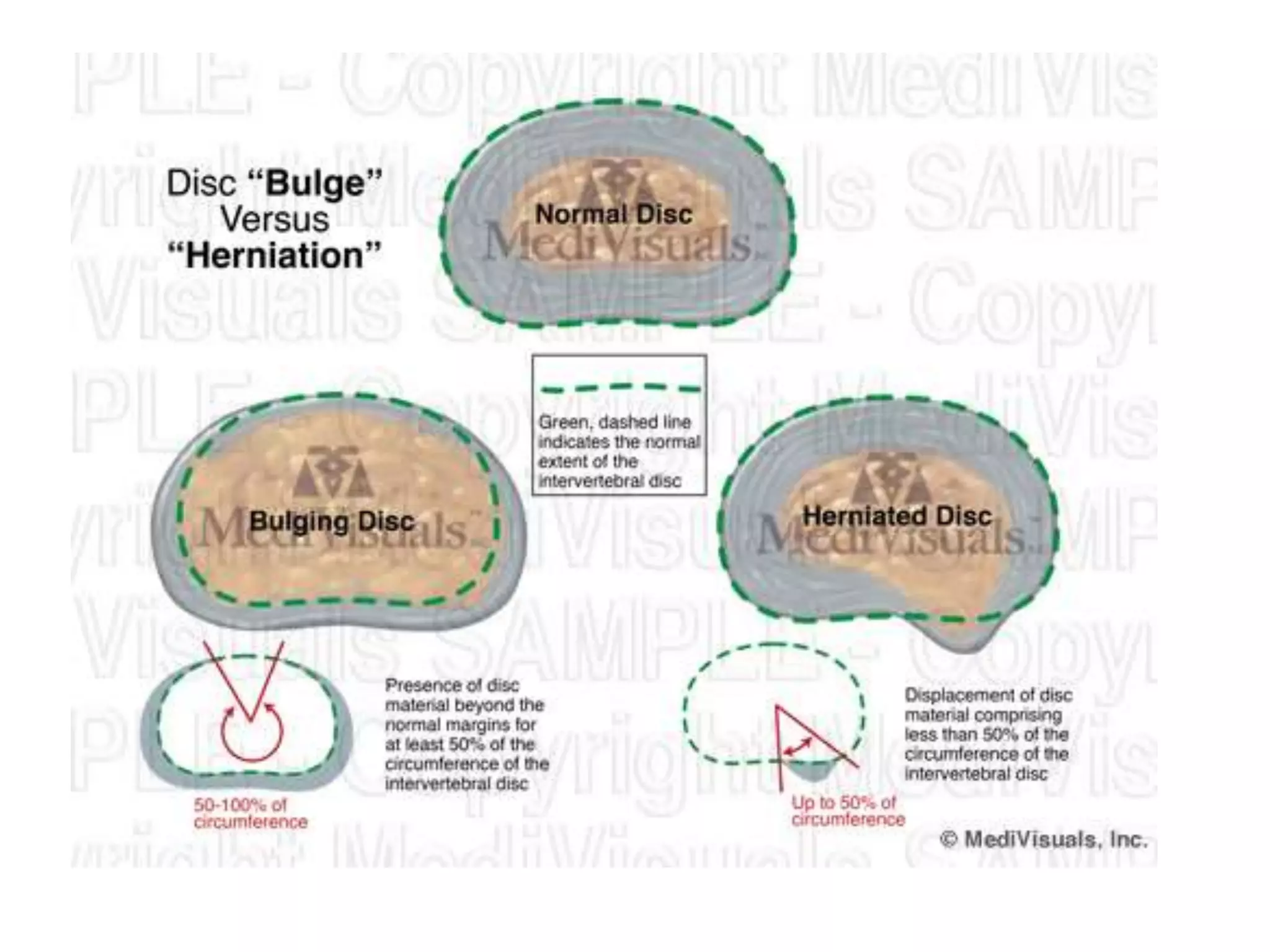
A ) DISCBULGE
Generalized or circumferential disc displacement (involving 50% to 100%
of the disc circumference) is known as “bulging”, and is not considered a
form of herniation. Bulging can be symmetrical (displacement of disc
material is equal in all directions) or asymmetrical (frequently associated
with scoliosis)
The term bulge refers to a morphologic characteristic and is not
correlated with etiology or symptomatology. Bulging can be physiologic
(e.g. in the mid-cervical spine and at L5–S1), can reflect advanced
degenerative disc disease, can be associated with bone remodeling (as
in advanced osteoporosis), occur with ligamentous laxity, or can be a
“pseudo image” due to partial volume averaging
(Fardon and Milette 2001).
15.
a–c. Symmetrical andasymmetrical bulging disc on transverse CT or MRI
scans.
a ) - Normally the intervertebral disc (gray) does not extend beyond the edges
of the ring apophyses (black line).
b ) - In a symmetrically bulging disc, the disc tissue extends concentrically
beyond the edges of the ring apophyses (50%–100% of disc circumference).
c ) - An asymmetrical bulging disc can be associated with scoliosis. Bulging
discs are not considered a form of herniation
a b c
18.
B ). ANNULARTEAR
Disruption of concentric collagenous fibers comprising
the anulus fibrosus
MR Findings
• T1WI: Contrast-enhancing nidus in disc margin
• T2WI: High signal zone at edge of disc which has low intrinsic
signal
20.
Concentric tearsare circumferentiallesions which are found in the outer
layers of the annular wall (Martin et al. 2002). They represent splitting between
adjacent lamellae of the annulus, like onion rings. Concentric tears are most
commonly encountered in the outer annulus fibrosus, and are believed to be of
traumatic origin especially from torsion overload injuries.
Radial tears are characterized by an annular tear which permeates from the
deep central part of the disc (nucleus pulposus) and extends outward toward the
annulus, in either a transverse or cranial-caudal plane.
Transverse tears, also known as “peripheral tears” or “rim lesions,” are
horizontal ruptures of fibers, near the insertion in the bony ring apophyses. Their
clinical significance remains unclear. Transverse tears are believed to be traumatically
induced and are often associated with small osteophytes.
TYPES
On a CTdiscography. The black arrows
point to the concentric anular tear in the
periphery of the anulus. The white arrows
points to the central radial tear.
In Fig. #1 the injected dye (black) does not
leak out of the nucleus. This is normal.
Fig.#2 demonstrates a massive Grade 4
radial disc tear. Note how the contrast
(black) has leaked out from the center of the
disc through a massive complete radial tear.
24.
L4-L5 CT diskogramdemonstrating
a large left posterolateral radial
anular tear associated with a left
foraminal and extraforaminal
herniaton
25.
C). DISC HERNIATION
Herniationis defined as a localized displacement of
disc material (nucleus, cartilage, fragmented
apophyseal bone, fragmented annular tissue) beyond
the limits of the intervertebral disc space.
(Fardon and Milette 2001).
Intravertebral Herniations
Protruded Disc
Extruded Disc
26.
Herniated discs inthe cranio-caudal (vertical)
direction through a break in one or both of the
vertebral body endplates are referred to as
“intravertebral herniations” (also known as Schmorl’s
nodes). They are often surrounded by reactive bone
marrow changes.
Nutrient vascular canals may leave scars in the
endplates, which are weak spots representing a route
for the early formation of intrabody nuclear
herniations
(Chandraraj et al. 1998).
INTRAVERTEBRAL HERNIATIONS
The terminology “protrudeddisc” is used when the base
of the disc is broader than any other diameter of the
displaced material.
Based on a two-dimensional assessment of the disc
contour in the transverse plane, a protruded disc can be
focal (involving <25% of the disc circumference) or
broad-based (involving 25%–50% of the disc circumference).
“PROTRUDED DISC
30.
Types of discherniation as seen on transverse CT or MRI
scans.
a, b Protrusions: the base of the herniated disc material is
broader than the apex. Protrusions can be broad-based (a) or
focal (b)
32.
The terminology “extrudeddisc” is used for a focal disc
extension of which the base against the parent disc is
narrower than the diameter of the extruded disc material,
measured in the same plane.
EXTRUDED DISC HERNIATIONS
Extrusion: the base of the herniation is
narrower than the apex (toothpaste sign)
34.
Massive lumbar discextrusion at L5–S1 in a 44-year-old man. Sagittal (a)
and axial (b) T1-weighted images; sagittal (c) and axial (d) T2-weighted
images. The extruded disc compresses and displaces the right S1 nerve
root. On the sagittal T1-weighted image, the continuity between the
extruding portion and the parent disc can clearly be identified.
36.
Extrusion is alsoused when there is no continuity between the
herniated disc material beyond the disc space and that within the disc
space
If the displaced disc material has no connection with the parent disc, it
is called a “sequestrated fragment” (Fig. 6.19). This is synonymous with
a “free fragment”.
37.
MIGRATION – SEQUESTRATION
Migration
indicatesdisplacement of disc material away from the site of extrusion, regardless of whether
sequestrated or not.
Sequestration
indicate that the displaced disc material has lost completely any continuity with the parent disc
38.
A,- Small subligamentousherniation (protrusion) without significant disk material migration.
B, - Subligamentous herniation with downward migration of disk material under the PLLC.
C, - Sub-ligamentous herniation with downward migration of disk material and sequestered
fragment (arrow).
40.
3) . VertebralEndplates and Bone Marrow
Changes
three degenerative stages of vertebral endplates and subchondral
bone (Modic et al. 1988a,b)
44.
• Modic type1 changes - acute inflammatory stage, and can
be associated with substantial functional disability.
• naturally transform into type 2 lesions (Mitra et al. 2004).
• The transformation usually takes place over a time course
of 1–2 years, and can relate to a change in patient’s
symptoms (Parizel et al. 1999).
45.
Degenerative Changes ofthe
Posterior Elements
1. Facet Joints
2. Ligamentum Flavum
3. Spinal Canal
4. Spinous Process
5. Nerve root
46.
The double obliquityof the facet joints in transverse and sagittal
planes, and the curvature of the articular surfaces makes plain films
less suited to the evaluation of facet joint degeneration.
(Grenier et al. 1987)
Only the portion of each joint that is oriented parallel to the X-ray
beam is visible. Although it is a moderately insensitive technique
compared to CT, it may be valuable in screening for facet joint
osteoarthritis.
(Pathria et al. 1987).
Osteophytes, hyperostosis and facet joint narrowing may be
observed on plain film; also concomitant spondylolisthesis may be
demonstrated by standard radio-of posterior soft tissue elements
(i.e. ligamentum flavum) and measurement of the transverse
diameter of the spinal canal.
(Grenier et al. 1987).
MODALITY OF CHOICE
47.
More subtle changes,e.g. cartilage changes, and subchondral erosions
can be better analyzed on axial CT and MR imaging. Both techniques
have intrinsic high spatial and contrast resolution. In general there is
moderate to good agreement between MR imaging and CT in the
assessment of facet joint osteoarthritis. Therefore, in the presence of
an MR examination,CT is not required for the evaluation of facet joint
degeneration. Conversely, it was demonstrated that CT was superior
to MR imaging in the depiction of joint space narrowing and
subchondral sclerosis.
(Weishaupt et al. 1999).
Using MR imaging, sagittal views are preferred for identifying the
pathological level(s), measuring the sagittal diameter of the spinal
canal, and for grading foraminal stenosis. Axial images at appropriate
levels are preferred for a more precise analysis of the facet joints
(cartilage, osteophytes)
Degenerative changes ofthe facet
joint
Degenerative Changes
Cartilage lining loses
water content
Cartilage wears away
Facets override each
other
Leads to abnormal
function of motion
segment
50.
Osteoarthritis of theFacet Joints
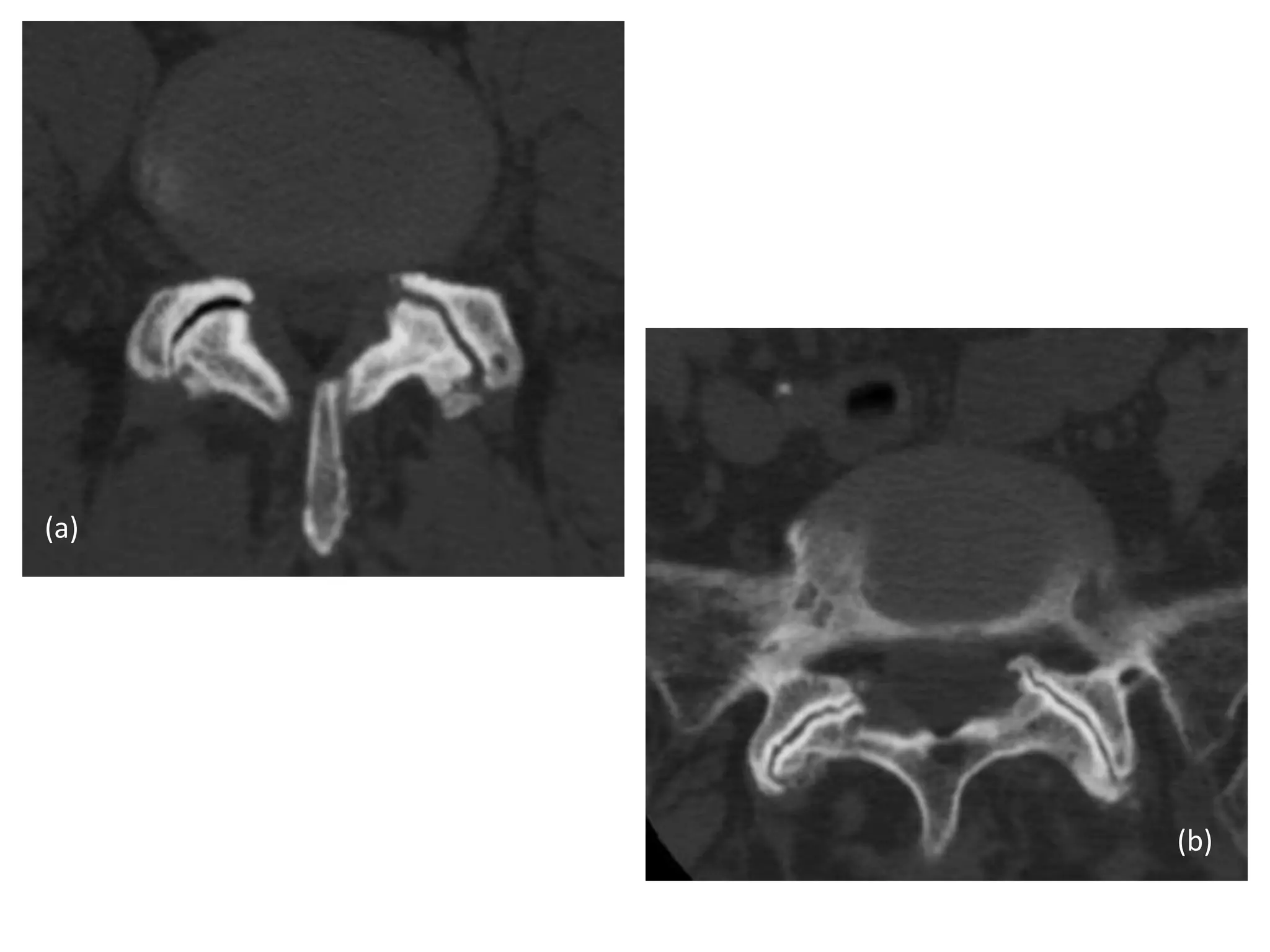
Osteophyte is excrescent new bone formation, lacking a medullary
space, arsing from the margin of the joint. Osteophytes protruding
ventrally from the anteromedial aspect of the facet joints may narrow
the lateral recesses and intervertebral foramina causing central or
lateral spinal canal stenosis .
(Wybier 2001).
Hypertrophy was defined as enlargement of an articular process with
normal proportions of its medullary cavity and cortex .
(Carrera et al. 1980).
53.
Pathria et al.(1987) used a four-point scale to grade facet joint
osteoarthritis on oblique radiographs and CT scans. These criteria were
refined by Weishaupt et al. (1999) who used these criteria for grading
osteoarthritis of the facet joints on CT and MR imaging.
GRADE CRITERIA
0 Normal facet joint space (2–4 mm width)
1 Narrowing of the facet joint space (<2 mm) and/or small osteophytes and/or
mild hypertrophy of the articular processes
2 Narrowing of the facet joint space and/or moderate osteophytes and/or
moderate hypertrophy of the articular processes and/or mild subarticular
bone erosions
3 Narrowing of the facet joint space and/or large osteophytes and/or severe
hypertrophy of the articular processes and/or severe subarticular bone
erosions and/or subchondral cysts
VACUUM PHENOMENA
Involving theintervertebral disc relate to the
accumulation of gas, principally nitrogen, in crevices
within the intervertebral disk or vertebra. While they
can commonly occur with intervertebral disc
degerative disease, their appearance does not
uniformly indicate "degenerative" disc disease, as
gaseous collections may accompany other processes
(vertebral osteomyelitis, Schmorl node formation,
spondylosis deformans, vertebral collapse with
osteonecrosis) affecting the disc and adjacent
vertebral bodies.
Associated Soft TissueChanges
Soft tissue changes associated with facet joint degeneration
include: degenerative cysts arising from the facet joints (so-
called Juxtafacet cysts), ligamentum flavum cysts, and
hypertrophy and/or calcification of the ligamentum flavum
59.
Degenerative cysts arisingfrom the facet
joints: juxtafacet cysts
Synovial cysts are periarticular cysts of the synovial membrane, with a
membrane attached to the joint capsule. They contain clear or yellow
mucinous fluid or gas. The walls are of loose myxoid connective or
fibrocollagenous tissue with a synovial lining. In contrast, ganglion cysts
have no connection to the joint and no synovial lining. They contain
myxoid material. The consistency of fluid within the cysts varies greatly
because of hemorrhage and inflammation.
(Stoodley et al. 2000).
60.
The signal intensityof the cysts is equal to or slightly
greater than that of cerebrospinal fluid (CSF) on both T1-
and T2-weighted images. Synovial cysts with high signal on
T1- and T2-weighted images indicate the presence of
subacute breakdown products of blood. All synovial cysts
have a low signal intensity rim at the periphery that is
accentuated on long TR/TE sequences. After administration
of gadolinium these cysts show rim enhancement.
( Tillich et al. 2001).
The typical appearanceon CT is of a rounded mass of low
attenuation adjacent to the facet joint. CT may show egg-shell
calcifications of the wall of the cyst (Lunardi et al. 1999) and gas
inside the cyst.
(Stoodley et al. 2000).
Degenerative Changes
Partial ruptures, necrosis
and calcifications
Negatively impact function
of motion segment
67.
CYSTS OF THELIGAMENTUM FLAVUM
The development of these cysts may be related to necrosis or
myxoid degeneration occurring in a hypertrophied
ligamentum flavum.
(Cakir et al. 2004).
Chronic degenerative changes in the ligamentum flavum,
followed by (repeated) hemorrhage gives rise to small
degenerative cysts which enlarge and coalesce to form a large
cyst.
( Cakir et al. 2004).
68.
On imaging, anintraspinal, extradural mass adjacent
to the ligamentum flavum is found. On CT, the lesion
has a low density attenuation. Unlike in synovial or
ganglion cysts, rim calcification has not been
reported.
(Terada et al. 2001)
On MRI, a well defined, round to ovoid cystic mass
lesion is observed. It has a high signal intensity on T2-
weighted images with a low signal intensity rim. Thick
peripheral enhancement after gadolinium injection is
seen.
( Mahalatti et al. 1999).
70.
LIGAMENTUM FLAVUM HYPERTROPHY
Symmetricalthickening of the ligamentum flavam is a frequently
observed finding in facet joint arthropathy. It results from joint
effusion, progressive ligamentousfibrosis, calcification and/or
ossification.
(Wybier 2001).
Calcifications of the ligamentum flavam have been observed in
patients with diffuse idiopathic skeletal hyperostosis(DISH) and
ankylosing spondylitis. Calcifications are also associated with metabolic
diseases such as renal failure, hypercalcemia, hyperparathyroidism,
hemochromatosis, and pseudogout. At the periarticular level, however,
it is generally considered a sign of degenerative disease, whereas at
the levels of insertions, it is considered a normal variant related to
traction.
(Ruiz Santiago et al. 1997).
71.
MRI of spinalstenosis: arrow points to the
moderately stenotic spinal canal caused by
hypertrophic facets and ligament flavum
72.
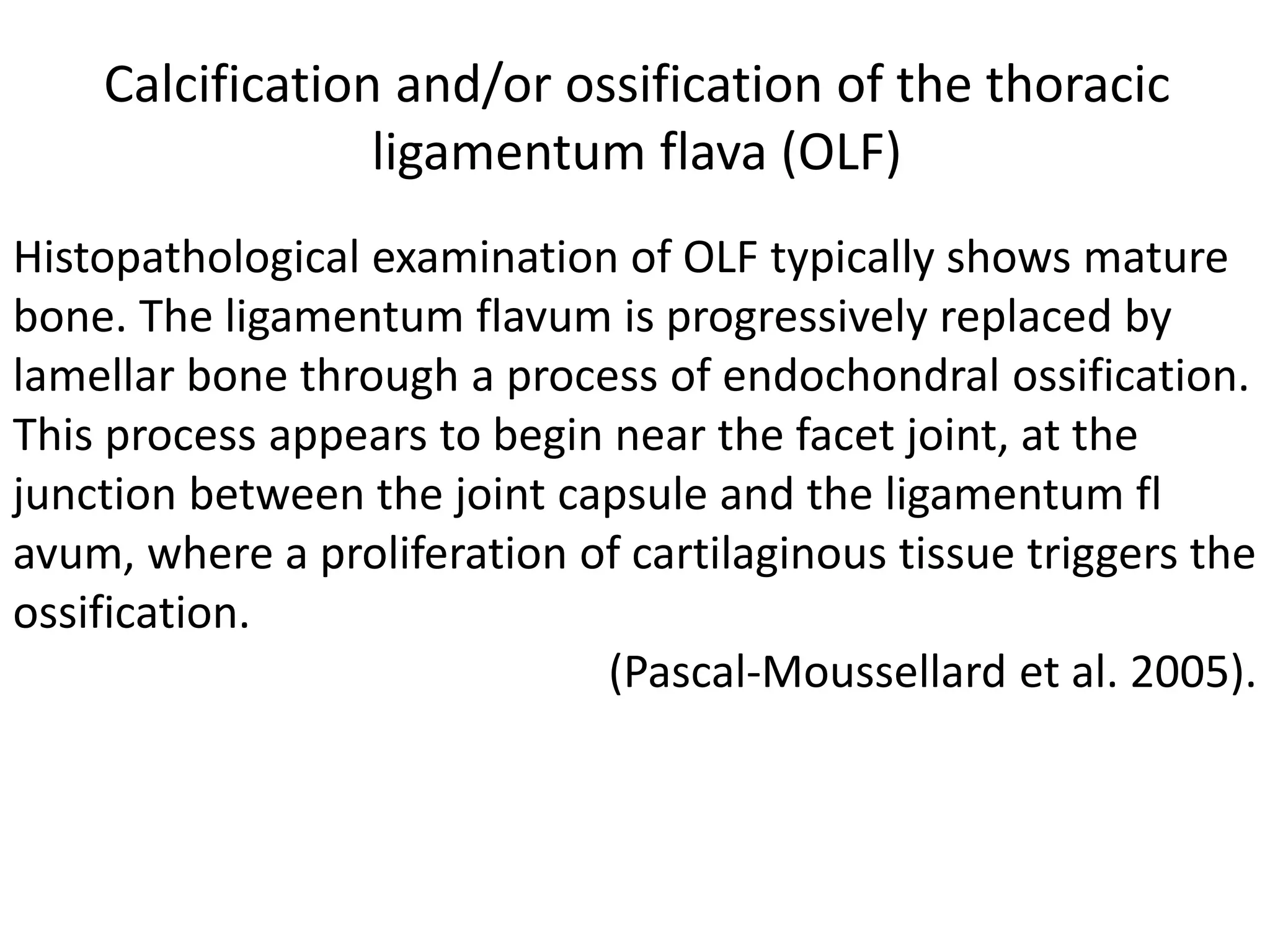
Histopathological examination ofOLF typically shows mature
bone. The ligamentum flavum is progressively replaced by
lamellar bone through a process of endochondral ossification.
This process appears to begin near the facet joint, at the
junction between the joint capsule and the ligamentum fl
avum, where a proliferation of cartilaginous tissue triggers the
ossification.
(Pascal-Moussellard et al. 2005).
Calcification and/or ossification of the thoracic
ligamentum flava (OLF)
75.
Spinal involvement withcalcification of the ligamenta flava due to
calcium pyrophosphate dihydrate (CPPD) deposition disease, also known
as pseudogout, is rare, but may also lead to spinal stenosis and spinal
cord compression. When involved, the cervical and lumbar regions are
commonly affected.
(Muthukumar et al. 2000).
CPPD deposition may be associated with hyperparathyroidism and
haemochromatosis.
(Brown et al. 1991).
SPONDYLOLISTHESIS
Spondylolisthesis (also knownas anterolisthesis) is defined as an
anterior displacement of a vertebra relative to the vertebra below,
whereas the reverse, i.e. when the superior vertebra slips posterior to
that below, is called retrolisthesis
(Butt and Saifuddin 2005).
83.
Degenerative spondylolisthesis, firstdescribed by Newman
(Newman 1955), most frequently is found at the lumbar and
cervical level. In contrast to what happens in isthmic
spondylolisthesis, particularly if bilateral, there is a spinal
canal stenosis due to arthritic facet joints and hypertrophic
yellow ligaments with associated narrowing of the neural
foramen and the lateral recess (Fig. 8.8). Obliterated anterior
fat tissue, lost periradicular tissue, and compression of the
dural sac are observed. If unilateral, the side of the
degenerated facet joints is mostly stressed (Osborn 1994).
SPONDYLOLISTHESIS
84.
GRADING OF LUMBAR
SPONDYLOLISTHESIS
Theforward slip of the upper vertebra is measured using the
method of Meyerding, or the method described by Taillard.
Using the method of Meyerding, the anteroposterior (AP)
diameter of the superior surface of the lower vertebra is
divided into quarters and a grade of I– IV is assigned to slips
of one, two, three or four quarters of the superior vertebra,
respectively. The other method, described by Taillard,
expresses the degree of slip as a percentage of the AP
diameter of the top of the lower vertebra .
(Butt and Saifuddin 2005).
86.
Type Cause
1. DysplasticCongenital dysplasia of the articular processes
2. Isthmic Defect in the pars articularis
3. Degenerative Degenerative changes in the facet joints
4. Traumatic Fracture of the neural arch other than the pars articularis
5. Pathological Weakening of the neural arch due to disorders of the bone
6. Iatrogenic Excessive removal of bone following spinal decompression
BASED ON ETIOLOGY, SPONDYLOLISTHESIS HAS BEEN CLASSIFIED BY
WILTSE ET AL.(1976)
A REVISED VERSION OF THIS CLASSIFICATION
87.
Isthmic spondylolisthesis occurswhen a bilateral defect in the
pars interarticularis is present. The pars interarticularis (also
known as the isthmus) is the part of the neural arch that joins
the superior and inferior articular processes. A defect at this
point functionally separates the vertebral body, pedicle, and
superior articular process from the inferior articular process
and remainder of the vertebra.
TYPE 2, ISTHMIC SPONDYLOLISTHESIS:
SPONDYLOLYSIS
90.
As the neuralarch is intact, even a small progression in the slip may
cause cauda equina syndrome. Women are four times more affected
than men. Most commonly, the L4–L5 level is involved and its
incidence increases four times if there is a sacralized L5. Clinical
symptoms include low-back pain and leg pain as a result of disc and
facet joint degeneration, lateral recess and foraminal stenosis
leading to nerve root compression. With progression of the
spondylolisthesis, the symptoms may change from low-back pain to
neurogenic claudication due to central canal stenosis .
(Butt and Saifuddin 2005).
Lateral plain fi lm shows anterolisthesis, degenerative changes of the
facet joints, and disc space narrowing. Malalignment of the spinous
processes with anterior slip of the spinous process relative to the
spinous process of the lower vertebra allows differentiation from
isthmic spondylolisthesis (Butt and Saifuddin 2005).
Type 3, Degenerative Spondylolisthesis
Spinous Process Abnormalities(Baastrup’s Disease)and
Associated Ligamentous Changes
Baastrup’s disease, also known as kissing spine, has been
described as a cause of low-back pain. It is characterized by close
approximation and contact of adjacent spinous processes with
resultant enlargement, flattening and reactive sclerosis of the
apposing interspinous surfaces (Chen et al. 2004).
Neoarthrosis between the spinous processes has been
described. Patients with Baastrup’s disease may experience pain
owing to irritation of the periosteum or adventitial bursae between
abutting spinous processes (Pinto et al. 2004).
Interspinous bursitis may communicate with the facet joints at
the same intervertebral level. They may be treated with steroid
injections (Wybier 2001).
The normal intervertebralforamen is shaped like an inverted
teardrop, and its height and crosssectionalarea vary from 11
to 19 m.m. and from 40 to 160 mm2, respectively. The
intervertebral foramen of the lumbar spine changes
significantly not only on fl exion-extension but also on lateral
bending and axial rotation (Fujiwara et al. 2001b). Foraminal
height ranges between 19 mm and 21 mm and the superior
and inferior sagittal diameter of the foramen ranges between
7 mm and 8 mm and between 5 mm and 6 mm, respectively.
(Cinotti et al. 2002).
Instead of measuring the dimensions of the intervertebral
foramen, a qualitative scoring system introduced by
Wildermuth et al.(1998) can be used to determine foraminal
narrowing.
99.
CRITERIA FOR GRADINGFORAMINAL OF THE FACET JOINTS
(AFTER WILDERMUTH ET AL. 1998)
GRADE Criteria
0 Normal intervertebral foramina; normal dorsolateral border of the intervertebral
disc and normal form at the foraminal epidural fat (oval or inverted pear shape)
1 Slight foraminal stenosis and deformity of the epidural fat, with the remaining fat
still completely surrounding the exiting nerve root.
2 Marked foraminal stenosis, with epidural fat only partially surrounding the nerve
root.
3 Advanced stenosis with obliteration of the epidural fat.
100.
1. DEGENERATIVE ENDPLATE CHANGES
2. DISC BULGE
3. ANNULAR TEAR
4. DISC HERNIATION
5. I. V. D. EXTRUSION / PROTRUSION
6. FACET ARTHROPATHY
7. FACET JOINT SYNOVIAL CYST
NEURAL ARCH
Excessive lumbarlordosis is frequently associated
with spine degeneration, especially in women
after menopause. Approximation of adjacent
vertebral neural arches may result in abnormal
bony contacts in different areas and may even
result in a neoarthrosis
(Wybier 2001).
Associated remodelling or bony sclerosis of the
NEURAL ARCH INTERVERTEBRAL NEOARTH
105.
annular tears
rim lesion
concentrictear
radial tear
Osti OL, Vernon-Roberts B, et al. “Annular Tears & Disc Degeneration” J Bone Joint Surg.
[Br] 1992; 74-B:678-82
Gordon SJ, Yang KH, Mayer PJ, et al: Mechanism of disc rupture. A preliminary report.
Spine 16:450-456, 1991
106.
internal disruption
Crock HV,Internal disc disruption. A challenge to disc prolapse fifty years on. Spine
1986 ;11:650-3
107.
Pathology of IntervertebralDisc Injury
• Annular Injury
– Annular rings
• Softened
• Overstretched
• Torn
– Normal viscoelasticity is exceeded
– Cannot stabilize or limit motion
– Nucleus pulposus exerts pressure on weak part
– Buckling occurs - Disc Bulge
108.
Pathology of IntervertebralDisc Injury
• Extrusion
– Fragmentation of
nucleus pulposus
– Nuclear material
dissects its way through
breaches in annulus
fibrosus
109.
Pathology of IntervertebralDisc Injury
• Prolapses
– Fissures provide
pathway for irritating
nuclear fluid to escape
onto perineural tissue *
• Persistent and chronic
back pain
*- Hampton et al






![annular tears
rim lesion
concentric tear
radial tear
Osti OL, Vernon-Roberts B, et al. “Annular Tears & Disc Degeneration” J Bone Joint Surg.
[Br] 1992; 74-B:678-82
Gordon SJ, Yang KH, Mayer PJ, et al: Mechanism of disc rupture. A preliminary report.
Spine 16:450-456, 1991](https://image.slidesharecdn.com/degenerativespine8-140312140817-phpapp02/75/Degenerative-spine-105-2048.jpg)