DENGUE FEVER

                                                 Dr. S. Rajendra
                                                     Kumar
                                                     Dept. Science &
                                                      Humanities
                                                  Mookambigai College of
                                                      Engineering


 http://www.mosquitoage.org/Portals/12/Images/dengue%20virus_em.jpg
Dengue fever
 What did you know…

         VS

What you need to know…
Contents
1. What is dengue fever

2. Distribution & History of dengue fever

3. Symptoms of dengue fever

4. Characteristics of the Aedes mosquito

5. Life cycle of the Aedes mosquito

6. How the Aedes mosquito transmit diseases

7. Health issues due to dengue fever

8. Treatment related to Dengue fever

9. How to prevent the spread of dengue fever – Site Control
What is dengue fever?
   Dengue Fever is an illness caused by
infection with a virus transmitted by the
            Aedes mosquito.
    Dengue Fever (DF) and Dengue
 Haemorrhagic Fever (DHF) are the most
 common mosquito-borne viral disease in
              the world.

            It can be fatal.
Symptoms of Dengue Fever


Example of a skin rash due
    to dengue fever
Dengue is a tropical febrile disease


    http://gamapserver.who.int/mapLibrary/Files/Maps/World_DengueTransmission_Extension_2008.png
Dengue Fever has a long history…
                      www.philadelphia-reflections.com/topic/17.htm


  992- Chinese
   Encyclopedia

1780- Philadelphia
 “break-bone fever”

 Benjamin Rush
Isolated by Albert Sabin in 1944


       http://www.notablebiographies.com/images/uewb_09_img0622.jp
       g
Spread of the vector and the disease
          go hand in hand
www.latinamericanstudies.org/Transatlantic.htm


                                                          Transatlantic Slave Trade


        World War II
                                                 http://neatorama.cachefly.net/images/2007-09/world-war-2.jpg
…and become a MAJOR pandemic
      in the last 50 years

Endemic in more than
    1oo countries

   2.5 billion
   people at risk


                       www.tatterhood.com/category/gameart/tastyplanet
How is it spread??


         http://www.metapathogen.com/IMG/Aedes-aegypti.jpg


THE VECTOR: Aedes aegypti
Characteristics of the
Aedes Mosquito
One distinct physical
feature – black and
white stripes on its body
and legs.

   Bites during the day.
Lays its eggs in clean,
stagnant water and year     Close-up of an Aedes mosquito
around breading
Favourite zone – Tropical regions, Breeding

temperature 16 – 40o C
Do you know…

Only the female Aedes mosquito
feeds on blood. This is because
they need the protein found in
blood to produce eggs. Male
mosquitoes feed only on plant
nectar.

On average, a female Aedes
mosquito can lay about 300 eggs
during her life span of 14 to 21
days.
Life cycle of the Aedes Mosquito


                                                              21 days
1-2 days
                                                         Longevity,
                                                   Fly range <1/2km


   Pupae                  Larvae                       Eggs


           4-5 days                    2-3 days


                                                  Eggs Desiccation
                      Stagnant water               for and years
How Do Aedes Mosquitoes Transmit
          Diseases...

 Mosquito bites and sucks                               And passes the virus
 blood containing the virus                               to healthy people
  from an infected person.                               when it bites them.


                              Virus is carried in its
                                      body.


  Aedes mosquitoes breeding…                    Dengue Virus infections …
Dengue Presentation

Early Stage
    Initially like other viral fever

But later……….
    Fever
    Rash
    Severe headache
    Musculoskeletal pains
Dengue Presentations
Dengue Presentations - Dengue
        Hemorrhagic Fever (DHF) / Dengue
             Shock Syndrome (DSS)
   Symptoms:
       Plasma leakage
       Hepatomegaly
       Low blood pressure

   Hypovolemic shock
   Death
Dengue Presentation - Bleeding
        from where?
 Bleeding into skin
 From Gums

 From Nose

 Into our food

  passages
 Blood in urine
Skin bleeds
Bleeding into the eye
Large bleed into skin
Rare types of Dengue
 Brain fever
 Liver damage

 Heart damage

 Severe bleeding

  into stomach
What are the tests needed?

 Routine blood test
 Tests to check the clotting

  process
 Special tests to identify the

  Dengue or its foot marks in our
  blood
 Urine to check protein leak
Treatment of Dengue

 Supportive measures – Mosquito screen
 Avoid Aspirin and pain killers

 Steroids should not be used

 Plenty of water and salt are required

 Children below 12 require careful watch

  for dangerous form
 No antibiotics are of proven value
Can we protect ourselves?
 There is no vaccine available as
  yet
 But we can prevent the disease by

  preventing ourselves from
  mosquito bite
There is no specific treatment for DHF
          http://www.health-res.com/EX/08-01-15/82560-main_Full.jpg


         Can only treat the symptoms
Aedes mosquito Breeding sites
BREEDING SOURCES
BREEDING SOURCES
Prevent Aedes from Breeding!


    Remove ALL sources of
       stagnant water.

   Deny the Aedes mosquito of any
         chance to breed.
Angry VHN in action- enemy home
under attack
Appears to be complex problem-
but solutions are simpler
Keep the unused grinder stone upside
down – Encourage to use as a sitting
stone
Washing with bleaching powder
or ash and a brush
Lock the concrete mixer in
upside down position after work
Covered with cloth
All plastic wastes are removed
Drilled on allsides
How can we stop it?

       Mosquito control:
          Improved   water
           storage – Physical
          Introduction of
           mosquito-eating
           fish – Biological
          Insecticides -
           Chemical
How can we stop it?

1. Anti Larval Measures: Treating
   breading source with chemical larvicide
   “Temephos 50%” EC at the rate of 1ppm
2.Anti Adult Measures: indoor and
   outdoor thermal fogging operation
   using 1 part of Pyrethrum 2% and 19
   parts diesal. Out door: 60 litre of
   Pyrethrum, 114 litre diesal are mixed for
   fogging
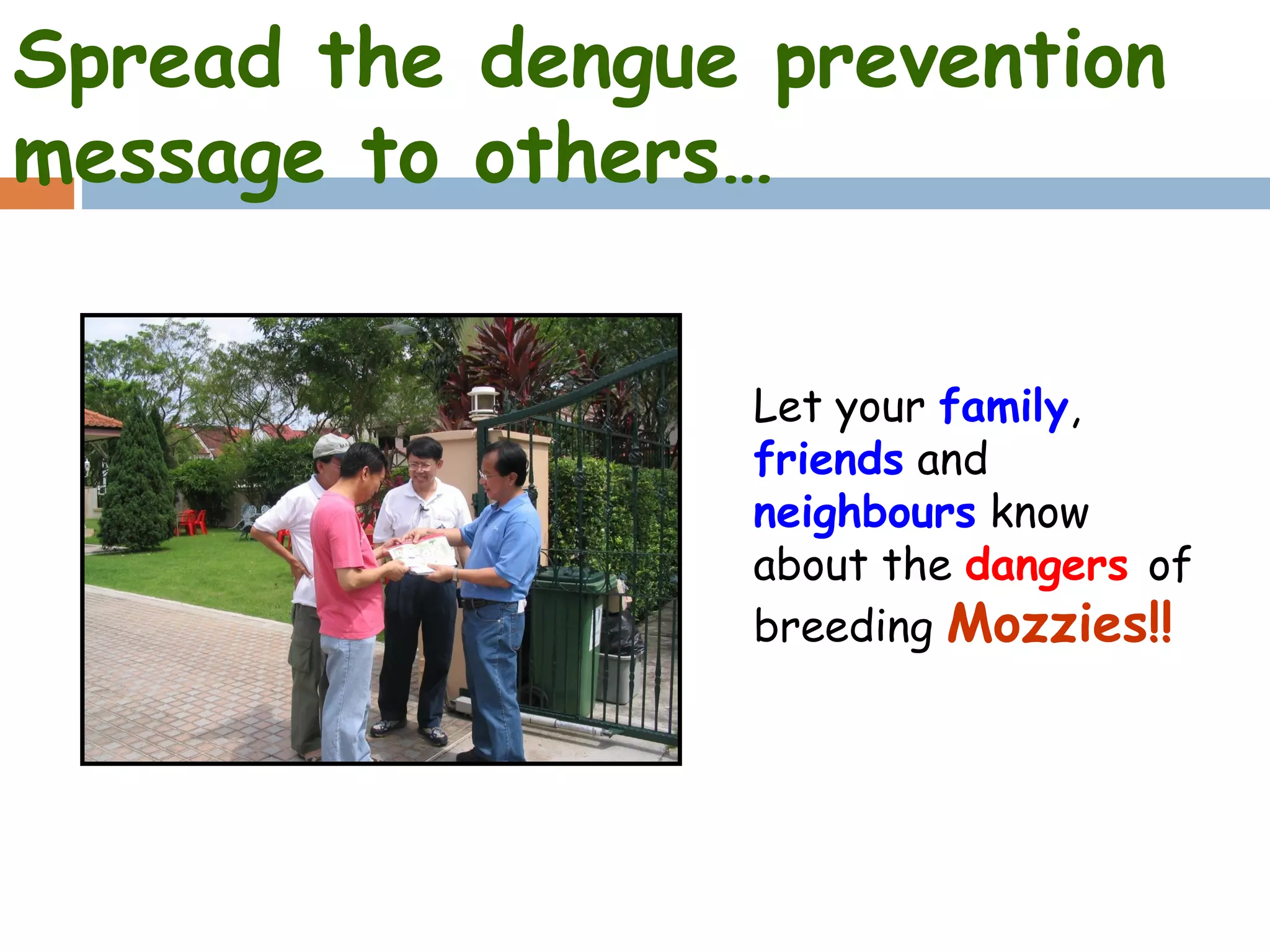
Spread the dengue prevention
message to others…


                 Let your family,
                 friends and
                 neighbours know
                 about the dangers of
                 breeding Mozzies!!
Thank you

Dengue mce 21_11_2012

  • 1.
    DENGUE FEVER Dr. S. Rajendra Kumar Dept. Science & Humanities Mookambigai College of Engineering http://www.mosquitoage.org/Portals/12/Images/dengue%20virus_em.jpg
  • 2.
    Dengue fever Whatdid you know… VS What you need to know…
  • 3.
    Contents 1. What isdengue fever 2. Distribution & History of dengue fever 3. Symptoms of dengue fever 4. Characteristics of the Aedes mosquito 5. Life cycle of the Aedes mosquito 6. How the Aedes mosquito transmit diseases 7. Health issues due to dengue fever 8. Treatment related to Dengue fever 9. How to prevent the spread of dengue fever – Site Control
  • 4.
    What is denguefever? Dengue Fever is an illness caused by infection with a virus transmitted by the Aedes mosquito. Dengue Fever (DF) and Dengue Haemorrhagic Fever (DHF) are the most common mosquito-borne viral disease in the world. It can be fatal.
  • 5.
    Symptoms of DengueFever Example of a skin rash due to dengue fever
  • 6.
    Dengue is atropical febrile disease http://gamapserver.who.int/mapLibrary/Files/Maps/World_DengueTransmission_Extension_2008.png
  • 7.
    Dengue Fever hasa long history… www.philadelphia-reflections.com/topic/17.htm 992- Chinese Encyclopedia 1780- Philadelphia “break-bone fever” Benjamin Rush
  • 8.
    Isolated by AlbertSabin in 1944 http://www.notablebiographies.com/images/uewb_09_img0622.jp g
  • 9.
    Spread of thevector and the disease go hand in hand www.latinamericanstudies.org/Transatlantic.htm Transatlantic Slave Trade World War II http://neatorama.cachefly.net/images/2007-09/world-war-2.jpg
  • 10.
    …and become aMAJOR pandemic in the last 50 years Endemic in more than 1oo countries 2.5 billion people at risk www.tatterhood.com/category/gameart/tastyplanet
  • 11.
    How is itspread?? http://www.metapathogen.com/IMG/Aedes-aegypti.jpg THE VECTOR: Aedes aegypti
  • 12.
    Characteristics of the AedesMosquito One distinct physical feature – black and white stripes on its body and legs.  Bites during the day. Lays its eggs in clean, stagnant water and year Close-up of an Aedes mosquito around breading Favourite zone – Tropical regions, Breeding temperature 16 – 40o C
  • 13.
    Do you know… Onlythe female Aedes mosquito feeds on blood. This is because they need the protein found in blood to produce eggs. Male mosquitoes feed only on plant nectar. On average, a female Aedes mosquito can lay about 300 eggs during her life span of 14 to 21 days.
  • 14.
    Life cycle ofthe Aedes Mosquito 21 days 1-2 days Longevity, Fly range <1/2km Pupae Larvae Eggs 4-5 days 2-3 days Eggs Desiccation Stagnant water for and years
  • 15.
    How Do AedesMosquitoes Transmit Diseases... Mosquito bites and sucks And passes the virus blood containing the virus to healthy people from an infected person. when it bites them. Virus is carried in its body. Aedes mosquitoes breeding… Dengue Virus infections …
  • 16.
    Dengue Presentation Early Stage  Initially like other viral fever But later……….  Fever  Rash  Severe headache  Musculoskeletal pains
  • 17.
  • 18.
    Dengue Presentations -Dengue Hemorrhagic Fever (DHF) / Dengue Shock Syndrome (DSS)  Symptoms:  Plasma leakage  Hepatomegaly  Low blood pressure  Hypovolemic shock  Death
  • 19.
    Dengue Presentation -Bleeding from where?  Bleeding into skin  From Gums  From Nose  Into our food passages  Blood in urine
  • 20.
  • 21.
  • 22.
  • 23.
    Rare types ofDengue  Brain fever  Liver damage  Heart damage  Severe bleeding into stomach
  • 24.
    What are thetests needed?  Routine blood test  Tests to check the clotting process  Special tests to identify the Dengue or its foot marks in our blood  Urine to check protein leak
  • 25.
    Treatment of Dengue Supportive measures – Mosquito screen  Avoid Aspirin and pain killers  Steroids should not be used  Plenty of water and salt are required  Children below 12 require careful watch for dangerous form  No antibiotics are of proven value
  • 26.
    Can we protectourselves?  There is no vaccine available as yet  But we can prevent the disease by preventing ourselves from mosquito bite
  • 27.
    There is nospecific treatment for DHF http://www.health-res.com/EX/08-01-15/82560-main_Full.jpg Can only treat the symptoms
  • 28.
  • 29.
  • 30.
  • 31.
    Prevent Aedes fromBreeding! Remove ALL sources of stagnant water. Deny the Aedes mosquito of any chance to breed.
  • 32.
    Angry VHN inaction- enemy home under attack
  • 33.
    Appears to becomplex problem- but solutions are simpler
  • 34.
    Keep the unusedgrinder stone upside down – Encourage to use as a sitting stone
  • 35.
    Washing with bleachingpowder or ash and a brush
  • 36.
    Lock the concretemixer in upside down position after work
  • 37.
  • 38.
    All plastic wastesare removed
  • 39.
  • 40.
    How can westop it? Mosquito control:  Improved water storage – Physical  Introduction of mosquito-eating fish – Biological  Insecticides - Chemical
  • 41.
    How can westop it? 1. Anti Larval Measures: Treating breading source with chemical larvicide “Temephos 50%” EC at the rate of 1ppm 2.Anti Adult Measures: indoor and outdoor thermal fogging operation using 1 part of Pyrethrum 2% and 19 parts diesal. Out door: 60 litre of Pyrethrum, 114 litre diesal are mixed for fogging
  • 42.
    Spread the dengueprevention message to others… Let your family, friends and neighbours know about the dangers of breeding Mozzies!!
  • 43.