
Director –Dhanendra Dhanuka
Desert Locust situation update 10 February 2020
Desert Locust situation
update 10 February 2020
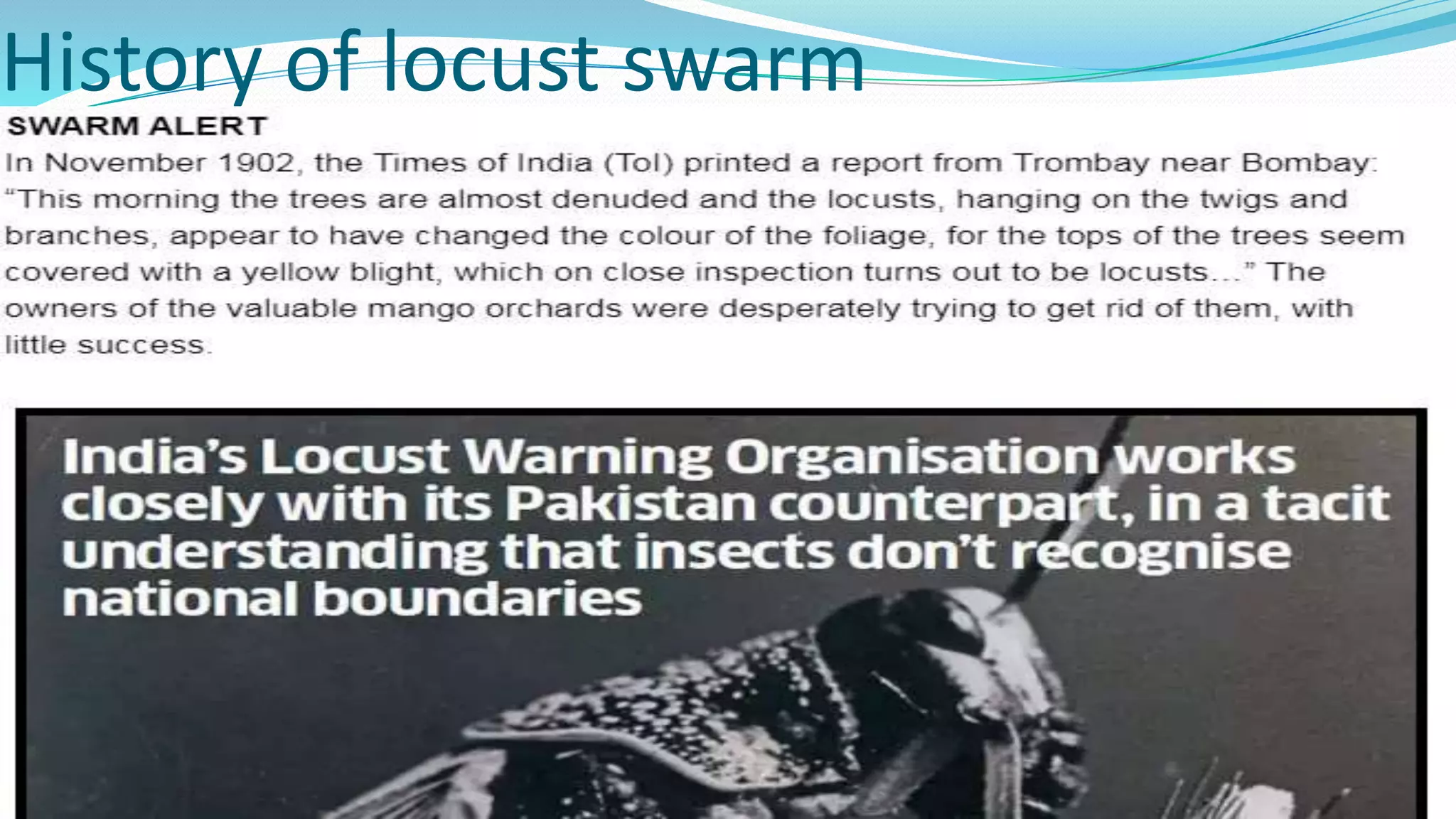
History of locust swarm
Desert Locust situation update 10 February 2020
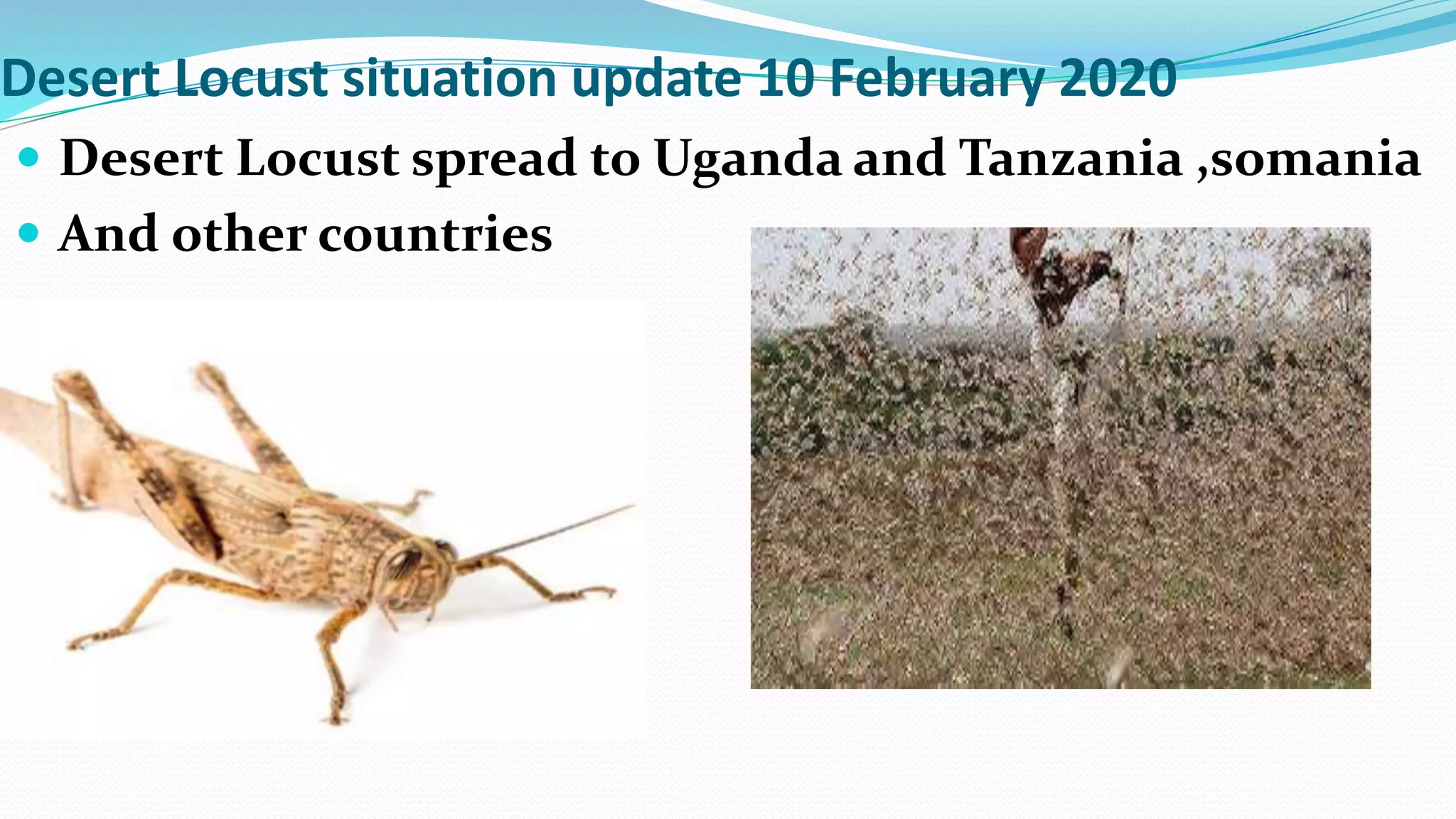
 Desert Locust spread to Uganda and Tanzania ,somania
 And other countries
10 February 2020
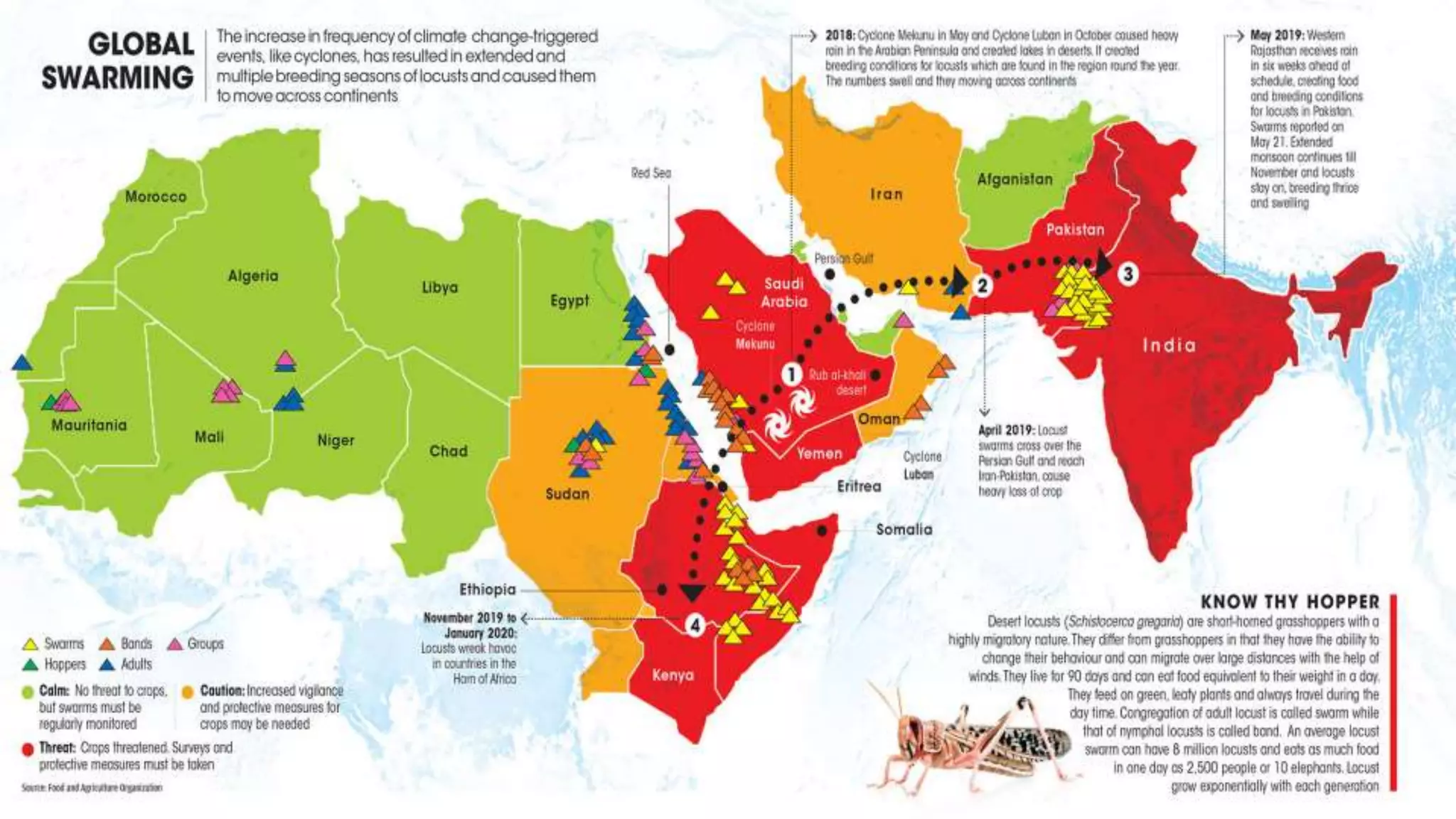
 Desert Locust spread to Uganda and Tanzania
 Breeding continues in the Horn of Africa, which will
cause locusts to increase further
in Ethiopia, Somalia and Kenya with new swarms
forming in March and April. Consequently, there is an
unprecedented threat to food security and livelihoods
in the region.
 Widespread egg laying and hatching have started, and
so far numerous dense early instar hopper bands are
present in some central areas. Aerial and ground
control operations are continuing.
Why locust swarm ?
 Due to climate change and adverse climatic condition for locust
 Rajasthan and Gujarat And some area of Punjab that has destroyed
crops over nearly 1.7 lakh hectares of farmland is an indirect consequence of
climate change, said experts Sunday at the Centre for Science and
Environment’s (CSE) annual media conclave Report in Rajasthan.
Facts about Locusts-
 Locusts are a collection of certain species of short-horned grasshoppers in the
family Acrididae that have a swarming phase.
 These insects are usually solitary, but under certain condition they become
more abundant and change their behavior and habits,.
 The Latin name for Desert Locust Schis-tocerca gregaria (Forskal).
Reproduction
 Desert Locust females lay eggs in an egg pod primarily in sandy soils at a depth
of 10-15 centimeters below the surface.
 A solitary female lays about 95-158 eggs whereas a gregarious female lays
usually less than 80 eggs in an egg pod. Females can lay at least three times in
their lifetime usually at intervals of about 6-11 days. Up to 1,000 egg pods have
been found in one square meter.
 Swarming Habit
 Desert Locusts usually fly with the wind at a speed of about 16-19 km/h
depending on the wind. Swarms can travel about 5-130 km or more in a day.
 Locusts can stay in the air for long periods of time. For example, locusts
regularly cross the Red Sea, a distance of 300 km.
 solitary Desert Locust adults usually fly at night whereas gregarious adults
(swarms) fly during the day.
 In India, the scheme Locust Control and Research (LC&R)
is responsible for control of Desert Locust and is being
implemented through Organization known as
“Locust Warning Organization (LWO)” established in
1939 and later work with the Directorate of Plant Protection
Quarantine and Storage in 1946.
Control (fao)-
 Can locusts hurt humans? Locusts do not attack people or animals. There is no evidence that
suggests that locusts carry diseases that could harm humans.
 How can locusts be controlled? At present the primary method of controlling Desert Locust
swarms and hopper bands is with mainly organphosphate chemicals applied in small concentrated
doses (referred to as ultra low volume (ULV) formulation) by vehicle-mounted and aerial sprayers
and to a lesser extent by knapsack and hand-held sprayers.
 Who carries out locust control operations? Locust survey and control are primarily the
responsibility of the Ministry of Agriculture in locust affected countries and are operations
undertaken by national locust units. There are also several regional locust organizations that assist
with survey and control operations. During times of outbreaks and plagues, external assistance
from the donor community and other international organizations is usually required.
 Are there any non-chemical ways to kill locusts? Extensive research is in progress on biological
control and other means of non-chemical control of locusts. The current focus is primarily on
pathogens and insect growth regulators. Thus far control by natural predators and parasites is
limited since locusts can quickly migrate away from most natural enemies. Although giant nets,
flamethrowers, lasers and huge vacuums have been proposed in the past, these are not in use for
locust control. People and birds often eat locusts but usually not enough to significantly reduce
population levels over large areas.

desert Locust warning 2020 #entomology

  • 1.
    Director –Dhanendra Dhanuka DesertLocust situation update 10 February 2020
  • 2.
  • 3.
  • 5.
    Desert Locust situationupdate 10 February 2020  Desert Locust spread to Uganda and Tanzania ,somania  And other countries
  • 6.
    10 February 2020 Desert Locust spread to Uganda and Tanzania  Breeding continues in the Horn of Africa, which will cause locusts to increase further in Ethiopia, Somalia and Kenya with new swarms forming in March and April. Consequently, there is an unprecedented threat to food security and livelihoods in the region.  Widespread egg laying and hatching have started, and so far numerous dense early instar hopper bands are present in some central areas. Aerial and ground control operations are continuing.
  • 7.
    Why locust swarm?  Due to climate change and adverse climatic condition for locust  Rajasthan and Gujarat And some area of Punjab that has destroyed crops over nearly 1.7 lakh hectares of farmland is an indirect consequence of climate change, said experts Sunday at the Centre for Science and Environment’s (CSE) annual media conclave Report in Rajasthan.
  • 9.
    Facts about Locusts- Locusts are a collection of certain species of short-horned grasshoppers in the family Acrididae that have a swarming phase.  These insects are usually solitary, but under certain condition they become more abundant and change their behavior and habits,.  The Latin name for Desert Locust Schis-tocerca gregaria (Forskal).
  • 10.
    Reproduction  Desert Locustfemales lay eggs in an egg pod primarily in sandy soils at a depth of 10-15 centimeters below the surface.  A solitary female lays about 95-158 eggs whereas a gregarious female lays usually less than 80 eggs in an egg pod. Females can lay at least three times in their lifetime usually at intervals of about 6-11 days. Up to 1,000 egg pods have been found in one square meter.  Swarming Habit  Desert Locusts usually fly with the wind at a speed of about 16-19 km/h depending on the wind. Swarms can travel about 5-130 km or more in a day.  Locusts can stay in the air for long periods of time. For example, locusts regularly cross the Red Sea, a distance of 300 km.  solitary Desert Locust adults usually fly at night whereas gregarious adults (swarms) fly during the day.
  • 11.
     In India,the scheme Locust Control and Research (LC&R) is responsible for control of Desert Locust and is being implemented through Organization known as “Locust Warning Organization (LWO)” established in 1939 and later work with the Directorate of Plant Protection Quarantine and Storage in 1946.
  • 12.
    Control (fao)-  Canlocusts hurt humans? Locusts do not attack people or animals. There is no evidence that suggests that locusts carry diseases that could harm humans.  How can locusts be controlled? At present the primary method of controlling Desert Locust swarms and hopper bands is with mainly organphosphate chemicals applied in small concentrated doses (referred to as ultra low volume (ULV) formulation) by vehicle-mounted and aerial sprayers and to a lesser extent by knapsack and hand-held sprayers.  Who carries out locust control operations? Locust survey and control are primarily the responsibility of the Ministry of Agriculture in locust affected countries and are operations undertaken by national locust units. There are also several regional locust organizations that assist with survey and control operations. During times of outbreaks and plagues, external assistance from the donor community and other international organizations is usually required.  Are there any non-chemical ways to kill locusts? Extensive research is in progress on biological control and other means of non-chemical control of locusts. The current focus is primarily on pathogens and insect growth regulators. Thus far control by natural predators and parasites is limited since locusts can quickly migrate away from most natural enemies. Although giant nets, flamethrowers, lasers and huge vacuums have been proposed in the past, these are not in use for locust control. People and birds often eat locusts but usually not enough to significantly reduce population levels over large areas.