Finance
Impact
Unlock Financial Opportunities
PREPARED BY: MD. SHANIAT
HOSSAIN
DEVELOPMENT
The systematic use of scientific and technical knowledge
to meet specific objectives or requirements
An extension of the theoretical or practical aspects of a
concept, design, discovery, or invention.
The process of adding improvements to a parcel of land,
such as grading, subdivisions, drainage, access, roads, utilities.
FINANCING
What is
Development
It is the act of providing funds for development purposes
and the whole range of management activities that guide
the allocation and use of those funds.
Financing for development is focused on new
stakeholders in the financing of development
cooperation and to support poor countries' financing of
development and poverty reduction a necessity when
official development assistance is no longer sufficient.
It reduces capital flight and increase taxation of
international companies in the countries where they
operate.
Financing For Development
APPROACH
Need to focus both on more financing and on effective financing. It's more
money and smarter money to reach the SDGs. And that development needs to
be economically, socially and environmentally sustainable.
The challenges of mobilizing the financing resources needed to help meet the
SDGs.
Developing new approaches and intervene public- private solutions that
mobilize al types of finance(public, private, domestic and international) all for
development.
Calling for unprecedented levels of cooperation, partnership and coordination
among the MDBs, UN, private sector, civil society academic organization and
governments.
FINANCING
Source
of
Development
for
INTERNATIONAL
INSTITUTIONS
Aims to stabilise the international monetary system and
help when monetary flow from trade causes problems
Provides help and advice as well as funds to countries
experiencing balance of payments problems
IMF gets its funds from its 184 member states
Focusing on providing funds for projects
Aimed at alleviating poverty, inequality
and promoting development
Currently has 184 members
 Grants
 Concessional Loans
 Loans
 Equity Investments
 Guarantees
TYPES OF FINANCING FROM THE WORLD BANK
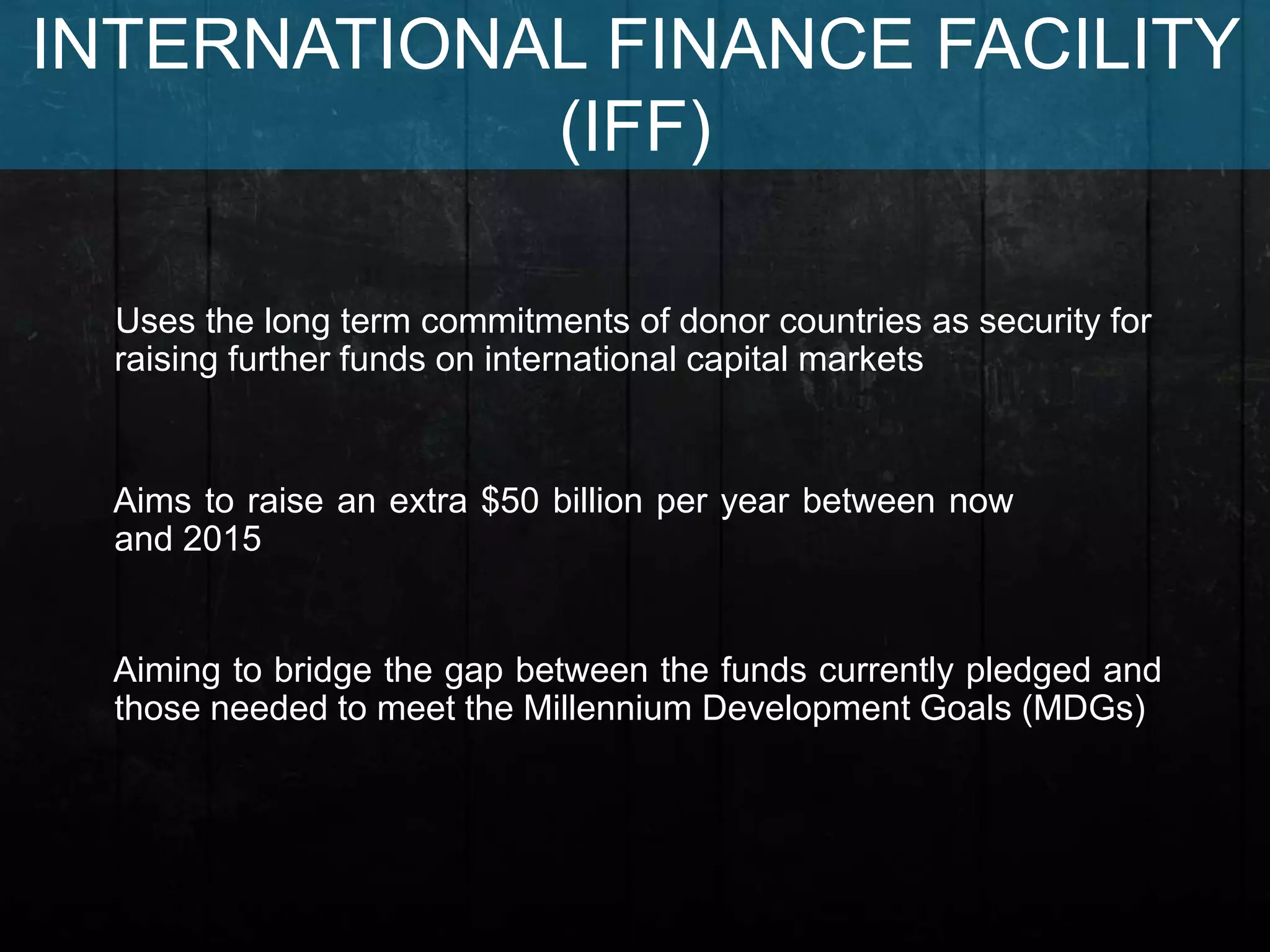
Aiming to bridge the gap between the funds currently pledged and
those needed to meet the Millennium Development Goals (MDGs)
Uses the long term commitments of donor countries as security for
raising further funds on international capital markets
Aims to raise an extra $50 billion per year between now
and 2015
INTERNATIONAL FINANCE FACILITY
(IFF)
Policies to attract investment
Has been criticised as being a means by which MNCs can
exploit poorer countries
Policies need to focus on having the right conditions in place
such as Infrastructure, Security, Peace, Local laws and
regulation, Government corruption, Tax regime
FOREIGN DIRECT INVESTMENT
(FDI)
To help developing countries improve tax systems to generate
tax revenue more efficiently
International taxes on pollution, air transport, arms, rent on
deep sea mineral extraction – funds raised used to help fund
development
Aims to reduce short term speculative trades and stabilise
currency flows
Issues of how far such taxes could raise sufficient funds and
whether they would distort markets too much
TAX
MEASURES
PUBLIC SECTOR
The Role
of
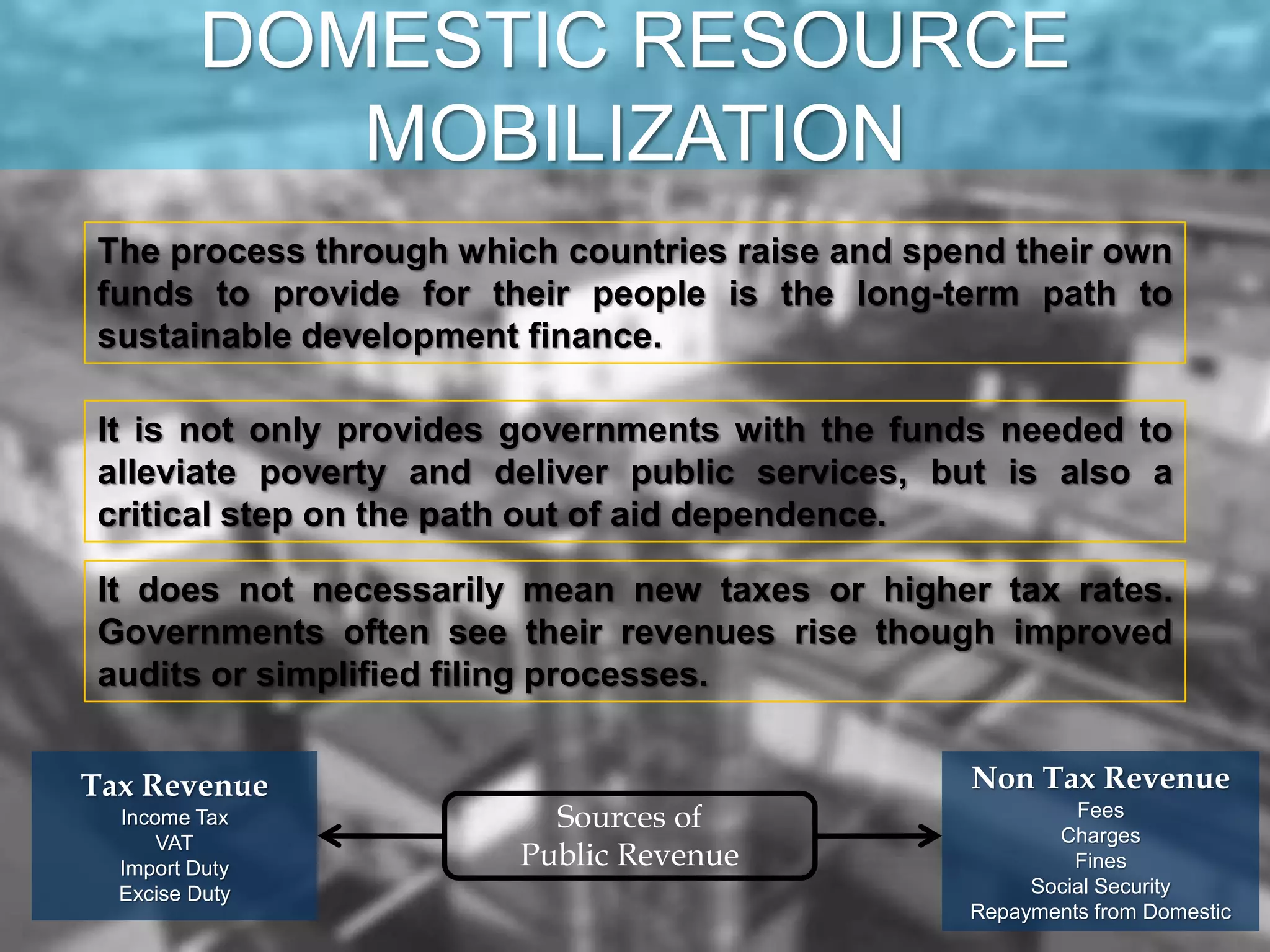
The process through which countries raise and spend their own
funds to provide for their people is the long-term path to
sustainable development finance.
It is not only provides governments with the funds needed to
alleviate poverty and deliver public services, but is also a
critical step on the path out of aid dependence.
It does not necessarily mean new taxes or higher tax rates.
Governments often see their revenues rise though improved
audits or simplified filing processes.
Tax Revenue
Income Tax
VAT
Import Duty
Excise Duty
Sources of
Public Revenue
Non Tax Revenue
Fees
Charges
Fines
Social Security
Repayments from Domestic
DOMESTIC RESOURCE
MOBILIZATION
Improving good governance and fighting corruption, better tax
policies, administration and public expenditure efficiency
Change technology and practice to improve collaboration and
cooperation
Conditions can be achieved by good governance and savers will
feel confident to save, investors to invest, and both will be served
by accountable governments providing public goods
Reduce red tape impediments to doing business and create a
new era of public private can collaboration.
WAYS OF DOMESTIC PUBLIC
RESOURCES
Raising the revenue fairly and equitably Ensure that when revenue
is spent it leads to improve service such as school, education, health
etc.
Improving the investment climate and reduce red tape impediments
to doing business.
Introduce new rules of law in place, take incentive for foreign
investor and try to reduce illicit financial flow
CONTINUED….
APPROACH
Domestic Resource Mobilization
For
Country
By increasing the TAX- GDP ratio
Increasing Public expenditure efficiency
Decreasing energy subsidies
Improving the infrastructure with the existing resource for better
efficiency
OFFICIAL DEVELOPMENT
ASSISANCE
THE ROLE
OF
ODA is the key measure used in practically all aid targets and assessments
of aid performance.
The DAC defines ODA as “those flows to countries and territories on the
DAC List of ODA Recipients and to multilateral institutions which are
provided by official agencies, including state and local governments, or by
their executive agencies.
The each transaction of which is administered with the promotion of the
economic development and welfare of developing countries as its main
objective is concessional in character and conveys a grant element of at
least 25 per cent.
OFFICIAL DEVELOPMENT
SSISANCE
COVERAGE
Military aid: No military equipment or services are reportable as ODA. Anti-
terrorism activities are also excluded. However, the cost of using donors’ armed
forces to deliver humanitarian aid is eligible.
Peacekeeping: Most peacekeeping expenditures are excluded in line with the
exclusion of military costs. However, some closely-defined developmentally
relevant activities within peacekeeping operations are included.
Nuclear energy: Reportable as ODA, provided it is for civilian purposes.
Cultural programs: Eligible as ODA if they build the cultural capacities of
recipient countries, but one-off tours by donor country artists or sportsmen, and
activities to promote the donors’ image, are excluded.
Graph
INTERNATIONAL DEVELOPMENT
ASSOCIATION
THE ROLE
OF
The International Development Association (or "IDA") is the World Bank’s
fund for the poorest countries. Since its inception in 1960, it has been a
core part of global development finance, providing half a trillion dollars, in
constant 2015 prices, for investments in 112 countries.
It provides long -term loans at zero interest to the poorest of the
developing country.
IDA’s goal is to reduce the disparities across and within countries, to bring
more people into the mainstream.
It helps build the human capital, policies, institutions and physical
infrastructure needed to bring about equitable and sustainable growth.
INTERNATIONAL DEVELOPMENT
ASSOCIATION
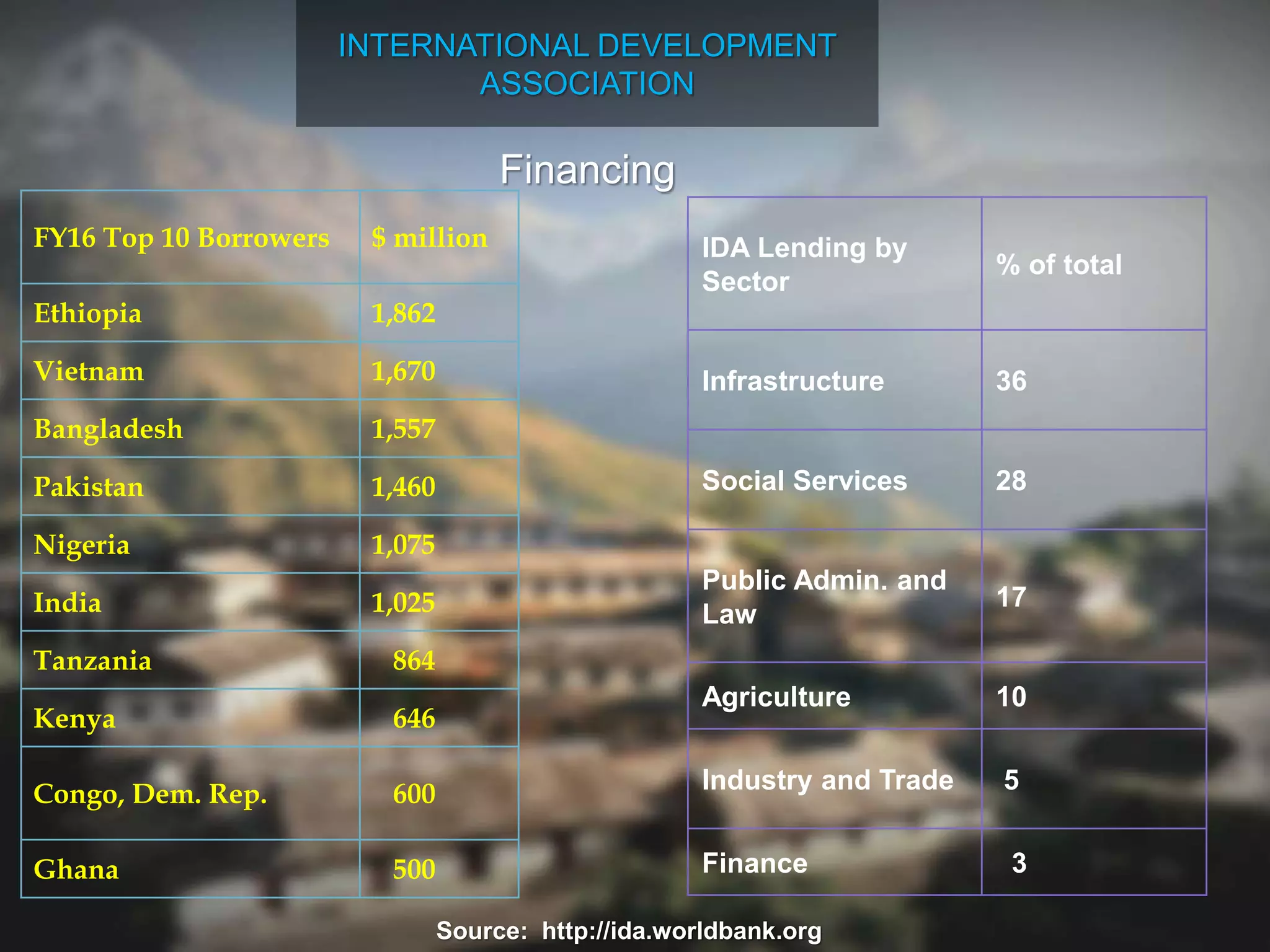
Financing
FY16 Top 10 Borrowers $ million
Ethiopia 1,862
Vietnam 1,670
Bangladesh 1,557
Pakistan 1,460
Nigeria 1,075
India 1,025
Tanzania 864
Kenya 646
Congo, Dem. Rep. 600
Ghana 500
Source: http://ida.worldbank.org
IDA Lending by
Sector
% of total
Infrastructure 36
Social Services 28
Public Admin. and
Law
17
Agriculture 10
Industry and Trade 5
Finance 3
INTERNATIONAL DEVELOPMENT
ASSOCIATION
GRAPH
Source : World Bank
PRIVATE SECTOR
The Role
of
BLENDED FINANCE
Blended finance is defined as the complementary use of grants (or grant-
equivalent instruments) and non-grant financing from private and/or public
sources to provide financing on terms that would make projects financially viable
and/or financially sustainable.
It has three key characteristics:
Leverage: Use of development finance and philanthropic funds to
attract private capital into deals.
Impact: Investments that drive social, environmental and
economic progress.
Returns: Financial returns for private investors in line with market
expectations, based on real and perceived risks.
Instruments Blend Finance
Example
of
Blended Finance
BLENDED FINANCE
THE ROLE
OF
Returns are seen as too low for the level of real or perceived risks.
Markets do not function efficiently, with local financial markets in developing
economies particularly weak.
Private investors have knowledge and capability gaps, which impede their
understanding of the investment opportunities in often unfamiliar territories.
Investors have limited mandates and incentives to invest in sectors or markets with
high development impact .
Local and global investment climates are challenging, including poor regulatory and
legal frameworks.
BLENDED FINANCE
APPROACHES
OF
Technical Assistance
(Technical/Operational
Expertise)
Technical Assistance addresses risks in new, uncertain and fragmented markets for investors. Costs and risks
associated with exposure to new markets, technical uncertainty,
and the inability to build a pipeline can be reduced through this mechanism.
Risk Underwriting
(Capital Preservation)
Risk Underwriting reduces specific risks associated with a transaction. This mechanism provides direct
compensation or assumes losses for specific negative events.
Market Incentives
(Results-based
Financing/Price
Guarantees)
Market Incentives address critical sectors that do not support market fundamentals. This helps new and
distressed markets that require either scale to be commercially viable or reduced volatility, by providing fixed
pricing for products.
PRIVATE
PHILANTHROPY
THE ROLE
OF
Philanthropic foundations play an important role in sustainable development is not
only in mobilizing financial resources, but also as development actors in their own
right. Until recently, however, governments and foundations have often followed
parallel paths without engaging in genuine complementary partnerships.
It will require a paradigm shift in how governments approach foundations,
embracing them as catalytic partners rather than solely considering them as
financiers.
The distinctive role of foundations in the development arena, and acknowledging
the innovative practices emerging from the philanthropic sector, the OECD
Development Centre launched the OECD Global Network of Foundations Working
for Development (netFWD) to serve as a platform for co-operation and exchange,
and as bridge between foundations and policy makers.
PRIVATE
PHILANTHROPY
THE ROLE
OF
Philanthropy’s financial contribution to development has nearly multiplied by ten
over a decade.
Philanthropy’s non-financial contribution to development includes testing
innovative approaches and leveraging resources from others.
INNOVATIVE FINANCING
CONTINUED….
Multilateral Debt for climate swaps initiative
Unlock funds to finance climate change adaption and mitigate projects
Remittances represent a key external financial flow
Unlocking value from Diaspora flows
Encouraging private voluntary contributions through matching funds
WORLD BANK facilitate the insurance of the bond by providing technical advice
Generate additional development funds by tapping new funding sources (that is, by looking beyond conventional
mechanisms such as budget outlays from established donors and bonds from traditional
international financial institutions) or by engaging new partners such as emerging donors and actors
in the private sector).
Enhance the efficiency of financial flows, by reducing delivery time and/or costs, especially for
emergency needs and in crisis situations.
Make financial flows more results-oriented, by explicitly linking funding flows to measurable
performance on the ground.
CONTINUED….
FRAGILE OR CONFLICT
Conflict, natural disasters, fragility, and humanitarian emergencies deprive millions of children
around the world of their right to education.
FRAGILE OR CONFLICT
During conflict, schools are often destroyed or become unsafe. Students are forced out of school,
making them more vulnerable and at risk of violence, forced labor, and permanent displacement,
without a guarantee that they can go back to school when they arrive at a safer destination.
Ensuring that children have access to education during conflict and crises protects their rights,
instills a sense of normalcy, and fosters resilience, inclusion and tolerance, supporting the long-
term processes of rebuilding and peace-building.
THE CHALLENGE
THE CHALLENGE
Citizen security is a growing concern in middle-income countries, closely
linked to rising inequality
Poverty will increasingly be concentrated in countries affected by fragility,
with almost half the world’s poor expected to live in these situations by 2030.
By 2030, the share of global poor living in fragile and conflict-affected
situations is projected to reach 46 percent.
Domestic expenditure on education as a share of total public expenditure increased
globally in low- and middle-income countries, on average, by 0.42 percentage
points (from 16.12% to 16.54%), while the average increase in GPE partner
developing countries was 1.46 percentage points.
SOLUTIONS
SOLUTIONS
Redefining fragility and monitoring the global,
regional, and country fragility risks.
Developing an operational framework for effective
support in countries affected by fragility and
conflict
Invest in the enabling environment for
technology adoption.
Developing innovative financing solutions,
including with private sector involvement, for
situations of fragility, conflict, and violence.
Establishing strong partnerships for
sustainable peace and development with
humanitarian, security, diplomatic, and
development actors.
Developing innovative financing solutions,
including with private sector involvement and
promoting fragility risk reduction in Bank
operations and ensuring operational and financial
rapid response to protracted and recurring crises.
RESOURCES
https://www.slideshare.net/MarAye/development-finance-
impact-project-mma-55693528
http://www.globalpartnership.org/multimedia/infographic/
education-cannot-wait-conflict-and-crises-end
https://www.youtube.com/watch?v=KFBGNiFl5p4
http://www.worldbank.org/en/results/2016/08/19/tacklin
g-fragility-conflict-and-violence-with-development-
solutions
http://www3.weforum.org/docs/WEF_Blended_
Finance_A_Primer_Development_Finance_Phil
anthropic_Funders_report_2015.pdf
THANK YOU

Development finance impact project

  • 1.
  • 2.
  • 3.
    The systematic useof scientific and technical knowledge to meet specific objectives or requirements An extension of the theoretical or practical aspects of a concept, design, discovery, or invention. The process of adding improvements to a parcel of land, such as grading, subdivisions, drainage, access, roads, utilities.
  • 4.
  • 5.
    It is theact of providing funds for development purposes and the whole range of management activities that guide the allocation and use of those funds. Financing for development is focused on new stakeholders in the financing of development cooperation and to support poor countries' financing of development and poverty reduction a necessity when official development assistance is no longer sufficient. It reduces capital flight and increase taxation of international companies in the countries where they operate.
  • 6.
    Financing For Development APPROACH Needto focus both on more financing and on effective financing. It's more money and smarter money to reach the SDGs. And that development needs to be economically, socially and environmentally sustainable. The challenges of mobilizing the financing resources needed to help meet the SDGs. Developing new approaches and intervene public- private solutions that mobilize al types of finance(public, private, domestic and international) all for development. Calling for unprecedented levels of cooperation, partnership and coordination among the MDBs, UN, private sector, civil society academic organization and governments.
  • 7.
  • 9.
    INTERNATIONAL INSTITUTIONS Aims to stabilisethe international monetary system and help when monetary flow from trade causes problems Provides help and advice as well as funds to countries experiencing balance of payments problems IMF gets its funds from its 184 member states Focusing on providing funds for projects Aimed at alleviating poverty, inequality and promoting development Currently has 184 members
  • 10.
     Grants  ConcessionalLoans  Loans  Equity Investments  Guarantees TYPES OF FINANCING FROM THE WORLD BANK
  • 12.
    Aiming to bridgethe gap between the funds currently pledged and those needed to meet the Millennium Development Goals (MDGs) Uses the long term commitments of donor countries as security for raising further funds on international capital markets Aims to raise an extra $50 billion per year between now and 2015 INTERNATIONAL FINANCE FACILITY (IFF)
  • 13.
    Policies to attractinvestment Has been criticised as being a means by which MNCs can exploit poorer countries Policies need to focus on having the right conditions in place such as Infrastructure, Security, Peace, Local laws and regulation, Government corruption, Tax regime FOREIGN DIRECT INVESTMENT (FDI)
  • 14.
    To help developingcountries improve tax systems to generate tax revenue more efficiently International taxes on pollution, air transport, arms, rent on deep sea mineral extraction – funds raised used to help fund development Aims to reduce short term speculative trades and stabilise currency flows Issues of how far such taxes could raise sufficient funds and whether they would distort markets too much TAX MEASURES
  • 15.
  • 16.
    The process throughwhich countries raise and spend their own funds to provide for their people is the long-term path to sustainable development finance. It is not only provides governments with the funds needed to alleviate poverty and deliver public services, but is also a critical step on the path out of aid dependence. It does not necessarily mean new taxes or higher tax rates. Governments often see their revenues rise though improved audits or simplified filing processes. Tax Revenue Income Tax VAT Import Duty Excise Duty Sources of Public Revenue Non Tax Revenue Fees Charges Fines Social Security Repayments from Domestic DOMESTIC RESOURCE MOBILIZATION
  • 17.
    Improving good governanceand fighting corruption, better tax policies, administration and public expenditure efficiency Change technology and practice to improve collaboration and cooperation Conditions can be achieved by good governance and savers will feel confident to save, investors to invest, and both will be served by accountable governments providing public goods Reduce red tape impediments to doing business and create a new era of public private can collaboration. WAYS OF DOMESTIC PUBLIC RESOURCES
  • 18.
    Raising the revenuefairly and equitably Ensure that when revenue is spent it leads to improve service such as school, education, health etc. Improving the investment climate and reduce red tape impediments to doing business. Introduce new rules of law in place, take incentive for foreign investor and try to reduce illicit financial flow CONTINUED….
  • 19.
    APPROACH Domestic Resource Mobilization For Country Byincreasing the TAX- GDP ratio Increasing Public expenditure efficiency Decreasing energy subsidies Improving the infrastructure with the existing resource for better efficiency
  • 20.
    OFFICIAL DEVELOPMENT ASSISANCE THE ROLE OF ODAis the key measure used in practically all aid targets and assessments of aid performance. The DAC defines ODA as “those flows to countries and territories on the DAC List of ODA Recipients and to multilateral institutions which are provided by official agencies, including state and local governments, or by their executive agencies. The each transaction of which is administered with the promotion of the economic development and welfare of developing countries as its main objective is concessional in character and conveys a grant element of at least 25 per cent.
  • 21.
    OFFICIAL DEVELOPMENT SSISANCE COVERAGE Military aid:No military equipment or services are reportable as ODA. Anti- terrorism activities are also excluded. However, the cost of using donors’ armed forces to deliver humanitarian aid is eligible. Peacekeeping: Most peacekeeping expenditures are excluded in line with the exclusion of military costs. However, some closely-defined developmentally relevant activities within peacekeeping operations are included. Nuclear energy: Reportable as ODA, provided it is for civilian purposes. Cultural programs: Eligible as ODA if they build the cultural capacities of recipient countries, but one-off tours by donor country artists or sportsmen, and activities to promote the donors’ image, are excluded.
  • 22.
  • 23.
    INTERNATIONAL DEVELOPMENT ASSOCIATION THE ROLE OF TheInternational Development Association (or "IDA") is the World Bank’s fund for the poorest countries. Since its inception in 1960, it has been a core part of global development finance, providing half a trillion dollars, in constant 2015 prices, for investments in 112 countries. It provides long -term loans at zero interest to the poorest of the developing country. IDA’s goal is to reduce the disparities across and within countries, to bring more people into the mainstream. It helps build the human capital, policies, institutions and physical infrastructure needed to bring about equitable and sustainable growth.
  • 24.
    INTERNATIONAL DEVELOPMENT ASSOCIATION Financing FY16 Top10 Borrowers $ million Ethiopia 1,862 Vietnam 1,670 Bangladesh 1,557 Pakistan 1,460 Nigeria 1,075 India 1,025 Tanzania 864 Kenya 646 Congo, Dem. Rep. 600 Ghana 500 Source: http://ida.worldbank.org IDA Lending by Sector % of total Infrastructure 36 Social Services 28 Public Admin. and Law 17 Agriculture 10 Industry and Trade 5 Finance 3
  • 25.
  • 26.
  • 27.
    BLENDED FINANCE Blended financeis defined as the complementary use of grants (or grant- equivalent instruments) and non-grant financing from private and/or public sources to provide financing on terms that would make projects financially viable and/or financially sustainable. It has three key characteristics: Leverage: Use of development finance and philanthropic funds to attract private capital into deals. Impact: Investments that drive social, environmental and economic progress. Returns: Financial returns for private investors in line with market expectations, based on real and perceived risks.
  • 28.
  • 29.
  • 30.
    BLENDED FINANCE THE ROLE OF Returnsare seen as too low for the level of real or perceived risks. Markets do not function efficiently, with local financial markets in developing economies particularly weak. Private investors have knowledge and capability gaps, which impede their understanding of the investment opportunities in often unfamiliar territories. Investors have limited mandates and incentives to invest in sectors or markets with high development impact . Local and global investment climates are challenging, including poor regulatory and legal frameworks.
  • 31.
    BLENDED FINANCE APPROACHES OF Technical Assistance (Technical/Operational Expertise) TechnicalAssistance addresses risks in new, uncertain and fragmented markets for investors. Costs and risks associated with exposure to new markets, technical uncertainty, and the inability to build a pipeline can be reduced through this mechanism. Risk Underwriting (Capital Preservation) Risk Underwriting reduces specific risks associated with a transaction. This mechanism provides direct compensation or assumes losses for specific negative events. Market Incentives (Results-based Financing/Price Guarantees) Market Incentives address critical sectors that do not support market fundamentals. This helps new and distressed markets that require either scale to be commercially viable or reduced volatility, by providing fixed pricing for products.
  • 32.
    PRIVATE PHILANTHROPY THE ROLE OF Philanthropic foundationsplay an important role in sustainable development is not only in mobilizing financial resources, but also as development actors in their own right. Until recently, however, governments and foundations have often followed parallel paths without engaging in genuine complementary partnerships. It will require a paradigm shift in how governments approach foundations, embracing them as catalytic partners rather than solely considering them as financiers. The distinctive role of foundations in the development arena, and acknowledging the innovative practices emerging from the philanthropic sector, the OECD Development Centre launched the OECD Global Network of Foundations Working for Development (netFWD) to serve as a platform for co-operation and exchange, and as bridge between foundations and policy makers.
  • 33.
    PRIVATE PHILANTHROPY THE ROLE OF Philanthropy’s financialcontribution to development has nearly multiplied by ten over a decade. Philanthropy’s non-financial contribution to development includes testing innovative approaches and leveraging resources from others.
  • 34.
  • 35.
    CONTINUED…. Multilateral Debt forclimate swaps initiative Unlock funds to finance climate change adaption and mitigate projects Remittances represent a key external financial flow Unlocking value from Diaspora flows Encouraging private voluntary contributions through matching funds WORLD BANK facilitate the insurance of the bond by providing technical advice Generate additional development funds by tapping new funding sources (that is, by looking beyond conventional mechanisms such as budget outlays from established donors and bonds from traditional international financial institutions) or by engaging new partners such as emerging donors and actors in the private sector). Enhance the efficiency of financial flows, by reducing delivery time and/or costs, especially for emergency needs and in crisis situations. Make financial flows more results-oriented, by explicitly linking funding flows to measurable performance on the ground.
  • 36.
  • 37.
  • 38.
    Conflict, natural disasters,fragility, and humanitarian emergencies deprive millions of children around the world of their right to education. FRAGILE OR CONFLICT During conflict, schools are often destroyed or become unsafe. Students are forced out of school, making them more vulnerable and at risk of violence, forced labor, and permanent displacement, without a guarantee that they can go back to school when they arrive at a safer destination. Ensuring that children have access to education during conflict and crises protects their rights, instills a sense of normalcy, and fosters resilience, inclusion and tolerance, supporting the long- term processes of rebuilding and peace-building.
  • 39.
  • 40.
    THE CHALLENGE Citizen securityis a growing concern in middle-income countries, closely linked to rising inequality Poverty will increasingly be concentrated in countries affected by fragility, with almost half the world’s poor expected to live in these situations by 2030. By 2030, the share of global poor living in fragile and conflict-affected situations is projected to reach 46 percent. Domestic expenditure on education as a share of total public expenditure increased globally in low- and middle-income countries, on average, by 0.42 percentage points (from 16.12% to 16.54%), while the average increase in GPE partner developing countries was 1.46 percentage points.
  • 41.
  • 42.
    SOLUTIONS Redefining fragility andmonitoring the global, regional, and country fragility risks. Developing an operational framework for effective support in countries affected by fragility and conflict Invest in the enabling environment for technology adoption. Developing innovative financing solutions, including with private sector involvement, for situations of fragility, conflict, and violence. Establishing strong partnerships for sustainable peace and development with humanitarian, security, diplomatic, and development actors. Developing innovative financing solutions, including with private sector involvement and promoting fragility risk reduction in Bank operations and ensuring operational and financial rapid response to protracted and recurring crises.
  • 43.
  • 44.