DIFFERENT LABORATORY EQUIPMENT USED IN
TOXICOLOGY AND MOLECULAR BIOLOGY
Muhammad Kamran M.Sc(Hons) Agri.Entomology
University College of Agriculture,
University of Sargodha
Pakistan
Contents
1. Personal Protective Equipment (PPE)
2. Volume Measuring Equipment
1. Non-volumetric containers
2. Volumetric labware
3. Equipment used for identification
1. Hand lens
2. Light Microscope
3. Inverted Microscope
4. Fluorescence Microscope
4. Analyzing Equipment (Analyzers)
1. Microplate Reader
2. PCR apparatus
3. Electrophoresis apparatus
4. Spectromer (UV/VIS )
5. Chromatography Equipment (GC,TLC, HPLC)
5. Other Equipment
1. Laboratory Refrigerators and Freezers
2. Instrument Sterilizers
3. Centrifuge
Chemical-resistant coveralls
Chemical-resistant gloves
Chemical-resistant footwear
Chemical-resistant hood or wide-brimmed hat
 Chemical-resistant
apron
 Chemical fume hoods
are used to protect
workers from
exposure to volatile
chemicals.
o For mixing and storing
solutions and are
generally not
calibrated.
o Instead, the
measurements, or
graduations, on the side
represent
approximations of
liquid capacity.
1.Non-volumetric
containers
Glass beaker
Erlenmeyer flasks
2. Volumetric labware
o Measure exact volumes of liquid
substances.
o Volumetric labware is denoted
with the capacity it is calibrated to
hold as well as the letters TC or
TD.
o Volumetric flasks prepare
solutions of a specific
concentration.
o Graduated cylinders are used to
measure volumes of liquid above
50 mL.
Volumetric flasks
Graduated cylinders
o Serological pipettes: Generally
used to measure and deliver
volumes in the range of 0.1 to 50
mL.
o Syringes: The use of syringes is
the most frequent method for
transferring liquid chemicals or
solvents in the laboratory.
o Micropipettors: For volumes of
0.2 microliters to 5 mL,
micropipettors should be used.
o Glass Hamilton syringes: When
plastic pipette tips are not
compatible with the liquid to be
measured, glass Hamilton syringes
are an alternative for accurate
measurement of volumes in the
microliter range.
o A magnifying glass is a
convex lens that is used to produce
a magnified image of an object.
o The lens is usually mounted in a
frame with a handle
o Hand lenses is used for identifying
gems, crystals, rocks, insects, leaves
or spiders from 5-30X magnification.
Hand lens
The light microscope
The light microscope is an
instrument used for
magnifying research
specimens.
Allow to view objects at
1000 times their original
size.
Inverted microscope
An inverted microscope is
a microscope with its light
source and condenser on the
top, above the stage pointing
down, while the objectives
and turret are below the stage
pointing up.
The main components of the light
microscope
Applications
• Light microscopy has the potential to visualize
a wide range of specimens.
• various configurations of the compound
microscope exists to suit many different
applications.
Fluorescence microscopes
A fluorescence microscope is
an optical microscope that
uses fluorescence and
phosphorescence instead of,
or in addition to, reflection
and absorption to study
properties of organic or
inorganic substances
Principle Components
• Main components of the fluorescent
microscope overlap greatly with the traditional
light microscope.
• The 2 main differences:
o The type of light source.
o The use of the specialized filter elements.
Applications
• Imaging of proteins
• To integrate the code for a fluorescent protein
such as green fluorescent protein, or GFP, into
the DNA of an organism.
• To investigate tumor cells
• Fluorescence Speckle Microscopy to study
movement and turnover kinetics of the protein.
Microplate reader
o The microplate reader allows for a variety of experiments to
be performed and measured simultaneously.
o Microplate readers can make absorbance, fluorescence and
luminescence measurements.
Multiplate readers are used
o To quantify protein
o Gene expression
o Various metabolic processes
such as reactive oxygen
species and calcium flux.
Components of a Microplate Reader
• Microplate readers come in different
shapes, sizes and set-ups.
• Multiwell plates: used to hold the
samples that are measured by the
machine.
• The loading tray: used to bring the
96-well plate into the machine.
• A computer interface: to operate the
plate reader and control its settings
and parameters.
Applications
• These are used in drug discovery, research, bioassay
validation, and biopharmaceutical manufacturing.
• ELISAs,
• Protein and nucleic acid quantification or enzyme activity
assays
• Bradford assay
• Fluorescent-based assays
• Luminescent assays
• High-throughput assays
PCR machine is used for an in-vitro technique
for amplification of a region of DNA whose
sequence is known or which lies between two
regions of known sequence
PCR Machine
Major Components
• Template DNA
• Oligonucleotide primers
• Thermostable DNA polymerase
• MgCl2
• dNTP’s
• Buffer
• Working concentrations
• KCL
• Tris-HCl
• NaCl2 (sometimes)
• Thermocycler
• Detectors
Primers
DNA template
Buffer
+ +
A C T G
MgCl2
Principle
Typically, a PCR is a three-step reaction.
o Denaturation of DNA
o In the first step of PCR, the sample is heated to 95–98°C, which
denatures the double-stranded DNA, splitting it into two single
strands.
o Primer hybridization ( Annealing)
o In the second step, the temperature is decreased to approximately
55–65°C, allowing the primers to bind, or anneal, to specific
sequences of DNA at each end of the target sequence, also
known as the template.
o DNA synthesis ( Primer extension)
o In the third step, the temperature is typically increased to 72°C,
allowing the DNA polymerase to extend the primers by the
addition of dNTPs to create a new strand of DNA, thus doubling
the quantity of DNA in the reaction.
Step 1:
Denaturation
dsDNA to ssDNA
Step 2:
Annealing
Primers onto template
Step 3:
Extension
dNTPs extend 2nd strand
Vierstraete 1999
extension products in one cycle serve as template in the next 28
Applications
• Genome mapping and gene function
determination
• Biodiversity studies ( e.g. evolution studies)
• Diagnostics ( prenatal testing of genetic diseases,
early detection of cancer, viral infections,
mutation detection...)
• Detection of drug resistance genes
• Forensic (DNA fingerprinting)
• Microarrays, molecular cloning, recombinant
DNA research.
Detection of amplification products
• Gel electrophoresis
• Sequencing of amplified fragment
• Southern blot
• etc...
30
Gel Electrophoresis Equipment
Electrophoresis
apparatus is used for the
separation of charged
molecules in an applied
electric field.
31
Major components
o Box to hold the gel
o Comb to create small wells in the agarose gel to
put the DNA sample into at the beginning of the
gel
o Positive and negative electrodes to create the
electrical current
o Power supply
o Gel photo imaging system
32
Principle
33
Applications of Gel Electrophoresis
DNA can be separated by electrophoresis to:
• Visualize bands of a molecular marker to genotype individual
• Verify amplification by PCR or sequencing reactions
• Check the quality and quantity of genomic DNA after DNA
extraction
• Used for investigating the DNA
• To investigate various binding modes of small molecules to
supercoiled DNA
• Complex mixtures can be separated to very high resolution by
this process (Sheehan, D.; 2000).
Chromatography Equipment
(TLC)
The solvent travels up
plate via capillary action
and the compounds
separate depending on
compound solubility.
Detection: Color changes
or by using UV light to
observe bands.
(HPLC)
A highly improved form of
column chromatography.
Solvent is forced through
under high pressures of up
to 400 atmospheres. That
makes it much faster.
(GC)
Gas chromatography is a
technique used for
separation of volatile
substances, or substances
that can be made volatile,
from one another in a
gaseous mixture at high
temperatures.
Detection: By comparing retention times of peaks
in a sample to retention times for standards.
HPLC Detectors
oUV/Vis
oRefractive index
oFluorescence
oEvaporative light scattering (ELSD)
oMS
oDiode Array Detector (DAD)
42
Application of HPLC
1. Pharmaceuticals industry
• To control the drug stability
• Quantity of drug determination from pharmaceutical dosage
forms, ex. Paracetamol determination in panadol tablet
• Quantity of drug determination from biological fluids, ex:
blood glucose level
2. Analysis of natural contamination
3. Forensic test
- Determination of steroid in blood, urine & sweat.
- Detection of psychotropic drug in plasma
4. Clinical test
5. Food and essence manufacture
43
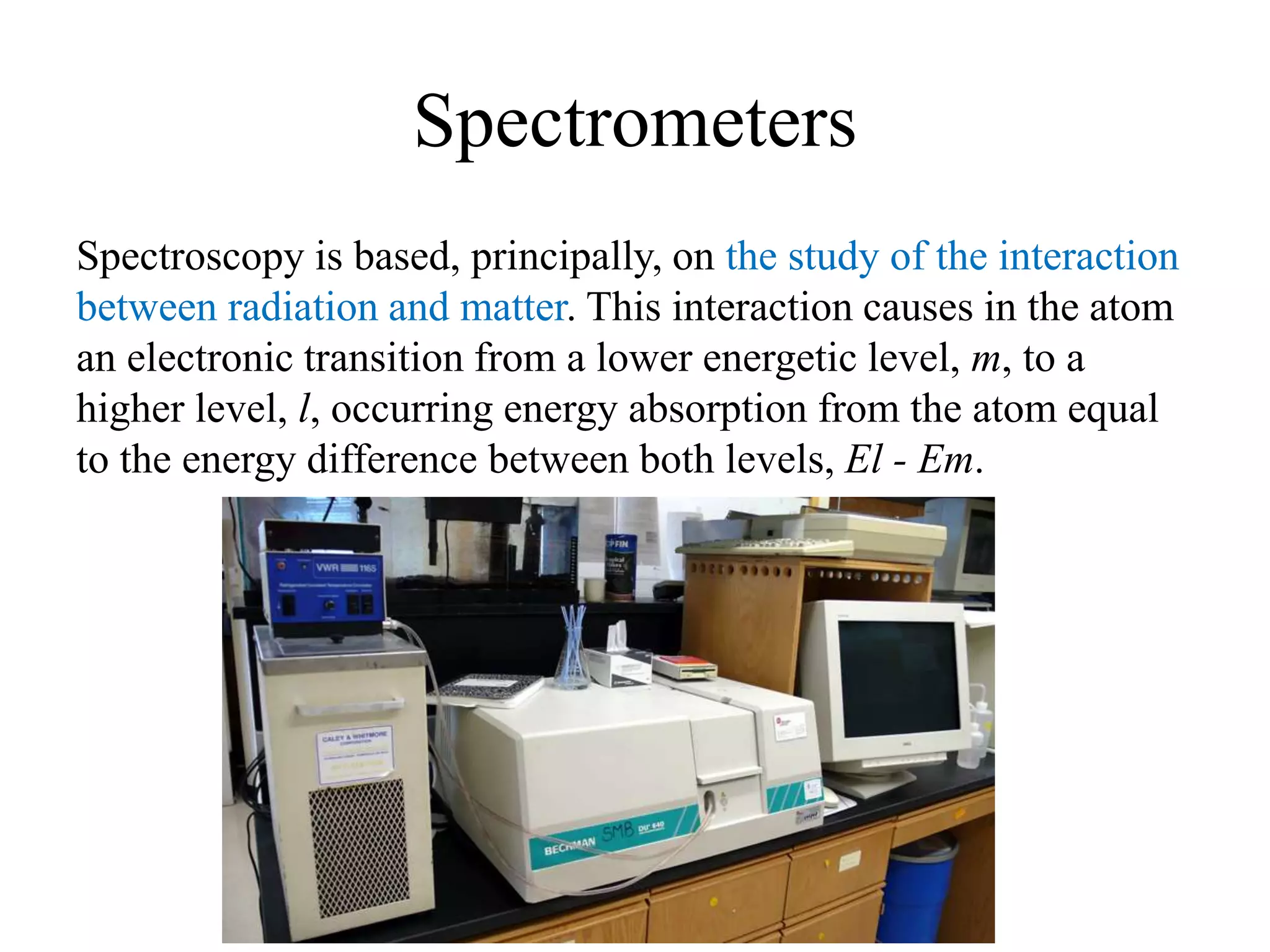
Spectrometers
Spectroscopy is based, principally, on the study of the interaction
between radiation and matter. This interaction causes in the atom
an electronic transition from a lower energetic level, m, to a
higher level, l, occurring energy absorption from the atom equal
to the energy difference between both levels, El - Em.
UV and Visible Spectroscopy
o UV-VIS spectroscopy is used to detect the presence of chromophores
like dienes, aromatics, polyenes, and conjugated ketones, etc
o It uses light in the visible and adjacent ranges.
o The absorption or reflectance in the visible range directly affects the
perceived color of the chemicals involved.
o This technique is complementary to fluorescence spectroscopy.
Application
o Quantitative Analysis
o Rate Measurements
o Analysis of Mixtures
o Chemical Reaction
o Biochemistry
o Molecular biology.
o Used as a detector for HPLC.
• Measuring tapes
• Insect-proof containers
• Scissors
• Fine forceps
• Fine pointed brush
o Instrument sterilizers
o Analytical balance can measure
down to ten thousandths or even
hundred thousandths of a gram.
Laboratory refrigerators and freezers
Centrifuge
A centrifuge is used to separate components of a
complex mixture.
Principle component
o The rotor, which is the moving part that spins
at high speeds.
o Many centrifuges will have a refrigeration unit
that allows the internal temperature to be
controlled during the spin.
Applications
The centrifuges can be used:
• To purify biological specimens like animal
cells.
• Useful for quickly isolating one cell type from
another, or for isolating individual organelles.
• The ultracentrifuge can spin in excess of
70,000 rpm, which makes it well suited for the
isolation of small particles, like DNA or
viruses.

Different Laboratory Equipment used in Toxicology and Molecular Biology

  • 1.
    DIFFERENT LABORATORY EQUIPMENTUSED IN TOXICOLOGY AND MOLECULAR BIOLOGY Muhammad Kamran M.Sc(Hons) Agri.Entomology University College of Agriculture, University of Sargodha Pakistan
  • 2.
    Contents 1. Personal ProtectiveEquipment (PPE) 2. Volume Measuring Equipment 1. Non-volumetric containers 2. Volumetric labware 3. Equipment used for identification 1. Hand lens 2. Light Microscope 3. Inverted Microscope 4. Fluorescence Microscope 4. Analyzing Equipment (Analyzers) 1. Microplate Reader 2. PCR apparatus 3. Electrophoresis apparatus 4. Spectromer (UV/VIS ) 5. Chromatography Equipment (GC,TLC, HPLC) 5. Other Equipment 1. Laboratory Refrigerators and Freezers 2. Instrument Sterilizers 3. Centrifuge
  • 4.
    Chemical-resistant coveralls Chemical-resistant gloves Chemical-resistantfootwear Chemical-resistant hood or wide-brimmed hat
  • 5.
     Chemical-resistant apron  Chemicalfume hoods are used to protect workers from exposure to volatile chemicals.
  • 7.
    o For mixingand storing solutions and are generally not calibrated. o Instead, the measurements, or graduations, on the side represent approximations of liquid capacity. 1.Non-volumetric containers Glass beaker Erlenmeyer flasks
  • 8.
    2. Volumetric labware oMeasure exact volumes of liquid substances. o Volumetric labware is denoted with the capacity it is calibrated to hold as well as the letters TC or TD. o Volumetric flasks prepare solutions of a specific concentration. o Graduated cylinders are used to measure volumes of liquid above 50 mL. Volumetric flasks Graduated cylinders
  • 9.
    o Serological pipettes:Generally used to measure and deliver volumes in the range of 0.1 to 50 mL. o Syringes: The use of syringes is the most frequent method for transferring liquid chemicals or solvents in the laboratory.
  • 10.
    o Micropipettors: Forvolumes of 0.2 microliters to 5 mL, micropipettors should be used. o Glass Hamilton syringes: When plastic pipette tips are not compatible with the liquid to be measured, glass Hamilton syringes are an alternative for accurate measurement of volumes in the microliter range.
  • 12.
    o A magnifyingglass is a convex lens that is used to produce a magnified image of an object. o The lens is usually mounted in a frame with a handle o Hand lenses is used for identifying gems, crystals, rocks, insects, leaves or spiders from 5-30X magnification. Hand lens
  • 13.
    The light microscope Thelight microscope is an instrument used for magnifying research specimens. Allow to view objects at 1000 times their original size.
  • 14.
    Inverted microscope An invertedmicroscope is a microscope with its light source and condenser on the top, above the stage pointing down, while the objectives and turret are below the stage pointing up.
  • 15.
    The main componentsof the light microscope
  • 16.
    Applications • Light microscopyhas the potential to visualize a wide range of specimens. • various configurations of the compound microscope exists to suit many different applications.
  • 17.
    Fluorescence microscopes A fluorescencemicroscope is an optical microscope that uses fluorescence and phosphorescence instead of, or in addition to, reflection and absorption to study properties of organic or inorganic substances
  • 18.
    Principle Components • Maincomponents of the fluorescent microscope overlap greatly with the traditional light microscope. • The 2 main differences: o The type of light source. o The use of the specialized filter elements.
  • 19.
    Applications • Imaging ofproteins • To integrate the code for a fluorescent protein such as green fluorescent protein, or GFP, into the DNA of an organism. • To investigate tumor cells • Fluorescence Speckle Microscopy to study movement and turnover kinetics of the protein.
  • 21.
    Microplate reader o Themicroplate reader allows for a variety of experiments to be performed and measured simultaneously. o Microplate readers can make absorbance, fluorescence and luminescence measurements. Multiplate readers are used o To quantify protein o Gene expression o Various metabolic processes such as reactive oxygen species and calcium flux.
  • 22.
    Components of aMicroplate Reader • Microplate readers come in different shapes, sizes and set-ups. • Multiwell plates: used to hold the samples that are measured by the machine. • The loading tray: used to bring the 96-well plate into the machine. • A computer interface: to operate the plate reader and control its settings and parameters.
  • 23.
    Applications • These areused in drug discovery, research, bioassay validation, and biopharmaceutical manufacturing. • ELISAs, • Protein and nucleic acid quantification or enzyme activity assays • Bradford assay • Fluorescent-based assays • Luminescent assays • High-throughput assays
  • 24.
    PCR machine isused for an in-vitro technique for amplification of a region of DNA whose sequence is known or which lies between two regions of known sequence PCR Machine
  • 26.
    Major Components • TemplateDNA • Oligonucleotide primers • Thermostable DNA polymerase • MgCl2 • dNTP’s • Buffer • Working concentrations • KCL • Tris-HCl • NaCl2 (sometimes) • Thermocycler • Detectors Primers DNA template Buffer + + A C T G MgCl2
  • 27.
    Principle Typically, a PCRis a three-step reaction. o Denaturation of DNA o In the first step of PCR, the sample is heated to 95–98°C, which denatures the double-stranded DNA, splitting it into two single strands. o Primer hybridization ( Annealing) o In the second step, the temperature is decreased to approximately 55–65°C, allowing the primers to bind, or anneal, to specific sequences of DNA at each end of the target sequence, also known as the template. o DNA synthesis ( Primer extension) o In the third step, the temperature is typically increased to 72°C, allowing the DNA polymerase to extend the primers by the addition of dNTPs to create a new strand of DNA, thus doubling the quantity of DNA in the reaction.
  • 28.
    Step 1: Denaturation dsDNA tossDNA Step 2: Annealing Primers onto template Step 3: Extension dNTPs extend 2nd strand Vierstraete 1999 extension products in one cycle serve as template in the next 28
  • 29.
    Applications • Genome mappingand gene function determination • Biodiversity studies ( e.g. evolution studies) • Diagnostics ( prenatal testing of genetic diseases, early detection of cancer, viral infections, mutation detection...) • Detection of drug resistance genes • Forensic (DNA fingerprinting) • Microarrays, molecular cloning, recombinant DNA research.
  • 30.
    Detection of amplificationproducts • Gel electrophoresis • Sequencing of amplified fragment • Southern blot • etc... 30
  • 31.
    Gel Electrophoresis Equipment Electrophoresis apparatusis used for the separation of charged molecules in an applied electric field. 31
  • 32.
    Major components o Boxto hold the gel o Comb to create small wells in the agarose gel to put the DNA sample into at the beginning of the gel o Positive and negative electrodes to create the electrical current o Power supply o Gel photo imaging system 32
  • 33.
  • 34.
    Applications of GelElectrophoresis DNA can be separated by electrophoresis to: • Visualize bands of a molecular marker to genotype individual • Verify amplification by PCR or sequencing reactions • Check the quality and quantity of genomic DNA after DNA extraction • Used for investigating the DNA • To investigate various binding modes of small molecules to supercoiled DNA • Complex mixtures can be separated to very high resolution by this process (Sheehan, D.; 2000).
  • 35.
    Chromatography Equipment (TLC) The solventtravels up plate via capillary action and the compounds separate depending on compound solubility. Detection: Color changes or by using UV light to observe bands. (HPLC) A highly improved form of column chromatography. Solvent is forced through under high pressures of up to 400 atmospheres. That makes it much faster. (GC) Gas chromatography is a technique used for separation of volatile substances, or substances that can be made volatile, from one another in a gaseous mixture at high temperatures. Detection: By comparing retention times of peaks in a sample to retention times for standards.
  • 42.
    HPLC Detectors oUV/Vis oRefractive index oFluorescence oEvaporativelight scattering (ELSD) oMS oDiode Array Detector (DAD) 42
  • 43.
    Application of HPLC 1.Pharmaceuticals industry • To control the drug stability • Quantity of drug determination from pharmaceutical dosage forms, ex. Paracetamol determination in panadol tablet • Quantity of drug determination from biological fluids, ex: blood glucose level 2. Analysis of natural contamination 3. Forensic test - Determination of steroid in blood, urine & sweat. - Detection of psychotropic drug in plasma 4. Clinical test 5. Food and essence manufacture 43
  • 44.
    Spectrometers Spectroscopy is based,principally, on the study of the interaction between radiation and matter. This interaction causes in the atom an electronic transition from a lower energetic level, m, to a higher level, l, occurring energy absorption from the atom equal to the energy difference between both levels, El - Em.
  • 45.
    UV and VisibleSpectroscopy o UV-VIS spectroscopy is used to detect the presence of chromophores like dienes, aromatics, polyenes, and conjugated ketones, etc o It uses light in the visible and adjacent ranges. o The absorption or reflectance in the visible range directly affects the perceived color of the chemicals involved. o This technique is complementary to fluorescence spectroscopy.
  • 46.
    Application o Quantitative Analysis oRate Measurements o Analysis of Mixtures o Chemical Reaction o Biochemistry o Molecular biology. o Used as a detector for HPLC.
  • 48.
    • Measuring tapes •Insect-proof containers • Scissors • Fine forceps • Fine pointed brush
  • 49.
    o Instrument sterilizers oAnalytical balance can measure down to ten thousandths or even hundred thousandths of a gram.
  • 50.
  • 51.
    Centrifuge A centrifuge isused to separate components of a complex mixture.
  • 52.
    Principle component o Therotor, which is the moving part that spins at high speeds. o Many centrifuges will have a refrigeration unit that allows the internal temperature to be controlled during the spin.
  • 53.
    Applications The centrifuges canbe used: • To purify biological specimens like animal cells. • Useful for quickly isolating one cell type from another, or for isolating individual organelles. • The ultracentrifuge can spin in excess of 70,000 rpm, which makes it well suited for the isolation of small particles, like DNA or viruses.