




Spinal Injections in Neurosurgical
Practice
Important introductory & Ethical Concerns
Mohamed M. Mohi Eldin,
Professor of Neurosurgery,
Faculty of Medicine,
Cairo University
One-Day Spine Clinic 1st workshop & hands-on
March 2nd 2016
Learning Objectives
• Reaching WISDOM in spine
management.
• Spinal injections an
important TOOL in diagnosis
and management.
• Mastering the different
techniques, with no harm to
the patients.
GENERAL PRINCIPLES !!
Ready to answer all questions
Provide the patient with a clear explanation of
the risks and benefits
Professionalism
Prioritization
Seeing the woods through the trees
Honesty first
Surgical team ethics
Families: Breaking bad news
Error disclosure and risk management
Different Clinical Assessment
The unseen FACET joints
The forgotten SACROILIAC joint
Which level claimed in multilevel affection
False normal MRIs
Appropriate supervision
Clinical decision making
Procedures
Follow-up
Documentation
Spinal injections as the first step on MIS career will learn you the
importance of documentation
Not only medicolegal
The most important step in
decision making process
Documentation
• Documenting an Effective history
• Documenting a discharge summary
• Legal aspects of medical documentation
– Timing and timeliness of notes
– Critical events documentation
– Altering the medical record
– Call schedule as legal document
• Procedure consent
– Procedure
– Alternatives
– Risks (*Description of risks that would influence a
reasonable person in the same circumstances)
Different Radiological Assessment
Neurosurgical Patient: Case Scenarios
Injections are integral parts of the case
scenarios, in both diagnosis and management
Making the Incision
The surgical environment
Sterile technique and preparation
The Manager when there is no
manager
Asked for help (Canada, Ireland…etc.)
Wellness of patients
Which is the more important imaging
modality here?
Patient’s Finger
Patient’s Finger
• Images are just pictures
• Images don’t necessarily tell you what is the
pain generator
• The patient’s finger may be more useful and
cost effective and accurate than any x-ray, CT,
MRI or bone scan
• Get comfortable looking at the images you
order
Only the needle knows…
INJECTION TYPES
• Joint injections (Facet & SIJ) are preceded by an aspiration
withdrawing joint fluid or blood. Most of the injections can
be followed by a booster injection 2 to 4 weeks later.
• “Trigger point" injection is done to a tendon area or into
the bursa surrounding such joints. These follow the same
guidelines as articular injections as far as frequency.
• Epidural steroid injection is useful for a variety of back
conditions including sciatica, arthritis, degenerative disc
problems, and spinal stenosis.
– Lumbar epidural is relatively simple technique and is unlikely to
be accompanied by complications except, perhaps a headache.
– Cervical epidural is a very specialized technique done only by
skilled and experienced.
INJECTION MATERIALS
Local anesthetics
Corticosteroid
Non-ionic contrast agents
Others
INJECTION MATERIALS
Local anesthetics
Pain Relief
Reversible neural blockade
Blocking sodium channels
Local anesthetics side effects
• locally or systemically
• seizures,
• Respiratory arrest,
• convulsions, confusion, death
• tremor, sluggishness, twitches,
• drowsiness, blurred vision,
• incoherent speech,
• light-headedness,
• cardiac depression,
• malignant hypertension, and
• anaphylaxis.
INJECTION MATERIALS
Corticosteroid
Musculoskeletal Pain Relieve Mechanisms:
Anti-inflammatory
direct membrane-stabilizing effect
Modulation effect on spinal cord
Immuno-suppressive
Corticosteroid Types
Betamethasone (Long-acting)
Dexamethasone (Long-acting)
Methylprednisolone (Intermediate-acting)
Prednisolone (Intermediate-acting)
Triamcinolone (Intermediate-acting)
Hydrocortisone (Short-acting)
Corticosteroid side effects
• Skin hypopigmentation,
• subcutaneous fat atrophy,
• tendon rupture,
• fluid retention,
• flushing,
• hyperglycemia,
• change in taste,
• insomnia, malaise and dyspepsia
• Systemic suppression of the adrenal glands
Corticosteroid side effects
Systemic Side-effects
Facial Flushing
Menstrual Irregularity
Hyperglycaemia
Suppress pituitary-adrenal
axis
Emotional upset
Anaphylaxis
Local Side-effects
Post-injection flare of pain
Skin depigmentation
Subcutaneous atrophy
Bleeding
Infection
Steroid Arthropathy
Tendon rupture/atrophy
Soft tissue calcification
Repeated injections of corticosteroids
can lead to a cushingoid appearance
Because of the long list of side effects, these drugs shouldn’t
be taken lightly, and many doctors limit the number of
injections per year to 3 or 4 max.
Always remember that the effects are usually temporary.
A good limit is three injections over a three-month period of
time (an injection to another location can be done at any
time)
Prolonged steroid injection is associated with osteonecrosis
INJECTION MATERIALS
Non-ionic contrast agents
Under fluoroscopy for needle
tip localization
Reduces risk of injection into a
blood vessel or
subarachnoid space
include
metrizamide (Amnipaque),
iopamidol (Isovue),
iohexol (Omnipaque)
Contrast agents side effects
local tissue toxicity
nausea, headache, and emesis
Anaphylaxis
90% occur within the first 15 min
Patients with contrast allergic reaction
history
Steroids and antihistamines 12 h, and 2 h prior
to the procedure in is recommended
Gadolinium is a viable alternative
GENERAL CONSIDERATIONS
Caution to avoid the risk of bleeding
Aspirin discontinue at least 3-7 days before
Pregnant women or suspected to be pregnant
should avoid radiation exposure from
fluoroscopy
GENERAL TECHNICAL POINTS 1
General Preparation
Proper positionng on the table first
Sterile drapping the injection site
Sterile gloves during the injection
Gown, cap, and mask are used specially if
myelography or discography is done
Antibiotics are used specially in patients with
implanted prosthetic devices or mitral valve
prolapse
GENERAL TECHNICAL POINTS 2
Local Preparation
Prior to injection
The injection site can be anesthetized for patient’s
comfort with:
Local injection
vapocoolant spray
anesthetic cream
GENERAL TECHNICAL POINTS 3
Needles
The syringe needle is always aspirated first to avoid
intravascular or, intrathecal injection
Avoid needle contact with articular cartilage surfaces
during injections
The injection is given slowly, with steady pressure
Avoid injecting into ligaments,
tendons, or periosteum
Tendons and ligaments can be ruptured if
corticosteroids are injected directly into them (less
than 1% of cases)
Repositioning the needle if there is
significant resistance
GENERAL TECHNICAL POINTS 4
Post-injection
A dressing is applied to the injection site
Rest for several days
No driving for 3 days
GENERAL CONTRAINDICATIONS
Absolute
Bacteremia
Joint infection
Cellulitis
Skin ulcerations
Osteomyelitis
Infectious arthritis
Epidural abscess
Fluoroscopy in pregnancy
GENERAL CONTRAINDICATIONS
Relative
• Septic focus (distant
chronic infection)
• Allergy to
– Injection material
– Contrast agents
• Latex allergy
• Diabetes mellitus
• Altered anatomy
(surgery or congenital)
GENERAL CONTRAINDICATIONS
Great deal of CAUTION
Patients requiring anticoagulation medication or with a known
bleeding diathesis
Avoid if
Prothrombin time (prolonged)
activated partial thromboplastin time
international normalized ratio (INR >1.2)
platelet level count (<100 000/ml)
GENERAL INDICATIONS
SPINAL INJECTION TECHNIQUES
• Radiculopathy (Transforaminal Injection)
• SI Joint Syndrome (SIJ Injection)
• Facet Joint Syndrome (FJ Injection)
• LDP (Epidurography, Epidural injection, VCD)
• Discography
• Myelography
• Sympathetic procedures
GENERAL COMPLICATIONS
• Intravascular or subarachnoid
• Allergic reaction
• Anaphylactic reaction
• Vasovagal syncope
• Dural puncture
• Spinal headache
• Epidural abscess
• Epidural hematoma
GENERAL COMPLICATIONS
ANAPHYLACTIC SHOCK
FROM corticosteroids or contrast material
Typically, contrast allergies occur at the time of
the injections, and can quickly progress to an
anaphylactic reaction with respiratory
compromise
Corticosteroid anaphylactic reactions often
occur within 2-6 h after the injection
(respiratory compromise, no reported fatalities)
GENERAL COMPLICATIONS
ALLERGIC REACTIONS
Corticosteroid allergic reactions are often
delayed by up to a week,
present as an intense hot, erythematous flushing
involving the neck, face, and occasionally the chest
area.
GENERAL COMPLICATIONS
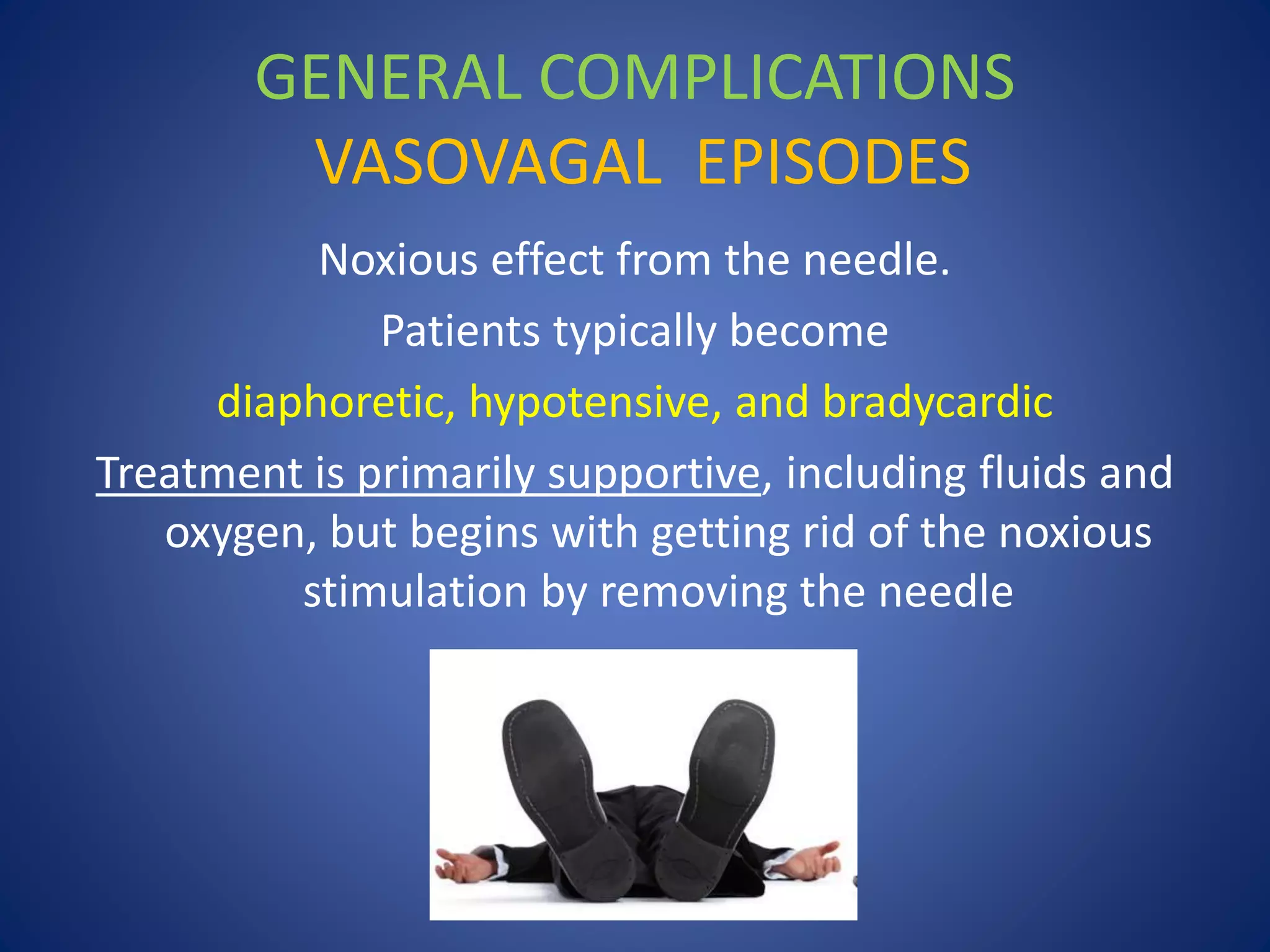
VASOVAGAL EPISODES
Noxious effect from the needle.
Patients typically become
diaphoretic, hypotensive, and bradycardic
Treatment is primarily supportive, including fluids and
oxygen, but begins with getting rid of the noxious
stimulation by removing the needle
GENERAL COMPLICATIONS
DURAL PUNCTURES
Dural puncture headaches can occur 1-2 days
after injections, with low incidence
Avoided by use of smaller gauge needles with
conical noncutting tips
GENERAL COMPLICATIONS
INTRATHECAL & INTRAVASCULAR INJECTIONS
Risk is proportional to the injected volume
Lead to
periorbital numbness, disorientation, light-
headedness, nystagmus, tinnitus, complete
sensory or motor block, muscle twitching,
respiratory depression, and seizures
GENERAL COMPLICATIONS
EPIDURAL HEMATOMA
Rare with normal clotting factors
Increases with anticoagulation & with Spinal stenosis
Can potentially lead to caudal equina or cord compression
Epidurals should be avoided in
platelet count less than 100 000 per ml
a spinal canal midsagittal diameter less than 12 mm
GENERAL COMPLICATIONS
EPIDURAL ABSCESS
Rare and is more common with the use of
an indwelling catheter
Present with severe back pain, fever, and chills
GENERAL EFFICACY
• The largest number of epidural outcome studies has
been reported for lumbar epidural steroid injections
followed by cervical epidural steroid injections
• There are no published randomized studies for thoracic
epidural steroid injections
• The evidence for caudal epidurals is strong for short-
term relief and moderate for long-term relief
• The findings for interlaminar epidurals are moderate
for short-term relief and limited for long-term relief of
symptoms.
• The results for TFESIs are strong for both short- and
long-term relief
• Only 22% of sacroiliac joint injections are
successfully performed without fluoroscopic
guidance
Thank You

Injections in Spine Practice: introductory concerns

  • 1.
    Spinal Injections inNeurosurgical Practice Important introductory & Ethical Concerns Mohamed M. Mohi Eldin, Professor of Neurosurgery, Faculty of Medicine, Cairo University One-Day Spine Clinic 1st workshop & hands-on March 2nd 2016
  • 2.
    Learning Objectives • ReachingWISDOM in spine management. • Spinal injections an important TOOL in diagnosis and management. • Mastering the different techniques, with no harm to the patients.
  • 3.
    GENERAL PRINCIPLES !! Readyto answer all questions Provide the patient with a clear explanation of the risks and benefits
  • 4.
  • 6.
    Honesty first Surgical teamethics Families: Breaking bad news Error disclosure and risk management
  • 7.
    Different Clinical Assessment Theunseen FACET joints The forgotten SACROILIAC joint Which level claimed in multilevel affection False normal MRIs
  • 8.
    Appropriate supervision Clinical decisionmaking Procedures Follow-up
  • 9.
    Documentation Spinal injections asthe first step on MIS career will learn you the importance of documentation Not only medicolegal The most important step in decision making process
  • 10.
    Documentation • Documenting anEffective history • Documenting a discharge summary • Legal aspects of medical documentation – Timing and timeliness of notes – Critical events documentation – Altering the medical record – Call schedule as legal document • Procedure consent – Procedure – Alternatives – Risks (*Description of risks that would influence a reasonable person in the same circumstances)
  • 11.
  • 12.
    Neurosurgical Patient: CaseScenarios Injections are integral parts of the case scenarios, in both diagnosis and management
  • 13.
    Making the Incision Thesurgical environment Sterile technique and preparation
  • 14.
    The Manager whenthere is no manager Asked for help (Canada, Ireland…etc.) Wellness of patients
  • 15.
    Which is themore important imaging modality here? Patient’s Finger
  • 16.
    Patient’s Finger • Imagesare just pictures • Images don’t necessarily tell you what is the pain generator • The patient’s finger may be more useful and cost effective and accurate than any x-ray, CT, MRI or bone scan • Get comfortable looking at the images you order
  • 17.
  • 18.
    INJECTION TYPES • Jointinjections (Facet & SIJ) are preceded by an aspiration withdrawing joint fluid or blood. Most of the injections can be followed by a booster injection 2 to 4 weeks later. • “Trigger point" injection is done to a tendon area or into the bursa surrounding such joints. These follow the same guidelines as articular injections as far as frequency. • Epidural steroid injection is useful for a variety of back conditions including sciatica, arthritis, degenerative disc problems, and spinal stenosis. – Lumbar epidural is relatively simple technique and is unlikely to be accompanied by complications except, perhaps a headache. – Cervical epidural is a very specialized technique done only by skilled and experienced.
  • 19.
  • 20.
    INJECTION MATERIALS Local anesthetics PainRelief Reversible neural blockade Blocking sodium channels
  • 21.
    Local anesthetics sideeffects • locally or systemically • seizures, • Respiratory arrest, • convulsions, confusion, death • tremor, sluggishness, twitches, • drowsiness, blurred vision, • incoherent speech, • light-headedness, • cardiac depression, • malignant hypertension, and • anaphylaxis.
  • 22.
    INJECTION MATERIALS Corticosteroid Musculoskeletal PainRelieve Mechanisms: Anti-inflammatory direct membrane-stabilizing effect Modulation effect on spinal cord Immuno-suppressive
  • 23.
    Corticosteroid Types Betamethasone (Long-acting) Dexamethasone(Long-acting) Methylprednisolone (Intermediate-acting) Prednisolone (Intermediate-acting) Triamcinolone (Intermediate-acting) Hydrocortisone (Short-acting)
  • 24.
    Corticosteroid side effects •Skin hypopigmentation, • subcutaneous fat atrophy, • tendon rupture, • fluid retention, • flushing, • hyperglycemia, • change in taste, • insomnia, malaise and dyspepsia • Systemic suppression of the adrenal glands
  • 25.
    Corticosteroid side effects SystemicSide-effects Facial Flushing Menstrual Irregularity Hyperglycaemia Suppress pituitary-adrenal axis Emotional upset Anaphylaxis Local Side-effects Post-injection flare of pain Skin depigmentation Subcutaneous atrophy Bleeding Infection Steroid Arthropathy Tendon rupture/atrophy Soft tissue calcification
  • 26.
    Repeated injections ofcorticosteroids can lead to a cushingoid appearance Because of the long list of side effects, these drugs shouldn’t be taken lightly, and many doctors limit the number of injections per year to 3 or 4 max. Always remember that the effects are usually temporary. A good limit is three injections over a three-month period of time (an injection to another location can be done at any time) Prolonged steroid injection is associated with osteonecrosis
  • 27.
    INJECTION MATERIALS Non-ionic contrastagents Under fluoroscopy for needle tip localization Reduces risk of injection into a blood vessel or subarachnoid space include metrizamide (Amnipaque), iopamidol (Isovue), iohexol (Omnipaque)
  • 28.
    Contrast agents sideeffects local tissue toxicity nausea, headache, and emesis Anaphylaxis 90% occur within the first 15 min
  • 29.
    Patients with contrastallergic reaction history Steroids and antihistamines 12 h, and 2 h prior to the procedure in is recommended Gadolinium is a viable alternative
  • 30.
    GENERAL CONSIDERATIONS Caution toavoid the risk of bleeding Aspirin discontinue at least 3-7 days before Pregnant women or suspected to be pregnant should avoid radiation exposure from fluoroscopy
  • 31.
    GENERAL TECHNICAL POINTS1 General Preparation Proper positionng on the table first Sterile drapping the injection site Sterile gloves during the injection Gown, cap, and mask are used specially if myelography or discography is done Antibiotics are used specially in patients with implanted prosthetic devices or mitral valve prolapse
  • 32.
    GENERAL TECHNICAL POINTS2 Local Preparation Prior to injection The injection site can be anesthetized for patient’s comfort with: Local injection vapocoolant spray anesthetic cream
  • 33.
    GENERAL TECHNICAL POINTS3 Needles The syringe needle is always aspirated first to avoid intravascular or, intrathecal injection Avoid needle contact with articular cartilage surfaces during injections The injection is given slowly, with steady pressure
  • 34.
    Avoid injecting intoligaments, tendons, or periosteum Tendons and ligaments can be ruptured if corticosteroids are injected directly into them (less than 1% of cases) Repositioning the needle if there is significant resistance
  • 35.
    GENERAL TECHNICAL POINTS4 Post-injection A dressing is applied to the injection site Rest for several days No driving for 3 days
  • 36.
    GENERAL CONTRAINDICATIONS Absolute Bacteremia Joint infection Cellulitis Skinulcerations Osteomyelitis Infectious arthritis Epidural abscess Fluoroscopy in pregnancy
  • 37.
    GENERAL CONTRAINDICATIONS Relative • Septicfocus (distant chronic infection) • Allergy to – Injection material – Contrast agents • Latex allergy • Diabetes mellitus • Altered anatomy (surgery or congenital)
  • 38.
    GENERAL CONTRAINDICATIONS Great dealof CAUTION Patients requiring anticoagulation medication or with a known bleeding diathesis Avoid if Prothrombin time (prolonged) activated partial thromboplastin time international normalized ratio (INR >1.2) platelet level count (<100 000/ml)
  • 39.
    GENERAL INDICATIONS SPINAL INJECTIONTECHNIQUES • Radiculopathy (Transforaminal Injection) • SI Joint Syndrome (SIJ Injection) • Facet Joint Syndrome (FJ Injection) • LDP (Epidurography, Epidural injection, VCD) • Discography • Myelography • Sympathetic procedures
  • 40.
    GENERAL COMPLICATIONS • Intravascularor subarachnoid • Allergic reaction • Anaphylactic reaction • Vasovagal syncope • Dural puncture • Spinal headache • Epidural abscess • Epidural hematoma
  • 41.
    GENERAL COMPLICATIONS ANAPHYLACTIC SHOCK FROMcorticosteroids or contrast material Typically, contrast allergies occur at the time of the injections, and can quickly progress to an anaphylactic reaction with respiratory compromise Corticosteroid anaphylactic reactions often occur within 2-6 h after the injection (respiratory compromise, no reported fatalities)
  • 42.
    GENERAL COMPLICATIONS ALLERGIC REACTIONS Corticosteroidallergic reactions are often delayed by up to a week, present as an intense hot, erythematous flushing involving the neck, face, and occasionally the chest area.
  • 43.
    GENERAL COMPLICATIONS VASOVAGAL EPISODES Noxiouseffect from the needle. Patients typically become diaphoretic, hypotensive, and bradycardic Treatment is primarily supportive, including fluids and oxygen, but begins with getting rid of the noxious stimulation by removing the needle
  • 44.
    GENERAL COMPLICATIONS DURAL PUNCTURES Duralpuncture headaches can occur 1-2 days after injections, with low incidence Avoided by use of smaller gauge needles with conical noncutting tips
  • 45.
    GENERAL COMPLICATIONS INTRATHECAL &INTRAVASCULAR INJECTIONS Risk is proportional to the injected volume Lead to periorbital numbness, disorientation, light- headedness, nystagmus, tinnitus, complete sensory or motor block, muscle twitching, respiratory depression, and seizures
  • 46.
    GENERAL COMPLICATIONS EPIDURAL HEMATOMA Rarewith normal clotting factors Increases with anticoagulation & with Spinal stenosis Can potentially lead to caudal equina or cord compression Epidurals should be avoided in platelet count less than 100 000 per ml a spinal canal midsagittal diameter less than 12 mm
  • 47.
    GENERAL COMPLICATIONS EPIDURAL ABSCESS Rareand is more common with the use of an indwelling catheter Present with severe back pain, fever, and chills
  • 48.
    GENERAL EFFICACY • Thelargest number of epidural outcome studies has been reported for lumbar epidural steroid injections followed by cervical epidural steroid injections • There are no published randomized studies for thoracic epidural steroid injections • The evidence for caudal epidurals is strong for short- term relief and moderate for long-term relief • The findings for interlaminar epidurals are moderate for short-term relief and limited for long-term relief of symptoms. • The results for TFESIs are strong for both short- and long-term relief
  • 49.
    • Only 22%of sacroiliac joint injections are successfully performed without fluoroscopic guidance
  • 50.