INTERNAL IMMOBILIZATION OF
FRACTURE
INTERNAL IMMOBILIZATION
 Intramedullary pinning and nailing
 Rush pins
 Cross pinning
 Wires
 Screws
 Transfixation
 Hanging pin cast
 Plate fixation Steinmann pins
INTRAMEDULLARY PINNING AND NAILING
 Sound and economical method of internal fixation
 Steinmann pins, Kuntscher nail (K-nail) is used for repair of long bone
fractures in large as well as in small animal
 A pin should provide 3 point fixation
CONT.
 Pin provides axial alignment and stability, but little rotational stability
 A pin should cover approx. 60-70% of diameter of medullary cavity
 Fracture of Radius, Tibia, Humerus and Femur can be repaired by this method
 Success rate of this method in large animals depends upon the size and weight of animal
 Two or more pins (stack pinning) can be used in adult animals especially in femur and
humerus
 Failure are related to mechanical factors such as
 Pin migration
 Bending
 loosening
CONT.
 Pin is inserted in the medullary cavity by using a simple hand driven chuck
 Pin can be inserted via 2 routes :-
 Retrograde : within the fracture site
 Normograde : from one end of the bone
Normograde Retrograde
RUSH PIN
 Used to treat fractures of the distal femur and supracondylar and
diaphyseal fractures of tibia
 A rush pin is tempered round intramedullary device
 It has hooked end that is used to drive and seat the pin into the bone
 Other end is tapered which bounces off the inner cortex as it is inserted
into the medullary cavity of bone
 Elastic bending nature of pins produces a spring like action to provide
rigid fixation
 Generally inserted from distal end of bone
Placement of rush pin
CROSS PINNING
 Useful in compound subarticular fractures of long bones
 Especially tibia, metacarpus and metatarsus
 Can also be used to repair fracture of mandible
WIRES
 In orthopaedic surgery different types of wire are used
 The rigid kirschner wire,
 The flexible orthopaedic wire
 Suture wire.
kirschner wire
Orthopaedic wire
Suture wire
ORTHOPAEDIC WIRE
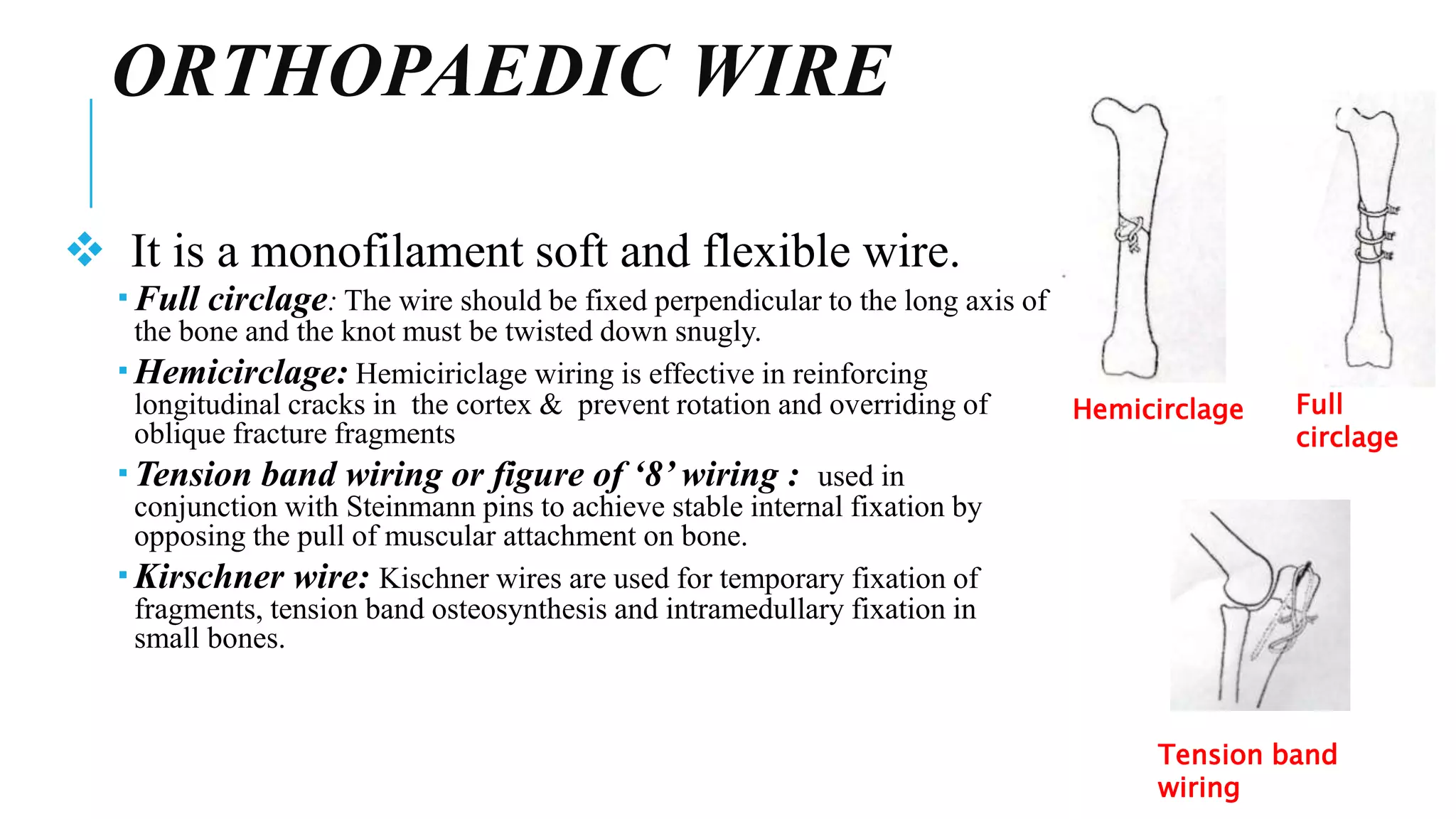
 It is a monofilament soft and flexible wire.
 Full circlage: The wire should be fixed perpendicular to the long axis of
the bone and the knot must be twisted down snugly.
 Hemicirclage: Hemiciriclage wiring is effective in reinforcing
longitudinal cracks in the cortex & prevent rotation and overriding of
oblique fracture fragments
 Tension band wiring or figure of ‘8’ wiring : used in
conjunction with Steinmann pins to achieve stable internal fixation by
opposing the pull of muscular attachment on bone.
 Kirschner wire: Kischner wires are used for temporary fixation of
fragments, tension band osteosynthesis and intramedullary fixation in
small bones.
Full
circlage
Hemicirclage
Tension band
wiring
SCREWS
 Cortical
 These screws are full threaded and used where cortical bone
predominates
 The inter-fragmentary compression is accomplished by drilling a long
gliding hole (oversized hole) in the near cortex and a smaller threaded
hole in the far cortex.
 Cancellous
 The screws are partially threaded used in cancellous bone e.g.
fracture of the olecranon, slab, fractures of the metacarpus and
metatarsus, condylar fractures and longitudinal fracture of the phalanx
can be fixed with screw.
 Oblique fracture of long bones can also be fixed by application of
screw in combination with internal or external support.
Cortical Screws
Cancellous Screws
TRANSFIXATION
 Most useful for treatment of diaphyseal fracture of the radius and tibia.
 A minimum of two intramedullary pins in each fractured fragment are
inserted transversely
The protruding ends of intramedullary pins are fixed in position by
connecting external bars and protected with caps.
 The pins are connected by one or more connecting bars.
 The assembly should be removed only after complete union of fractured
fragments
Transfixation pins
COMPLICATION:
 Soft tissue infection,
 Bone necrosis,
 Periosteal reaction around the transverse pins.
 Pathological fracture may occur at the point of insertion of transverse pins.
HANGING PIN CAST
 Only one pin is inserted tissue transversely through the proximal fragment .
 This technique has the advantage of preventing rotation of the fractured bone
& downward slipping of the plaster cast.
PLATE FIXATION
 Plate provide axial compression, counteract rotational forces,
 can effectively immobilize oblique and comminuted fracture.
 Plate classification: ( according to the function)
Compression plate: Static compression (a transverse or short oblique
fracture can be best treated by compression plate
Neutralization Plate: Splinting and lag screw fixation (comminuted
fracture are anatomically reconstructed).
Buttress Plate: Splinting or bridging a fracture area with buttress of the
main fragments.
Buttress Plate
Neutralization Plate
DYNAMIC COMPRESSION PLATE
(DCP)
 DCP is used for compression and stabilization of a fracture.
 Compression is achieved by tightening the screw inserted in a specially designed
hole in the plate.
 There are three sizes of DCP used in small animal surgery (2.7 mm, 3.5mm and
4.5 mm).
 At least 3 cortical screw on each side of the fracture fragment should be used.
SCAPULAR FRACTURE
May occur through the body, spine, acromion, neck, supraglenoid tuberosity and
glenoid cavity
Uncommon in dogs and cats bcoz large muscles surrounding scapula protect it from
direct injury
Common concurrent injuries include :
Thoracic injuries
Pulmonary contusions
Rib fracture
Nerve injury
DIAGNOSIS
 History
 Physical examination :
 Non weight bearing lameness,
 Swelling over scapula,
 crepitation on palpation
 Diagnostic imaging : Radiographs of scapula should include
Lateral view
Caudocranial view
SURGICAL TREATMENT
 Fixation systems applicable for scapular fracture includes
oPlates and screws ,
oOrthopaedic wires and
oKirschner wires
Use of crossed krischner
wire
Use of Plating (B) and Orthopaedic wires (D) to
repair transverse fracture

lect_7_-_Internal_fixation_-_I.pptx

  • 1.
  • 2.
    INTERNAL IMMOBILIZATION  Intramedullarypinning and nailing  Rush pins  Cross pinning  Wires  Screws  Transfixation  Hanging pin cast  Plate fixation Steinmann pins
  • 3.
    INTRAMEDULLARY PINNING ANDNAILING  Sound and economical method of internal fixation  Steinmann pins, Kuntscher nail (K-nail) is used for repair of long bone fractures in large as well as in small animal  A pin should provide 3 point fixation
  • 4.
    CONT.  Pin providesaxial alignment and stability, but little rotational stability  A pin should cover approx. 60-70% of diameter of medullary cavity  Fracture of Radius, Tibia, Humerus and Femur can be repaired by this method  Success rate of this method in large animals depends upon the size and weight of animal  Two or more pins (stack pinning) can be used in adult animals especially in femur and humerus  Failure are related to mechanical factors such as  Pin migration  Bending  loosening
  • 5.
    CONT.  Pin isinserted in the medullary cavity by using a simple hand driven chuck  Pin can be inserted via 2 routes :-  Retrograde : within the fracture site  Normograde : from one end of the bone Normograde Retrograde
  • 6.
    RUSH PIN  Usedto treat fractures of the distal femur and supracondylar and diaphyseal fractures of tibia  A rush pin is tempered round intramedullary device  It has hooked end that is used to drive and seat the pin into the bone  Other end is tapered which bounces off the inner cortex as it is inserted into the medullary cavity of bone  Elastic bending nature of pins produces a spring like action to provide rigid fixation  Generally inserted from distal end of bone Placement of rush pin
  • 7.
    CROSS PINNING  Usefulin compound subarticular fractures of long bones  Especially tibia, metacarpus and metatarsus  Can also be used to repair fracture of mandible
  • 8.
    WIRES  In orthopaedicsurgery different types of wire are used  The rigid kirschner wire,  The flexible orthopaedic wire  Suture wire. kirschner wire Orthopaedic wire Suture wire
  • 9.
    ORTHOPAEDIC WIRE  Itis a monofilament soft and flexible wire.  Full circlage: The wire should be fixed perpendicular to the long axis of the bone and the knot must be twisted down snugly.  Hemicirclage: Hemiciriclage wiring is effective in reinforcing longitudinal cracks in the cortex & prevent rotation and overriding of oblique fracture fragments  Tension band wiring or figure of ‘8’ wiring : used in conjunction with Steinmann pins to achieve stable internal fixation by opposing the pull of muscular attachment on bone.  Kirschner wire: Kischner wires are used for temporary fixation of fragments, tension band osteosynthesis and intramedullary fixation in small bones. Full circlage Hemicirclage Tension band wiring
  • 12.
    SCREWS  Cortical  Thesescrews are full threaded and used where cortical bone predominates  The inter-fragmentary compression is accomplished by drilling a long gliding hole (oversized hole) in the near cortex and a smaller threaded hole in the far cortex.  Cancellous  The screws are partially threaded used in cancellous bone e.g. fracture of the olecranon, slab, fractures of the metacarpus and metatarsus, condylar fractures and longitudinal fracture of the phalanx can be fixed with screw.  Oblique fracture of long bones can also be fixed by application of screw in combination with internal or external support. Cortical Screws Cancellous Screws
  • 13.
    TRANSFIXATION  Most usefulfor treatment of diaphyseal fracture of the radius and tibia.  A minimum of two intramedullary pins in each fractured fragment are inserted transversely The protruding ends of intramedullary pins are fixed in position by connecting external bars and protected with caps.  The pins are connected by one or more connecting bars.  The assembly should be removed only after complete union of fractured fragments Transfixation pins
  • 15.
    COMPLICATION:  Soft tissueinfection,  Bone necrosis,  Periosteal reaction around the transverse pins.  Pathological fracture may occur at the point of insertion of transverse pins.
  • 16.
    HANGING PIN CAST Only one pin is inserted tissue transversely through the proximal fragment .  This technique has the advantage of preventing rotation of the fractured bone & downward slipping of the plaster cast.
  • 17.
    PLATE FIXATION  Plateprovide axial compression, counteract rotational forces,  can effectively immobilize oblique and comminuted fracture.  Plate classification: ( according to the function) Compression plate: Static compression (a transverse or short oblique fracture can be best treated by compression plate Neutralization Plate: Splinting and lag screw fixation (comminuted fracture are anatomically reconstructed). Buttress Plate: Splinting or bridging a fracture area with buttress of the main fragments. Buttress Plate Neutralization Plate
  • 18.
    DYNAMIC COMPRESSION PLATE (DCP) DCP is used for compression and stabilization of a fracture.  Compression is achieved by tightening the screw inserted in a specially designed hole in the plate.  There are three sizes of DCP used in small animal surgery (2.7 mm, 3.5mm and 4.5 mm).  At least 3 cortical screw on each side of the fracture fragment should be used.
  • 19.
    SCAPULAR FRACTURE May occurthrough the body, spine, acromion, neck, supraglenoid tuberosity and glenoid cavity Uncommon in dogs and cats bcoz large muscles surrounding scapula protect it from direct injury Common concurrent injuries include : Thoracic injuries Pulmonary contusions Rib fracture Nerve injury
  • 20.
    DIAGNOSIS  History  Physicalexamination :  Non weight bearing lameness,  Swelling over scapula,  crepitation on palpation  Diagnostic imaging : Radiographs of scapula should include Lateral view Caudocranial view
  • 21.
    SURGICAL TREATMENT  Fixationsystems applicable for scapular fracture includes oPlates and screws , oOrthopaedic wires and oKirschner wires Use of crossed krischner wire Use of Plating (B) and Orthopaedic wires (D) to repair transverse fracture