1. This document discusses exoplanets and the possibility of life existing on them.
2. It provides information on the transit method used to detect exoplanets and describes how astronomers analyzed data from 3 stars, one with a confirmed exoplanet, to detect changes in brightness indicating a planet.
3. Specific exoplanets thought to potentially support life are mentioned, including Gliese 581 d which is suggested to have conditions making life possible due to possessing water, an atmosphere, and temperatures within the habitable range.
Introduction to exoplanets, their definition as planets orbiting stars, and the current count of 1854 known exoplanets.
Introduction of detection methods, especially the Transit method that measures brightness fluctuations to find exoplanets.
Overview of Gliese 581 system and its exoplanets, focusing on their potential to support life with details on atmosphere, temperature, and water presence.
Gliese 581
• Fourexoplanets
• From closest to farthest:
Gliese 581 e
Gliese 581 b
Gliese 581 c
Gliese 581 d
17.
Gliese 581 d
•Atmosphere: Yes
• Water in all three aggregate states
• About 12 °C
• Pressure under 10 bar
• No rotate (one site always to the sun)
• Might a water-world
Conclusion
1. Life onexoplanets, this presentation is about exoplanets and the
possibility to find life on them.
2. Exoplanets are planets in other star systems, so they orbit other
stars instead of our sun. Now there are about 1854 known and in
the last few weeks (today 28.01.2015) they proved the one
thousands exoplanet. Also they found three new planets which are
like the earth.
3. But how can we detect them? If we try to take photos we just see
red dots, and this is also just possible to the near one.
22.
• 4. Abetter method is the Transit method. There you measure the
brightness from the star with the exoplanet, and when the exoplanet go in
front of the star the curve of the brightness sink at about 0, 1%.
• 5. With this method we tried to find an exoplanet. We took three stars
where we know that one have an exoplanet, and took 147 photos from
them, with in 3 and a half hour. For this we used the Faulkes Telescope.
• 6. Here you can see star 1 is the star with the exoplanet. Star 2 and 3 have
no exoplanets.
• 7. We put all the pictures in the program IRIS and measure the brightness
from every picture.
• 8. This Values we put in an EXCEL table…
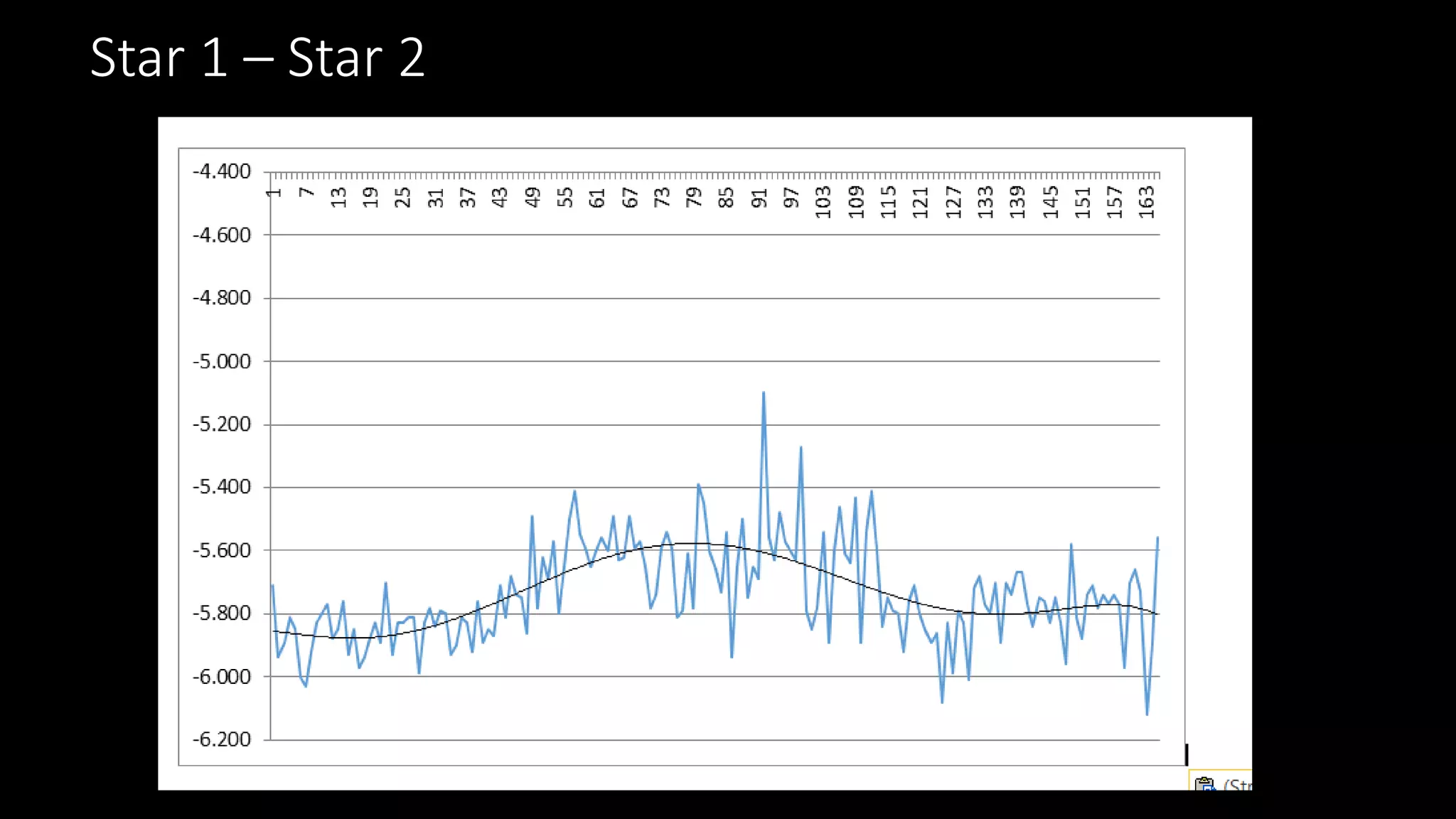
• 9. And did with them these graphs. In this graph we see the brightness
different between star 1 with the exoplanet and star 2 without an
exoplanet. And we can good see the wave in the curve which show that it
get darker.
23.
• 10. Herewe also see the wave because the graph is also with star 1.
• 11. But now here we see no real wave, and this is right because both
stars have no planet.
• 12. For Comparison here all three and this is our proof for the
exoplanet.
• 13. Now to the life on exoplanets. That life on exoplanets is possible it
have to be in the habitable zone. This is the zone around a star where
water is in all the aggregate states, this means the average
temperature is about 0 and 10 °C.
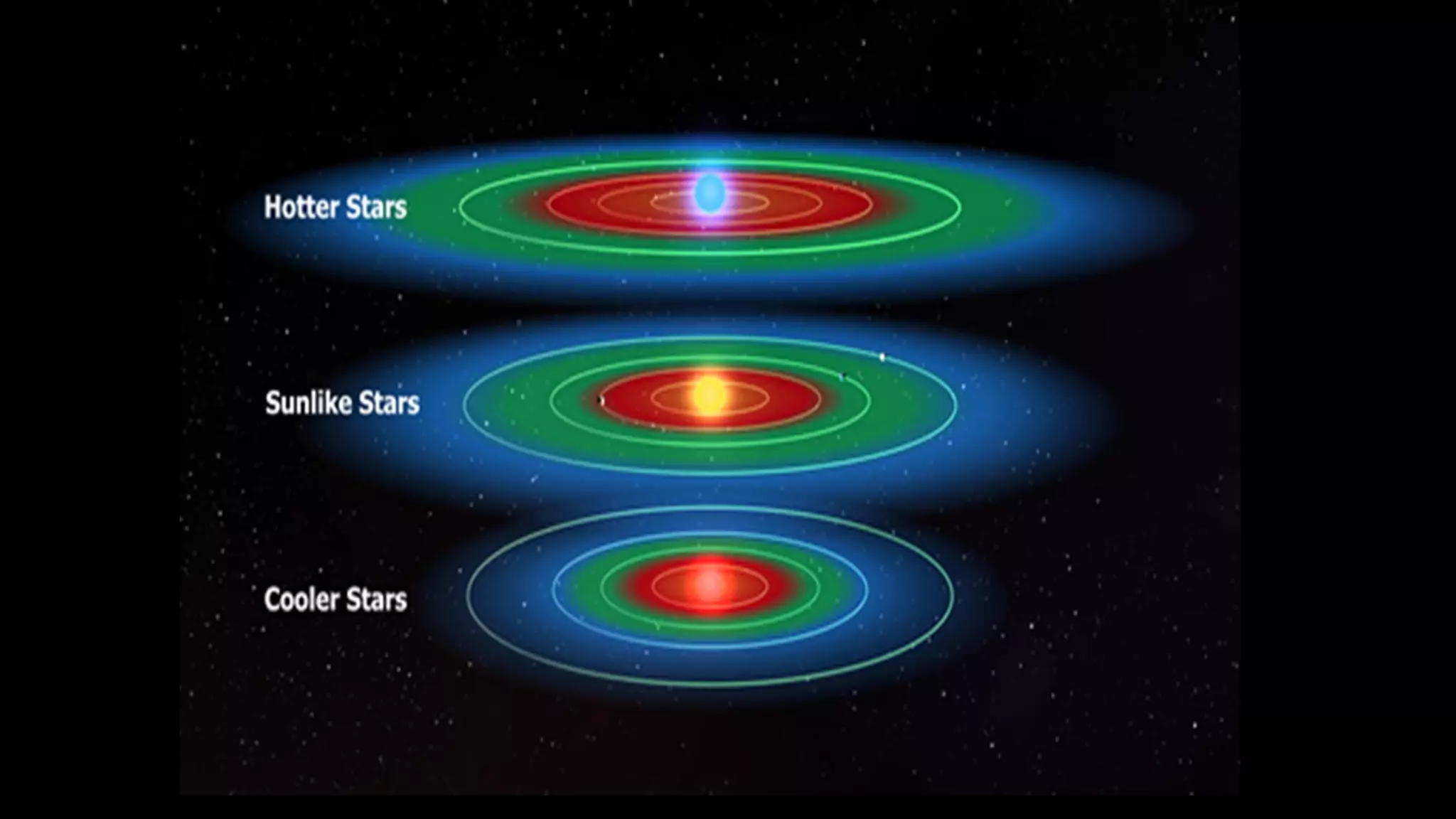
• 14. Here we see that the habitable zone is further away by hotter
stars and nearer by cooler stars.
• 15. Now some examples for Exoplanets. Here is Gliese 581 with 4
proved exoplanets, which are might earth like.
24.
• 16. HereGliese 581 c is maybe a planet with life. The temperature is
between -3 and 40 °C and it has an atmosphere.
• 17. Gliese 581 d very good because it has water, an atmosphere, an
average temperature about 2°C and especially at this Planet is that it
don`t rotate by his self. So one side always show to the star and then
it is might possible to find a palace with the perfect temperature.
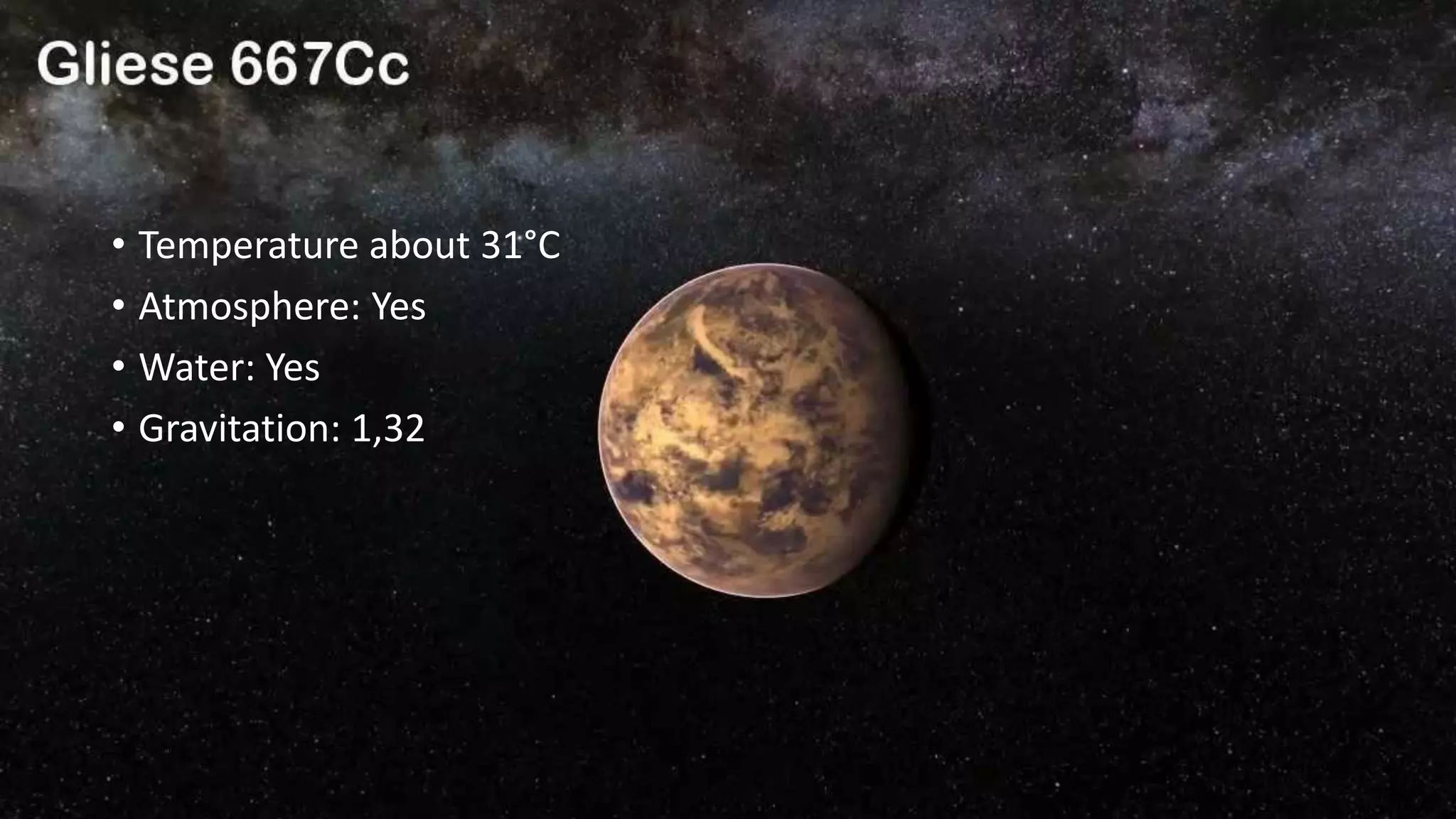
• 18. Gliese 667 C has also water, an atmosphere, and the average
temperature is about 31°C.
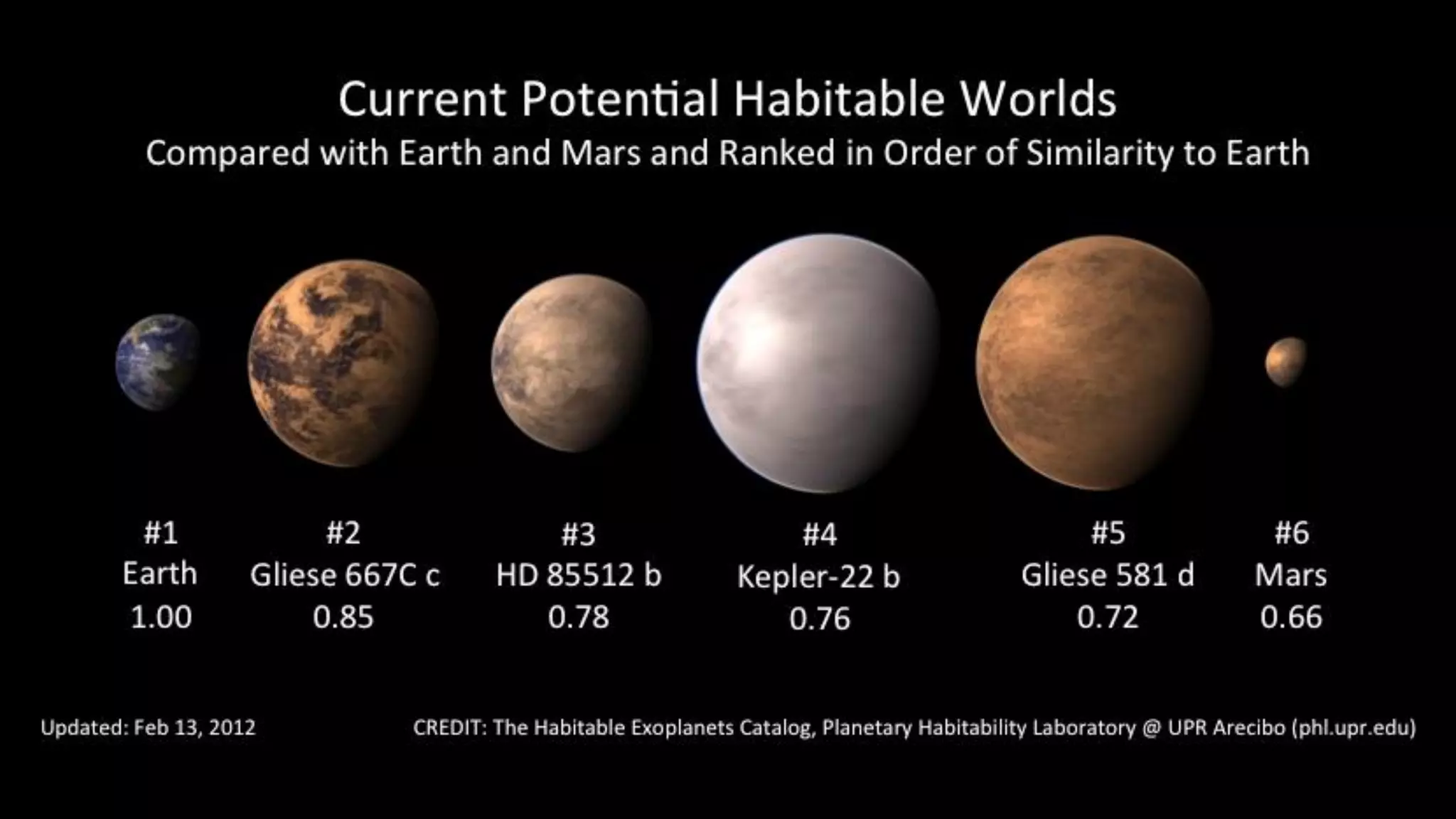
• 19. Now there is a list of the 6th best planets for life. Here number 1
is the earth because we know there is life, and the mars is only on the
6th place.
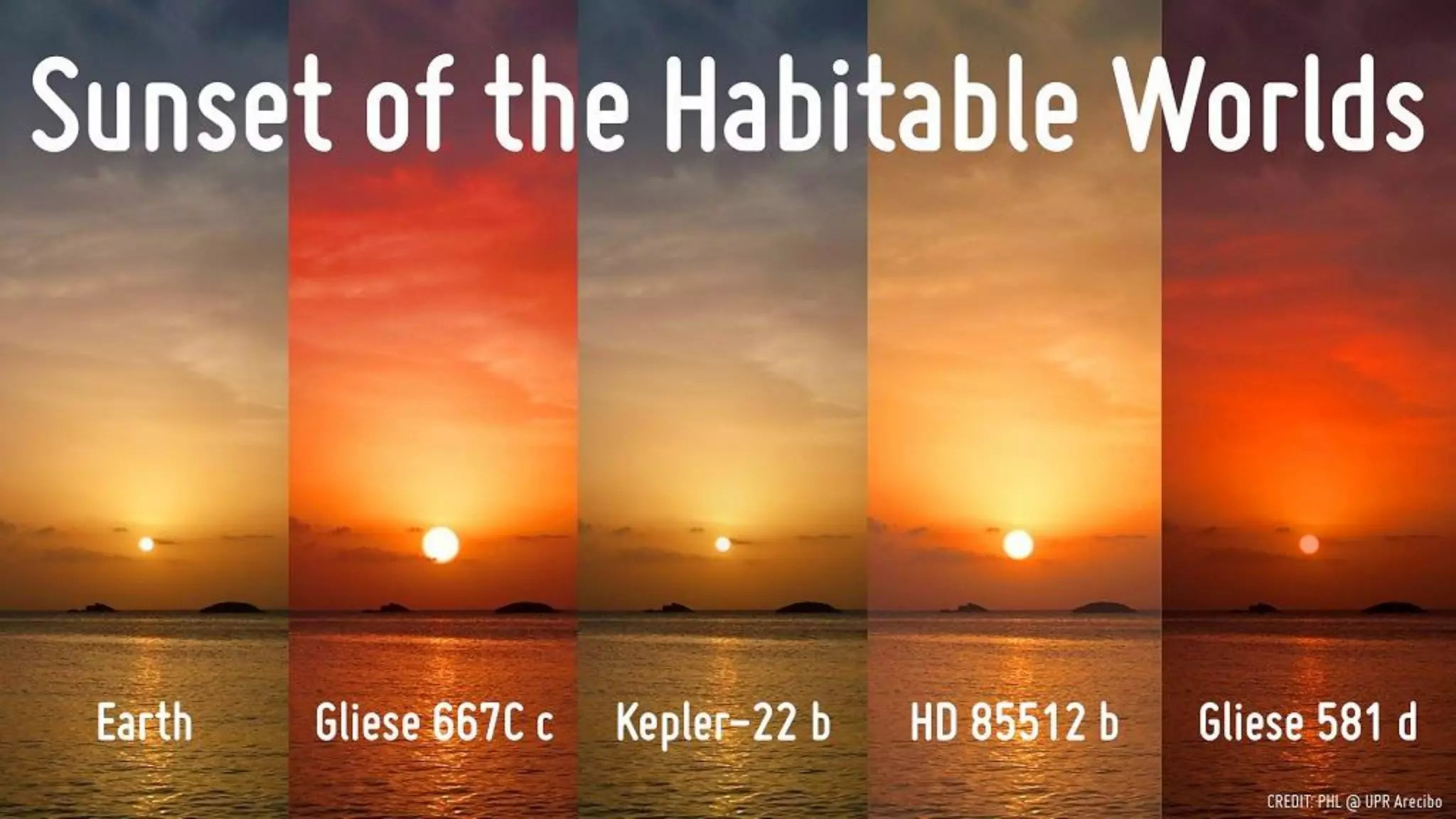
• 20. For the end the sunset on different exoplanets, how it would look
with their stars.