Light pollution is excessive and misdirected artificial light that negatively impacts wildlife, human health, and astronomy. It is caused by wasted light that illuminates areas where it is not needed, such as light shining into neighbors' windows or up into the sky. Outdoor lighting is commonly used for safety and security purposes but can be designed and directed better to reduce light pollution effects. Tips for reducing light pollution include using motion sensors, low-wattage bulbs, and proper shielding to direct light only where it is needed.
What is lightpollution?
• It is wasted light that performs no function or task
• It is artificial light that goes where it’s not supposed to
go.
– Neighbor’s window
– Into the sky
See google Earth at night
7.
Negative Impact onWildlife
• Animals and plants live by a
rhythm based on a 24 hour
cycle. Wildlife and fish can
become disoriented by too
much artificial light at night.
• It interferes with migration,
mating, foraging for food, and
sleep.
• Night wildlife: bat, skunk,
moth, turtle, owl, frog
8.
Negative Impact onHuman Health
• Light trespass into
bedrooms disrupts
sleep patterns.
• New research is being
done to discover the
impact to our
biological clocks.
9.
Negative Impact onAstronomy
• Light pollution negatively affects
one of our greatest natural
laboratories, the night skies.
10.
Purpose of outdoorlighting
• Provide a safe and secure
environment at night.
• Extend the use of parks
and walkways into the
night.
• To enhance
historic/notable features
• To enhance travel on the
roads and at intersections.
11.
What is outdoorlighting now?
• Street lighting
• Roadway lighting
• Parks
• Stadiums
• Parking lots
• Landscaping
• Buildings
• Pedestrian and Bicycling Pathways
12.
Tips for reducinglight pollution
• Its an obvious one, but switch
off any lights you are not
using.
• Use low-watt lightbulbs youll
save on bills and reduce glare.
• Use sensors or timers so
outdoor lights are only on
when they need to be.
• Install thick curtains or blinds
to minimise light escaping
your home at night.
• Use appropiate street lamps.
#6 Without proper lighting design you get light pollution. Light pollution is one of those rare pollutions that actually costs less to solve than it does to continue as it is. Let’s look at what lighting engineers should consider when they design a lighting scheme.
#8 There is more and more research being done about the effects of light pollution on animals, but there is a lot we don’t know yet. This is what we do know. In addition no one spectrum of light is the best for all species. Yellow lights do not attract insects, however, red lights do not attract sea turtles. Good lighting design takes into consideration all aspects of the area to be lit.
#9 The research being done on our biological clocks is going to be very interesting. Our bodies naturally produce many hormones, including melatonin when they are in total darkness. Melatonin is found in practically all species, and acts as an anti-oxidant for the body. If you have light trespass into your bedroom, this biological rhythm may become disturbed. How much light does it take and for how long? These are questions that they are studying, and when we have more information about correlations between light and health we will publish them.
#10 Astronomy is often a “gateway” to other sciences because the laboratory is just outside. The optics perfected in telescopes has been used in satellite technology for weather and communications. Optics designs have also been modified for ophthalmic applications and diagnosis. Radio astronomers have led the way in advances to increase bandwidth for television, satellite, and radio communications. Astrophysics has been the major impetus behind super computer construction for over 50 years. Sensors and detectors have been developed and improved because of the science of Astronomy. These include x-rays used in healthcare, luggage scanners, energy research and biomedical research. Astronomical studies provide information on climate change, weather patterns, and solar observations affecting our planet. So you see, it’s to our mutual benefit to continue to provide clear skies for this research.
#11 All of these purposes show an excellent reason for having light at night, but perhaps we could look at the design of these outdoor lights to determine if there is a better way to light. Why is design important?
#12 This photo illustrates most of the types of lighting that we see everyday. Both the good and the bad. Which takes us to…..
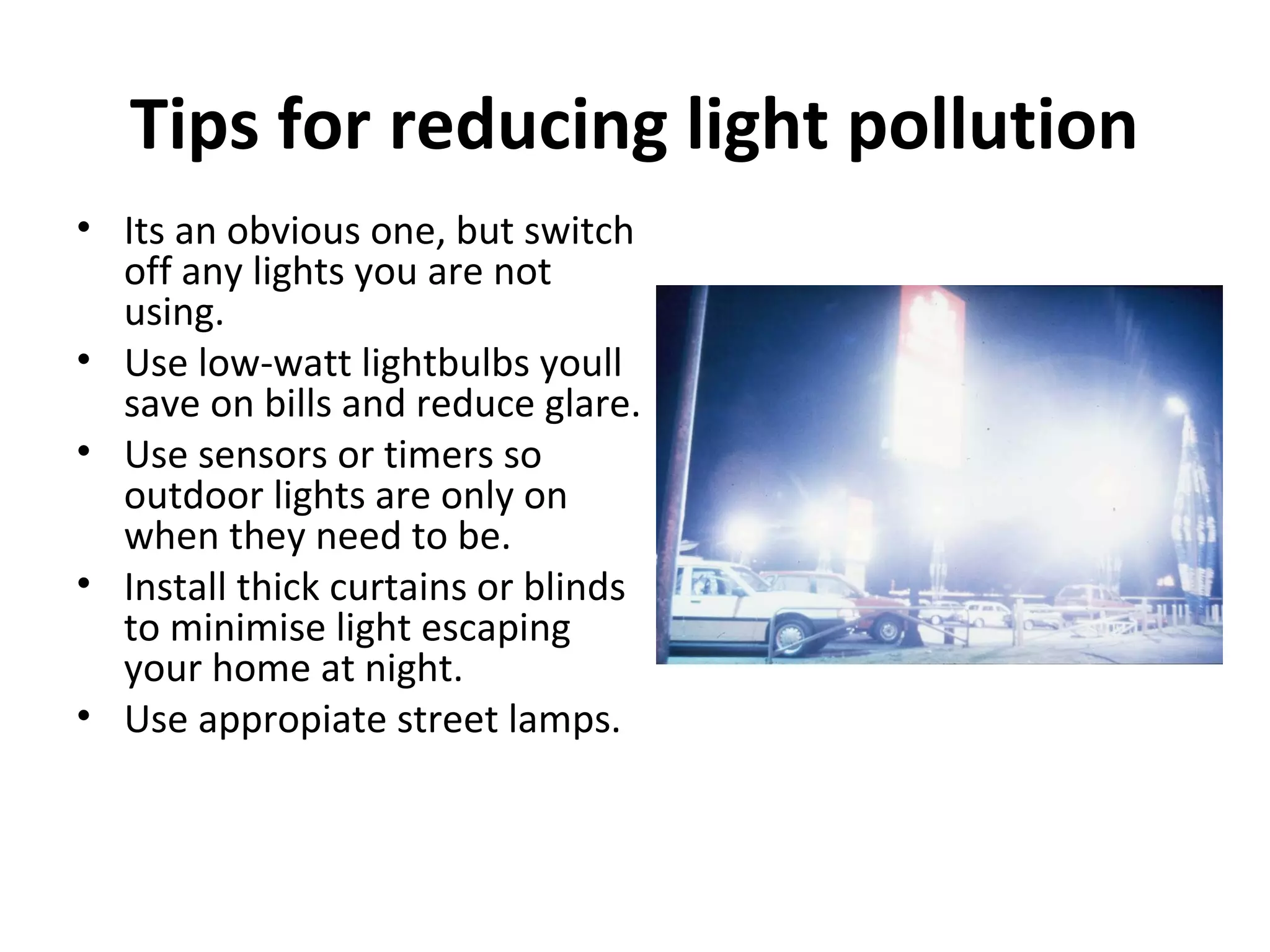
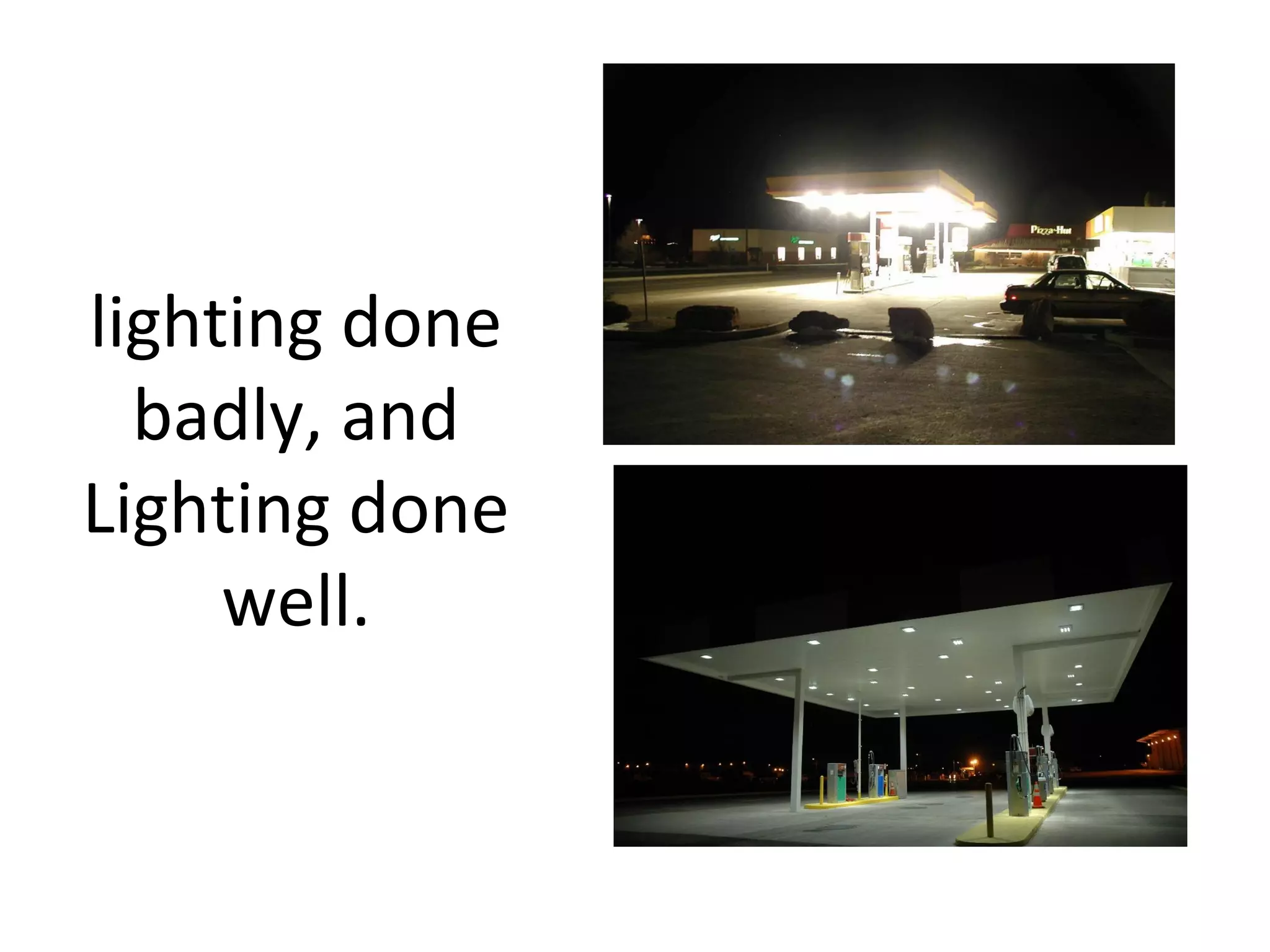
#13 Promoting fully shielded lighting is the backbone of reducing wasted light and energy. These luminaires cost no more than un-shielded light fixtures. We understand that people need some lighting at night, let’s just look at it in a different way. Better lighting that does not spread the light upward where it is not needed. This photo is a perfect example for using shielded lighting to reduce glare, reduce upward light, and perhaps using a timer to dim the lights or turn them off at night. While it’s possible that someone wants to look for a car at 1:00 a.m., it is not probable.
#15 These two ball fields show a good contrast between unshielded and shielded lighting. The field on the left is producing glare and so much of its light is wasted going into the sky. The field on the right has much less impact on the surrounding area because it is only lighting the field, not the neighborhood. Which one would you rather live next to?






![Light trespass and_pollution[1]](https://cdn.slidesharecdn.com/ss_thumbnails/lighttrespassandpollution1-140206161337-phpapp02-thumbnail.jpg?width=640&height=640&fit=bounds)


