LOCUST
পঙ্গপাল Date of publication : 29.5.2020
Dr Tusar Kanti Ghosal
61, Sudhangshu Nagar
Area : Bharat Club, Gunjabari
Post & Dist. Cooch Behar
State : West Bengal, India 736101
E mail : drtkghosal@gmail.com
ORTHOPTERON INSECT
Kingdom : ANIMALIA
Super class : HEXAPODA
(insects and non-insects
having 3 pairs of legs)
Class : INSECTA (insects)
Sub class : PTERYGOTA
(winged insects)
Order : ORTHOPTERA
(grasshoppers, locusts, mole
crickets, true crickets, bush
crickets, katydids)
Katytid
Mole cricket House cricket
House cricket
Locust (solitary) Long horned grasshopper Short horned grasshopper
Grasshopper
These are not a locust
It is not a locust.....
Fore legs are
raptorial or
praying type
Yes, it is a Praying mantis
Body size : above 5 cm
It is a katytid…….
////////////////////
Body size : less 4 cm
It is also a large brown katytid, not locust…….
Body size : above 5 cm
It is a Long horned grasshopper……………..
Body size : less 4 cm.////////////////////
It is a short horn grasshopper…………
LOCUST
LOCUST
////////////////////
Body size : less 4 cm.
……………..Yes, it is a solitary locust
Grasshoppers and locusts are closely related insects belonging to
the Acrididae family. Locusts are actually grasshoppers that is capable of becoming
gregarious and migratory under optimum environmental conditions. Locust has three
phases ie solitary, gregarious and transient phase.
Body size : above 5 cm
/////////////////////////
পঙ্গপাল, LOCUST
Locust শব্দটি এসেসে Latin শব্দ locusta ,যার অর্থ lobster বা ল াকাস্ট।
ছ াট শশিংস়ের শবসশষ প্রজাশি যাসের জীবন চসে ে বা ঝাাঁক বাধার পযথা়ে
র্াসক। একা র্াকা অবস্থা়ে এই ঘাে ফশ িংগুস া অনপকারী, িারা েিংখ্যা়ে
র্াসক কম এবিং কৃ শষর জনয শবরাট লকান আশর্থক ক্ষশি কসর না।
তবে অনাবৃশির পর দ্রুি ফেস র বধথন হস এসের মশিসে
র্াকা লেসরাসটাশনন িাসের মসধয আচরণগি পশরবিথ সনর েূত্রপাি কসর।
ফবল িারা প্রচুর পশরমাসন ও দ্রুি জন্মোন শুরু কসর। িখ্ন িারা একসত্র
র্াসক, যখ্ন িাসের েিংখ্যা লবশশ হ়ে িারা যাযাবর হস়ে পস ।
পঙ্গপাবলর এই মরক তিশর করার ইশিহাে বহু পুরসনা।পুরসনা
শমশরী়েরা িাসের কবসর এসের এসকশে ।
ছেবরাবটানিি (Serotonin)
লেসরাসটাশনন(Serotonin)বা ৫-হাইড্রশিশিপ্টাশমন হ মশিসের
স্না়েুসক েিংসযাগকারী একটি শনউসরািান্সশমটার, যার
রাো়েশনক নাম ৫-হাইড্রশিশিপ্টাশমন। রক্তনাশ কা়ে রক্ত
প্রবাসহ এটি োহাযয কসর। এটি মানুসষর লক্ষসত্র ভা
র্াকার অনুভূ শি প্রোন কসর| িাই এসক অসনকেম়ে
েুখ্ানুভূ শির হরসমান ব া হ়ে।যশেও এটি হরসমান ন়ে,
এটি একটি মসনাএমাইন।
Few popular locust
Garden locust,
Acanthacris ruficornis
Adult
Nymph
Desert Locust,
Schistocerca gregaria (Forskål)
Migratory locust,
Locusta migratoria
Bombay locust,
Cyrtacanthacris succincta
Moroccan locust,
Dociostaurus maroccanus (Thunberg)
Italian locust,
Calliptamus italicus (Linn. )
Australian Plague Locust,
Chortoicetes terminifera (Walker)
Biology of Locust
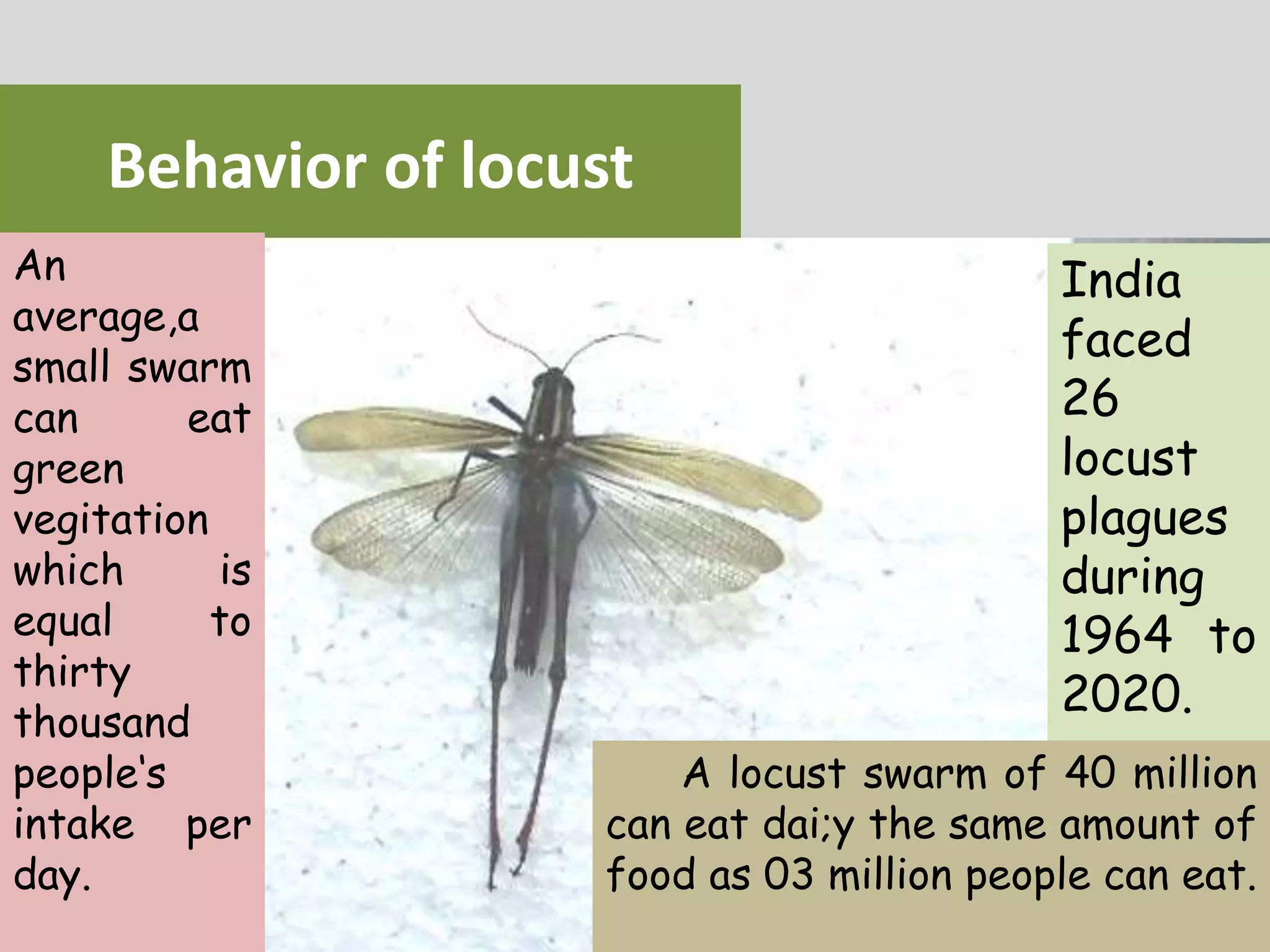
Behavior of locust
India
faced
26
locust
plagues
during
1964 to
2020.
An
average,a
small swarm
can eat
green
vegitation
which is
equal to
thirty
thousand
people‘s
intake per
day.
A locust swarm of 40 million
can eat dai;y the same amount of
food as 03 million people can eat.
In solitary phase (low numbers and
densities), locusts behave as individuals,much
like grasshoppers.
In gregarious phase, they form dense and
highly mobile (marching) bands of hoppers
and flying swarms of adults (winged locusts),
which behave as an entity.
Behavior of locust
Migratory locust, Locusta migratoria Linn.1758
Female adult (solitary)
Nymph (solitary)
Migratory locust, Locusta migratoria
(Gregorius stage)
Usually lead shy, solitary lives but when they get
crowded together they become gregarious and
destructive. It is reported to be solitary in India
since 1927
CLASSIFICATION OF
DESERT LOCUST :
Kingdom: ANIMALIA
Super class: HEXAPODA
Class: INSECTA
Sub class: PTERYGOTA
Order: ORTHOPTERA (grasshoppers, locusts, crickets, katydids)
Sub orders: CAELIFERA (grasshoppers, locusts, mole crickets)
Family: ACRIDIDAE (short horned grasshoppers & locusts)
Genus: Schistocerca
Species: gregaria
India : North-West India to some time East India.
Pakitan : Mostly Balochistan, Sindh and Punjab states.
Yemen
Saudi Arabia
Oman and Sudan
Native homelands of Desert Locust
(Schistocerca gregariain) in Asia…….
Note : The locusts occurred in their traditional late summer breeding
areas, the vast Thar parker, Cholistan deserts, Rajistan desert of south-
western India and Thor desert of India is their home lands.
Desert Locust which is present in about 30 countries during recession
periods and can extend over or into parts of 60 countries during
plagues.
Locust plagues in India
India faced 26 locust plagues during 1964 to 2020.
Colonial government set up a locust warning
organisation in 1939 in Karachi, now in Pakistan.
After that India set up a a separate surveillance
organisation namly “India's Locust Warning
Organisation ”1946.
Large and aggressive swarms of desert locust have invaded more than
24 districts covering more than 50,000 hectares areas of Rajasthan,
Madhya Pradesh, Uttar pradesh ,Gujarat and Punjab are badly effected
till 30 th May 2020.
Locust plagues in India on May 2020
BREEDING ZONE of
Desert locust, Schistocerca gregaria (Forsskal,1775)
Nymph of desert Locust: Difference in
the colour of solitary (green) and
gregarious (black with orange spots)
Adults are yellow, then pink with spots
Desert Locust, Schistocerca
gregaria (Forskål 1775), which is present
in about 30 countries during recession
periods (about 16 million square
kilometers) and can extend over or into
parts of 60 countries during plagues
(about 29 million square kilometers)
PEST MANAGEMENT
Helicopter, drone is required to search, monitoring and chemical spray at
terget.
Use of environmentally acceptable pesticides in locust/grasshopper
control programs in Africa and Asia.
Nympth swarms were controlled by spraying and baiting with Ultra Low
Volume (ULV) Malathion, fenitrothion and dieldrin with the help of
spraying aircraft at Thar desert.
BHC dust may use at Thar to control 1st and 2nd stage hoppers.
Aldrin or BHC baits were used for 3rd, 4th and 5th stage hoppers and
young adults.
Bendiocarb, carbaryl as bait; chlorpyrifos, carbaryl as barrier spray ;
acephate on dry vegetation and propoxur as liquid spray.
My class mates (Batch 1980) namely Bikash,
Tanmoy, Gama, Aktar, Kajol, Puspendu,
Shelly, Mohadeb, Bimal and all others of
J.B.Pur High School (Estd. 1846). This school
is 2nd oldest High School of Howrah district,
West Bengal, India (711408)

Locust in India (slides 24)

  • 1.
    LOCUST পঙ্গপাল Date ofpublication : 29.5.2020 Dr Tusar Kanti Ghosal 61, Sudhangshu Nagar Area : Bharat Club, Gunjabari Post & Dist. Cooch Behar State : West Bengal, India 736101 E mail : [email protected]
  • 2.
    ORTHOPTERON INSECT Kingdom :ANIMALIA Super class : HEXAPODA (insects and non-insects having 3 pairs of legs) Class : INSECTA (insects) Sub class : PTERYGOTA (winged insects) Order : ORTHOPTERA (grasshoppers, locusts, mole crickets, true crickets, bush crickets, katydids)
  • 3.
    Katytid Mole cricket Housecricket House cricket Locust (solitary) Long horned grasshopper Short horned grasshopper Grasshopper These are not a locust
  • 4.
    It is nota locust..... Fore legs are raptorial or praying type Yes, it is a Praying mantis Body size : above 5 cm
  • 5.
    It is akatytid……. //////////////////// Body size : less 4 cm
  • 6.
    It is alsoa large brown katytid, not locust……. Body size : above 5 cm
  • 7.
    It is aLong horned grasshopper…………….. Body size : less 4 cm.////////////////////
  • 8.
    It is ashort horn grasshopper………… LOCUST LOCUST //////////////////// Body size : less 4 cm.
  • 9.
    ……………..Yes, it isa solitary locust Grasshoppers and locusts are closely related insects belonging to the Acrididae family. Locusts are actually grasshoppers that is capable of becoming gregarious and migratory under optimum environmental conditions. Locust has three phases ie solitary, gregarious and transient phase. Body size : above 5 cm /////////////////////////
  • 10.
    পঙ্গপাল, LOCUST Locust শব্দটিএসেসে Latin শব্দ locusta ,যার অর্থ lobster বা ল াকাস্ট। ছ াট শশিংস়ের শবসশষ প্রজাশি যাসের জীবন চসে ে বা ঝাাঁক বাধার পযথা়ে র্াসক। একা র্াকা অবস্থা়ে এই ঘাে ফশ িংগুস া অনপকারী, িারা েিংখ্যা়ে র্াসক কম এবিং কৃ শষর জনয শবরাট লকান আশর্থক ক্ষশি কসর না। তবে অনাবৃশির পর দ্রুি ফেস র বধথন হস এসের মশিসে র্াকা লেসরাসটাশনন িাসের মসধয আচরণগি পশরবিথ সনর েূত্রপাি কসর। ফবল িারা প্রচুর পশরমাসন ও দ্রুি জন্মোন শুরু কসর। িখ্ন িারা একসত্র র্াসক, যখ্ন িাসের েিংখ্যা লবশশ হ়ে িারা যাযাবর হস়ে পস । পঙ্গপাবলর এই মরক তিশর করার ইশিহাে বহু পুরসনা।পুরসনা শমশরী়েরা িাসের কবসর এসের এসকশে ।
  • 11.
    ছেবরাবটানিি (Serotonin) লেসরাসটাশনন(Serotonin)বা ৫-হাইড্রশিশিপ্টাশমনহ মশিসের স্না়েুসক েিংসযাগকারী একটি শনউসরািান্সশমটার, যার রাো়েশনক নাম ৫-হাইড্রশিশিপ্টাশমন। রক্তনাশ কা়ে রক্ত প্রবাসহ এটি োহাযয কসর। এটি মানুসষর লক্ষসত্র ভা র্াকার অনুভূ শি প্রোন কসর| িাই এসক অসনকেম়ে েুখ্ানুভূ শির হরসমান ব া হ়ে।যশেও এটি হরসমান ন়ে, এটি একটি মসনাএমাইন।
  • 12.
    Few popular locust Gardenlocust, Acanthacris ruficornis Adult Nymph Desert Locust, Schistocerca gregaria (Forskål) Migratory locust, Locusta migratoria Bombay locust, Cyrtacanthacris succincta Moroccan locust, Dociostaurus maroccanus (Thunberg) Italian locust, Calliptamus italicus (Linn. ) Australian Plague Locust, Chortoicetes terminifera (Walker)
  • 13.
  • 14.
    Behavior of locust India faced 26 locust plagues during 1964to 2020. An average,a small swarm can eat green vegitation which is equal to thirty thousand people‘s intake per day. A locust swarm of 40 million can eat dai;y the same amount of food as 03 million people can eat.
  • 15.
    In solitary phase(low numbers and densities), locusts behave as individuals,much like grasshoppers. In gregarious phase, they form dense and highly mobile (marching) bands of hoppers and flying swarms of adults (winged locusts), which behave as an entity. Behavior of locust
  • 16.
    Migratory locust, Locustamigratoria Linn.1758 Female adult (solitary) Female adult (solitary) Nymph (solitary)
  • 17.
    Migratory locust, Locustamigratoria (Gregorius stage) Usually lead shy, solitary lives but when they get crowded together they become gregarious and destructive. It is reported to be solitary in India since 1927
  • 18.
    CLASSIFICATION OF DESERT LOCUST: Kingdom: ANIMALIA Super class: HEXAPODA Class: INSECTA Sub class: PTERYGOTA Order: ORTHOPTERA (grasshoppers, locusts, crickets, katydids) Sub orders: CAELIFERA (grasshoppers, locusts, mole crickets) Family: ACRIDIDAE (short horned grasshoppers & locusts) Genus: Schistocerca Species: gregaria
  • 19.
    India : North-WestIndia to some time East India. Pakitan : Mostly Balochistan, Sindh and Punjab states. Yemen Saudi Arabia Oman and Sudan Native homelands of Desert Locust (Schistocerca gregariain) in Asia……. Note : The locusts occurred in their traditional late summer breeding areas, the vast Thar parker, Cholistan deserts, Rajistan desert of south- western India and Thor desert of India is their home lands. Desert Locust which is present in about 30 countries during recession periods and can extend over or into parts of 60 countries during plagues.
  • 20.
    Locust plagues inIndia India faced 26 locust plagues during 1964 to 2020. Colonial government set up a locust warning organisation in 1939 in Karachi, now in Pakistan. After that India set up a a separate surveillance organisation namly “India's Locust Warning Organisation ”1946.
  • 21.
    Large and aggressiveswarms of desert locust have invaded more than 24 districts covering more than 50,000 hectares areas of Rajasthan, Madhya Pradesh, Uttar pradesh ,Gujarat and Punjab are badly effected till 30 th May 2020. Locust plagues in India on May 2020
  • 22.
    BREEDING ZONE of Desertlocust, Schistocerca gregaria (Forsskal,1775) Nymph of desert Locust: Difference in the colour of solitary (green) and gregarious (black with orange spots) Adults are yellow, then pink with spots Desert Locust, Schistocerca gregaria (Forskål 1775), which is present in about 30 countries during recession periods (about 16 million square kilometers) and can extend over or into parts of 60 countries during plagues (about 29 million square kilometers)
  • 23.
    PEST MANAGEMENT Helicopter, droneis required to search, monitoring and chemical spray at terget. Use of environmentally acceptable pesticides in locust/grasshopper control programs in Africa and Asia. Nympth swarms were controlled by spraying and baiting with Ultra Low Volume (ULV) Malathion, fenitrothion and dieldrin with the help of spraying aircraft at Thar desert. BHC dust may use at Thar to control 1st and 2nd stage hoppers. Aldrin or BHC baits were used for 3rd, 4th and 5th stage hoppers and young adults. Bendiocarb, carbaryl as bait; chlorpyrifos, carbaryl as barrier spray ; acephate on dry vegetation and propoxur as liquid spray.
  • 24.
    My class mates(Batch 1980) namely Bikash, Tanmoy, Gama, Aktar, Kajol, Puspendu, Shelly, Mohadeb, Bimal and all others of J.B.Pur High School (Estd. 1846). This school is 2nd oldest High School of Howrah district, West Bengal, India (711408)