COURSE NO : ENT 692 (Doctoral Seminar - II)
Locust swarming in India : Past and
Present
Speaker
Ranapratap A. Raut
1010120025
Ph.D. Scholar 4th Semester
(Plant Pathology)
Major Guide
Dr. Lalit Mahatma
Associate Professor
Department of Plant Pathology
NMCA , NAU, Navsari
Minor guide
Dr. G. B. Kalariya
Training Associate (Pl. Protection)
Training and Visit Scheme
Directorate of Extension Education
NAU, Navsari
Content
INTRODUCTION
HISTORY
DISTRIBUTION
LOCUST BIOLOGY
LOCUST BEHAVIOUR
EFFECT OF CLIMATE ON LOCUST
LOCUST WARNING ORGANIZATION
MANAGEMENT
LOCUST SWARMING IN INDIA (2019-20)
CONCLUSION 1
INTRODUCTION
Locusts are the major agricultural pests of the world.
Different species of grasshoppers, those which can live in two different
phases viz. solitary and gregarious phase are called locusts
ļ¶ā€œAll Locusts are Grasshoppers but all Grasshoppers can’t be called as
Locustā€
Locusts are the short horned grasshoppers with highly migratory habit,
marked polymorphism and voracious feeding behaviour
They are indeed the sleeping giants that can flare up any time to inflict
heavy damage to the crops leading to national emergency of food and
fodder
2
 The written record of locusts is 3,500 years old, in Oracle Script (Jiaguwen, the earliest Chinese script), asking:
ā€œWill locusts appear in the field; will it not rain?ā€
 In the Persian Zoroastrian Vendidad, locust is declared as one of the Xrafstra (evil) creations of Angra
Mainya (Destructive Spirit).
 The Bible (Old Testament) describes the attack of locusts.
 The Book of Nahum (Chapter 3; Verse 15) states the fact that locusts increase their numbers rapidly
 The Book of Deutronomy (Chapter 28; Verse 42) says that the swarms of locusts will take over all your trees
and the crops of your land, you will sow much seed in the field but you will harvest little
 In the ancient epic in Sanskrit, the Mahabharata, Karna warns the Pandavas in the war ā€œthe Kauravas will
pounce on them as the swarm of locustsā€ (ą¤•ą„Œą¤°ą¤µą„ą¤Æą¤µą¤‚ą¤¶ą¤¦ą¤¾ą¤µą„‡ą¤½ą¤æ ą¤øą„ą¤®ą¤Øą„ क ą¤ą¤· ą¤¶ą¤²ą¤­ą¤¾ą¤Æą¤¤ą„‡)
 The Holy Quran also mentions locusts saying Allah punished Egypt with five different plagues
HISTORY
3
 An Indian Entomologist and a pioneer in the study and
management of the Desert Locust (Schistocerca gregaria)
 In 1930, he was assigned to study of locusts at Quetta,
Baluchistan and from 1933 at Karachi
 He worked there until 1939 serving as the Research Head for
the Locust Scheme
 He worked on a comprehensive monograph on ā€œThe Desert
Locust in Indiaā€ which was published in 1960
 This monumental research also led to the establishment of a
more permanent Locust Warning Organization
(11th Sept., 1885 to 1st June, 1972)
Dr. Yelseti Ramachandra Rao
4
Sr. No. Common name Scientific Name
1. The Desert Locust Schistocerca gregaria
2. The Bombay Locust Nomadacris succincta
3. The Migratory Locust
Locusta migratoria manilensis;
Locusta migratoria migratoriaoides
4. The Italian Locust Calliptamus italicus
5. The Moroccan Locust Dociostaurus morocannus
6. The Red Locust Nomadacris septemfaciata
7. The Brown Locust Locustana pardalina
8. The South American Locust Schistocerca paranensis
9. The Australian Locust Chortoicetes termenifera
10. The Tree Locust Anacridium spp.
Table 1: Species of locusts found in the world
Locust Species
 More than 12,000 described grasshopper species, 19 are considered locusts, out of which 10 important species
5
Desert locust Migratory locust
Bombay locust
Tree locust
Species of locusts found in India
6
Desert Locust
Domain : Eukaryota
Kingdom : Metazoa
Phylum : Arthropoda
Subphylum : Uniramia
Class : Insecta
Order : Orthoptera
Family : Acrididae
Genus : Schistocerca
Species : Schistocerca gregaria CABI (modified 11th December, 2020)
7
 The invasion area of desert locust covers about 30 million sq km which includes whole or parts of nearly
64 countries.
Western
 Locust-affected countries in West and North-West Africa: Algeria, Chad, Libya, Mali, Mauritania,
Morocco, Niger, Senegal, and Tunisia; during plagues only: Burkina Faso, Cape Verde, Gambia, Guinea
and Guinea-Bissau.
Central
 Locust-affected countries along the Red Sea; Djibouti, Egypt, Eritrea, Ethiopia, Oman, Saudi Arabia,
Somalia, Sudan, Yemen: during plagues only: Bahrain , Iraq, Israel, Jordan, Kenya, Kuwait, Qatar, Syria,
Tanzania, Turkey, UAE and Uganda.
Eastern
 Locust-affected countries in South-West Asia: Afghanistan, India, Iran and Pakistan.
DISTRIBUTION
8
Fig. 1. Distribution of desert locust in the World 9
 Short horned and short hind legs
 In breeding in desert /cropped area
 Phase changing : Solitary and Gregarious
 Hopper band/adult swarm formed
 Long distance migration: 100-5000 km
 Long horned and big hind legs
 In cropped Area
 No phase changing
 No hopper band/adult swarm
 No long distance migration
10
LOCUST BIOLOGY
 Egg
 Nymph or Hopper
 Adult
Locust life cycle has three distinct stages
11
a) Eggs
Laying depth 5-15 cm
Laying period 7-30 hours
No. times female lays 2-3
Interval between laying 6-11 days
Eggs/pod 60-150 (solitary); 35-80 (gregarious)
Eggs/generation 400/female (solitary); 140/female (gregarious)
Pod length 3-4 cm
Incubation period 10-65 days
Mortality 5-65% (range); 13% (average, solitary); 33% (average,
gregarious)
Symmons and Cressman, 2001
12
Eggs Eggs pod
13
 An immature locust is called a nymph or hopper
 Miniature to adults but wingless
 Lighter in color than adult
b) Nymph
14
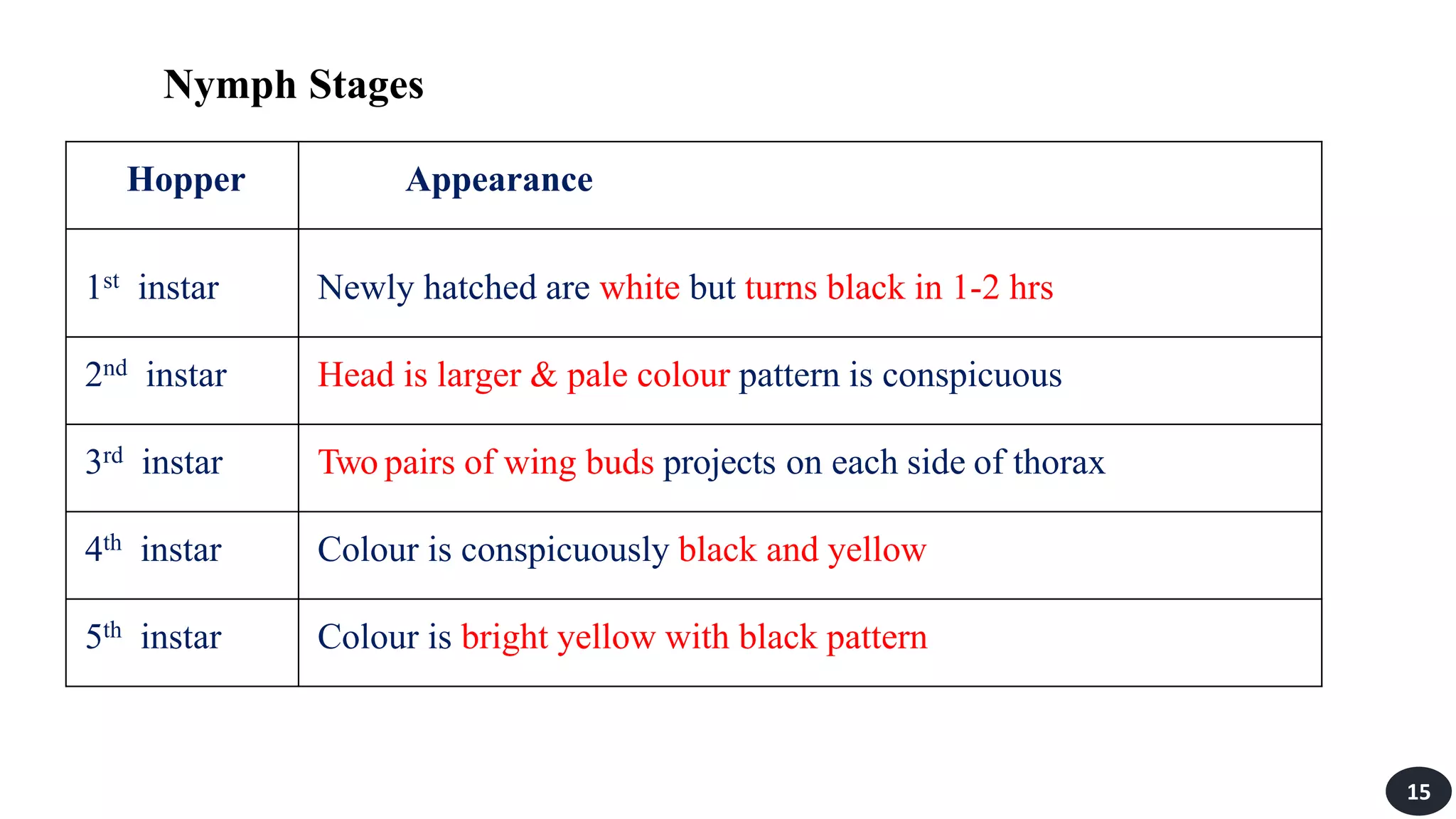
Nymph Stages
Hopper Appearance
1st instar Newly hatched are white but turns black in 1-2 hrs
2nd instar Head is larger & pale colour pattern is conspicuous
3rd instar Two pairs of wing buds projects on each side of thorax
4th instar Colour is conspicuously black and yellow
5th instar Colour is bright yellow with black pattern
15
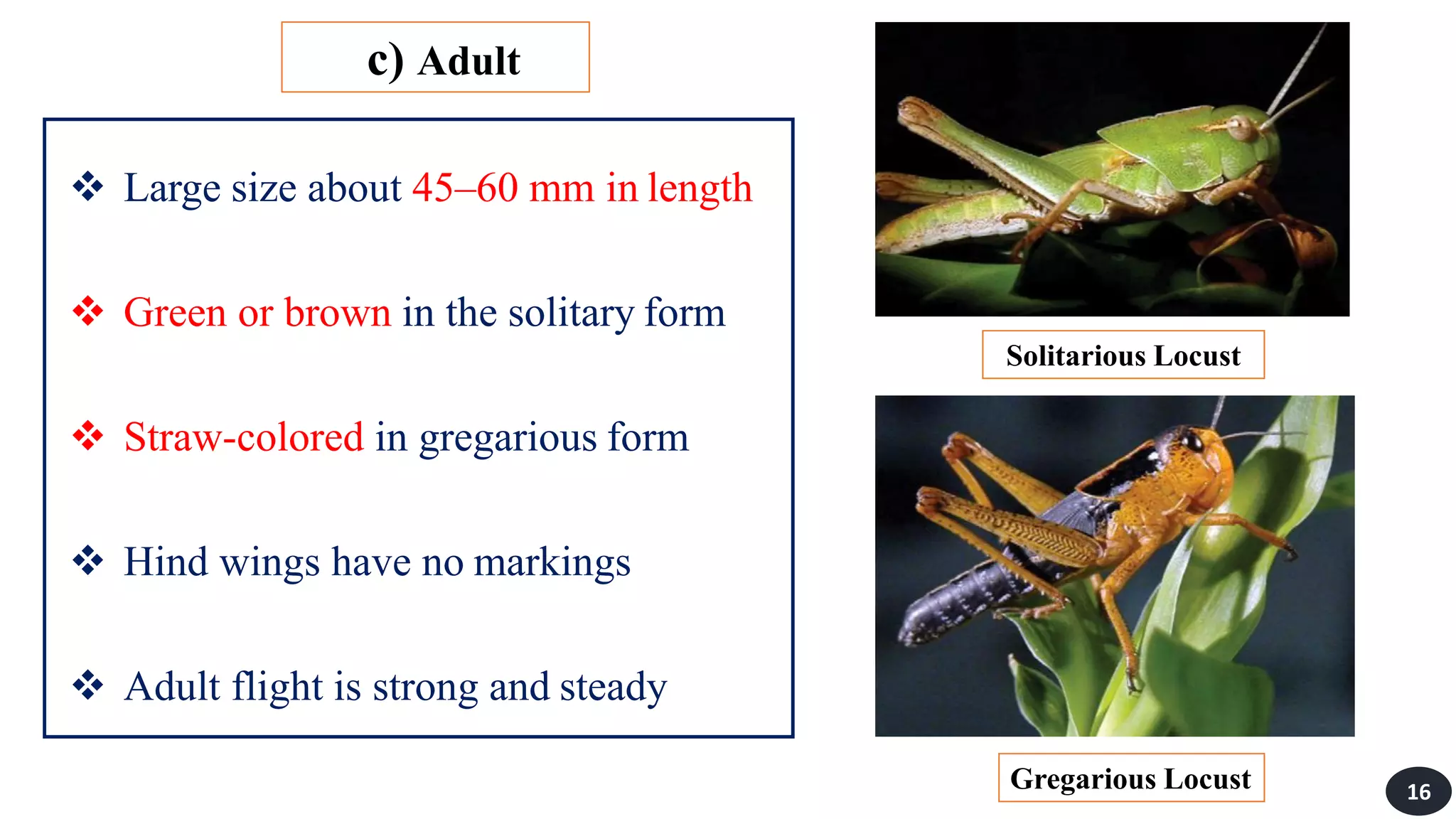
 Large size about 45–60 mm in length
 Green or brown in the solitary form
 Straw-colored in gregarious form
 Hind wings have no markings
 Adult flight is strong and steady
c) Adult
Gregarious Locust
Solitarious Locust
16
 Solitarious Phase : when individuals live mostly separate from each other.
 Gregarious Phase : when large numbers of individuals gather together.
 Transiens : Intermediate phase when locusts are grouping and starting to act as a single mass and are
either changing from solitarious to gregarious (gregarization) or from gregarious to solitarious
(dissociation).
 Congregans : Part of the transiens phase during which locusts are congregating and are in transition
from the solitarious to the gregarious phase.
 Dissocians : Part of the transiens phase during which locusts are in transition from the gregarious to
the solitarious phase.
 Fledging : The final moult is from the fifth-instar hopper to the adult stage. This change is called
fledging and the young adult is called a fledgling.
Phase terminology
17
 Found in breeding ground
 Shy –brown colored
 Try to keep distance from other locust
 Do not form swarm/band
 Fly short distance at night
 Colour pattern and behaviour changed
 Nymphs form large groups –Hopper bands
 Adults form large group - Swarm
 Fledgling: Pink, Voracious
 Sexually matured: yellow colour
 Fly at day time 2-3 hrs after sunrise till 1-2 hr after
sunset
 Rest at night on trees
Fledgling Sexually matured
Matured adult
Gregarious Locust
Solitarious Locust
18
Symmons and Cressman, 2001 19
Fig. 2. Adult and hopper phases
Life Cycle
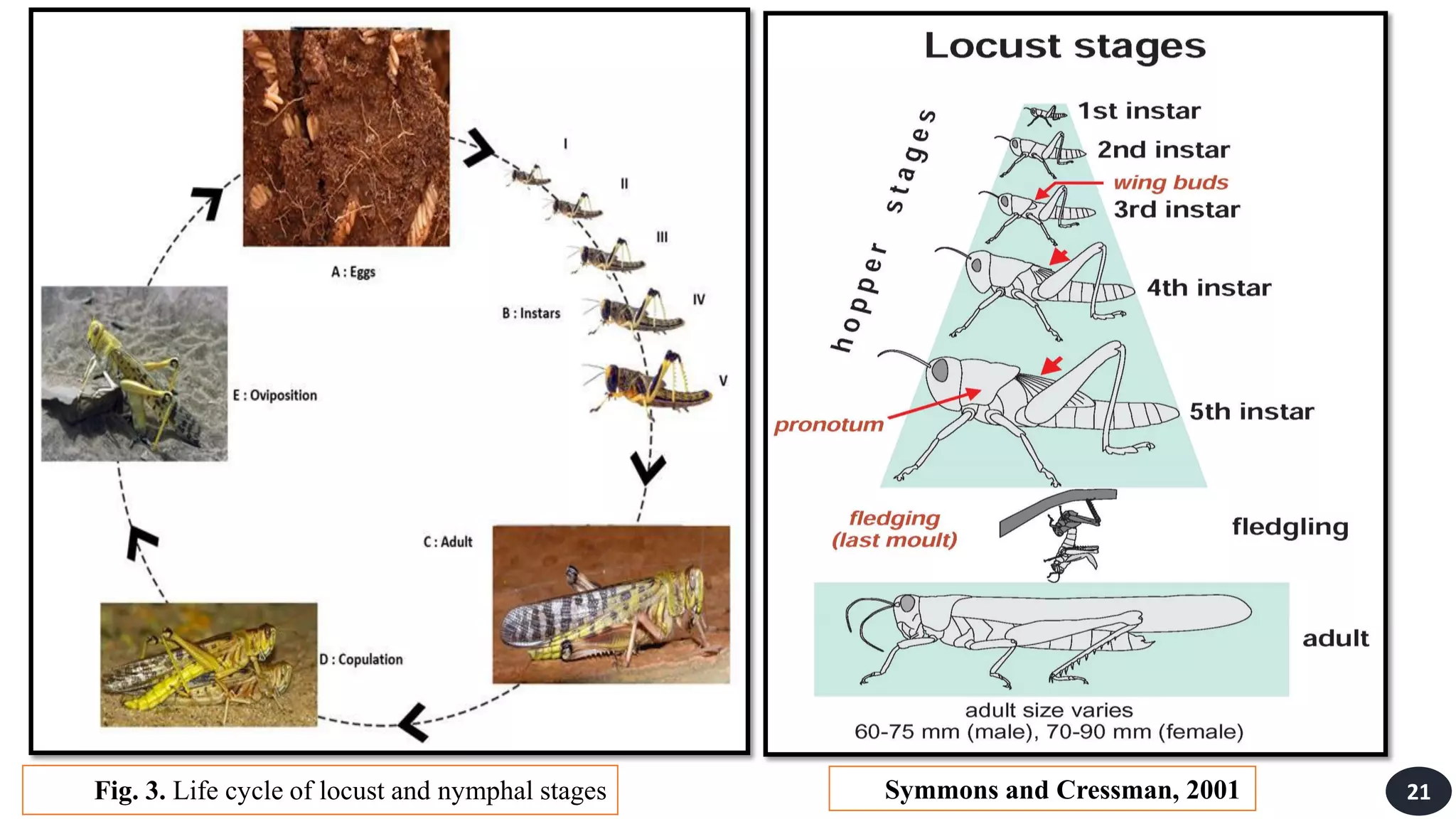
 Female lays eggs in a hole in damp, warm or sandy soil called
a pod usually at a depth of 2-15 cm.
 Each pod contain 60-80 pale yellow banana-shaped eggs 5-6
mm long.
 Eggs hatch in 14-20 days
 Afterwards the nymphs move by crawling or hopping along
the ground as they have no wings.
 5 nymphal instars and nymphs take 4-8 weeks to complete
development
 Adult is the final stage
 Locusts at this level have fully fledged wings and can fly
without problem.
20
Symmons and Cressman, 2001 21
Fig. 3. Life cycle of locust and nymphal stages
Stages Duration
Egg 10 - 65 days
Hopper 24 - 95 days (36 days average)
Adult maturation 3 weeks - 6 months (2 - 4 months average)
Total 2 - 6 months
Life cycle parameters
Symmons and Cressman, 2001
22
 In all, there are three breeding seasons for locusts
 Winter breeding [November to December]
 Spring breeding [January to June]
 Summer breeding [July to October]
 India has only one locust breeding season and that is summer breeding
 The neighboring country Pakistan has both spring and summer breeding
Breeding Season
23
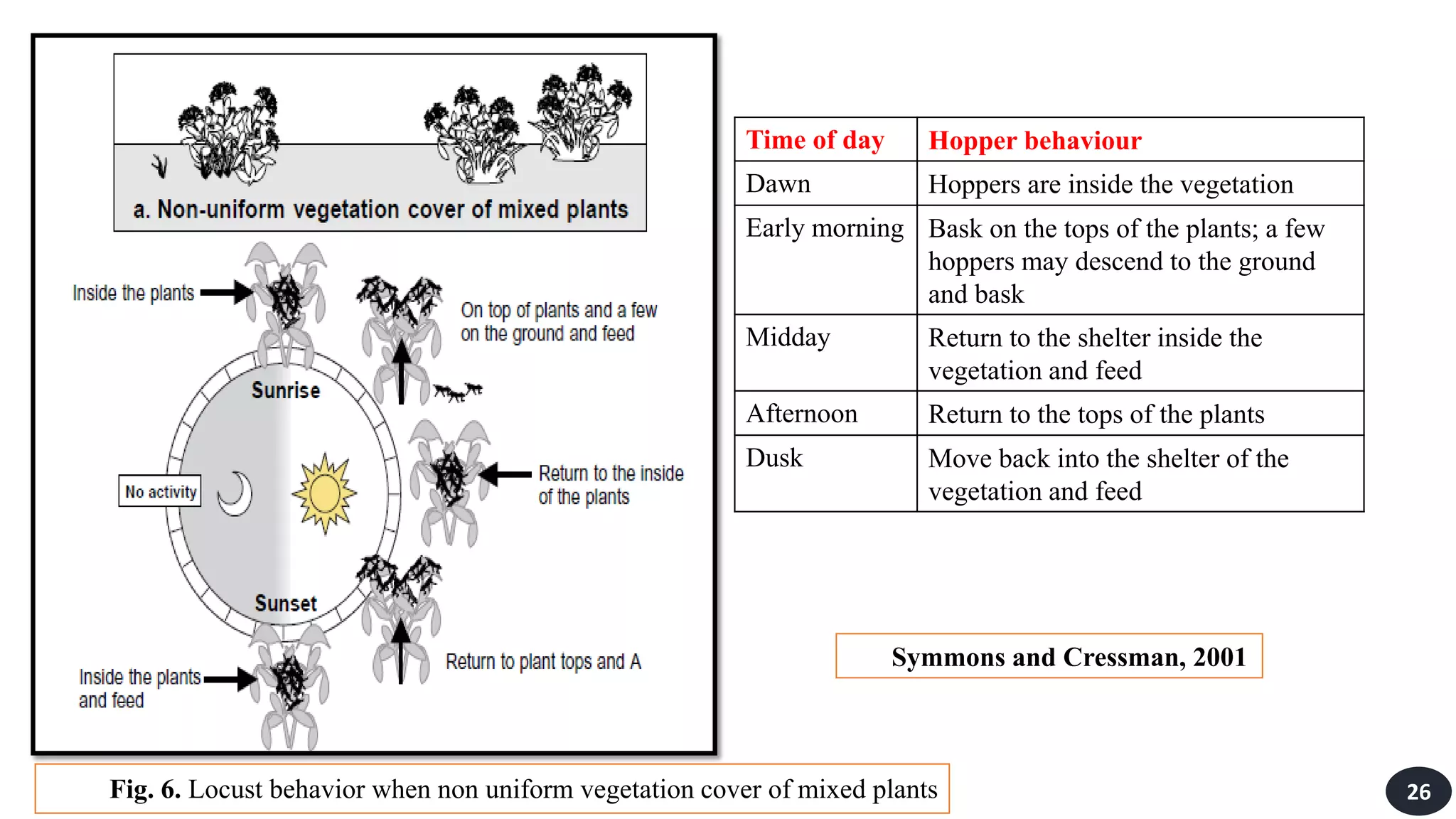
Time of day Hopper behaviour
Dawn – before sunrise Hoppers crawl over the
ground, rest and bask on
the ground (facing the sun)
Sunrise – early morning Rest and bask on the ground
Mid morning – noon March on the ground
Noon Hoppers face into the sun
Afternoon March on the ground
Dusk Rest and feed (if possible)
LOCUST BEHAVIOUR
Symmons and Cressman, 2001
24
Fig. 4. Locust behavior when available of bare soil
Time of day Hopper behaviour
Dawn – before
sunrise
Hoppers crawl over vegetation or ground
followed by ascent to the tops of the
plants
After sunrise –
early morning
Descend from the plants to the ground
and bask on the ground on the sunny
sides of plants
Noon Climb back into the vegetation and
shelter inside the plants or rest on the
highest part of the plants
Afternoon Descend again from the plants to the
ground and bask on the sunny sides of
the plants
Near dusk Climb back into the vegetation
Symmons and Cressman, 2001
25
Fig. 5. Locust behavior when uniform low vegetation cover
Time of day Hopper behaviour
Dawn Hoppers are inside the vegetation
Early morning Bask on the tops of the plants; a few
hoppers may descend to the ground
and bask
Midday Return to the shelter inside the
vegetation and feed
Afternoon Return to the tops of the plants
Dusk Move back into the shelter of the
vegetation and feed
Symmons and Cressman, 2001
26
Fig. 6. Locust behavior when non uniform vegetation cover of mixed plants
Time of day Hopper behavior
Dawn Hoppers move towards the top and
eastern side of the plants
Sunrise Descend to the ground on the eastern
side of the plants
Midday Take shelter inside the vegetation
Afternoon Leave the bases on the southwest side
of the plants and move over the
ground
Dusk Move into the shelter of the plants and
feed
Symmons and Cressman, 2001
27
Fig. 7. Locust behavior when non uniform vegetation cover of taller plants
 The desert locust adult can consume roughly
its own weight in fresh food per day, that is
about two grams every day.
 A 1 km2 size swarm contains about 40 million
locusts, which eat the same amount of food in
one day as about 35,000 people.
 This is based on a person eating an average of
2.3 kg of food per day, according to the
USDA.
How much food can a Desert Locust eat?
A square km swarm eats the same amount as 35,000 peoples
2g
1
km
2
2 g
Symmons and Cressman, 2001 28
 Desert locust adults and swarms can migrate great distances in a short amount of time (150 km/day).
 They can stay in the air for long periods, for example, they regularly cross the Red Sea, a distance of more than 300 km,
and sometimes move across the Sahara from Sudan to Mauritania to Morocco, a distance of nearly 5,000 km.
 There have been some exceptionally impressive swarm migrations, for example from Northwest Africa to the British
Isles in 1954.
 Over ten days in October, 1988, in the most spectacular migration in recent history, Desert Locusts crossed the Atlantic
Ocean from West Africa to the Caribbean, a distance of about 6,000 km.
How far and how fast can Desert Locusts migrate?
Symmons and Cressman, 2001 29
EFFECT OF CLIMATE ON LOCUST
30
Eggs
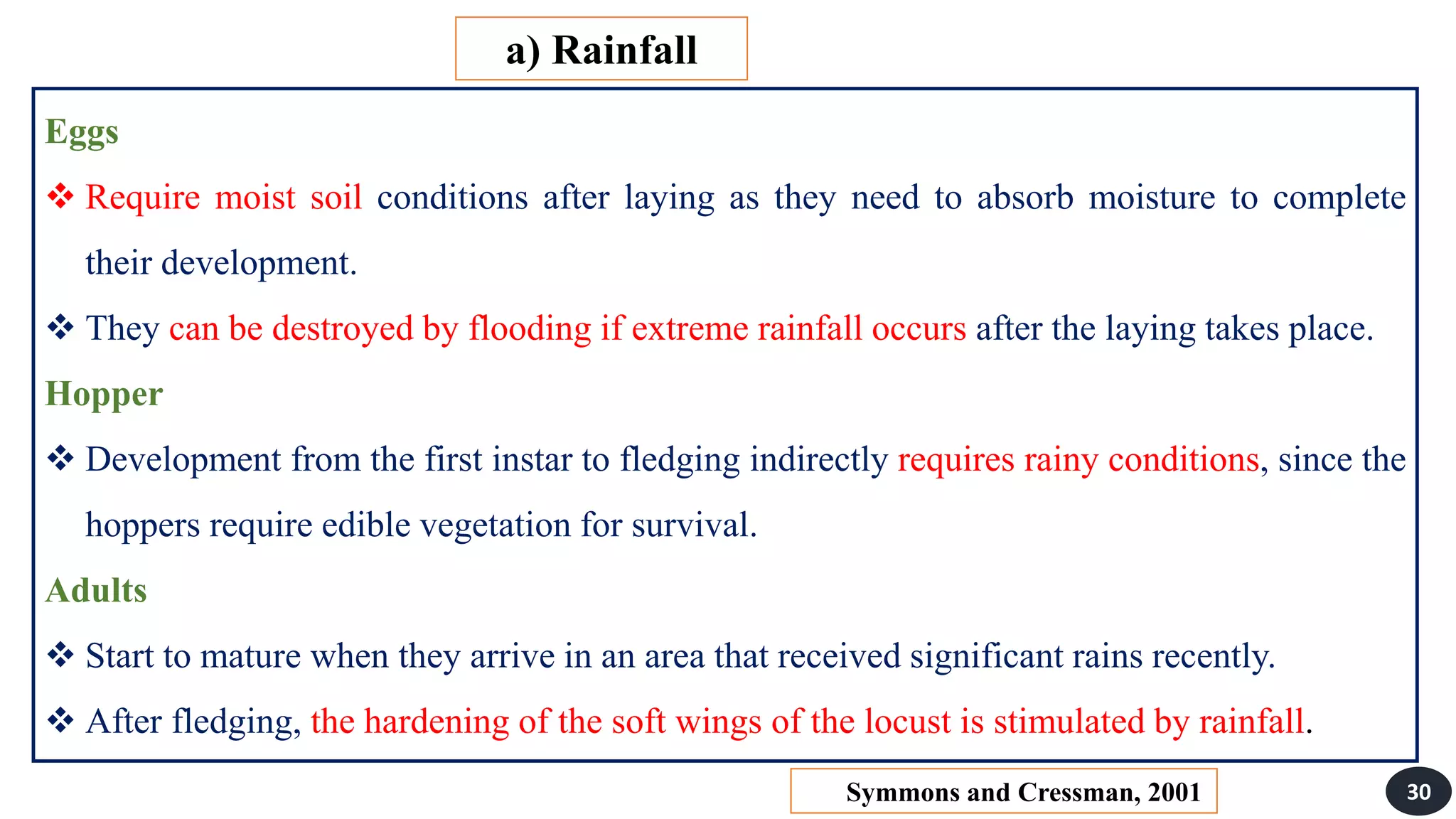
 Require moist soil conditions after laying as they need to absorb moisture to complete
their development.
 They can be destroyed by flooding if extreme rainfall occurs after the laying takes place.
Hopper
 Development from the first instar to fledging indirectly requires rainy conditions, since the
hoppers require edible vegetation for survival.
Adults
 Start to mature when they arrive in an area that received significant rains recently.
 After fledging, the hardening of the soft wings of the locust is stimulated by rainfall.
a) Rainfall
30
Symmons and Cressman, 2001
Egg
 Temperatures below 15°C are unfavourable.
 Under conditions of high temperatures, egg development is more rapid.
 Egg mortality may occur when soil temperatures are above 37°C.
Hopper
 The hopper development period decreases with increasing daily air temperature from 24°C to
32°C.
Adults
 Take off in temperatures above 20°C–22°C and fly with the wind.
 The migration of solitary adults occurs at night, usually 20 minutes after sunset, when the air
temperature is above 20°C–22°C.
Swarms
 In sunny conditions, they can take off in temperatures of at least 15°C–17°C.
 Under cloudy conditions, take-off occurs when temperatures reach 23°C–26°C.
 Under cooler conditions, take-off can be delayed to some 4–6 hours after sunrise.
b) Temperature
30
Symmons and Cressman, 2001
Fig 8. Effect of temperature on egg and hopper development
Symmons and Cressman, 2001
33
Eggs : can dry up if exposed to wind.
Hopper : band movement is usually downwind.
Adult
 The direction of the flight is downwind.
 Swarms land about an hour before sunset as convection dies away
Swarms
 The structure of swarms depends on weather conditions, governed by convective winds and low
pressure systems.
 Cool, overcast weather favours stratiform swarms, while hot afternoons promote cumuliform
swarms.
 Swarms are usually stratiform in the morning and become cumuliform in the heat of the day.
c) Wind
34
Symmons and Cressman, 2001
LOCUST WARNING ORGANISATION
 In India, the scheme Locust Control and Research (LC&R) is responsible for control of
desert locust and is being implemented through Organization known as ā€œLocust Warning
Organisation (LWO)ā€ established in 1939 and later amalgamated with the ā€˜Directorate of
Plant Protection Quarantine and Storage’ in 1946.
 During X five year plan, LWO has been restructured into one Central Headquarter at
Faridabad (Haryana), one Field Headquarter at Jodhpur and 10 Locust Circle Offices
(LCOs) at Bikaner, Jaisalmer, Barmer, Jalore, Phalodi, Nagaur, Suratgarh and Churu
(Rajasthan) and Palanpur and Bhuj (Gujarat) by merging five Circle offices and 23 Locust
Outposts.
 Besides, there is one Field Station for Investigations on Locusts (FSIL) situated at Bikaner.
35
36
Fig. 9. Locust Circle Offices (LCOs) 37
 To monitor, forewarn and control locust in Scheduled Desert Area (SDA) being
International obligation and commitment
 To conduct research on locust and grasshoppers
 Liasoning and coordination with National and International Organizations.
 Human Resource development through training and demonstration for staff of
Locust Warning Organization (LWO), State officials, BSF personnel and farmers.
 To maintain control potential to combat locust emergency by organizing locust
control campaign.
Objectives
38
 Keep constant vigil through field survey to prevent crop losses due to locust attack in approximately 2
lakh sq. kms. Scheduled Desert Area in the states of Rajasthan, Gujarat an Haryana.
 Avoid upsurge of locust population in SDA and entry of locust swarms into India through prompt control
operations.
 Hold Indo-Pak Border meetings for exchange of locust situation information between two countries to
effectively monitor the situation and ensure preparedness to tackle the emerging locust threat, if any.
 Train the farmers, state functionaries and locust staff on latest locust control technologies.
 Advise state functionaries, BSF personnel, Panchayat Raj Institutions to inform the nearest LWO office if
any locust activity was reported in their areas for needful action.
 Issuance of Desert Locust Situation Bulletin at fortnightly intervals to inform all concerned stakeholders
about emerging locust situation in India.
 Conduct research at Field Station on Investigation on Locusts (FSIL) at Bikaner on bio-efficacy of
pesticides and bio-pesticides for locust control.
Functions
39
State District Tehsil, Taluka Area
No. of
Villages
Area in sq
km
Rajasthan
Alwar Bansure, Behror 318 1380.30
Barmer Barmer, Chohtan, Pachpadra, Sheo, Ramsar, Siwana 1636 27,755.64
Bikaner Bikaner, Lunkaransar, Nokha, Sri, Kolayatji 673 22,611.13
Churu
Churu, Rajgarh, Ratangarh, Sardarshahar, Sri
Dungargarh, Taranagar, Sujangarh
940 16,806.12
Jaisalmer Jaisalmer, Pokaran 562 43,583.94
Jalore Ahore, Bhinmal, Jalore, Sanchore 612 12,208.56
Jhunjhunu Chirawa, Jhunjhunu, Khetri, Udaipur, Shekhawati 692 5,879.82
Jodhpur Jodhpur, Osian, Phalodi, Shergarh 624 17,660.10
Nagaur Nagaur, Jayal, Didwana, Ladnun, Nawa 878 11,132.70
Sikar
Sikar, Lachhmangarh, Neem ka Thana, Fatehgarh, Sawai
Madhopur
1506 7,765.80
Sriganganagar Sriganganagar, Anupgarh, Bhadra, Nohar, Suratgarh 2308 12,466.56
Total Rajasthan 1,79,250.67
Table 2. Scheduled Desert Area
40
Gujarat Amreli Dwarka Taluka 42 711.17
Banaskantha Deesa, Deodar, Dhanera, Palanpur (West of main
Ahmedabad-Rly Line), Radhanpur, Tharad (Vav,
Santalpur, Sihori, Talukas)
1086 9,843.09
Bhuj Abdasa, Khadif, Khauvda, Lakhpat, Nakhtrana,
Western-Half), Rapar
655 7,013.47
Halar (Jamnagar) Drol & Parts of Jdia, Kalyanpur, Khambalia, Jamnagar,
Lalpura, Talukas lying along the gulf of Rann of Kutch.
221 2,374.50
Total of Gujarat 23,077.58
Haryana Mohindergarh Mohindergarh, Narnaul 378 3,457.20
Total Haryana 3,457.20
Grand Total 2,05,785.45
Source - Locust Warning Organization
41
MANAGEMENT OF DESERT LOCUST
42
a) Traditional methods
 Killing them with flame throwers
 Ploughing or burning the egg infested field
 Trapping the hoppers in pits
 Loud sounds
 Use of nets
43
Scattering locust food (carrier) impregnated with insecticide.
Studies have shown that the best carriers for locust bait are maize meal, wheat bran,
maize bran, cotton seed husk and rice bran.
The ratio of the carrier to insecticide is 20:1.
For instance, 20 kg of wheat bran (or other selected carrier) and 1 kg of 1% bendiocarb
dust or 3ml of fipronil 5 SC can be used as killing agent.
Bait can be used to kill both hoppers and settled adults but its main use is against
hoppers.
It can be used against all hopper instars but gives very poor results during the last 2-3
days of the fifth instar and during all moulting periods.
b) Baiting
Shrestha et al, 2021 44
 Applying a fine dust impregnated with insecticide.
 The most suitable insecticidal dust for killing locusts and grasshoppers is bendiocarb.
 Dust can be applied by hand and mix the commercial product with fine sand to give a
better distribution
 Some of the insecticide dusts used for control of locust are:
a. Fenvalrate 0.4 DP
b. Malathion 5 DP
c. Quinalphos 1.5 DP
c) Dusting
Shrestha et al, 2021 45
Product Description
Neem Consists tetranortriterpenoid compounds which are known for repellency,
anti-feedant, metamorphosis disturbances, hormonal regulation and
fertility inhibitor property
Linseed Oil Helps in disrupting the swarm formation of locusts
d) Use of botanicals
Shrestha et al, 2021
46
Table 3. Botanicals for locust management
Biocontrol Agent Mode of action
Microsporidia/ Protozoa
Nosema locustae Canning Inundative augmentation
Fungi
Metarhizium anisopliae var. acridum Driver &
Milner
Inundative augmentation
Metarhizium flavoviridae Gams & Roszypal Inundative augmentation
Beauveria bassiana (Bals.-Criv.) Vuill. Inundative augmentation
Bacteria
Bacillus thuringiensis (Bt) Berliner Inundative augmentation
Bacillus sphaericus Meyer and Neide Inundative augmentation
e) Use of biocontrol agents
Shrestha et al, 2021 47
Table 4. Biocontrol agents for locust management
Green Muscleā„¢ is effective against various species including
 Desert locust
 Red locust
 Brown locusts
 Sahelian tree locusts
 Variegated grasshopper
 Senegalese grasshopper
 African rice grasshoppers
 Sahelian grasshoppers
Green Muscleā„¢ stems from a programme called LUBILOSA ā€œLUtte
BIologique contre les LOcustes et SAuteriauxā€, (biological control of locusts
and grasshoppers), which was funded by the governments of Canada, the
Netherlands, Switzerland, Britain and the USA.
Metharizium anisopliae var. acridum
Source - CABI 48
f) Use of natural enemies
Natural enemy Type Life stages
Acanthodactylus cantoris Günther Predator Adults/ Nymphs
Argiope arcuata Lucas Predator Adults/ Nymphs
Argyope arcuata Simon Predator Adults/ Nymphs
Mantis religiosa Linnaeus Predator Adults/ Nymphs
Sphex nivosus (Smith) Predator Adults/ Nymphs
Seniorwhitea krameri (Boettcher) Parasite Adults/ Nymphs
Symmictus costatus Loew Parasite Adults/ Nymphs
Uromastix hardwickii Boulenger Predator Adults/ Nymphs
Stomorhina lunata Fabricius Parasite Eggs
Systoechus aurifacies Greathead Predator Eggs
Systoechus somali Oldroyd Predator Eggs
Trox procerus Har. Predator Eggs
Shrestha et al, 2021 49
Table 5. Natural enemies for locust management
Table 6 (A). Pesticides approved used for control of desert locust in scheduled desert area only
Sr.
No.
Chemical
Dosage
a.i.(g)/ha Formulations (g/ml)/ha
1 Malathion 96% ulv 925 1000
2 Malathion 5% DP 925 20000
3 Fenvalerate 0.4% DP 80-100 20000-25000
4 Quinalphos 1.5% DP 375 25000
g) Use of pesticides
50
Table 6 (B). Pesticides approved used for control of desert locust on crops, Acacia and other trees
Sr. No. Name of pesticides a.i.(g)/ha Formulations (g/ml)/ha
1 Chloropyriphos 20% EC 240 1200
2 Chloropyriphos 50% EC 240 500
3 Deltamethrin 2.8% EC 12.5 500
4 Deltamethrin 1.25% ulv 12.5 1000
5 Diflubenzuron 25% WP 60* 240
6 Fipronil 5% SC 6.25 125
7 Fipronil 2.92% EC 6.25 220
8 Lambda cyhalothrin5% EC 20 400
9 Lambda cyhalothrin10% WP 20 200
10 Malathion 50% EC 925 1850
11 Malathion 25% WP 925 3700
*Only for hoppers control
51
Source - Locust Warning Organization
Outbreak
 Small pockets that are confined to certain areas
Upsurge
 Slightly larger groups but still confined to a geographical area
Plagues
 Extremely large groups which are separated by breeding locations but come together to form swarms.
Recession
 Period without widespread and heavy infestations by swarms.
Remission
 Period of deep recession marked by the complete absence of gregarious populations.
52
Term related to locust attack
Table 7. Adult swarm and hopper band sizes
Adult swarm size Hopper band size
Very small less than 1km2 1-25 m2
Small 1-10 km2 25-2,500 m2
Medium 10-100 km2 2,500 m2-10 ha
Large 100-500 km2 10-50 ha
Very large 500+ km2 50+ ha
Source - Locust Warning Organization
53
Sr. No. Year
1 1812-1821
2 1843-1844
3 1863-1867
4 1869-1873
5 1876-1881
6 1889-1891
7 1900-1907
8 1912-1920
9 1926-1931
10 1940-1946
11 1949-1955
12 1959-1962
Sr. No. Year No. of swarms incursion
1 1964 004
2 1968 167
3 1970 002
4 1973 006
5 1974 006
6 1975 019
7 1976 002
8 1978 020
9 1983 026
10 1986 003
11 1989 015
12 1993 172
13 1997 004
14 2019 276
15 2020 103
Table 8. (B) Locust upsurges
Table 8. (A) Locust plagues
LOCUST ATTACKS IN INDIA’S AGRICULTURAL HISTORY
 Small scale localized locust breeding have also been reported and controlled during the period 1998, 2002, 2005 , 2007
and 2010.
Source - Locust Warning Organization
54
Sr. No. Year Loss in Rs.
1 1926-31 Rs.10 crore.
2 1940-46 Rs. 2 crore
3 1949-55 Rs. 2 crore
4 1959-62 Rs.50 lakh.
5 1978 Rs. 2 lakh
6 1993 Rs. 7.18 lakh.
Table 9. Economic losses caused due to locust attack
55
Source - Down To Earth, 16-30 June 2020 (downtoearth.org.in)
56
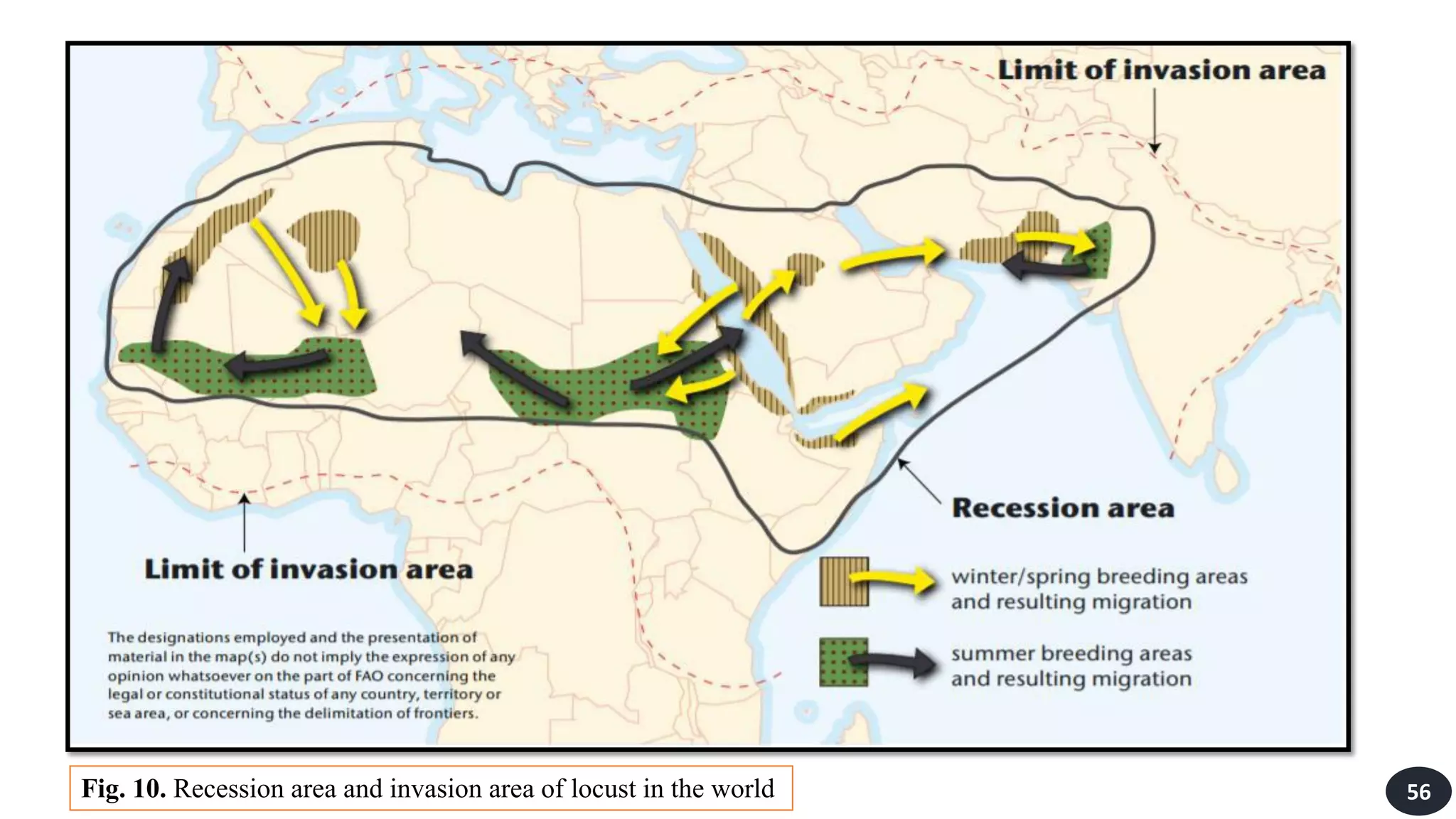
Fig. 10. Recession area and invasion area of locust in the world
LOCUST SWARMING IN INDIA
(2019-20)
57
a) Effects of climate change
 The Indian ocean is warming up more than usual due to climate change. The rain become more extreme due
to enhanced heating of ocean.
 Dipole was beginning to take shape by late 2018 and locust outbreak was growing in Africa increased last
year
 The Indian ocean dipole was so strong that it overrode concern of a drought in India last June 2019 and
brought torrential rainfall, contained in several parts of west Asia, Aman, Yeman, in the horn of Africa,
Ethiopia, Somalia and Kenya so much so that the dry sand become heavily moisture, laden facilitating the
formation of several locust swarm.
 Due to favourable wind it helps swarm to fly and breeds in traditional grounds in Iran, Afghanistan, Pakistan
and India
Causes of outbreak of locust in India
58
Hussain, 2020
59
Fig. 11. Indian Ocean Dipole (Neutral phase)
When the western part is warmer than the east, it is called a positive dipole.
60
Fig. 12. Indian Ocean Dipole (Positive phase)
61
Fig. 13. Monthly Dipole Mode Index (DMI) from January, 1979 to December, 2019
 The above average rainy season in East Africa region created favourable condition
for locust to breed torrential rain hits east Africa around the time of December
2019.
 In fact there were floods and cyclones as well East Africa including Kenya,
Uganda, Ethiopia, Somalia.
 These countries were badly effected flooded during Dec. 2019 due to floods and
torrential rains congenial environmental condition, such as rain, moist soil and
vegetation created for the locust.
b) Spread of the outbreak from East Africa
62
Hussain, 2020
 The soil become moist and there is abundant vegetation around due to rains, so this becomes a great
opportunity for the locust to breed and change into the gregarious phase.
 So the locust began to breed in huge numbers there and a plague hits east Africa so around February
2020.
 The winds of cyclones that had hit the shores and it caused changes the wind direction and in such a
way that they were further pushing the swarms of locust towards India.
 They would not have normally travelled they further moved in this direction because of cyclone
winds and very negative influence on Madhya Pradesh U.P, Rajasthan, Delhi and Haryana.
c) Environmental Condition
d) Cyclone Amphan Impact
63
Hussain, 2020
Hussain, 2020
Cyclone Mekunu developed in the Indian Ocean and moved towards the Southern Arabian Peninsula, causes heavy rain
fall on the 24th and continued until the 26th. A total of 278 mm rainfall which is three times the annual rainfall of Salalah.
Lakes formed in between the sands in the Empty Quarter.
64
Source - Locust Watch (FAO)
Fig. 14. Cyclone Mekunu
Small-scale breeding occurred in the interior of Sudan. The first indication of potential breeding in areas that received
heavy rains from Cyclone Mekunu in May was received from southern Oman where scattered late instar hoppers were
seen at one location on the edge of the Empty Quarter in early October.
65
Source - Locust Watch (FAO)
Fig. 15. Situation of locust in the month of October, 2018
Cyclone Luban developed on 6th October in the central Arabian Sea and moved to the Southern Arabian Peninsula.
Cyclone Luban brought heavy rains and flooding to coastal and interior areas of eastern Yemen and southern Oman.
66
Source - Locust Watch (FAO)
Fig. 16. Cyclone Luban
Groups of adults started to form in the interior of Sudan from good rains during September and October, and moved to
the Red Sea coastal plains. Low numbers of adults appeared on the Red Sea coast in Saudi Arabia.
67
Source - Locust Watch (FAO)
Fig. 17. Situation of locust in the month of November, 2018
Favourable ecological conditions and extensive breeding caused a desert locust outbreak to develop in the winter breeding
areas along the Red Sea coast in Sudan and Eritrea. Small-scale breeding occurred on the Red Sea coast in Saudi
Arabia.
68
Source - Locust Watch (FAO)
Fig. 18. Situation of locust in the month of December, 2018
Immature swarms started to leave the Empty Quarter and moved to eastern Yemen, the interior of Saudi Arabia,
the UAE coast and the coast of Southwest Iran where locusts had not been reported for 50 years.
69
Source - Locust Watch (FAO)
Fig. 19. Situation of locust in the month of January, 2019
Swarms continued to move from the Empty Quarter to eastern Yemen, Southern Oman and the interior of Saudi
Arabia.
70
Source - Locust Watch (FAO)
Fig. 20. Situation of locust in the month of February, 2019
Breeding and band formation increasing in Southern Iran, extending to Southwest Pakistan as a result of
groups and at least one swarm arriving from Iran.
March, 2019
71
Source - Locust Watch (FAO)
Fig. 21. Situation of locust in the month of March, 2019
72
April, 2019
Source - Locust Watch (FAO)
Fig. 22. Situation of locust in the month of April, 2019
Spring breeding intensified in the spring breeding areas of Saudi Arabia and Iran. Smaller-scale breeding occurred
in adjacent areas of Southwest Pakistan.
May, 2019
73
Source - Locust Watch (FAO)
Fig. 23. Situation of locust in the month of May, 2019
Groups and swarms moved to the Indo-Pakistan border where rains fell some six weeks earlier than normal.
74
Source - Locust Warning Organization
Fig. 24. Situation of locust in the month of May, 2019 in India
In 2019, the intense desert locust outbreaks were reported from India 's northern Gujarat state. Dated 09/07/2019, 22/07/2019, 14/12/2019,
three serious attacks have been recorded in North Gujarat during 2019. Locust swarm was observed in Kutch, Banaskantha, Patan,
Sabarkantha & Mehsana district of North Gujarat.
75
Fig. 25 Movement of locust (Gujrat)
Banaskantha
76
Source - Locust Warning Organization
Fig. 26. Movement of locust (Punjab)
Fazilka
77
Source - Locust Warning Organization
Fig. 27. Situation of locust in 2nd fortnight of March, 2020
Locust Situation: 16-31 March, 2020
78
Source - Locust Warning Organization
Fig. 28. Locust situation 1st fortnight of April, 2020 (Raj. & Pun.)
79
Source - Locust Warning Organization
Fig. 29. Movement of locust (M.P. & Maharashtra)
80
Source - Locust Warning Organization
Fig. 30. Movement of locust (Uttar Pradesh)
81
Source - Locust Warning Organization
Fig. 31. Movement of locust (Haryana)
82
Source - Locust Warning Organization
Fig. 32. Locust situation during 2nd fortnight of August, 2020
83
Source - Locust Warning Organization
Fig. 33. Current situation of locust in India and World
Fig 34. A resident tries to fend off swarms of locusts from a mango tree in a residential area of Jaipur, on May 25th, 2020
84
Fig.35. Swarms of locusts gather at top a residential building in Jaipur, in the Indian state of Rajasthan, on May 25th, 2020
85
Fig. 36. A man takes pictures of locusts swarming over a residential area of Allahabad, India on June 11th, 2020
86
Fig. 37. Pictures of locust attack 87
States District affected by locust
Rajasthan
18
Sri Ganganagar
Nagauar
Bikaner
Hanumangarh
Chittorgarh
Karauli
Sawai Madhopur
Jodhpur
Jhalawar
Jaisalmer
Barmer
Jaipur
Churu
Sirohi
Bundi
Sikar
Pratabgarh
Dholpur
States District affected by locust
Gujarat
8
Banaskantha
Mehsana
Sabarkantha
Amreli
Patan
Bhuj
Surendarnagar
Maharashtra
3
Amravati
Wardha
Nagpur
M. P
6
Mandsaur
Neemuch
Sheopur
Morena
Chatarpur
Panna
Table 10. Districts affected by locust in India during 2019-20
88
States District affected by locust
U.P
10
Jhansi
Mahoba
Hamirpur
Agra
Aligarh
Mathura
Bulandshahr
Kanpur
Lalitpur
Farrukhabad
States District affected by locust
Haryana
5
Rewari
Jhajjar
Sisra
Charkhi Dadri
Bhiwani
Punjab
3
Fazilka
Sri Muktsar Sahib
Bathinda
Hussain, 2020
89
 During 2019-20, locust incursion was reported in Rajasthan, Gujarat and Punjab.
 In the following year, the insect attacked Rajasthan, Gujrat, Haryana, Punjab, Uttar
Pradesh, Madhya Pradesh, and Maharashtra.
 Rajasthan and Gujarat reported the highest a crop losses of at least 179,750 ha and
21,500 ha, respectively, over the two years.
 During 2020-21, Uttar Pradesh reported a nominal crop loss of 202.9 ha, vegetation
damage was below 33 per cent in Maharashtra (805.8 ha) and UP (292.4 ha).
Source - Down To Earth, Tuesday 16th March 2021
90
 Control rooms were established in Locust offices and District Headquarters and WhatsApp groups were created in all
affected States for real time exchange of information and coordination.
 To strengthen locust control capabilities in India,10 ground spray equipments were imported from Micron, UK, during
January, 2020 and 15 equipments in June, 2020.
 Sixty control teams with spray equipment mounted vehicles and more than 200 Central Government personnel were
engaged in locust control operations.
 Additional 55 vehicles have been purchased to strengthen the control capabilities.
 Purchase of 3,00,000 liters of Malathion 96% ULV and sufficient stock of pesticides were maintained.
 Government of India was also issued a supply order of 5 aerial spray kits from M/s Micron, UK in March, 2020.
 Under Sub-mission on Agriculture Mechanization assistance for purchase of 800 tractors mounted spray equipments
sanctioned for Rajasthan State Government (2.86 crores).
 Financial assistance of Rs. 14 Crore sanctioned for Rajasthan State under RKVY for hiring of vehicles, tractors and for
purchase of pesticides.
Government initiatives for locust control
91
 Use of drones in locust control for the first time in the world after finalizing protocols
 Indian Air Force also strengthened air control capability by customizing Mi17 Helicopter for aerial spray.
 Financial assistance of Rs. 1.80 crore sanctioned for Gujarat State for purchase of vehicles, spray equipment's,
safety uniform, android application, training with regard to locust.
 The States have also deployed hundreds of staff from agriculture and revenue departments for locust survey
and control.
 All personnel worked day and night on all days in far flung areas, worked even on holidays and festivals,
sometimes without adequate food and shelter due to the lockdown situation, to ensure that the locust was
effectively controlled.
 When the locust settled down at night around 8 to 9 pm and its location was tracked and verified control
operations are planned and executed jointly by Locust offices and District Agriculture officials in the late night
to early morning hours and went on till the remaining population of locusts took flight.
Source - Agricultural situation in India (July, 2020) published by Directorate of Economics and Statistics, Department of
Agriculture, Co-operation and Farmers Welfare, Ministry of Agriculture and Farmers Welfare. Government of India
92
Period Area cover for control operation
May 2019 to Feb 2020 403383 ha
April, 2020 to August 2020 279916 ha
Total 683299 ha
 For 2019-20, State Government of Rajasthan has reported that a relief of Rs. 132.54 crores
have been paid to 79,922 farmers due to locust attack from State Disaster Response Fund in
the form of Agriculture input subsidy.
 State Government of Gujarat has reported that a total amount of approximately Rs. 18.74
crore has been paid to 9137 farmers during 2019-20 as agricultural input subsidy from the
State Disaster Response Fund.
93
Source - Locust Warning Organization
Ministry of Agriculture and Farmers Welfare ( Press release on 18th Sept., 2020)
CONCLUSION
 Locust causes huge loss to agriculture (1 km2 swarm can eat about 80,000 kg food/day)
 Temperature, rainfall and wind are the favourable environmental conditions for locust breeding and
swarming
 Commercially, insecticides are used for the locust control, but in future biocontrol agent like Metarhizium
anisopliae var. acridum will be commercially available for locust control
 Climate change is the main reason for the locust outbreak during 2019-20 in India
 Rajasthan, Gujrat, Haryana, Punjab, Uttar Pradesh, Madhya Pradesh, and Maharashtra are the affected
states during 2019-20 locust outbreaks
 Rajasthan and Gujarat reported the highest a crop losses of at least 179,750 ha and 21,500 ha, respectively,
over the two years.
 The successful control operations have demonstrated well-knit co-ordination and cooperation between
officials of Central and State Governments at every level along with the local representative and the
farmers
94
Slogan for Locust
Locust Says :
ā€œDon’t Show me any vegetation Green,
Otherwise Our Attack will make it Clean ā€
THANK YOU

Locust.pdf

  • 1.
    COURSE NO :ENT 692 (Doctoral Seminar - II) Locust swarming in India : Past and Present Speaker Ranapratap A. Raut 1010120025 Ph.D. Scholar 4th Semester (Plant Pathology) Major Guide Dr. Lalit Mahatma Associate Professor Department of Plant Pathology NMCA , NAU, Navsari Minor guide Dr. G. B. Kalariya Training Associate (Pl. Protection) Training and Visit Scheme Directorate of Extension Education NAU, Navsari
  • 2.
    Content INTRODUCTION HISTORY DISTRIBUTION LOCUST BIOLOGY LOCUST BEHAVIOUR EFFECTOF CLIMATE ON LOCUST LOCUST WARNING ORGANIZATION MANAGEMENT LOCUST SWARMING IN INDIA (2019-20) CONCLUSION 1
  • 3.
    INTRODUCTION Locusts are themajor agricultural pests of the world. Different species of grasshoppers, those which can live in two different phases viz. solitary and gregarious phase are called locusts ļ¶ā€œAll Locusts are Grasshoppers but all Grasshoppers can’t be called as Locustā€ Locusts are the short horned grasshoppers with highly migratory habit, marked polymorphism and voracious feeding behaviour They are indeed the sleeping giants that can flare up any time to inflict heavy damage to the crops leading to national emergency of food and fodder 2
  • 4.
     The writtenrecord of locusts is 3,500 years old, in Oracle Script (Jiaguwen, the earliest Chinese script), asking: ā€œWill locusts appear in the field; will it not rain?ā€  In the Persian Zoroastrian Vendidad, locust is declared as one of the Xrafstra (evil) creations of Angra Mainya (Destructive Spirit).  The Bible (Old Testament) describes the attack of locusts.  The Book of Nahum (Chapter 3; Verse 15) states the fact that locusts increase their numbers rapidly  The Book of Deutronomy (Chapter 28; Verse 42) says that the swarms of locusts will take over all your trees and the crops of your land, you will sow much seed in the field but you will harvest little  In the ancient epic in Sanskrit, the Mahabharata, Karna warns the Pandavas in the war ā€œthe Kauravas will pounce on them as the swarm of locustsā€ (ą¤•ą„Œą¤°ą¤µą„ą¤Æą¤µą¤‚ą¤¶ą¤¦ą¤¾ą¤µą„‡ą¤½ą¤æ ą¤øą„ą¤®ą¤Øą„ क ą¤ą¤· ą¤¶ą¤²ą¤­ą¤¾ą¤Æą¤¤ą„‡)  The Holy Quran also mentions locusts saying Allah punished Egypt with five different plagues HISTORY 3
  • 5.
     An IndianEntomologist and a pioneer in the study and management of the Desert Locust (Schistocerca gregaria)  In 1930, he was assigned to study of locusts at Quetta, Baluchistan and from 1933 at Karachi  He worked there until 1939 serving as the Research Head for the Locust Scheme  He worked on a comprehensive monograph on ā€œThe Desert Locust in Indiaā€ which was published in 1960  This monumental research also led to the establishment of a more permanent Locust Warning Organization (11th Sept., 1885 to 1st June, 1972) Dr. Yelseti Ramachandra Rao 4
  • 6.
    Sr. No. Commonname Scientific Name 1. The Desert Locust Schistocerca gregaria 2. The Bombay Locust Nomadacris succincta 3. The Migratory Locust Locusta migratoria manilensis; Locusta migratoria migratoriaoides 4. The Italian Locust Calliptamus italicus 5. The Moroccan Locust Dociostaurus morocannus 6. The Red Locust Nomadacris septemfaciata 7. The Brown Locust Locustana pardalina 8. The South American Locust Schistocerca paranensis 9. The Australian Locust Chortoicetes termenifera 10. The Tree Locust Anacridium spp. Table 1: Species of locusts found in the world Locust Species  More than 12,000 described grasshopper species, 19 are considered locusts, out of which 10 important species 5
  • 7.
    Desert locust Migratorylocust Bombay locust Tree locust Species of locusts found in India 6
  • 8.
    Desert Locust Domain :Eukaryota Kingdom : Metazoa Phylum : Arthropoda Subphylum : Uniramia Class : Insecta Order : Orthoptera Family : Acrididae Genus : Schistocerca Species : Schistocerca gregaria CABI (modified 11th December, 2020) 7
  • 9.
     The invasionarea of desert locust covers about 30 million sq km which includes whole or parts of nearly 64 countries. Western  Locust-affected countries in West and North-West Africa: Algeria, Chad, Libya, Mali, Mauritania, Morocco, Niger, Senegal, and Tunisia; during plagues only: Burkina Faso, Cape Verde, Gambia, Guinea and Guinea-Bissau. Central  Locust-affected countries along the Red Sea; Djibouti, Egypt, Eritrea, Ethiopia, Oman, Saudi Arabia, Somalia, Sudan, Yemen: during plagues only: Bahrain , Iraq, Israel, Jordan, Kenya, Kuwait, Qatar, Syria, Tanzania, Turkey, UAE and Uganda. Eastern  Locust-affected countries in South-West Asia: Afghanistan, India, Iran and Pakistan. DISTRIBUTION 8
  • 10.
    Fig. 1. Distributionof desert locust in the World 9
  • 11.
     Short hornedand short hind legs  In breeding in desert /cropped area  Phase changing : Solitary and Gregarious  Hopper band/adult swarm formed  Long distance migration: 100-5000 km  Long horned and big hind legs  In cropped Area  No phase changing  No hopper band/adult swarm  No long distance migration 10
  • 12.
    LOCUST BIOLOGY  Egg Nymph or Hopper  Adult Locust life cycle has three distinct stages 11
  • 13.
    a) Eggs Laying depth5-15 cm Laying period 7-30 hours No. times female lays 2-3 Interval between laying 6-11 days Eggs/pod 60-150 (solitary); 35-80 (gregarious) Eggs/generation 400/female (solitary); 140/female (gregarious) Pod length 3-4 cm Incubation period 10-65 days Mortality 5-65% (range); 13% (average, solitary); 33% (average, gregarious) Symmons and Cressman, 2001 12
  • 14.
  • 15.
     An immaturelocust is called a nymph or hopper  Miniature to adults but wingless  Lighter in color than adult b) Nymph 14
  • 16.
    Nymph Stages Hopper Appearance 1stinstar Newly hatched are white but turns black in 1-2 hrs 2nd instar Head is larger & pale colour pattern is conspicuous 3rd instar Two pairs of wing buds projects on each side of thorax 4th instar Colour is conspicuously black and yellow 5th instar Colour is bright yellow with black pattern 15
  • 17.
     Large sizeabout 45–60 mm in length  Green or brown in the solitary form  Straw-colored in gregarious form  Hind wings have no markings  Adult flight is strong and steady c) Adult Gregarious Locust Solitarious Locust 16
  • 18.
     Solitarious Phase: when individuals live mostly separate from each other.  Gregarious Phase : when large numbers of individuals gather together.  Transiens : Intermediate phase when locusts are grouping and starting to act as a single mass and are either changing from solitarious to gregarious (gregarization) or from gregarious to solitarious (dissociation).  Congregans : Part of the transiens phase during which locusts are congregating and are in transition from the solitarious to the gregarious phase.  Dissocians : Part of the transiens phase during which locusts are in transition from the gregarious to the solitarious phase.  Fledging : The final moult is from the fifth-instar hopper to the adult stage. This change is called fledging and the young adult is called a fledgling. Phase terminology 17
  • 19.
     Found inbreeding ground  Shy –brown colored  Try to keep distance from other locust  Do not form swarm/band  Fly short distance at night  Colour pattern and behaviour changed  Nymphs form large groups –Hopper bands  Adults form large group - Swarm  Fledgling: Pink, Voracious  Sexually matured: yellow colour  Fly at day time 2-3 hrs after sunrise till 1-2 hr after sunset  Rest at night on trees Fledgling Sexually matured Matured adult Gregarious Locust Solitarious Locust 18
  • 20.
    Symmons and Cressman,2001 19 Fig. 2. Adult and hopper phases
  • 21.
    Life Cycle  Femalelays eggs in a hole in damp, warm or sandy soil called a pod usually at a depth of 2-15 cm.  Each pod contain 60-80 pale yellow banana-shaped eggs 5-6 mm long.  Eggs hatch in 14-20 days  Afterwards the nymphs move by crawling or hopping along the ground as they have no wings.  5 nymphal instars and nymphs take 4-8 weeks to complete development  Adult is the final stage  Locusts at this level have fully fledged wings and can fly without problem. 20
  • 22.
    Symmons and Cressman,2001 21 Fig. 3. Life cycle of locust and nymphal stages
  • 23.
    Stages Duration Egg 10- 65 days Hopper 24 - 95 days (36 days average) Adult maturation 3 weeks - 6 months (2 - 4 months average) Total 2 - 6 months Life cycle parameters Symmons and Cressman, 2001 22
  • 24.
     In all,there are three breeding seasons for locusts  Winter breeding [November to December]  Spring breeding [January to June]  Summer breeding [July to October]  India has only one locust breeding season and that is summer breeding  The neighboring country Pakistan has both spring and summer breeding Breeding Season 23
  • 25.
    Time of dayHopper behaviour Dawn – before sunrise Hoppers crawl over the ground, rest and bask on the ground (facing the sun) Sunrise – early morning Rest and bask on the ground Mid morning – noon March on the ground Noon Hoppers face into the sun Afternoon March on the ground Dusk Rest and feed (if possible) LOCUST BEHAVIOUR Symmons and Cressman, 2001 24 Fig. 4. Locust behavior when available of bare soil
  • 26.
    Time of dayHopper behaviour Dawn – before sunrise Hoppers crawl over vegetation or ground followed by ascent to the tops of the plants After sunrise – early morning Descend from the plants to the ground and bask on the ground on the sunny sides of plants Noon Climb back into the vegetation and shelter inside the plants or rest on the highest part of the plants Afternoon Descend again from the plants to the ground and bask on the sunny sides of the plants Near dusk Climb back into the vegetation Symmons and Cressman, 2001 25 Fig. 5. Locust behavior when uniform low vegetation cover
  • 27.
    Time of dayHopper behaviour Dawn Hoppers are inside the vegetation Early morning Bask on the tops of the plants; a few hoppers may descend to the ground and bask Midday Return to the shelter inside the vegetation and feed Afternoon Return to the tops of the plants Dusk Move back into the shelter of the vegetation and feed Symmons and Cressman, 2001 26 Fig. 6. Locust behavior when non uniform vegetation cover of mixed plants
  • 28.
    Time of dayHopper behavior Dawn Hoppers move towards the top and eastern side of the plants Sunrise Descend to the ground on the eastern side of the plants Midday Take shelter inside the vegetation Afternoon Leave the bases on the southwest side of the plants and move over the ground Dusk Move into the shelter of the plants and feed Symmons and Cressman, 2001 27 Fig. 7. Locust behavior when non uniform vegetation cover of taller plants
  • 29.
     The desertlocust adult can consume roughly its own weight in fresh food per day, that is about two grams every day.  A 1 km2 size swarm contains about 40 million locusts, which eat the same amount of food in one day as about 35,000 people.  This is based on a person eating an average of 2.3 kg of food per day, according to the USDA. How much food can a Desert Locust eat? A square km swarm eats the same amount as 35,000 peoples 2g 1 km 2 2 g Symmons and Cressman, 2001 28
  • 30.
     Desert locustadults and swarms can migrate great distances in a short amount of time (150 km/day).  They can stay in the air for long periods, for example, they regularly cross the Red Sea, a distance of more than 300 km, and sometimes move across the Sahara from Sudan to Mauritania to Morocco, a distance of nearly 5,000 km.  There have been some exceptionally impressive swarm migrations, for example from Northwest Africa to the British Isles in 1954.  Over ten days in October, 1988, in the most spectacular migration in recent history, Desert Locusts crossed the Atlantic Ocean from West Africa to the Caribbean, a distance of about 6,000 km. How far and how fast can Desert Locusts migrate? Symmons and Cressman, 2001 29
  • 31.
    EFFECT OF CLIMATEON LOCUST 30
  • 32.
    Eggs  Require moistsoil conditions after laying as they need to absorb moisture to complete their development.  They can be destroyed by flooding if extreme rainfall occurs after the laying takes place. Hopper  Development from the first instar to fledging indirectly requires rainy conditions, since the hoppers require edible vegetation for survival. Adults  Start to mature when they arrive in an area that received significant rains recently.  After fledging, the hardening of the soft wings of the locust is stimulated by rainfall. a) Rainfall 30 Symmons and Cressman, 2001
  • 33.
    Egg  Temperatures below15°C are unfavourable.  Under conditions of high temperatures, egg development is more rapid.  Egg mortality may occur when soil temperatures are above 37°C. Hopper  The hopper development period decreases with increasing daily air temperature from 24°C to 32°C. Adults  Take off in temperatures above 20°C–22°C and fly with the wind.  The migration of solitary adults occurs at night, usually 20 minutes after sunset, when the air temperature is above 20°C–22°C. Swarms  In sunny conditions, they can take off in temperatures of at least 15°C–17°C.  Under cloudy conditions, take-off occurs when temperatures reach 23°C–26°C.  Under cooler conditions, take-off can be delayed to some 4–6 hours after sunrise. b) Temperature 30 Symmons and Cressman, 2001
  • 34.
    Fig 8. Effectof temperature on egg and hopper development Symmons and Cressman, 2001 33
  • 35.
    Eggs : candry up if exposed to wind. Hopper : band movement is usually downwind. Adult  The direction of the flight is downwind.  Swarms land about an hour before sunset as convection dies away Swarms  The structure of swarms depends on weather conditions, governed by convective winds and low pressure systems.  Cool, overcast weather favours stratiform swarms, while hot afternoons promote cumuliform swarms.  Swarms are usually stratiform in the morning and become cumuliform in the heat of the day. c) Wind 34 Symmons and Cressman, 2001
  • 36.
    LOCUST WARNING ORGANISATION In India, the scheme Locust Control and Research (LC&R) is responsible for control of desert locust and is being implemented through Organization known as ā€œLocust Warning Organisation (LWO)ā€ established in 1939 and later amalgamated with the ā€˜Directorate of Plant Protection Quarantine and Storage’ in 1946.  During X five year plan, LWO has been restructured into one Central Headquarter at Faridabad (Haryana), one Field Headquarter at Jodhpur and 10 Locust Circle Offices (LCOs) at Bikaner, Jaisalmer, Barmer, Jalore, Phalodi, Nagaur, Suratgarh and Churu (Rajasthan) and Palanpur and Bhuj (Gujarat) by merging five Circle offices and 23 Locust Outposts.  Besides, there is one Field Station for Investigations on Locusts (FSIL) situated at Bikaner. 35
  • 37.
  • 38.
    Fig. 9. LocustCircle Offices (LCOs) 37
  • 39.
     To monitor,forewarn and control locust in Scheduled Desert Area (SDA) being International obligation and commitment  To conduct research on locust and grasshoppers  Liasoning and coordination with National and International Organizations.  Human Resource development through training and demonstration for staff of Locust Warning Organization (LWO), State officials, BSF personnel and farmers.  To maintain control potential to combat locust emergency by organizing locust control campaign. Objectives 38
  • 40.
     Keep constantvigil through field survey to prevent crop losses due to locust attack in approximately 2 lakh sq. kms. Scheduled Desert Area in the states of Rajasthan, Gujarat an Haryana.  Avoid upsurge of locust population in SDA and entry of locust swarms into India through prompt control operations.  Hold Indo-Pak Border meetings for exchange of locust situation information between two countries to effectively monitor the situation and ensure preparedness to tackle the emerging locust threat, if any.  Train the farmers, state functionaries and locust staff on latest locust control technologies.  Advise state functionaries, BSF personnel, Panchayat Raj Institutions to inform the nearest LWO office if any locust activity was reported in their areas for needful action.  Issuance of Desert Locust Situation Bulletin at fortnightly intervals to inform all concerned stakeholders about emerging locust situation in India.  Conduct research at Field Station on Investigation on Locusts (FSIL) at Bikaner on bio-efficacy of pesticides and bio-pesticides for locust control. Functions 39
  • 41.
    State District Tehsil,Taluka Area No. of Villages Area in sq km Rajasthan Alwar Bansure, Behror 318 1380.30 Barmer Barmer, Chohtan, Pachpadra, Sheo, Ramsar, Siwana 1636 27,755.64 Bikaner Bikaner, Lunkaransar, Nokha, Sri, Kolayatji 673 22,611.13 Churu Churu, Rajgarh, Ratangarh, Sardarshahar, Sri Dungargarh, Taranagar, Sujangarh 940 16,806.12 Jaisalmer Jaisalmer, Pokaran 562 43,583.94 Jalore Ahore, Bhinmal, Jalore, Sanchore 612 12,208.56 Jhunjhunu Chirawa, Jhunjhunu, Khetri, Udaipur, Shekhawati 692 5,879.82 Jodhpur Jodhpur, Osian, Phalodi, Shergarh 624 17,660.10 Nagaur Nagaur, Jayal, Didwana, Ladnun, Nawa 878 11,132.70 Sikar Sikar, Lachhmangarh, Neem ka Thana, Fatehgarh, Sawai Madhopur 1506 7,765.80 Sriganganagar Sriganganagar, Anupgarh, Bhadra, Nohar, Suratgarh 2308 12,466.56 Total Rajasthan 1,79,250.67 Table 2. Scheduled Desert Area 40
  • 42.
    Gujarat Amreli DwarkaTaluka 42 711.17 Banaskantha Deesa, Deodar, Dhanera, Palanpur (West of main Ahmedabad-Rly Line), Radhanpur, Tharad (Vav, Santalpur, Sihori, Talukas) 1086 9,843.09 Bhuj Abdasa, Khadif, Khauvda, Lakhpat, Nakhtrana, Western-Half), Rapar 655 7,013.47 Halar (Jamnagar) Drol & Parts of Jdia, Kalyanpur, Khambalia, Jamnagar, Lalpura, Talukas lying along the gulf of Rann of Kutch. 221 2,374.50 Total of Gujarat 23,077.58 Haryana Mohindergarh Mohindergarh, Narnaul 378 3,457.20 Total Haryana 3,457.20 Grand Total 2,05,785.45 Source - Locust Warning Organization 41
  • 43.
  • 44.
    a) Traditional methods Killing them with flame throwers  Ploughing or burning the egg infested field  Trapping the hoppers in pits  Loud sounds  Use of nets 43
  • 45.
    Scattering locust food(carrier) impregnated with insecticide. Studies have shown that the best carriers for locust bait are maize meal, wheat bran, maize bran, cotton seed husk and rice bran. The ratio of the carrier to insecticide is 20:1. For instance, 20 kg of wheat bran (or other selected carrier) and 1 kg of 1% bendiocarb dust or 3ml of fipronil 5 SC can be used as killing agent. Bait can be used to kill both hoppers and settled adults but its main use is against hoppers. It can be used against all hopper instars but gives very poor results during the last 2-3 days of the fifth instar and during all moulting periods. b) Baiting Shrestha et al, 2021 44
  • 46.
     Applying afine dust impregnated with insecticide.  The most suitable insecticidal dust for killing locusts and grasshoppers is bendiocarb.  Dust can be applied by hand and mix the commercial product with fine sand to give a better distribution  Some of the insecticide dusts used for control of locust are: a. Fenvalrate 0.4 DP b. Malathion 5 DP c. Quinalphos 1.5 DP c) Dusting Shrestha et al, 2021 45
  • 47.
    Product Description Neem Consiststetranortriterpenoid compounds which are known for repellency, anti-feedant, metamorphosis disturbances, hormonal regulation and fertility inhibitor property Linseed Oil Helps in disrupting the swarm formation of locusts d) Use of botanicals Shrestha et al, 2021 46 Table 3. Botanicals for locust management
  • 48.
    Biocontrol Agent Modeof action Microsporidia/ Protozoa Nosema locustae Canning Inundative augmentation Fungi Metarhizium anisopliae var. acridum Driver & Milner Inundative augmentation Metarhizium flavoviridae Gams & Roszypal Inundative augmentation Beauveria bassiana (Bals.-Criv.) Vuill. Inundative augmentation Bacteria Bacillus thuringiensis (Bt) Berliner Inundative augmentation Bacillus sphaericus Meyer and Neide Inundative augmentation e) Use of biocontrol agents Shrestha et al, 2021 47 Table 4. Biocontrol agents for locust management
  • 49.
    Green Muscleā„¢ iseffective against various species including  Desert locust  Red locust  Brown locusts  Sahelian tree locusts  Variegated grasshopper  Senegalese grasshopper  African rice grasshoppers  Sahelian grasshoppers Green Muscleā„¢ stems from a programme called LUBILOSA ā€œLUtte BIologique contre les LOcustes et SAuteriauxā€, (biological control of locusts and grasshoppers), which was funded by the governments of Canada, the Netherlands, Switzerland, Britain and the USA. Metharizium anisopliae var. acridum Source - CABI 48
  • 50.
    f) Use ofnatural enemies Natural enemy Type Life stages Acanthodactylus cantoris Günther Predator Adults/ Nymphs Argiope arcuata Lucas Predator Adults/ Nymphs Argyope arcuata Simon Predator Adults/ Nymphs Mantis religiosa Linnaeus Predator Adults/ Nymphs Sphex nivosus (Smith) Predator Adults/ Nymphs Seniorwhitea krameri (Boettcher) Parasite Adults/ Nymphs Symmictus costatus Loew Parasite Adults/ Nymphs Uromastix hardwickii Boulenger Predator Adults/ Nymphs Stomorhina lunata Fabricius Parasite Eggs Systoechus aurifacies Greathead Predator Eggs Systoechus somali Oldroyd Predator Eggs Trox procerus Har. Predator Eggs Shrestha et al, 2021 49 Table 5. Natural enemies for locust management
  • 51.
    Table 6 (A).Pesticides approved used for control of desert locust in scheduled desert area only Sr. No. Chemical Dosage a.i.(g)/ha Formulations (g/ml)/ha 1 Malathion 96% ulv 925 1000 2 Malathion 5% DP 925 20000 3 Fenvalerate 0.4% DP 80-100 20000-25000 4 Quinalphos 1.5% DP 375 25000 g) Use of pesticides 50
  • 52.
    Table 6 (B).Pesticides approved used for control of desert locust on crops, Acacia and other trees Sr. No. Name of pesticides a.i.(g)/ha Formulations (g/ml)/ha 1 Chloropyriphos 20% EC 240 1200 2 Chloropyriphos 50% EC 240 500 3 Deltamethrin 2.8% EC 12.5 500 4 Deltamethrin 1.25% ulv 12.5 1000 5 Diflubenzuron 25% WP 60* 240 6 Fipronil 5% SC 6.25 125 7 Fipronil 2.92% EC 6.25 220 8 Lambda cyhalothrin5% EC 20 400 9 Lambda cyhalothrin10% WP 20 200 10 Malathion 50% EC 925 1850 11 Malathion 25% WP 925 3700 *Only for hoppers control 51 Source - Locust Warning Organization
  • 53.
    Outbreak  Small pocketsthat are confined to certain areas Upsurge  Slightly larger groups but still confined to a geographical area Plagues  Extremely large groups which are separated by breeding locations but come together to form swarms. Recession  Period without widespread and heavy infestations by swarms. Remission  Period of deep recession marked by the complete absence of gregarious populations. 52 Term related to locust attack
  • 54.
    Table 7. Adultswarm and hopper band sizes Adult swarm size Hopper band size Very small less than 1km2 1-25 m2 Small 1-10 km2 25-2,500 m2 Medium 10-100 km2 2,500 m2-10 ha Large 100-500 km2 10-50 ha Very large 500+ km2 50+ ha Source - Locust Warning Organization 53
  • 55.
    Sr. No. Year 11812-1821 2 1843-1844 3 1863-1867 4 1869-1873 5 1876-1881 6 1889-1891 7 1900-1907 8 1912-1920 9 1926-1931 10 1940-1946 11 1949-1955 12 1959-1962 Sr. No. Year No. of swarms incursion 1 1964 004 2 1968 167 3 1970 002 4 1973 006 5 1974 006 6 1975 019 7 1976 002 8 1978 020 9 1983 026 10 1986 003 11 1989 015 12 1993 172 13 1997 004 14 2019 276 15 2020 103 Table 8. (B) Locust upsurges Table 8. (A) Locust plagues LOCUST ATTACKS IN INDIA’S AGRICULTURAL HISTORY  Small scale localized locust breeding have also been reported and controlled during the period 1998, 2002, 2005 , 2007 and 2010. Source - Locust Warning Organization 54
  • 56.
    Sr. No. YearLoss in Rs. 1 1926-31 Rs.10 crore. 2 1940-46 Rs. 2 crore 3 1949-55 Rs. 2 crore 4 1959-62 Rs.50 lakh. 5 1978 Rs. 2 lakh 6 1993 Rs. 7.18 lakh. Table 9. Economic losses caused due to locust attack 55 Source - Down To Earth, 16-30 June 2020 (downtoearth.org.in)
  • 57.
    56 Fig. 10. Recessionarea and invasion area of locust in the world
  • 58.
    LOCUST SWARMING ININDIA (2019-20) 57
  • 59.
    a) Effects ofclimate change  The Indian ocean is warming up more than usual due to climate change. The rain become more extreme due to enhanced heating of ocean.  Dipole was beginning to take shape by late 2018 and locust outbreak was growing in Africa increased last year  The Indian ocean dipole was so strong that it overrode concern of a drought in India last June 2019 and brought torrential rainfall, contained in several parts of west Asia, Aman, Yeman, in the horn of Africa, Ethiopia, Somalia and Kenya so much so that the dry sand become heavily moisture, laden facilitating the formation of several locust swarm.  Due to favourable wind it helps swarm to fly and breeds in traditional grounds in Iran, Afghanistan, Pakistan and India Causes of outbreak of locust in India 58 Hussain, 2020
  • 60.
    59 Fig. 11. IndianOcean Dipole (Neutral phase)
  • 61.
    When the westernpart is warmer than the east, it is called a positive dipole. 60 Fig. 12. Indian Ocean Dipole (Positive phase)
  • 62.
    61 Fig. 13. MonthlyDipole Mode Index (DMI) from January, 1979 to December, 2019
  • 63.
     The aboveaverage rainy season in East Africa region created favourable condition for locust to breed torrential rain hits east Africa around the time of December 2019.  In fact there were floods and cyclones as well East Africa including Kenya, Uganda, Ethiopia, Somalia.  These countries were badly effected flooded during Dec. 2019 due to floods and torrential rains congenial environmental condition, such as rain, moist soil and vegetation created for the locust. b) Spread of the outbreak from East Africa 62 Hussain, 2020
  • 64.
     The soilbecome moist and there is abundant vegetation around due to rains, so this becomes a great opportunity for the locust to breed and change into the gregarious phase.  So the locust began to breed in huge numbers there and a plague hits east Africa so around February 2020.  The winds of cyclones that had hit the shores and it caused changes the wind direction and in such a way that they were further pushing the swarms of locust towards India.  They would not have normally travelled they further moved in this direction because of cyclone winds and very negative influence on Madhya Pradesh U.P, Rajasthan, Delhi and Haryana. c) Environmental Condition d) Cyclone Amphan Impact 63 Hussain, 2020 Hussain, 2020
  • 65.
    Cyclone Mekunu developedin the Indian Ocean and moved towards the Southern Arabian Peninsula, causes heavy rain fall on the 24th and continued until the 26th. A total of 278 mm rainfall which is three times the annual rainfall of Salalah. Lakes formed in between the sands in the Empty Quarter. 64 Source - Locust Watch (FAO) Fig. 14. Cyclone Mekunu
  • 66.
    Small-scale breeding occurredin the interior of Sudan. The first indication of potential breeding in areas that received heavy rains from Cyclone Mekunu in May was received from southern Oman where scattered late instar hoppers were seen at one location on the edge of the Empty Quarter in early October. 65 Source - Locust Watch (FAO) Fig. 15. Situation of locust in the month of October, 2018
  • 67.
    Cyclone Luban developedon 6th October in the central Arabian Sea and moved to the Southern Arabian Peninsula. Cyclone Luban brought heavy rains and flooding to coastal and interior areas of eastern Yemen and southern Oman. 66 Source - Locust Watch (FAO) Fig. 16. Cyclone Luban
  • 68.
    Groups of adultsstarted to form in the interior of Sudan from good rains during September and October, and moved to the Red Sea coastal plains. Low numbers of adults appeared on the Red Sea coast in Saudi Arabia. 67 Source - Locust Watch (FAO) Fig. 17. Situation of locust in the month of November, 2018
  • 69.
    Favourable ecological conditionsand extensive breeding caused a desert locust outbreak to develop in the winter breeding areas along the Red Sea coast in Sudan and Eritrea. Small-scale breeding occurred on the Red Sea coast in Saudi Arabia. 68 Source - Locust Watch (FAO) Fig. 18. Situation of locust in the month of December, 2018
  • 70.
    Immature swarms startedto leave the Empty Quarter and moved to eastern Yemen, the interior of Saudi Arabia, the UAE coast and the coast of Southwest Iran where locusts had not been reported for 50 years. 69 Source - Locust Watch (FAO) Fig. 19. Situation of locust in the month of January, 2019
  • 71.
    Swarms continued tomove from the Empty Quarter to eastern Yemen, Southern Oman and the interior of Saudi Arabia. 70 Source - Locust Watch (FAO) Fig. 20. Situation of locust in the month of February, 2019
  • 72.
    Breeding and bandformation increasing in Southern Iran, extending to Southwest Pakistan as a result of groups and at least one swarm arriving from Iran. March, 2019 71 Source - Locust Watch (FAO) Fig. 21. Situation of locust in the month of March, 2019
  • 73.
    72 April, 2019 Source -Locust Watch (FAO) Fig. 22. Situation of locust in the month of April, 2019 Spring breeding intensified in the spring breeding areas of Saudi Arabia and Iran. Smaller-scale breeding occurred in adjacent areas of Southwest Pakistan.
  • 74.
    May, 2019 73 Source -Locust Watch (FAO) Fig. 23. Situation of locust in the month of May, 2019 Groups and swarms moved to the Indo-Pakistan border where rains fell some six weeks earlier than normal.
  • 75.
    74 Source - LocustWarning Organization Fig. 24. Situation of locust in the month of May, 2019 in India
  • 76.
    In 2019, theintense desert locust outbreaks were reported from India 's northern Gujarat state. Dated 09/07/2019, 22/07/2019, 14/12/2019, three serious attacks have been recorded in North Gujarat during 2019. Locust swarm was observed in Kutch, Banaskantha, Patan, Sabarkantha & Mehsana district of North Gujarat. 75 Fig. 25 Movement of locust (Gujrat) Banaskantha
  • 77.
    76 Source - LocustWarning Organization Fig. 26. Movement of locust (Punjab) Fazilka
  • 78.
    77 Source - LocustWarning Organization Fig. 27. Situation of locust in 2nd fortnight of March, 2020 Locust Situation: 16-31 March, 2020
  • 79.
    78 Source - LocustWarning Organization Fig. 28. Locust situation 1st fortnight of April, 2020 (Raj. & Pun.)
  • 80.
    79 Source - LocustWarning Organization Fig. 29. Movement of locust (M.P. & Maharashtra)
  • 81.
    80 Source - LocustWarning Organization Fig. 30. Movement of locust (Uttar Pradesh)
  • 82.
    81 Source - LocustWarning Organization Fig. 31. Movement of locust (Haryana)
  • 83.
    82 Source - LocustWarning Organization Fig. 32. Locust situation during 2nd fortnight of August, 2020
  • 84.
    83 Source - LocustWarning Organization Fig. 33. Current situation of locust in India and World
  • 85.
    Fig 34. Aresident tries to fend off swarms of locusts from a mango tree in a residential area of Jaipur, on May 25th, 2020 84
  • 86.
    Fig.35. Swarms oflocusts gather at top a residential building in Jaipur, in the Indian state of Rajasthan, on May 25th, 2020 85
  • 87.
    Fig. 36. Aman takes pictures of locusts swarming over a residential area of Allahabad, India on June 11th, 2020 86
  • 88.
    Fig. 37. Picturesof locust attack 87
  • 89.
    States District affectedby locust Rajasthan 18 Sri Ganganagar Nagauar Bikaner Hanumangarh Chittorgarh Karauli Sawai Madhopur Jodhpur Jhalawar Jaisalmer Barmer Jaipur Churu Sirohi Bundi Sikar Pratabgarh Dholpur States District affected by locust Gujarat 8 Banaskantha Mehsana Sabarkantha Amreli Patan Bhuj Surendarnagar Maharashtra 3 Amravati Wardha Nagpur M. P 6 Mandsaur Neemuch Sheopur Morena Chatarpur Panna Table 10. Districts affected by locust in India during 2019-20 88
  • 90.
    States District affectedby locust U.P 10 Jhansi Mahoba Hamirpur Agra Aligarh Mathura Bulandshahr Kanpur Lalitpur Farrukhabad States District affected by locust Haryana 5 Rewari Jhajjar Sisra Charkhi Dadri Bhiwani Punjab 3 Fazilka Sri Muktsar Sahib Bathinda Hussain, 2020 89
  • 91.
     During 2019-20,locust incursion was reported in Rajasthan, Gujarat and Punjab.  In the following year, the insect attacked Rajasthan, Gujrat, Haryana, Punjab, Uttar Pradesh, Madhya Pradesh, and Maharashtra.  Rajasthan and Gujarat reported the highest a crop losses of at least 179,750 ha and 21,500 ha, respectively, over the two years.  During 2020-21, Uttar Pradesh reported a nominal crop loss of 202.9 ha, vegetation damage was below 33 per cent in Maharashtra (805.8 ha) and UP (292.4 ha). Source - Down To Earth, Tuesday 16th March 2021 90
  • 92.
     Control roomswere established in Locust offices and District Headquarters and WhatsApp groups were created in all affected States for real time exchange of information and coordination.  To strengthen locust control capabilities in India,10 ground spray equipments were imported from Micron, UK, during January, 2020 and 15 equipments in June, 2020.  Sixty control teams with spray equipment mounted vehicles and more than 200 Central Government personnel were engaged in locust control operations.  Additional 55 vehicles have been purchased to strengthen the control capabilities.  Purchase of 3,00,000 liters of Malathion 96% ULV and sufficient stock of pesticides were maintained.  Government of India was also issued a supply order of 5 aerial spray kits from M/s Micron, UK in March, 2020.  Under Sub-mission on Agriculture Mechanization assistance for purchase of 800 tractors mounted spray equipments sanctioned for Rajasthan State Government (2.86 crores).  Financial assistance of Rs. 14 Crore sanctioned for Rajasthan State under RKVY for hiring of vehicles, tractors and for purchase of pesticides. Government initiatives for locust control 91
  • 93.
     Use ofdrones in locust control for the first time in the world after finalizing protocols  Indian Air Force also strengthened air control capability by customizing Mi17 Helicopter for aerial spray.  Financial assistance of Rs. 1.80 crore sanctioned for Gujarat State for purchase of vehicles, spray equipment's, safety uniform, android application, training with regard to locust.  The States have also deployed hundreds of staff from agriculture and revenue departments for locust survey and control.  All personnel worked day and night on all days in far flung areas, worked even on holidays and festivals, sometimes without adequate food and shelter due to the lockdown situation, to ensure that the locust was effectively controlled.  When the locust settled down at night around 8 to 9 pm and its location was tracked and verified control operations are planned and executed jointly by Locust offices and District Agriculture officials in the late night to early morning hours and went on till the remaining population of locusts took flight. Source - Agricultural situation in India (July, 2020) published by Directorate of Economics and Statistics, Department of Agriculture, Co-operation and Farmers Welfare, Ministry of Agriculture and Farmers Welfare. Government of India 92
  • 94.
    Period Area coverfor control operation May 2019 to Feb 2020 403383 ha April, 2020 to August 2020 279916 ha Total 683299 ha  For 2019-20, State Government of Rajasthan has reported that a relief of Rs. 132.54 crores have been paid to 79,922 farmers due to locust attack from State Disaster Response Fund in the form of Agriculture input subsidy.  State Government of Gujarat has reported that a total amount of approximately Rs. 18.74 crore has been paid to 9137 farmers during 2019-20 as agricultural input subsidy from the State Disaster Response Fund. 93 Source - Locust Warning Organization Ministry of Agriculture and Farmers Welfare ( Press release on 18th Sept., 2020)
  • 95.
    CONCLUSION  Locust causeshuge loss to agriculture (1 km2 swarm can eat about 80,000 kg food/day)  Temperature, rainfall and wind are the favourable environmental conditions for locust breeding and swarming  Commercially, insecticides are used for the locust control, but in future biocontrol agent like Metarhizium anisopliae var. acridum will be commercially available for locust control  Climate change is the main reason for the locust outbreak during 2019-20 in India  Rajasthan, Gujrat, Haryana, Punjab, Uttar Pradesh, Madhya Pradesh, and Maharashtra are the affected states during 2019-20 locust outbreaks  Rajasthan and Gujarat reported the highest a crop losses of at least 179,750 ha and 21,500 ha, respectively, over the two years.  The successful control operations have demonstrated well-knit co-ordination and cooperation between officials of Central and State Governments at every level along with the local representative and the farmers 94
  • 96.
    Slogan for Locust LocustSays : ā€œDon’t Show me any vegetation Green, Otherwise Our Attack will make it Clean ā€
  • 97.