Low back pain (LBP) is a significant issue affecting many adults and incurs substantial treatment costs. Physical therapy plays a crucial role in managing LBP through evaluations, tailored exercise prescriptions, and postural awareness techniques, leading to improved outcomes. A comprehensive rehabilitation program, guided by professionals, can effectively prevent recurrence of injuries and enhance recovery.
It has beenwell documented that
low back pain will afflict most adults
at one time or another.
The costs of treatment of low back
pain (LBP) are over 40 billion
dollars each year and rising.
3.
Back injuries area
common
phenomenon in
sports, estimated to
occur in 10%-15%
of all participants.
4.
Back injuries have
beenreported in
11% of gymnasts
and up to 50% of
American football
linemen.
5.
A concern tosports
physicians is the
recurrence of these
debilitating
problems in 26% of
males and 33% of
females.
6.
Early intervention andappropriate
rehabilitation often reduce the
chronic nature and progression of
injury.
7.
LBP Treatment Protocol
Exacttreatment protocol through rehabilitative
medicine and physical therapy has been vague
and incomplete.
The following information describes the role of
physical therapy and athletic training in the
treatment of LBP.
8.
Physical Therapy Evaluation
Afterthe patient is
referred to
rehabilitation with a
definitive diagnosis
from the physician, an
evaluation is
performed to gather
further information
9.
The diagnosis ofLBP by an MD, PA or NP can
tell not only what it is but also what it isn’t. The
Diagnostic tests that can be performed can
expose underlying pathology that clinical signs
and symptoms don’t always show.
– Heck, AT and Sparano, PT
10.
Patient History
A completedetailed history of the patient’s injury is taken.
- How did the injury occur?
- Date of the injury or length of chronicity
- Description of symptoms
- Do symptoms worsen at certain times or during certain
movements?
- Discussion of the patients profession
and hobbies.
- LOOK for RED FLAGS!! Fever, Night Pain, etc
11.
Clinical Examination
Assessment ofposture type
Assessment of active motion of the spine
Which movements cause pain?
Which movements give relief?
Assessment of lower extremities and flexibility.
Strength testing of abdominals and paraspinals
through an exercise prescription.
12.
Treatment Plan
From thereferring physician’s diagnosis,
patient history and clinical exam the therapist
can formulate a treatment plan.
13.
Therapeutic Exercise
Prescription
Choosing the proper exercises, movements,
and stretches are a crucial part of the physical
therapy program.
Fiber Type
Type Ifibers accounted for 63% of
lumbar deep paraspinals and 74% of
deep thoracic muscles.
Sirca A, Kostec V
16.
Whats the Difference??
TypeI postural or tonic muscles
become tighter and shorter when
weakened. This can account for an
increase in spasm with less and
less trauma.
Vladimir Janda
17.
PAIN, SPASM, WEAKNESS?
Markedasymmetry
of lumbar multifidus
musculature was
noted on same side
of pain using real
time ultrasound.
Stokes, Hides et al
18.
Acute Pain vs.Chronic Pain
Acute LBP Chronic LBP
- The acute injury being - The chronic injury being
defined as the time frame
defined as the time in which the injured tissue
frame in which the had time to heal, but still
injured tissue is causes pain.
continuing to heal. - Isolation movements can
be more aggressive to
- Isolation movements improve motion, circulation
should minimize pain and strength for chronic
LBP.
for acute LBP.
19.
Directional Preference
Prescribing exerciseswith a directional
preference for pain reduction significantly
reduced symptoms. 74% of 300 patients
studied experienced improvement.
Long, Donelson and Fung
DON’T YOU DO THIS WITH ALL OTHER
INJURED STRUCTURES!!!
20.
Prescribing Isolation Exercises
-Flexion motion related
injuries treat with
extension exercises.
- Extension motion related
injuries treat with flexion
exercises.
- Almost all lumbar injuries
respond favorably to
rotational exercises in the
isolation stage.
21.
Direction of IsolationMovements
Examples:
- Herniated discs are usually sustained in
flexion motions
- Acute spondylo fractures are usually
sustained in repetitive extension motions
- Chronic lumbar stenosis conditions are
aggravated in extension positions.
22.
Isolation Exercises/Therapeutic
Movements
- Exercises are prescribed with a minimum of
15 reps per set to ensure maximal localized
circulation.
- Williams flexion, McKenzie extension and
spinal stabilization all could be beginnings
but none is complete at the end !
23.
Use of Modalities
- Moist heat, massage,
ultrasound and electrical
stimulation increase
circulation and decrease
swelling.
-Joint Mob and stretches
stimulate increases in
ROM
-Remember only PRE’s
Create Protein Synthesis!!!
EXERCISE
24.
Other exercises implementedat the time of
isolation exercises can provide added benefits
to the patient, as long as they do not cause
added pain.
25.
Postural Awareness Exercises
Peopleare experiencing
prolonged stress and strain to
their backs and necks, due to
their work environments.
Patients with chronic work
related injuries can usually
progress quickly, given the
correct strengthening and
exercise program.
The McKenzie classification
system of spinal pain is used
by our clinics to lessen
postural pain.
Introducing patients to postural
awareness techniques, like the
Alexander technique have
given our patients great
results.
26.
Flexibility Exercises
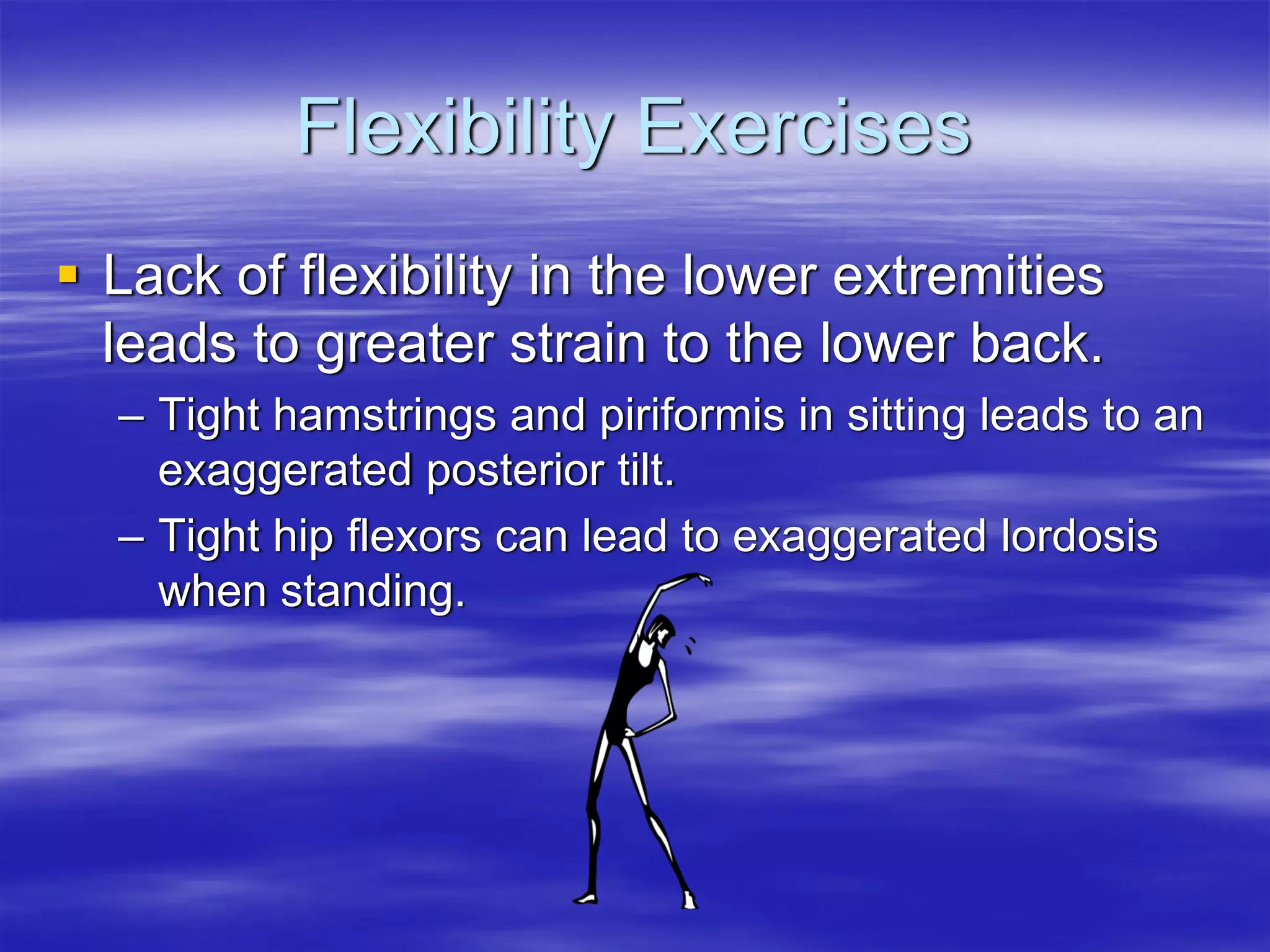
Lack offlexibility in the lower extremities
leads to greater strain to the lower back.
– Tight hamstrings and piriformis in sitting leads to an
exaggerated posterior tilt.
– Tight hip flexors can lead to exaggerated lordosis
when standing.
27.
Cardiovascular Training
Endurance training3-5 times per week can be
beneficial to patient with LBP.
- Walking, biking, and swimming are ideal.
Exercises that are opposite the movement pattern of
the injury are recommended.
- Remember flexion injuries usually use extension
movements for relief and vice versa.
- A patient with a disc problem will benefit from
walking.
- A patient with a spondylo fracture will benefit from
rows.
28.
Strengthening of theLumbar
Musculature
Rehabilitation
strengthening exercises
are introduced once
isolation therapeutic
exercises are tolerated.
By strengthening the
injured structure of the
lumbar spine along with
the hips and abdominals,
more stabilization will be
provided to the injured
area.
29.
Goals of Strengthening
Raisethe level of physical
tolerance.
Introduce the use of free
weights by providing
exercises that correlate
with daily activities,
hobbies or work.
The uses of MEDEX
lumbar program to provide
a quantitative analysis of
segmental strength.
30.
Free weights vs.Machines
Strengthening tonic
stabilizing muscles during
dynamic exercise i.e.
lunges and squats keeps a
strength balance with
Phasic arm, leg and Trunk
Musculature. This is why in
the sports specific/ return
to work phase free weights
are better than machines
31.
Sports Specific Training
Thiswould be
implemented to further
specialize the
strengthening
program.
It would simulate the
patterns of sports or
exercise that the
patient engages in
regularly.
32.
Stages Of Rehab
AcuteStage Exercises, Therapeutic Movement
– 1st seven days -frequency- daily
Subacute Exercises- add aerobic
– 2nd seven days- frequency- every other day
Rehabilitation Stage- strengthening, flexibility and
free weights/machines
– Weeks 3 and 4- frequency- 3 times per week
Sports Specific Stage
– Weeks 4 on- frequency- 2-3 times per week
Through a comprehensivetreatment plan
patients can achieve great results, while
learning ways to prevent recurrent injuries to
their lower backs.
All above recommendations should be done
in the guidance of an experienced physical
therapist or athletic trainer