HOW TO PREDICT
PERFORMANCE
ON THE JOB
ARE SKILLS & PREVIOUS
EXPERIENCES SUFFICIENT TO
PREDICT PERFORMANCE?
The goal is
to really
maximize
the green
decisions
and also
minimize
the red
decisions
EVER HEARD OF TAYLOR RUSSELL’S
FRAMEWORK?
Our prediction
ActualPerformance
Correct decisions Incorrect decisions
MUST
AVOID
WHEN
HIRING
DISCRIMINATION
HARD SKILLS ONLY
UNDEVELOPABLE
Undevelopable : unable or unwilling to learn and train
HOW TO PREDICT PERFORMANCE?
COGNITIVE
ABILITY
DID YOU
KNOW?
INDIVIDUAL DIFFERENCES AND
JOB PERFORMANCE
Frank Schmidt and John Hunter
They found that cognitive ability was the single
strongest predictor of performance in a very
broad range of jobs.
Cognitive ability, AKA “intelligence” is what determines our reasoning
power and problem solving power.
COGNITIVE ABILITY
The capacity to learn, reason,
problem solve, plan, think
abstractly, and comprehend
complex ideas.
Arvey & alii, 1995
COMMON
MYTHS
DEBUNKED
___
COGNITIVE
ABILITY
IN THE
WORKPLACE
COGNITIVE ABILITY
AND
JOB PERFORMANCE
MYTHS ABOUT
COGNITIVE ABILITY
Cognitive ability only
matters in complex jobs
All you need is a certain
amount – any more does
not help
HOW TO PREDICT
PERFORMANCE?
THE ROLE OF SKILLS
DID YOU
KNOW?
JOB PERFORMANCE REQUIRES
4 CATEGORIES OF SKILLS
1) KNOWLEDGE
2) TECHNICAL SKILLS
3) SOFT SKILLS
4) SELF-UPGRADING
Hire for
personal
abilities,
and
train for
skills
JOB PERFORMANCE :
HARD SKILLS ARE NOT ENOUGH
• Hard skills alone are not good predictors
of performance on the job.
• Idem for years of job experience (Schmidt
& Hunter, 1998).
• Performance on the job requires
the WHOLE SKILLSET: comprising
Soft Skills, and Self-Upgrading Skills.
JOB PERFORMANCE REQUIRES 4 CATEGORIES OF SKILLS :
SOFT SKILLS
TOP 10 SKILLS in 2020 (link)
SOFT SKILLS ARE:
Personal and interpersonal
behaviours and characteristics
that develop and maximize
human performance
• Experience-based
• People-related
• Attitudinal
• Behavioural
• Non-domain-specific
• Trans-situational
• Non-technical
• Intangible
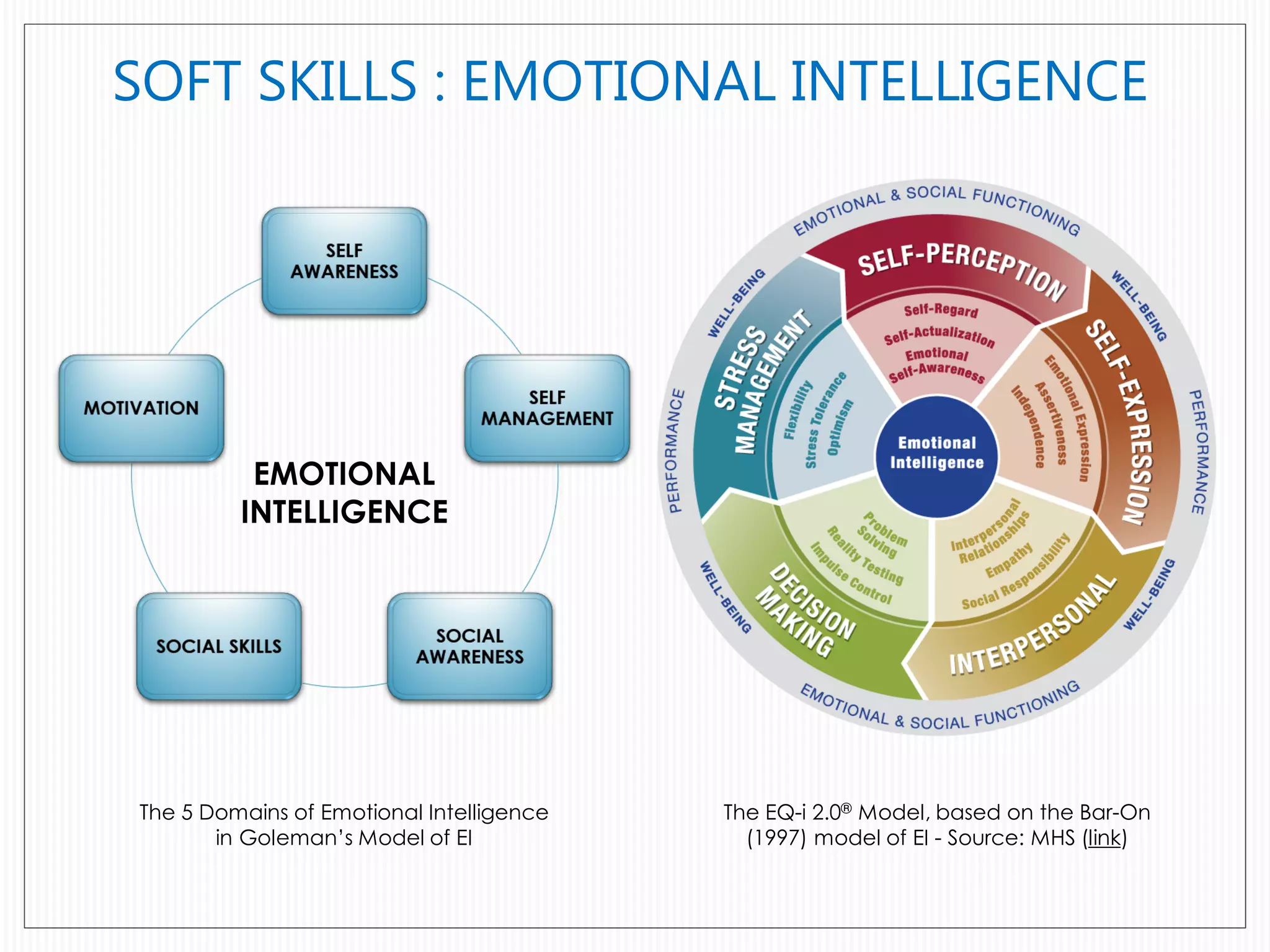
SOFT SKILLS : EMOTIONAL INTELLIGENCE
The EQ-i 2.0® Model, based on the Bar-On
(1997) model of EI - Source: MHS (link)
The 5 Domains of Emotional Intelligence
in Goleman’s Model of EI
EMOTIONAL
INTELLIGENCE
• Learning to learn.
• Equipping with new skills.
• Making oneself more knowledgeable.
• Lifelong learning, learning agility,
personal adaptability.
JOB PERFORMANCE REQUIRES 4 CATEGORIES OF SKILLS :
SELF-UPGRADING SKILLS
HOW TO PREDICT PERFORMANCE?
THE ROLE OF
PERSONALITY
Cognitive ability, AKA “intelligence” is what determines our reasoning
power and problem solving power.
PERSONALITY
Our unique and relatively
stable patterns of behavior,
thoughts, and emotions.
Funder, 2011
An evolution of the Big Five model of personality,
the HEXACO model (and behaviour-based
questionnaire), measures 6 dimensions of personality
to predict performance on the job.
JOB PERFORMANCE AND PERSONALITY
HEXACO
H
E
X
A
C
O
“Moral character is described by the honesty-humility personality
dimension, a factor that had been overlooked in the famous “big
five” model of personality.” (T. Cohen, Scientific American Mind – Link)
Whereas
Cognitive
Ability tells us
a lot about
what a person
can do,
Personality
tells us about
what a person
is willing to
do and how
they might
go about
doing it.
P. Dunlop
Source : sacsconsult.com.au
IMPACT OF PERSONALITY ON JOB PERFORMANCE
HEXACO
Personality traits evaluated in Ashton & alii’s HEXACO Model
KEY
FINDINGS
JOB PERFORMANCE AND PERSONALITY
HEXACO
CONSCIENTIOUSNESS
has been shown to predict performance across many
jobs.
HONESTY-HUMILITY
along with conscientiousness and guilt proneness,
predicts positive job performance and ethical
leadership.
EXTRAVERSION
has been shown to predict performance in sales jobs.
Personality can also be used to predict negative work
outcomes. For example :
• people who are less agreeable seem to be more
inclined to withdraw from their work.
• people who are less honest tend to engage in
activities like counterproductive work behaviours,
stealing or taking longer breaks. (Source: P. Dunlop)
PERSONALITY AND JOB PERFORMANCE
IMPORTANCE OF SITUATIONS
WEAK SITUATIONS
Our personality is likely to be most important in
situations where we have the freedom to
choose how we behave.
STRONG SITUATIONS
Quite often, personality does not determine
our behavior so much : it is the situation that
determines how we behave.
SITUATION
PERSONALITY
BEHAVIOUR
PERSONALITY
BEHAVIOUR
SITUATION
Strong situations : when the boss is watching, the least conscientious person will try to work hard;
the most extroverted person will probably stay quiet when in a library.
HOW TO PREDICT PERFORMANCE?
THE ROLE OF
MOTIVATION
Without the
will to do
the tasks,
skills and
knowledge
alone won't
lead to
performancePERFORMANCE ON THE JOB
Personality
SKILLS
Cognitive
ability
Motivation
Both ability (cognitive & physical ability, knowledge,
necessary skills), and motivation are essential for a
person to perform well on a job.
JOB PERFORMANCE AND MOTIVATION
M.Gagne
MOTIVATION IS DESCRIBED AS :
THE DIRECTION, INTENSITY,
AND DURATION OF BEHAVIOUR.
The direction of behavior :
• is indicated by the choices a person
makes (e.g. : between two activities).
Intensity of behaviour :
• is another indicator of motivation
considering the efforts a person is
willing to put into an activity.
The duration of a behaviour :
• the longer a person spends on an
activity, or the more they persist in
the face of obstacles indicates high
motivation for this activity.
DIFFERENT
WAYS TO
MEASURE
MOTIVATION
• Evaluating people’s behaviours
Measure how much time people persist on a task
Do they persist or give up in the face of obstacles?
Measure reaction time (faster reaction times
indicate more motivation).
• Non-verbal signs
Observe facial expressions and body posture
Do people look happy, focused and attentive? (hi-M)
Observe eye movements : pupil dilatation indicates
interest; blinks indicate shifts of attention.
Observe body language : Leaning the body in
conversation and keeping an open posture indicates
interest; crossing one’s arms and turning one’s body
away indicate lack of interest or motivation to avoid.
• Asking people to report on it
Engagement surveys, pulse surveys, feedback, eNPS.
PERFORMANCE ON THE JOB
HOW TO MEASURE MOTIVATION?
WHAT KIND OF
MOTIVATION
PREDICTS BEST
PERFORMANCE
ON THE JOB?
Different types of motivation affect performance and
well being. Deci and Ryan developed a motivation
model (Self-determination theory), which distinguishes
between 2 types of motivation :
MOTIVATION PREDICTING
PERFORMANCE ON THE JOB
MOTIVATION AND JOB PERFORMANCE
SELF-DETERMINATION CONTINUUM
Self-Determination Theory : Intrinsic and Extrinsic Motivation,
Ryan & Deci, 2000. ( Source : Researchgate)
WHAT KIND OF MOTIVATION PREDICTS
BEST PERFORMANCE ON THE JOB?
Two types of motivation lead to the best
performance and well-being outcomes:
• Intrinsic motivation
the person finds interest, enjoyment,
inherent satisfaction in the task.
• Extrinsic autonomous motivation
the person finds the task important,
meaningful, or has a strong sense of duty.
People with these 2 types of motivation put
more energy into their work.
MOTIVATION
AS A
PREDICTOR OF
PERFORMANCE
ON THE JOB
HOW TO PREDICT PERFORMANCE?
SYNTHESIS
4 STRONG
PREDICTORS OF
PERFORMANCE
ON THE JOB
HOW TO PREDICT PERFORMANCE
ON THE JOB
RESOURCES & REFERENCES
• The Validity and Utility of Selection Methods, Schmidt &
Hunter (Researchgate – link).
• HEXACO Personality Inventory : http://hexaco.org/
• Individual Differences and Personality, Ashton, Elsevier.
• Daniel Goleman : Emotional Intelligence (link).
• MHS : The EQ-i 2.0 Model and The Science Behind It (link).
• Self-Determination Theory, Deci & Ryan, Guilford (link).

How To Predict Performance on the Job ?

  • 1.
  • 2.
    ARE SKILLS &PREVIOUS EXPERIENCES SUFFICIENT TO PREDICT PERFORMANCE?
  • 3.
    The goal is toreally maximize the green decisions and also minimize the red decisions EVER HEARD OF TAYLOR RUSSELL’S FRAMEWORK? Our prediction ActualPerformance Correct decisions Incorrect decisions
  • 4.
  • 5.
    HOW TO PREDICTPERFORMANCE? COGNITIVE ABILITY
  • 6.
    DID YOU KNOW? INDIVIDUAL DIFFERENCESAND JOB PERFORMANCE Frank Schmidt and John Hunter They found that cognitive ability was the single strongest predictor of performance in a very broad range of jobs.
  • 7.
    Cognitive ability, AKA“intelligence” is what determines our reasoning power and problem solving power. COGNITIVE ABILITY The capacity to learn, reason, problem solve, plan, think abstractly, and comprehend complex ideas. Arvey & alii, 1995
  • 8.
    COMMON MYTHS DEBUNKED ___ COGNITIVE ABILITY IN THE WORKPLACE COGNITIVE ABILITY AND JOBPERFORMANCE MYTHS ABOUT COGNITIVE ABILITY Cognitive ability only matters in complex jobs All you need is a certain amount – any more does not help
  • 9.
  • 10.
    DID YOU KNOW? JOB PERFORMANCEREQUIRES 4 CATEGORIES OF SKILLS 1) KNOWLEDGE 2) TECHNICAL SKILLS 3) SOFT SKILLS 4) SELF-UPGRADING
  • 11.
    Hire for personal abilities, and train for skills JOBPERFORMANCE : HARD SKILLS ARE NOT ENOUGH • Hard skills alone are not good predictors of performance on the job. • Idem for years of job experience (Schmidt & Hunter, 1998). • Performance on the job requires the WHOLE SKILLSET: comprising Soft Skills, and Self-Upgrading Skills.
  • 12.
    JOB PERFORMANCE REQUIRES4 CATEGORIES OF SKILLS : SOFT SKILLS TOP 10 SKILLS in 2020 (link) SOFT SKILLS ARE: Personal and interpersonal behaviours and characteristics that develop and maximize human performance • Experience-based • People-related • Attitudinal • Behavioural • Non-domain-specific • Trans-situational • Non-technical • Intangible
  • 13.
    SOFT SKILLS :EMOTIONAL INTELLIGENCE The EQ-i 2.0® Model, based on the Bar-On (1997) model of EI - Source: MHS (link) The 5 Domains of Emotional Intelligence in Goleman’s Model of EI EMOTIONAL INTELLIGENCE
  • 14.
    • Learning tolearn. • Equipping with new skills. • Making oneself more knowledgeable. • Lifelong learning, learning agility, personal adaptability. JOB PERFORMANCE REQUIRES 4 CATEGORIES OF SKILLS : SELF-UPGRADING SKILLS
  • 15.
    HOW TO PREDICTPERFORMANCE? THE ROLE OF PERSONALITY
  • 16.
    Cognitive ability, AKA“intelligence” is what determines our reasoning power and problem solving power. PERSONALITY Our unique and relatively stable patterns of behavior, thoughts, and emotions. Funder, 2011
  • 17.
    An evolution ofthe Big Five model of personality, the HEXACO model (and behaviour-based questionnaire), measures 6 dimensions of personality to predict performance on the job. JOB PERFORMANCE AND PERSONALITY HEXACO H E X A C O “Moral character is described by the honesty-humility personality dimension, a factor that had been overlooked in the famous “big five” model of personality.” (T. Cohen, Scientific American Mind – Link) Whereas Cognitive Ability tells us a lot about what a person can do, Personality tells us about what a person is willing to do and how they might go about doing it. P. Dunlop
  • 18.
    Source : sacsconsult.com.au IMPACTOF PERSONALITY ON JOB PERFORMANCE HEXACO Personality traits evaluated in Ashton & alii’s HEXACO Model
  • 19.
    KEY FINDINGS JOB PERFORMANCE ANDPERSONALITY HEXACO CONSCIENTIOUSNESS has been shown to predict performance across many jobs. HONESTY-HUMILITY along with conscientiousness and guilt proneness, predicts positive job performance and ethical leadership. EXTRAVERSION has been shown to predict performance in sales jobs. Personality can also be used to predict negative work outcomes. For example : • people who are less agreeable seem to be more inclined to withdraw from their work. • people who are less honest tend to engage in activities like counterproductive work behaviours, stealing or taking longer breaks. (Source: P. Dunlop)
  • 20.
    PERSONALITY AND JOBPERFORMANCE IMPORTANCE OF SITUATIONS WEAK SITUATIONS Our personality is likely to be most important in situations where we have the freedom to choose how we behave. STRONG SITUATIONS Quite often, personality does not determine our behavior so much : it is the situation that determines how we behave. SITUATION PERSONALITY BEHAVIOUR PERSONALITY BEHAVIOUR SITUATION Strong situations : when the boss is watching, the least conscientious person will try to work hard; the most extroverted person will probably stay quiet when in a library.
  • 21.
    HOW TO PREDICTPERFORMANCE? THE ROLE OF MOTIVATION
  • 22.
    Without the will todo the tasks, skills and knowledge alone won't lead to performancePERFORMANCE ON THE JOB Personality SKILLS Cognitive ability Motivation Both ability (cognitive & physical ability, knowledge, necessary skills), and motivation are essential for a person to perform well on a job. JOB PERFORMANCE AND MOTIVATION M.Gagne
  • 23.
    MOTIVATION IS DESCRIBEDAS : THE DIRECTION, INTENSITY, AND DURATION OF BEHAVIOUR. The direction of behavior : • is indicated by the choices a person makes (e.g. : between two activities). Intensity of behaviour : • is another indicator of motivation considering the efforts a person is willing to put into an activity. The duration of a behaviour : • the longer a person spends on an activity, or the more they persist in the face of obstacles indicates high motivation for this activity.
  • 24.
    DIFFERENT WAYS TO MEASURE MOTIVATION • Evaluatingpeople’s behaviours Measure how much time people persist on a task Do they persist or give up in the face of obstacles? Measure reaction time (faster reaction times indicate more motivation). • Non-verbal signs Observe facial expressions and body posture Do people look happy, focused and attentive? (hi-M) Observe eye movements : pupil dilatation indicates interest; blinks indicate shifts of attention. Observe body language : Leaning the body in conversation and keeping an open posture indicates interest; crossing one’s arms and turning one’s body away indicate lack of interest or motivation to avoid. • Asking people to report on it Engagement surveys, pulse surveys, feedback, eNPS. PERFORMANCE ON THE JOB HOW TO MEASURE MOTIVATION?
  • 25.
    WHAT KIND OF MOTIVATION PREDICTSBEST PERFORMANCE ON THE JOB? Different types of motivation affect performance and well being. Deci and Ryan developed a motivation model (Self-determination theory), which distinguishes between 2 types of motivation : MOTIVATION PREDICTING PERFORMANCE ON THE JOB
  • 26.
    MOTIVATION AND JOBPERFORMANCE SELF-DETERMINATION CONTINUUM Self-Determination Theory : Intrinsic and Extrinsic Motivation, Ryan & Deci, 2000. ( Source : Researchgate)
  • 27.
    WHAT KIND OFMOTIVATION PREDICTS BEST PERFORMANCE ON THE JOB? Two types of motivation lead to the best performance and well-being outcomes: • Intrinsic motivation the person finds interest, enjoyment, inherent satisfaction in the task. • Extrinsic autonomous motivation the person finds the task important, meaningful, or has a strong sense of duty. People with these 2 types of motivation put more energy into their work. MOTIVATION AS A PREDICTOR OF PERFORMANCE ON THE JOB
  • 28.
    HOW TO PREDICTPERFORMANCE? SYNTHESIS
  • 29.
    4 STRONG PREDICTORS OF PERFORMANCE ONTHE JOB HOW TO PREDICT PERFORMANCE ON THE JOB
  • 30.
    RESOURCES & REFERENCES •The Validity and Utility of Selection Methods, Schmidt & Hunter (Researchgate – link). • HEXACO Personality Inventory : http://hexaco.org/ • Individual Differences and Personality, Ashton, Elsevier. • Daniel Goleman : Emotional Intelligence (link). • MHS : The EQ-i 2.0 Model and The Science Behind It (link). • Self-Determination Theory, Deci & Ryan, Guilford (link).