Musculoskeletal
Examination
Benjamin Paul Kent
CT2 - Trauma and Orthopaedics, Derriford Hospital
Aims
• Cover common presentations
• Case based scenarios
• SOCRATES
• "In a surgeon's gown
physicians may make some
clinical progress"
• General rules for MSK
examination
• Detailed guides for specific
examination
Case 1
• A 63 year old male farmer presents to you their GP, with
increasing stiffness and pain in his hands. The patient
has only been seen once previously, takes no regular
medication and has no recorded medical history.
• Please take a focused history and examination.
Case 1
• Pain - SOCRATES
• Ache, worse over day, all
fingers symmetrically,
worse in thumb bases,
paracetamol works but
doesn't want to get
addicted
• Family history
• Aches and pains when
old
• Previous similar episodes
• On and off ache but no
clear episodes
• Other joints
• Knees aren't great but
not the main issue
• Other illness or symptoms
• Fit as a fiddle, no trauma
Case 1
• Tough hard skin on
palms
• Nails dirty and chipped
• No temp difference
• Hard nodules on DIPJ
• 1st MCPJ "squared off"
• ROM equal bilateral
• Grip strength
maintained
• Normal sensation
Case 1
• Degenerative arthritis
• Inflammatory arthritis
• Spondyloarthropathy
• Septic arthritis
• Neurological
Case 1
• Osteoarthritis
• Heberden's nodes vs
Bouchard's nodes
• Investigation
• Blood tests
• Imaging
• Aspiration
• Causes
• Primary - idiopathic
• Secondary - trauma,
infection, obesity
• Management
• Life style - work and weight
• Medication - analgesia and
disease modifying
• Surgery
Case 2
• You are on placement in a general practice. A 26 year
old male presents with recurrent neck pain and stiffness.
The system shows they have been seen multiple times
for this complaint and have some other chronic
conditions.
• Please perform a focused history and examination.
Case 2
• Pain - SOCRATES
• Stiffness more than pain,
worse some days, no clear
pattern, analgesia helps
with pain
• Family history
• Remembers Gran on
fathers side was known as
"the hunchback"
• Previous similar episodes
• Multiple episodes all
attributed to active lifestyle
or injury
• Other joints
• Neck and back
predominantly
• Other illness or symptoms
• Occasional asthma but
under control with inhalers
Case 2
• No skin changes
• No gross deformity of
spine
• Normal palpation of
entire spine
• Markedly reduced ROM
in cervical spine in all
planes
• FROM rest of spine
• Neurologically normal
Case 2
• Spondyloarthropathy
• Inflammatory arthritis
• Degenerative arthritis
• Discitis
• Neurological
Case 2
• Ankylosing spondylitis
• "Bamboo spine"
• Investigations
• Blood test
• Imaging
• Management
• Life style - work and
weight
• Medication - analgesia
and disease modifying
• Surgery
Case 3
• You are on placement in a general practice. A 51 year
old female patient has come in to discuss aches and
pains in her hands and feet. She has been seen most
recently about dry eyes.
• Please perform a focused history and examination.
Case 3
• Pain - SOCRATES
• Stiffness associated with pain,
worse in episodes that last days,
seems to improve with
movement and eventually settles
for a while, analgesia helps with
pain toward the end of these
attacks
• Family history
• All parents have had aches when
older, but mother may have had
them in her 40's, ended up with
"odd looking fingers"
• Previous similar episodes
• Multiple episodes self resolved
but seem to be getting longer
and more deformity esp in fingers
• Other joints
• Fingers and feet cause majority
of pain
• Other illness or symptoms
• Dry eyes - recently given eye
drops
Case 3
• No skin changes
• Nails dry and cracked
• No temp difference
• Boggy swelling of all
small joints of hands
• Deformity of joints
• Reduced extension in
fingers
• Grip strength reduced
bilaterally
• Normal sensation
Case 3
• Inflammatory arthritis
• Spondyloarthropathy
• Degenerative arthritis
• Crystal arthropathy
• Neurological
Case 3
• Rheumatoid arthritis
• Ulnar deviation and swan
neck deformity
• Investigations
• Blood test
• Imaging
• Management
• Life style - work and
weight
• Medication - analgesia
and disease modifying
• Surgery
Case 4
• You are on placement in a general practice. A 41 year
old handy man is booked in to see you about a pain in
his left shoulder.
• Please perform a focused history and examination.
Case 4
• Pain - SOCRATES
• Sudden onset, day after
a big job repainting a
house, generalised
around shoulder and
upper arm, unable to
sleep in this side
• Family history
• Nil
• Previous similar episodes
• Less severe episode 2
weeks ago, settled with
simple analgesia
• Other joints
• No other problems
• Other illness or symptoms
• Nil
Case 4
• No skin changes
• No temp difference
• Shoulders and muscle
bulk appear symmetrical
• Unable to actively abduct
the shoulder due to pain
• Passive movement is
normal however is
painful
• No winging of the
scapula
• Apprehension test
positive
Case 4
• Rotator cuff lesion
• Painful arch syndrome
• Septic arthritis
• Inflammatory arthritis
• Degenerative arthritis
• Crystal arthropathy
• Neurological
Case 4
• Rotator cuff lesion
• Investigations
• Blood test
• Imaging
• Management
• Life style - work and
weight
• Medication - analgesia
and disease modifying
• Surgery
Generic MSK Examination
• Wash hands
• Clarify your ID
• Explain what you are going to
do
• Gain consent
• Exposure - even if patient is in
shorts as examiner will inform
you if not necessary
• Compare both sides
• Look, feel, move +/- special
tests
• Neurovascular status
• Cover or suggest to redress.
• Wash hands
• Thank patient
• Suggest further beside tests
and investigations
Ankle and Foot Examination
• Common presentation
• ED, GP, Ortho/Rheum clinic
• Acute and chronic
• Fractures, plantar fasciitis, tendinitis
• Degenerative and inflammatory arthritis
• Ask patient to walk to assess gait
• Standing
• Varus/Valgus, arches, Achilles' tendon
• Inspect shoes
• Ask patient to get on bed
• Inspect
• Symmetry, nails, skin, toes, calluses
• Palpate
• Temperature
• Joints - begin proximal, IPJ - MTPJ - mid
foot - subtalar joint - ankle
• Pulses
• Movement
• Inversion, eversion, dorsiflexion,
plantarflexion
• Not forgetting mid foot inversion and
eversion
Knee Examination
• Common presentation
• ED, GP, Ortho/Rheum clinic
• Acute and chronic
• Pain, locking or giving way
• Fractures, bursitis, ligamental or cartilage damage
• Degenerative and inflammatory arthritis
• Ask patient to walk
• Gait and muscle bulk
• Standing
• Varus/Valgus, symmetry, hyperextension, bakers cyst
• Inspect shoes
• Ask patient to get on bed
• Inspect
• Symmetry and effusion
• Palpate
• Temperature
• With knee flexed to 90 degrees - joint line, patella tendon
• Gutter sweep and patella tap
• Pulses
• Movement
• Flexion and extension
• Special
• Anterior Draw's test - knee flexed at 90 degrees, foot fixed by
sitting on (inform patient), thumbs on joint line, fingers behind
tibia, if no end point likely ACL rupture
• Posterior sag (Pen Test) - observe knee from side, place pen
on tibial tuberosity, if PCL is ruptured the tibia will shift
posteriorly no gap between pen, if gap half way but touching
top and bottom (severe shift), if gap at top of pen normal.
• Lateral and medial stress test - hold ankle in axial, knee flexed
to 15 degree, stress medial and lateral colaterals, if excessive
movement compare to unaffected side.
• McMurray's test - DO NOT PREFORM!
Hip Examination
• Common presentation
• ED, GP, Ortho/Rheum clinic
• Acute and chronic
• Fractures, bursitis, irritable hip, perches disease,
slipped upper femoral epiphysis.
• Degenerative and inflammatory arthritis
• Referred pain - esp knee and spine
• Ask patient to walk
• Gait (antalgic or trendelenburg), muscle bulk
• Standing
• Varus/Valgus, pelvic tilt, spine
• Inspect shoes
• Ask patient to get on bed
• Inspect
• Symmetry, apparent and true leg length
• Palpate
• Temperature
• Joint, muscle bulk and over bursa
• Pulses
• Movement
• Flexion, extension, internal and external rotation
• Special
• Thomas' test - hand under lumbar spine, flex
opposite hip, if hip lifts off hand this confirms a
fixed flexion deformity
Spine Examination
• Common presentation
• ED, GP, Ortho/Rheum clinic
• Acute and chronic
• Fractures, discitis, spondyloarthropathy
• Degenerative and inflammatory arthritis
• Ask patient to walk
• Standing
• Scoliosis, cervical lordosis, thoracic
kyphosis, lumbar lordosis and muscle bulk
• Inspect shoes
• Ask patient to get on bed
• Sat facing away from you or sideways on a
chair
• Palpate
• Start head to toe along spinous processes,
sacroiliac joints, paraspinal muscles
• Movement - active only
• Lumbar flexion, extension and lateral flexion
• Thoracic rotation - fix pelvis by sitting patient
down
• Special
• Straight leg raise - diagnostic of sciatica
• Neurological exam a must - be guided by
sight of pain
Shoulder Examination
• Common presentation
• ED, GP, Ortho/Rheum clinic
• Acute and chronic
• Fractures, bursitis, frozen shoulder, painful arch,
rotator cuff, impingement
• Degenerative and inflammatory arthritis
• Referred pain - esp spine
• Standing - Inspect
• Muscle bulk, symmetry and natural stance
• Ask patient to get on bed
• Sat up facing away from you or sideways on a chair
• Palpate
• Temperature
• Sternoclavicular joint - clavicle - acromioclavicular joint -
acromion - spine of scapula - anterior then posterior
glenohumeral joint - muscle bulk around shoulder
• Pulses
• Movement
• Flexion, extension, abduction, adduction internal and
external rotation
• Special
• Impingement test - hold shoulder at 90 degrees with the
forearm pointing down, press backward on arm,
positive if pain
• Apprehension test - hold shoulder at 90 degrees with
the forearm pointing upward, press backward on arm,
positive if patient feels instability
• Scarf test - hold elbow at 90 degrees, inform patient to
place hand on other shoulder and push back.
• Functional test - hands behind head, hands behind
lumbar spine
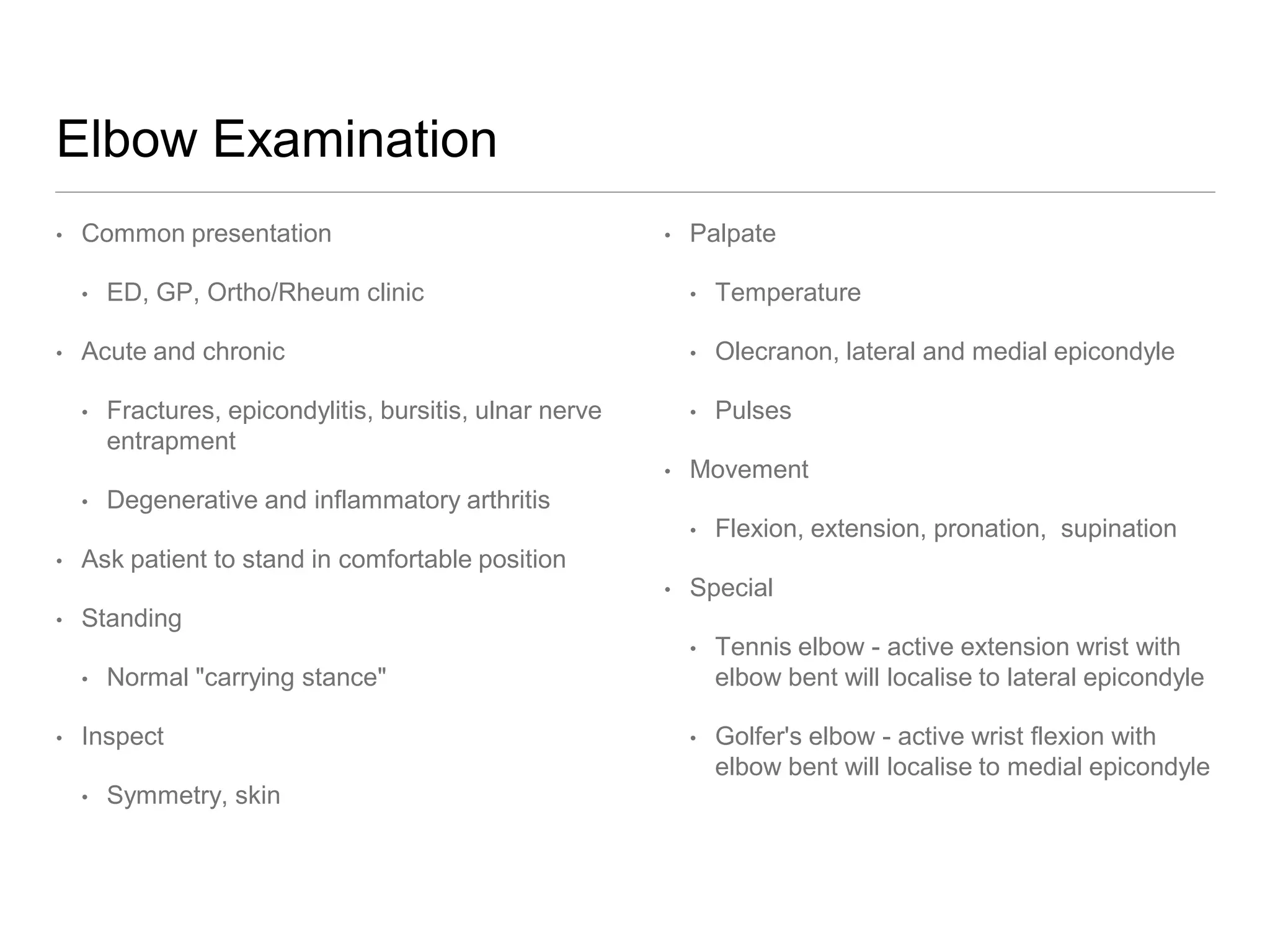
Elbow Examination
• Common presentation
• ED, GP, Ortho/Rheum clinic
• Acute and chronic
• Fractures, epicondylitis, bursitis, ulnar nerve
entrapment
• Degenerative and inflammatory arthritis
• Ask patient to stand in comfortable position
• Standing
• Normal "carrying stance"
• Inspect
• Symmetry, skin
• Palpate
• Temperature
• Olecranon, lateral and medial epicondyle
• Pulses
• Movement
• Flexion, extension, pronation, supination
• Special
• Tennis elbow - active extension wrist with
elbow bent will localise to lateral epicondyle
• Golfer's elbow - active wrist flexion with
elbow bent will localise to medial epicondyle
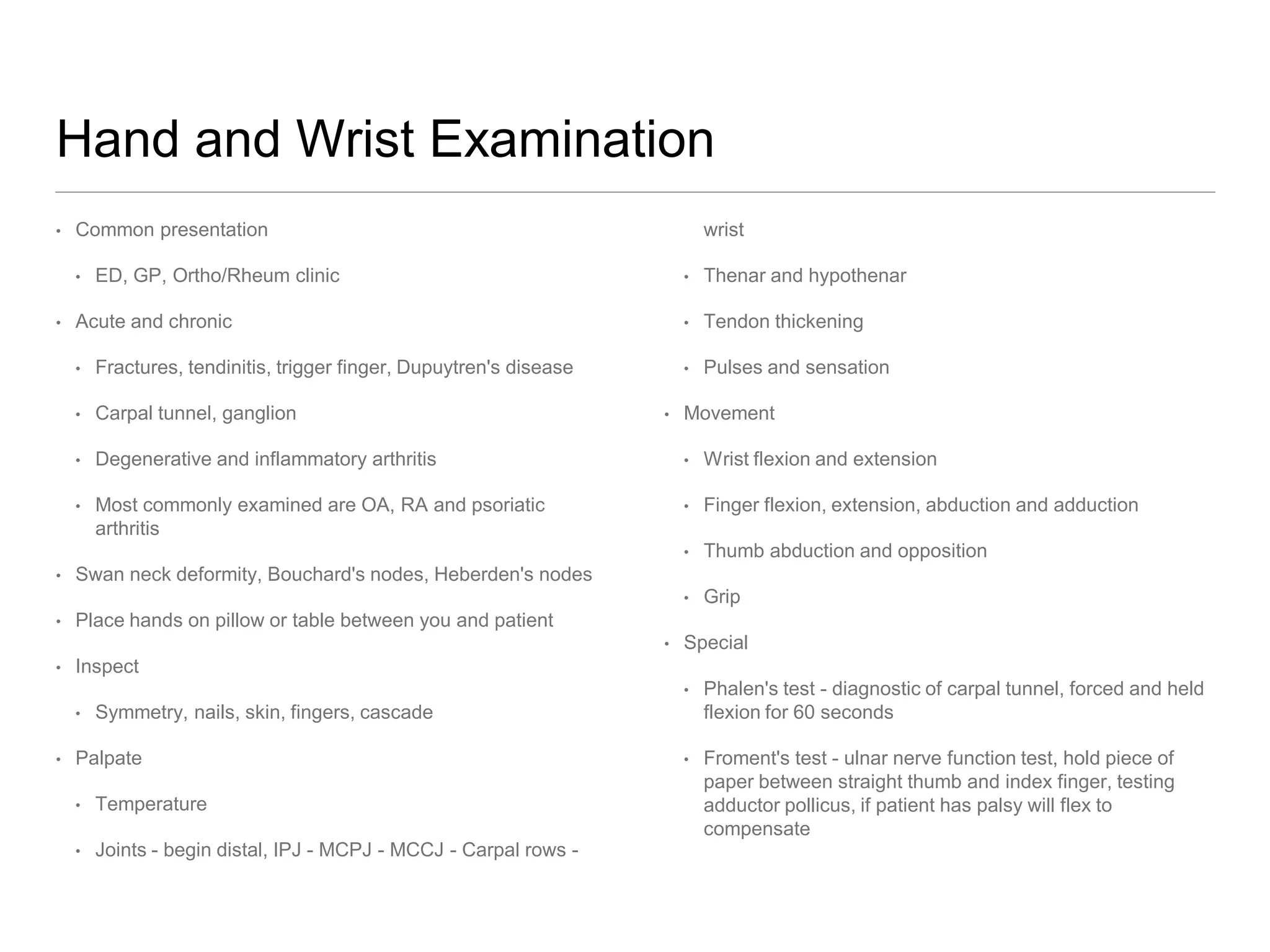
Hand and Wrist Examination
• Common presentation
• ED, GP, Ortho/Rheum clinic
• Acute and chronic
• Fractures, tendinitis, trigger finger, Dupuytren's disease
• Carpal tunnel, ganglion
• Degenerative and inflammatory arthritis
• Most commonly examined are OA, RA and psoriatic
arthritis
• Swan neck deformity, Bouchard's nodes, Heberden's nodes
• Place hands on pillow or table between you and patient
• Inspect
• Symmetry, nails, skin, fingers, cascade
• Palpate
• Temperature
• Joints - begin distal, IPJ - MCPJ - MCCJ - Carpal rows -
wrist
• Thenar and hypothenar
• Tendon thickening
• Pulses and sensation
• Movement
• Wrist flexion and extension
• Finger flexion, extension, abduction and adduction
• Thumb abduction and opposition
• Grip
• Special
• Phalen's test - diagnostic of carpal tunnel, forced and held
flexion for 60 seconds
• Froment's test - ulnar nerve function test, hold piece of
paper between straight thumb and index finger, testing
adductor pollicus, if patient has palsy will flex to
compensate

MSK

  • 1.
    Musculoskeletal Examination Benjamin Paul Kent CT2- Trauma and Orthopaedics, Derriford Hospital
  • 2.
    Aims • Cover commonpresentations • Case based scenarios • SOCRATES • "In a surgeon's gown physicians may make some clinical progress" • General rules for MSK examination • Detailed guides for specific examination
  • 3.
    Case 1 • A63 year old male farmer presents to you their GP, with increasing stiffness and pain in his hands. The patient has only been seen once previously, takes no regular medication and has no recorded medical history. • Please take a focused history and examination.
  • 4.
    Case 1 • Pain- SOCRATES • Ache, worse over day, all fingers symmetrically, worse in thumb bases, paracetamol works but doesn't want to get addicted • Family history • Aches and pains when old • Previous similar episodes • On and off ache but no clear episodes • Other joints • Knees aren't great but not the main issue • Other illness or symptoms • Fit as a fiddle, no trauma
  • 5.
    Case 1 • Toughhard skin on palms • Nails dirty and chipped • No temp difference • Hard nodules on DIPJ • 1st MCPJ "squared off" • ROM equal bilateral • Grip strength maintained • Normal sensation
  • 6.
    Case 1 • Degenerativearthritis • Inflammatory arthritis • Spondyloarthropathy • Septic arthritis • Neurological
  • 7.
    Case 1 • Osteoarthritis •Heberden's nodes vs Bouchard's nodes • Investigation • Blood tests • Imaging • Aspiration • Causes • Primary - idiopathic • Secondary - trauma, infection, obesity • Management • Life style - work and weight • Medication - analgesia and disease modifying • Surgery
  • 8.
    Case 2 • Youare on placement in a general practice. A 26 year old male presents with recurrent neck pain and stiffness. The system shows they have been seen multiple times for this complaint and have some other chronic conditions. • Please perform a focused history and examination.
  • 9.
    Case 2 • Pain- SOCRATES • Stiffness more than pain, worse some days, no clear pattern, analgesia helps with pain • Family history • Remembers Gran on fathers side was known as "the hunchback" • Previous similar episodes • Multiple episodes all attributed to active lifestyle or injury • Other joints • Neck and back predominantly • Other illness or symptoms • Occasional asthma but under control with inhalers
  • 10.
    Case 2 • Noskin changes • No gross deformity of spine • Normal palpation of entire spine • Markedly reduced ROM in cervical spine in all planes • FROM rest of spine • Neurologically normal
  • 11.
    Case 2 • Spondyloarthropathy •Inflammatory arthritis • Degenerative arthritis • Discitis • Neurological
  • 12.
    Case 2 • Ankylosingspondylitis • "Bamboo spine" • Investigations • Blood test • Imaging • Management • Life style - work and weight • Medication - analgesia and disease modifying • Surgery
  • 13.
    Case 3 • Youare on placement in a general practice. A 51 year old female patient has come in to discuss aches and pains in her hands and feet. She has been seen most recently about dry eyes. • Please perform a focused history and examination.
  • 14.
    Case 3 • Pain- SOCRATES • Stiffness associated with pain, worse in episodes that last days, seems to improve with movement and eventually settles for a while, analgesia helps with pain toward the end of these attacks • Family history • All parents have had aches when older, but mother may have had them in her 40's, ended up with "odd looking fingers" • Previous similar episodes • Multiple episodes self resolved but seem to be getting longer and more deformity esp in fingers • Other joints • Fingers and feet cause majority of pain • Other illness or symptoms • Dry eyes - recently given eye drops
  • 15.
    Case 3 • Noskin changes • Nails dry and cracked • No temp difference • Boggy swelling of all small joints of hands • Deformity of joints • Reduced extension in fingers • Grip strength reduced bilaterally • Normal sensation
  • 16.
    Case 3 • Inflammatoryarthritis • Spondyloarthropathy • Degenerative arthritis • Crystal arthropathy • Neurological
  • 17.
    Case 3 • Rheumatoidarthritis • Ulnar deviation and swan neck deformity • Investigations • Blood test • Imaging • Management • Life style - work and weight • Medication - analgesia and disease modifying • Surgery
  • 18.
    Case 4 • Youare on placement in a general practice. A 41 year old handy man is booked in to see you about a pain in his left shoulder. • Please perform a focused history and examination.
  • 19.
    Case 4 • Pain- SOCRATES • Sudden onset, day after a big job repainting a house, generalised around shoulder and upper arm, unable to sleep in this side • Family history • Nil • Previous similar episodes • Less severe episode 2 weeks ago, settled with simple analgesia • Other joints • No other problems • Other illness or symptoms • Nil
  • 20.
    Case 4 • Noskin changes • No temp difference • Shoulders and muscle bulk appear symmetrical • Unable to actively abduct the shoulder due to pain • Passive movement is normal however is painful • No winging of the scapula • Apprehension test positive
  • 21.
    Case 4 • Rotatorcuff lesion • Painful arch syndrome • Septic arthritis • Inflammatory arthritis • Degenerative arthritis • Crystal arthropathy • Neurological
  • 22.
    Case 4 • Rotatorcuff lesion • Investigations • Blood test • Imaging • Management • Life style - work and weight • Medication - analgesia and disease modifying • Surgery
  • 23.
    Generic MSK Examination •Wash hands • Clarify your ID • Explain what you are going to do • Gain consent • Exposure - even if patient is in shorts as examiner will inform you if not necessary • Compare both sides • Look, feel, move +/- special tests • Neurovascular status • Cover or suggest to redress. • Wash hands • Thank patient • Suggest further beside tests and investigations
  • 24.
    Ankle and FootExamination • Common presentation • ED, GP, Ortho/Rheum clinic • Acute and chronic • Fractures, plantar fasciitis, tendinitis • Degenerative and inflammatory arthritis • Ask patient to walk to assess gait • Standing • Varus/Valgus, arches, Achilles' tendon • Inspect shoes • Ask patient to get on bed • Inspect • Symmetry, nails, skin, toes, calluses • Palpate • Temperature • Joints - begin proximal, IPJ - MTPJ - mid foot - subtalar joint - ankle • Pulses • Movement • Inversion, eversion, dorsiflexion, plantarflexion • Not forgetting mid foot inversion and eversion
  • 25.
    Knee Examination • Commonpresentation • ED, GP, Ortho/Rheum clinic • Acute and chronic • Pain, locking or giving way • Fractures, bursitis, ligamental or cartilage damage • Degenerative and inflammatory arthritis • Ask patient to walk • Gait and muscle bulk • Standing • Varus/Valgus, symmetry, hyperextension, bakers cyst • Inspect shoes • Ask patient to get on bed • Inspect • Symmetry and effusion • Palpate • Temperature • With knee flexed to 90 degrees - joint line, patella tendon • Gutter sweep and patella tap • Pulses • Movement • Flexion and extension • Special • Anterior Draw's test - knee flexed at 90 degrees, foot fixed by sitting on (inform patient), thumbs on joint line, fingers behind tibia, if no end point likely ACL rupture • Posterior sag (Pen Test) - observe knee from side, place pen on tibial tuberosity, if PCL is ruptured the tibia will shift posteriorly no gap between pen, if gap half way but touching top and bottom (severe shift), if gap at top of pen normal. • Lateral and medial stress test - hold ankle in axial, knee flexed to 15 degree, stress medial and lateral colaterals, if excessive movement compare to unaffected side. • McMurray's test - DO NOT PREFORM!
  • 26.
    Hip Examination • Commonpresentation • ED, GP, Ortho/Rheum clinic • Acute and chronic • Fractures, bursitis, irritable hip, perches disease, slipped upper femoral epiphysis. • Degenerative and inflammatory arthritis • Referred pain - esp knee and spine • Ask patient to walk • Gait (antalgic or trendelenburg), muscle bulk • Standing • Varus/Valgus, pelvic tilt, spine • Inspect shoes • Ask patient to get on bed • Inspect • Symmetry, apparent and true leg length • Palpate • Temperature • Joint, muscle bulk and over bursa • Pulses • Movement • Flexion, extension, internal and external rotation • Special • Thomas' test - hand under lumbar spine, flex opposite hip, if hip lifts off hand this confirms a fixed flexion deformity
  • 27.
    Spine Examination • Commonpresentation • ED, GP, Ortho/Rheum clinic • Acute and chronic • Fractures, discitis, spondyloarthropathy • Degenerative and inflammatory arthritis • Ask patient to walk • Standing • Scoliosis, cervical lordosis, thoracic kyphosis, lumbar lordosis and muscle bulk • Inspect shoes • Ask patient to get on bed • Sat facing away from you or sideways on a chair • Palpate • Start head to toe along spinous processes, sacroiliac joints, paraspinal muscles • Movement - active only • Lumbar flexion, extension and lateral flexion • Thoracic rotation - fix pelvis by sitting patient down • Special • Straight leg raise - diagnostic of sciatica • Neurological exam a must - be guided by sight of pain
  • 28.
    Shoulder Examination • Commonpresentation • ED, GP, Ortho/Rheum clinic • Acute and chronic • Fractures, bursitis, frozen shoulder, painful arch, rotator cuff, impingement • Degenerative and inflammatory arthritis • Referred pain - esp spine • Standing - Inspect • Muscle bulk, symmetry and natural stance • Ask patient to get on bed • Sat up facing away from you or sideways on a chair • Palpate • Temperature • Sternoclavicular joint - clavicle - acromioclavicular joint - acromion - spine of scapula - anterior then posterior glenohumeral joint - muscle bulk around shoulder • Pulses • Movement • Flexion, extension, abduction, adduction internal and external rotation • Special • Impingement test - hold shoulder at 90 degrees with the forearm pointing down, press backward on arm, positive if pain • Apprehension test - hold shoulder at 90 degrees with the forearm pointing upward, press backward on arm, positive if patient feels instability • Scarf test - hold elbow at 90 degrees, inform patient to place hand on other shoulder and push back. • Functional test - hands behind head, hands behind lumbar spine
  • 29.
    Elbow Examination • Commonpresentation • ED, GP, Ortho/Rheum clinic • Acute and chronic • Fractures, epicondylitis, bursitis, ulnar nerve entrapment • Degenerative and inflammatory arthritis • Ask patient to stand in comfortable position • Standing • Normal "carrying stance" • Inspect • Symmetry, skin • Palpate • Temperature • Olecranon, lateral and medial epicondyle • Pulses • Movement • Flexion, extension, pronation, supination • Special • Tennis elbow - active extension wrist with elbow bent will localise to lateral epicondyle • Golfer's elbow - active wrist flexion with elbow bent will localise to medial epicondyle
  • 30.
    Hand and WristExamination • Common presentation • ED, GP, Ortho/Rheum clinic • Acute and chronic • Fractures, tendinitis, trigger finger, Dupuytren's disease • Carpal tunnel, ganglion • Degenerative and inflammatory arthritis • Most commonly examined are OA, RA and psoriatic arthritis • Swan neck deformity, Bouchard's nodes, Heberden's nodes • Place hands on pillow or table between you and patient • Inspect • Symmetry, nails, skin, fingers, cascade • Palpate • Temperature • Joints - begin distal, IPJ - MCPJ - MCCJ - Carpal rows - wrist • Thenar and hypothenar • Tendon thickening • Pulses and sensation • Movement • Wrist flexion and extension • Finger flexion, extension, abduction and adduction • Thumb abduction and opposition • Grip • Special • Phalen's test - diagnostic of carpal tunnel, forced and held flexion for 60 seconds • Froment's test - ulnar nerve function test, hold piece of paper between straight thumb and index finger, testing adductor pollicus, if patient has palsy will flex to compensate