DEGENERATIVE DISEASE OF
THE SPINE
By Dr. Mutta
&
Dr Adeb
Facilitated by Prof. Kahamba
outline
• Objectives.
• Introduction.
• Epidemiology.
• Patho-anatomy.
• Symptomatic degenerative spine.
• Management.
Objectives.
• To understand the pathoanatomy of the degenerative disease of the
spine.
• To understand the symptomatic degenerative spine.
• To understand the common degenerative diseases of the spine.
• To understand the role of non-operative management in the
degenerative spine disease.
• To understand the operative management of the degenerative spine.
Introduction.
• Can be defined as a gradual Loss of normal stuctural function of the
spine over time.
• Caused mainly by aging, but also tumours, arthritis or infection.
• Leading to structural failure and compression of the neural structures
within the spinal canal, discs and neuro foramen.
• Affects mostly the mobile parts of the spine (cervical and lumbar
spine).
Epidermiology.
Degenerative cervical spine disease.
• On the basis of radiologic findings, 90% of men older than 50 years
and 90% of women older than 60 years have evidence of
degenerative changes in the cervical spine.
• Both sexes seem to be affected equally but the presentation is usually
early in males.
• No race seem to be more affected by the disease.
• Age seem to be the major factor in cervical spondylosis, with
• 25% of adults under the age of 40,
• 50% of adults over the age of 40, and
• 85% of adults over the age of 60
• Also there is increased incidence those who carry heavy loads on
their heads or shoulders, in dancers and gymnasts, horse back riders.
Lumbar degenerative disease.
• Incidence is 27-37% of the asymptomatic lower back pain population.
eg In the United States, 3% of individuals aged 20-29 years and rising
to more than 80% of individuals older than 40 years have lumbar
spondylosis.
• occurs in 6-10% of the general population and has been found to be
as high as 25-60% in athletes.
• The prevalence of radiographic spondylosis increases with age and
become more past the age of 65.
• Age is the greatest risk factor, but other possibilities include disc
desiccation, previous injury, joint overload from malalignment and/or
abnormal z-joint orientation, and genetic predisposition.
• Studies evaluating the role of body mass index (BMI), level of activity,
and gender on incidence and severity of lumbar spondylosis do not
show a clear correlation.
Pathoanatomy.
Ligaments.
Intricate stack of bones
Joints.
Degenerative changes.
• Intervertebral disc Changes.
• Vertebral body/ Endplate changes.
• Degenerative changes of the posterior elements.
Intervertebral disc changes.
• Includes, Disc buldge, Annular tear, and Herniation.
• Vacuum Phenomenon
• Brought by decrease in water and proteoglycan content in the annulus
fibrosus.
• Collagen fibres becomes distorted.
• Leading to disc tear, decreased disc height and volume, and loss of
resistance to physiological loads.
Disc Buldge.
• Generalized or circumferential disc displacement (involving 50% to
100% of the disc circumference) is known as "bulging", and is not
considered a form of herniation.
• Bulging can be symmetrical (displacement of disc material is equal in
all directions) or asymmetrical (frequently associated with scoliosis)
Annular tear.
• Disruption of concentric collagenous fibers comprising the anulus
fibrosus.
Disc herniation.
• Herniation is defined as a localized displacement of disc material
(nucleus, cartilage, fragmented annular tissue) beyond the limits of
the intervertebral disc space.
(Fardon and Milette 2001).
Vertebral body/ Endplate changes.
Modic changes classification consists of 4 types.
• Type 0 - normal disc and vertebral body appearance.
• Type I - presence of bone marrow edema within vertebral body and
hyper-vascularization.
• Type II - fatty replacements of the red bone marrow within vertebral
body.
• Type III - subchondral bone sclerosis.
Vertebral osteophites.
• An osteophyte is a fibrocartilage-capped bony outgrowth.
• Can be extraspinal (marginal, central, periosteal, or capsular) or
Vertebral (traction or claw).
Degenerative changes of the posterior elements.
• Facet Joints.
• Ligamentum Flavum.
• PLL
Facet joints.
• Cartilage lining Losses water content, cartilage wears away, facets
override on each other.
• Leading to abnormal function of motion segment.
• Facet joint Ligaments become thickened and hypertrophic.
• New bone formation around the joint can occur with the development
of osteophytes or “bone spurs.”
Ligamentum flavum.
• Loss of elastin fibres which are replaced by collagen fibers.
• Also deposition of Ca2+.
• Ligamentum flavum can lose strength and elasticity, causing it to
thicken and buckle towards the spinal cord and neuroforamina.
Posterior Longitudinal ligament.
Symptomatic degenerative spine disease.
Axial Pain.
• Muscle spasms.
• Dicogenic pain.
• Degenerated facet.
• Uncovertebral joints.
Radiculopathy.
• Neuroforamina compression.
The abdominal cutaneous reflex:
Upper abdominal reflex: T8/9
Lower abdominal reflex: T10/12
Cremasteric reflex: L1–2 superficial reflex
Anal cutaneous/bulbocavenosus/priapism: S2, 3, 4
DTR
Biceps reflex - elbow flex – C5/6
Supinator reflex – wrist ext – C6/7
Triceps reflex – elbow ext – C7/8
Infrapatella – knee ext – L3/4
Achilles – ankle planta flex – S1/S2
Melopathy.
• Spinal cord compression.
Cervical degenerative disease.
• Axial neck pain - pain localised to the spinal column.
• Cervical radiculopathy - complaints in a dermatomal or myotomal
distribution often occurring in the arms. May be numbness, pain or
loss of function.
• Cervical myelopathy - a cluster of complaints and findings due to
intrinsic damage to the spinal cord itself. Numbness, coordination and
gait issues, grip weakness and bowel and bladder complaints with
associated physical findings may be reported.
• Central cord syndrome, in which motor and sensory deficits affected
the upper extremities more severely than the lower extremities.
• Brown-Séquard syndrome, which consisted of ipsilateral motor
deficits with contralateral sensory deficits.
• Brachialgia and cord syndrome, which consisted of radicular pain in
the upper extremity along with motor and/ or sensory long-tract
signs.
• Transverse lesion syndrome, in which the corticospinal,
spinothalamic, and posterior cord tracts were involved with almost
equal severity and which was associated with the longest duration of
symptoms, suggesting that this category may be an end stage of the
disease.
• Motor system syndrome, in which corticospinal tracts and anterior
horn cells were involved, resulting in spasticity
Lumbar degenerative diseases.
• Axial Pain
• Radiculopathy.
Sciatica.
• Spinal causes.
• Disc changes.
• Vertebral body changes.
• Posterior Elements changes.
• Trauma & Tumors.
• Non Spinal causes.
• Piriformis syndrome.
• Wallet Sciatica (Credit-carditis)
• Trauma
Myelopathy.
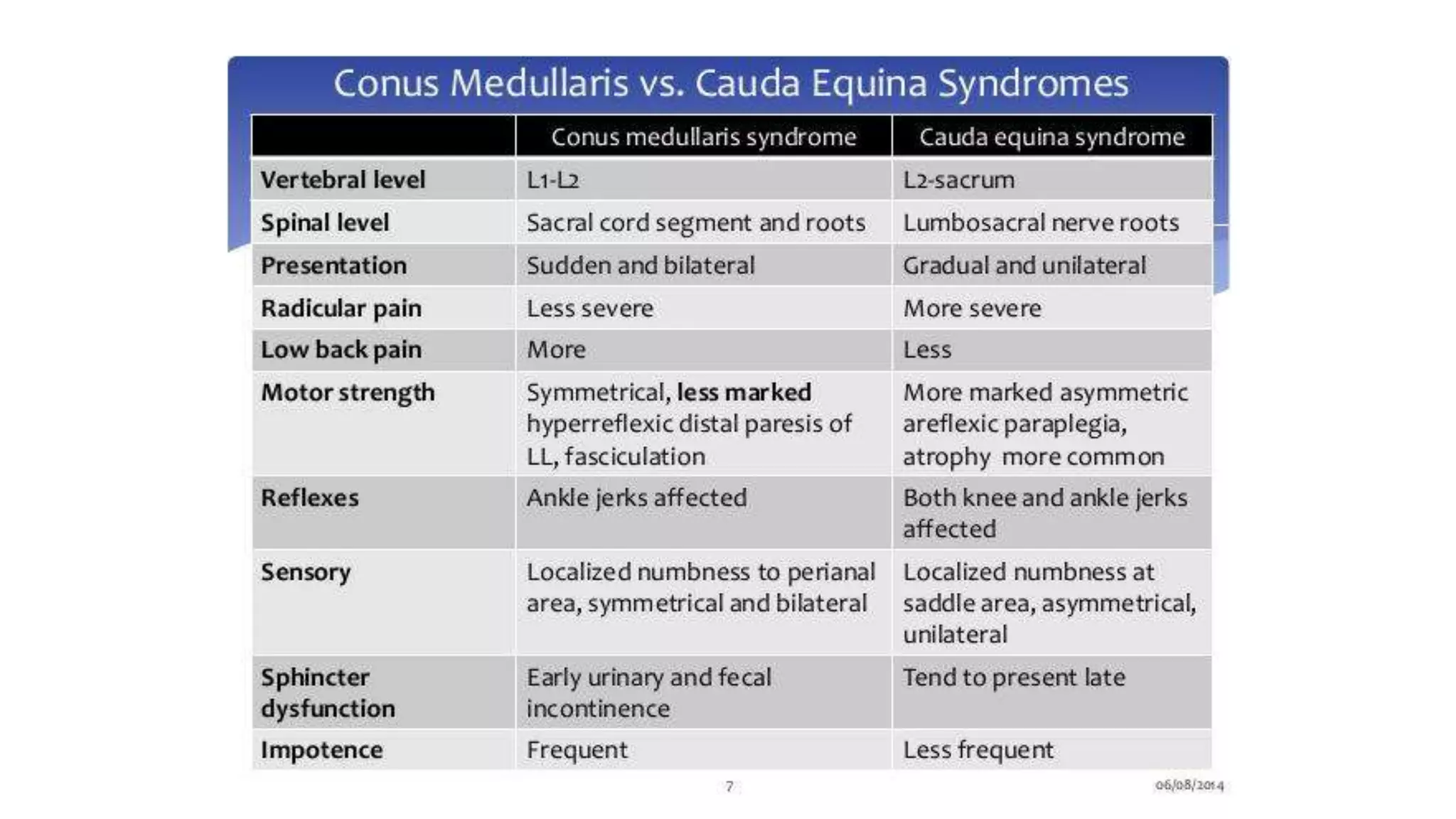
Conus medularis syndrome.
• Most distal part of the spinal cord situated at level of L1-L2 vertebral
bodies and comprises of sacral segments S1-S5.
• May present with Saddle anasthesia, Absent Bulbocarvenous reflexes,
and absent anal reflexes.
• LMN- at the level of the lesion.
• UMN- below the level of the lesion.
• Saddle Anaesthesia: A loss of feeling or numbness between the legs
and/or back passage and/or genitals.
• Bladder Disturbance: Difficulty controlling urination, loss of sensation.
• Bowel Disturbance: Inability to control bowel movements, a loss of
sensation and/or constipation
• Sexual Problems: Inability to maintain erection or ejaculate, loss of
sensation during intercourse
• Nerve Root Pain: Combination of pain, numbness or weakness in back and
legs and/or changing temperature sensations and/or
• spasms in the lower limbs.
Spondylolisthesis
• Spondylolisthesis (also known as anterolisthesis) is defined as an
anterior displacement of a vertebra relative to the vertebra below,
whereas the reverse, i.e. when the superior vertebra slips posterior to
that below, is called retrolisthesis
(Butt and Saifuddin 2005).
Grading.
Management.
IMAGING
Radiograph: AP,Lat,oblique
general findings
degenerative changes of uncovertebral and facet joints
osteophyte formation
disc space narrowing
decreased sagittal diameter
cord compression occurs with canal diameter is < 13mm
lateral radiograph
important to look for diameter of spinal canal
• a Pavlov ratio of less than 0.8 suggest a congenitally narrow spinal
canal predisposing to stenosis and cord compression
• sagittal alignment
• C2 to C7 alignment
MRI
• views
T2 axial imaging gives needed information on the status of the soft
tissues.
• findings
disc degeneration and herniation
foraminal stenosis with nerve root compression (loss of perineural
fat)
central compression with CSF effacement
CT without contrast
• complementary information with an MRI, more useful to evaluate
OPLL and osteophytes
CT myelography
• More invasive than an MRI , excellent information on degree of
spinal cord compression
Discography
indications
• controversial and rarely indicated in cervical spondylosis
Studies
Nerve conduction studies
• high false negative rate
• may be useful to distinguish peripheral from central processes
Selective nerve root corticosteroid injections
• may help confirm level of radiculopathy in patients with multiple level
disease, and when physical exam findings and EMG fail to localize
level .
INDICATIONS
Evaluate degree of spinal
cord and nerve root compression
FINDINGS
effacement of CSF indicates functional stenosis
spinal cord signal changes
seen as bright signal on T2 images (myelomalacia)
signal changes on T1-weighted images correlate with a poorer prognosis following
surgical decompression
compression ratio of < 0.4 carries poor prognosis
• LABS
Focused :eg
Lipid profile,RFT,LFT,SICKLING,RBS,UA
General education on spine health
Driving
smoking cessation
Avoid lifting
professional athletes
Weight management
Physical therapy/Orthotics
•
Aims of Physical therapy
1.To reduce pain
2.To increase muscle strength and length
3.To increase joint ROM
Physical Therapy Modalities:1st Line
• 1.Exercise therapy
2.Ice/ Heat therapy
3.Manual therapy
4.Traction
5.Electrotherapy
Splints and Orthotics
Types of spinal orthotics:CO,CTO,CTLO
Pharmacotherapy
Multi-modal pain management
WHO Pain LAdder
Commonly Used medications
NSAIDS:Diclofenac
STEROIDS:Prednisolone
CALCIUM SUPPLEMENTS
VITAMINS:Vitamin B Complex containing 1,6 and 12
MUSCLE RELAXANTS eg Baclofen
ANXIOLYTICS/ANTI-CONVULSANTS: eg Pregabalin,Gabapentin
CAFERGOT+ERGOTAMINE
•
Surgery and follow-up reviews
Operative
surgical decompression, restoration of lordosis, stabilization
indications
significant functional impairment and
1-2 level disease
lordotic, neutral or kyphotic alignment
techniques
appropriate procedure depends on
cervical alignment
 number of stenotic levels
location of compression
medical conditions e.g., goiter
Anterior Decompression and Fusion (ACDF)
indications
mainstay of treatment in most patients with single or two level disease
fixed cervical kyphosis of > 10 degrees
anterior procedure can correct kyphosis
compression arising from 2 or fewer disc segments
pathology is anterior (OPLL, soft discs, disc osteophyte complexes)
approach
uses Smith-Robinson anterior approach
corpectomy and strut graft may be required for multilevel spondylosis
Laminoplasty
indications
gaining in popularity
useful when maintaining motion is desired
avoids complications of fusion so may be indicated in
patients at high risk of pseudoarthrosis
contraindications
cervical kyphosis
> 13 degrees is a contraindication to posterior
decompression
Laminectomy with posterior fusion
indications
• multilevel compression with kyphosis of < 10 degrees
• > 13 degrees of fixed kyphosis is a contraindication for a posterior procedure
• in flexible kyphotic spine, posterior decompression and fusion may be indicated if
kyphotic deformity can be corrected prior to instrumentation
contraindications
• fixed kyphosis of > 10 degrees is a contraindication to posterior decompression
• will not adequately decompress spinal cord as it is "bowstringing" anterior
Combined anterior and posterior surgery
indications
• multilevel stenosis in the rigid kyphotic spine
• multi-level anterior cervical corpectomies
• postlaminectomy kyphosis
Laminectomy alone
indications
• rarely indicated due to risk of post laminectomy kyphosis
anterior cervical discectomy and fusion
indications
• persistent and disabling pain that has failed nonoperative modalities
• progressive and significant neurologic deficits .
posterior foraminotomy
indications
• foraminal soft disc herniation causing single level radiculopathy ideal
• may be used in osteophytic foraminal narrowing
cervical total disc replacement
indications (controversial)
• single level disease with minimal arthrosis of the facets .
Techniques
Anterior Cervical Discectomy and Fusion (ACDF)
approach
• uses Smith-Robinson anterior approach
techniques
• decompression
• placement of bone graft increases disk height and decompresses the neural foramen through
indirect decompression
• corpectomy and strut graft may be required for multilevel spondylosis
• fixation --- anterior plating functions to increase fusion rates and preserve position of interbody
cage or strut graft .
Posterior foraminotomy
approach
• posterior approach
technique
• if anterior disc herniation is to be removed, then superior portion of
inferior pedicle should be removed .
Total disc replacement
approach
• uses Smith-Robinson anterior approach
Patient Follow Plan:To review progress of care and to identify
complications
• Thank you
References
• AO Spine masters series Volume 3, Volume 8
• Rao R. Neck pain, cervical radiculopathy, and cervical myelopathy:
pathophysiology, natural history, and clinical evaluation. J Bone Joint
Surg Am. 2002
• Zhang YH, Zhao CQ, Jiang LS, Chen XD, Dai LY. Modic changes: a
systematic review of the literature. Eur Spine J. 2008
• Clinical biomechanics of spine by Augustus white
• Handbook of neurosurgery Greenberg
Prof Kahamba. Comments
• Ideal BMI
• Exercises( Swimming for Old people)
• Orthopeadics matress
• Avoid Bending forwards.
• Limit lifting heavy objects than 20 kgs.
• Orthotics for a short time. ( To avoid Disuse muscle atrophy), only when
travelling.
Out of 100, 5% will come with acute disc ( will be operated on emergency
basis) 95% will go under conservative management, 80% will respond to non
operative Tx, remaining 15% will have failed conservative management, and
will need Elective surgery. ( let the patient earn the surgery)

Muttaz Degenerative spine.pptx

  • 1.
    DEGENERATIVE DISEASE OF THESPINE By Dr. Mutta & Dr Adeb Facilitated by Prof. Kahamba
  • 2.
    outline • Objectives. • Introduction. •Epidemiology. • Patho-anatomy. • Symptomatic degenerative spine. • Management.
  • 3.
    Objectives. • To understandthe pathoanatomy of the degenerative disease of the spine. • To understand the symptomatic degenerative spine. • To understand the common degenerative diseases of the spine. • To understand the role of non-operative management in the degenerative spine disease. • To understand the operative management of the degenerative spine.
  • 4.
    Introduction. • Can bedefined as a gradual Loss of normal stuctural function of the spine over time. • Caused mainly by aging, but also tumours, arthritis or infection. • Leading to structural failure and compression of the neural structures within the spinal canal, discs and neuro foramen.
  • 5.
    • Affects mostlythe mobile parts of the spine (cervical and lumbar spine).
  • 6.
    Epidermiology. Degenerative cervical spinedisease. • On the basis of radiologic findings, 90% of men older than 50 years and 90% of women older than 60 years have evidence of degenerative changes in the cervical spine. • Both sexes seem to be affected equally but the presentation is usually early in males.
  • 7.
    • No raceseem to be more affected by the disease. • Age seem to be the major factor in cervical spondylosis, with • 25% of adults under the age of 40, • 50% of adults over the age of 40, and • 85% of adults over the age of 60 • Also there is increased incidence those who carry heavy loads on their heads or shoulders, in dancers and gymnasts, horse back riders.
  • 8.
    Lumbar degenerative disease. •Incidence is 27-37% of the asymptomatic lower back pain population. eg In the United States, 3% of individuals aged 20-29 years and rising to more than 80% of individuals older than 40 years have lumbar spondylosis. • occurs in 6-10% of the general population and has been found to be as high as 25-60% in athletes. • The prevalence of radiographic spondylosis increases with age and become more past the age of 65.
  • 9.
    • Age isthe greatest risk factor, but other possibilities include disc desiccation, previous injury, joint overload from malalignment and/or abnormal z-joint orientation, and genetic predisposition. • Studies evaluating the role of body mass index (BMI), level of activity, and gender on incidence and severity of lumbar spondylosis do not show a clear correlation.
  • 10.
  • 11.
  • 12.
    Degenerative changes. • Intervertebraldisc Changes. • Vertebral body/ Endplate changes. • Degenerative changes of the posterior elements.
  • 13.
    Intervertebral disc changes. •Includes, Disc buldge, Annular tear, and Herniation. • Vacuum Phenomenon • Brought by decrease in water and proteoglycan content in the annulus fibrosus. • Collagen fibres becomes distorted. • Leading to disc tear, decreased disc height and volume, and loss of resistance to physiological loads.
  • 14.
    Disc Buldge. • Generalizedor circumferential disc displacement (involving 50% to 100% of the disc circumference) is known as "bulging", and is not considered a form of herniation. • Bulging can be symmetrical (displacement of disc material is equal in all directions) or asymmetrical (frequently associated with scoliosis)
  • 15.
    Annular tear. • Disruptionof concentric collagenous fibers comprising the anulus fibrosus.
  • 16.
    Disc herniation. • Herniationis defined as a localized displacement of disc material (nucleus, cartilage, fragmented annular tissue) beyond the limits of the intervertebral disc space. (Fardon and Milette 2001).
  • 17.
    Vertebral body/ Endplatechanges. Modic changes classification consists of 4 types. • Type 0 - normal disc and vertebral body appearance. • Type I - presence of bone marrow edema within vertebral body and hyper-vascularization. • Type II - fatty replacements of the red bone marrow within vertebral body. • Type III - subchondral bone sclerosis.
  • 18.
    Vertebral osteophites. • Anosteophyte is a fibrocartilage-capped bony outgrowth. • Can be extraspinal (marginal, central, periosteal, or capsular) or Vertebral (traction or claw).
  • 19.
    Degenerative changes ofthe posterior elements. • Facet Joints. • Ligamentum Flavum. • PLL
  • 20.
    Facet joints. • Cartilagelining Losses water content, cartilage wears away, facets override on each other. • Leading to abnormal function of motion segment. • Facet joint Ligaments become thickened and hypertrophic. • New bone formation around the joint can occur with the development of osteophytes or “bone spurs.”
  • 21.
    Ligamentum flavum. • Lossof elastin fibres which are replaced by collagen fibers. • Also deposition of Ca2+. • Ligamentum flavum can lose strength and elasticity, causing it to thicken and buckle towards the spinal cord and neuroforamina.
  • 22.
  • 23.
    Symptomatic degenerative spinedisease. Axial Pain. • Muscle spasms. • Dicogenic pain. • Degenerated facet. • Uncovertebral joints.
  • 24.
  • 26.
    The abdominal cutaneousreflex: Upper abdominal reflex: T8/9 Lower abdominal reflex: T10/12 Cremasteric reflex: L1–2 superficial reflex Anal cutaneous/bulbocavenosus/priapism: S2, 3, 4
  • 27.
    DTR Biceps reflex -elbow flex – C5/6 Supinator reflex – wrist ext – C6/7 Triceps reflex – elbow ext – C7/8 Infrapatella – knee ext – L3/4 Achilles – ankle planta flex – S1/S2
  • 28.
  • 29.
    Cervical degenerative disease. •Axial neck pain - pain localised to the spinal column. • Cervical radiculopathy - complaints in a dermatomal or myotomal distribution often occurring in the arms. May be numbness, pain or loss of function.
  • 31.
    • Cervical myelopathy- a cluster of complaints and findings due to intrinsic damage to the spinal cord itself. Numbness, coordination and gait issues, grip weakness and bowel and bladder complaints with associated physical findings may be reported.
  • 32.
    • Central cordsyndrome, in which motor and sensory deficits affected the upper extremities more severely than the lower extremities. • Brown-Séquard syndrome, which consisted of ipsilateral motor deficits with contralateral sensory deficits. • Brachialgia and cord syndrome, which consisted of radicular pain in the upper extremity along with motor and/ or sensory long-tract signs.
  • 33.
    • Transverse lesionsyndrome, in which the corticospinal, spinothalamic, and posterior cord tracts were involved with almost equal severity and which was associated with the longest duration of symptoms, suggesting that this category may be an end stage of the disease. • Motor system syndrome, in which corticospinal tracts and anterior horn cells were involved, resulting in spasticity
  • 34.
    Lumbar degenerative diseases. •Axial Pain • Radiculopathy.
  • 35.
    Sciatica. • Spinal causes. •Disc changes. • Vertebral body changes. • Posterior Elements changes. • Trauma & Tumors. • Non Spinal causes. • Piriformis syndrome. • Wallet Sciatica (Credit-carditis) • Trauma
  • 36.
    Myelopathy. Conus medularis syndrome. •Most distal part of the spinal cord situated at level of L1-L2 vertebral bodies and comprises of sacral segments S1-S5. • May present with Saddle anasthesia, Absent Bulbocarvenous reflexes, and absent anal reflexes. • LMN- at the level of the lesion. • UMN- below the level of the lesion.
  • 38.
    • Saddle Anaesthesia:A loss of feeling or numbness between the legs and/or back passage and/or genitals. • Bladder Disturbance: Difficulty controlling urination, loss of sensation. • Bowel Disturbance: Inability to control bowel movements, a loss of sensation and/or constipation • Sexual Problems: Inability to maintain erection or ejaculate, loss of sensation during intercourse • Nerve Root Pain: Combination of pain, numbness or weakness in back and legs and/or changing temperature sensations and/or • spasms in the lower limbs.
  • 41.
    Spondylolisthesis • Spondylolisthesis (alsoknown as anterolisthesis) is defined as an anterior displacement of a vertebra relative to the vertebra below, whereas the reverse, i.e. when the superior vertebra slips posterior to that below, is called retrolisthesis (Butt and Saifuddin 2005).
  • 42.
  • 43.
  • 44.
    IMAGING Radiograph: AP,Lat,oblique general findings degenerativechanges of uncovertebral and facet joints osteophyte formation disc space narrowing decreased sagittal diameter cord compression occurs with canal diameter is < 13mm
  • 45.
    lateral radiograph important tolook for diameter of spinal canal • a Pavlov ratio of less than 0.8 suggest a congenitally narrow spinal canal predisposing to stenosis and cord compression • sagittal alignment • C2 to C7 alignment
  • 46.
    MRI • views T2 axialimaging gives needed information on the status of the soft tissues. • findings disc degeneration and herniation foraminal stenosis with nerve root compression (loss of perineural fat) central compression with CSF effacement
  • 47.
    CT without contrast •complementary information with an MRI, more useful to evaluate OPLL and osteophytes CT myelography • More invasive than an MRI , excellent information on degree of spinal cord compression
  • 48.
    Discography indications • controversial andrarely indicated in cervical spondylosis
  • 49.
    Studies Nerve conduction studies •high false negative rate • may be useful to distinguish peripheral from central processes Selective nerve root corticosteroid injections • may help confirm level of radiculopathy in patients with multiple level disease, and when physical exam findings and EMG fail to localize level .
  • 50.
    INDICATIONS Evaluate degree ofspinal cord and nerve root compression FINDINGS effacement of CSF indicates functional stenosis spinal cord signal changes seen as bright signal on T2 images (myelomalacia) signal changes on T1-weighted images correlate with a poorer prognosis following surgical decompression compression ratio of < 0.4 carries poor prognosis
  • 51.
    • LABS Focused :eg Lipidprofile,RFT,LFT,SICKLING,RBS,UA
  • 52.
    General education onspine health Driving smoking cessation Avoid lifting professional athletes Weight management
  • 53.
    Physical therapy/Orthotics • Aims ofPhysical therapy 1.To reduce pain 2.To increase muscle strength and length 3.To increase joint ROM
  • 54.
    Physical Therapy Modalities:1stLine • 1.Exercise therapy 2.Ice/ Heat therapy 3.Manual therapy 4.Traction 5.Electrotherapy Splints and Orthotics Types of spinal orthotics:CO,CTO,CTLO
  • 55.
    Pharmacotherapy Multi-modal pain management WHOPain LAdder Commonly Used medications NSAIDS:Diclofenac STEROIDS:Prednisolone CALCIUM SUPPLEMENTS VITAMINS:Vitamin B Complex containing 1,6 and 12 MUSCLE RELAXANTS eg Baclofen ANXIOLYTICS/ANTI-CONVULSANTS: eg Pregabalin,Gabapentin CAFERGOT+ERGOTAMINE •
  • 56.
    Surgery and follow-upreviews Operative surgical decompression, restoration of lordosis, stabilization indications significant functional impairment and 1-2 level disease lordotic, neutral or kyphotic alignment techniques appropriate procedure depends on cervical alignment  number of stenotic levels location of compression medical conditions e.g., goiter
  • 57.
    Anterior Decompression andFusion (ACDF) indications mainstay of treatment in most patients with single or two level disease fixed cervical kyphosis of > 10 degrees anterior procedure can correct kyphosis compression arising from 2 or fewer disc segments pathology is anterior (OPLL, soft discs, disc osteophyte complexes) approach uses Smith-Robinson anterior approach corpectomy and strut graft may be required for multilevel spondylosis
  • 58.
    Laminoplasty indications gaining in popularity usefulwhen maintaining motion is desired avoids complications of fusion so may be indicated in patients at high risk of pseudoarthrosis contraindications cervical kyphosis > 13 degrees is a contraindication to posterior decompression
  • 59.
    Laminectomy with posteriorfusion indications • multilevel compression with kyphosis of < 10 degrees • > 13 degrees of fixed kyphosis is a contraindication for a posterior procedure • in flexible kyphotic spine, posterior decompression and fusion may be indicated if kyphotic deformity can be corrected prior to instrumentation contraindications • fixed kyphosis of > 10 degrees is a contraindication to posterior decompression • will not adequately decompress spinal cord as it is "bowstringing" anterior
  • 60.
    Combined anterior andposterior surgery indications • multilevel stenosis in the rigid kyphotic spine • multi-level anterior cervical corpectomies • postlaminectomy kyphosis Laminectomy alone indications • rarely indicated due to risk of post laminectomy kyphosis
  • 61.
    anterior cervical discectomyand fusion indications • persistent and disabling pain that has failed nonoperative modalities • progressive and significant neurologic deficits . posterior foraminotomy indications • foraminal soft disc herniation causing single level radiculopathy ideal • may be used in osteophytic foraminal narrowing cervical total disc replacement indications (controversial) • single level disease with minimal arthrosis of the facets .
  • 62.
    Techniques Anterior Cervical Discectomyand Fusion (ACDF) approach • uses Smith-Robinson anterior approach techniques • decompression • placement of bone graft increases disk height and decompresses the neural foramen through indirect decompression • corpectomy and strut graft may be required for multilevel spondylosis • fixation --- anterior plating functions to increase fusion rates and preserve position of interbody cage or strut graft .
  • 63.
    Posterior foraminotomy approach • posteriorapproach technique • if anterior disc herniation is to be removed, then superior portion of inferior pedicle should be removed .
  • 64.
    Total disc replacement approach •uses Smith-Robinson anterior approach Patient Follow Plan:To review progress of care and to identify complications
  • 65.
  • 66.
    References • AO Spinemasters series Volume 3, Volume 8 • Rao R. Neck pain, cervical radiculopathy, and cervical myelopathy: pathophysiology, natural history, and clinical evaluation. J Bone Joint Surg Am. 2002 • Zhang YH, Zhao CQ, Jiang LS, Chen XD, Dai LY. Modic changes: a systematic review of the literature. Eur Spine J. 2008 • Clinical biomechanics of spine by Augustus white • Handbook of neurosurgery Greenberg
  • 67.
    Prof Kahamba. Comments •Ideal BMI • Exercises( Swimming for Old people) • Orthopeadics matress • Avoid Bending forwards. • Limit lifting heavy objects than 20 kgs. • Orthotics for a short time. ( To avoid Disuse muscle atrophy), only when travelling. Out of 100, 5% will come with acute disc ( will be operated on emergency basis) 95% will go under conservative management, 80% will respond to non operative Tx, remaining 15% will have failed conservative management, and will need Elective surgery. ( let the patient earn the surgery)

Editor's Notes

  • #15 The term bulge refers to a morphologic characteristic and is not correlated with etiology or symptomatology. Bulging can be physiologic (e.g. in the mid-cervical spine and at L5-S1), can reflect advanced degenerative disc disease, can be associated with bone remodeling (as in advanced osteoporosis), occur with ligamentous laxity, or can be a "pseudo image" due to partial volume averaging An asymmetrical bulging disc can be associated with scoliosis. Bulging discs are not considered a form of herniation
  • #16 Concentric tears are circumferential lesions which are found in the outer layers of the annular wall (Martin et al. 2002). They represent splitting between adjacent lamellae of the annulus, like onion rings. Concentric tears are most commonly encountered in the outer annulus fibrosus, and are believed to be of traumatic origin especially from torsion overload injuries. Radial tears are characterized by an annular tear which permeates from the deep central part of the disc (nucleus pulposus) and extends outward toward the annulus, in either a transverse or cranial-caudal plane. Transverse tears, also known as "peripheral tears" or "rim lesions," are horizontal ruptures of fibers, near the insertion in the bony ring apophyses. Their clinical significance remains unclear. Transverse tears are believed to be traumatically induced and are often associated with small osteophytes.
  • #17 Protuded disc- The terminology "protruded disc" is used when the base of the disc is broader than any other diameter of the displaced material. Based on a two-dimensional assessment of the disc contour in the transverse plane, a protruded disc can be focal (involving <25% of the disc circumference) or broad-based (involving 25%-50% of the disc circumference). Extruded disc- The terminology "extruded disc" is used for a focal disc extension of which the base against the parent disc is narrower than the diameter of the extruded disc material, measured in the same plane. Migrated disc- indicates displacement of disc material away from the site of extrusion, regardless of whether sequestrated or not. Sequestered disc- indicate that the displaced disc material has lost completely any continuity with the parent disc.
  • #18 Their presence in clients receiving physiotherapy for low back pain may be of significance when discussing prognosis and benefits of exercise therapy.  Proposed risk factors for developing MC include: Body mass index (BMI) ranking of overweight or obese Advanced age Smoking.
  • #19 Risk factors for development of osteophytes include age, body mass index, physical activity, and other genetic and environmental factors. Transforming growth factor β plays a role in the pathophysiology of osteophyte formation. Osteophytes can cause pain, limit range of motion, affect quality of life, and cause multiple symptoms at the spine. Medical treatment involves the use of bisphosphonates and other non-steroidal anti-inflammatory agents. Surgical treatment in the form of cheilectomy for impingement syndromes during joint replacement is recommended.
  • #21 Cervical facet syndrome includes following symptoms:  Axial neck pain (rarely radiating past the shoulders), most common unilaterally Pain with and/or limitation of extension and rotation Tenderness upon palpation Radiating pain locally or into the shoulders or upper back, and rarely radiate in the front or down an arm or into the fingers as a herniated disc might. Lumbar facet syndrome can be characterised by following symptoms:[6] Pain or tenderness in lower back. Local tenderness/stiffness alongside the spine in the lower back. Pain, stiffness or difficulty with certain movements (such as standing up straight or getting up from a chair. Pain upon hyperextension Referred pain from upper lumbar facet joints can extend into the flank, hip and upper lateral thigh Referred pain from lower lumbar facet joints can penetrate deep into the thigh, laterally and/or posteriorly L4-L5 and L5-S1 facet joints can refer pain extending into the distal lateral leg, and in rare instances to the foot
  • #24 In a substantial number of patients, axial neck pain is a result of muscular or ligamentous factors related to posture, poor ergonomics, stress, and/or chronic muscle fatigue. Neck muscle pain can develop secondarily as a result of postural adaptations to a primary source of pain in the shoulder, the craniovertebral junction, or the temporomandibular joint. The physiology of this pain process in the involved muscles is unclear. Patients with chronic myofascial pain have been shown to have a lower level of high energy phosphates in the in- volved muscle tissue. It is unclear whether this causes the pain or is a result of the pain. Raj Rao 2002 Nerve fibers and nerve endings found in the peripheral portions of the disc2,3 offer a possible mechanism by which degenerated cer- vical discs can produce pain directly. The disc is innervated by the sinuver- tebral nerve, formed by branches from the ventral nerve root and the sympa- thetic plexus3 (Fig. 1). Once formed, the nerve turns back into the inter- vertebral foramen along the posterior aspect of the disc, supplying portions of the annulus, the posterior longi- tudinal ligament, the periosteum of the vertebral body and pedicle, and the adjacent epidural veins. A recent re- view of the findings of cervical discog- raphy performed over a twelve-year period suggested that reliable patterns of pain are produced by stimulation of each cervical disc4 (Fig. 2). The au- thors reported a high percentage of patients in whom multiple discs were concurrently responsible for axial neck pain.
  • #25 The exact pathogenesis of radicular pain is unclear, but it is generally thought that, in addition to the compression, an inflammatory response of some kind is necessary for pain to develop. Within the compressed nerve root intrinsic blood vessels show increased permeability, which secondarily results in edema of the nerve root. Chronic edema and fibrosis within the nerve root can alter the response threshold and increase the sensitivity of the nerve root to pain. Neurogenic chemical mediators of pain released from the cell bodies of the sensory neurons and non-neurogenic mediators released from disc tissue may play a role in initiating and perpetuating this inflammatory response Cervical radiculopathy refers to symp- toms in a specific dermatomal distribu- tion in the upper extremity. Patients describe sharp pain and tingling or burning sensations in the involved area. There may be sensory or motor loss cor- responding to the involved nerve root, and reflex activity may be diminished. Patients typically have severe neck and arm pain that prevents them from getting into a comfortable position. They may hold the arm over the head, typically resting the wrist or forearm on top of the head (the shoulder abduction sign12) and sometimes tilting the head to the contralateral side. The symptoms are usually aggravated by extension or lateral rotation of the head to the side of the pain (the Spurling maneuver).
  • #29 The anterior-posterior diameter of the sub- axial spine in normal adults measures 17 to 18 mm, and the diameter of the spinal cord is approximately 10 mm in this region. Individuals with an anterior- posterior diameter of the spinal canal of <13 mm are considered to have congenital cervical stenosis. There is a strong association between flattening of the cord within the narrowed spinal canal and the development of cervical myelopathy. Penning et al.13 believed that symptoms of cord compression occurred when the transverse area of the cord was <60 mm2. Houser et al. thought that the shape and degree of flattening of the spinal cord could be an indicator of neurologic deficit; 98% of their patients with severe stenosis and a banana-shaped spinal cord had clinical evidence of myelopathy14. Ono et al. de- scribed an anterior-posterior cord- compression ratio that was calculated by dividing the anterior-posterior di- ameter of the cord by the transverse di- ameter of the cord. Patients with substantial flattening of the cord, suggested by an anterior-posterior ra- tio of <0.40 tended to have worse neu- rologic function. Ogino et al. thought that an increase in this ratio to ≥0.40 or an increase in the transverse area to >40 mm2 was a strong predictor of recovery following surgery16.
  • #43 The forward slip of the upper vertebra is measured using the method of Meyerding, or the method described by Taillard. Using the method of Meyerding, the anteroposterior (AP) diameter of the superior surface of the lower vertebra is divided into quarters and a grade of I- IV is assigned to slips of one, two, three or four quarters of the superior vertebra, respectively. The other method, described by Taillard, expresses the degree of slip as a percentage of the AP diameter of the top of the lower vertebra (Butt and Saifuddin 2005).