OECD and ProgressBeyond GDP
GDP is an important economic indicator that measures output.
But it doesn’t give a full picture of social progress and well-beingBut it is not sufficient to measure
If GDP per capita rises, itmeanswe’re all gettingricher, right?
Wrong.  GDP per capita isjust GDP divided by the size of the population. It doesn’t tell  us what people are actuallyearning or if that’srising.
Equally, GDP leaves out somegoodthings …
Raisingchildren, cooking dinner or tidying up may or may not be counted in GDP depending on whether they’re done in the home, by the state or by a firm.
GDP includes how muchwe’respending on  thingslikeeducation, the police and health…
But itisn’tdesigned to measure the  outcomesof all thatspending  – are ourkids gettingsmarter, ourstreetssafer, ourhospitals more effective?
Badthingscanbegoodfor GDP:Natural disasterskill and maim millions …
But all thatcleaning up afterwardsmeansextra economicactivity, whichisgood for GDP.
GDP is a good economicmeasure …
… but not so good for measuringprogess, well-beingor happiness.
Relying on GDP alonewouldbelikedriving a car onlylookingat the speedometer…
Relying on GDP alonewouldbelikedriving a car onlylookingat the speedometer…But otherindicators are necesary to assess the success of a policy.
OECD work onmeasuringprogressOECD  has taken part in the Stiglitz-Sen-FitoussiCommission on the Measurement of Economic Performance and Social Progress
OECD producesmany comparable indicatorsthatcan help assessingprogress.
GDP per capitaTakeinequality.This map shows GDP per capita for countries in Western Europe.
GDP per capitaTakeinequality.This map shows GDP per capita for countries in Western Europe.But whenwe break down those countries by region ….
Other patterns emerge:Differenceswithin countries canbebiggerthanthosebetweencountriesSource:OECD Regional eXplorerhttp://stats.oecd.org/OECDregionalstatistics/ and OECD Factbook, http://stats.oecd.org/oecdfactbook/
Differences in incomecanbeeven more striking …
Source:OECD(2008), GrowingUnequal, chart 1.6Data: http://dx.doi.org/10.1787/420721018310
Again, differencesacross countries are lesserSource:OECD(2008), GrowingUnequal, chart 1.6Data: http://dx.doi.org/10.1787/420721018310
Again, differencesacross countries are lesserthandifferenceswithin a country.Source:OECD(2008), GrowingUnequal, chart 1.6Data: http://dx.doi.org/10.1787/420721018310
In most OECD countries, incomeinequalityisrising…Source:OECD(2008), GrowingUnequal, chart 1.5Data: http://dx.doi.org/10.1787/420718178732
OECD has an extensive range of indicators,such as PISA, thatmeasureeducationoutcomes…thingslikehowwellstudents are doing, and whetherthey’rebeingheld back by poverty.
Equally, students in some countries do much better in  the OECD’s PISA tests. Source:OECD(2009), Society at a Glance, chart SS.4.1.Data: http://dx.doi.org/10.1787/550180640382
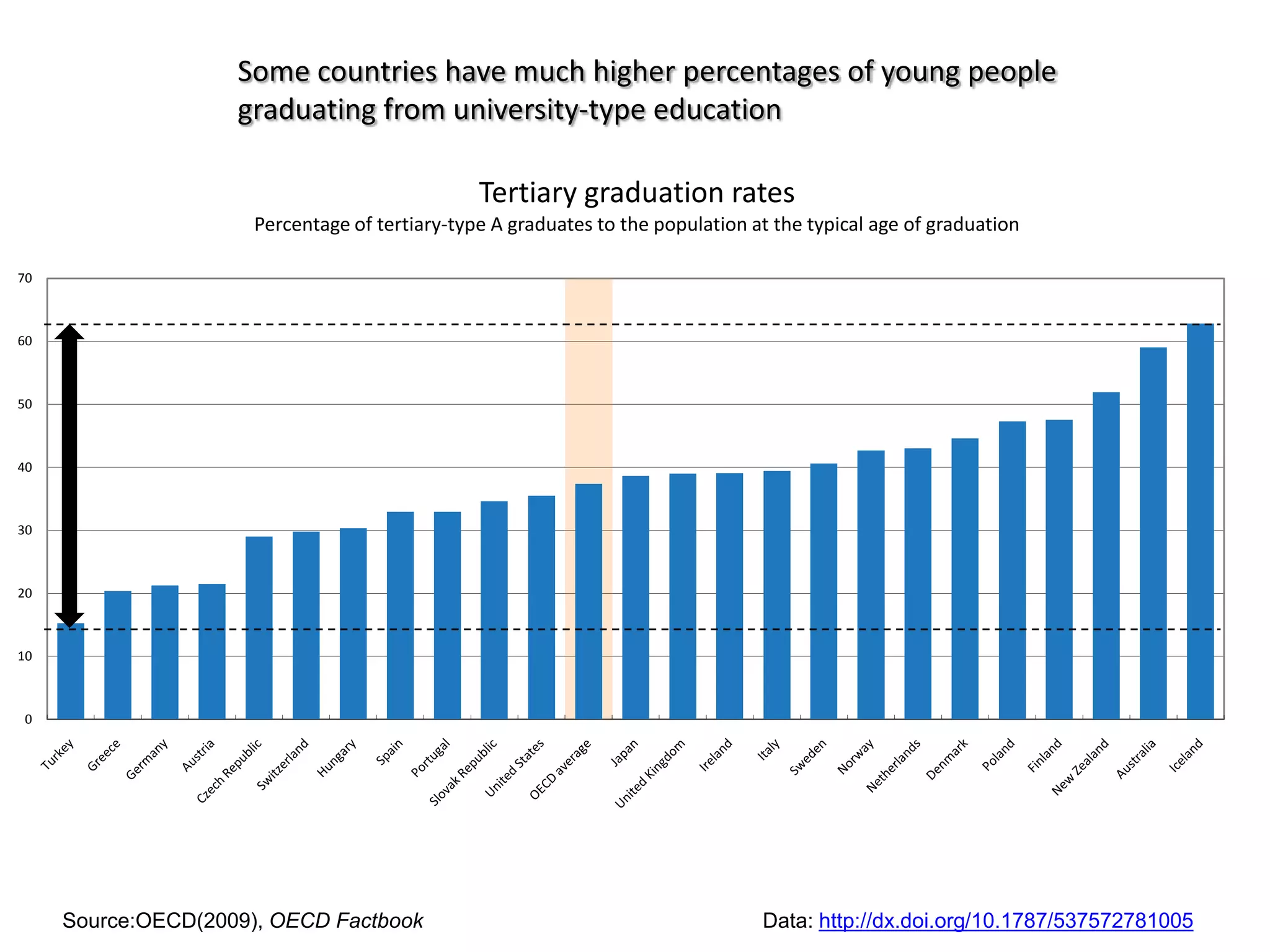
Some countries have much higher percentages of young people graduating from university-type education Source:OECD(2009), OECD FactbookData: http://dx.doi.org/10.1787/537572781005
OECD also measures the outcome of health services.
Source:OECD(2009), Health at a Glance, Chart 1.1.1.Data: http://dx.doi.org/10.1787/717383404708
Life expectancy has increased by 10 yearssince 1960…Source:OECD(2009), Health at a Glance, Chart 1.1.1.Data: http://dx.doi.org/10.1787/717383404708
Life expectancy has increased by 10 yearssince 1960…The gap between countries is a thirdof whatitwasSource:OECD(2009), Health at a Glance, Chart 1.1.1.Data: http://dx.doi.org/10.1787/717383404708
Potentialyears of life lostis the amount of time that people who die before 70 would have livedif theyhad not diedprematurely. Prematuremortality has halved in OECD since 1970.MexicoPortugalUnited StatesOECDSwedenSource:OECD(2009), Health at a Glance, chart 1.3.2.Data: http://dx.doi.org/10.1787/717458111254
OECD canalsocompare outcomes of law-enforcementservices.
Source:OECD(2009), Society at a Glance, Table CO.3.2.Data: http://dx.doi.org/10.1787/550717741440
EnvironmentdashboardOECD statistics examine not onlyenvironmental capital –clean water, forests, animal species and so on … but also the factorsthat are threateningthem – greenhousegasemissions, pollution, urbanisation.
For instance, OECD and itssisteragency IEA measure CO2emissionsSource:IEA(2009), CO2 Emissionsfrom Fuel Combustion
But alsoresources, such as threatenedspeciesSource:OECD(2008), OECD Environmental Data Compendium, table 1.A.
Clearly, wecan’tassesspeople’squality of life just by lookingatwhatthe economyisproducing (whichiswhat GDP measures).
Weneed to consider a muchwider range of indicators, someobjective (how long are people living?) and somesubjective(do youfeel happy?)
Measuringleisure time is an example of an objective measure of well-being…Source:OECD(2009), Society at a Glance, chart 2.3Data: http://dx.doi.org/10.1787/548528164155
While polling people on life satisfaction is a subjectiveindicator.Source:OECD(2009), Society at a Glance, chart CO.1.1 and CO.2.1.Data: http://dx.doi.org/10.1787/550664800231Data: http://dx.doi.org/10.1787/550708264007
We’ve made a good start on measuringprogress …
We’ve made a good start on measuringprogress …but westill have a lot more to do.
For further information:www.oecdilibrary.orgOECD Factbook 2009Society at a Glance 2009GrowingUnequal?OECD iLibrary, - all OECD publicationsHealthat a Glance 2009OECD Environmental OutlookSustainableDevelopmentDoingBetter for Children
Image sources:http://www.flickr.com/photos/cristic/251337503/http://www.flickr.com/photos/telstar/128486232/http://www.flickr.com/photos/flickravatar/3197059682/http://www.flickr.com/photos/lilivc/364968396/http://www.flickr.com/photos/g_kat26/3614041318/http://www.daylife.com/photo/0c1F93Y0Xebqbhttp://www.flickr.com/photos/bulent/172267112/© Inmagine Ltd.http://www.flickr.com/photos/chrissuderman/248876814/http://www.flickr.com/photos/26870279@N04/3881367834/http://www.flickr.com/photos/tellmewhat/3647622370/http://www.flickr.com/photos/kseniab/556687241/http://www.flickr.com/photos/dws/11303021/

OECD and Progress - Beyond GDP

Editor's Notes

  • #3 http://www.flickr.com/photos/telstar/128486232/sizes/o/
  • #5 http://www.flickr.com/photos/_sid_/1288628937/sizes/o/
  • #6 http://www.flickr.com/photos/_sid_/1288628937/sizes/o/
  • #7 http://www.flickr.com/photos/bulent/172267112/
  • #8 http://www.flickr.com/photos/bulent/172267112/
  • #9 http://www.flickr.com/photos/chrissuderman/248876814/sizes/l/http://www.flickr.com/photos/tellmewhat/3647622370/sizes/l/http://www.flickr.com/photos/kseniab/556687241/sizes/l/
  • #10 http://www.flickr.com/photos/chrissuderman/248876814/sizes/l/http://www.flickr.com/photos/tellmewhat/3647622370/sizes/l/http://www.flickr.com/photos/kseniab/556687241/sizes/l/
  • #13 http://www.flickr.com/photos/lilivc/364968396/sizes/l/
  • #14 http://www.flickr.com/photos/lilivc/364968396/sizes/l/
  • #15 http://www.flickr.com/photos/g_kat26/3614041318/sizes/o/
  • #16 http://www.flickr.com/photos/g_kat26/3614041318/sizes/o/
  • #23 [SLIDE CHANGE … text to replace “average income of various deciles (from top to bottom: richest 10%, next 10%, … to poorest 10%)]But when we break down income by decile (richest 10%, next richest 10% and so on) we see that the wealthiest people in some countries have a much bigger slice of the income pie than in others.
  • #24 [SLIDE CHANGE … text to replace “average income of various deciles (from top to bottom: richest 10%, next 10%, … to poorest 10%)]But when we break down income by decile (richest 10%, next richest 10% and so on) we see that the wealthiest people in some countries have a much bigger slice of the income pie than in others.
  • #25 [SLIDE CHANGE … text to replace “average income of various deciles (from top to bottom: richest 10%, next 10%, … to poorest 10%)]But when we break down income by decile (richest 10%, next richest 10% and so on) we see that the wealthiest people in some countries have a much bigger slice of the income pie than in others.
  • #29 Some countries have much higher percentages of young people graduating from university-type education
  • #30 Some countries have much higher percentages of young people graduating from university-type education
  • #32 Do we need to add the “divided by 3” note? Means nothing to me.
  • #33 Do we need to add the “divided by 3” note? Means nothing to me.
  • #34 Do we need to add the “divided by 3” note? Means nothing to me.
  • #35 Potentialyears of life lostis the amount of time that people who die before 70 would have lived if theyhad not diedprematurely.Prematuremortality has halved in OECD since 1970.
  • #41 http://www.flickr.com/photos/dws/11303021/sizes/o/, itisnecessary to takeintoaccountindicatorsnot basedon production, bothobjective and subjective.
  • #42 http://www.flickr.com/photos/dws/11303021/sizes/o/, itisnecessary to takeintoaccountindicatorsnot basedon production, bothobjective and subjective.
  • #43 Add ‘hours spent sleeping’ to personal care?