THL, Helsinki 4 October 2019
Olli Kangas
Olli.kangas@utu.fi
Some reflections on
the Basic Income (BI) experiment
in Finland
INVEST
The Center-True Finns-Conservatives coalition cabinet
(nominated 28. May 2015) took basic income (BI) experiment in
its working program by referring to:
• Changes in the labor markets
• Does our social security system properly correspond to changes in
labor markets?
• Or are there any changes at all?
• ‘No’, say the opponents of BI
• ‘Substantial’, say the proponents of BI
• Elimination of incentive traps
• Too many cases where work does not pay (enough)
• Elimination of bureaucratic traps
• Clients’ fears on bureaucratic machinery
• To create a more transparent system
Background
•There is a number of income-tested ‘basic’
benefits paid on top of each other
•That leads to effective marginal tax rates of
80%-100% (or higher)
• labor market subsidy + housing allowance + social
assistance and income-related day care fees
• Work does not pay (enough)
• How the benefit receivers value their free-time?
•Could the BI be a solution?
To abolish incentive traps
Steps towards the experiment…
• €20 Mill. for the experiment
• Some extra funds for planning the experiment
• Open competition on the funds
• 15. September 2016 Kela’s consortium was selected to plan the experimental
setting and the model(s)
• Work began in the mid-October 2015
• The first report delivered 30. March 2016
• The final report delivered the 16 December 2016
• The experiment started 1.1. 2017 and was planned to last 2 years
• Political promises on new experiments 2018 / 2019
• Promises did not materialize
• In the governmental program of Antti Rinne’s left-centre coalition cabinet there is
promise to start an experiment with negative income tax 4
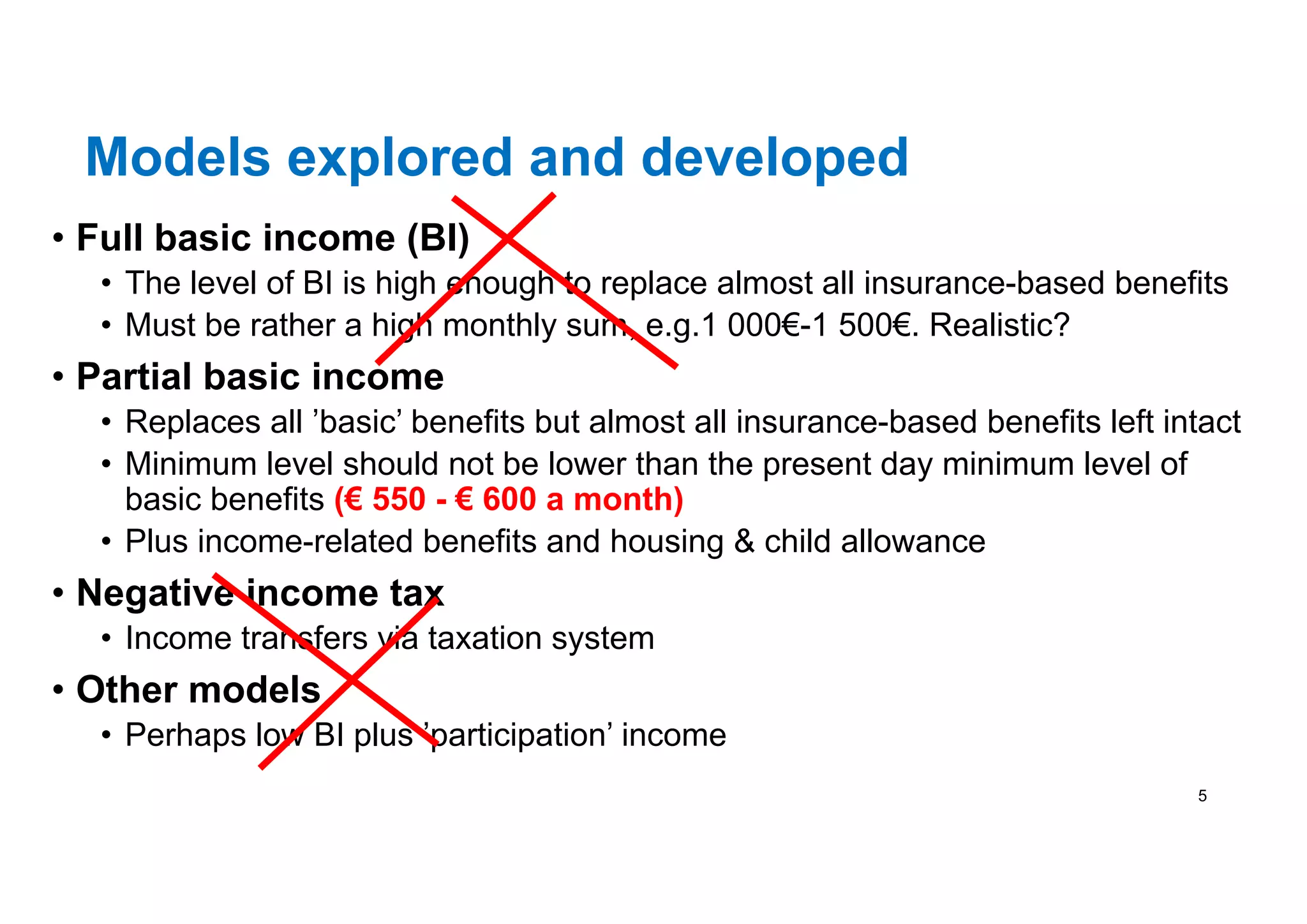
Models explored and developed
• Full basic income (BI)
• The level of BI is high enough to replace almost all insurance-based benefits
• Must be rather a high monthly sum, e.g.1 000€-1 500€. Realistic?
• Partial basic income
• Replaces all ’basic’ benefits but almost all insurance-based benefits left intact
• Minimum level should not be lower than the present day minimum level of
basic benefits (€ 550 - € 600 a month)
• Plus income-related benefits and housing & child allowance
• Negative income tax
• Income transfers via taxation system
• Other models
• Perhaps low BI plus ’participation’ income
5
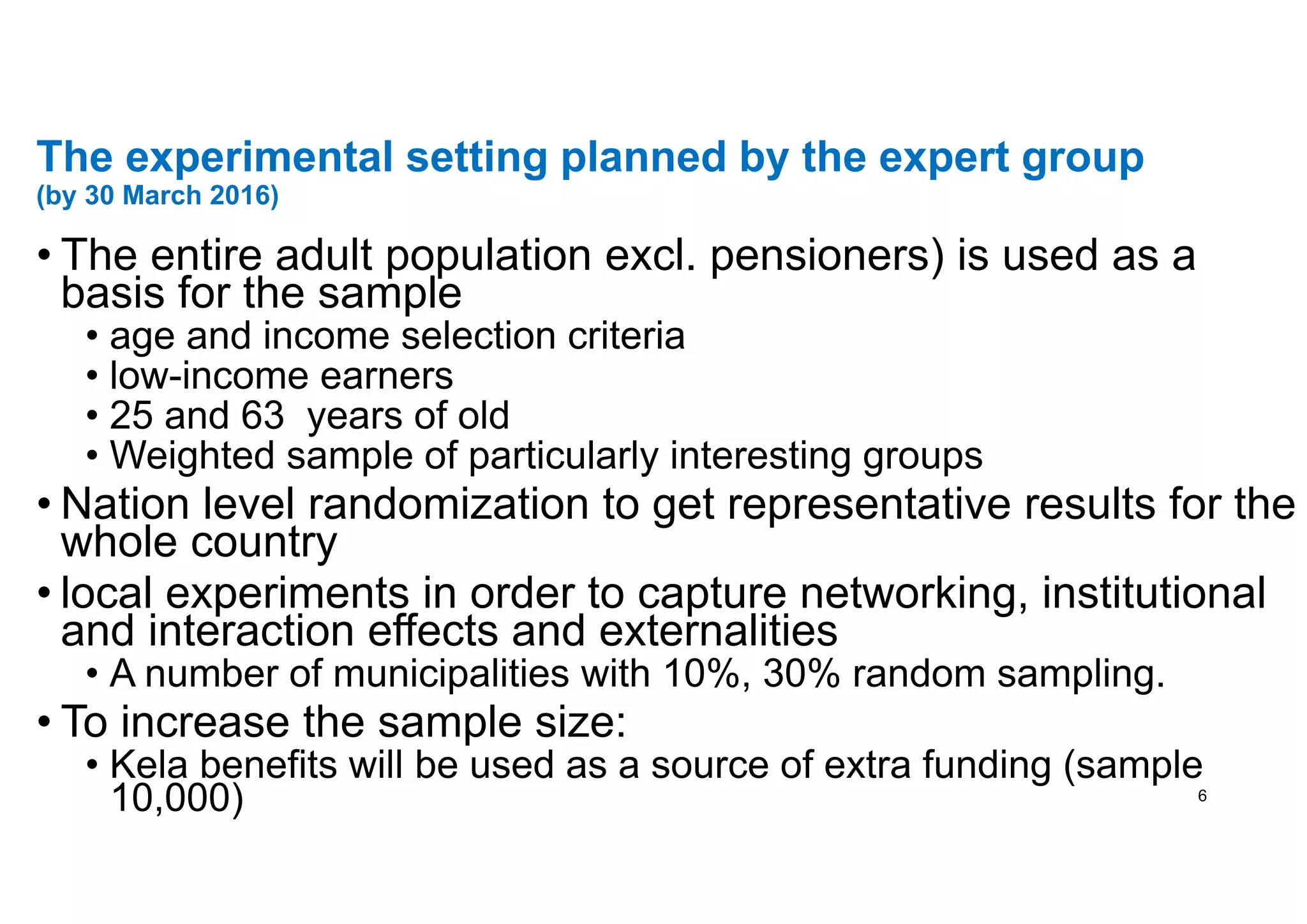
The experimental setting planned by the expert group
(by 30 March 2016)
• The entire adult population excl. pensioners) is used as a
basis for the sample
• age and income selection criteria
• low-income earners
• 25 and 63 years of old
• Weighted sample of particularly interesting groups
• Nation level randomization to get representative results for the
whole country
• local experiments in order to capture networking, institutional
and interaction effects and externalities
• A number of municipalities with 10%, 30% random sampling.
• To increase the sample size:
• Kela benefits will be used as a source of extra funding (sample
10,000) 6
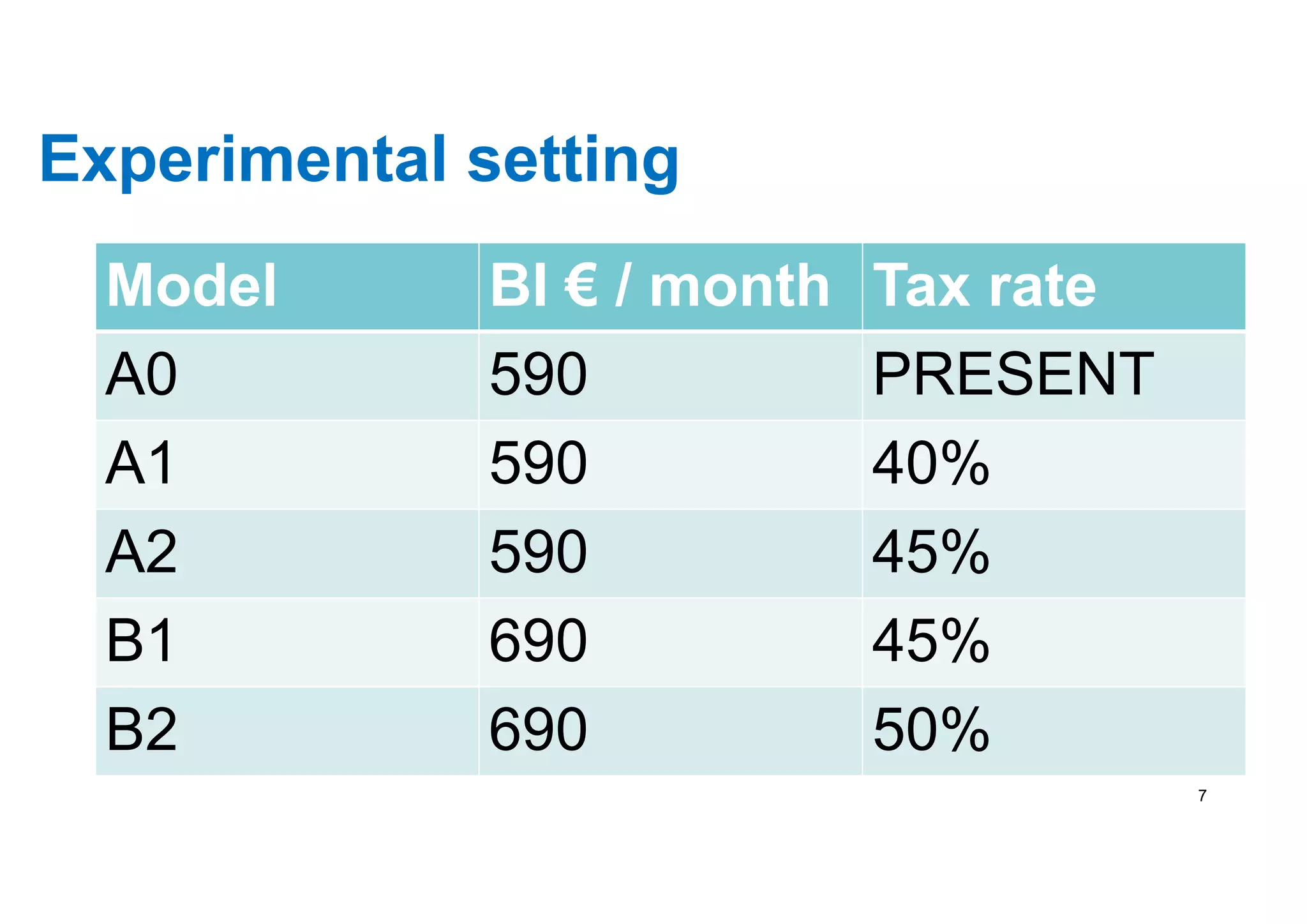
Experimental setting
Model BI € / month Tax rate
A0 590 PRESENT
A1 590 40%
A2 590 45%
B1 690 45%
B2 690 50%
7
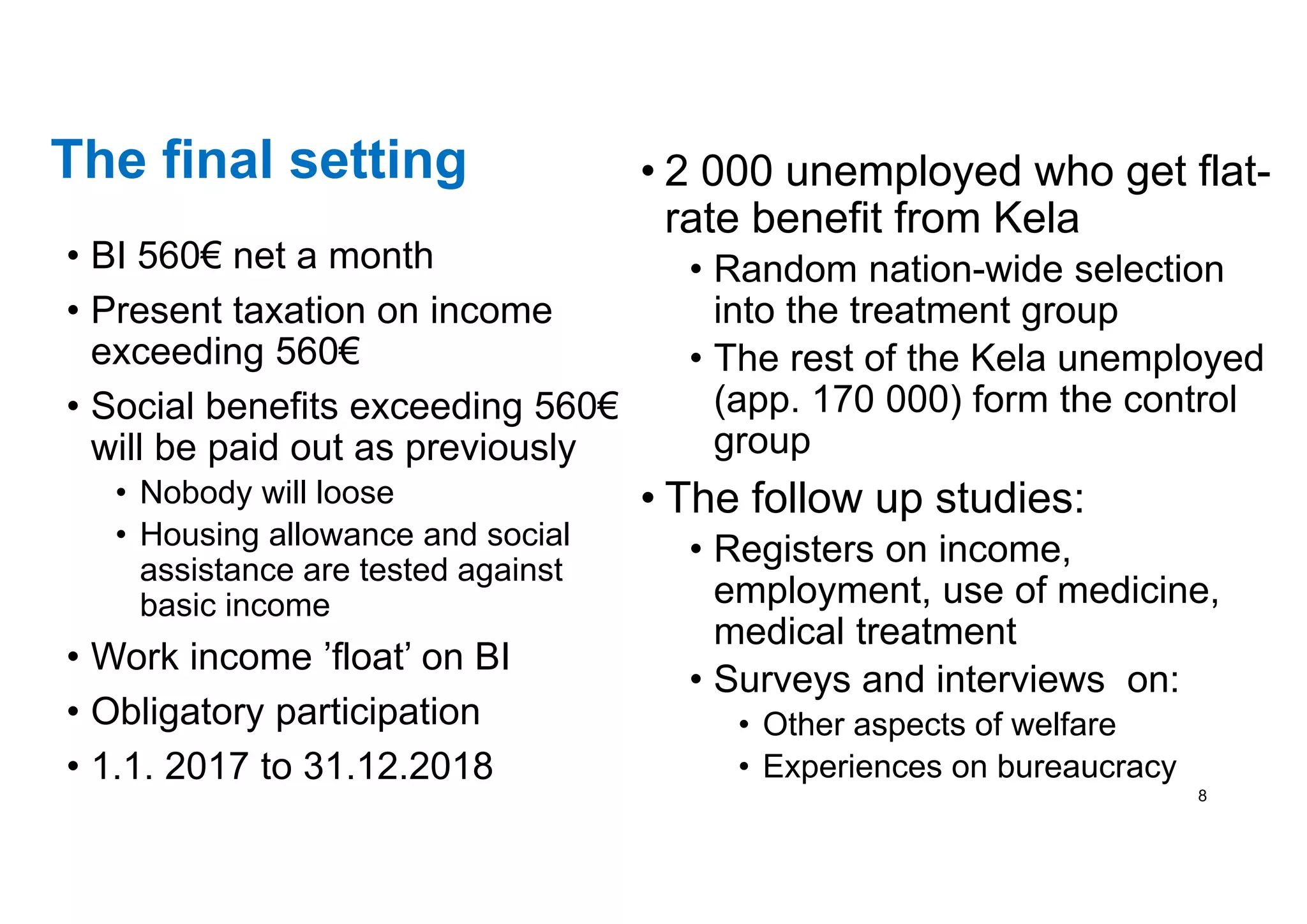
The final setting
• BI 560€ net a month
• Present taxation on income
exceeding 560€
• Social benefits exceeding 560€
will be paid out as previously
• Nobody will loose
• Housing allowance and social
assistance are tested against
basic income
• Work income ’float’ on BI
• Obligatory participation
• 1.1. 2017 to 31.12.2018
• 2 000 unemployed who get flat-
rate benefit from Kela
• Random nation-wide selection
into the treatment group
• The rest of the Kela unemployed
(app. 170 000) form the control
group
• The follow up studies:
• Registers on income,
employment, use of medicine,
medical treatment
• Surveys and interviews on:
• Other aspects of welfare
• Experiences on bureaucracy
8
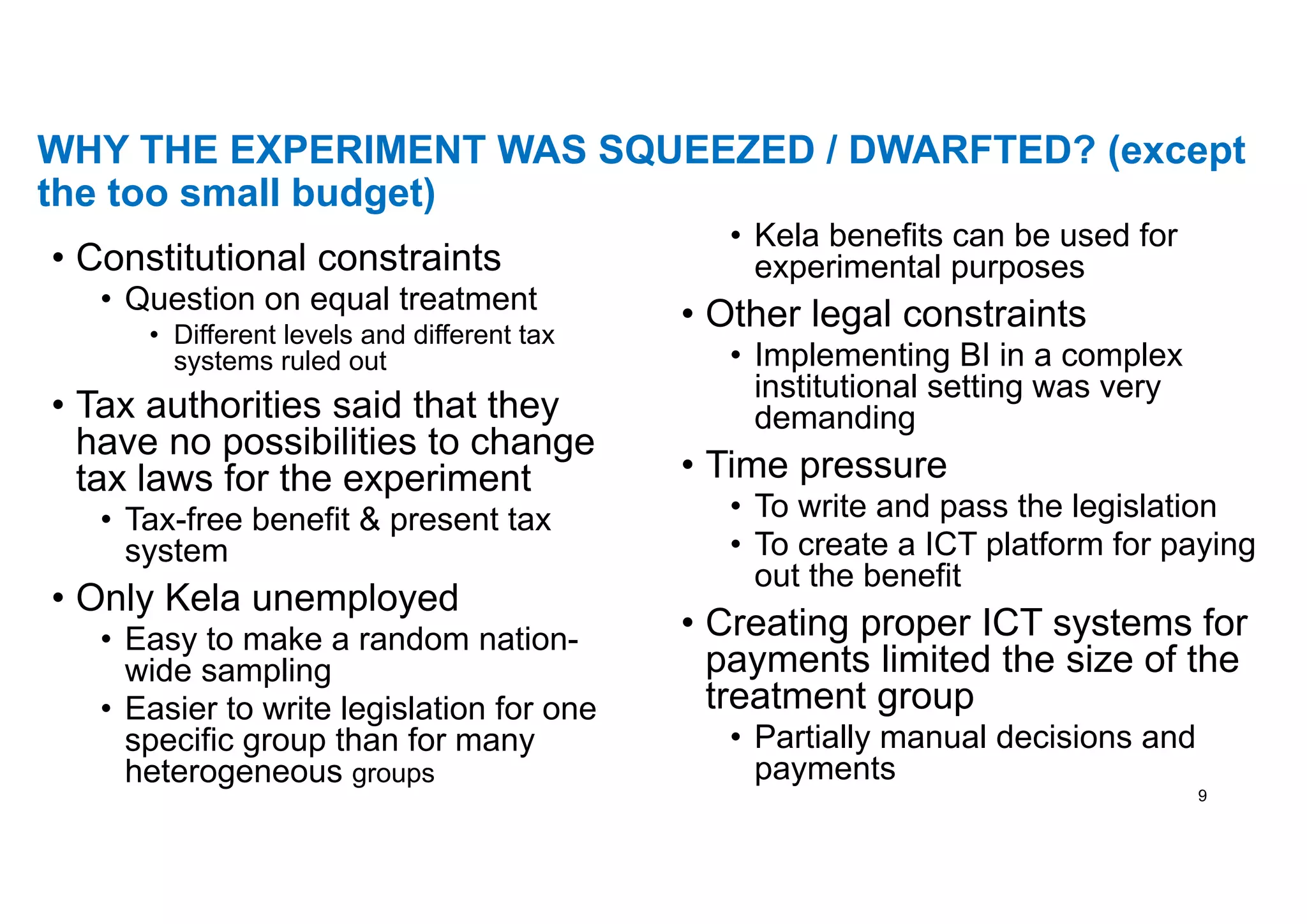
WHY THE EXPERIMENT WAS SQUEEZED / DWARFTED? (except
the too small budget)
• Constitutional constraints
• Question on equal treatment
• Different levels and different tax
systems ruled out
• Tax authorities said that they
have no possibilities to change
tax laws for the experiment
• Tax-free benefit & present tax
system
• Only Kela unemployed
• Easy to make a random nation-
wide sampling
• Easier to write legislation for one
specific group than for many
heterogeneous groups
• Kela benefits can be used for
experimental purposes
• Other legal constraints
• Implementing BI in a complex
institutional setting was very
demanding
• Time pressure
• To write and pass the legislation
• To create a ICT platform for paying
out the benefit
• Creating proper ICT systems for
payments limited the size of the
treatment group
• Partially manual decisions and
payments
9
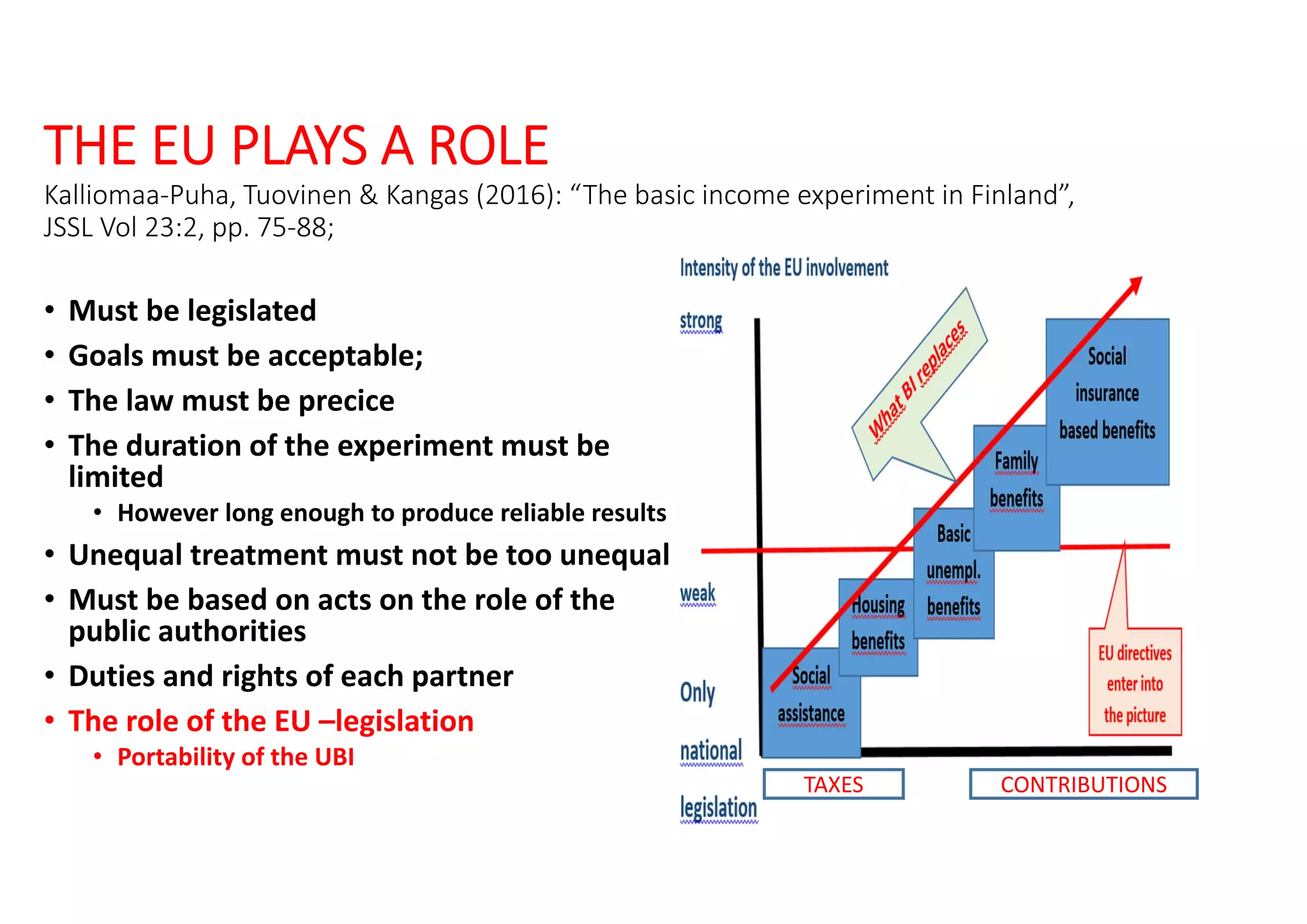
THE EU PLAYS A ROLE
Kalliomaa‐Puha, Tuovinen & Kangas (2016): “The basic income experiment in Finland”, 
JSSL Vol 23:2, pp. 75‐88; 
• Must be legislated
• Goals must be acceptable;
• The law must be precice
• The duration of the experiment must be
limited
• However long enough to produce reliable results
• Unequal treatment must not be too unequal
• Must be based on acts on the role of the
public authorities
• Duties and rights of each partner
• The role of the EU –legislation
• Portability of the UBI
10
TAXES CONTRIBUTIONS
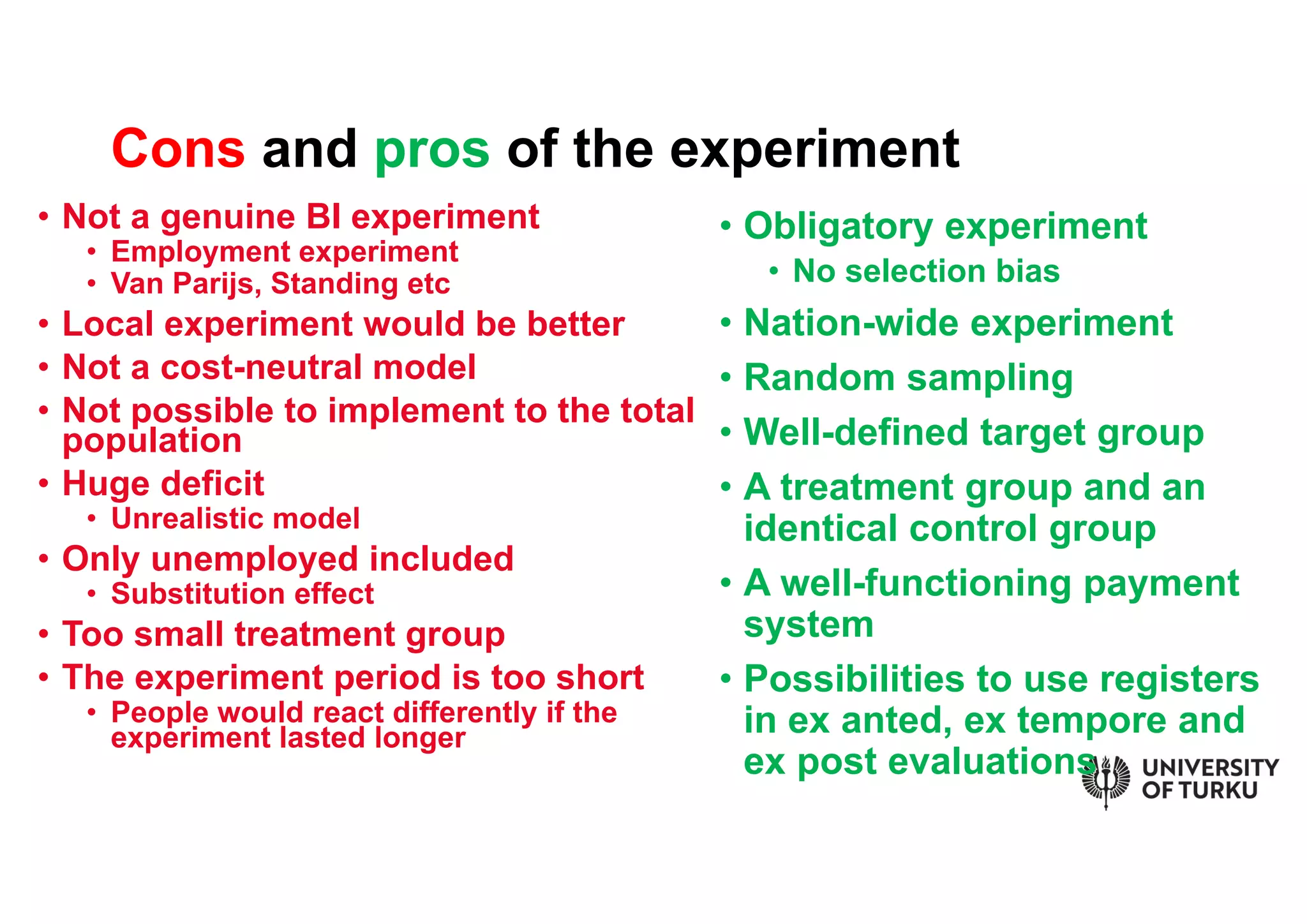
• Not a genuine BI experiment
• Employment experiment
• Van Parijs, Standing etc
• Local experiment would be better
• Not a cost-neutral model
• Not possible to implement to the total
population
• Huge deficit
• Unrealistic model
• Only unemployed included
• Substitution effect
• Too small treatment group
• The experiment period is too short
• People would react differently if the
experiment lasted longer
• Obligatory experiment
• No selection bias
• Nation-wide experiment
• Random sampling
• Well-defined target group
• A treatment group and an
identical control group
• A well-functioning payment
system
• Possibilities to use registers
in ex anted, ex tempore and
ex post evaluations
Cons and pros of the experiment
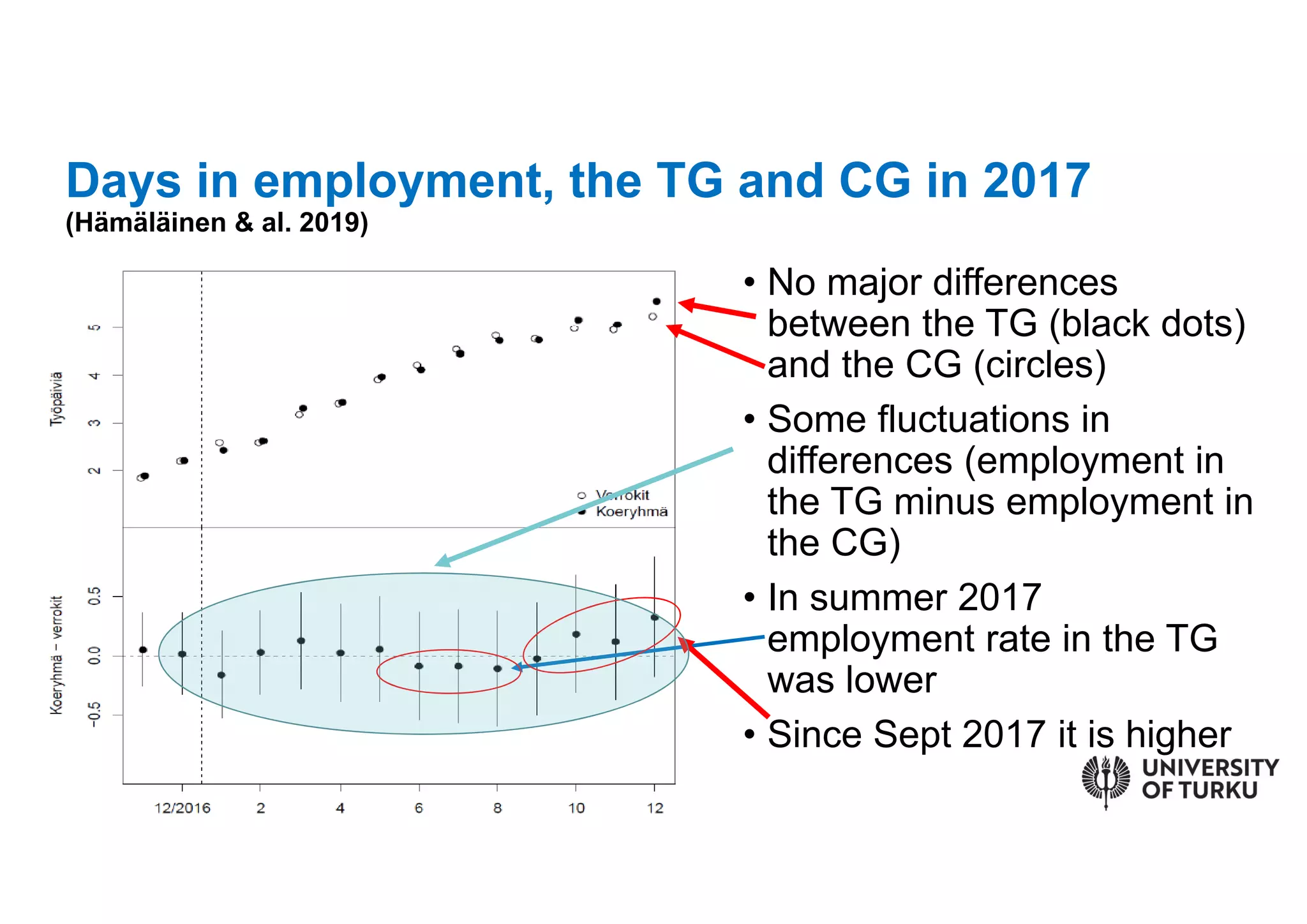
Days in employment, the TG and CG in 2017
(Hämäläinen & al. 2019)
• No major differences
between the TG (black dots)
and the CG (circles)
• Some fluctuations in
differences (employment in
the TG minus employment in
the CG)
• In summer 2017
employment rate in the TG
was lower
• Since Sept 2017 it is higher
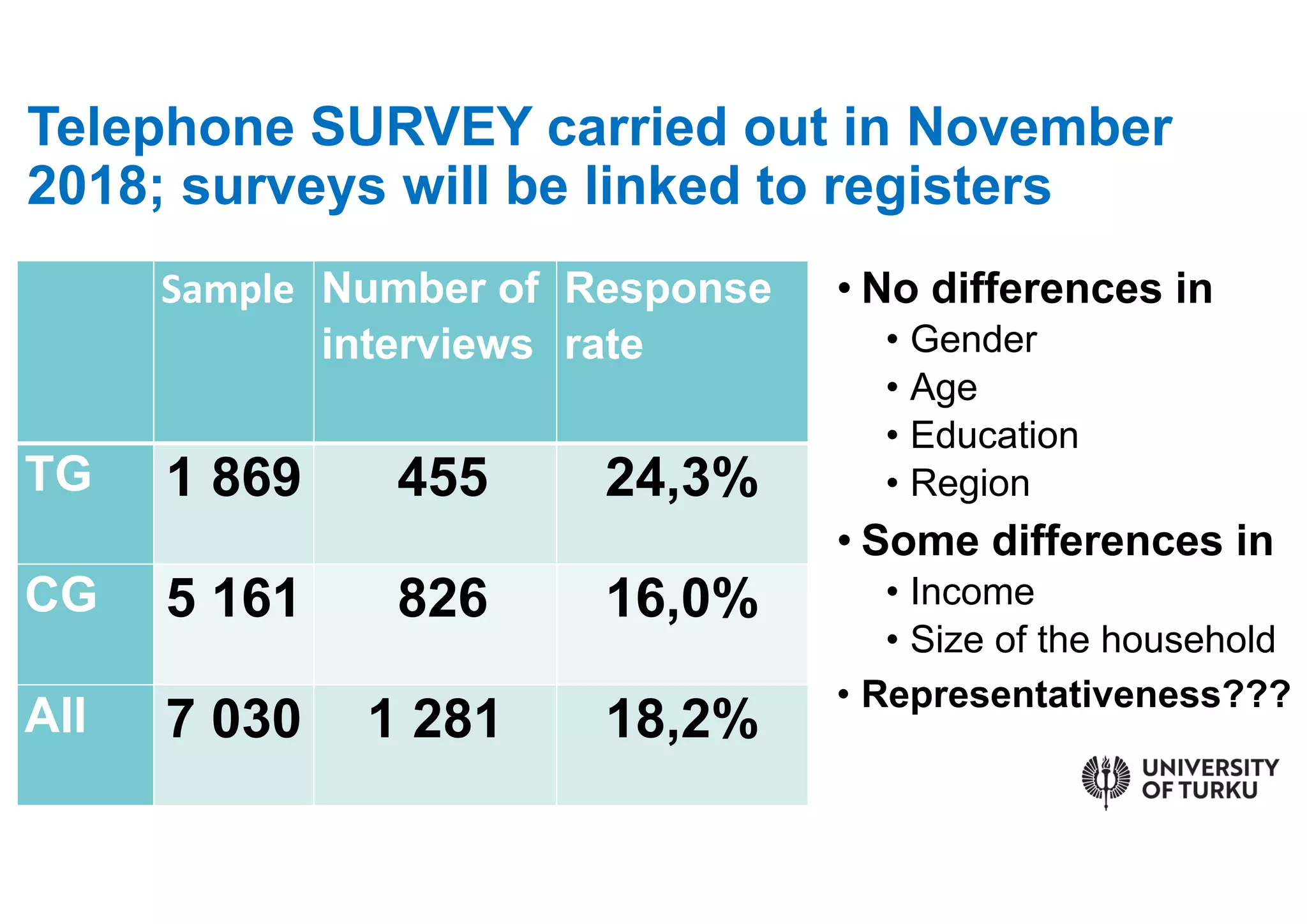
Sample Number of
interviews
Response
rate
TG 1 869 455 24,3%
CG 5 161 826 16,0%
All 7 030 1 281 18,2%
• No differences in
• Gender
• Age
• Education
• Region
• Some differences in
• Income
• Size of the household
• Representativeness???
Telephone SURVEY carried out in November
2018; surveys will be linked to registers
• https://www.youtube.com/watch?v=aYjVQ8BYLDk
Some preliminary evidence from the
Finnish basic income experiment

Olli Kangas: Finnish Basic Income Experiment

  • 1.
    THL, Helsinki 4October 2019 Olli Kangas [email protected] Some reflections on the Basic Income (BI) experiment in Finland INVEST
  • 2.
    The Center-True Finns-Conservativescoalition cabinet (nominated 28. May 2015) took basic income (BI) experiment in its working program by referring to: • Changes in the labor markets • Does our social security system properly correspond to changes in labor markets? • Or are there any changes at all? • ‘No’, say the opponents of BI • ‘Substantial’, say the proponents of BI • Elimination of incentive traps • Too many cases where work does not pay (enough) • Elimination of bureaucratic traps • Clients’ fears on bureaucratic machinery • To create a more transparent system Background
  • 3.
    •There is anumber of income-tested ‘basic’ benefits paid on top of each other •That leads to effective marginal tax rates of 80%-100% (or higher) • labor market subsidy + housing allowance + social assistance and income-related day care fees • Work does not pay (enough) • How the benefit receivers value their free-time? •Could the BI be a solution? To abolish incentive traps
  • 4.
    Steps towards theexperiment… • €20 Mill. for the experiment • Some extra funds for planning the experiment • Open competition on the funds • 15. September 2016 Kela’s consortium was selected to plan the experimental setting and the model(s) • Work began in the mid-October 2015 • The first report delivered 30. March 2016 • The final report delivered the 16 December 2016 • The experiment started 1.1. 2017 and was planned to last 2 years • Political promises on new experiments 2018 / 2019 • Promises did not materialize • In the governmental program of Antti Rinne’s left-centre coalition cabinet there is promise to start an experiment with negative income tax 4
  • 5.
    Models explored anddeveloped • Full basic income (BI) • The level of BI is high enough to replace almost all insurance-based benefits • Must be rather a high monthly sum, e.g.1 000€-1 500€. Realistic? • Partial basic income • Replaces all ’basic’ benefits but almost all insurance-based benefits left intact • Minimum level should not be lower than the present day minimum level of basic benefits (€ 550 - € 600 a month) • Plus income-related benefits and housing & child allowance • Negative income tax • Income transfers via taxation system • Other models • Perhaps low BI plus ’participation’ income 5
  • 6.
    The experimental settingplanned by the expert group (by 30 March 2016) • The entire adult population excl. pensioners) is used as a basis for the sample • age and income selection criteria • low-income earners • 25 and 63 years of old • Weighted sample of particularly interesting groups • Nation level randomization to get representative results for the whole country • local experiments in order to capture networking, institutional and interaction effects and externalities • A number of municipalities with 10%, 30% random sampling. • To increase the sample size: • Kela benefits will be used as a source of extra funding (sample 10,000) 6
  • 7.
    Experimental setting Model BI€ / month Tax rate A0 590 PRESENT A1 590 40% A2 590 45% B1 690 45% B2 690 50% 7
  • 8.
    The final setting •BI 560€ net a month • Present taxation on income exceeding 560€ • Social benefits exceeding 560€ will be paid out as previously • Nobody will loose • Housing allowance and social assistance are tested against basic income • Work income ’float’ on BI • Obligatory participation • 1.1. 2017 to 31.12.2018 • 2 000 unemployed who get flat- rate benefit from Kela • Random nation-wide selection into the treatment group • The rest of the Kela unemployed (app. 170 000) form the control group • The follow up studies: • Registers on income, employment, use of medicine, medical treatment • Surveys and interviews on: • Other aspects of welfare • Experiences on bureaucracy 8
  • 9.
    WHY THE EXPERIMENTWAS SQUEEZED / DWARFTED? (except the too small budget) • Constitutional constraints • Question on equal treatment • Different levels and different tax systems ruled out • Tax authorities said that they have no possibilities to change tax laws for the experiment • Tax-free benefit & present tax system • Only Kela unemployed • Easy to make a random nation- wide sampling • Easier to write legislation for one specific group than for many heterogeneous groups • Kela benefits can be used for experimental purposes • Other legal constraints • Implementing BI in a complex institutional setting was very demanding • Time pressure • To write and pass the legislation • To create a ICT platform for paying out the benefit • Creating proper ICT systems for payments limited the size of the treatment group • Partially manual decisions and payments 9
  • 10.
    THE EU PLAYS A ROLE Kalliomaa‐Puha, Tuovinen & Kangas (2016): “The basic income experiment in Finland”,  JSSL Vol 23:2, pp. 75‐88;  • Must belegislated • Goals must be acceptable; • The law must be precice • The duration of the experiment must be limited • However long enough to produce reliable results • Unequal treatment must not be too unequal • Must be based on acts on the role of the public authorities • Duties and rights of each partner • The role of the EU –legislation • Portability of the UBI 10 TAXES CONTRIBUTIONS
  • 11.
    • Not agenuine BI experiment • Employment experiment • Van Parijs, Standing etc • Local experiment would be better • Not a cost-neutral model • Not possible to implement to the total population • Huge deficit • Unrealistic model • Only unemployed included • Substitution effect • Too small treatment group • The experiment period is too short • People would react differently if the experiment lasted longer • Obligatory experiment • No selection bias • Nation-wide experiment • Random sampling • Well-defined target group • A treatment group and an identical control group • A well-functioning payment system • Possibilities to use registers in ex anted, ex tempore and ex post evaluations Cons and pros of the experiment
  • 12.
    Days in employment,the TG and CG in 2017 (Hämäläinen & al. 2019) • No major differences between the TG (black dots) and the CG (circles) • Some fluctuations in differences (employment in the TG minus employment in the CG) • In summer 2017 employment rate in the TG was lower • Since Sept 2017 it is higher
  • 13.
    Sample Number of interviews Response rate TG1 869 455 24,3% CG 5 161 826 16,0% All 7 030 1 281 18,2% • No differences in • Gender • Age • Education • Region • Some differences in • Income • Size of the household • Representativeness??? Telephone SURVEY carried out in November 2018; surveys will be linked to registers
  • 14.