Spinal Arthrodesis Using
Pedicle Screws in
Osteoporosis
Mohamed Mohi Eldin, MD,
Professor of Neurosurgery,
Faculty of Medicine,
Cairo University,
Egypt.
Pedicle Screw Constructs
• Advantages:
1) Three-column fixation,
2) short-segments instrumentation,
3) Maintain sagittal alignment.
Performance of Pedicle Screw Systems
The key is strength of attachment to spine.
Solid fixation (when screws are placed in dense,
good-quality trabecular bone)
Aging population
• Bone mineral density (BMD) is one of main
factors related to spinal instrumentation
failure.
• In vitro: poor BMD compromises screw
fixation.
For a spine surgeon
It is unavoidable to require
spinal decompression &
stabilization for osteoporosis
or other decreased bone
quality
Secondary osteoporosis
Performance of pedicle screws
In osteoporotic patients
potential complications
screw loosening,
migration, or pullout,
compromising outcome
Screw-bone interface
stripped easily during
screw tapping and
insertion
Pedicle screws use is relatively
contraindicated in osteoporosis
because of:
• High risk of failure (screw pullout)
• Damage caused by such pullouts can
complicate revision surgeries.
How to improve pedicle screw fixation
in osteoporotic bone
1. Augmentation with cement
2. Multiaxial expandable pedicle screw
3. Bicortical sacral screws for the sacrum
4. Bilateral iliac screws for the pelvis
5. Hydroxyapatite Coating of screws
6. Double screws (Only in cadavers)
7. Multiple levels
8. Increase points of fixation
Spinal Arthrodesis Using
Cannulated, Fenestrated, Augmented
Screws
Old Attempts
To enhance pedicle screw fixation
Passive diffusion of cement
into the vertebral body and
pedicle
immediately prior to screw
insertion
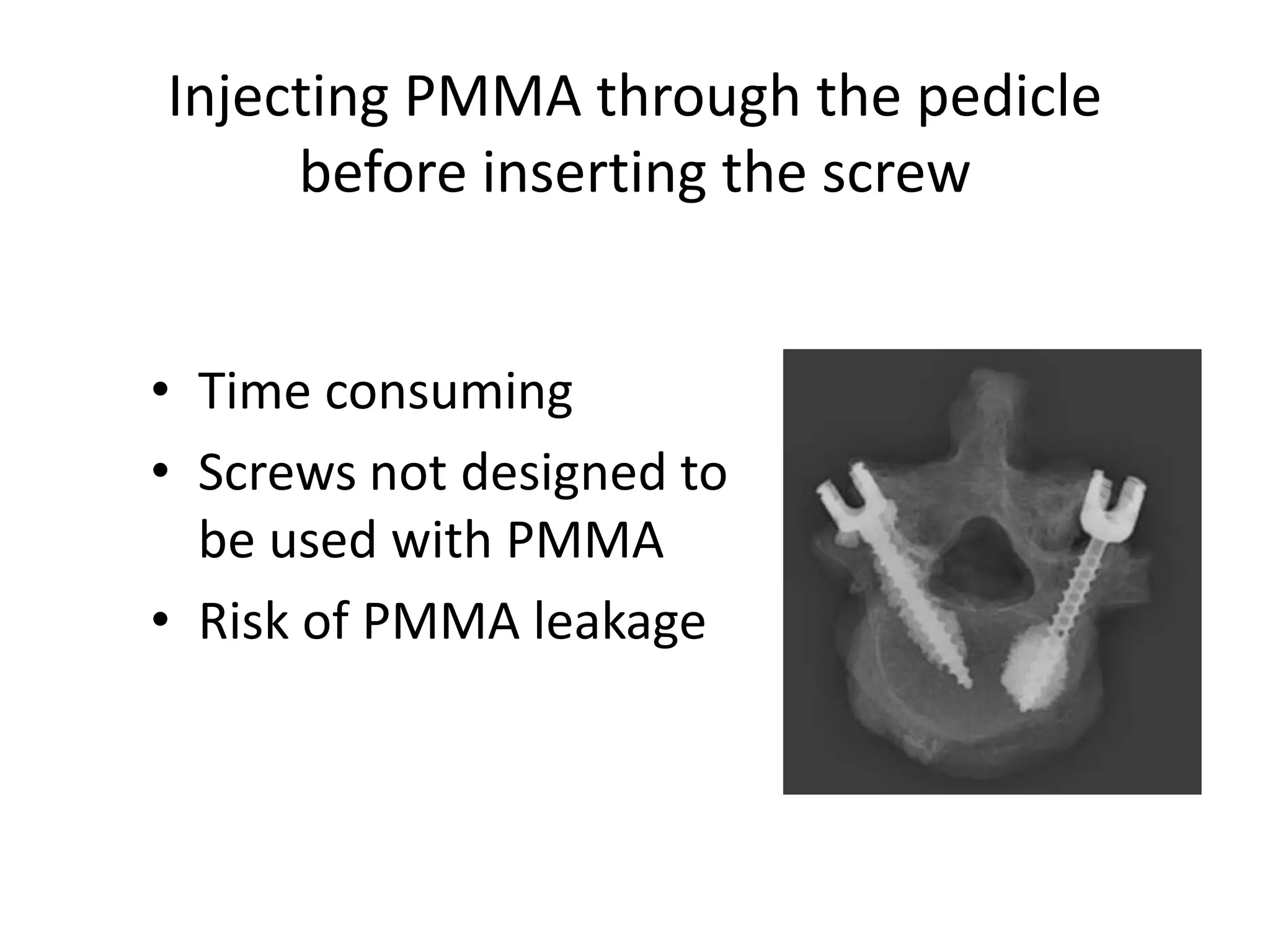
Injecting PMMA through the pedicle
before inserting the screw
• Time consuming
• Screws not designed to
be used with PMMA
• Risk of PMMA leakage
PMMA traditional technique Risks
• Extravasation (fractured
cortex)
• Thermal damage,
• Difficult removal,
• Potential for major
neurologic compromise
• Rare fatal fat embolism
However
• Time could be diminished
• Avoidance of extrusion could be done by
Altering delivery of PMMA
through a fenestrated pedicle screw.
Cannulated Screw with Distal Fenestrations
(a novel-concept)
After screw insertion, cement can be injected
and will distribute evenly around
the thread of the screw
The cement is extruded
through the fenestrations
to fill the spaces inside the
osteoporotic cancellous
bone;
Under fluoroscopic guidance
Depending on the surgical plan
Either
– A pure bilateral percutaneous
pedicle screw arthrodesis
– A combination of unilateral
percutaneous with a
contralateral miniopen
(modified Wiltse).
For the Pure Percutaneous
Fenestrated Screw Placement
The position of holes,
as far as possible from
posterior wall
(to prevent leakage)
After augmentation, change of screw
position is no longer possible
Trial of placement of the
rod should be done
before cement
injection to avoid
positioning issues after
cement injection.
• PMMA bone cement is
delivered through
– the cement cannula within
the screws
– Cement delivery system
connected by connector.
• To prevent cement
leakage, the injection is
done in a higher viscosity
state (started 5 minutes
after mixing).
• Injection must be done
under fluoroscopic
control to immediately
stop the injection in
case of cement
extravasations
– anterior,
– posterior, or
– into an adjacent disc
Test, Try, Inject, Fix & Lock
For combination of unilateral percutaneous
with a contralateral Miniopen Techniques
When a central canal
decompression or
an interbody fusion
(LIF) is planned
Cement Volume
injected into each screw
• Varies from 1.5 to 3mL.
– The ideal amount is 2mL.
– The safer amount
• 1.0 cc for the thoracic spine
• 1.5 cc for the lumbar spine
• Greater volume did not
lead to higher pullout
strength.
An optimal positioning of the
fenestrated pedicle screws
• The length of screw is
important, as far as possible
from the posterior wall.
• Placed in middle of pedicle to
avoid cortical breaches
• An optimal alignment with
pedicle with good convergent
trajectory.
The Location & Dispersion
of Cement
• The fenestrations,
whether partial or
full, led to a more
optimal distribution
of cement inside the
vertebrae
Typical bone cement
distribution in lumbar
spine
Micro-CT showing
the interdigitation of
the bone cement
within the vertebral
body
When compared with standard pedicle
screws without PMMA
Augmented fenestrated
screws showed increased
pullout strength in
osteoporosis
When Compared to
Traditional Technique
• Cement injection
increases pull-out
strength (200%) in both
• The fenestrated cement
technique required
more power until failure
Cross-section
Comparing Clinical Safety
• The fenestrated technique
decrease the risk of nerve
injury significantly
– small numbers of pedicle wall
violations
– no extrusion of cement into
spinal canal
• Medial wall violations in
traditional delivery technique
with PMMA extrusion into
the canal.
Comparing location of cement
• In the fenestrated technique,
the cement confined to
vertebral body with NO
proximal migration (screw as
a plug)
• Even in the presence of
pedicle wall violation during
insertion.
Cement Leakage
in traditional delivery technique
The PMMA is pushed against the walls of the pedicle
during screw insertion, allowing cement to extrude
from any violation into spinal canal.
Operative efficiency of the fenestrated
delivery technique
• In traditional technique,
– Number of pedicle screws is
limited by how fast the cement
hardens vs. how fast a surgeon
can place screws by hand.
• In fenestrated technique,
– all screws are placed prior to
mixing the cement so cement is
injected through pre-placed
screws much easier.
The fenestrated technique appears
to save both time and money
7 Tips to prevent cement
extravasations
1. Optimal positioning of screws
2. Good preoperative CT planning (to
select correct diameter)
3. No injection if:
– Breaches suspected
– Bicortical screw fixation
4. Start injection when high viscosity
obtained
5. Injection under fluoroscopic
control (immediate control)
6. Controlled delivery system
7. Avoid to inject high volume of
cement
Despite this caution
33% of radiological
cement extravasation;
however,
non-symptomatic
Avoid breakage of the cement bridges
between the screw & bone
• Before injecting cement:
– Fixation system locked
– Rods tested in position
• After injecting cement:
– No torsion movement
should be applied to
screws
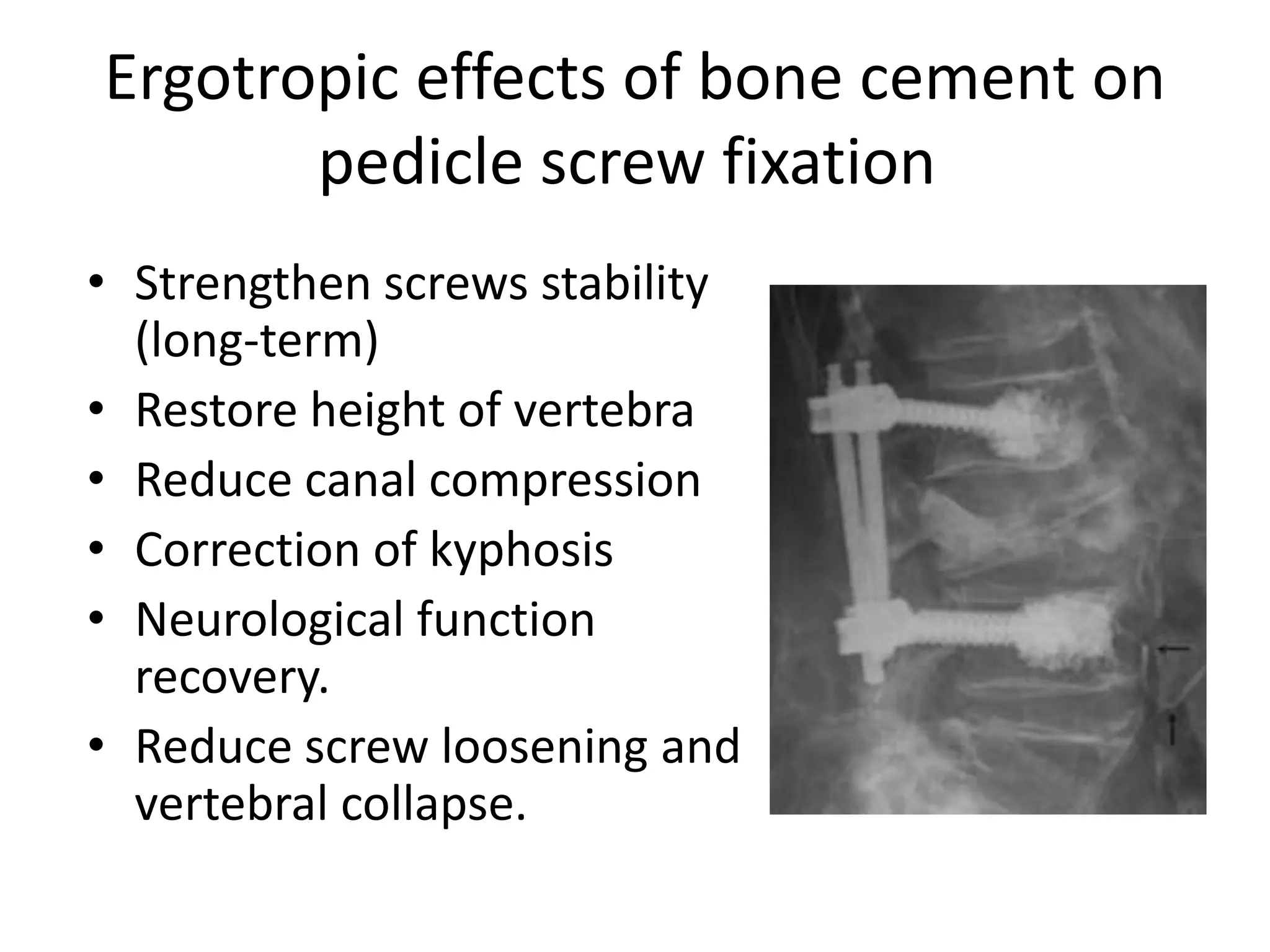
Ergotropic effects of bone cement on
pedicle screw fixation
• Strengthen screws stability
(long-term)
• Restore height of vertebra
• Reduce canal compression
• Correction of kyphosis
• Neurological function
recovery.
• Reduce screw loosening and
vertebral collapse.
Cement augmentation versus
extended instrumentation
Lengthening
instrumentation
results in
higher increase of stability
during fatigue testing
in osteoporotic spine
compared with cement
augmentation.
Failure of
Cement-
Augmented
Pedicle Screws in
the Osteoporotic
Spine
Expansive Pedicle Screws for Severe
Osteoporosis
before and
after expansion
Expansive screw
different preparations
Expansive screws after expansion
(A) 6-slit screw with
16-mm EEL
(B) 6-slit screw with
22-mm EEL.
• Increase in both the number of slits and the
extent of screw expansion had little impact on
the screw-anchoring strength.
• Cement augmentation is the most influential
factor for improving screw pullout strength for
expansive pedicle screws.
The Effects of Screw Design and
Cement Augmentation
Various cemented screws
after pullout tests
Left to right:
• solid,
• 4-slit with 16-mm,
• 4-slit with 22-mm,
• 6-slit with 16-mm,
• 6-slit with 22-mm.
Bicortical purchase
• The cortex is stronger than cancellous bone
in normal and osteoporotic vertebrae,
• Logically stronger than cortical-cancellous
purchase,
• Improve pullout strength from 20% to 50%,
depending on
– patient’s vertebrae,
– screw dimensions,
– screw type
Bicortical screw increases risk of
damage to various anterior structures
usually used only at the S1 level (avoiding
damage to the aorta and vena cava)
Hydroxyapatite Coating of screws
• Improving pedicle screw-bone contact,
• Improving bone ingrowth, and mineralization
• Increasing screw pullout strength
• Require significantly greater insertional torque
than uncoated screws
Double screws
(Only in cadaveric studies)
Because pedicles of osteoporotic vertebrae are
often larger than those of non-osteoporotic
vertebra, it may be possible to implant two
small-diameter pedicle screws into one
pedicle to improve fixation.
Multiple levels and points of fixation
• Cement augmentation of
most rostral pedicle screws
can also help avoid failure
in multilevel constructs
• Extension of the fusion to
the sacrum/ilium can
reduce the potential high
risk for failure of constructs
ending with pedicle screws
at L5.
Case Presentations
Miniopen correction/reduction of 2nd degree
L4,5 Spondylolithesis in osteoporotic with
Interbody cage & Augmentation of Fenestraed
Screws
Isthmic Spondylolisthesis L4 on L5
T10 burst fracture
L1 burst fracture
T12 burst fracture
L1 burst fracture
L2 burst fracture
L1 burst fracture
Pedicle screw fixation in osteoporotic fractures

Pedicle screw fixation in osteoporotic fractures

  • 1.
    Spinal Arthrodesis Using PedicleScrews in Osteoporosis Mohamed Mohi Eldin, MD, Professor of Neurosurgery, Faculty of Medicine, Cairo University, Egypt.
  • 2.
    Pedicle Screw Constructs •Advantages: 1) Three-column fixation, 2) short-segments instrumentation, 3) Maintain sagittal alignment.
  • 3.
    Performance of PedicleScrew Systems The key is strength of attachment to spine. Solid fixation (when screws are placed in dense, good-quality trabecular bone)
  • 4.
    Aging population • Bonemineral density (BMD) is one of main factors related to spinal instrumentation failure. • In vitro: poor BMD compromises screw fixation.
  • 5.
    For a spinesurgeon It is unavoidable to require spinal decompression & stabilization for osteoporosis or other decreased bone quality
  • 6.
  • 7.
    Performance of pediclescrews In osteoporotic patients potential complications screw loosening, migration, or pullout, compromising outcome Screw-bone interface stripped easily during screw tapping and insertion
  • 8.
    Pedicle screws useis relatively contraindicated in osteoporosis because of: • High risk of failure (screw pullout) • Damage caused by such pullouts can complicate revision surgeries.
  • 9.
    How to improvepedicle screw fixation in osteoporotic bone 1. Augmentation with cement 2. Multiaxial expandable pedicle screw 3. Bicortical sacral screws for the sacrum 4. Bilateral iliac screws for the pelvis 5. Hydroxyapatite Coating of screws 6. Double screws (Only in cadavers) 7. Multiple levels 8. Increase points of fixation
  • 10.
    Spinal Arthrodesis Using Cannulated,Fenestrated, Augmented Screws
  • 11.
    Old Attempts To enhancepedicle screw fixation Passive diffusion of cement into the vertebral body and pedicle immediately prior to screw insertion
  • 12.
    Injecting PMMA throughthe pedicle before inserting the screw • Time consuming • Screws not designed to be used with PMMA • Risk of PMMA leakage
  • 13.
    PMMA traditional techniqueRisks • Extravasation (fractured cortex) • Thermal damage, • Difficult removal, • Potential for major neurologic compromise • Rare fatal fat embolism
  • 14.
    However • Time couldbe diminished • Avoidance of extrusion could be done by Altering delivery of PMMA through a fenestrated pedicle screw.
  • 15.
    Cannulated Screw withDistal Fenestrations (a novel-concept) After screw insertion, cement can be injected and will distribute evenly around the thread of the screw
  • 16.
    The cement isextruded through the fenestrations to fill the spaces inside the osteoporotic cancellous bone; Under fluoroscopic guidance
  • 17.
    Depending on thesurgical plan Either – A pure bilateral percutaneous pedicle screw arthrodesis – A combination of unilateral percutaneous with a contralateral miniopen (modified Wiltse).
  • 18.
    For the PurePercutaneous Fenestrated Screw Placement The position of holes, as far as possible from posterior wall (to prevent leakage)
  • 19.
    After augmentation, changeof screw position is no longer possible Trial of placement of the rod should be done before cement injection to avoid positioning issues after cement injection.
  • 20.
    • PMMA bonecement is delivered through – the cement cannula within the screws – Cement delivery system connected by connector. • To prevent cement leakage, the injection is done in a higher viscosity state (started 5 minutes after mixing).
  • 21.
    • Injection mustbe done under fluoroscopic control to immediately stop the injection in case of cement extravasations – anterior, – posterior, or – into an adjacent disc
  • 22.
  • 23.
    For combination ofunilateral percutaneous with a contralateral Miniopen Techniques When a central canal decompression or an interbody fusion (LIF) is planned
  • 24.
    Cement Volume injected intoeach screw • Varies from 1.5 to 3mL. – The ideal amount is 2mL. – The safer amount • 1.0 cc for the thoracic spine • 1.5 cc for the lumbar spine • Greater volume did not lead to higher pullout strength.
  • 25.
    An optimal positioningof the fenestrated pedicle screws • The length of screw is important, as far as possible from the posterior wall. • Placed in middle of pedicle to avoid cortical breaches • An optimal alignment with pedicle with good convergent trajectory.
  • 26.
    The Location &Dispersion of Cement • The fenestrations, whether partial or full, led to a more optimal distribution of cement inside the vertebrae
  • 27.
    Typical bone cement distributionin lumbar spine Micro-CT showing the interdigitation of the bone cement within the vertebral body
  • 28.
    When compared withstandard pedicle screws without PMMA Augmented fenestrated screws showed increased pullout strength in osteoporosis
  • 29.
    When Compared to TraditionalTechnique • Cement injection increases pull-out strength (200%) in both • The fenestrated cement technique required more power until failure Cross-section
  • 30.
    Comparing Clinical Safety •The fenestrated technique decrease the risk of nerve injury significantly – small numbers of pedicle wall violations – no extrusion of cement into spinal canal • Medial wall violations in traditional delivery technique with PMMA extrusion into the canal.
  • 31.
    Comparing location ofcement • In the fenestrated technique, the cement confined to vertebral body with NO proximal migration (screw as a plug) • Even in the presence of pedicle wall violation during insertion.
  • 32.
    Cement Leakage in traditionaldelivery technique The PMMA is pushed against the walls of the pedicle during screw insertion, allowing cement to extrude from any violation into spinal canal.
  • 33.
    Operative efficiency ofthe fenestrated delivery technique • In traditional technique, – Number of pedicle screws is limited by how fast the cement hardens vs. how fast a surgeon can place screws by hand. • In fenestrated technique, – all screws are placed prior to mixing the cement so cement is injected through pre-placed screws much easier.
  • 34.
    The fenestrated techniqueappears to save both time and money
  • 35.
    7 Tips toprevent cement extravasations 1. Optimal positioning of screws 2. Good preoperative CT planning (to select correct diameter) 3. No injection if: – Breaches suspected – Bicortical screw fixation 4. Start injection when high viscosity obtained 5. Injection under fluoroscopic control (immediate control) 6. Controlled delivery system 7. Avoid to inject high volume of cement
  • 36.
    Despite this caution 33%of radiological cement extravasation; however, non-symptomatic
  • 37.
    Avoid breakage ofthe cement bridges between the screw & bone • Before injecting cement: – Fixation system locked – Rods tested in position • After injecting cement: – No torsion movement should be applied to screws
  • 38.
    Ergotropic effects ofbone cement on pedicle screw fixation • Strengthen screws stability (long-term) • Restore height of vertebra • Reduce canal compression • Correction of kyphosis • Neurological function recovery. • Reduce screw loosening and vertebral collapse.
  • 39.
    Cement augmentation versus extendedinstrumentation Lengthening instrumentation results in higher increase of stability during fatigue testing in osteoporotic spine compared with cement augmentation.
  • 40.
  • 41.
    Expansive Pedicle Screwsfor Severe Osteoporosis before and after expansion
  • 42.
  • 43.
    Expansive screws afterexpansion (A) 6-slit screw with 16-mm EEL (B) 6-slit screw with 22-mm EEL.
  • 44.
    • Increase inboth the number of slits and the extent of screw expansion had little impact on the screw-anchoring strength. • Cement augmentation is the most influential factor for improving screw pullout strength for expansive pedicle screws. The Effects of Screw Design and Cement Augmentation
  • 45.
    Various cemented screws afterpullout tests Left to right: • solid, • 4-slit with 16-mm, • 4-slit with 22-mm, • 6-slit with 16-mm, • 6-slit with 22-mm.
  • 46.
    Bicortical purchase • Thecortex is stronger than cancellous bone in normal and osteoporotic vertebrae, • Logically stronger than cortical-cancellous purchase, • Improve pullout strength from 20% to 50%, depending on – patient’s vertebrae, – screw dimensions, – screw type
  • 47.
    Bicortical screw increasesrisk of damage to various anterior structures usually used only at the S1 level (avoiding damage to the aorta and vena cava)
  • 48.
    Hydroxyapatite Coating ofscrews • Improving pedicle screw-bone contact, • Improving bone ingrowth, and mineralization • Increasing screw pullout strength • Require significantly greater insertional torque than uncoated screws
  • 49.
    Double screws (Only incadaveric studies) Because pedicles of osteoporotic vertebrae are often larger than those of non-osteoporotic vertebra, it may be possible to implant two small-diameter pedicle screws into one pedicle to improve fixation.
  • 50.
    Multiple levels andpoints of fixation • Cement augmentation of most rostral pedicle screws can also help avoid failure in multilevel constructs • Extension of the fusion to the sacrum/ilium can reduce the potential high risk for failure of constructs ending with pedicle screws at L5.
  • 51.
    Case Presentations Miniopen correction/reductionof 2nd degree L4,5 Spondylolithesis in osteoporotic with Interbody cage & Augmentation of Fenestraed Screws
  • 52.
  • 53.
  • 54.
  • 55.
  • 56.
  • 57.
  • 58.