Periodontal diseases & cardiovascular system By Dr Sachin Rathod
Periodontal disease is an infectious disease that can affect and be affected by systemic health conditions. Studies have found an association between periodontal disease and coronary heart disease/atherosclerosis. Periodontal pathogens have been found in atherosclerotic plaques, and periodontal disease may increase systemic inflammation and coagulation factors like CRP and fibrinogen that promote atherosclerosis and thrombosis. This systemic inflammation and increased coagulability from chronic periodontal infection could lead to acute events like myocardial infarction.
Periodontal diseases & cardiovascular system By Dr Sachin Rathod
3.
INTRODUCTION
• Periodontal diseaseis an infectious
disease but
environmental, physical, social & host
stresses may affect & modify disease
expression.
• Evidences also show the converse
sides of relationship between systemic
health & oral health i.e., the potential
effect of periodontal disease on a wide
range of organ system.
6.
Periodontal Disease &Coronary
Heart disease/Atherosclerosis
• To further explore the periodontal
disease & CHD/atherosclerosis
association, investigators have studied
specific disorders & medical outcomes to
determine their relationship to
periodontal status.
• In cross sectional studies of patients
with acute myocardial infection
compared with age & gender matched
control patients, MI patients had
significantly worse dental health than
did controls.
8.
• This associationbetween poor dental
health and myocardial infarction was
independent of known risk factors for
heart diseases such as
age, cholesterol
level, hypertension, diabetes &
smoking.
• There may be a greater risk for CHD
related events such as MI when
periodontitis affects a greater number
of teeth in mouth as compared to
subjects having periodontitis of fewer
teeth.
ISCHEMIC HEART DISEASE
•IHD is associated with the process of
atherogenesis and thrombogenesis.
• Increased viscosity of blood may
promote major ischemic heart disease
and cerebrovascular accident by
increasing risk of thrombus formation.
THROMBOGENESIS
• Platelet aggregationplays a major role in
thrombogenesis,& most cases of acute
MI are precipitated by
thromboembolism.
• Oral organisms may be involved in
coronary thrombogenesis.
• Platelet selectively bind some strains of
Streptococci sanguis, a common
component of supragingival plaque &
Porphyromonas gingivalis, a pathogen
closely related with periodontitis.
15.
• Aggregation ofplatelets is induced by
the platelet aggregation associated
protein (PAAP) expressed on some
strains of these bacteria.
• It results in formation of
thromboemboli and resultant cardiac
and pulmonary changes.
16.
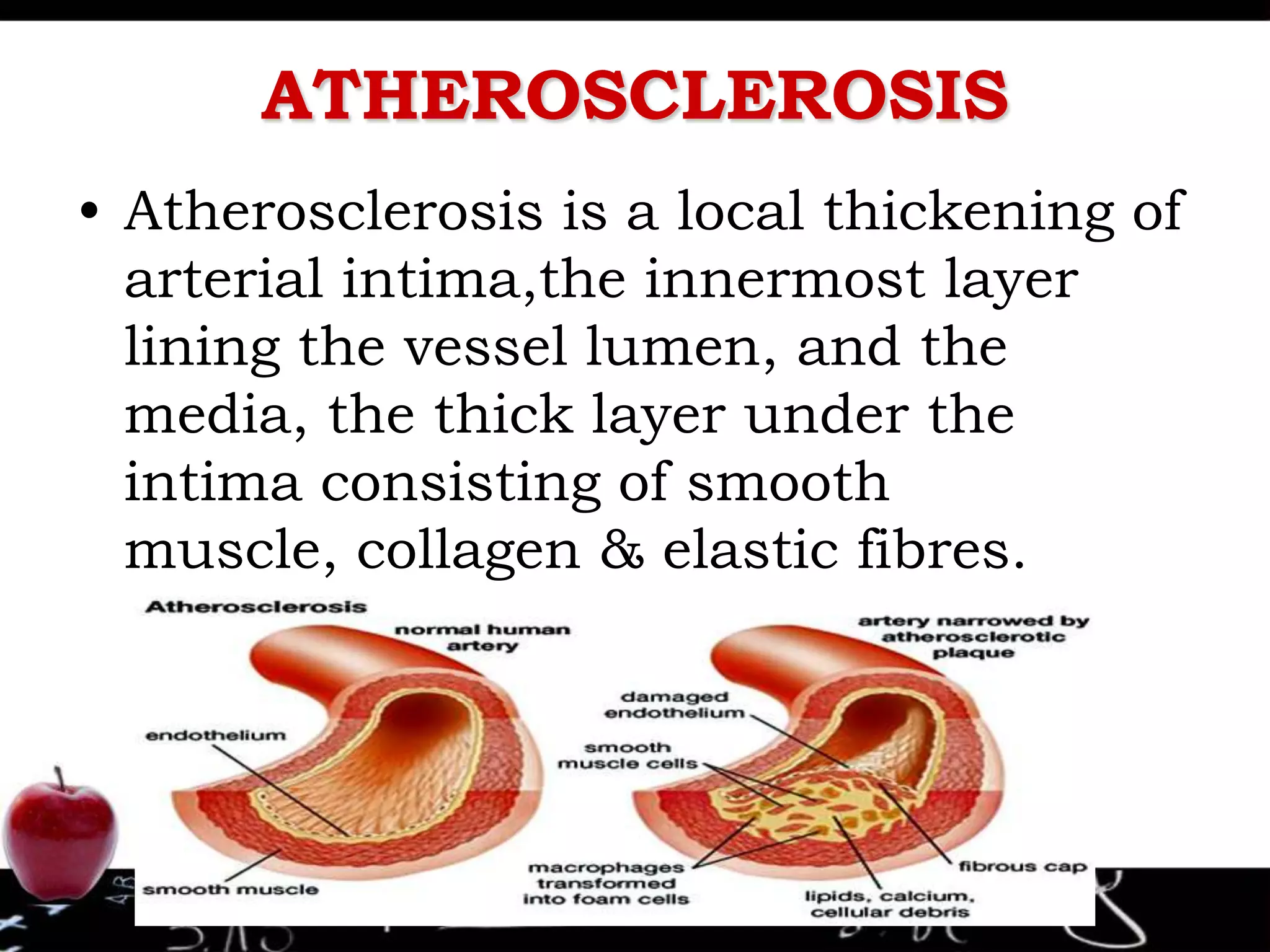
ATHEROSCLEROSIS
• Atherosclerosis isa local thickening of
arterial intima,the innermost layer
lining the vessel lumen, and the
media, the thick layer under the
intima consisting of smooth
muscle, collagen & elastic fibres.
17.
Pathogenesis
• First, circulatingmonocytes adhere to
the vascular endothelium, mediated by
various adhesion molecules including
intercellular adhesion molecule-1(ICAM-
1), endothelial leukocyte adhesion
molecule-1 (ELAM-1) & vascular
adhesion molecule-1(VCAM-1).
• After binding of the monocots, they
penetrate the endothelium & migrate
under the arterial intimae.
• Monocytes nowinjest the circulating
low density lipoprotein (LDL), & form
foam cells which are characterstics of
atheromatous plaques.
• Proinflammatory cytokines, such as
interleukin-1, tumor necrosis factor &
prostaglandin E-2 are
produced, which propogate the
atheromatous lesion.
20.
• Further thereis smooth muscle and
collagen proliferation within the
media, thickening the arterial wall.
Atheromatous plaque formation &
thickening of vessel wall narrow the
lumen & decrease the blood flow.
• Arterial thrombosis occurs after an
atheromatous plaque ruptures.
21.
Role of periodontalinfection in
myocardial infarction
• In several studies of atheromas obtained
during endarterectomy, more than half
of the lesions contained periodontal
pathogens.
• Periodontal diseases result in chronic
system exposure to products of these
bacteria.
• Low level bacterimia may initiate host
responses that alter the
coagulability, endothelial & vessel wall
integrity, platelet function, resultin in
thromboembolic events.
22.
• There iswide variation in host
response to bacterial challenge.
• Patients with exuberant inflammatory
response have a hyper inflammatory
monocyte/ macrophage phenotype.
• Here monocytes secrete increased
levels of proinflammatory mediators in
response to bacterial LPS compared to
normal monocyte phenotype.
23.
• The monocytecell line is intimately
involved in pathogenesis of both
periodontal disease and
atherosclerosis.
• Diet induced increased LDL level may
increase secretion of destructive &
inflammatory cytokines by monocytes.
• The presence of an Mф phenotype
may place patient at risk of both CHD
& periodontitis.
24.
• Also, detectionof systemic inflammatory
markers play an important role in risk
assesment for vascular events such as
MI & cerebral infarction.
• Acute phase protein such as C- reactive
protein (CRP) & fibrinogen are produced
in liver in response to inflammatory or
infectious stimuli & act as inflammatory
markers.
• CRP induces monocytes to stimulate
coagulation pathway & increases blood
coagulability.
25.
• Recent effortshave focused on
periodontitis as a potential trigger
for systemic inflammation.
• Serum CRP & fibrinogen levels are
often elevated in subjects with
periodontitis compared with non
periodontitis subjects & may act
as intermediary steps in the path
way from periodontal infection to
cardiovascular disease.