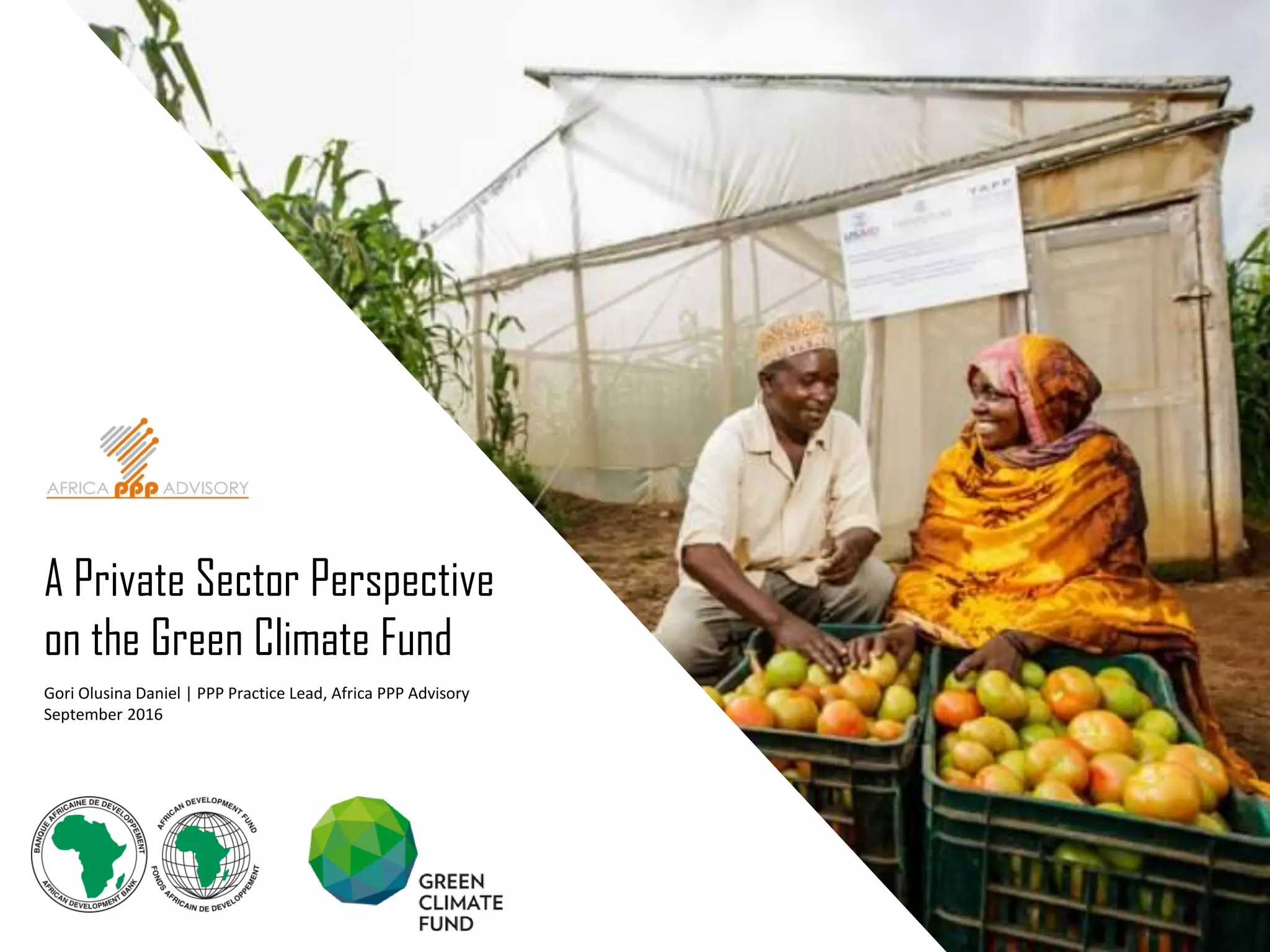
A Private Sector Perspective
on the Green Climate Fund
Gori Olusina Daniel | PPP Practice Lead, Africa PPP Advisory
September 2016
FACILITATOR BIO
2
Gori Olusina Daniel
Infrastructure & Capital Projects
PPP Practice Lead
M:+44 (0) 788 909 8103
T: +44 (0) 1322 27 9292
E: gori.olusinadaniel@apppadvisory.com
Gori is a senior Infrastructure and Capital
Projects Commercial Specialist and Project
Leader with over ten years’ experience of
commercial and financial due diligence, PPP
policy and contract management.
He has worked on large-scale public sector
infrastructure and concession projects, such
as the London Oyster smartcard and
Crossrail, and on a range of Transport and
Energy PPP, and Human Capacity
Development projects in Africa.
He also advises on joint ventures, mergers
and acquisitions, business development and
internationalisation strategies, investment
promotion and facilitation, public financial
management, business planning, strategy,
performance management, delivery and
change management.
“
1
2
3
4
5
OVERVIEW OF THE GREEN CLIMATE FUND
BARRIERS TO CLIMATE PROJECT
INVESTMENT
OPPORTUNITIES FOR LEVERAGING
PRIVATE SECTOR FINANCE
CRITICAL ISSUES FOR CHANNELING
CLIMATE FINANCE THROUGH THE
PRIVATE SECTOR
TOOLS FOR MITIGATING RISK TO
CATALYZE THE PRIVATE SECTOR
CONTENTS
3
“
KEY OBJECTIVES
Introduces the Green Climate Fund, describes
its focus, highlights the mechanism for
accessing it, and distinguishes it from other
climate funds
This presentation:
Provides an overview of the GCF Private Sector
Facility
Considers the critical issues for channeling
climate finance via the private sector
4
“
INTRODUCTION
5
“
INTRODUCTION
6
Source: Wilson Center’s Environmental Change and Security Program 2014
CLIMATE CHANGE HOTSPOTS
7
INTRODUCTION
KEY QUESTIONS
How do we deal
with a problem
whose effects are
not equally suffered
by those who cause
it?
How can the global
community converge
on a common policy
to preserve the
earth for generations
yet unborn?
8
“ BACKGROUND
The GCF is a fund within the
framework of the United
National Framework
Convention on Climate
Change (UNFCC), and was
founded as a financial
mechanism to assist
developing countries in
adaptation and mitigation
practices to counter climate
change
MISSION
The GCF exists to expand
collective human action to
respond to climate change
and aims to mobilise
unprecedented levels of
funding to invest in low-
emission and climate
resilient development on our
home planet
The Green Climate
Fund is an important
response to some of the
most critical questions
facing our generation
and exists to:
 Promote the paradigm
shift towards low-
emission and climate
resilient development
pathways
 Maximise the impact of
its funding for
adaptation and
mitigation
OVERVIEW OF THE GCF
9
OVERVIEW OF THE GCF
The GCF raises funds from state,
regional, and city governments
on an ongoing basis
Current resources in pledges from
43 countries amount to $10.3
billion of which $9.9 billion has
been signed
By 2020 the GCF aims to raise
$100 billion a year globally, from
public and private sources
Only 19 of the 43 countries that
have pledged to the fund have
fully disbursed their signed
pledges
10
OVERVIEW OF THE GCF
Country Pledge in USD (millions) % Disbursed
1 USA 3,000 17%
2 Japan 1,500 25%
3 United Kingdom 1,211 33%
4 France 1,037 13%
5 Germany 1,003 25%
Table 1: Top 5 Contributors to the GCF
11
Source: GCF Resource Mobilization Status Update ( as at September 10, 2016). Available
at http://www.greenclimate.fund/partners/contributors/resource-mobilization
THE PRIVATE SECTOR FACILITY
Public sources for meeting the
considerable levels of
investment required for
adaptation and mitigation
efforts is limited
The GCF Private Sector Facility
has been established to allow
direct and indirect financing by
the GCF for private sector
activities
Climate Change poses a threat,
but also creates commercial
opportunities for the private
sector
The private sector seek channels
that can manage risk and support
capital intensive projects through
which to direct their climate
finance investments
12
PRIVATE SECTOR CLIMATE FINANCE
The potential for private
investment is substantial,
but to unlock these flows, a
range of existing country and
project barriers will need to
be overcome
Prospective investments are
expected to cover the full
costs of the project, including
the cost of capital, and
achieve a return
commensurate with the risks
Private firms make
investment decisions based
on a project’s commercial
viability
13
CRITICAL ISSUES
14
STRUCTURAL
 Network Effects: Many technologies rely on networks to happen
 Fragmentation and Transactional costs: Many low carbon investments are small scale which
makes them difficult to deliver and typically leads to higher transaction costs.
 Agency problem: In energy efficiency, the person paying for the investment is often not the
one reaping the benefit
 Status Quo bias: Like with most changes, there is a bias in society for the status quo
FINANCIAL
 Revenue: Many fossil fuels still subsidized and carbon externality not yet consistently priced
 Higher Initial Capital Requirement: Low carbon technologies require high upfront cost
relative to high carbon technologies. However operating costs are relatively lower
 O&M Costs: O&M costs for solar and wind are low and this is primarily due to zero fuel costs.
However skill levels of local technicians may also be low, making repair and maintenance cost
artificially high.
 Risk: Poor credit rating and unreliable equity betas (volatility of returns) of renewable energy
companies makes financiers rate risk as high. This is naturally exacerbated by new technology
risk which has accounted for the notable failures of firms such as Solyndra.
TECHNICAL CAPABILITY
 Immaturity: Markets are evolving and capacity needs to be built across the value chain including
in the financial community.
 Awareness and education: Lack of awareness of opportunity and understanding of the technical
solutions available as well as their financial benefits.
 Inability to price risk: Inability to calculate an appropriate premium on risk due to limited
historical data; cross industry linkages make risk assessment more challenging
 Technical solutions: Products are inferior or perceived to be inferior on some usage dimensions
(e.g. the case for energy efficient light bulbs)
MITIGATING RISK TO STIMULATE PRIVATE
INVESTMENT
15
5
6
Letters of
credit
Insurance
Products
Loan
Guarantees
Policy
dialogue
and
Technical
Assistance
Credit
Enhancement
with
Concessional
Finance
Power
Purchase
Agreements
2
1
34
REQUIREMENTS FOR CATALYZING THE
PRIVATE SECTOR
16
REGULATION
01
Should emphasize
Renewable Portfolio
Obligations (RPOS) -
mandatory share of
renewables in
electricity mix. Both
at national and sub
national levels.
Power purchase
agreements between
off-takers and
generators regulated
to ensure fair pricing
etc
POLICY
02
Takes the form of a
policy that creates
an incentive to
directly increase
return on
investment, such as
feed-in-tariffs and
policy actions in the
financial sector can
play important
complementary role
to increase
investment at large
scale and required
pa
R&D INITIATIVE
03
Stimulate primary
research and fund
valley of death
technologies to
commercialization
(see examples in US
Sunshot and ARPA-
E, Germany's Sixth
Federal Energy
Research
Programme and
China's 973 Program
CAPITAL INCENTIVES
04
Capital incentives
help reduce
exposure to high
capital investment
(e.g. China's Golden
Sun, US ARRA,
SolarCity Buffalo
project etc)
FUNCTIONAL CARBON
MARKETS
05
Carbon markets with
adequate carbon
pricing mechanism
can provide a
significant revenue
source that can help
improve the returns
for private sector
projects in climate-
related areas.
In mature financial
markets, financing
can, in principle, be
raised against future
carbon revenues.
OPPORTUNITIES FOR LEVERAGING
PRIVATE SECTOR FINANCE
17
YIELDCOS:
Yieldcos aim to exploit the predictable and low-risk nature of operational renewable projects to
provide high dividends to investors, often on a quarterly basis, making them attractive to many
investors. By establishing yieldcos, the original project developers and utilities can re-invest the
proceeds to renewable project development activities.
GREEN BONDS:
Green bonds are themed bonds focused exclusively on low carbon investments. It offers an
attractive way to access institutional investor capital as the risk and returns of the bonds are
typically determined by the issuer’s full balance sheet, not just green assets.
CONCESSIONAL FINANCE:
There is an increasing critical role for concessional finance to absorb the gap in risk-return
expectation of the market for climate investment. Taking a small but adverse risk return position
in the financing of a program or a project than the private sector, enables the project to move
forward. Such structures hold the promise to unlock large private flows to low carbon investment
in developing countries for relatively small amounts of public funds
CONCLUSION
18
 Despite being one of the lowest carbon emitters; studies by the United Nations
Environmental Programme (UNEP) suggest that damage from Climate Change, relative
to population and GDP, will be higher in Africa than in any region.
 The GCF was established in 2010 to reduce greenhouse gas emissions in developing
countries, and help vulnerable societies adapt to the impacts of Climate Change.
 The GCF includes a Private Sector Facility, which serves to ensure that private sector
interests are aligned with national climate policies.
 The private sector currently contributes the bulk of the investment in Green Climate
finance (World Bank, 2014); but the potential to unlock more of the investment
required to effect a paradigm shift from fossil fuels to more sustainable sources of
energy requires a range of policy and market incentives to level the playing field by
correctly pricing fossil fuel energy, and addressing the significant barriers that plague
investment in renewable energy and energy efficient projects.
 As an Accredited Entity of the GCF, the AfDB can and should play a key role in
influencing the policy of Regional Member Countries, and proactively address the
barriers to private sector investments through the provision of concessionary
financing, insurance products, loan guarantees, and other credit enhancement
instruments that improve the commercial viability of Renewable Energy and Energy
Efficierncy projects across the continent.
NOTES
19
Africa PPP Advisory is a trading style of Adams & Moore’s Africa Practice and a subsidiary of AME Trade
Ltd - organisers of the Africa PPP Conference and Showcase. For general enquiries or to see how we can
assist you, please contact:
E: enquiries@apppadvisory.com T: +44 (0) 1322 27 9292 F: +44 (0)1322 27 83 83 W: www.africappp.com

Private Sector Perspective on the Green Climate Fund_AfDB 210916

  • 1.
    A Private SectorPerspective on the Green Climate Fund Gori Olusina Daniel | PPP Practice Lead, Africa PPP Advisory September 2016
  • 2.
    FACILITATOR BIO 2 Gori OlusinaDaniel Infrastructure & Capital Projects PPP Practice Lead M:+44 (0) 788 909 8103 T: +44 (0) 1322 27 9292 E: [email protected] Gori is a senior Infrastructure and Capital Projects Commercial Specialist and Project Leader with over ten years’ experience of commercial and financial due diligence, PPP policy and contract management. He has worked on large-scale public sector infrastructure and concession projects, such as the London Oyster smartcard and Crossrail, and on a range of Transport and Energy PPP, and Human Capacity Development projects in Africa. He also advises on joint ventures, mergers and acquisitions, business development and internationalisation strategies, investment promotion and facilitation, public financial management, business planning, strategy, performance management, delivery and change management.
  • 3.
    “ 1 2 3 4 5 OVERVIEW OF THEGREEN CLIMATE FUND BARRIERS TO CLIMATE PROJECT INVESTMENT OPPORTUNITIES FOR LEVERAGING PRIVATE SECTOR FINANCE CRITICAL ISSUES FOR CHANNELING CLIMATE FINANCE THROUGH THE PRIVATE SECTOR TOOLS FOR MITIGATING RISK TO CATALYZE THE PRIVATE SECTOR CONTENTS 3
  • 4.
    “ KEY OBJECTIVES Introduces theGreen Climate Fund, describes its focus, highlights the mechanism for accessing it, and distinguishes it from other climate funds This presentation: Provides an overview of the GCF Private Sector Facility Considers the critical issues for channeling climate finance via the private sector 4
  • 5.
  • 6.
    “ INTRODUCTION 6 Source: Wilson Center’sEnvironmental Change and Security Program 2014 CLIMATE CHANGE HOTSPOTS
  • 7.
  • 8.
    KEY QUESTIONS How dowe deal with a problem whose effects are not equally suffered by those who cause it? How can the global community converge on a common policy to preserve the earth for generations yet unborn? 8
  • 9.
    “ BACKGROUND The GCFis a fund within the framework of the United National Framework Convention on Climate Change (UNFCC), and was founded as a financial mechanism to assist developing countries in adaptation and mitigation practices to counter climate change MISSION The GCF exists to expand collective human action to respond to climate change and aims to mobilise unprecedented levels of funding to invest in low- emission and climate resilient development on our home planet The Green Climate Fund is an important response to some of the most critical questions facing our generation and exists to:  Promote the paradigm shift towards low- emission and climate resilient development pathways  Maximise the impact of its funding for adaptation and mitigation OVERVIEW OF THE GCF 9
  • 10.
    OVERVIEW OF THEGCF The GCF raises funds from state, regional, and city governments on an ongoing basis Current resources in pledges from 43 countries amount to $10.3 billion of which $9.9 billion has been signed By 2020 the GCF aims to raise $100 billion a year globally, from public and private sources Only 19 of the 43 countries that have pledged to the fund have fully disbursed their signed pledges 10
  • 11.
    OVERVIEW OF THEGCF Country Pledge in USD (millions) % Disbursed 1 USA 3,000 17% 2 Japan 1,500 25% 3 United Kingdom 1,211 33% 4 France 1,037 13% 5 Germany 1,003 25% Table 1: Top 5 Contributors to the GCF 11 Source: GCF Resource Mobilization Status Update ( as at September 10, 2016). Available at http://www.greenclimate.fund/partners/contributors/resource-mobilization
  • 12.
    THE PRIVATE SECTORFACILITY Public sources for meeting the considerable levels of investment required for adaptation and mitigation efforts is limited The GCF Private Sector Facility has been established to allow direct and indirect financing by the GCF for private sector activities Climate Change poses a threat, but also creates commercial opportunities for the private sector The private sector seek channels that can manage risk and support capital intensive projects through which to direct their climate finance investments 12
  • 13.
    PRIVATE SECTOR CLIMATEFINANCE The potential for private investment is substantial, but to unlock these flows, a range of existing country and project barriers will need to be overcome Prospective investments are expected to cover the full costs of the project, including the cost of capital, and achieve a return commensurate with the risks Private firms make investment decisions based on a project’s commercial viability 13
  • 14.
    CRITICAL ISSUES 14 STRUCTURAL  NetworkEffects: Many technologies rely on networks to happen  Fragmentation and Transactional costs: Many low carbon investments are small scale which makes them difficult to deliver and typically leads to higher transaction costs.  Agency problem: In energy efficiency, the person paying for the investment is often not the one reaping the benefit  Status Quo bias: Like with most changes, there is a bias in society for the status quo FINANCIAL  Revenue: Many fossil fuels still subsidized and carbon externality not yet consistently priced  Higher Initial Capital Requirement: Low carbon technologies require high upfront cost relative to high carbon technologies. However operating costs are relatively lower  O&M Costs: O&M costs for solar and wind are low and this is primarily due to zero fuel costs. However skill levels of local technicians may also be low, making repair and maintenance cost artificially high.  Risk: Poor credit rating and unreliable equity betas (volatility of returns) of renewable energy companies makes financiers rate risk as high. This is naturally exacerbated by new technology risk which has accounted for the notable failures of firms such as Solyndra. TECHNICAL CAPABILITY  Immaturity: Markets are evolving and capacity needs to be built across the value chain including in the financial community.  Awareness and education: Lack of awareness of opportunity and understanding of the technical solutions available as well as their financial benefits.  Inability to price risk: Inability to calculate an appropriate premium on risk due to limited historical data; cross industry linkages make risk assessment more challenging  Technical solutions: Products are inferior or perceived to be inferior on some usage dimensions (e.g. the case for energy efficient light bulbs)
  • 15.
    MITIGATING RISK TOSTIMULATE PRIVATE INVESTMENT 15 5 6 Letters of credit Insurance Products Loan Guarantees Policy dialogue and Technical Assistance Credit Enhancement with Concessional Finance Power Purchase Agreements 2 1 34
  • 16.
    REQUIREMENTS FOR CATALYZINGTHE PRIVATE SECTOR 16 REGULATION 01 Should emphasize Renewable Portfolio Obligations (RPOS) - mandatory share of renewables in electricity mix. Both at national and sub national levels. Power purchase agreements between off-takers and generators regulated to ensure fair pricing etc POLICY 02 Takes the form of a policy that creates an incentive to directly increase return on investment, such as feed-in-tariffs and policy actions in the financial sector can play important complementary role to increase investment at large scale and required pa R&D INITIATIVE 03 Stimulate primary research and fund valley of death technologies to commercialization (see examples in US Sunshot and ARPA- E, Germany's Sixth Federal Energy Research Programme and China's 973 Program CAPITAL INCENTIVES 04 Capital incentives help reduce exposure to high capital investment (e.g. China's Golden Sun, US ARRA, SolarCity Buffalo project etc) FUNCTIONAL CARBON MARKETS 05 Carbon markets with adequate carbon pricing mechanism can provide a significant revenue source that can help improve the returns for private sector projects in climate- related areas. In mature financial markets, financing can, in principle, be raised against future carbon revenues.
  • 17.
    OPPORTUNITIES FOR LEVERAGING PRIVATESECTOR FINANCE 17 YIELDCOS: Yieldcos aim to exploit the predictable and low-risk nature of operational renewable projects to provide high dividends to investors, often on a quarterly basis, making them attractive to many investors. By establishing yieldcos, the original project developers and utilities can re-invest the proceeds to renewable project development activities. GREEN BONDS: Green bonds are themed bonds focused exclusively on low carbon investments. It offers an attractive way to access institutional investor capital as the risk and returns of the bonds are typically determined by the issuer’s full balance sheet, not just green assets. CONCESSIONAL FINANCE: There is an increasing critical role for concessional finance to absorb the gap in risk-return expectation of the market for climate investment. Taking a small but adverse risk return position in the financing of a program or a project than the private sector, enables the project to move forward. Such structures hold the promise to unlock large private flows to low carbon investment in developing countries for relatively small amounts of public funds
  • 18.
    CONCLUSION 18  Despite beingone of the lowest carbon emitters; studies by the United Nations Environmental Programme (UNEP) suggest that damage from Climate Change, relative to population and GDP, will be higher in Africa than in any region.  The GCF was established in 2010 to reduce greenhouse gas emissions in developing countries, and help vulnerable societies adapt to the impacts of Climate Change.  The GCF includes a Private Sector Facility, which serves to ensure that private sector interests are aligned with national climate policies.  The private sector currently contributes the bulk of the investment in Green Climate finance (World Bank, 2014); but the potential to unlock more of the investment required to effect a paradigm shift from fossil fuels to more sustainable sources of energy requires a range of policy and market incentives to level the playing field by correctly pricing fossil fuel energy, and addressing the significant barriers that plague investment in renewable energy and energy efficient projects.  As an Accredited Entity of the GCF, the AfDB can and should play a key role in influencing the policy of Regional Member Countries, and proactively address the barriers to private sector investments through the provision of concessionary financing, insurance products, loan guarantees, and other credit enhancement instruments that improve the commercial viability of Renewable Energy and Energy Efficierncy projects across the continent.
  • 19.
  • 20.
    Africa PPP Advisoryis a trading style of Adams & Moore’s Africa Practice and a subsidiary of AME Trade Ltd - organisers of the Africa PPP Conference and Showcase. For general enquiries or to see how we can assist you, please contact: E: [email protected] T: +44 (0) 1322 27 9292 F: +44 (0)1322 27 83 83 W: www.africappp.com