PSYCHOLOGICAL TEST
TRANSLATION /
ADAPTATIONS
Translate the following:
Conceptualization
Example
What is the central issue in
translations/adaptations?
 Producing instruments that measure target
 constructs adequately in target cultures
A Note on Terminology
 Translation
     Conventional term, still often used
 Adaptation
     Has become generic term for modern translation
      practices
     Based on increased sensitivity for non-linguistic factors
      in translations, such as cultural norms of address,
      relevance of thorough knowledge of target culture
Main Applications of
Translations/Adaptations
 Comparative       Studies
    Comparison of construct or mean scores
     across cultures
    High demands on comparability of scores
      Maximizing   comparability
 Monocultural      studies in target culture
    Main issue is ensuring validity in new context
    Few demands on comparability scores
      Maximizing   local suitability
Translations in Historical Perspective
    Stage   1:
       Close translations were standard practice
       Techniques were developed (e.g., translation back
        translation)
    Important    societal developments:
       Globalization and migration (multi-ethnic societies)
    Stage   2:
       Increasing appreciation that close translations have
        problems, e.g., Grade 12 = Form 6 = ……?
       Need for adaptations, localizations
       Need for standardization of adaptation procedures
What is a Good Translation/
Adaptation?
 Dependent       on perspective
  Linguistic
           perspective
  Psychological perspective
 Mapping       problem:
  Translating/adaptingcan be seen as finding an
   optimal mapping of text in two languages
 What   is a good mapping?
 A  good mapping shows equivalence of the
   original and translation
Example
 What   is the American equivalent of the
  Dutch item “Hoe heet de koningin van
  Nederland?” (Suppose that item is part of
  a test of crystallized intelligence)
 Literal/close translation: What is the name
  of the queen of the Netherlands?”
    Problem: Item more difficult for American
     children than for Dutch children
 Adaptation: “What is the name of the
 president of the USA?”
    Problem: Queen and president are not equally
     known in their respective countries
What Does “Equivalent” Mean?
 Eusebius Hieronymus (St. Jerome, famous
 bible translator from Greek and Hebrew to
 Latin; ±347—419/420):
 2  types of translations: “words” and “meanings”
   (he favored the latter)
 Here   two types of equivalence relevant:
   linguistic
                    mapping/equivalence
   psychological   }
Linguistic Equivalence

(Broader   than similarity of words)
Linguistic equivalence refers to
 similarity of linguistic features of a text.
Examples of relevant linguistic
 features are:
    Lexical similarity
    Grammatical accuracy
    In general: emphasis on formal-textual characteristics (cf.
     automatic translations)
Psychological Equivalence
Psychological     equivalence refers
 to similarity of (psychological)
 meaning and scores
Similarity in a broad sense:
 Textual,      e.g.,
   Connotationof words, implied context of text
   Comprehensibility

 Metrical:
   Score   comparability
Relationship between Two
Perspectives

               Three possible relations between linguistic and
                  psychological features, depending on the
                  overlap:
             a. complete                           c. none
                              b. partial


    psych.     linguistic

        Translatable        Poorly translatable   Essentially
                                                  non-translatable
Translatability
A psychological test/item is
  Well   translatable if linguistic and
   psychological features yield the same
   translation
  Poorly   translatable if linguistic and
   psychological features do not entirely
   converge (e.g., translation of slang:
   meaning is translatable, but conciseness
   is lost)
  Non-translatable if there is a complete
   or nearly complete nonoverlap (e.g.,
   Jabberwocky)
Framework for
  Translations/Adaptations
Need    for a theoretical—
 methodological framework that
 links all stages of a project
Bias and equivalence as key
 concepts
Steps in Designing Cross-Cultural Tests
          (Hambleton & Patsula, 1999)
1. Ensure that construct equivalence exists in the language and cultural groups
   of interest.
2. Decide whether to adapt an existing test or develop a new test.
3. Select well-qualified translators.
4. Translate and adapt the test.
5. Review the adapted version of the test and make necessary revisions.
6. Conduct a small tryout of the adapted version of the test.
7. Carry out a more ambitious field-test.
8. Choose a statistical design for connecting scores on the source and target
   language versions of the test.
9. If cross-cultural comparisons are of interest, ensure equivalence of the
   language versions of the test.
10. Perform validation research, as appropriate.
11. Document the process and prepare a manual for the users of the adapted
    tests.
12. Train users.
13. Monitor experiences with the adapted test, and make appropriate revisions.
Overview of Common Procedures to
 Examine Accuracy of Translations/
 Adaptations

 Procedures   as opportunities to strengthen the
  quality of a translation/adaptation project
 Two taxonomies presented here:
   common: (back) translations vs. committee
    approach
   use of existing/new material
Theoretical and Methodological
Background
 Crucial concept in translations is equivalence:
   Linguistic
     Mapping of linguistic meaning (word meaning,
      sentence meaning)
   Psychological
     Mapping of psychological meaning (serves the
      same psychological function in all languages?)
 A good translation combines these considerations
Options
 Adoption   (Close “literal” translation)
  Advantage:  maintains metric equivalence
  Disadvantage: adequacy (too) readily assumed,
   should be demonstrated
 Adaptation(changing contents of one or
 more items so as to increase cultural
 appropriateness)
  Advantage:   more flexible, more tailored to the
   context
  Disadvantage: fewer statistical techniques
   available to compare scores across cultures
 Assembly   (composing a new instrument)
  Advantage: very flexible
  Disadvantage: almost no comparability
   maintained
A Sample of Possible Procedures
(after Harkness, 2003)

                         • Translation back translation
                         • Committee approach (forward
   Translation stage       translations)
                         • Mixed approaches (e.g., independent
                           forwards)

                         •Think alouds, focus groups
    Pretesting stage
                         •Feedback from mono- and bilinguals
      (qualitative)      •Comprehension and readability checks


  Pretesting or actual
                         • Equivalence and bias analyses (DIF,
     administration        structural equivalence)
     (quantitative)
Strength and Weakness of
    Translations Back Translation
       Main strengths                Main weaknesses

• Well accepted quality         • Capitalizes on linguistic,
  check; standard                 cultural, and item-writing
  procedures well known in        skills of (usually) a single
  scientific community (incl.     person
  researchers, grant            • Can produce stilted
  institutions and journal        language
  boards)                       • Readability and
• No knowledge of target          comprehensibility in
  language required               target language may be
                                  problematic
What is the Best Option?
  One type is not intrinsically better or worse than
   another
  Main question is

     NOT
     What    is globally the best choice?
     BUT
     What  is the best choice in a specific
       case?
Four Important Perspectives
(Harkness & Van de Vijver, in preparation):

   Construct           Cultural          Linguistic      Measurement
  equivalence        equivalence        equivalence      equivalence
 • Similarity of    • Norms about      • Translation    • Retention of
   construct in       interaction        accuracy:        psychometric
   source and         (modes of          Retention of     features
   target culture     address)           denotation       (response
                    • “Cultural fact     and              styles)
                      sheet”             connotation    • Similarity of
                                                          factors
                                                          measured by
                                                          a test and
                                                          comparability
                                                          of scores
Adaptation Perspectives
Construct


 Culture
              Integration   Indicator


Language


Measurement
A  good translation/adaptation
 combines equivalence
 perspectives
What is a good translation/
 adaptation?
 A translation or adaptation is
  good when it combines high
  levels of construct, cultural,
  linguistic, and measurement
  equivalence.
Is There a Best Way to Translate an
Instrument?
  Simple  items often straightforward to
   translate
    Close translations will do well, various kinds
     of equivalence jointly maximized
  More complex items often require choices
   about which equivalence will be maximized:
    Maximizing comparability or cultural
     appropriateness ?
Different
         perspectives on
 equivalence often, but not always
 compatible

 Example: cross-cultural differences in modes
 of address
  Maximizing linguistic equivalence may
   challenge cultural appropriateness (e.g.,
   requests may be too direct)
  Maximizing cultural appropriateness may
   challenge statistical equivalence (e.g.,
   rephrasing may threaten comparability of
   scores)
Taxonomy of Adaptations
   Patel, Abas, Broadhead, Todd, & Reeler (2001)
     In Zimbabwe, multiple somatic complaints such as
      headaches and fatigue are the most common
      presentations of depression. On inquiry, however, most
      patients freely admit to cognitive and emotional
      symptoms. Many somatic symptoms, especially those
      related to the heart and the head, are cultural
      metaphors for fear or grief. Most depressed individuals
      attribute their symptoms to “thinking too much”
      (kufungisisa), to a supernatural cause, and to social
      stressors. Our data confirm the view that although
      depression in developing countries often presents with
      somatic symptoms, most patients do not attribute their
      symptoms to a somatic illness and cannot be said to
      have “pure” somatisation. This means that it is vital to
      understand the culture specific terminology used by
      patients and to assess mood in those with multiple
      somatic complaints.
   Consequence
     Common western measures of depression will under-
      diagnose depression in Shona speakers.
Example Culture-Driven
  Example: ‘Burglar’ (Picture Arrangement; adapted for use
  in low-SES children in Bangalore, India )


                                           


          Problems:
          1. Unclear whether the burglar was getting in
             or getting out;
          2. Man not recognized as burglar;
          3. Window was not recognized (vertically
             moving windows are uncommon in India)

  Malda, Van de Vijver, Srinivasan, Transler (2008): Adapting a Western Cognitive Test for a
                                                                                        30

  Non-Western Context: The KABC-II in Bangalore, India
Example of Language-Driven
    Adaptation
   Example: Do you often feel distressed?
   Translation to Dutch:
     “Distressed” does not have an equivalent word in Dutch
     Possible solutions
         Composite of different emotions in Dutch; ask for frequency
          of composite (“how often do you feel X and Y?”). Problem:
          composite may not be recognizable
         Choose a single emotion that is as close as possible; problem:
          change of item content if no close match can be found
         Describe the emotion in the item (e.g., vignette); problem:
          may require a similar description in English original
     Need to check adequacy of chosen solution in statistical
       analysis
     Combination of judgmental and statistical evidence crucial in
       instruments that are more difficult to translate/adapt
Example: ‘Painting’


Problem: mirror was not recognized
Rover
       Test content:
            Additional instructions in subtest Rover
            One additional instruction in subtest Pattern
            Reasoning
            Slight change of subtest composition and item order
            in       subtest Triangles

Sample item Original version 


     Sample item Indian version 


    Problem: original sample item was too difficult; this
    item has been added as actual test item
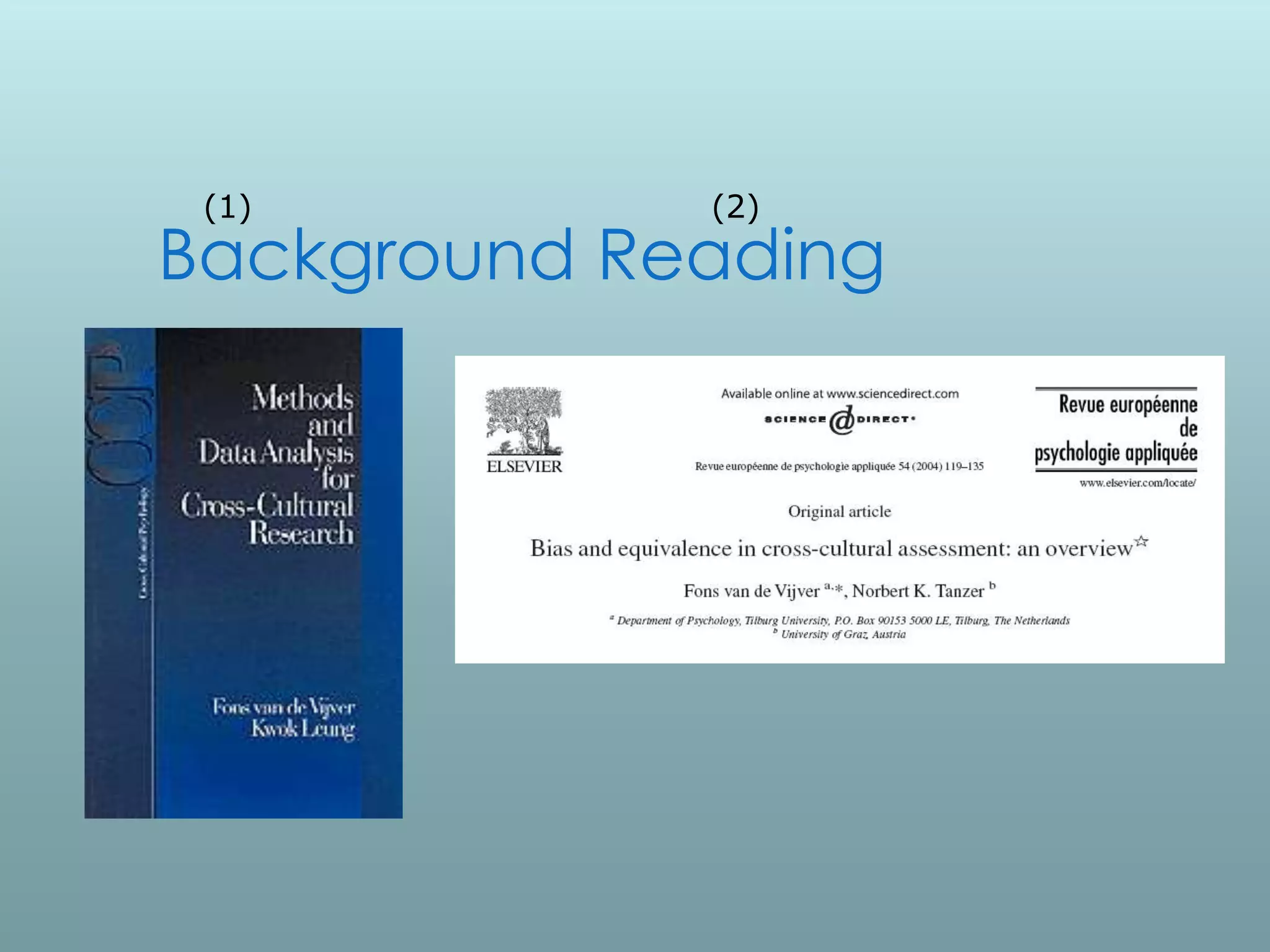
(1)         (2)
Background Reading
What now is the challenge
for psychologists?
Construct  own psychological
 instrument of which is basically
 applicable for our own culture
 instead of adaptations of other
 cultures test.
THE END
  Thank you
for listening !!..

Psychological test adaptation

  • 1.
  • 2.
  • 3.
  • 4.
    What is thecentral issue in translations/adaptations?  Producing instruments that measure target constructs adequately in target cultures
  • 5.
    A Note onTerminology  Translation  Conventional term, still often used  Adaptation  Has become generic term for modern translation practices  Based on increased sensitivity for non-linguistic factors in translations, such as cultural norms of address, relevance of thorough knowledge of target culture
  • 6.
    Main Applications of Translations/Adaptations Comparative Studies  Comparison of construct or mean scores across cultures  High demands on comparability of scores  Maximizing comparability  Monocultural studies in target culture  Main issue is ensuring validity in new context  Few demands on comparability scores  Maximizing local suitability
  • 7.
    Translations in HistoricalPerspective  Stage 1:  Close translations were standard practice  Techniques were developed (e.g., translation back translation)  Important societal developments:  Globalization and migration (multi-ethnic societies)  Stage 2:  Increasing appreciation that close translations have problems, e.g., Grade 12 = Form 6 = ……?  Need for adaptations, localizations  Need for standardization of adaptation procedures
  • 8.
    What is aGood Translation/ Adaptation?  Dependent on perspective  Linguistic perspective  Psychological perspective  Mapping problem:  Translating/adaptingcan be seen as finding an optimal mapping of text in two languages  What is a good mapping? A good mapping shows equivalence of the original and translation
  • 9.
    Example  What is the American equivalent of the Dutch item “Hoe heet de koningin van Nederland?” (Suppose that item is part of a test of crystallized intelligence)  Literal/close translation: What is the name of the queen of the Netherlands?”  Problem: Item more difficult for American children than for Dutch children  Adaptation: “What is the name of the president of the USA?”  Problem: Queen and president are not equally known in their respective countries
  • 10.
    What Does “Equivalent”Mean?  Eusebius Hieronymus (St. Jerome, famous bible translator from Greek and Hebrew to Latin; ±347—419/420): 2 types of translations: “words” and “meanings” (he favored the latter)  Here two types of equivalence relevant: linguistic mapping/equivalence psychological }
  • 11.
    Linguistic Equivalence (Broader than similarity of words) Linguistic equivalence refers to similarity of linguistic features of a text. Examples of relevant linguistic features are:  Lexical similarity  Grammatical accuracy  In general: emphasis on formal-textual characteristics (cf. automatic translations)
  • 12.
    Psychological Equivalence Psychological equivalence refers to similarity of (psychological) meaning and scores Similarity in a broad sense: Textual, e.g.,  Connotationof words, implied context of text  Comprehensibility Metrical:  Score comparability
  • 13.
    Relationship between Two Perspectives Three possible relations between linguistic and psychological features, depending on the overlap: a. complete c. none b. partial psych. linguistic Translatable Poorly translatable Essentially non-translatable
  • 14.
    Translatability A psychological test/itemis Well translatable if linguistic and psychological features yield the same translation Poorly translatable if linguistic and psychological features do not entirely converge (e.g., translation of slang: meaning is translatable, but conciseness is lost) Non-translatable if there is a complete or nearly complete nonoverlap (e.g., Jabberwocky)
  • 15.
    Framework for Translations/Adaptations Need for a theoretical— methodological framework that links all stages of a project Bias and equivalence as key concepts
  • 16.
    Steps in DesigningCross-Cultural Tests (Hambleton & Patsula, 1999) 1. Ensure that construct equivalence exists in the language and cultural groups of interest. 2. Decide whether to adapt an existing test or develop a new test. 3. Select well-qualified translators. 4. Translate and adapt the test. 5. Review the adapted version of the test and make necessary revisions. 6. Conduct a small tryout of the adapted version of the test. 7. Carry out a more ambitious field-test. 8. Choose a statistical design for connecting scores on the source and target language versions of the test. 9. If cross-cultural comparisons are of interest, ensure equivalence of the language versions of the test. 10. Perform validation research, as appropriate. 11. Document the process and prepare a manual for the users of the adapted tests. 12. Train users. 13. Monitor experiences with the adapted test, and make appropriate revisions.
  • 17.
    Overview of CommonProcedures to Examine Accuracy of Translations/ Adaptations  Procedures as opportunities to strengthen the quality of a translation/adaptation project  Two taxonomies presented here:  common: (back) translations vs. committee approach  use of existing/new material
  • 18.
    Theoretical and Methodological Background Crucial concept in translations is equivalence:  Linguistic  Mapping of linguistic meaning (word meaning, sentence meaning)  Psychological  Mapping of psychological meaning (serves the same psychological function in all languages?)  A good translation combines these considerations
  • 19.
    Options  Adoption (Close “literal” translation)  Advantage: maintains metric equivalence  Disadvantage: adequacy (too) readily assumed, should be demonstrated  Adaptation(changing contents of one or more items so as to increase cultural appropriateness)  Advantage: more flexible, more tailored to the context  Disadvantage: fewer statistical techniques available to compare scores across cultures  Assembly (composing a new instrument)  Advantage: very flexible  Disadvantage: almost no comparability maintained
  • 20.
    A Sample ofPossible Procedures (after Harkness, 2003) • Translation back translation • Committee approach (forward Translation stage translations) • Mixed approaches (e.g., independent forwards) •Think alouds, focus groups Pretesting stage •Feedback from mono- and bilinguals (qualitative) •Comprehension and readability checks Pretesting or actual • Equivalence and bias analyses (DIF, administration structural equivalence) (quantitative)
  • 21.
    Strength and Weaknessof Translations Back Translation Main strengths Main weaknesses • Well accepted quality • Capitalizes on linguistic, check; standard cultural, and item-writing procedures well known in skills of (usually) a single scientific community (incl. person researchers, grant • Can produce stilted institutions and journal language boards) • Readability and • No knowledge of target comprehensibility in language required target language may be problematic
  • 22.
    What is theBest Option?  One type is not intrinsically better or worse than another  Main question is NOT What is globally the best choice? BUT What is the best choice in a specific case?
  • 23.
    Four Important Perspectives (Harkness& Van de Vijver, in preparation): Construct Cultural Linguistic Measurement equivalence equivalence equivalence equivalence • Similarity of • Norms about • Translation • Retention of construct in interaction accuracy: psychometric source and (modes of Retention of features target culture address) denotation (response • “Cultural fact and styles) sheet” connotation • Similarity of factors measured by a test and comparability of scores
  • 24.
    Adaptation Perspectives Construct Culture Integration Indicator Language Measurement
  • 25.
    A goodtranslation/adaptation combines equivalence perspectives What is a good translation/ adaptation? A translation or adaptation is good when it combines high levels of construct, cultural, linguistic, and measurement equivalence.
  • 26.
    Is There aBest Way to Translate an Instrument?  Simple items often straightforward to translate  Close translations will do well, various kinds of equivalence jointly maximized  More complex items often require choices about which equivalence will be maximized:  Maximizing comparability or cultural appropriateness ?
  • 27.
    Different perspectives on equivalence often, but not always compatible  Example: cross-cultural differences in modes of address  Maximizing linguistic equivalence may challenge cultural appropriateness (e.g., requests may be too direct)  Maximizing cultural appropriateness may challenge statistical equivalence (e.g., rephrasing may threaten comparability of scores)
  • 28.
  • 29.
    Patel, Abas, Broadhead, Todd, & Reeler (2001)  In Zimbabwe, multiple somatic complaints such as headaches and fatigue are the most common presentations of depression. On inquiry, however, most patients freely admit to cognitive and emotional symptoms. Many somatic symptoms, especially those related to the heart and the head, are cultural metaphors for fear or grief. Most depressed individuals attribute their symptoms to “thinking too much” (kufungisisa), to a supernatural cause, and to social stressors. Our data confirm the view that although depression in developing countries often presents with somatic symptoms, most patients do not attribute their symptoms to a somatic illness and cannot be said to have “pure” somatisation. This means that it is vital to understand the culture specific terminology used by patients and to assess mood in those with multiple somatic complaints.  Consequence  Common western measures of depression will under- diagnose depression in Shona speakers.
  • 30.
    Example Culture-Driven Example: ‘Burglar’ (Picture Arrangement; adapted for use in low-SES children in Bangalore, India )   Problems: 1. Unclear whether the burglar was getting in or getting out; 2. Man not recognized as burglar; 3. Window was not recognized (vertically moving windows are uncommon in India) Malda, Van de Vijver, Srinivasan, Transler (2008): Adapting a Western Cognitive Test for a 30 Non-Western Context: The KABC-II in Bangalore, India
  • 31.
    Example of Language-Driven Adaptation  Example: Do you often feel distressed?  Translation to Dutch:  “Distressed” does not have an equivalent word in Dutch  Possible solutions  Composite of different emotions in Dutch; ask for frequency of composite (“how often do you feel X and Y?”). Problem: composite may not be recognizable  Choose a single emotion that is as close as possible; problem: change of item content if no close match can be found  Describe the emotion in the item (e.g., vignette); problem: may require a similar description in English original  Need to check adequacy of chosen solution in statistical analysis  Combination of judgmental and statistical evidence crucial in instruments that are more difficult to translate/adapt
  • 32.
  • 33.
    Rover  Test content:  Additional instructions in subtest Rover  One additional instruction in subtest Pattern Reasoning  Slight change of subtest composition and item order in subtest Triangles Sample item Original version  Sample item Indian version  Problem: original sample item was too difficult; this item has been added as actual test item
  • 34.
    (1) (2) Background Reading
  • 35.
    What now isthe challenge for psychologists? Construct own psychological instrument of which is basically applicable for our own culture instead of adaptations of other cultures test.
  • 36.
    THE END Thank you for listening !!..