RANDOMIZATION
Presenter: Dr Subhradeep Sonowal, Post Graduate
Trainee 2nd year, Department of Community
Medicine
OUTLINES
1. Background of clinical trial
2. Randomized controlled trial
3. Randomization
4. Advantages of Randomization
5. Types of Randomization
6. Bias in RCT
7. Allocation Concealment
8. Blinding and its types
9. Conclusion
BACKGROUND
 First planned trial on scurvy
by James Lind in 1747.
 James Lind, a Scottish surgeon took 12 sailors suffering from scurvy and
divided them into 6 pairs.
 Each pair received 6 different treatments for scurvy.
 The two patients who were given lemons and oranges recovered most
quickly, suggesting a beneficial effect of citrus.
Dunn PM. James Lind (1716-94) of Edinburgh and the treatment of scurvy. Arch Dis Child Fetal
Neonatal Ed. 1997;76(1):F64-F65. doi:10.1136/fn.76.1.f64
3
 In 1914,conducted trials on
asylum inmates and children in orphanages .
 Proved Pellagra to be nutritional deficiency disease and not
infectious disease.
 172 pellagra patients and 162 non pellagra orphans had been
followed for 2 years.
 There was a single recurrence in an orphan, and no incident
cases.
Evans BK; Feinstein AR (1 September 1994). "Joseph Goldberger: an unsung
hero of American clinical epidemiology". Ann Intern Med. 121 (5): 372–75.
4
RANDOMIZED CONTROL TRIAL
 An epidemiological experiment in which
 subjects in a population are randomly allocated into groups,
usually called study and control groups,
 to receive or not to receive an experimental, preventive or
therapeutic procedure, maneuver, or intervention
(John M Last Dictionary of Epidemiology , 5th Edition)
Bhalwar R. Text Book of Public Health and Community Medicine. Department of Community
Medicine, AFMC,Pune, 2009: 341-42
RANDOMIZATION
Randomization is a statistical procedure by which the
participants are allocated into groups called “study”
and “control” groups, to receive or not to receive an
experimental preventive or therapeutic procedure,
manoeuvre or intervention.
(Park K. Park’s textbook of preventive and social medicine. 25th
ed. Jabalpur: M/S Banarsidas Bhanot; 2019:403-407)
Study
participants
Study Group
Control
Group
Outcome
Outcome
• Group 1
• Group 2
ADVANTAGES OF
RANDOMIZATION
1. Eliminates selection bias.
2. Allows comparability.
3. Balances arms with respect to prognostic variables
TYPES OF RANDOMIZATION
Randomization
Simple Block Stratified Unequal
SIMPLE RANDOMIZATION
 This method is equivalent to tossing a coin for each subject
that enters a trial, such as Heads = Active, Tails = Placebo.
 It is usually carried out using:
- A random-number table
- A computerized random number generator
Allot participants into Group A or Group B by:
• Even no.: Group A
Odd no.: Group B
OR
• 0-4: Group A and 5-9: Group B
LIMITATION
Might have unequal distribution in each group
which might imbalance the randomization
procedure.
To solve this issue block randomization is
done.
BLOCK RANDOMIZATION
 The basic idea of block randomization is
 to divide potential patients into m blocks of size 2n
 randomize each block such that n patients are allocated to A
and n to B.
 then choose the blocks randomly.
 This method ensures equal treatment allocation within each
block if the complete block is used.
ICH Harmonised Tripartite Guideline Statistical Principles for
Clinical Trials, E9
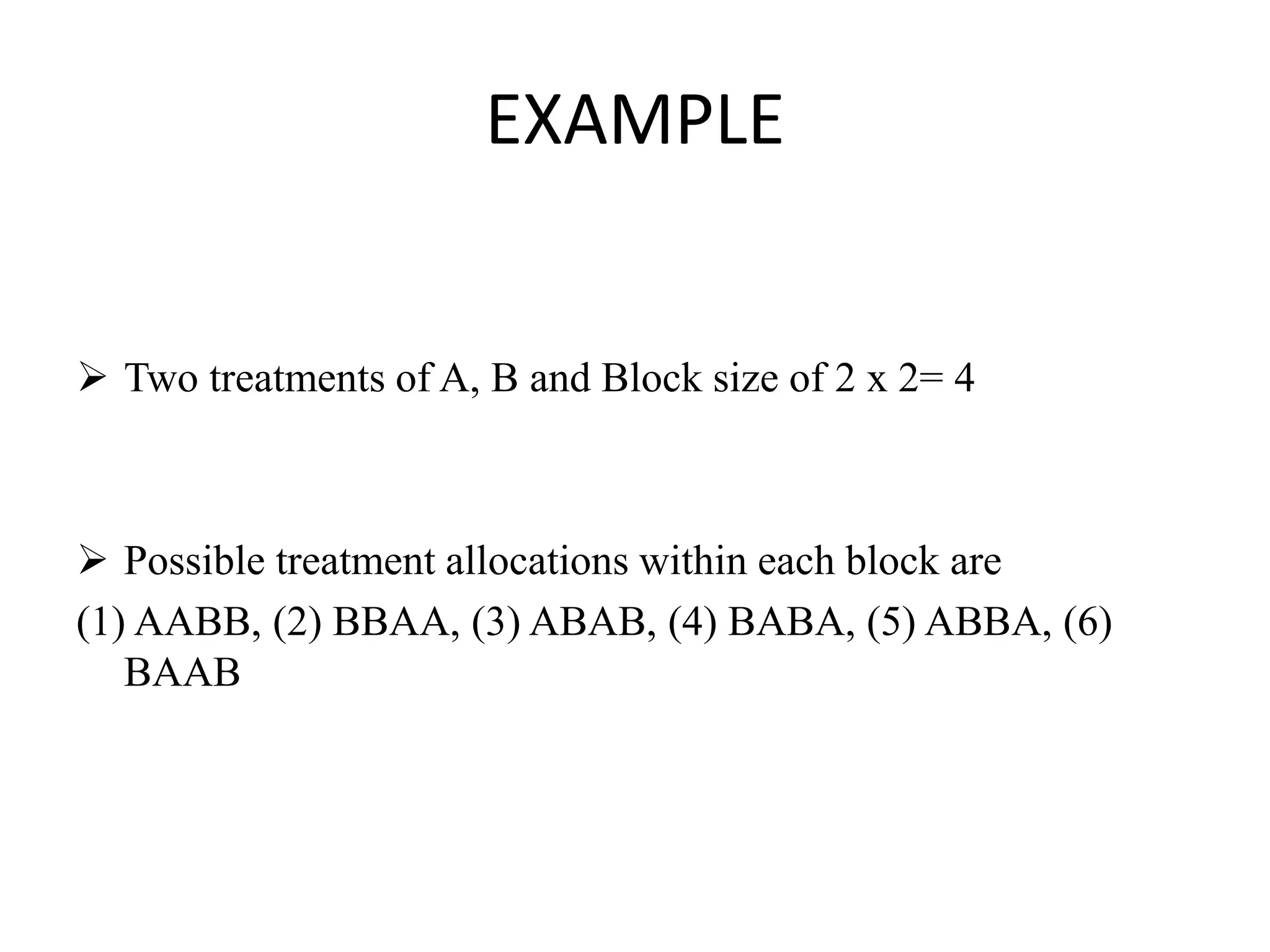
EXAMPLE
 Two treatments of A, B and Block size of 2 x 2= 4
 Possible treatment allocations within each block are
(1) AABB, (2) BBAA, (3) ABAB, (4) BABA, (5) ABBA, (6)
BAAB
LIMITATION
If blocking is not masked in open-label trials, the sequence
becomes somewhat predictable (e.g. 2n= 4):
 B A B ? Must be A.
 AA ? ? Must be B B.
This could lead to selection bias
STRATIFIED RANDOMIZATION
 It is often called Prognostic Stratification
 The randomization process is restricted by grouping the
experimental units into more or less homogenous
strata before the process of random allocation
 Investigator decides which strata are important and how many
stratification variables can be considered
Gordis L. Epidemiology. Fifth edition. Philadelphia, PA: Elsevier
Saunders, 2014.
UNEQUAL RANDOMIZATION
 When two or more treatments under evaluation have a cost
difference it may be more economically efficient to randomize
fewer patients to the expensive treatment and more to the
cheaper one.
 The subject survival time depends on which treatment they
receive.
 More extreme allocation may be used in these trials to allocate
fewer patients into the placebo group. Generally,
randomization ratio of 3:1 will lose considerable statistical
power, more extreme than 3:1 is not very useful, which leads
to much larger sample size.
OTHER METHODS
Covariate-Adaptive Randomization
 Covariate randomization designs aim to balance the
covariates across the treatment groups
 This randomization assigns the next patient to the group
that causes the smallest imbalance across the covariate
groups
Singh, Rajneesh & Saroj, Rakesh & K. H. H. V. S. S., Narasimha & Murthy, & Supervisor,. (2018). A
Conventional Approach of Covariate Adaptive Randomization Method in Clinical Trials-A Review.
MINIMIZATION
 Treatment allocation is only done randomly for the first
unit; after that it depends on the characteristics of those
units already allocated
 Minimizes the imbalance between the number of patients in
each treatment group over a number of factors
 Calculates the imbalance within each factor should the
patient be allocated to a particular treatment group.
Pocock, Stuart J.; Simon, Richard (Mar 1975). "Sequential Treatment Assignment with Balancing for Prognostic
Factors in the Controlled Clinical Trial". Biometrics. International Biometric Society. 31 (1): 103–
115. doi:10.2307/2529712
BIAS IN RCT
 Bias is any systemic error in the determination of
association between exposure and disease
 In RCT, bias may arise from the errors of assessment
of the outcome due to human element
SOURCES OF BIAS IN RCT
Subject
Variation
• Participants report improvement on knowing that
they are receiving a new form of treatment
Observer
Bias
• Investigator get influenced on knowing beforehand
the particular procedure or therapy
Evaluation
Bias
• Investigator may subconsciously give a
favourable report of the outcome of trial
ALLOCATION CONCEALMENT
 Allocation Concealment is a technique used to prevent
selection bias in Randomised Controlled Trials (RCT’s) by
concealing the allocation sequence from those assigning
participants to the intervention groups, until the moment of
assignment.
 Thus it prevents researchers from (unconsciously or otherwise)
influencing which participants are assigned to the intervention
or control group.
IMPORTANT ASPECTS
Adequate generation of the allocation
sequence
Concealment of the allocation sequence until
assignment occurs
BLINDING
Blinding refers to the concealment of group allocation from
one or more individuals involved in a clinical research study,
most commonly a randomized controlled trial (RCT).
Karanicolas PJ, Farrokhyar F, Bhandari M. Practical tips for surgical research:
blinding: who, what, when, why, how?. Can J Surg. 2010;53(5):345-348.
Blinding
Open Single Double Triple
1. Open trial : Participant and Investigator knows who is
getting which intervention.
2. Single blind trial: Participant not aware.
3. Double blind trial : Neither investigator nor participant is
aware.
4. Triple blind trial : Investigator,participant and analyst are
not aware.
ALLOCATION CONCEALMENT
VS
BLINDING
TIME
RANDOMIZATION
CONCEALMENT
OF ALLOCATION
BLINDING
SELECTION BIAS PERFORMANCE BIAS
CONCLUSION
 Randomization is often called the “heart” of a control trial
 Gives the greatest confidence that groups are comparable
 Ensures that the investigator has no control over allocation
ofthe subjects to either group
 Every individual has an equal chance of being allocated into
either group
REFERENCES
1. Park K. Park’s textbook of preventive and social medicine.
25th ed. Jabalpur: M/S Banarsidas Bhanot; 2019:403-407
2. Dunn PM. James Lind (1716-94) of Edinburgh and the
treatment of scurvy. Arch Dis Child Fetal Neonatal Ed.
1997;76(1):F64-F65. doi:10.1136/fn.76.1.f64
3. Evans BK; Feinstein AR (1 September 1994). "Joseph
Goldberger: an unsung hero of American clinical
epidemiology". Ann Intern Med. 121 (5): 372–75.
4. Bhalwar R. Text Book of Public Health and Community
Medicine. Department of Community Medicine,
AFMC,Pune, 2009: 341-42
5. ICH Harmonised Tripartite Guideline Statistical Principles for
Clinical Trials, E9
6. Gordis L. Epidemiology. Fifth edition. Philadelphia, PA:
Elsevier Saunders, 2014.
7. Singh, Rajneesh & Saroj, Rakesh & K. H. H. V. S. S.,
Narasimha & Murthy, & Supervisor,. (2018). A Conventional
Approach of Covariate Adaptive Randomization Method in
Clinical Trials-A Review.
8. Pocock, Stuart J.; Simon, Richard (Mar 1975). "Sequential
Treatment Assignment with Balancing for Prognostic Factors
in the Controlled Clinical Trial". Biometrics. International
Biometric Society. 31 (1): 103–115.
9. Karanicolas PJ, Farrokhyar F, Bhandari M. Practical tips for
surgical research: blinding: who, what, when, why,
how?. Can J Surg. 2010;53(5):345-348.
Randomization

Randomization

  • 1.
    RANDOMIZATION Presenter: Dr SubhradeepSonowal, Post Graduate Trainee 2nd year, Department of Community Medicine
  • 2.
    OUTLINES 1. Background ofclinical trial 2. Randomized controlled trial 3. Randomization 4. Advantages of Randomization 5. Types of Randomization 6. Bias in RCT 7. Allocation Concealment 8. Blinding and its types 9. Conclusion
  • 3.
    BACKGROUND  First plannedtrial on scurvy by James Lind in 1747.  James Lind, a Scottish surgeon took 12 sailors suffering from scurvy and divided them into 6 pairs.  Each pair received 6 different treatments for scurvy.  The two patients who were given lemons and oranges recovered most quickly, suggesting a beneficial effect of citrus. Dunn PM. James Lind (1716-94) of Edinburgh and the treatment of scurvy. Arch Dis Child Fetal Neonatal Ed. 1997;76(1):F64-F65. doi:10.1136/fn.76.1.f64 3
  • 4.
     In 1914,conductedtrials on asylum inmates and children in orphanages .  Proved Pellagra to be nutritional deficiency disease and not infectious disease.  172 pellagra patients and 162 non pellagra orphans had been followed for 2 years.  There was a single recurrence in an orphan, and no incident cases. Evans BK; Feinstein AR (1 September 1994). "Joseph Goldberger: an unsung hero of American clinical epidemiology". Ann Intern Med. 121 (5): 372–75. 4
  • 5.
    RANDOMIZED CONTROL TRIAL An epidemiological experiment in which  subjects in a population are randomly allocated into groups, usually called study and control groups,  to receive or not to receive an experimental, preventive or therapeutic procedure, maneuver, or intervention (John M Last Dictionary of Epidemiology , 5th Edition)
  • 6.
    Bhalwar R. TextBook of Public Health and Community Medicine. Department of Community Medicine, AFMC,Pune, 2009: 341-42
  • 7.
    RANDOMIZATION Randomization is astatistical procedure by which the participants are allocated into groups called “study” and “control” groups, to receive or not to receive an experimental preventive or therapeutic procedure, manoeuvre or intervention. (Park K. Park’s textbook of preventive and social medicine. 25th ed. Jabalpur: M/S Banarsidas Bhanot; 2019:403-407)
  • 8.
  • 9.
    ADVANTAGES OF RANDOMIZATION 1. Eliminatesselection bias. 2. Allows comparability. 3. Balances arms with respect to prognostic variables
  • 10.
  • 11.
    SIMPLE RANDOMIZATION  Thismethod is equivalent to tossing a coin for each subject that enters a trial, such as Heads = Active, Tails = Placebo.  It is usually carried out using: - A random-number table - A computerized random number generator
  • 12.
    Allot participants intoGroup A or Group B by: • Even no.: Group A Odd no.: Group B OR • 0-4: Group A and 5-9: Group B
  • 13.
    LIMITATION Might have unequaldistribution in each group which might imbalance the randomization procedure. To solve this issue block randomization is done.
  • 14.
    BLOCK RANDOMIZATION  Thebasic idea of block randomization is  to divide potential patients into m blocks of size 2n  randomize each block such that n patients are allocated to A and n to B.  then choose the blocks randomly.  This method ensures equal treatment allocation within each block if the complete block is used. ICH Harmonised Tripartite Guideline Statistical Principles for Clinical Trials, E9
  • 15.
    EXAMPLE  Two treatmentsof A, B and Block size of 2 x 2= 4  Possible treatment allocations within each block are (1) AABB, (2) BBAA, (3) ABAB, (4) BABA, (5) ABBA, (6) BAAB
  • 16.
    LIMITATION If blocking isnot masked in open-label trials, the sequence becomes somewhat predictable (e.g. 2n= 4):  B A B ? Must be A.  AA ? ? Must be B B. This could lead to selection bias
  • 17.
    STRATIFIED RANDOMIZATION  Itis often called Prognostic Stratification  The randomization process is restricted by grouping the experimental units into more or less homogenous strata before the process of random allocation  Investigator decides which strata are important and how many stratification variables can be considered
  • 18.
    Gordis L. Epidemiology.Fifth edition. Philadelphia, PA: Elsevier Saunders, 2014.
  • 19.
    UNEQUAL RANDOMIZATION  Whentwo or more treatments under evaluation have a cost difference it may be more economically efficient to randomize fewer patients to the expensive treatment and more to the cheaper one.  The subject survival time depends on which treatment they receive.  More extreme allocation may be used in these trials to allocate fewer patients into the placebo group. Generally, randomization ratio of 3:1 will lose considerable statistical power, more extreme than 3:1 is not very useful, which leads to much larger sample size.
  • 20.
    OTHER METHODS Covariate-Adaptive Randomization Covariate randomization designs aim to balance the covariates across the treatment groups  This randomization assigns the next patient to the group that causes the smallest imbalance across the covariate groups Singh, Rajneesh & Saroj, Rakesh & K. H. H. V. S. S., Narasimha & Murthy, & Supervisor,. (2018). A Conventional Approach of Covariate Adaptive Randomization Method in Clinical Trials-A Review.
  • 21.
    MINIMIZATION  Treatment allocationis only done randomly for the first unit; after that it depends on the characteristics of those units already allocated  Minimizes the imbalance between the number of patients in each treatment group over a number of factors  Calculates the imbalance within each factor should the patient be allocated to a particular treatment group. Pocock, Stuart J.; Simon, Richard (Mar 1975). "Sequential Treatment Assignment with Balancing for Prognostic Factors in the Controlled Clinical Trial". Biometrics. International Biometric Society. 31 (1): 103– 115. doi:10.2307/2529712
  • 22.
    BIAS IN RCT Bias is any systemic error in the determination of association between exposure and disease  In RCT, bias may arise from the errors of assessment of the outcome due to human element
  • 23.
    SOURCES OF BIASIN RCT Subject Variation • Participants report improvement on knowing that they are receiving a new form of treatment Observer Bias • Investigator get influenced on knowing beforehand the particular procedure or therapy Evaluation Bias • Investigator may subconsciously give a favourable report of the outcome of trial
  • 24.
    ALLOCATION CONCEALMENT  AllocationConcealment is a technique used to prevent selection bias in Randomised Controlled Trials (RCT’s) by concealing the allocation sequence from those assigning participants to the intervention groups, until the moment of assignment.  Thus it prevents researchers from (unconsciously or otherwise) influencing which participants are assigned to the intervention or control group.
  • 25.
    IMPORTANT ASPECTS Adequate generationof the allocation sequence Concealment of the allocation sequence until assignment occurs
  • 26.
    BLINDING Blinding refers tothe concealment of group allocation from one or more individuals involved in a clinical research study, most commonly a randomized controlled trial (RCT). Karanicolas PJ, Farrokhyar F, Bhandari M. Practical tips for surgical research: blinding: who, what, when, why, how?. Can J Surg. 2010;53(5):345-348.
  • 27.
  • 28.
    1. Open trial: Participant and Investigator knows who is getting which intervention. 2. Single blind trial: Participant not aware. 3. Double blind trial : Neither investigator nor participant is aware. 4. Triple blind trial : Investigator,participant and analyst are not aware.
  • 29.
  • 30.
    CONCLUSION  Randomization isoften called the “heart” of a control trial  Gives the greatest confidence that groups are comparable  Ensures that the investigator has no control over allocation ofthe subjects to either group  Every individual has an equal chance of being allocated into either group
  • 31.
    REFERENCES 1. Park K.Park’s textbook of preventive and social medicine. 25th ed. Jabalpur: M/S Banarsidas Bhanot; 2019:403-407 2. Dunn PM. James Lind (1716-94) of Edinburgh and the treatment of scurvy. Arch Dis Child Fetal Neonatal Ed. 1997;76(1):F64-F65. doi:10.1136/fn.76.1.f64 3. Evans BK; Feinstein AR (1 September 1994). "Joseph Goldberger: an unsung hero of American clinical epidemiology". Ann Intern Med. 121 (5): 372–75. 4. Bhalwar R. Text Book of Public Health and Community Medicine. Department of Community Medicine, AFMC,Pune, 2009: 341-42
  • 32.
    5. ICH HarmonisedTripartite Guideline Statistical Principles for Clinical Trials, E9 6. Gordis L. Epidemiology. Fifth edition. Philadelphia, PA: Elsevier Saunders, 2014. 7. Singh, Rajneesh & Saroj, Rakesh & K. H. H. V. S. S., Narasimha & Murthy, & Supervisor,. (2018). A Conventional Approach of Covariate Adaptive Randomization Method in Clinical Trials-A Review.
  • 33.
    8. Pocock, StuartJ.; Simon, Richard (Mar 1975). "Sequential Treatment Assignment with Balancing for Prognostic Factors in the Controlled Clinical Trial". Biometrics. International Biometric Society. 31 (1): 103–115. 9. Karanicolas PJ, Farrokhyar F, Bhandari M. Practical tips for surgical research: blinding: who, what, when, why, how?. Can J Surg. 2010;53(5):345-348.