Vasantrao Naik Marathwada Krishi
Vidyapith , Parbhani.
Trichogramma : a living insecticide?
Presented by
SHIVANI SHANKAR CHUNKE
REG.NO: 2015A / 64ML
Submitted to
Seminar in charge
Dr. V.K. BHAMARE
Assistant Professor, Dept. of
Entomology College of Agriculture,
Latur
Trichogramma wasp
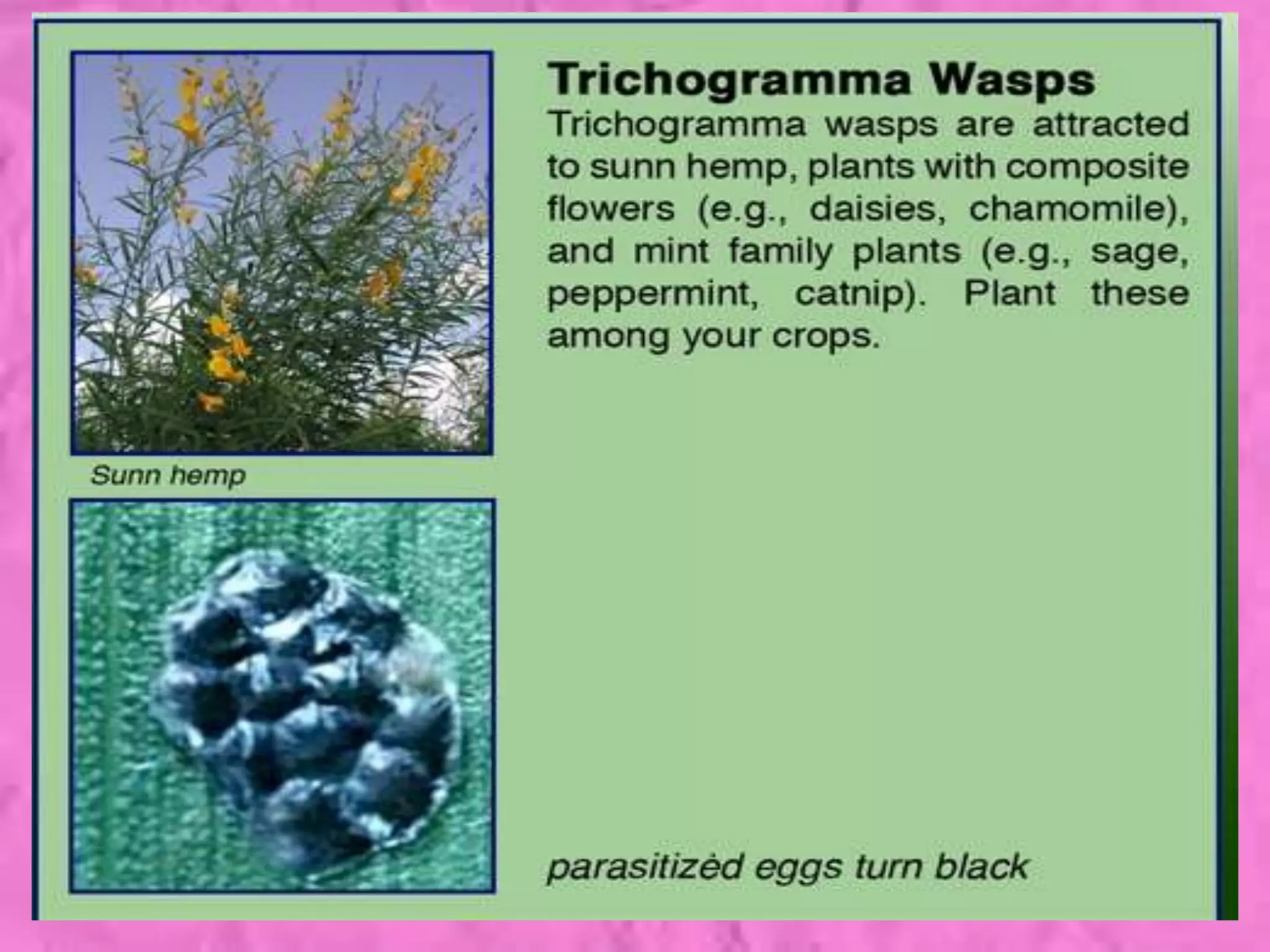
 Tiny wasp,size >1 mm.
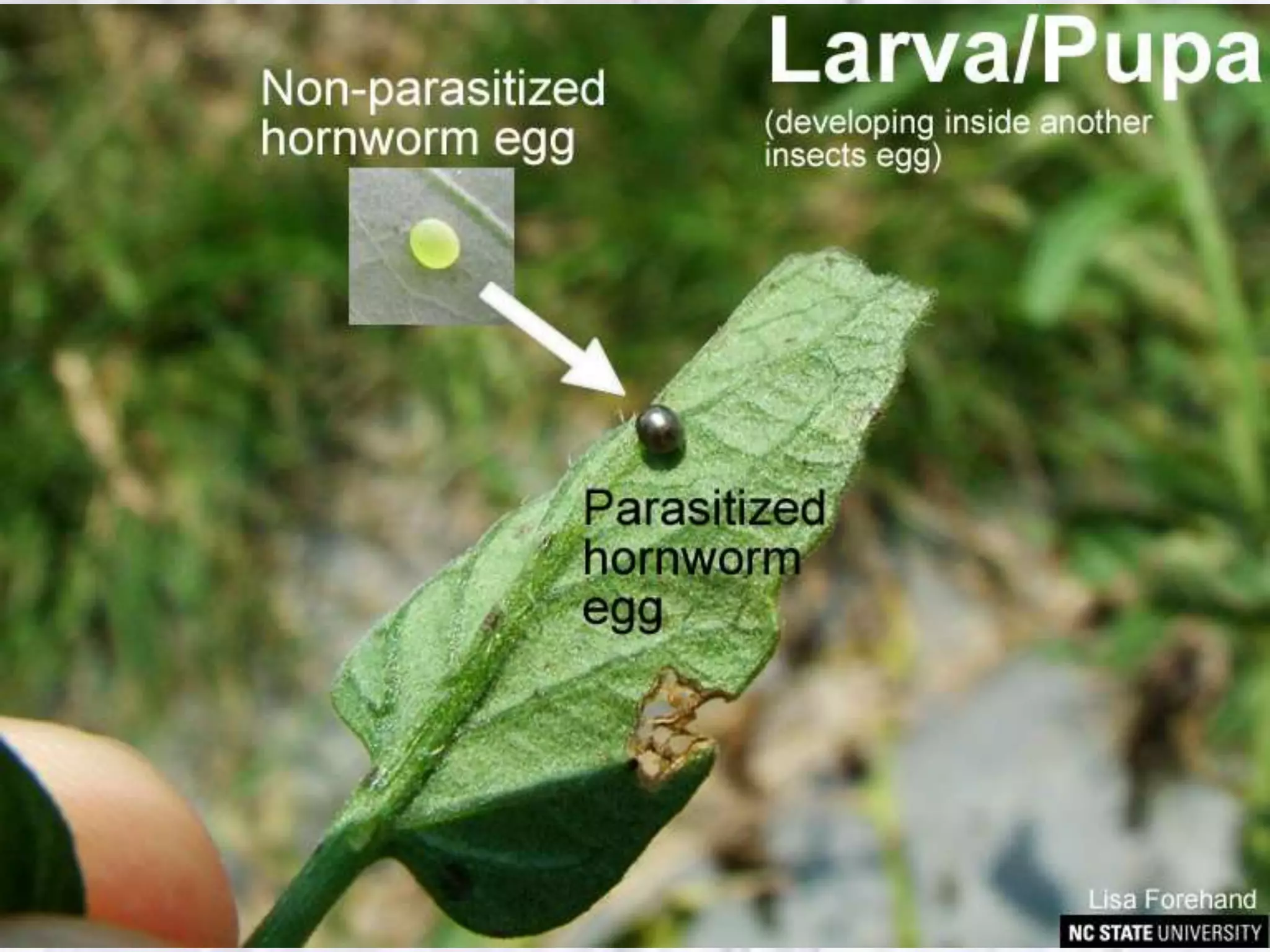
 Eggs deposites in host eggs.
 Wasp larvae eats host eggs from inside.
And parasitized eggs turn black.
 8-10 days lifecycle.
 Harmless to peoples and animals.
 Adult wasps are nector feeders.
Introduction
Trichogrammatidae -840 species, and are so small that
reproduction is carried out by parasitizing the eggs of other insects.
Most important parasitoid for more than 100 years.
Play important role in pest suppression programme by destroying
the early stage of the pest.
Curtailing the use of pesticides and contributing to prevent
environmental pollution.
More than 150 species of Trichogrammatids are distributed
throughout the world parasitizing eggs of over 200 insect species.
 Belonging to major orders Lepidoptera, Coleoptera, Neuroptera
and Diptera, the majority being Lepidoptera.
 In India, 26 Trichogrammatids are recorded; out of which,
1. Trichogramma chilonis (Ishii),
2. T. japonicum (Ashmead) and
3. T. acheae
4. T. brasiliensis are of significant importance.
 Worldwide over 32 million ha area under agricultural crops
and forest are treated annually with different Trichogramma
species in 19 countries.
 Mostly in China and Republic of Soviet Union (Li, 1994).
 Their levels of parasitism sometimes reach to 100 per cent
depending upon the environmental conditions (Shahid et al.,
2007).
Species of
trichogramma
Used for parasitization of host eggs
T. chilonis Mainly for lepidopteran pests, in sugarcane, corn,
cotton, vegetables and fruits crops pests.
T. japonicum Rice stem borer
T. brasiliensis For lepidopteran pests on Chickpea and Pigeonpea.
T. minutum For ornamentals, orchards, grapes pests and trees
where the protective zone is five feet or more above
ground level.
T. platneri For avocados, ornamentals, orchards and grape pests.
Species used
Species of
trichogramma
Used for parasitization of host eggs
T. brassicae For vegetable, orchards, gardens and field crops pests.
T. pretiosum Best in vegetable gardens pests where the protective
zone is five feet or less above ground level.
T. dendrolimi
Lepidopterous pests on cruciferous crops.
T. evanescence Lepidopterous pests
T. exiguam For cotton pests
T. papilonis For citrus pests
Adult of trichogramma is smaller than the
host eggs which they parasitzes.
How dose Trichogramma actually
Parasite on other host eggs
Immediately after they hatch, female Trichogramma wasps
begin their search for the egg of a ‘target species’.
 Once host egg is found – through pheromones and visual cues.
 The wasp drills a hole into the egg and deposits two to three
eggs of her own.
 How many of their own eggs to lay, is calculated by timing
walks across moth egg surfaces.
In a mere 24 hours, the wasps eggs hatch within the host egg
and the larvae consume the yolk and embryo.
The larvae then undergo three instars before a pupae stage.
 They emerging about nine days after they were initially laid within the
host egg (Knutson 1998).
Trichogramma larvae eat out the insides of pest eggs, pupate, and cut
an exit hole in moth egg shells for winged adults to squeeze through.
Males emerge first, wait for females, and immediately mate. The life
cycle from egg to adult is completed in 7 to 10 days (longer in cool
weather).
 Short life cycle -30 generations per season, and rapid population
increase. Hence, early season releases produce large populations
positioned to fight pest invasions.
Introduction introduces the insect en mass as a temporary measure to
parasitize as many eggs as possible, i.e., as a chemical insecticide replacement.
Augmentation is the supplementation of a naturally occurring
species to boost numbers and effectiveness (similar to the hatchery process
used with some fish).
 Introduction
 Augmentation
Conservation involves some introduction but in lieu of a short term
solution this method promotes environmental and crop management
processes that increase population numbers of natural enemies of pest
species, including the use of selective insecticides, and habitat provision.
Conservation
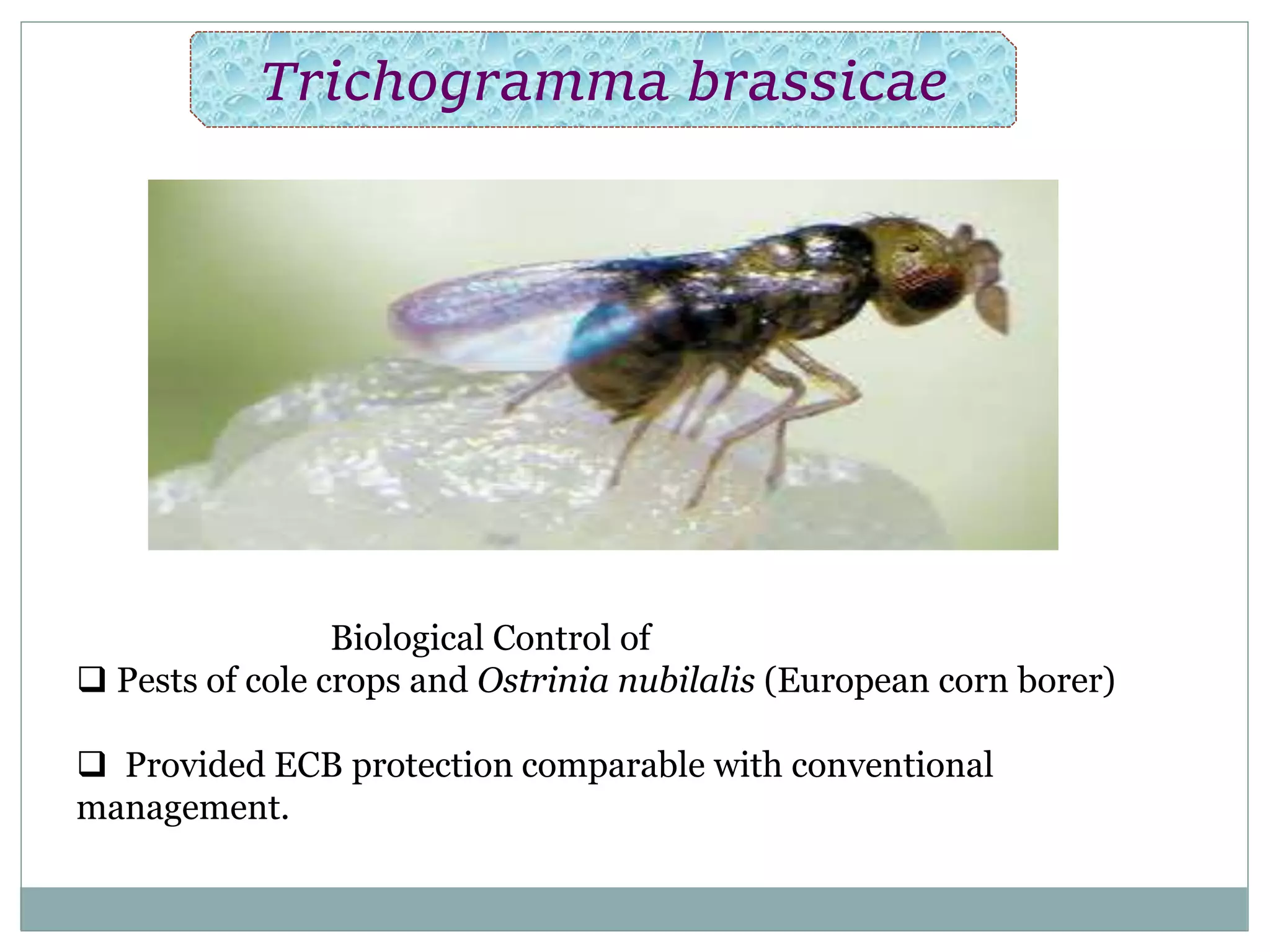
Trichogramma brassicae
Biological Control of
 Pests of cole crops and Ostrinia nubilalis (European corn borer)
 Provided ECB protection comparable with conventional
management.
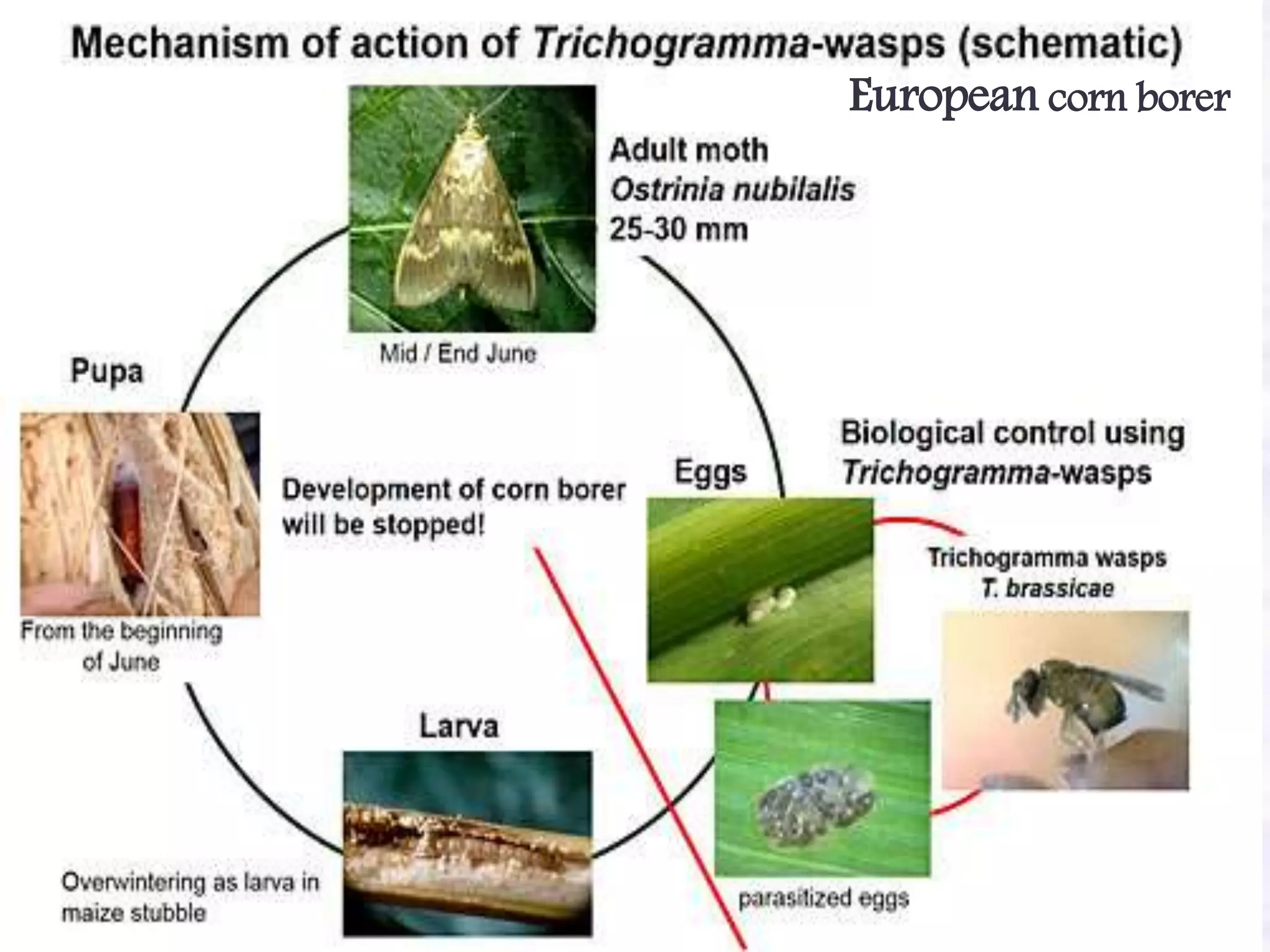
European corn borer
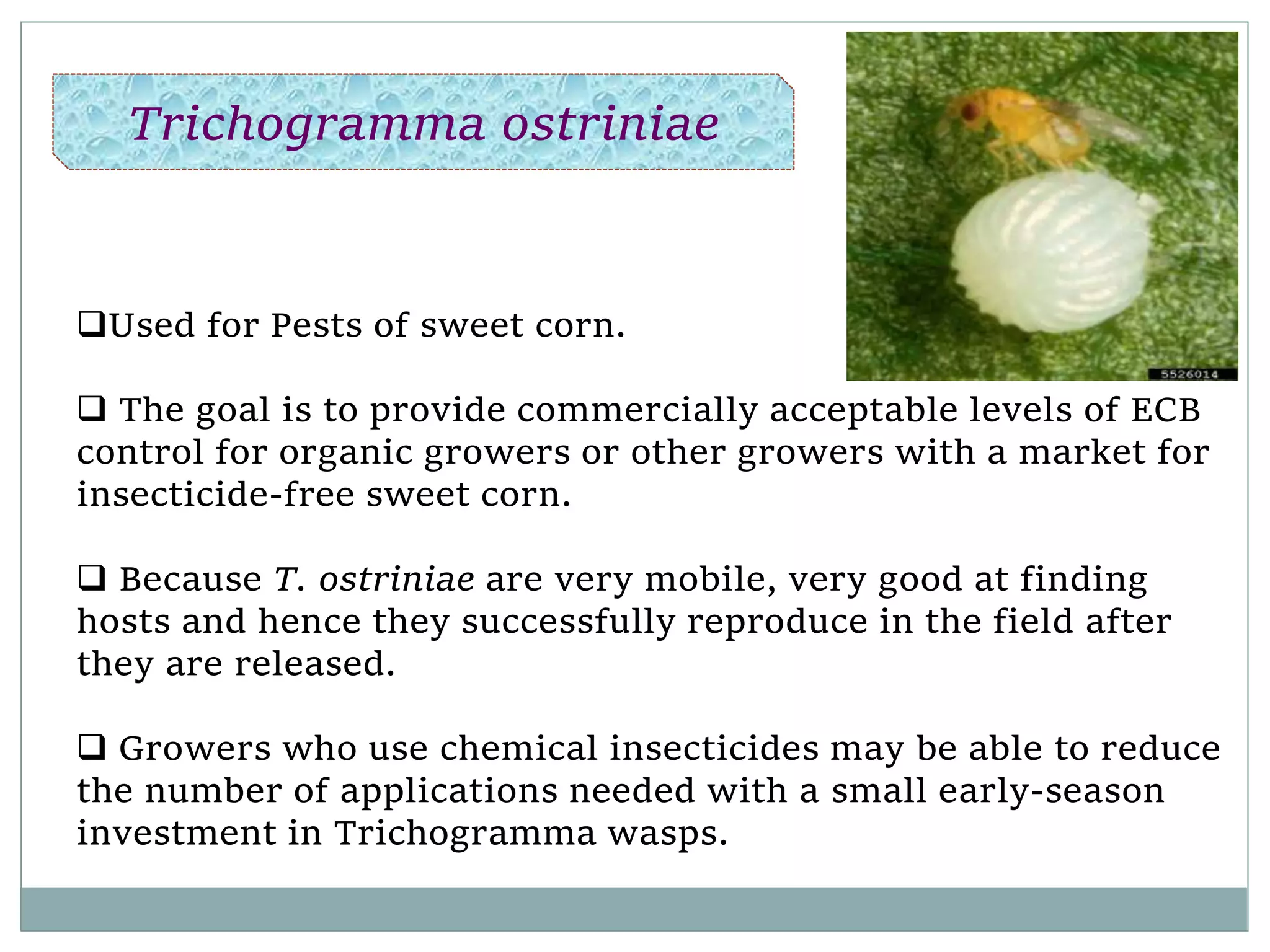
Used for Pests of sweet corn.
 The goal is to provide commercially acceptable levels of ECB
control for organic growers or other growers with a market for
insecticide-free sweet corn.
 Because T. ostriniae are very mobile, very good at finding
hosts and hence they successfully reproduce in the field after
they are released.
 Growers who use chemical insecticides may be able to reduce
the number of applications needed with a small early-season
investment in Trichogramma wasps.
Trichogramma ostriniae
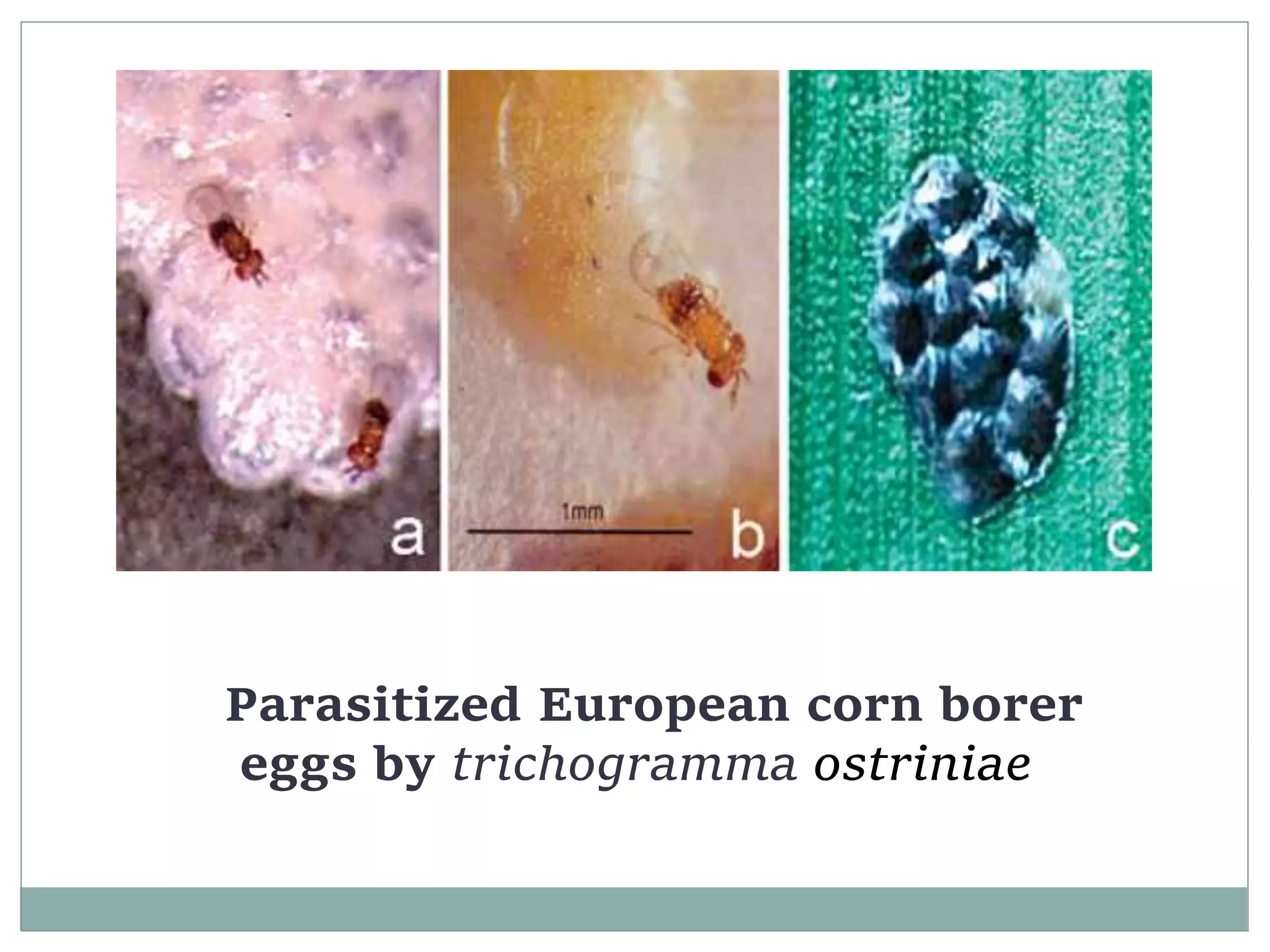
Parasitized European corn borer
eggs by trichogramma ostriniae
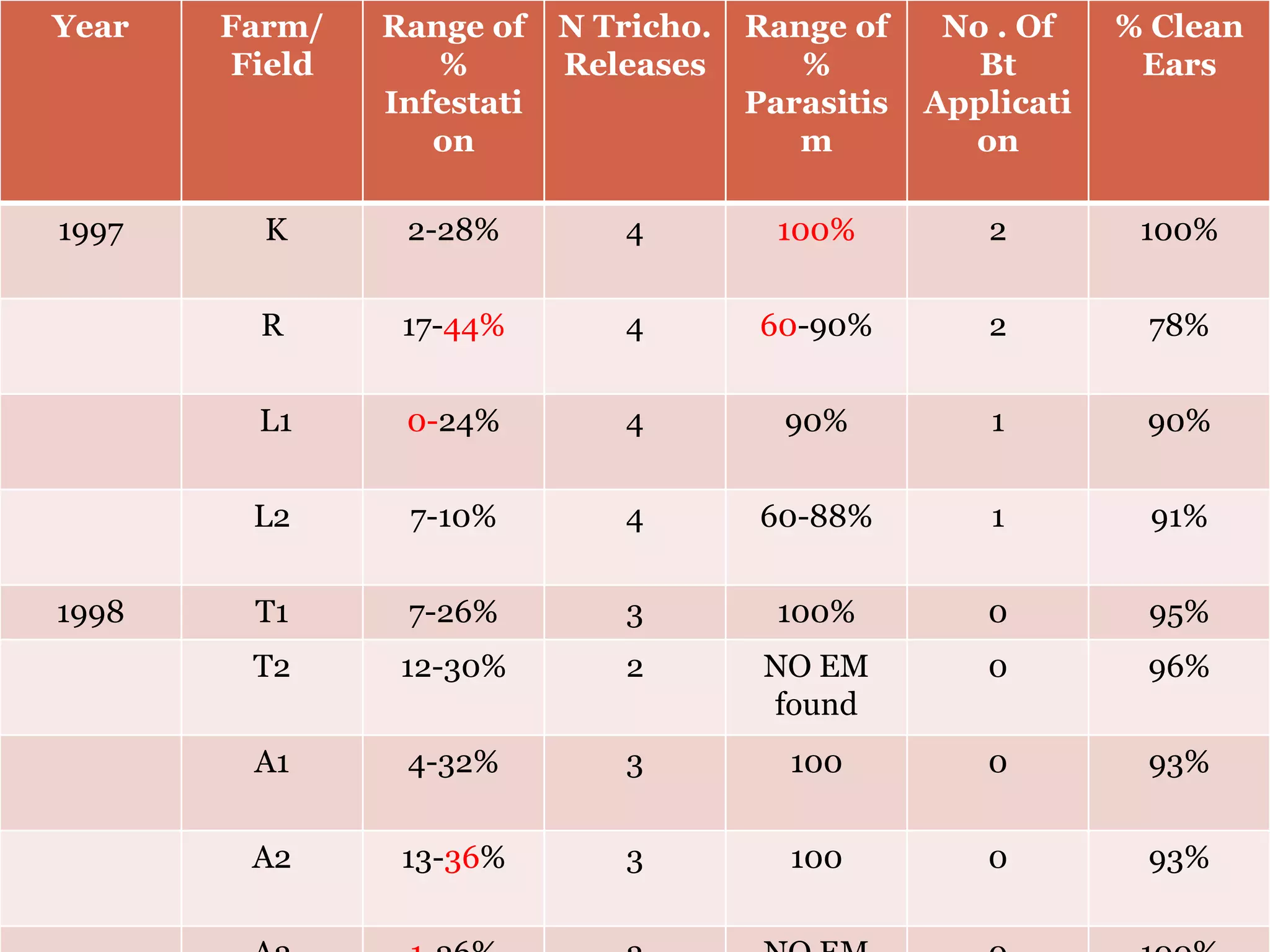
Year Farm/
Field
Range of
%
Infestati
on
N Tricho.
Releases
Range of
%
Parasitis
m
No . Of
Bt
Applicati
on
% Clean
Ears
1997 K 2-28% 4 100% 2 100%
R 17-44% 4 60-90% 2 78%
L1 0-24% 4 90% 1 90%
L2 7-10% 4 60-88% 1 91%
1998 T1 7-26% 3 100% 0 95%
T2 12-30% 2 NO EM
found
0 96%
A1 4-32% 3 100 0 93%
A2 13-36% 3 100 0 93%
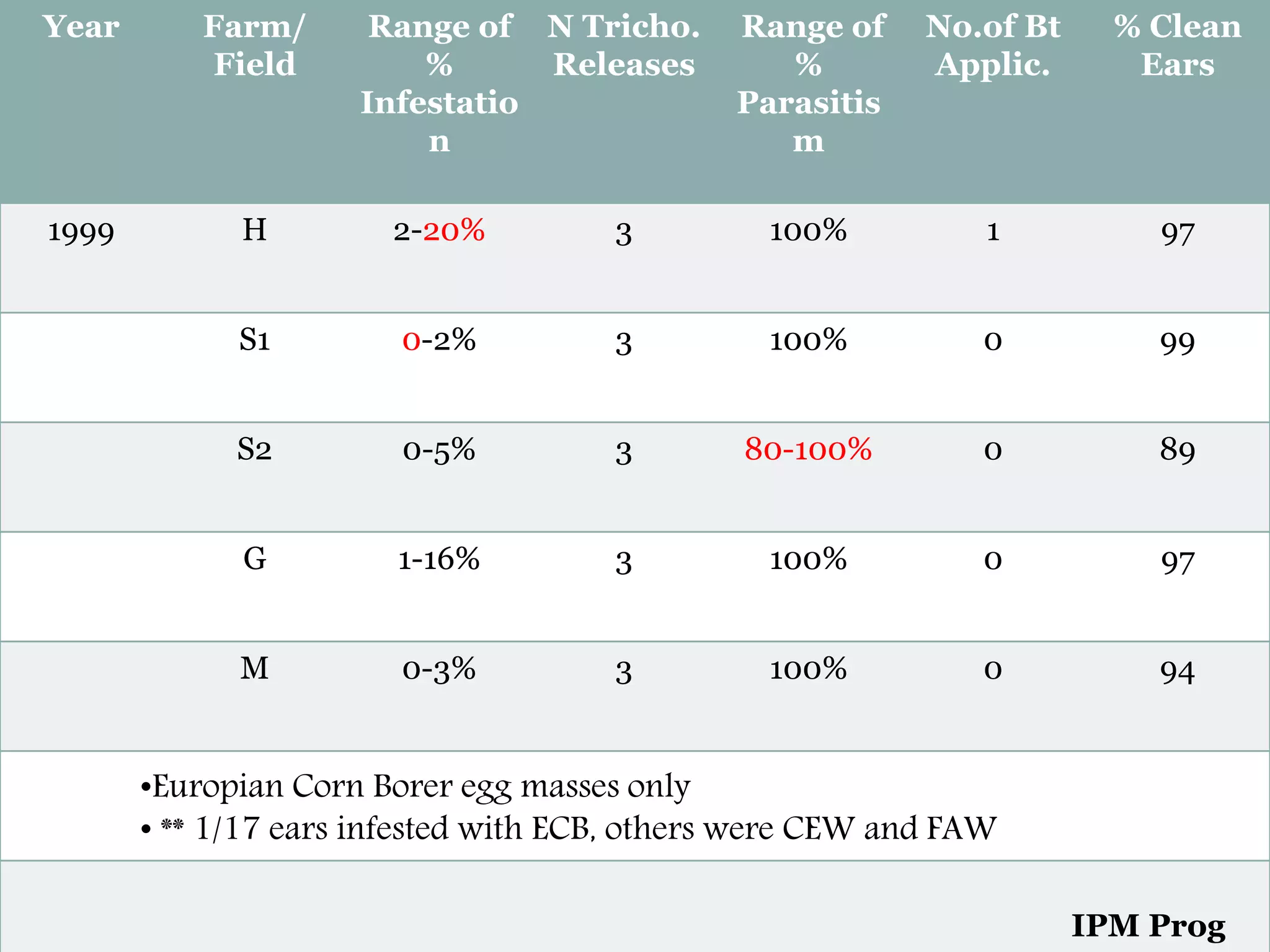
Year Farm/
Field
Range of
%
Infestatio
n
N Tricho.
Releases
Range of
%
Parasitis
m
No.of Bt
Applic.
% Clean
Ears
1999 H 2-20% 3 100% 1 97
S1 0-2% 3 100% 0 99
S2 0-5% 3 80-100% 0 89
G 1-16% 3 100% 0 97
M 0-3% 3 100% 0 94
•Europian Corn Borer egg masses only
• ** 1/17 ears infested with ECB, others were CEW and FAW
IPM Prog
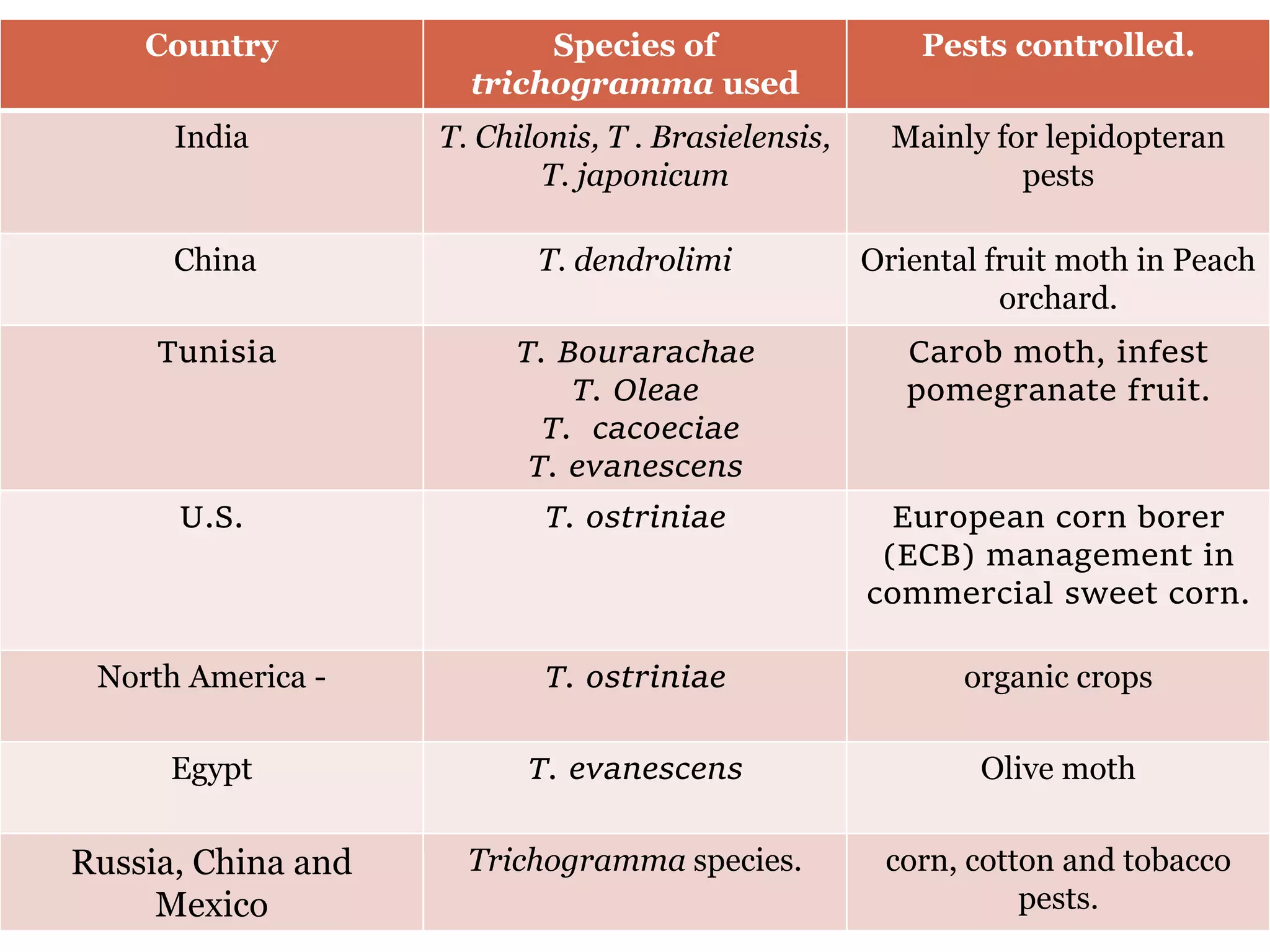
Country Species of
trichogramma used
Pests controlled.
India T. Chilonis, T . Brasielensis,
T. japonicum
Mainly for lepidopteran
pests
China T. dendrolimi Oriental fruit moth in Peach
orchard.
Tunisia T. Bourarachae
T. Oleae
T. cacoeciae
T. evanescens
Carob moth, infest
pomegranate fruit.
U.S. T. ostriniae European corn borer
(ECB) management in
commercial sweet corn.
North America - T. ostriniae organic crops
Egypt T. evanescens Olive moth
Russia, China and
Mexico
Trichogramma species. corn, cotton and tobacco
pests.
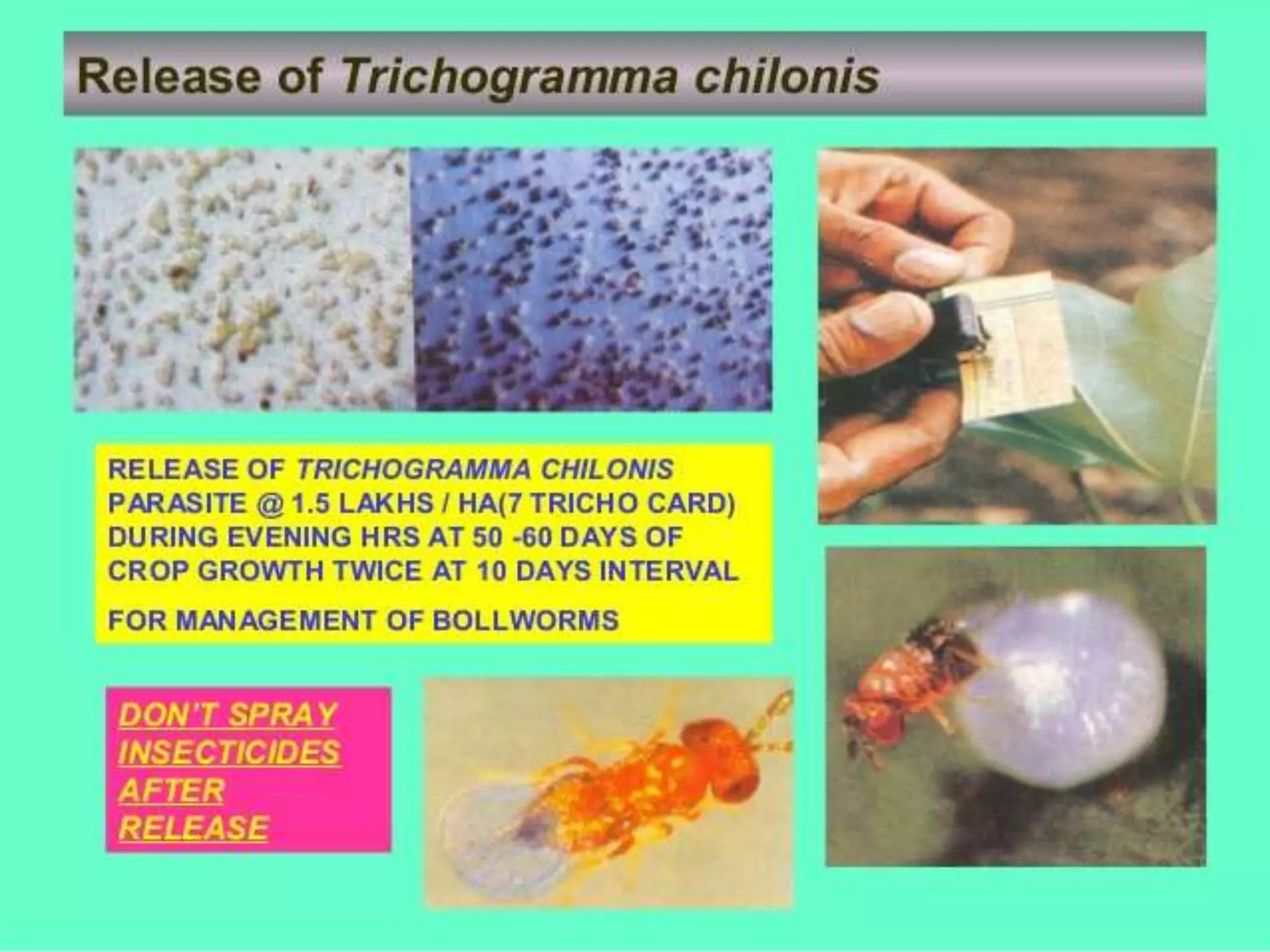
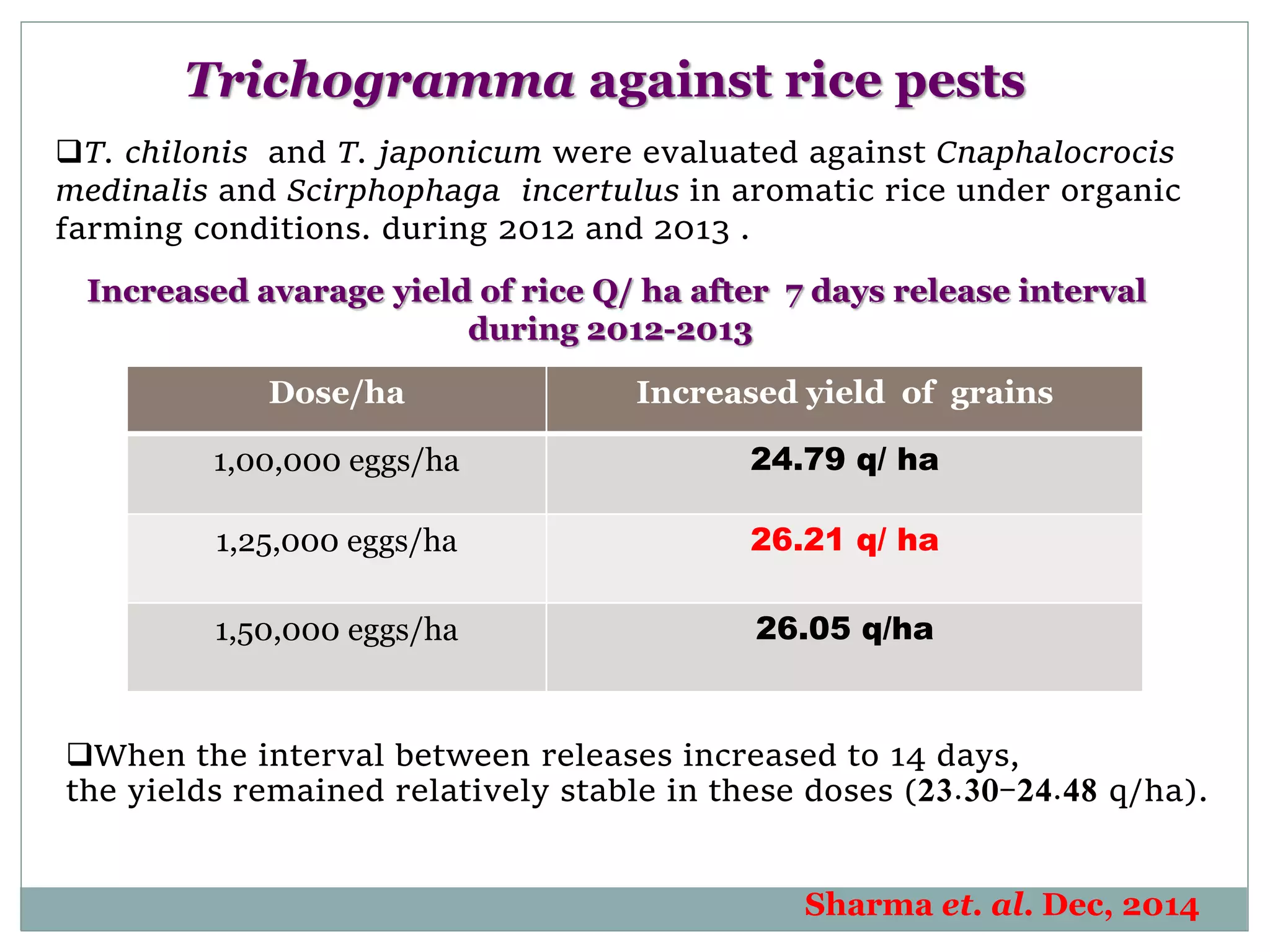
Trichogramma against rice pests
T. chilonis and T. japonicum were evaluated against Cnaphalocrocis
medinalis and Scirphophaga incertulus in aromatic rice under organic
farming conditions. during 2012 and 2013 .
Increased avarage yield of rice Q/ ha after 7 days release interval
during 2012-2013
Dose/ha Increased yield of grains
1,00,000 eggs/ha 24.79 q/ ha
1,25,000 eggs/ha 26.21 q/ ha
1,50,000 eggs/ha 26.05 q/ha
When the interval between releases increased to 14 days,
the yields remained relatively stable in these doses (23.30-24.48 q/ha).
Sharma et. al. Dec, 2014
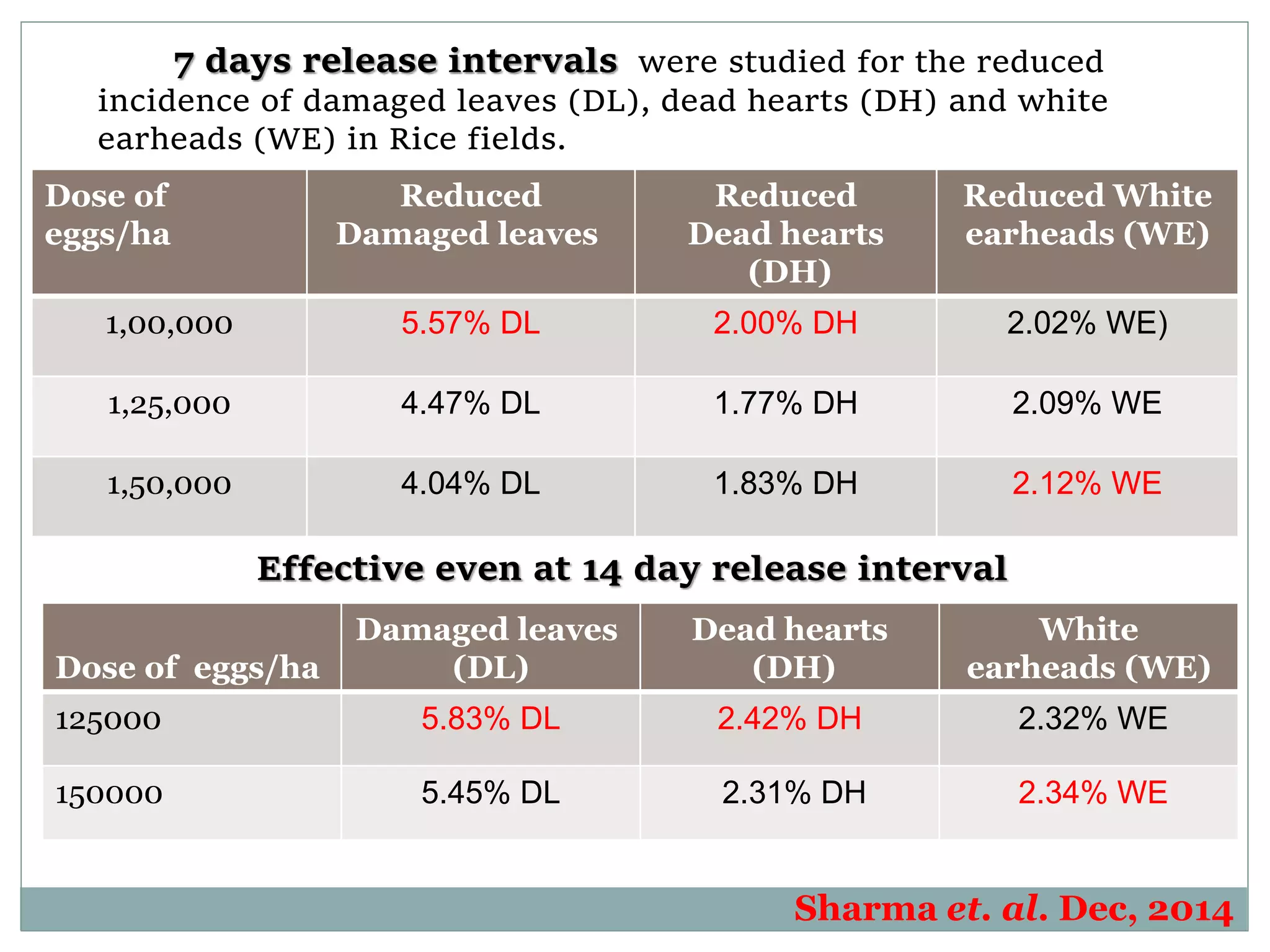
Dose of
eggs/ha
Reduced
Damaged leaves
Reduced
Dead hearts
(DH)
Reduced White
earheads (WE)
1,00,000 5.57% DL 2.00% DH 2.02% WE)
1,25,000 4.47% DL 1.77% DH 2.09% WE
1,50,000 4.04% DL 1.83% DH 2.12% WE
7 days release intervals were studied for the reduced
incidence of damaged leaves (DL), dead hearts (DH) and white
earheads (WE) in Rice fields.
Dose of eggs/ha
Damaged leaves
(DL)
Dead hearts
(DH)
White
earheads (WE)
125000 5.83% DL 2.42% DH 2.32% WE
150000 5.45% DL 2.31% DH 2.34% WE
Effective even at 14 day release interval
Sharma et. al. Dec, 2014
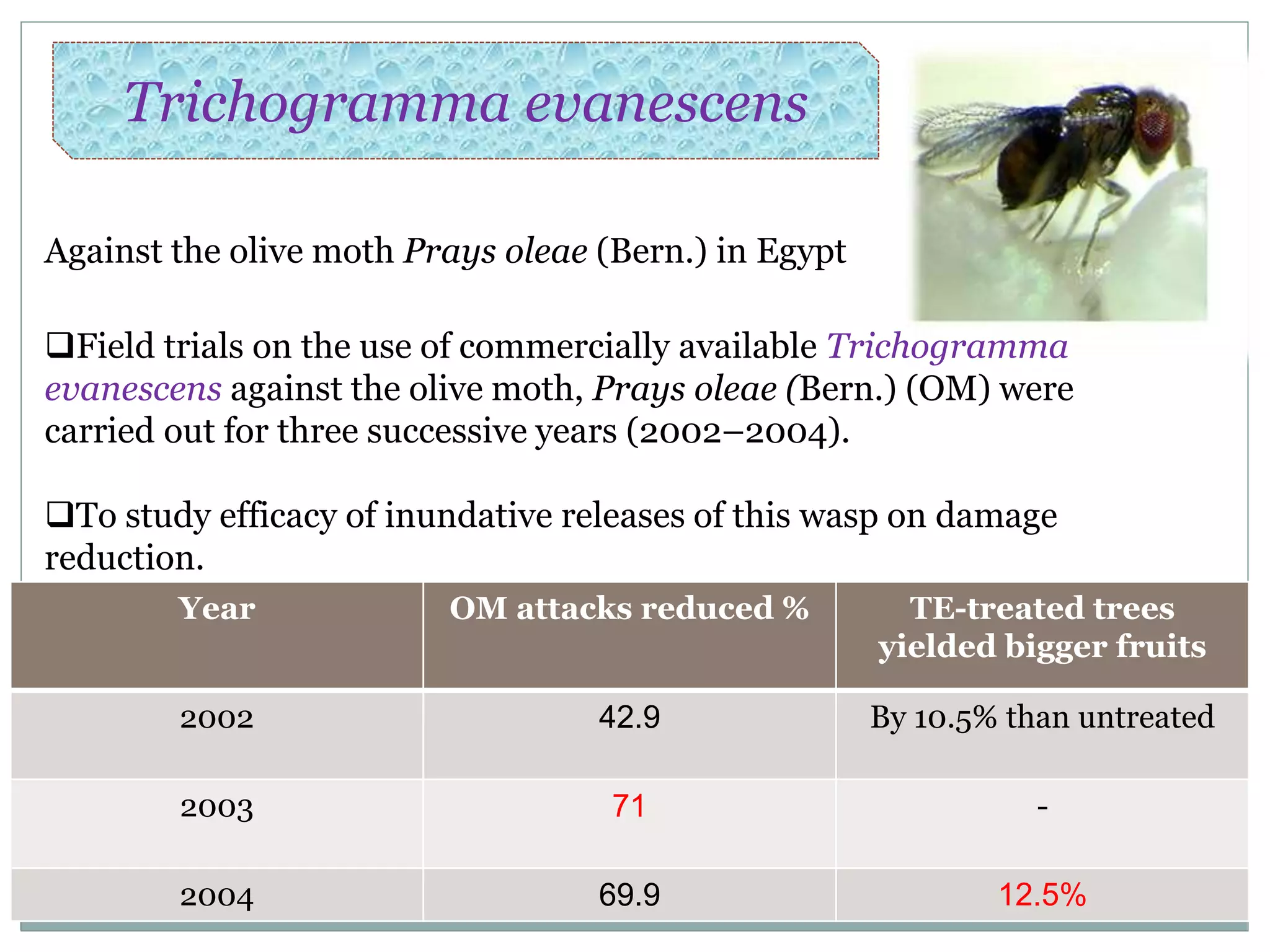
Trichogramma evanescens
Against the olive moth Prays oleae (Bern.) in Egypt
Field trials on the use of commercially available Trichogramma
evanescens against the olive moth, Prays oleae (Bern.) (OM) were
carried out for three successive years (2002–2004).
To study efficacy of inundative releases of this wasp on damage
reduction.
Year OM attacks reduced % TE-treated trees
yielded bigger fruits
2002 42.9 By 10.5% than untreated
2003 71 -
2004 69.9 12.5%
Impact of T. evanescens releases on weight (g) and number of
premature fall of olive fruits, percentage of damaged ripe fruits and
fruit harvest/tree(kg) during 2002-2004 olive seasons.
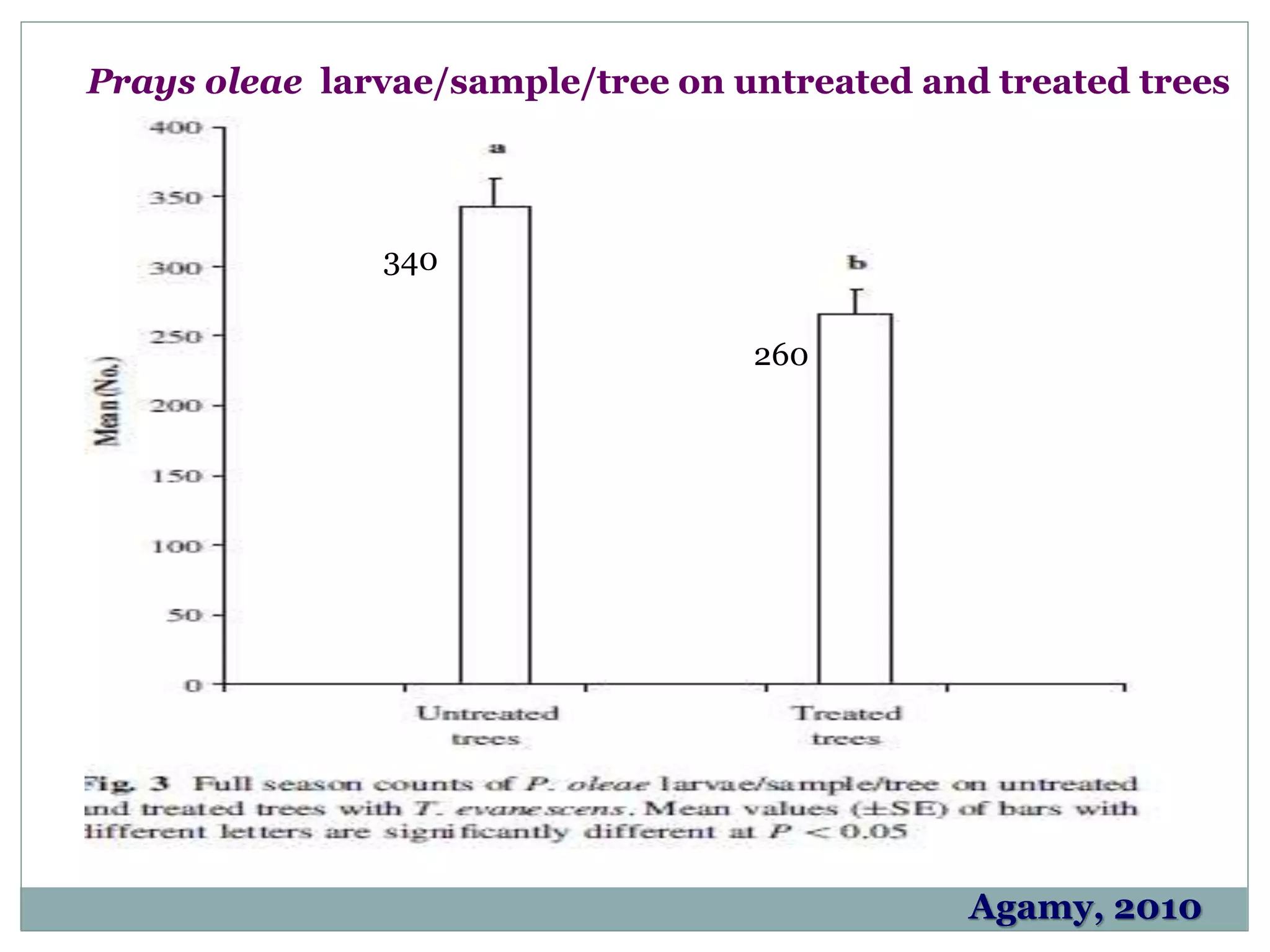
Agamy, 2010
Agamy, 2010
Prays oleae larvae/sample/tree on untreated and treated trees
340
260
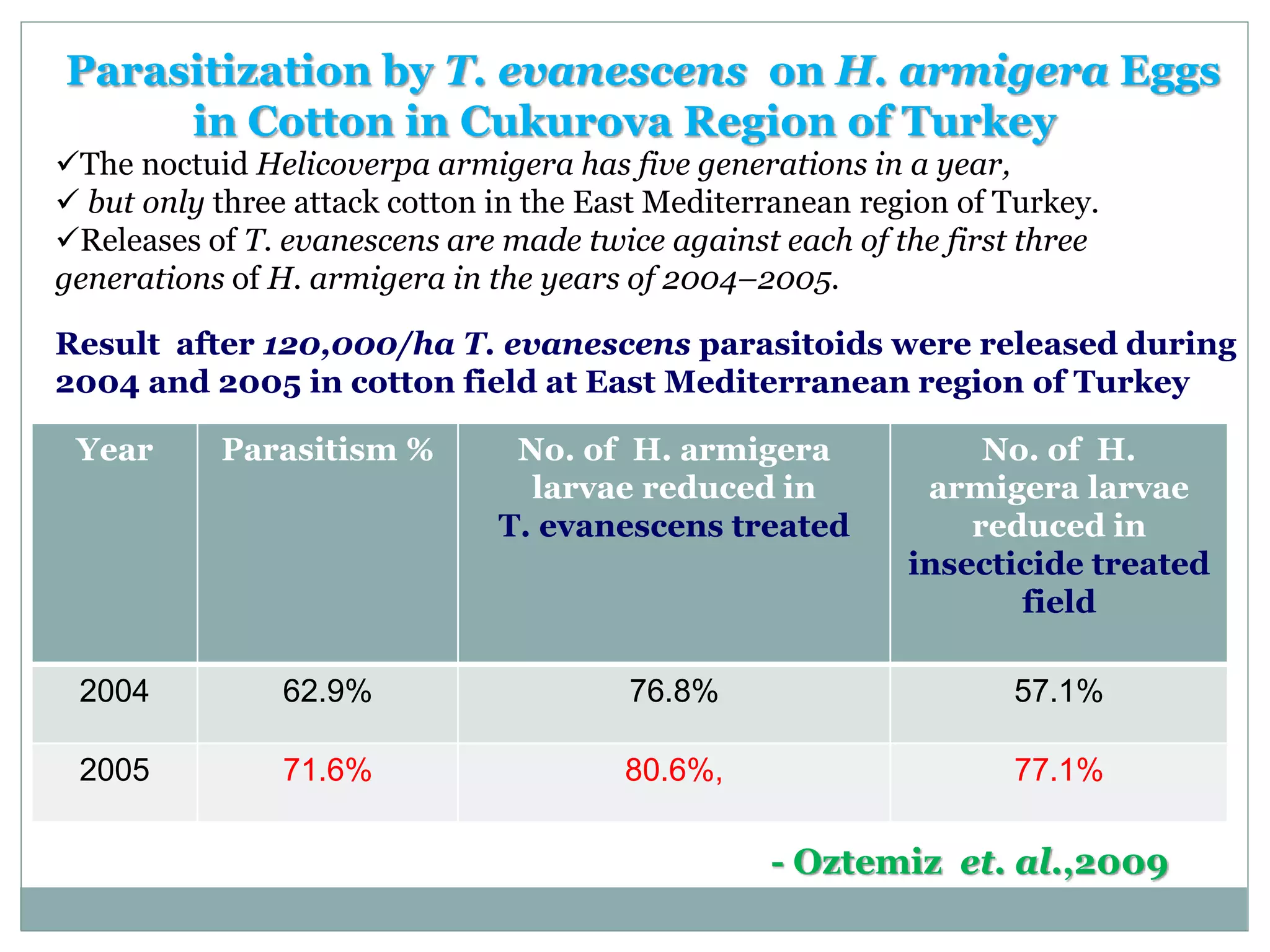
Parasitization by T. evanescens on H. armigera Eggs
in Cotton in Cukurova Region of Turkey
The noctuid Helicoverpa armigera has five generations in a year,
 but only three attack cotton in the East Mediterranean region of Turkey.
Releases of T. evanescens are made twice against each of the first three
generations of H. armigera in the years of 2004–2005.
Result after 120,000/ha T. evanescens parasitoids were released during
2004 and 2005 in cotton field at East Mediterranean region of Turkey
Year Parasitism % No. of H. armigera
larvae reduced in
T. evanescens treated
No. of H.
armigera larvae
reduced in
insecticide treated
field
2004 62.9% 76.8% 57.1%
2005 71.6% 80.6%, 77.1%
- Oztemiz et. al.,2009
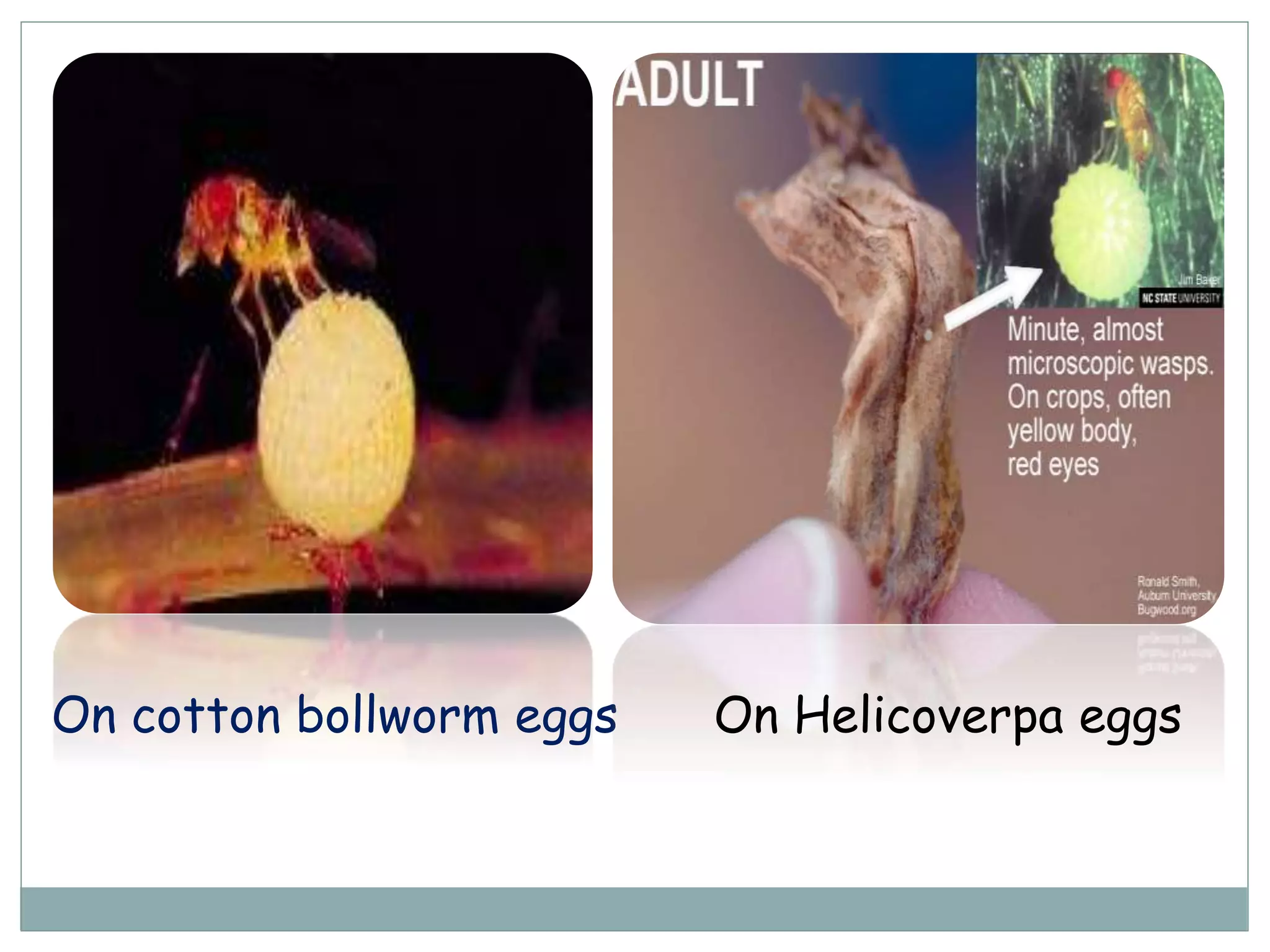
On cotton bollworm eggs On Helicoverpa eggs
Heliothis virescens (tobacco budworm) is a key pest of cotton.
 Chemical control is the main tactic to control H. virescens damage to
cotton but widespread use of chemical and biological insecticides (such as
Bacillus thuringiensis products) ultimately leads to the selection of resistant
pest strains.
 T. atopovirilia ,T. acacioi and T. Pretiosum were used for this purpose .
Among that T. atopovirilia had significantly higher rates of parasitism of
H. virescens eggs than the three other species.
 Trichogramma alone can parasitize 80-96% of Heliothis (cotton
bollworm, tobacco budworm, tomato fruitworm), alfalfa caterpillar, cabbage
worm and other pest eggs (Lindgren, 1969).
Trichogramma on cotton and tobacco pest
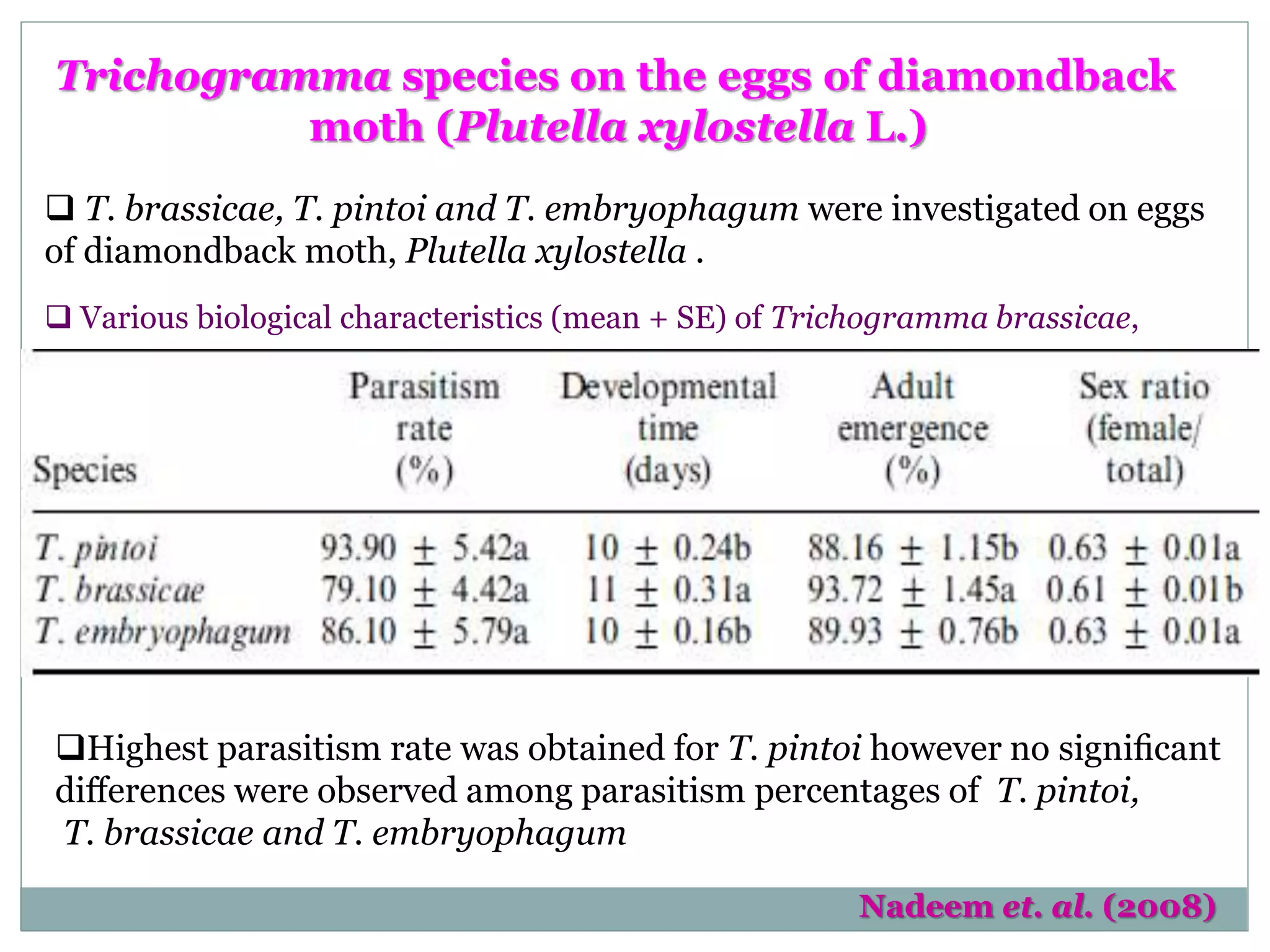
 Various biological characteristics (mean + SE) of Trichogramma brassicae,
.
Trichogramma species on the eggs of diamondback
moth (Plutella xylostella L.)
 T. brassicae, T. pintoi and T. embryophagum were investigated on eggs
of diamondback moth, Plutella xylostella .
Nadeem et. al. (2008)
Highest parasitism rate was obtained for T. pintoi however no significant
differences were observed among parasitism percentages of T. pintoi,
T. brassicae and T. embryophagum
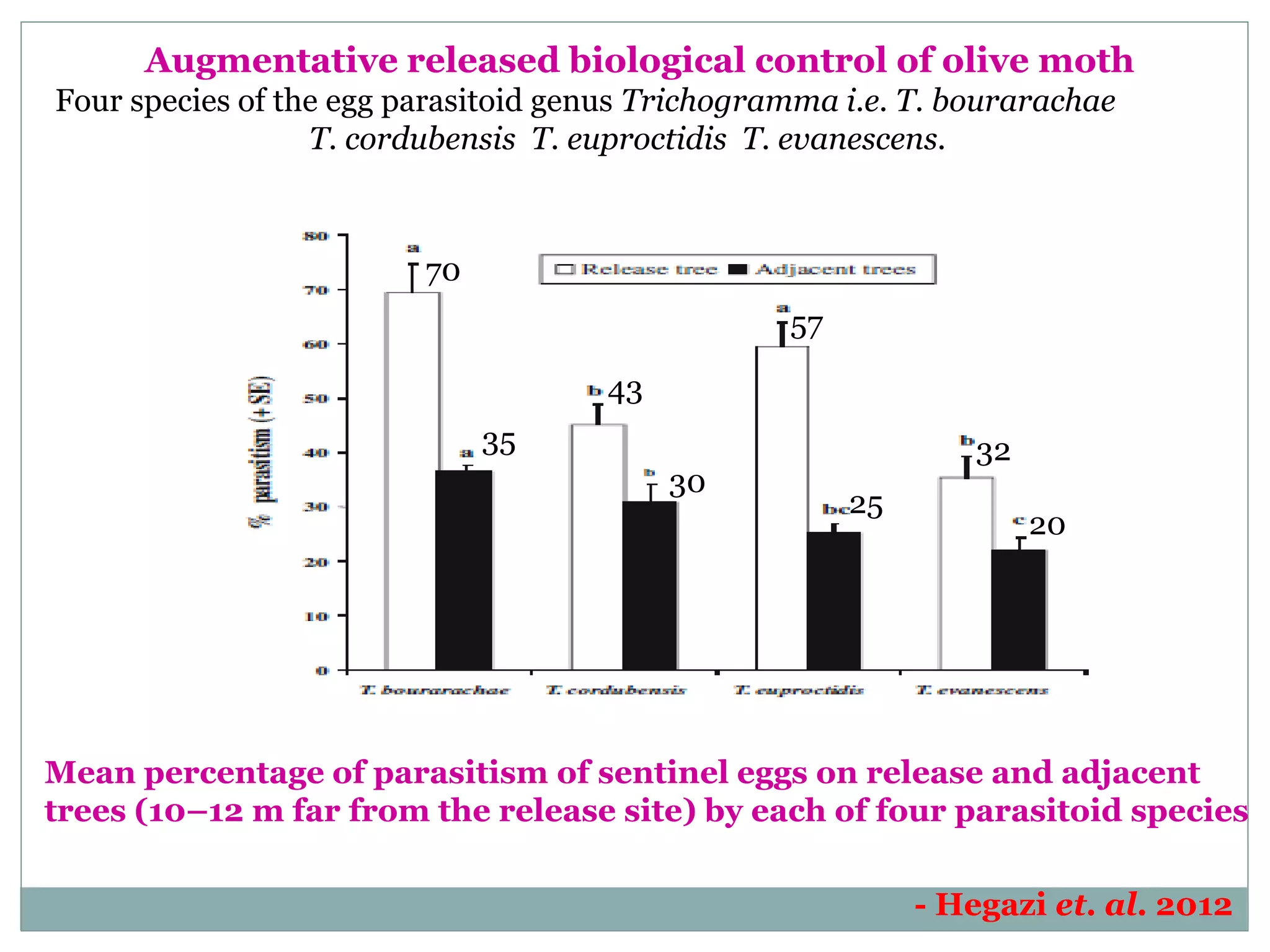
Augmentative released biological control of olive moth
Four species of the egg parasitoid genus Trichogramma i.e. T. bourarachae
T. cordubensis T. euproctidis T. evanescens.
Mean percentage of parasitism of sentinel eggs on release and adjacent
trees (10–12 m far from the release site) by each of four parasitoid species
- Hegazi et. al. 2012
43
30
57
25
32
20
70
35
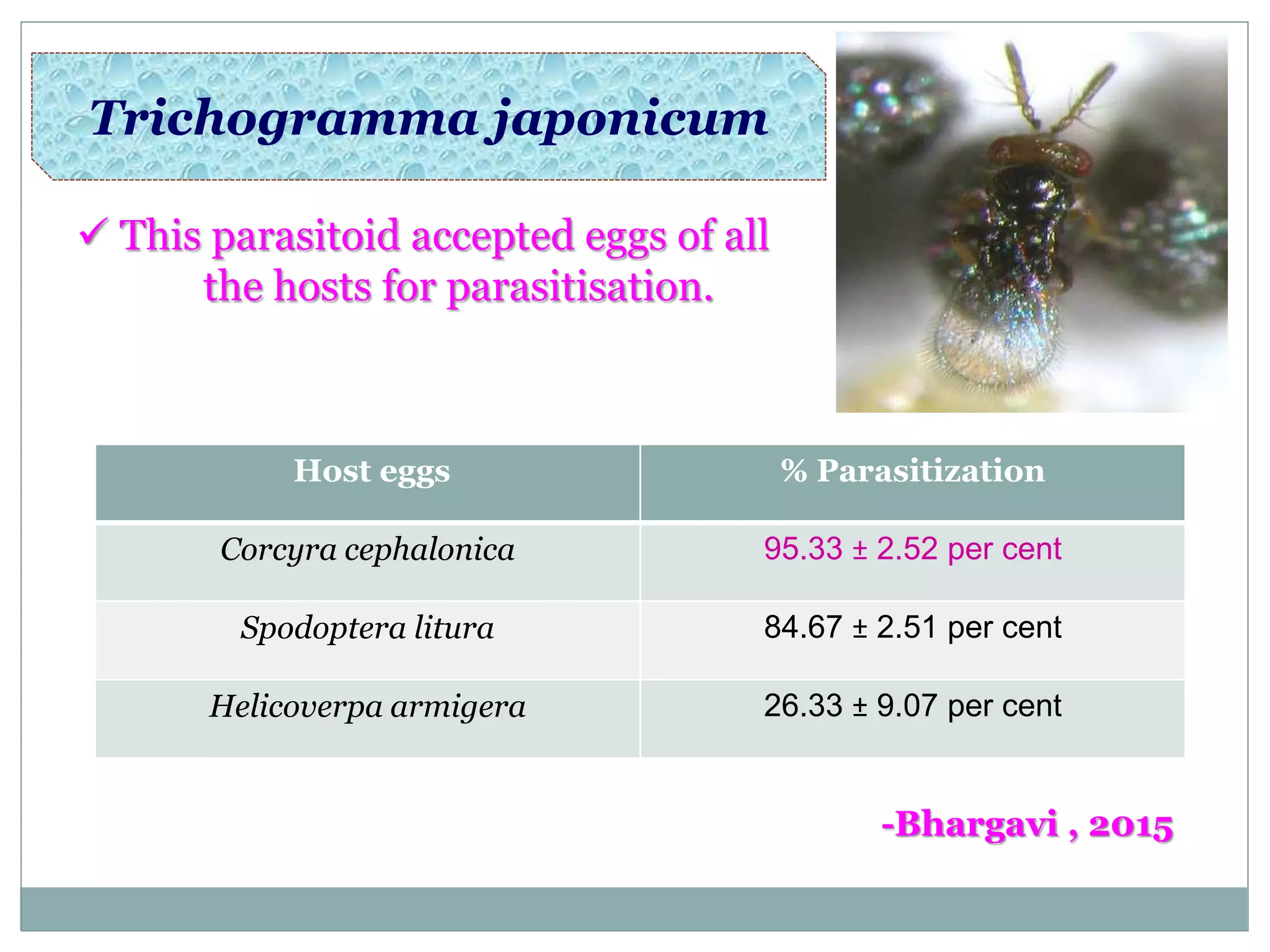
Trichogramma japonicum
Host eggs % Parasitization
Corcyra cephalonica 95.33 ± 2.52 per cent
Spodoptera litura 84.67 ± 2.51 per cent
Helicoverpa armigera 26.33 ± 9.07 per cent
 This parasitoid accepted eggs of all
the hosts for parasitisation.
-Bhargavi , 2015
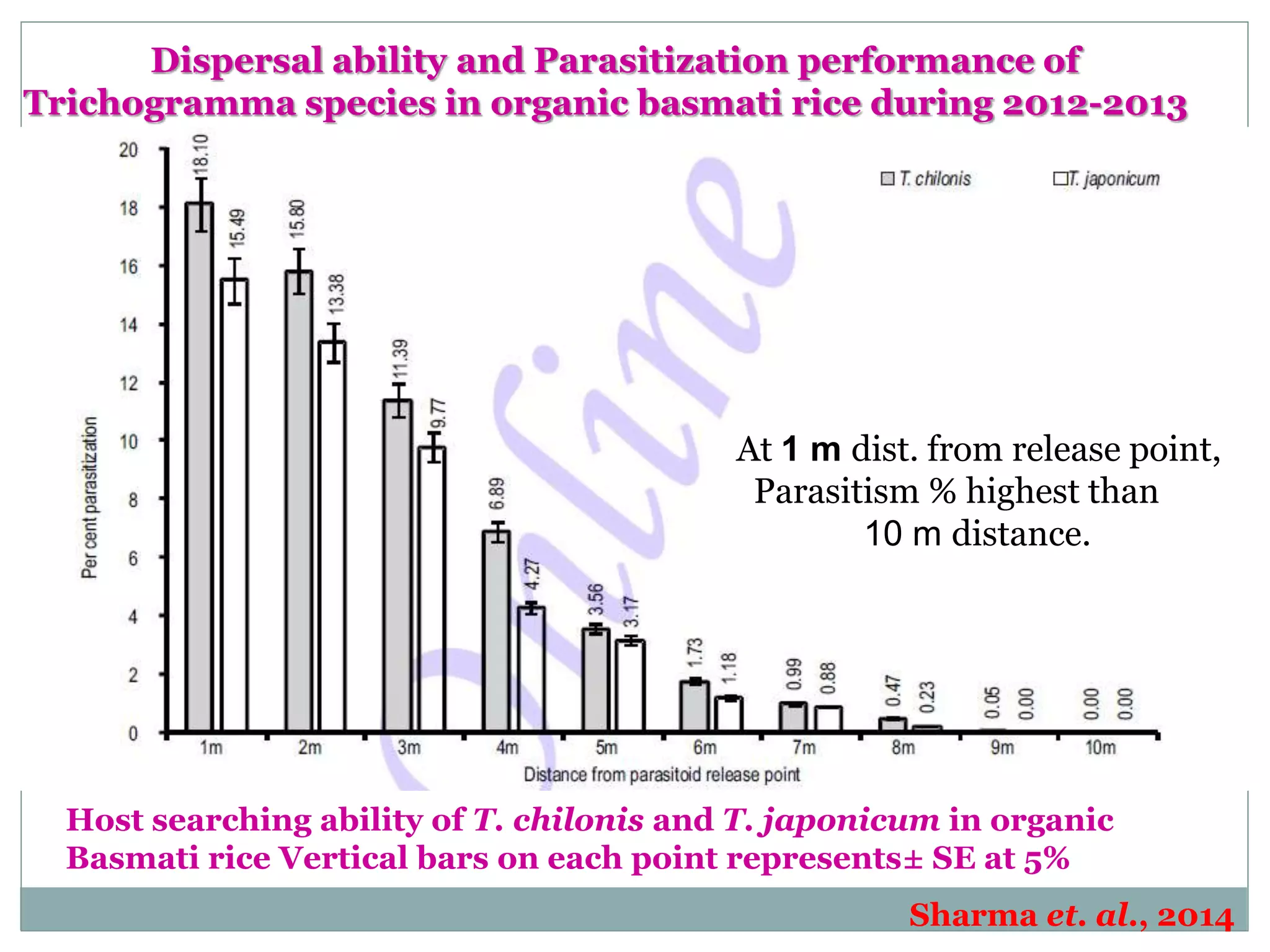
Dispersal ability and Parasitization performance of
Trichogramma species in organic basmati rice during 2012-2013
Host searching ability of T. chilonis and T. japonicum in organic
Basmati rice Vertical bars on each point represents± SE at 5%
Sharma et. al., 2014
At 1 m dist. from release point,
Parasitism % highest than
10 m distance.
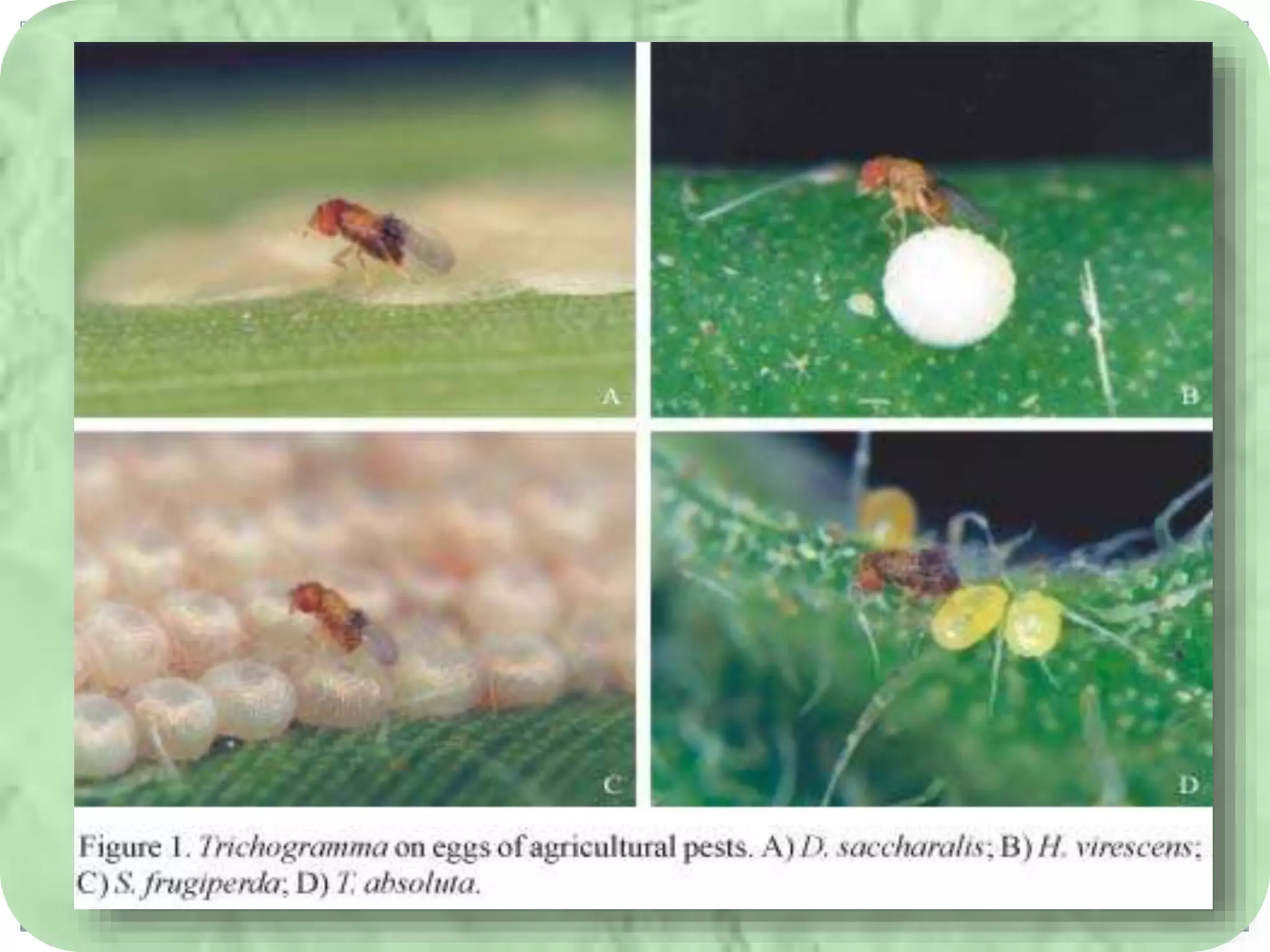
 Trichogramma destroy eggs of over 200 pest moth species .
Cutworms, fruit worms, leaf worms, leafrollers, loopers,
armyworms, borers etc.
Preventing ravenous worms (caterpillars) from hatching out and
devouring crops.
On pandemic leaf roller Parasitised Cutworm eggs
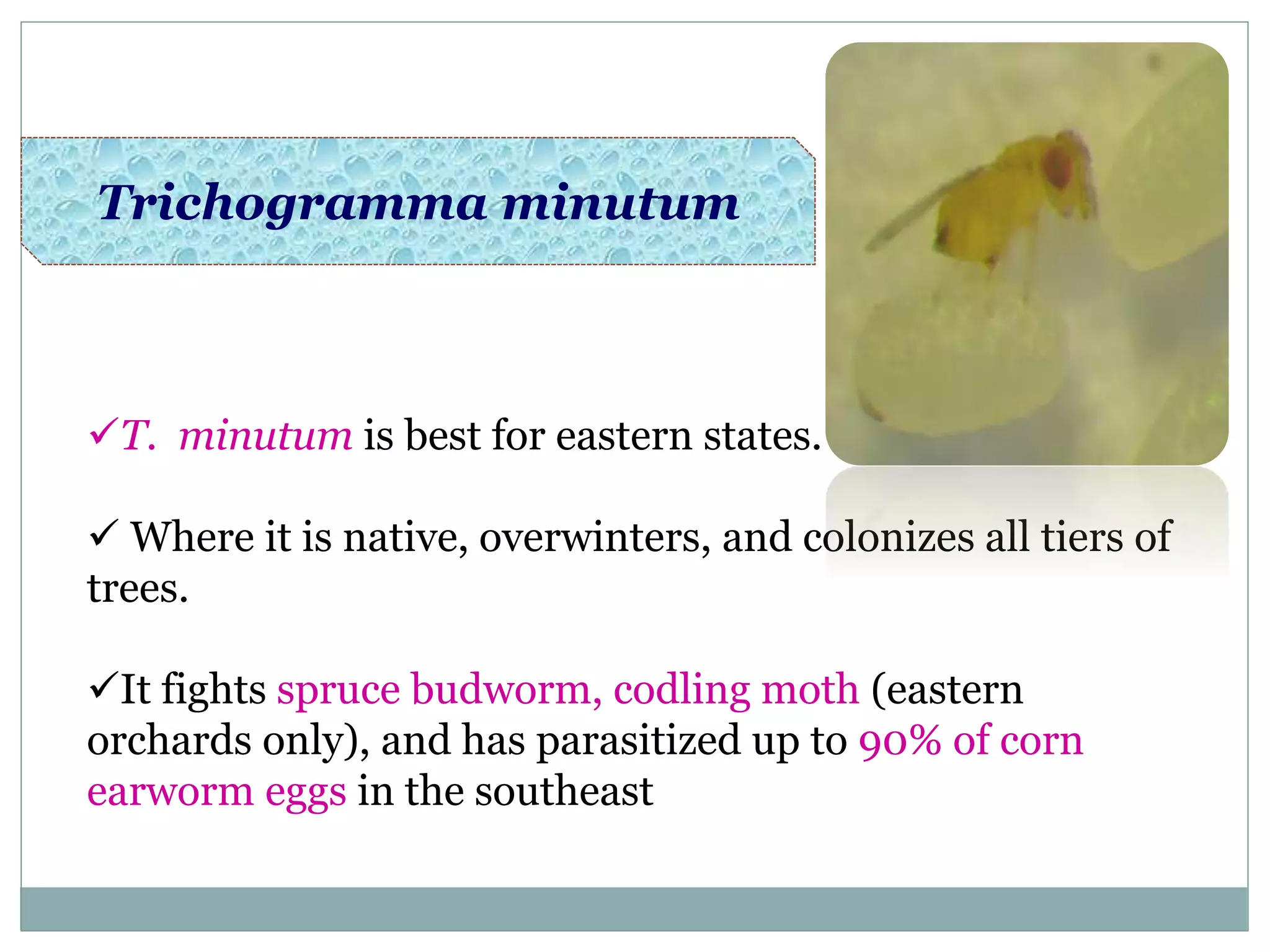
Trichogramma minutum
T. minutum is best for eastern states.
 Where it is native, overwinters, and colonizes all tiers of
trees.
It fights spruce budworm, codling moth (eastern
orchards only), and has parasitized up to 90% of corn
earworm eggs in the southeast
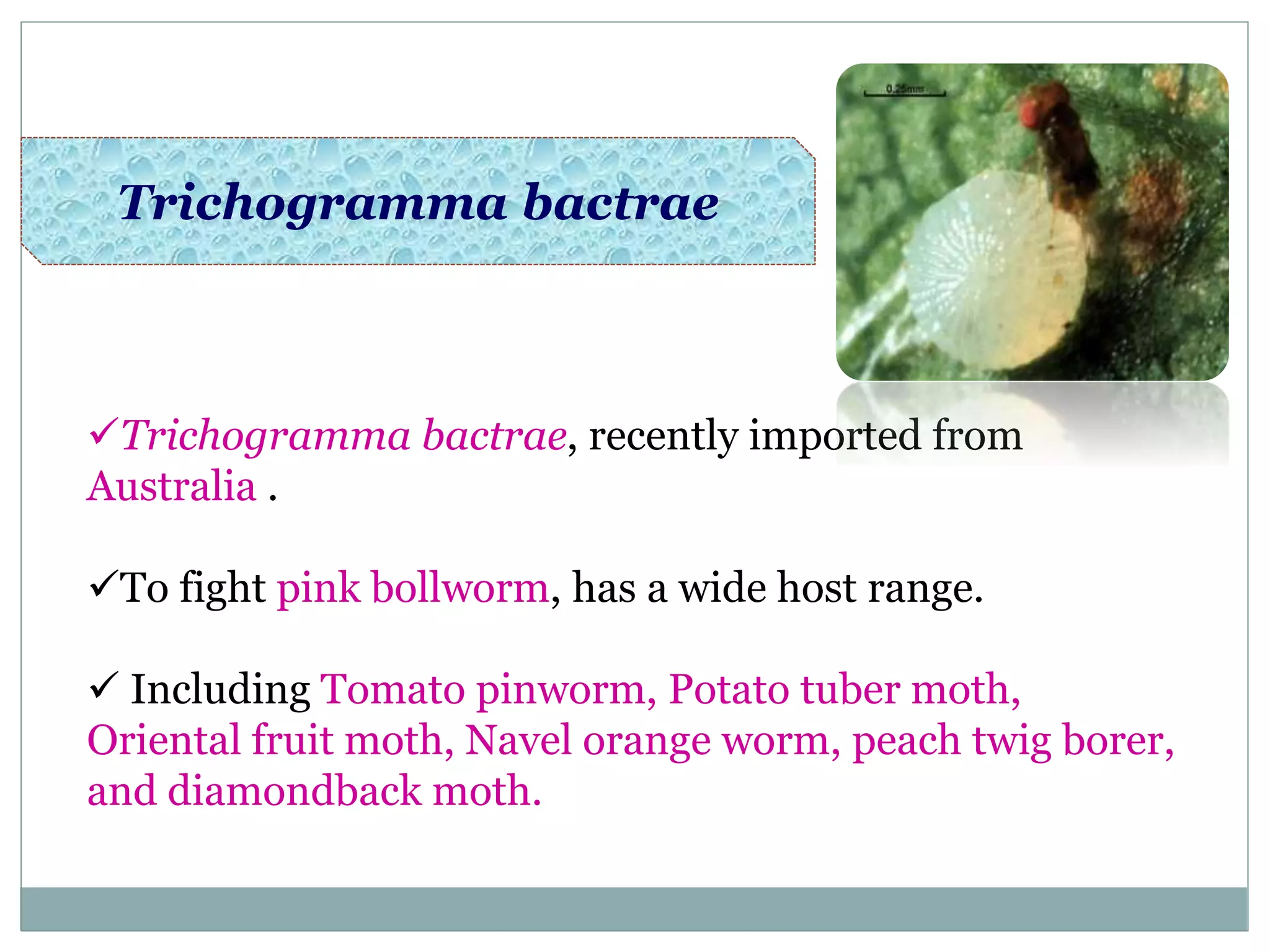
Trichogramma bactrae
Trichogramma bactrae, recently imported from
Australia .
To fight pink bollworm, has a wide host range.
 Including Tomato pinworm, Potato tuber moth,
Oriental fruit moth, Navel orange worm, peach twig borer,
and diamondback moth.
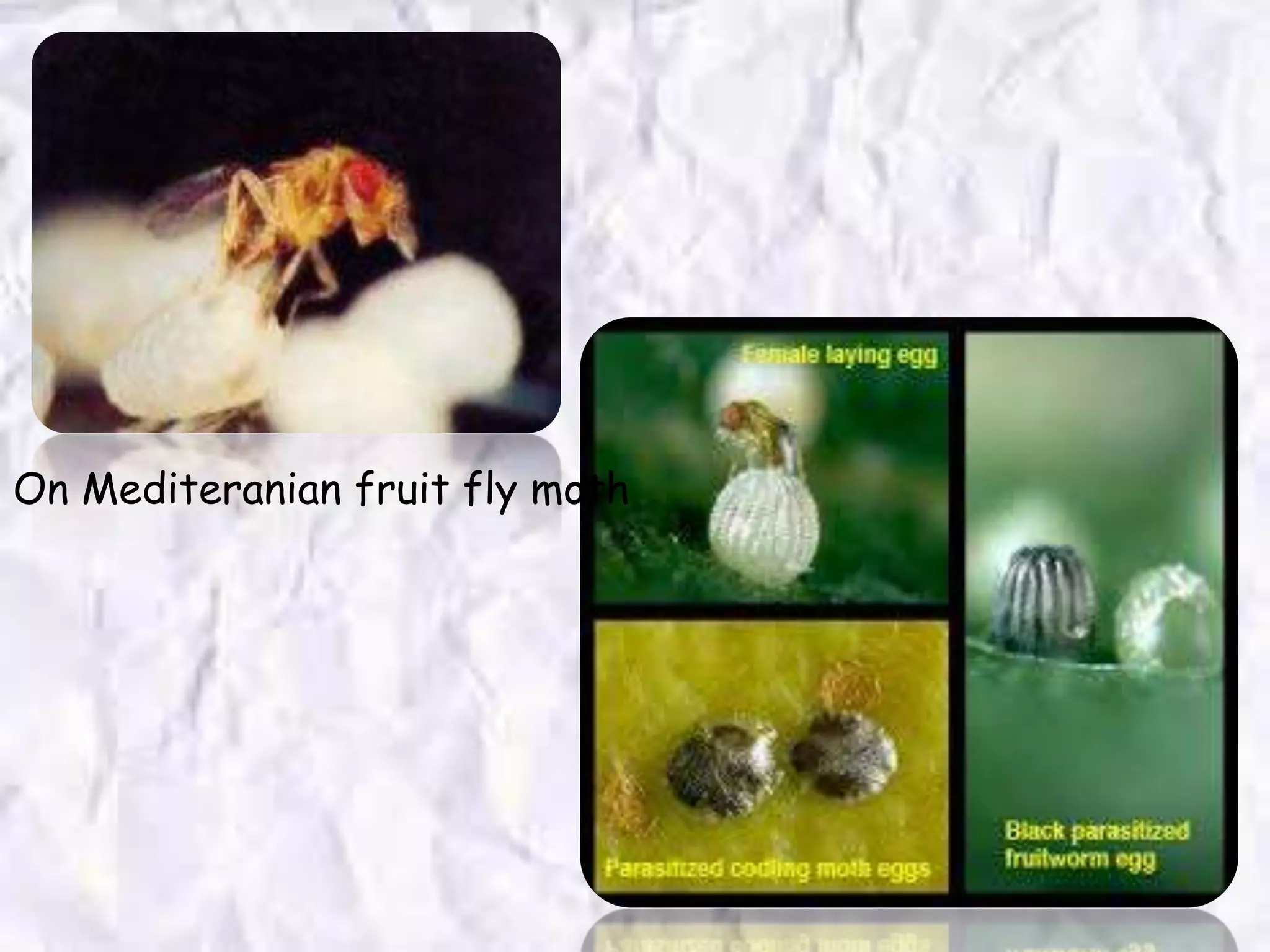
On Mediteranian fruit fly moth
 Today, Trichogramma species are the most widely used insect natural
enemy in the world , partly because they are easy to mass rear and they attack
many important crop insect pests.
 9 species of Trichogramma are reared in private or government owned
insectaries around the world and released annually on an estimated 80
million acres of agricultural crops and forests in 30 countries (45, 61).
 Trichogramma are released to control some 28 different caterpillar pests
attacking corn, rice, sugarcane, cotton, vegetables, sugar beets, fruit trees and
pine and spruce trees.
FUTURE SCOPE
Fruit damage ranged below 10% infested fruits and fruit yield was
significantly increased on tress where wasps were applied.
Most releases are to control corn borers, sugarcane borers and cotton
bollworm has demonstrated the potential of this approach.
Researchers in the U.S. are currently evaluating Trichogramma for the
control of codling moth in apples and almonds, leafrollers in apples,
European corn borer in corn, and bollworm/budworm in cotton .
Former Soviet republics claim that 6-8,000 Trichogramma per acre
produce 68% cutworm parasitism on wheat and sugar beets.
The olive moth Prays oleae (Bern.) and Jasmin moth, Palpita unionalis
(Hubner) are serious pests of mordern olive plantations in Egypt,
causing significant yield loss by fruit fall as well as by damage on
leaves, flowers and fruits.
The egg parasitoid spp. T. bourarchae, T. cordubensis, T.
euproctidis as well as commercially available T. evanecens were used
and resulted that Trichogramma species accomplished higher egg
parasitism (up to 91%) than the commercially strain .
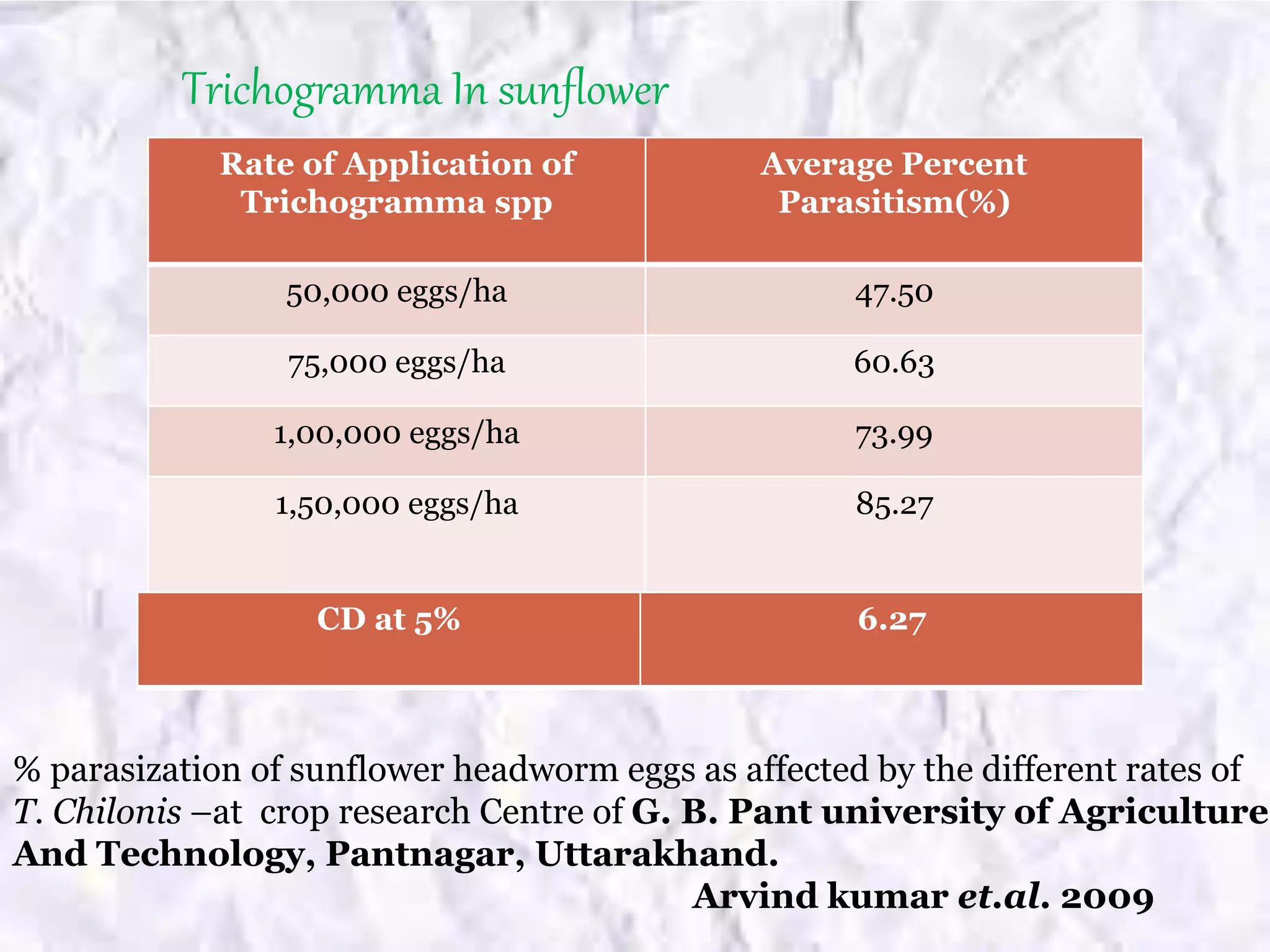
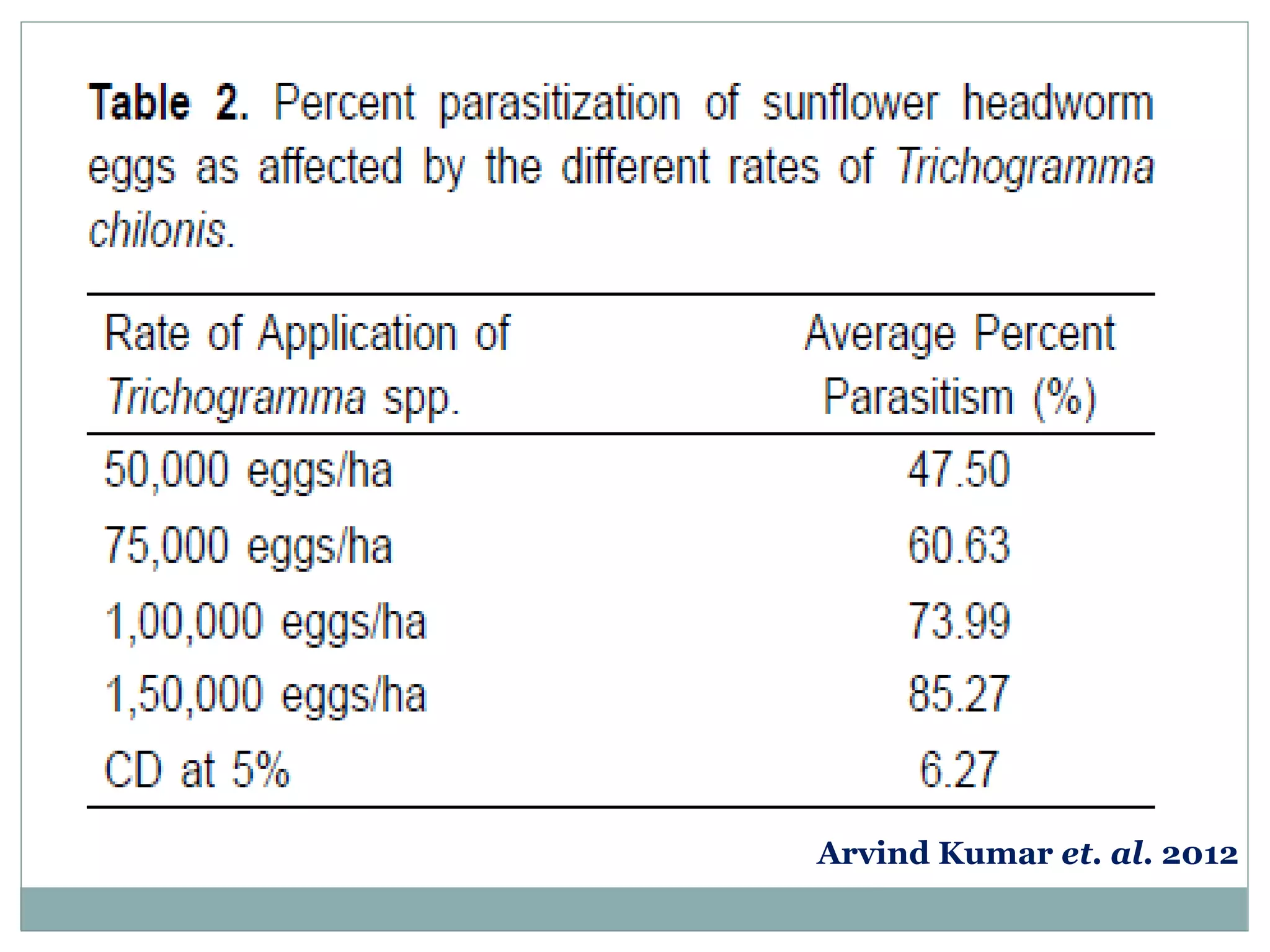
Trichogramma In sunflower
Rate of Application of
Trichogramma spp
Average Percent
Parasitism(%)
50,000 eggs/ha 47.50
75,000 eggs/ha 60.63
1,00,000 eggs/ha 73.99
1,50,000 eggs/ha 85.27
CD at 5% 6.27
% parasization of sunflower headworm eggs as affected by the different rates of
T. Chilonis –at crop research Centre of G. B. Pant university of Agriculture
And Technology, Pantnagar, Uttarakhand.
Arvind kumar et.al. 2009
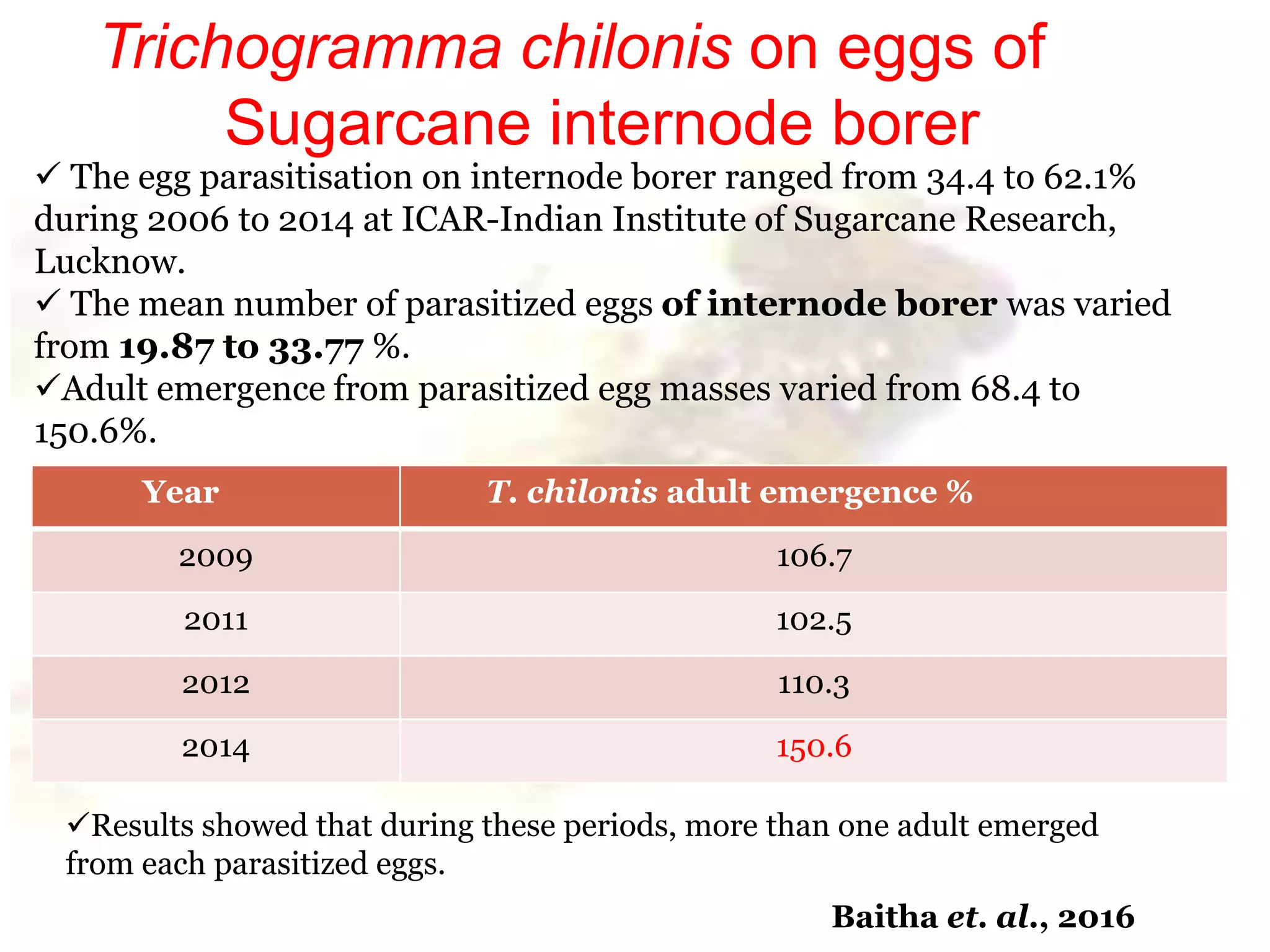
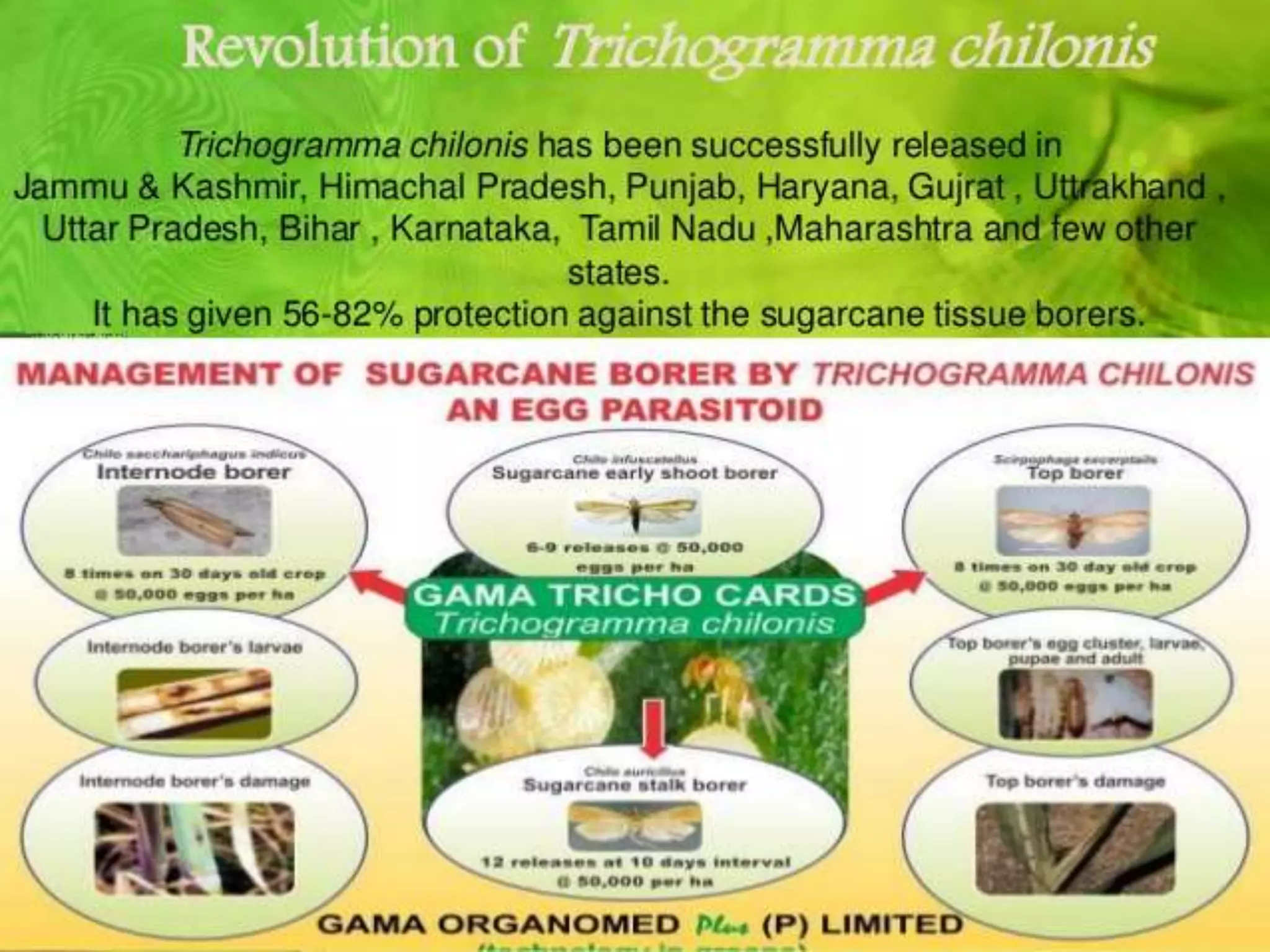
 The egg parasitisation on internode borer ranged from 34.4 to 62.1%
during 2006 to 2014 at ICAR-Indian Institute of Sugarcane Research,
Lucknow.
 The mean number of parasitized eggs of internode borer was varied
from 19.87 to 33.77 %.
Adult emergence from parasitized egg masses varied from 68.4 to
150.6%.
Trichogramma chilonis on eggs of
Sugarcane internode borer
Year T. chilonis adult emergence %
2009 106.7
2011 102.5
2012 110.3
2014 150.6
Results showed that during these periods, more than one adult emerged
from each parasitized eggs.
Baitha et. al., 2016
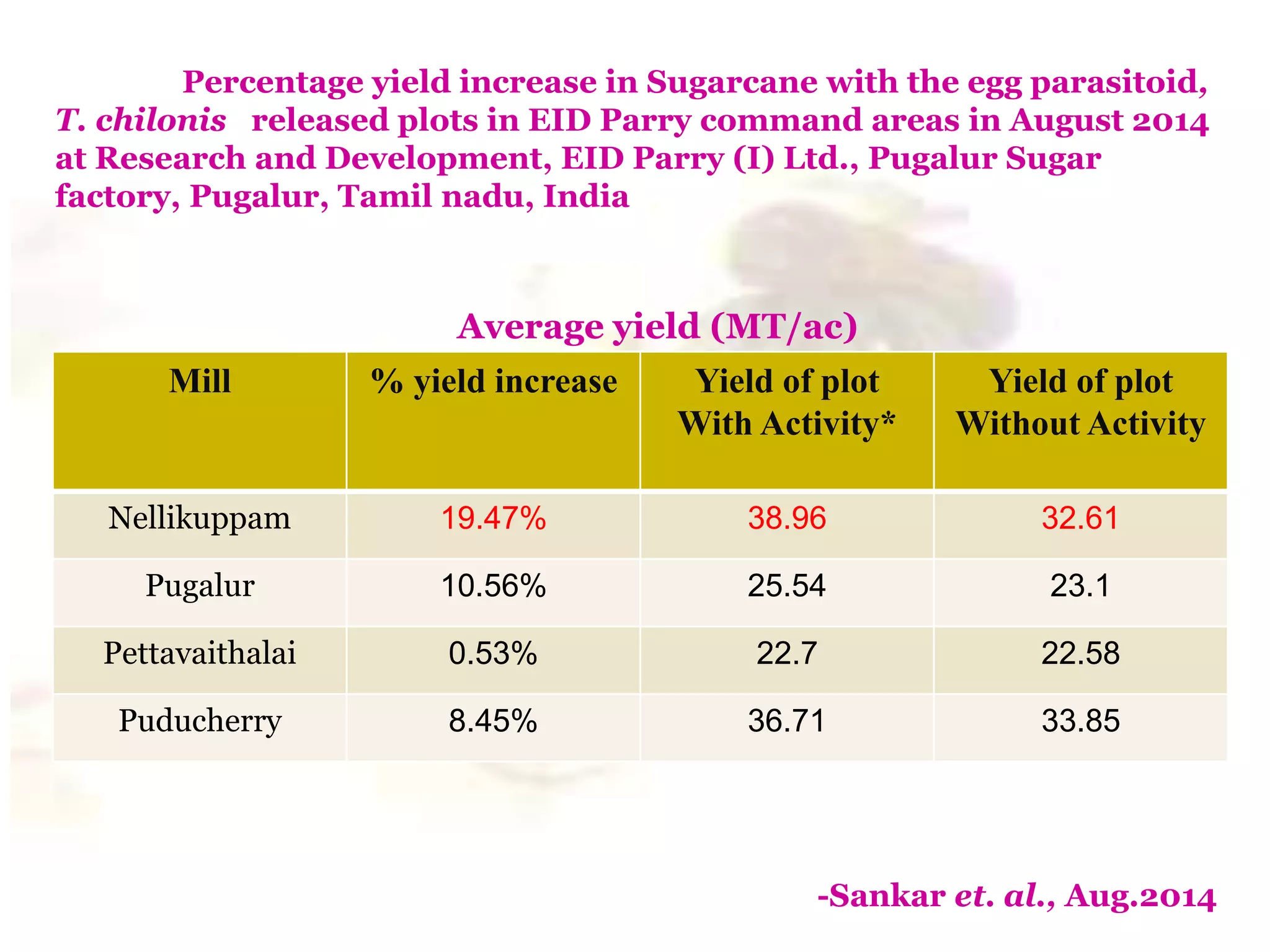
Percentage yield increase in Sugarcane with the egg parasitoid,
T. chilonis released plots in EID Parry command areas in August 2014
at Research and Development, EID Parry (I) Ltd., Pugalur Sugar
factory, Pugalur, Tamil nadu, India
Mill % yield increase Yield of plot
With Activity*
Yield of plot
Without Activity
Nellikuppam 19.47% 38.96 32.61
Pugalur 10.56% 25.54 23.1
Pettavaithalai 0.53% 22.7 22.58
Puducherry 8.45% 36.71 33.85
-Sankar et. al., Aug.2014
Average yield (MT/ac)
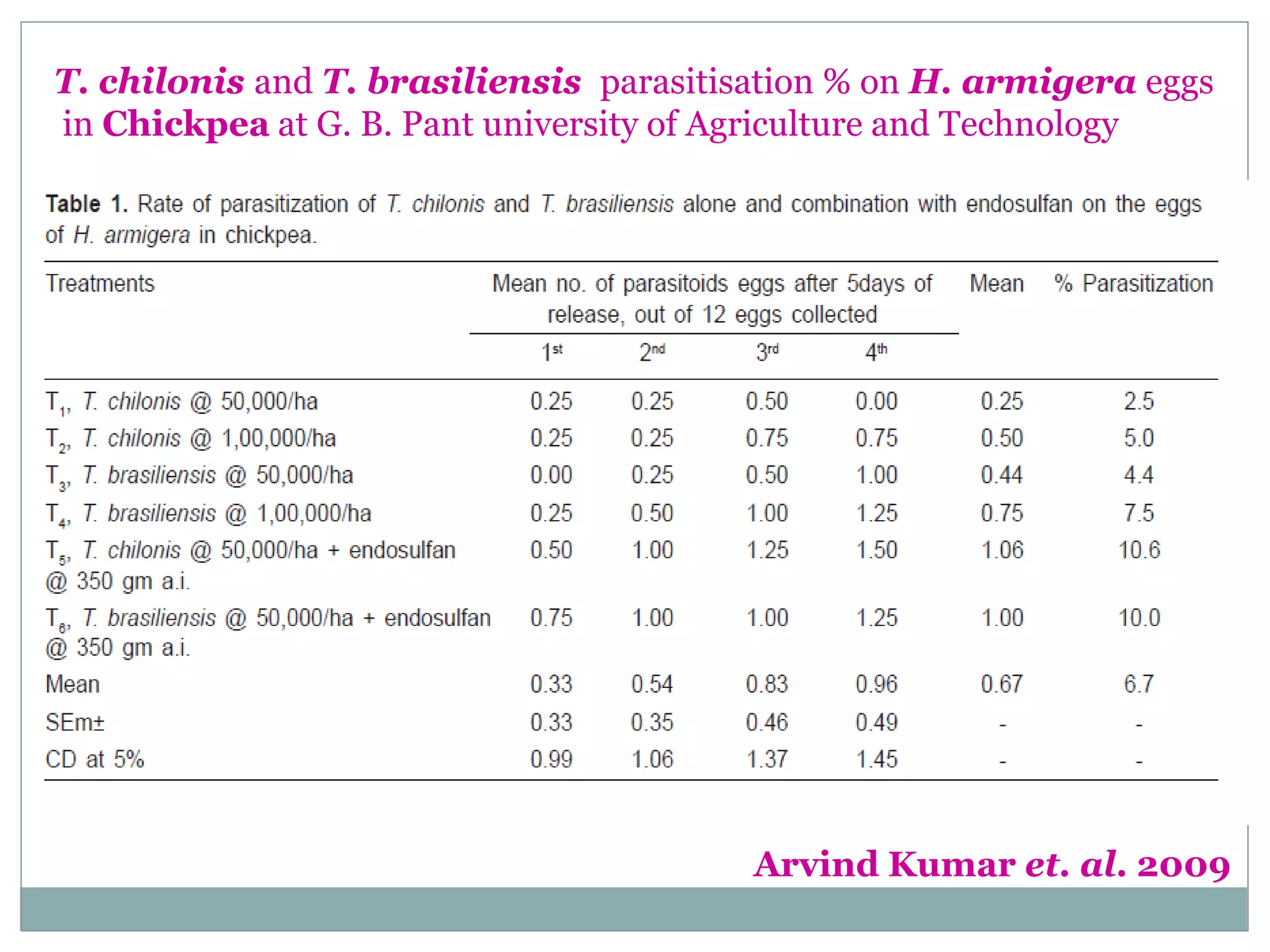
T. chilonis and T. brasiliensis parasitisation % on H. armigera eggs
in Chickpea at G. B. Pant university of Agriculture and Technology
Arvind Kumar et. al. 2009
T. chilonis and T. brasiliensis parasitisation % on H. armigera
eggs in Pigeonpea at G. B. Pant university of Agriculture and
Technology
Arvind Kumar et. al. 2009
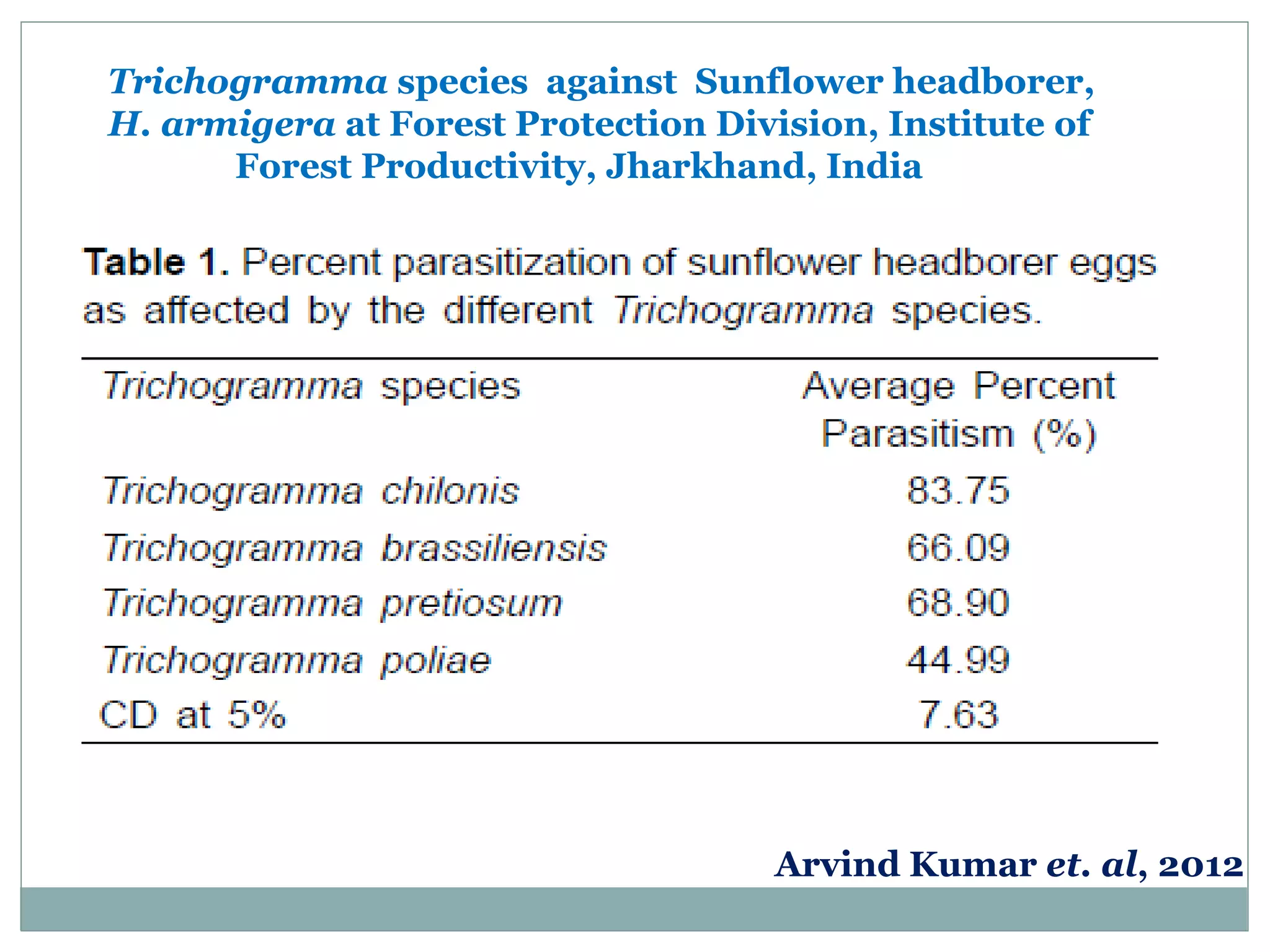
Trichogramma species against Sunflower headborer,
H. armigera at Forest Protection Division, Institute of
Forest Productivity, Jharkhand, India
Arvind Kumar et. al, 2012
Arvind Kumar et. al. 2012
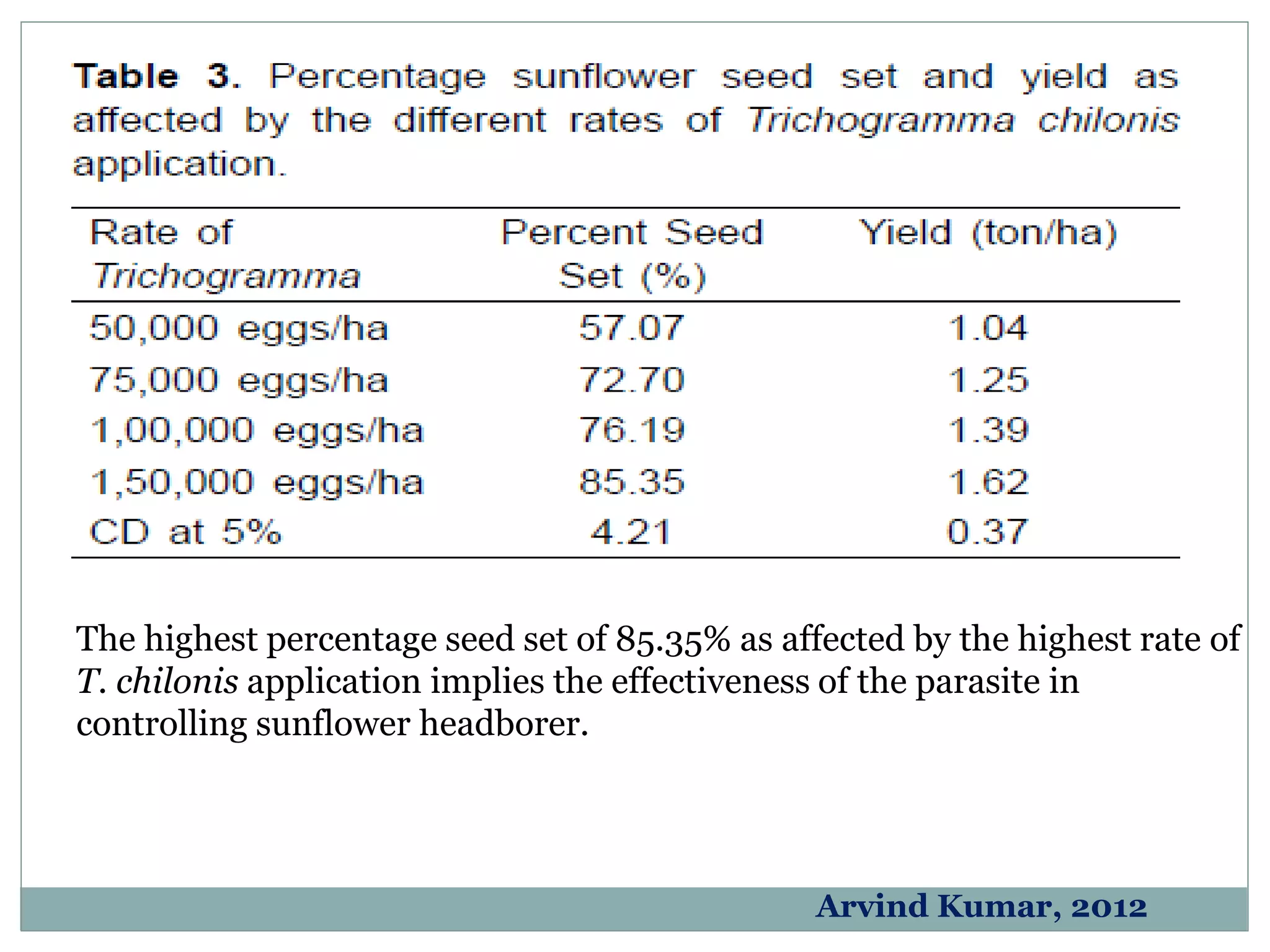
Arvind Kumar, 2012
The highest percentage seed set of 85.35% as affected by the highest rate of
T. chilonis application implies the effectiveness of the parasite in
controlling sunflower headborer.
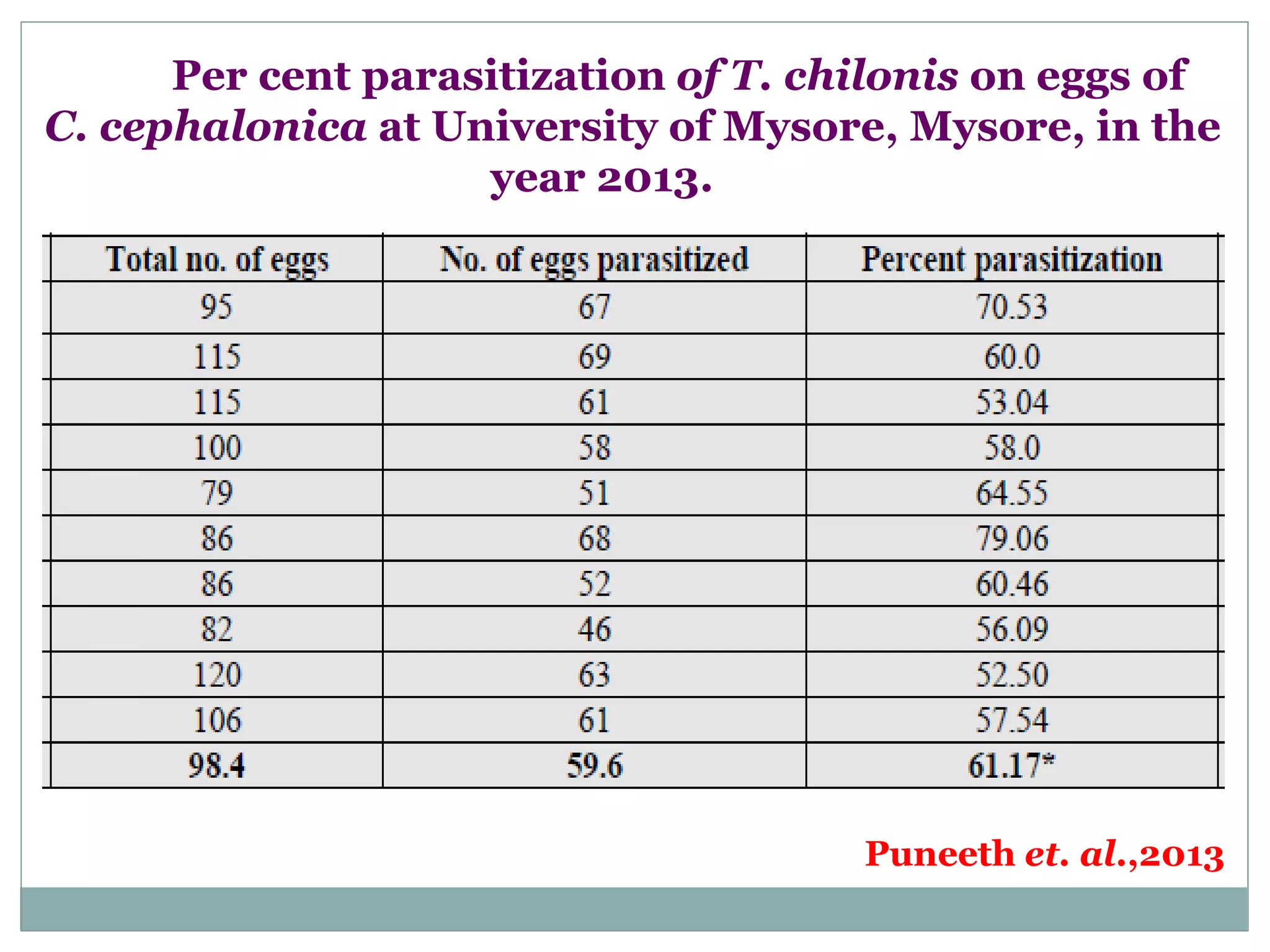
Per cent parasitization of T. chilonis on eggs of
C. cephalonica at University of Mysore, Mysore, in the
year 2013.
Puneeth et. al.,2013
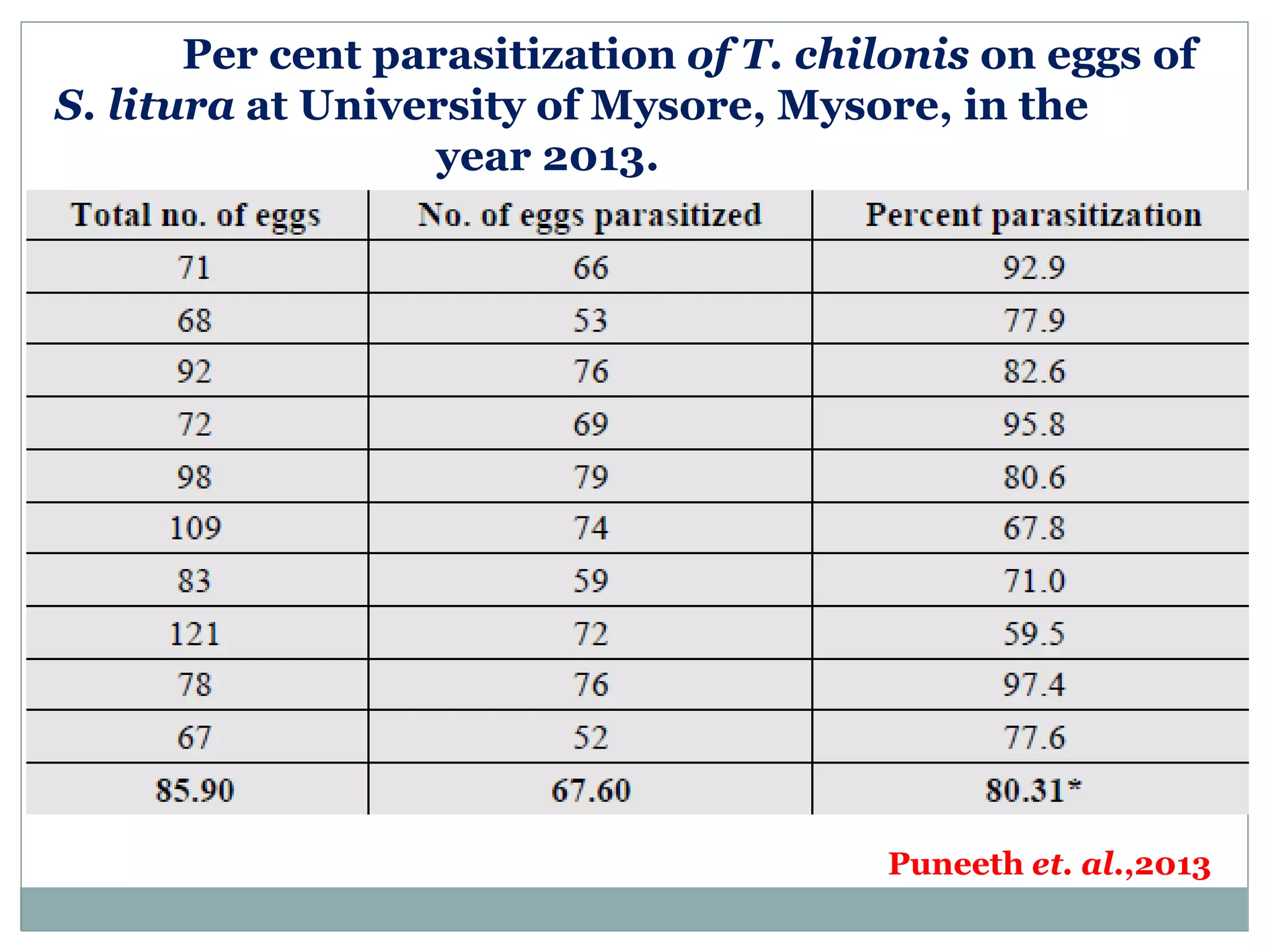
Per cent parasitization of T. chilonis on eggs of
S. litura at University of Mysore, Mysore, in the
year 2013.
Puneeth et. al.,2013
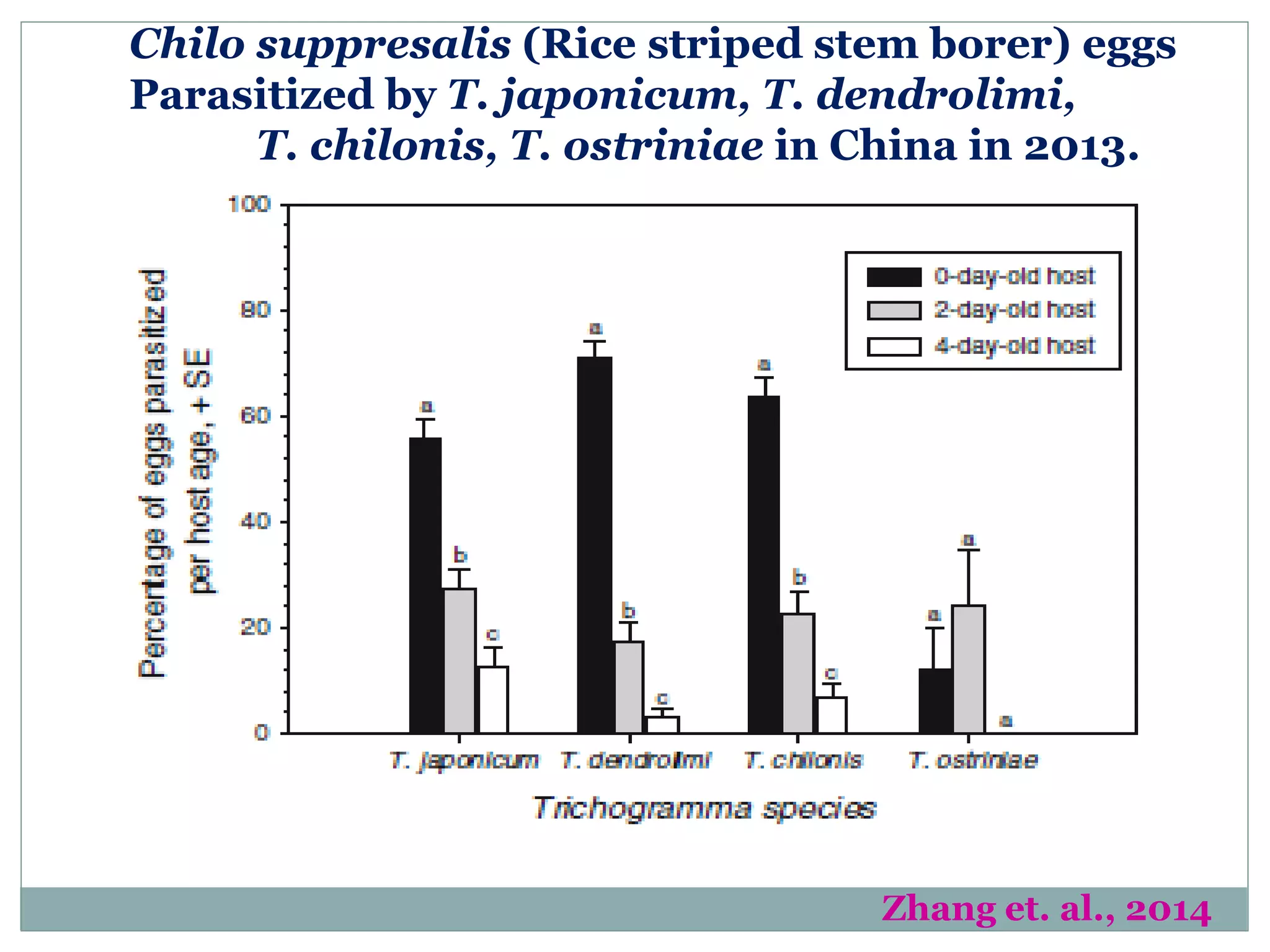
Chilo suppresalis (Rice striped stem borer) eggs
Parasitized by T. japonicum, T. dendrolimi,
T. chilonis, T. ostriniae in China in 2013.
Zhang et. al., 2014
The most difficult aspect of the bio-control processes is the
timing of field release.
 This is because of the many factors that influence the
effectiveness of the wasps, such as; environmental conditions,
the type of crop, use of pesticides, predation, the state of the
wasps after shipping and most significantly the varying egg
deposition periods of host species.
 Hassan (1982 cited in Smith 1996) has shown that a
release of the wasps a few days before the pest species lay
their eggs is most effective.
Constaints in use of trichogramma
 There are some issues associated with Trichogramma as an
insecticide replacement.
As with any form of biological control, non-target species and
persistence in the environment resulting in competition with
native species is a concern.
 There are also pitfalls associated with Trichogramma itself.
 Parasitism is a form of replaceable mortality (Knutson 1998),
that is to say the amount of eggs being parasitized by
Trichogramma replaces another type of mortality that the eggs
experience, predation, for example; and due to the short
lifespan of these wasps, maintaining the necessary population
levels in the field can be difficult (Knutson 1998).
Despite these issues Trichogramma has been deemed an
effective form of pest control (Smith 1996).
Use of this wasp family in Russia, China, Switzerland and
Canada has produced results that have reduced the need for
insecticides and increased crop values.
 This presentation shows that Trichogrammatidae is one of the large
family comprising , number of Trichogramma species parasitising the eggs
of different hosts .
Which are Considered as major and economic pests of crops such as rice,
sugarcane, Cruciferaceae vegetable, store grain pests, pigeon pea, Chickpea
etc.
It found beneficial means of biological control , not only in India but
also in the whole world.
And gives promising results of pest suppression of early stages of the
growth ; mainly lepidopteran order which is the 2nd large order of insects.
Its parasitization % sometimes reach to 100% depending upon
environmental condition, and host eggs age.
Thus , Trichogramma is found as good as insecticides ,and can be a
better replacement for the insecticidal use.
And in the real sence, it is actually a living insecticide………..
Seminar Trichogramma :a living insecticide?

Seminar Trichogramma :a living insecticide?

  • 2.
    Vasantrao Naik MarathwadaKrishi Vidyapith , Parbhani. Trichogramma : a living insecticide? Presented by SHIVANI SHANKAR CHUNKE REG.NO: 2015A / 64ML Submitted to Seminar in charge Dr. V.K. BHAMARE Assistant Professor, Dept. of Entomology College of Agriculture, Latur
  • 3.
    Trichogramma wasp  Tinywasp,size >1 mm.  Eggs deposites in host eggs.  Wasp larvae eats host eggs from inside. And parasitized eggs turn black.  8-10 days lifecycle.  Harmless to peoples and animals.  Adult wasps are nector feeders.
  • 4.
    Introduction Trichogrammatidae -840 species,and are so small that reproduction is carried out by parasitizing the eggs of other insects. Most important parasitoid for more than 100 years. Play important role in pest suppression programme by destroying the early stage of the pest. Curtailing the use of pesticides and contributing to prevent environmental pollution. More than 150 species of Trichogrammatids are distributed throughout the world parasitizing eggs of over 200 insect species.
  • 5.
     Belonging tomajor orders Lepidoptera, Coleoptera, Neuroptera and Diptera, the majority being Lepidoptera.  In India, 26 Trichogrammatids are recorded; out of which, 1. Trichogramma chilonis (Ishii), 2. T. japonicum (Ashmead) and 3. T. acheae 4. T. brasiliensis are of significant importance.  Worldwide over 32 million ha area under agricultural crops and forest are treated annually with different Trichogramma species in 19 countries.  Mostly in China and Republic of Soviet Union (Li, 1994).  Their levels of parasitism sometimes reach to 100 per cent depending upon the environmental conditions (Shahid et al., 2007).
  • 6.
    Species of trichogramma Used forparasitization of host eggs T. chilonis Mainly for lepidopteran pests, in sugarcane, corn, cotton, vegetables and fruits crops pests. T. japonicum Rice stem borer T. brasiliensis For lepidopteran pests on Chickpea and Pigeonpea. T. minutum For ornamentals, orchards, grapes pests and trees where the protective zone is five feet or more above ground level. T. platneri For avocados, ornamentals, orchards and grape pests. Species used
  • 7.
    Species of trichogramma Used forparasitization of host eggs T. brassicae For vegetable, orchards, gardens and field crops pests. T. pretiosum Best in vegetable gardens pests where the protective zone is five feet or less above ground level. T. dendrolimi Lepidopterous pests on cruciferous crops. T. evanescence Lepidopterous pests T. exiguam For cotton pests T. papilonis For citrus pests
  • 8.
    Adult of trichogrammais smaller than the host eggs which they parasitzes.
  • 9.
    How dose Trichogrammaactually Parasite on other host eggs Immediately after they hatch, female Trichogramma wasps begin their search for the egg of a ‘target species’.  Once host egg is found – through pheromones and visual cues.  The wasp drills a hole into the egg and deposits two to three eggs of her own.  How many of their own eggs to lay, is calculated by timing walks across moth egg surfaces. In a mere 24 hours, the wasps eggs hatch within the host egg and the larvae consume the yolk and embryo. The larvae then undergo three instars before a pupae stage.
  • 10.
     They emergingabout nine days after they were initially laid within the host egg (Knutson 1998). Trichogramma larvae eat out the insides of pest eggs, pupate, and cut an exit hole in moth egg shells for winged adults to squeeze through. Males emerge first, wait for females, and immediately mate. The life cycle from egg to adult is completed in 7 to 10 days (longer in cool weather).  Short life cycle -30 generations per season, and rapid population increase. Hence, early season releases produce large populations positioned to fight pest invasions.
  • 13.
    Introduction introduces theinsect en mass as a temporary measure to parasitize as many eggs as possible, i.e., as a chemical insecticide replacement. Augmentation is the supplementation of a naturally occurring species to boost numbers and effectiveness (similar to the hatchery process used with some fish).  Introduction  Augmentation Conservation involves some introduction but in lieu of a short term solution this method promotes environmental and crop management processes that increase population numbers of natural enemies of pest species, including the use of selective insecticides, and habitat provision. Conservation
  • 16.
    Trichogramma brassicae Biological Controlof  Pests of cole crops and Ostrinia nubilalis (European corn borer)  Provided ECB protection comparable with conventional management.
  • 17.
  • 18.
    Used for Pestsof sweet corn.  The goal is to provide commercially acceptable levels of ECB control for organic growers or other growers with a market for insecticide-free sweet corn.  Because T. ostriniae are very mobile, very good at finding hosts and hence they successfully reproduce in the field after they are released.  Growers who use chemical insecticides may be able to reduce the number of applications needed with a small early-season investment in Trichogramma wasps. Trichogramma ostriniae
  • 19.
    Parasitized European cornborer eggs by trichogramma ostriniae
  • 20.
    Year Farm/ Field Range of % Infestati on NTricho. Releases Range of % Parasitis m No . Of Bt Applicati on % Clean Ears 1997 K 2-28% 4 100% 2 100% R 17-44% 4 60-90% 2 78% L1 0-24% 4 90% 1 90% L2 7-10% 4 60-88% 1 91% 1998 T1 7-26% 3 100% 0 95% T2 12-30% 2 NO EM found 0 96% A1 4-32% 3 100 0 93% A2 13-36% 3 100 0 93%
  • 21.
    Year Farm/ Field Range of % Infestatio n NTricho. Releases Range of % Parasitis m No.of Bt Applic. % Clean Ears 1999 H 2-20% 3 100% 1 97 S1 0-2% 3 100% 0 99 S2 0-5% 3 80-100% 0 89 G 1-16% 3 100% 0 97 M 0-3% 3 100% 0 94 •Europian Corn Borer egg masses only • ** 1/17 ears infested with ECB, others were CEW and FAW IPM Prog
  • 22.
    Country Species of trichogrammaused Pests controlled. India T. Chilonis, T . Brasielensis, T. japonicum Mainly for lepidopteran pests China T. dendrolimi Oriental fruit moth in Peach orchard. Tunisia T. Bourarachae T. Oleae T. cacoeciae T. evanescens Carob moth, infest pomegranate fruit. U.S. T. ostriniae European corn borer (ECB) management in commercial sweet corn. North America - T. ostriniae organic crops Egypt T. evanescens Olive moth Russia, China and Mexico Trichogramma species. corn, cotton and tobacco pests.
  • 23.
    Trichogramma against ricepests T. chilonis and T. japonicum were evaluated against Cnaphalocrocis medinalis and Scirphophaga incertulus in aromatic rice under organic farming conditions. during 2012 and 2013 . Increased avarage yield of rice Q/ ha after 7 days release interval during 2012-2013 Dose/ha Increased yield of grains 1,00,000 eggs/ha 24.79 q/ ha 1,25,000 eggs/ha 26.21 q/ ha 1,50,000 eggs/ha 26.05 q/ha When the interval between releases increased to 14 days, the yields remained relatively stable in these doses (23.30-24.48 q/ha). Sharma et. al. Dec, 2014
  • 24.
    Dose of eggs/ha Reduced Damaged leaves Reduced Deadhearts (DH) Reduced White earheads (WE) 1,00,000 5.57% DL 2.00% DH 2.02% WE) 1,25,000 4.47% DL 1.77% DH 2.09% WE 1,50,000 4.04% DL 1.83% DH 2.12% WE 7 days release intervals were studied for the reduced incidence of damaged leaves (DL), dead hearts (DH) and white earheads (WE) in Rice fields. Dose of eggs/ha Damaged leaves (DL) Dead hearts (DH) White earheads (WE) 125000 5.83% DL 2.42% DH 2.32% WE 150000 5.45% DL 2.31% DH 2.34% WE Effective even at 14 day release interval Sharma et. al. Dec, 2014
  • 25.
    Trichogramma evanescens Against theolive moth Prays oleae (Bern.) in Egypt Field trials on the use of commercially available Trichogramma evanescens against the olive moth, Prays oleae (Bern.) (OM) were carried out for three successive years (2002–2004). To study efficacy of inundative releases of this wasp on damage reduction. Year OM attacks reduced % TE-treated trees yielded bigger fruits 2002 42.9 By 10.5% than untreated 2003 71 - 2004 69.9 12.5%
  • 26.
    Impact of T.evanescens releases on weight (g) and number of premature fall of olive fruits, percentage of damaged ripe fruits and fruit harvest/tree(kg) during 2002-2004 olive seasons. Agamy, 2010
  • 27.
    Agamy, 2010 Prays oleaelarvae/sample/tree on untreated and treated trees 340 260
  • 28.
    Parasitization by T.evanescens on H. armigera Eggs in Cotton in Cukurova Region of Turkey The noctuid Helicoverpa armigera has five generations in a year,  but only three attack cotton in the East Mediterranean region of Turkey. Releases of T. evanescens are made twice against each of the first three generations of H. armigera in the years of 2004–2005. Result after 120,000/ha T. evanescens parasitoids were released during 2004 and 2005 in cotton field at East Mediterranean region of Turkey Year Parasitism % No. of H. armigera larvae reduced in T. evanescens treated No. of H. armigera larvae reduced in insecticide treated field 2004 62.9% 76.8% 57.1% 2005 71.6% 80.6%, 77.1% - Oztemiz et. al.,2009
  • 29.
    On cotton bollwormeggs On Helicoverpa eggs
  • 30.
    Heliothis virescens (tobaccobudworm) is a key pest of cotton.  Chemical control is the main tactic to control H. virescens damage to cotton but widespread use of chemical and biological insecticides (such as Bacillus thuringiensis products) ultimately leads to the selection of resistant pest strains.  T. atopovirilia ,T. acacioi and T. Pretiosum were used for this purpose . Among that T. atopovirilia had significantly higher rates of parasitism of H. virescens eggs than the three other species.  Trichogramma alone can parasitize 80-96% of Heliothis (cotton bollworm, tobacco budworm, tomato fruitworm), alfalfa caterpillar, cabbage worm and other pest eggs (Lindgren, 1969). Trichogramma on cotton and tobacco pest
  • 31.
     Various biologicalcharacteristics (mean + SE) of Trichogramma brassicae, . Trichogramma species on the eggs of diamondback moth (Plutella xylostella L.)  T. brassicae, T. pintoi and T. embryophagum were investigated on eggs of diamondback moth, Plutella xylostella . Nadeem et. al. (2008) Highest parasitism rate was obtained for T. pintoi however no significant differences were observed among parasitism percentages of T. pintoi, T. brassicae and T. embryophagum
  • 32.
    Augmentative released biologicalcontrol of olive moth Four species of the egg parasitoid genus Trichogramma i.e. T. bourarachae T. cordubensis T. euproctidis T. evanescens. Mean percentage of parasitism of sentinel eggs on release and adjacent trees (10–12 m far from the release site) by each of four parasitoid species - Hegazi et. al. 2012 43 30 57 25 32 20 70 35
  • 33.
    Trichogramma japonicum Host eggs% Parasitization Corcyra cephalonica 95.33 ± 2.52 per cent Spodoptera litura 84.67 ± 2.51 per cent Helicoverpa armigera 26.33 ± 9.07 per cent  This parasitoid accepted eggs of all the hosts for parasitisation. -Bhargavi , 2015
  • 34.
    Dispersal ability andParasitization performance of Trichogramma species in organic basmati rice during 2012-2013 Host searching ability of T. chilonis and T. japonicum in organic Basmati rice Vertical bars on each point represents± SE at 5% Sharma et. al., 2014 At 1 m dist. from release point, Parasitism % highest than 10 m distance.
  • 35.
     Trichogramma destroyeggs of over 200 pest moth species . Cutworms, fruit worms, leaf worms, leafrollers, loopers, armyworms, borers etc. Preventing ravenous worms (caterpillars) from hatching out and devouring crops. On pandemic leaf roller Parasitised Cutworm eggs
  • 36.
    Trichogramma minutum T. minutumis best for eastern states.  Where it is native, overwinters, and colonizes all tiers of trees. It fights spruce budworm, codling moth (eastern orchards only), and has parasitized up to 90% of corn earworm eggs in the southeast
  • 37.
    Trichogramma bactrae Trichogramma bactrae,recently imported from Australia . To fight pink bollworm, has a wide host range.  Including Tomato pinworm, Potato tuber moth, Oriental fruit moth, Navel orange worm, peach twig borer, and diamondback moth.
  • 39.
  • 40.
     Today, Trichogrammaspecies are the most widely used insect natural enemy in the world , partly because they are easy to mass rear and they attack many important crop insect pests.  9 species of Trichogramma are reared in private or government owned insectaries around the world and released annually on an estimated 80 million acres of agricultural crops and forests in 30 countries (45, 61).  Trichogramma are released to control some 28 different caterpillar pests attacking corn, rice, sugarcane, cotton, vegetables, sugar beets, fruit trees and pine and spruce trees. FUTURE SCOPE Fruit damage ranged below 10% infested fruits and fruit yield was significantly increased on tress where wasps were applied.
  • 41.
    Most releases areto control corn borers, sugarcane borers and cotton bollworm has demonstrated the potential of this approach. Researchers in the U.S. are currently evaluating Trichogramma for the control of codling moth in apples and almonds, leafrollers in apples, European corn borer in corn, and bollworm/budworm in cotton . Former Soviet republics claim that 6-8,000 Trichogramma per acre produce 68% cutworm parasitism on wheat and sugar beets. The olive moth Prays oleae (Bern.) and Jasmin moth, Palpita unionalis (Hubner) are serious pests of mordern olive plantations in Egypt, causing significant yield loss by fruit fall as well as by damage on leaves, flowers and fruits. The egg parasitoid spp. T. bourarchae, T. cordubensis, T. euproctidis as well as commercially available T. evanecens were used and resulted that Trichogramma species accomplished higher egg parasitism (up to 91%) than the commercially strain .
  • 42.
    Trichogramma In sunflower Rateof Application of Trichogramma spp Average Percent Parasitism(%) 50,000 eggs/ha 47.50 75,000 eggs/ha 60.63 1,00,000 eggs/ha 73.99 1,50,000 eggs/ha 85.27 CD at 5% 6.27 % parasization of sunflower headworm eggs as affected by the different rates of T. Chilonis –at crop research Centre of G. B. Pant university of Agriculture And Technology, Pantnagar, Uttarakhand. Arvind kumar et.al. 2009
  • 44.
     The eggparasitisation on internode borer ranged from 34.4 to 62.1% during 2006 to 2014 at ICAR-Indian Institute of Sugarcane Research, Lucknow.  The mean number of parasitized eggs of internode borer was varied from 19.87 to 33.77 %. Adult emergence from parasitized egg masses varied from 68.4 to 150.6%. Trichogramma chilonis on eggs of Sugarcane internode borer Year T. chilonis adult emergence % 2009 106.7 2011 102.5 2012 110.3 2014 150.6 Results showed that during these periods, more than one adult emerged from each parasitized eggs. Baitha et. al., 2016
  • 45.
    Percentage yield increasein Sugarcane with the egg parasitoid, T. chilonis released plots in EID Parry command areas in August 2014 at Research and Development, EID Parry (I) Ltd., Pugalur Sugar factory, Pugalur, Tamil nadu, India Mill % yield increase Yield of plot With Activity* Yield of plot Without Activity Nellikuppam 19.47% 38.96 32.61 Pugalur 10.56% 25.54 23.1 Pettavaithalai 0.53% 22.7 22.58 Puducherry 8.45% 36.71 33.85 -Sankar et. al., Aug.2014 Average yield (MT/ac)
  • 47.
    T. chilonis andT. brasiliensis parasitisation % on H. armigera eggs in Chickpea at G. B. Pant university of Agriculture and Technology Arvind Kumar et. al. 2009
  • 48.
    T. chilonis andT. brasiliensis parasitisation % on H. armigera eggs in Pigeonpea at G. B. Pant university of Agriculture and Technology Arvind Kumar et. al. 2009
  • 49.
    Trichogramma species againstSunflower headborer, H. armigera at Forest Protection Division, Institute of Forest Productivity, Jharkhand, India Arvind Kumar et. al, 2012
  • 50.
  • 51.
    Arvind Kumar, 2012 Thehighest percentage seed set of 85.35% as affected by the highest rate of T. chilonis application implies the effectiveness of the parasite in controlling sunflower headborer.
  • 52.
    Per cent parasitizationof T. chilonis on eggs of C. cephalonica at University of Mysore, Mysore, in the year 2013. Puneeth et. al.,2013
  • 53.
    Per cent parasitizationof T. chilonis on eggs of S. litura at University of Mysore, Mysore, in the year 2013. Puneeth et. al.,2013
  • 54.
    Chilo suppresalis (Ricestriped stem borer) eggs Parasitized by T. japonicum, T. dendrolimi, T. chilonis, T. ostriniae in China in 2013. Zhang et. al., 2014
  • 55.
    The most difficultaspect of the bio-control processes is the timing of field release.  This is because of the many factors that influence the effectiveness of the wasps, such as; environmental conditions, the type of crop, use of pesticides, predation, the state of the wasps after shipping and most significantly the varying egg deposition periods of host species.  Hassan (1982 cited in Smith 1996) has shown that a release of the wasps a few days before the pest species lay their eggs is most effective. Constaints in use of trichogramma
  • 56.
     There aresome issues associated with Trichogramma as an insecticide replacement. As with any form of biological control, non-target species and persistence in the environment resulting in competition with native species is a concern.  There are also pitfalls associated with Trichogramma itself.  Parasitism is a form of replaceable mortality (Knutson 1998), that is to say the amount of eggs being parasitized by Trichogramma replaces another type of mortality that the eggs experience, predation, for example; and due to the short lifespan of these wasps, maintaining the necessary population levels in the field can be difficult (Knutson 1998).
  • 57.
    Despite these issuesTrichogramma has been deemed an effective form of pest control (Smith 1996). Use of this wasp family in Russia, China, Switzerland and Canada has produced results that have reduced the need for insecticides and increased crop values.
  • 59.
     This presentationshows that Trichogrammatidae is one of the large family comprising , number of Trichogramma species parasitising the eggs of different hosts . Which are Considered as major and economic pests of crops such as rice, sugarcane, Cruciferaceae vegetable, store grain pests, pigeon pea, Chickpea etc. It found beneficial means of biological control , not only in India but also in the whole world. And gives promising results of pest suppression of early stages of the growth ; mainly lepidopteran order which is the 2nd large order of insects. Its parasitization % sometimes reach to 100% depending upon environmental condition, and host eggs age. Thus , Trichogramma is found as good as insecticides ,and can be a better replacement for the insecticidal use. And in the real sence, it is actually a living insecticide………..