14 January 2016
The
Future
of Work
Policy Forum
JOIN THE DEBATE!
The
Future
of Work
WHERE DO YOU SEE THE
FUTURE OF WORK GOING?
The Honourable
MaryAnn Mihychuk
Minister of Employment,
Workforce Development,
and Labour - Canada
“
To help workers meet the challenges of
a changing world of work, the
government should offer adequate
training (and re-training) programmes,
promote apprenticeships and remove
punitive requirements for accessing
social safety nets.
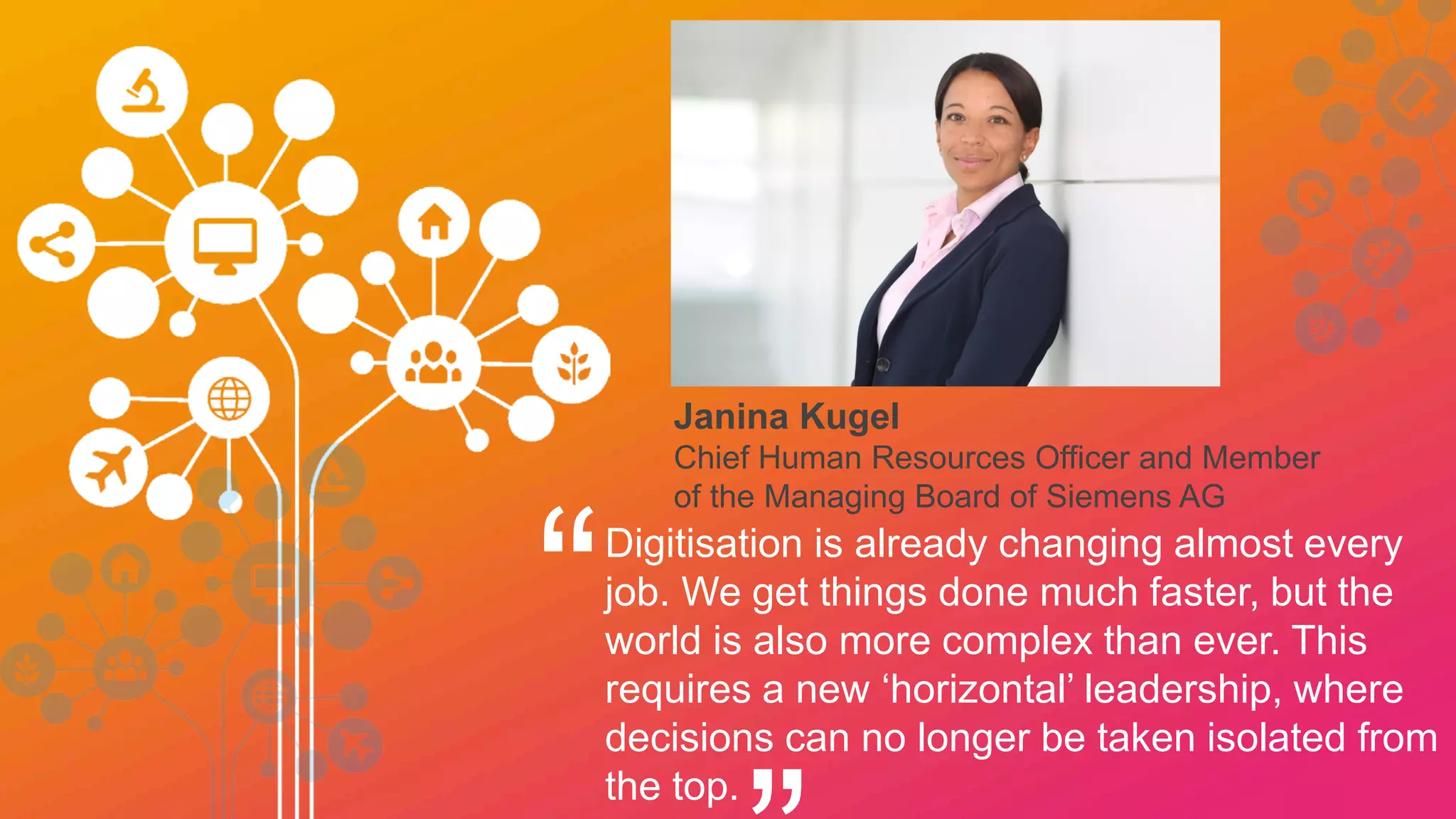
Janina Kugel
Chief Human Resources Officer and Member
of the Managing Board of Siemens AG
“Digitisation is already changing almost every
job. We get things done much faster, but the
world is also more complex than ever. This
requires a new ‘horizontal’ leadership, where
decisions can no longer be taken isolated from
the top.
David Plouffe
Senior Vice President of Policy and Strategy, Uber
“On-demand technology platforms will give
people more control over their jobs and
their lives, offering flexible work that
empowers them to decide where, when
and for how long they work.
Ms Irene Wennemo
State Secretary to the
Swedish Minister for
Employment
“
Modern labour markets are
increasingly dynamic, but the benefits
of flexibility should be coupled with
effective policies to fight inequality and
ensure that workers have sufficient
access to upskilling opportunities and
adequate safety nets.
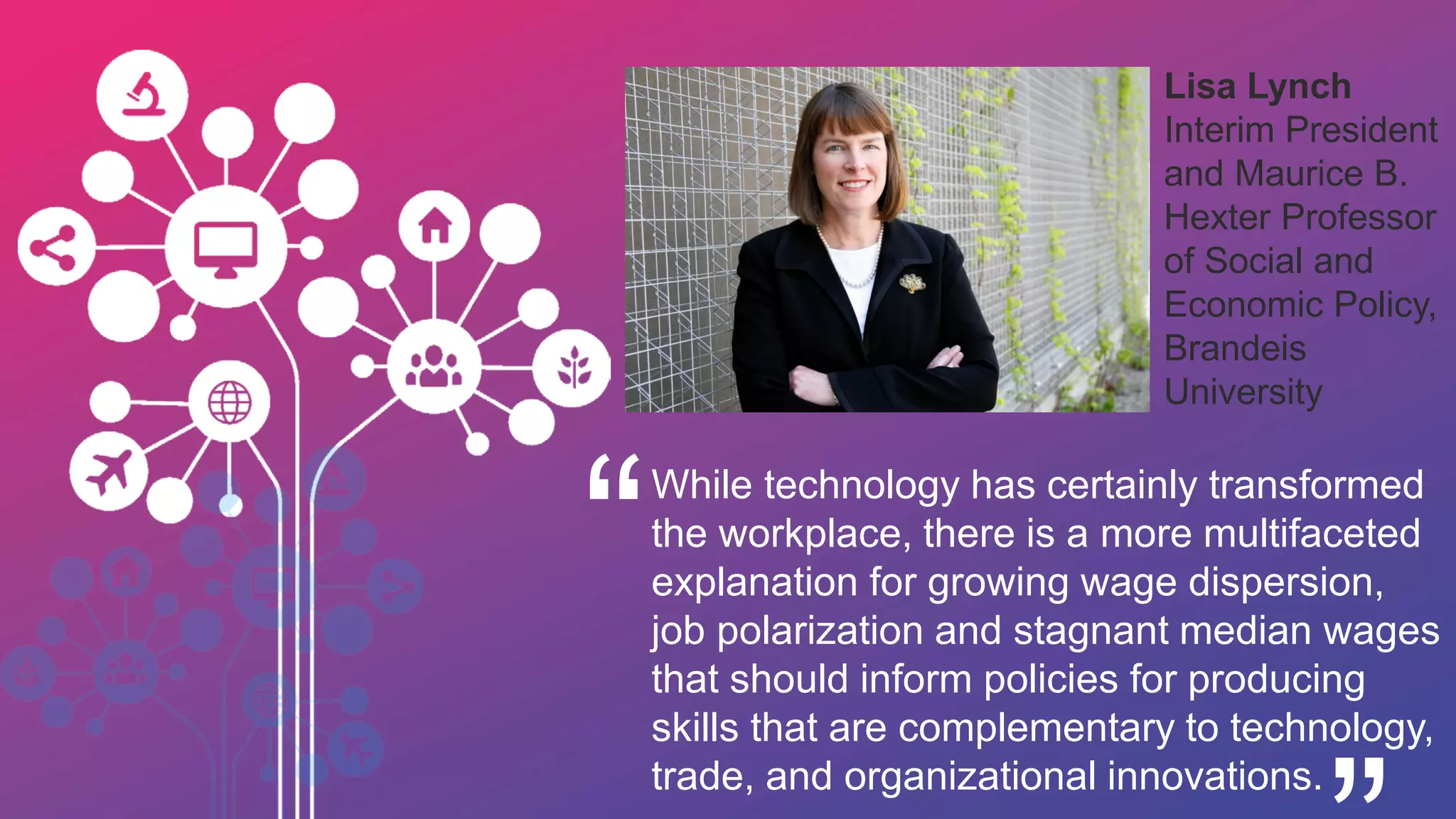
Lisa Lynch
Interim President
and Maurice B.
Hexter Professor
of Social and
Economic Policy,
Brandeis
University
“While technology has certainly transformed
the workplace, there is a more multifaceted
explanation for growing wage dispersion,
job polarization and stagnant median wages
that should inform policies for producing
skills that are complementary to technology,
trade, and organizational innovations.
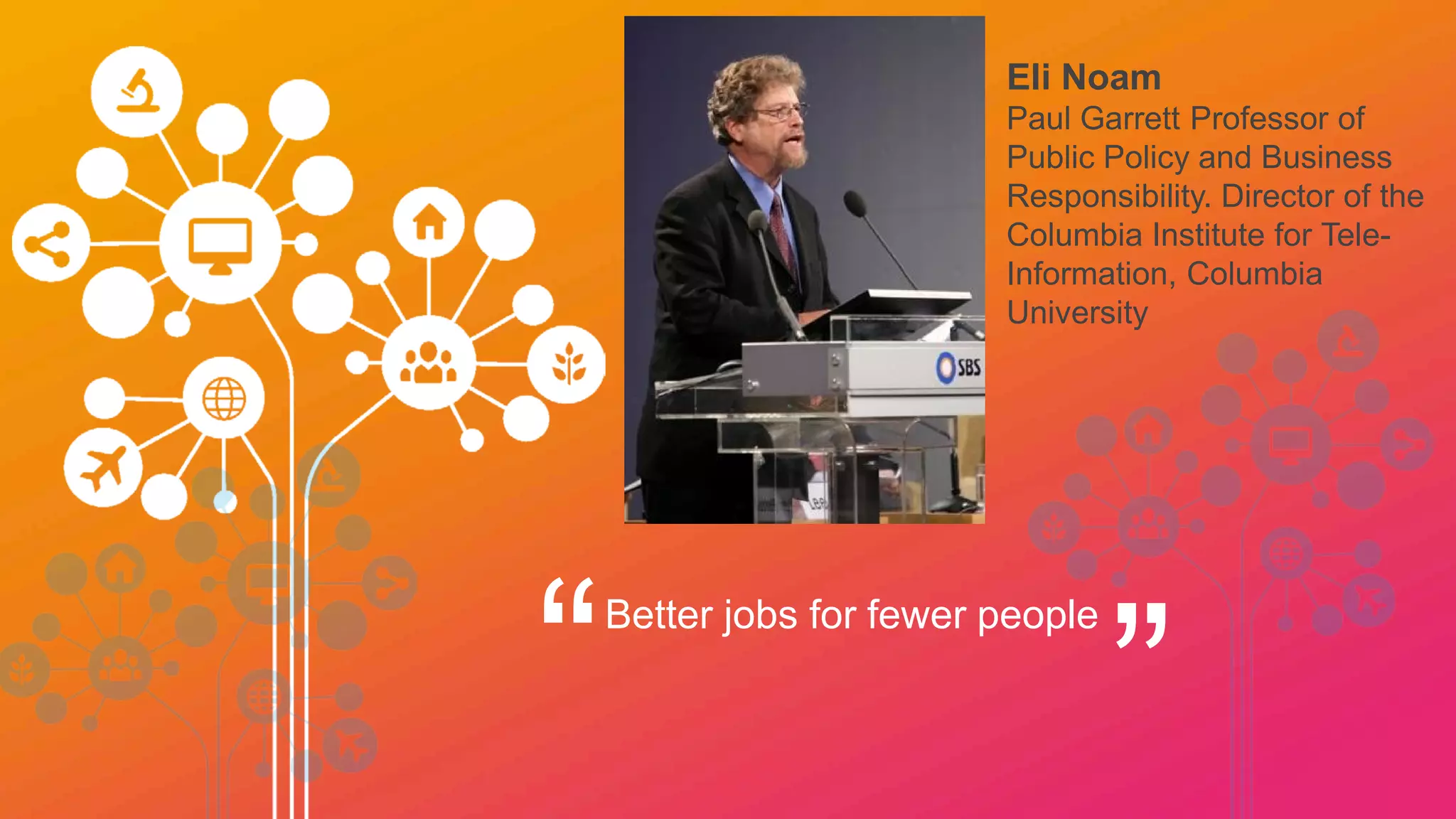
Eli Noam
Paul Garrett Professor of
Public Policy and Business
Responsibility. Director of the
Columbia Institute for Tele-
Information, Columbia
University
“Better jobs for fewer people
”
Giuseppe Recchi
Executive chairman
of Telecom Italia
and Fondazione
Telecome Italia
“I do not see the future of work in its
replacement or displacement by
technology but in the complementarity of
humans and machines. Smarter machines
and smarter people can complement each
other to create a mass of customized
products and services: the world of new
artisans.
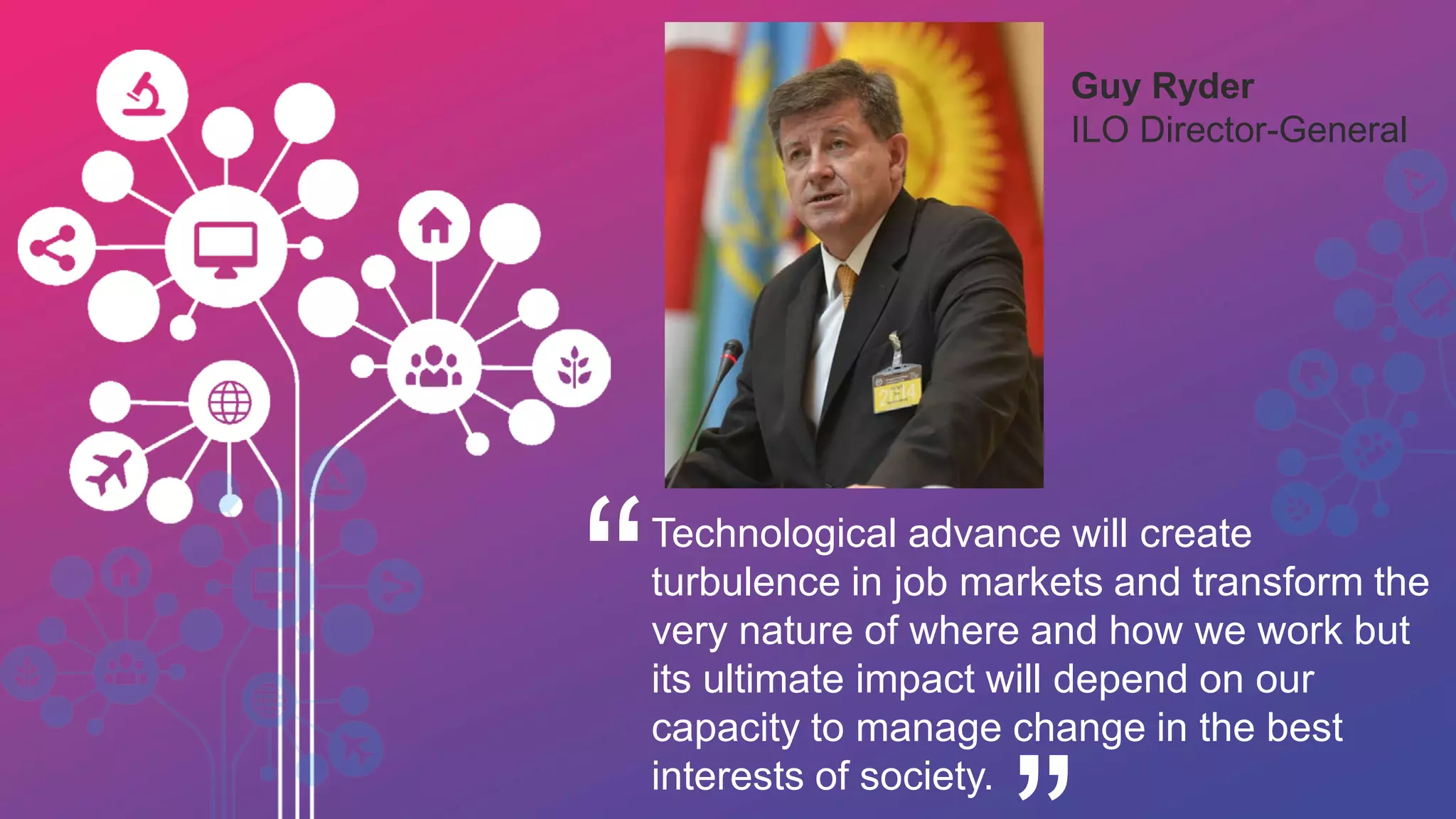
Guy Ryder
ILO Director-General
“Technological advance will create
turbulence in job markets and transform the
very nature of where and how we work but
its ultimate impact will depend on our
capacity to manage change in the best
interests of society.
The Rt Hon Priti Patel
Minister of State for
Employment – United
Kingdom
“
”
Employers also have
a big role to play for
people with health
conditions.
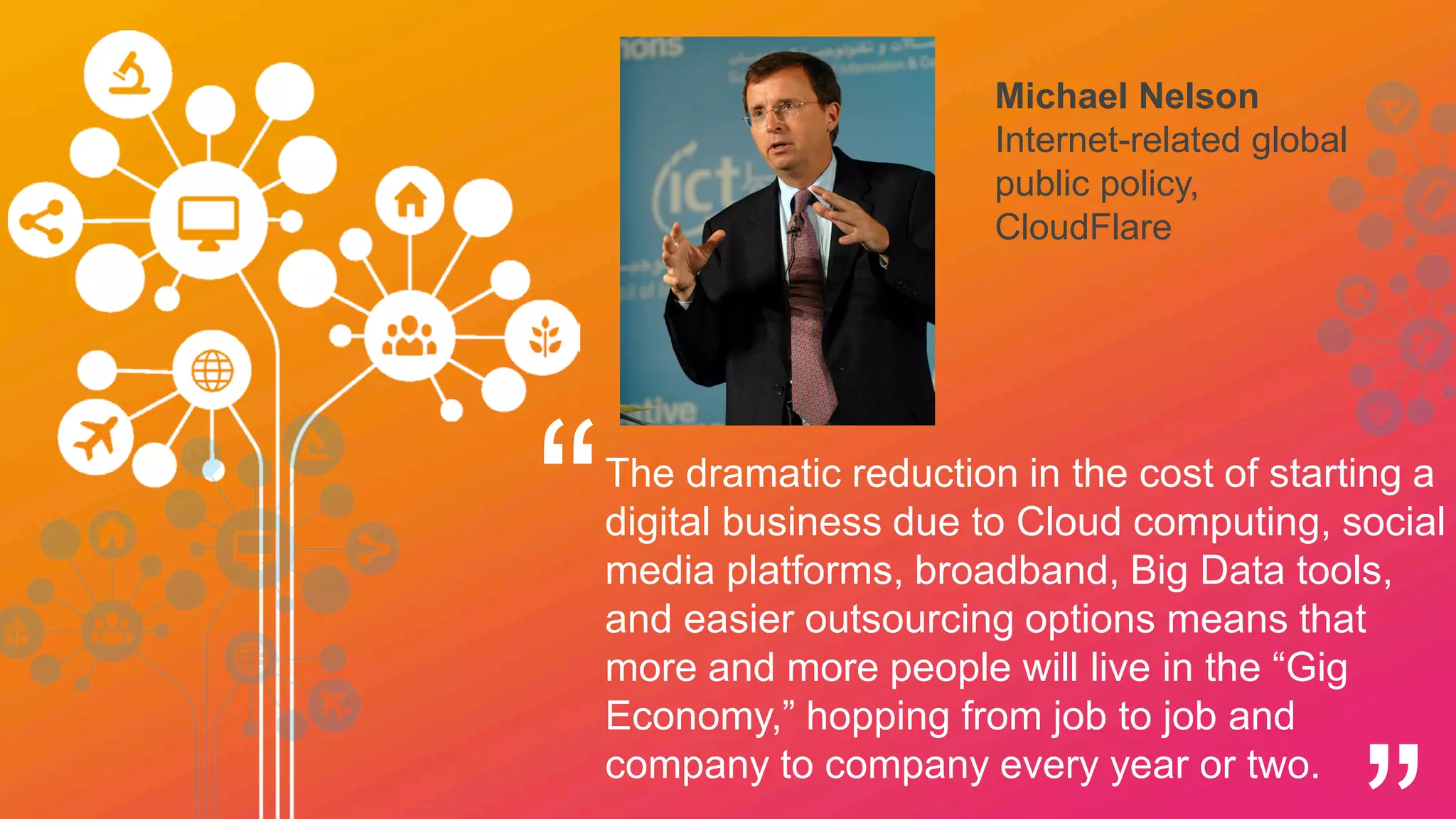
Michael Nelson
Internet-related global
public policy,
CloudFlare
“The dramatic reduction in the cost of starting a
digital business due to Cloud computing, social
media platforms, broadband, Big Data tools,
and easier outsourcing options means that
more and more people will live in the “Gig
Economy,” hopping from job to job and
company to company every year or two.
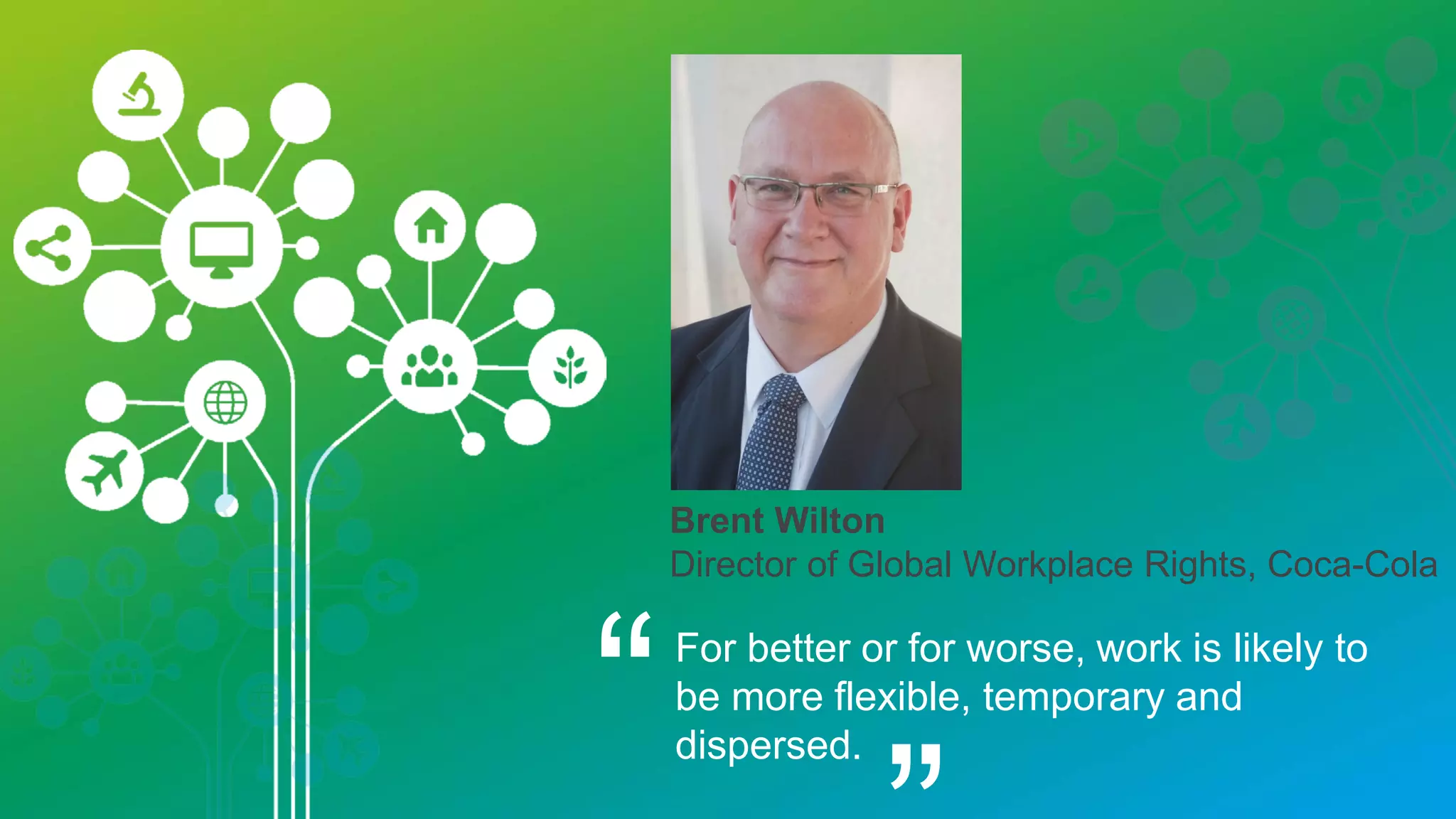
Brent Wilton
Director of Global Workplace Rights, Coca-Cola
“For better or for worse, work is likely to
be more flexible, temporary and
dispersed.
Marie-Gabrielle
Ineichen-Fleisch
State Secretary of Economic
Affairs, Switzerland
“We need to develop
VET at the tertiary
level but also improve
permeability with
academic education.
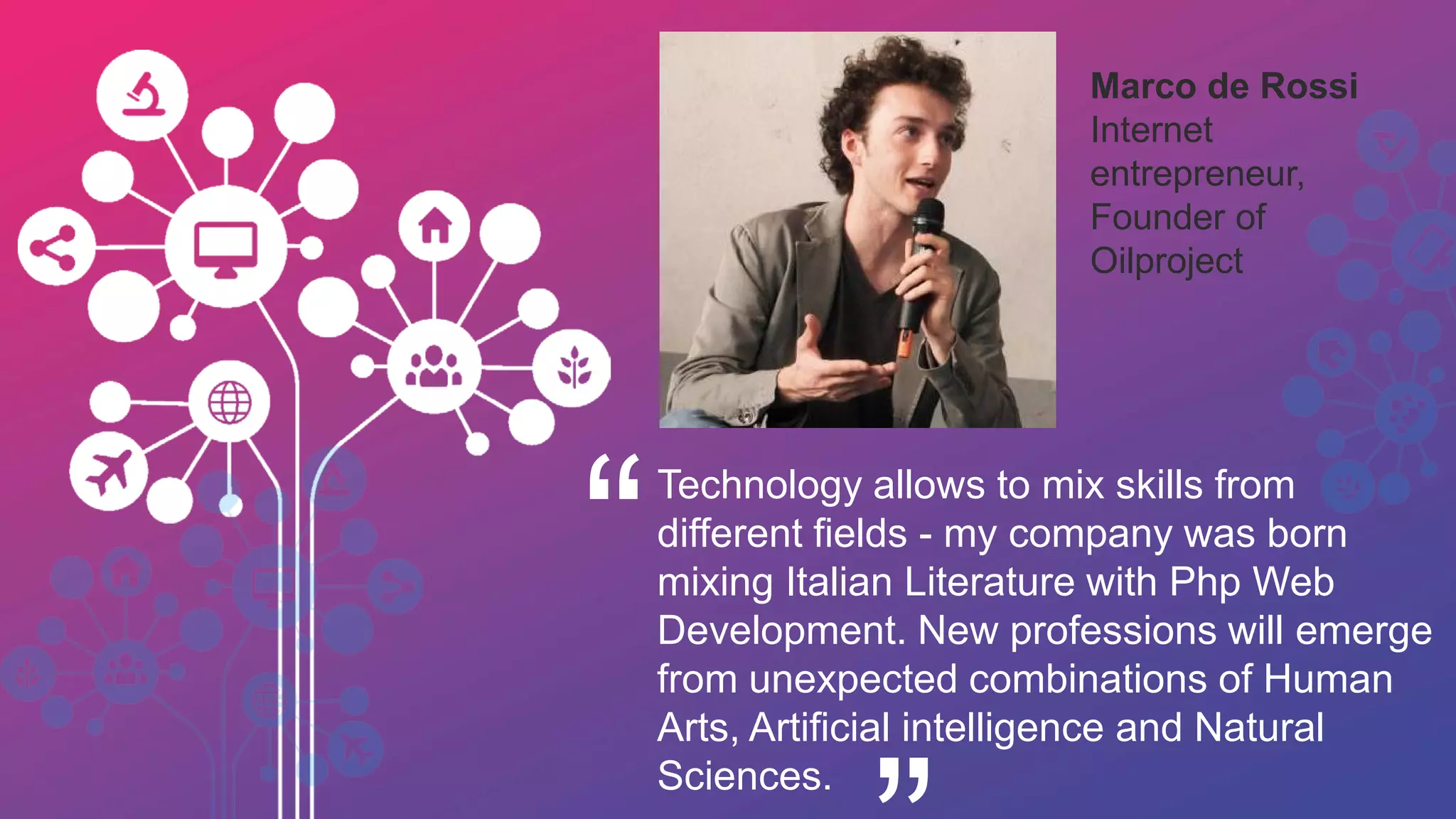
Marco de Rossi
Internet
entrepreneur,
Founder of
Oilproject
“Technology allows to mix skills from
different fields - my company was born
mixing Italian Literature with Php Web
Development. New professions will emerge
from unexpected combinations of Human
Arts, Artificial intelligence and Natural
Sciences.
Augustin Verlinde
Founder of Frizbiz
“
We are looking towards a more flexible, more
independent, more collaborative way to work. It will be run
by a generation with new values, and new expectations.
Our generation wants to lead their life, and work smarter.
To make it possible, we need smart regulation for a smart
development. New technology and digitisation will help
this work transition, and make the best use towards higher
value and digitised opportunities.
Ms. Andrea Nahles
Federal Minister of Labour and
Social Affairs - Germany
“
There are a number of things that the government
can do to adapt to the changes brought about by
digitalisation, but I expect employers also to accept
their responsibilities. (…) New businesses need to
play the game and be socially responsible. Let’s not
create a parallel universe in the world of work
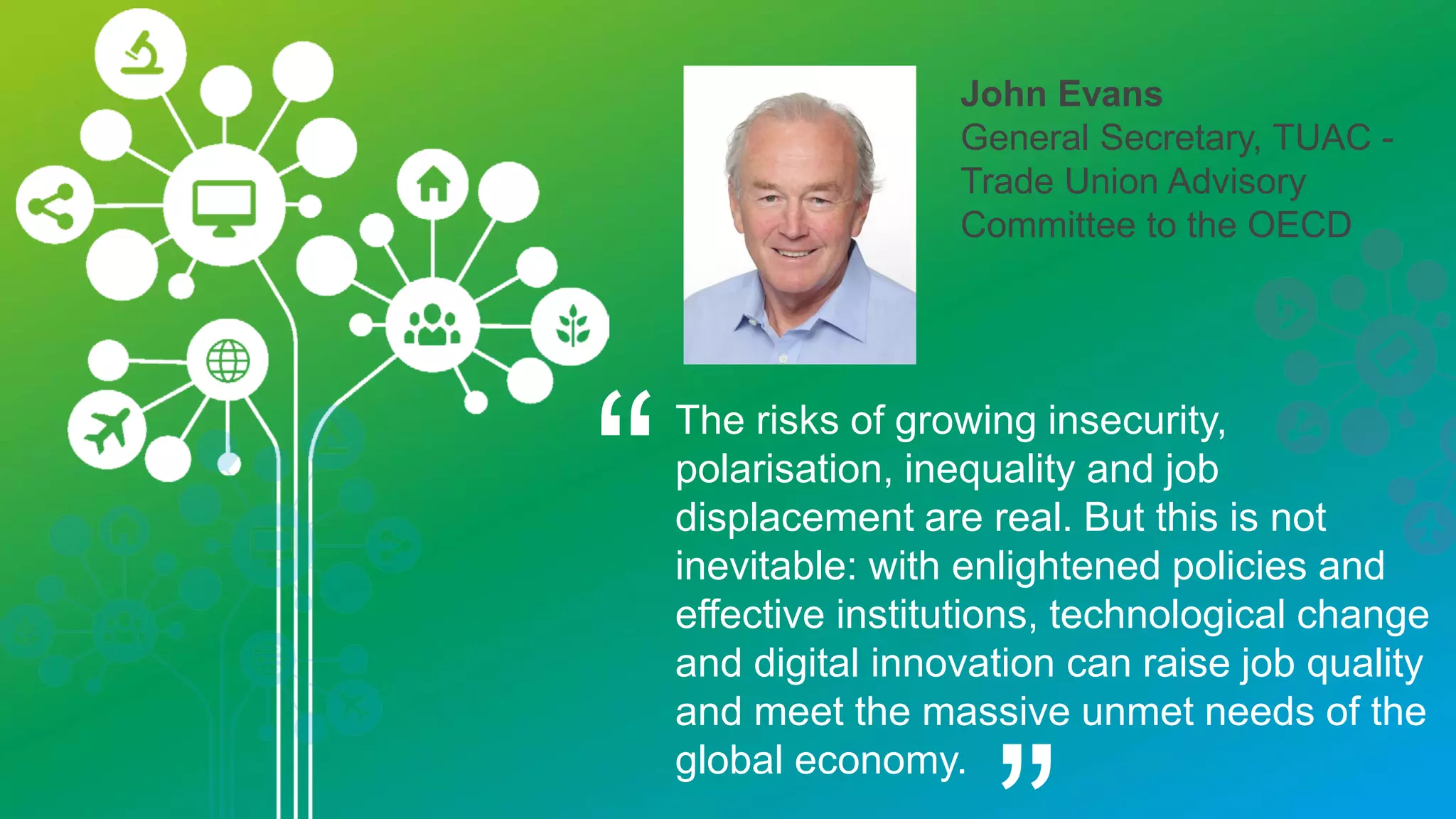
John Evans
General Secretary, TUAC -
Trade Union Advisory
Committee to the OECD
“
The risks of growing insecurity,
polarisation, inequality and job
displacement are real. But this is not
inevitable: with enlightened policies and
effective institutions, technological change
and digital innovation can raise job quality
and meet the massive unmet needs of the
global economy.
Philip Jennings
General Secretary of UNI Global Union
“
It’s time for the world of digital
capitalism to take the impacts on jobs and
social justice seriously.
Mr. Thomas Perez
Secretary of Labor – United
States
“In the United States we need
to make sure that economic
growth results in shared
prosperity
William Spriggs
Chief Economist to the
AFL-CIO, Professor of
Economics at Howard
University
“
The great challenge of technology to labor markets
and equality is brought about from policies keeping
unemployment high, wages and the collective voice
of workers low. This will turn technology from
advancing society as it did in the middle of the 20th
Century to rent seeking, lower labor standards and
wages in the 21st Century if we do not change our
policies soon.
Jacques van den Broek
CEO and chairman of the
Executive Board of Randstad
Holding nv
“The future of work will bring radical
change for talent, companies and society,
a change where the digitalisation is
disrupting many traditional approaches
from education to employment; we all
need to be prepared, start today by having
an agile plan, act on it and adapt - not
easy but it can be done.
Mr. Nkosi, Sango Phathekile
Holomisa
Deputy Minister of Labour –
South Africa
“How can we extend
comprehensive social
security to the entire
workforce?
Bernd Liepert
CIO, KUKA AG and
President euRobotics
“Robots will work with people, enabling them to realize
their full potential while also reducing boring and
physically demanding tasks. Facing a decreasing and
aging workforce, robots are the only means to increase
productivity and to offer more rewarding job
opportunities to our workers. Future generations will be
robotic natives. They will naturally work with robots as
we do today with computers and smartphones.
Robots will assist and interact with
people in their everyday lives at
home, at public places and at work,
increasing quality of life.
The
Future
of Work
FIND OUT MORE AT
oe.cd/future-of-work

Slide reel future of work 2016

  • 1.
  • 2.
    JOIN THE DEBATE! The Future ofWork WHERE DO YOU SEE THE FUTURE OF WORK GOING?
  • 3.
    The Honourable MaryAnn Mihychuk Ministerof Employment, Workforce Development, and Labour - Canada “ To help workers meet the challenges of a changing world of work, the government should offer adequate training (and re-training) programmes, promote apprenticeships and remove punitive requirements for accessing social safety nets.
  • 4.
    Janina Kugel Chief HumanResources Officer and Member of the Managing Board of Siemens AG “Digitisation is already changing almost every job. We get things done much faster, but the world is also more complex than ever. This requires a new ‘horizontal’ leadership, where decisions can no longer be taken isolated from the top.
  • 5.
    David Plouffe Senior VicePresident of Policy and Strategy, Uber “On-demand technology platforms will give people more control over their jobs and their lives, offering flexible work that empowers them to decide where, when and for how long they work.
  • 6.
    Ms Irene Wennemo StateSecretary to the Swedish Minister for Employment “ Modern labour markets are increasingly dynamic, but the benefits of flexibility should be coupled with effective policies to fight inequality and ensure that workers have sufficient access to upskilling opportunities and adequate safety nets.
  • 7.
    Lisa Lynch Interim President andMaurice B. Hexter Professor of Social and Economic Policy, Brandeis University “While technology has certainly transformed the workplace, there is a more multifaceted explanation for growing wage dispersion, job polarization and stagnant median wages that should inform policies for producing skills that are complementary to technology, trade, and organizational innovations.
  • 8.
    Eli Noam Paul GarrettProfessor of Public Policy and Business Responsibility. Director of the Columbia Institute for Tele- Information, Columbia University “Better jobs for fewer people ”
  • 9.
    Giuseppe Recchi Executive chairman ofTelecom Italia and Fondazione Telecome Italia “I do not see the future of work in its replacement or displacement by technology but in the complementarity of humans and machines. Smarter machines and smarter people can complement each other to create a mass of customized products and services: the world of new artisans.
  • 10.
    Guy Ryder ILO Director-General “Technologicaladvance will create turbulence in job markets and transform the very nature of where and how we work but its ultimate impact will depend on our capacity to manage change in the best interests of society.
  • 11.
    The Rt HonPriti Patel Minister of State for Employment – United Kingdom “ ” Employers also have a big role to play for people with health conditions.
  • 12.
    Michael Nelson Internet-related global publicpolicy, CloudFlare “The dramatic reduction in the cost of starting a digital business due to Cloud computing, social media platforms, broadband, Big Data tools, and easier outsourcing options means that more and more people will live in the “Gig Economy,” hopping from job to job and company to company every year or two.
  • 13.
    Brent Wilton Director ofGlobal Workplace Rights, Coca-Cola “For better or for worse, work is likely to be more flexible, temporary and dispersed.
  • 14.
    Marie-Gabrielle Ineichen-Fleisch State Secretary ofEconomic Affairs, Switzerland “We need to develop VET at the tertiary level but also improve permeability with academic education.
  • 15.
    Marco de Rossi Internet entrepreneur, Founderof Oilproject “Technology allows to mix skills from different fields - my company was born mixing Italian Literature with Php Web Development. New professions will emerge from unexpected combinations of Human Arts, Artificial intelligence and Natural Sciences.
  • 16.
    Augustin Verlinde Founder ofFrizbiz “ We are looking towards a more flexible, more independent, more collaborative way to work. It will be run by a generation with new values, and new expectations. Our generation wants to lead their life, and work smarter. To make it possible, we need smart regulation for a smart development. New technology and digitisation will help this work transition, and make the best use towards higher value and digitised opportunities.
  • 17.
    Ms. Andrea Nahles FederalMinister of Labour and Social Affairs - Germany “ There are a number of things that the government can do to adapt to the changes brought about by digitalisation, but I expect employers also to accept their responsibilities. (…) New businesses need to play the game and be socially responsible. Let’s not create a parallel universe in the world of work
  • 18.
    John Evans General Secretary,TUAC - Trade Union Advisory Committee to the OECD “ The risks of growing insecurity, polarisation, inequality and job displacement are real. But this is not inevitable: with enlightened policies and effective institutions, technological change and digital innovation can raise job quality and meet the massive unmet needs of the global economy.
  • 19.
    Philip Jennings General Secretaryof UNI Global Union “ It’s time for the world of digital capitalism to take the impacts on jobs and social justice seriously.
  • 20.
    Mr. Thomas Perez Secretaryof Labor – United States “In the United States we need to make sure that economic growth results in shared prosperity
  • 21.
    William Spriggs Chief Economistto the AFL-CIO, Professor of Economics at Howard University “ The great challenge of technology to labor markets and equality is brought about from policies keeping unemployment high, wages and the collective voice of workers low. This will turn technology from advancing society as it did in the middle of the 20th Century to rent seeking, lower labor standards and wages in the 21st Century if we do not change our policies soon.
  • 22.
    Jacques van denBroek CEO and chairman of the Executive Board of Randstad Holding nv “The future of work will bring radical change for talent, companies and society, a change where the digitalisation is disrupting many traditional approaches from education to employment; we all need to be prepared, start today by having an agile plan, act on it and adapt - not easy but it can be done.
  • 23.
    Mr. Nkosi, SangoPhathekile Holomisa Deputy Minister of Labour – South Africa “How can we extend comprehensive social security to the entire workforce?
  • 24.
    Bernd Liepert CIO, KUKAAG and President euRobotics “Robots will work with people, enabling them to realize their full potential while also reducing boring and physically demanding tasks. Facing a decreasing and aging workforce, robots are the only means to increase productivity and to offer more rewarding job opportunities to our workers. Future generations will be robotic natives. They will naturally work with robots as we do today with computers and smartphones. Robots will assist and interact with people in their everyday lives at home, at public places and at work, increasing quality of life.
  • 25.
    The Future of Work FIND OUTMORE AT oe.cd/future-of-work