Social Media is the democratization of information,
transforming people from content readers and
consumers into content publishers.
Social media is a CONVERSATION between…
•  Internet forums/groups   •  Vlogs
•  Social networks          •  Social tagging
•  Blogs                    •  Social bookmarking
•  Wikis                    •  Micro-blogging
•  Podcasts                 •  Virtual communities
•  File/data-sharing        •  RSS feeds
TRADITIONAL                      SOCIAL
Driven and controlled by         Driven and controlled by users
editors and publishers

Based on a one-to-many           Based on a many-to-many
model (also called a broadcast   model, rooted in conversations
model)

Government regulation and        Democracy of users and no
censorship                       censorship restraints

Limited channels of              Endless channels of
information                      information
•  Years to Reach 50 millions Users:
    •  Radio (38 Years)
    •  TV (13 Years)
    •  Internet (4 Years)
    •  iPod (3 Years)
    •  Facebook added 100 million users in less than 9 months
    •  iPhone applications hit 1 billion in 9 months
•  If Facebook were a country it would be the world’s 3rd largest between
   the United States and Indonesia
•  Facebook users spend 5 billion minutes on the site each day
•  20 hours of video are uploaded to YouTube every minute
•  One billionth Tweet in 2008. 13.1 billion currently
•    For people who are deeply immersed in social media, social
     networks are already a much heavier influence on personal choices
     than traditional advertising
•    53% of people say that blog content influences purchase decisions
•    78% of consumers say they trust other consumers' recommendations
     over all advertising/marketing avenues
•    According to IPG Emerging Media Lab, 87% of online community
     members report participating in social causes that are new to them
     since their involvement in online communities began
•    Social media is a potential growth area through which major donors
     can be cultivated. The Social Media for Social Causes Study found
     that 84% of the “social media savvy” aged 30-49 and 55% of those
     older than 50 have used social media to discuss philanthropy.
•  Expand and extend marketing campaigns
•  Improve customer service
•  Manage crisis communications/online reputation
   management
•  Solicit feedback from the public
•  Build relationships with employees, donors, volunteers,
   influencers, fans/supporters, lawmakers and citizens
•  Create buzz
•  Establish yourself as an expert
•  Free-access social networking Web site that connects
   people with friends and others who work, study and live
   around them
•  Users can join networks organized by city,
   workplace, school, and region to connect and interact
   with other people
•  People can also add friends, send them messages,
   and update their personal profiles to notify friends about
   their activities
•  Organizations should set up a Page
Page


Profile
          •  Facebook.com/nonprofits
•  A social networking and
   micro-blogging service that
   enables its users to send
   and read other users'
   updates known as tweets
•  Tweets are text-based posts
   of up to 140 characters in
   length
•  Updates are displayed on
   the user's profile page and
   delivered to other users
   who have signed up to
   receive them
•  YouTube is the world's most
   popular online video
   community allowing millions of
   people to discover, watch and
   share originally created videos
•  Provides a forum for people to
   connect, inform and inspire
   others across the globe and
   acts as a distribution platform
   for original content creators
•  YouTube accounts for 10% of
   all Internet traffic
•  YouTube.com/nonprofits
•  YouTube.com/allforgood
   –  AllForGood.org
•  Flickr is an online photo
   management and sharing
   application for images and
   video hosting Web site, Web
   services suite, and online
   community platform
•  Popular Web site for users to
   share personal photographs,
   the service is widely used by
   bloggers as a photo repository
•  Good mediums to create thought leadership positions.
•  Blogs are usually maintained by an individual with regular entries of
   commentary, descriptions of events, or other material such as
   graphics or video.
     •  Most blogs are interactive, allowing visitors to leave comments
        and even message each other via widgets on the blogs. It is this
        interactivity that distinguishes them from other static websites
     •  Many blogs provide commentary or news on a particular subject;
        others function as more personal online diaries
•  A podcast is a series of digital media files (audio or video) that are
   released episodically and often downloaded through web syndication.
•  All of the social mediums mentioned previously are accessible via
   smart phone.
•  Mobile Marketing is meant to describe marketing on or with a mobile
   device, such as a mobile phone.
     •  SMS
     •  MMS
     •  Games
     •  Mobile web
     •  Apps
     •  Geo-location (e.g., Foursquare)
Social media sites:
•  Facebook.com (Facebook.com/nonprofits)
•  Twitter.com
     – Search.twitter.com / tweetscan.com
     – Tweetdeck
•  Flickr.com
•  YouTube.com (YouTube.com/nonprofits)
Great resource for nonprofits:
•  Beth’s blog: How nonprofits can use social media:
   http://beth.typepad.com/beths_blog/
•  ROI is different from traditional PR and marketing models
•  No control over message
•  Demands transparency
•  Needs a “human element”
•  Pitches and campaigns can be publicly mocked
•  Release dates/embargoes are not honored
•  Requires high level of commitment (time and energy)
Quantitative                                 Qualitative
•  Web site visits resulting from social     •  Inclusion of your campaign(s) in
   media campaign(s)                            digital marketing trend coverage
•    Social media application downloads      •    Online media audits that measure the
                                                  sentiment and mindshare for your
•    Responses to online offers                   organization online; audits repeated
•    Audience impressions for blog                at regular intervals after a baseline is
     coverage                                     established
•    Blog and RSS subscriber numbers         •    Online surveys to benchmark and
                                                  monitor a range of end-user
•    Audience reach for podcasts                  perceptions, including online brand
•    Number of articles or broadcast clips        awareness and mindshare among
     supporting your social media                 your organization’s competitors
     campaign
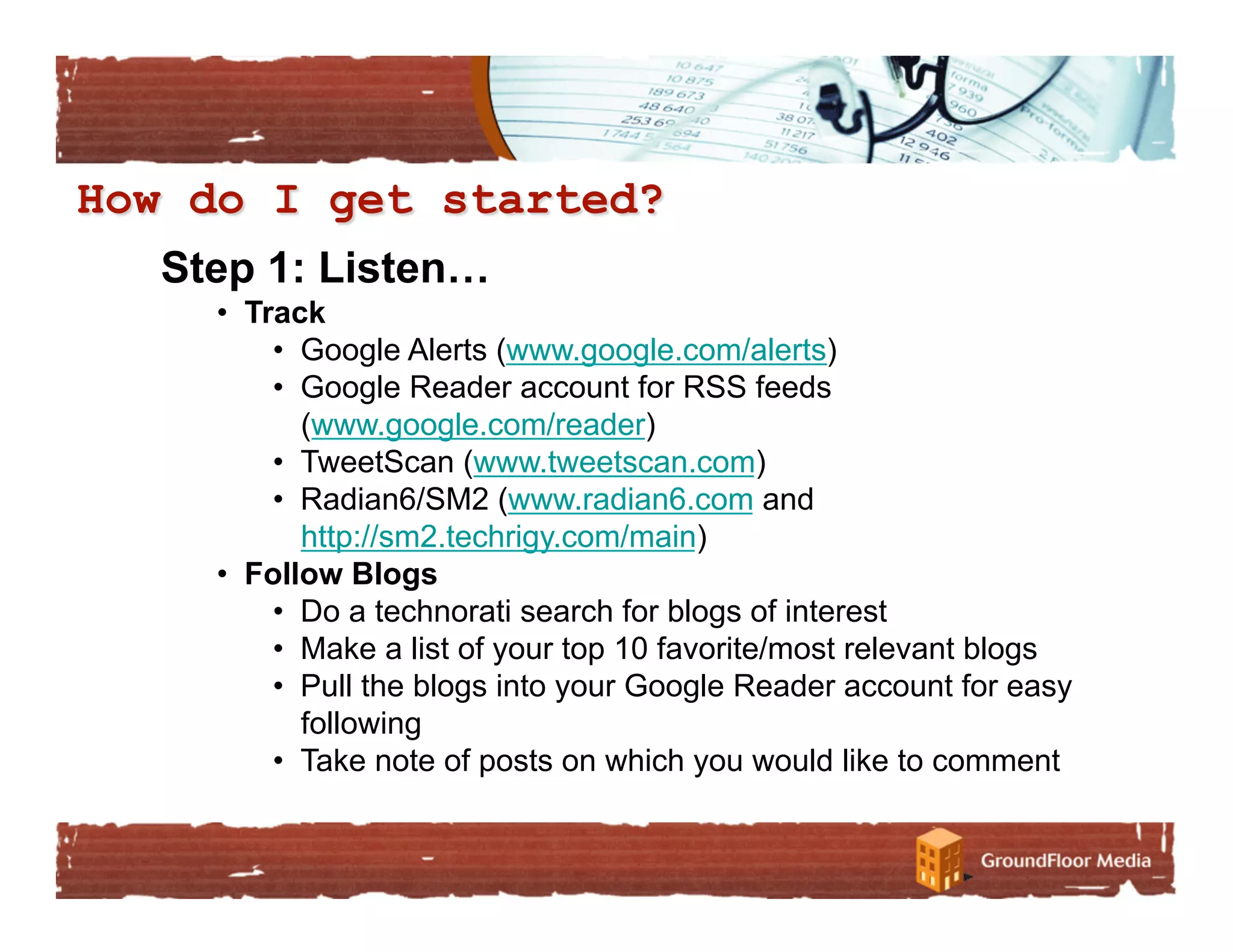
Step 1: Listen…
  •  Track
       •  Google Alerts (www.google.com/alerts)
       •  Google Reader account for RSS feeds
          (www.google.com/reader)
       •  TweetScan (www.tweetscan.com)
       •  Radian6/SM2 (www.radian6.com and
          http://sm2.techrigy.com/main)
  •  Follow Blogs
       •  Do a technorati search for blogs of interest
       •  Make a list of your top 10 favorite/most relevant blogs
       •  Pull the blogs into your Google Reader account for easy
          following
       •  Take note of posts on which you would like to comment
Step 2: Enter…
  •  Develop/refine messaging
  •  Set up appropriate social media vehicles
       •  Facebook profile, page and/or cause page
       •  Twitter account
       •  LinkedIn profile and Build Your Network
       •  Digg account
       •  Blog
       •  Etc.
  •  Become a member of relevant groups
       •  Yahoo Groups
       •  Facebook fan pages
       •  Etc.
  •  Practice on personal level
Step 3: Engage…
  •  Comment on relevant blogs, groups, etc., as appropriate
      •  Favorite blogs
      •  Yahoo Answers
      •  LinkedIn Answers
  •  Publish own positioning
      •  Facebook
      •  YouTube
      •  Twitter
      •  Blog
  •  Monitor replies and respond, when appropriate
  •  Refresh content regularly
GroundFloor Media
             www.GroundFloorMedia.com
            gfsm@groundfloormedia.com

        Follow us on Twitter @GroundFloorPR

       Become a fan of GroundFloor Media at
         www.facebook.com/groundfloormedia

Check out our glog at http://blog.groundfloormedia.com/

Social media 101 presentation 8 24-10.ppt

  • 2.
    Social Media isthe democratization of information, transforming people from content readers and consumers into content publishers.
  • 3.
    Social media isa CONVERSATION between…
  • 4.
    •  Internet forums/groups •  Vlogs •  Social networks •  Social tagging •  Blogs •  Social bookmarking •  Wikis •  Micro-blogging •  Podcasts •  Virtual communities •  File/data-sharing •  RSS feeds
  • 5.
    TRADITIONAL SOCIAL Driven and controlled by Driven and controlled by users editors and publishers Based on a one-to-many Based on a many-to-many model (also called a broadcast model, rooted in conversations model) Government regulation and Democracy of users and no censorship censorship restraints Limited channels of Endless channels of information information
  • 8.
    •  Years toReach 50 millions Users: •  Radio (38 Years) •  TV (13 Years) •  Internet (4 Years) •  iPod (3 Years) •  Facebook added 100 million users in less than 9 months •  iPhone applications hit 1 billion in 9 months •  If Facebook were a country it would be the world’s 3rd largest between the United States and Indonesia •  Facebook users spend 5 billion minutes on the site each day •  20 hours of video are uploaded to YouTube every minute •  One billionth Tweet in 2008. 13.1 billion currently
  • 9.
    •  For people who are deeply immersed in social media, social networks are already a much heavier influence on personal choices than traditional advertising •  53% of people say that blog content influences purchase decisions •  78% of consumers say they trust other consumers' recommendations over all advertising/marketing avenues •  According to IPG Emerging Media Lab, 87% of online community members report participating in social causes that are new to them since their involvement in online communities began •  Social media is a potential growth area through which major donors can be cultivated. The Social Media for Social Causes Study found that 84% of the “social media savvy” aged 30-49 and 55% of those older than 50 have used social media to discuss philanthropy.
  • 10.
    •  Expand andextend marketing campaigns •  Improve customer service •  Manage crisis communications/online reputation management •  Solicit feedback from the public •  Build relationships with employees, donors, volunteers, influencers, fans/supporters, lawmakers and citizens •  Create buzz •  Establish yourself as an expert
  • 11.
    •  Free-access socialnetworking Web site that connects people with friends and others who work, study and live around them •  Users can join networks organized by city, workplace, school, and region to connect and interact with other people •  People can also add friends, send them messages, and update their personal profiles to notify friends about their activities •  Organizations should set up a Page
  • 12.
    Page Profile •  Facebook.com/nonprofits
  • 14.
    •  A socialnetworking and micro-blogging service that enables its users to send and read other users' updates known as tweets •  Tweets are text-based posts of up to 140 characters in length •  Updates are displayed on the user's profile page and delivered to other users who have signed up to receive them
  • 17.
    •  YouTube isthe world's most popular online video community allowing millions of people to discover, watch and share originally created videos •  Provides a forum for people to connect, inform and inspire others across the globe and acts as a distribution platform for original content creators •  YouTube accounts for 10% of all Internet traffic
  • 18.
  • 19.
    •  YouTube.com/allforgood –  AllForGood.org
  • 20.
    •  Flickr isan online photo management and sharing application for images and video hosting Web site, Web services suite, and online community platform •  Popular Web site for users to share personal photographs, the service is widely used by bloggers as a photo repository
  • 23.
    •  Good mediumsto create thought leadership positions. •  Blogs are usually maintained by an individual with regular entries of commentary, descriptions of events, or other material such as graphics or video. •  Most blogs are interactive, allowing visitors to leave comments and even message each other via widgets on the blogs. It is this interactivity that distinguishes them from other static websites •  Many blogs provide commentary or news on a particular subject; others function as more personal online diaries •  A podcast is a series of digital media files (audio or video) that are released episodically and often downloaded through web syndication.
  • 26.
    •  All ofthe social mediums mentioned previously are accessible via smart phone. •  Mobile Marketing is meant to describe marketing on or with a mobile device, such as a mobile phone. •  SMS •  MMS •  Games •  Mobile web •  Apps •  Geo-location (e.g., Foursquare)
  • 28.
    Social media sites: • Facebook.com (Facebook.com/nonprofits) •  Twitter.com – Search.twitter.com / tweetscan.com – Tweetdeck •  Flickr.com •  YouTube.com (YouTube.com/nonprofits) Great resource for nonprofits: •  Beth’s blog: How nonprofits can use social media: http://beth.typepad.com/beths_blog/
  • 29.
    •  ROI isdifferent from traditional PR and marketing models •  No control over message •  Demands transparency •  Needs a “human element” •  Pitches and campaigns can be publicly mocked •  Release dates/embargoes are not honored •  Requires high level of commitment (time and energy)
  • 30.
    Quantitative Qualitative •  Web site visits resulting from social •  Inclusion of your campaign(s) in media campaign(s) digital marketing trend coverage •  Social media application downloads •  Online media audits that measure the sentiment and mindshare for your •  Responses to online offers organization online; audits repeated •  Audience impressions for blog at regular intervals after a baseline is coverage established •  Blog and RSS subscriber numbers •  Online surveys to benchmark and monitor a range of end-user •  Audience reach for podcasts perceptions, including online brand •  Number of articles or broadcast clips awareness and mindshare among supporting your social media your organization’s competitors campaign
  • 32.
    Step 1: Listen… •  Track •  Google Alerts (www.google.com/alerts) •  Google Reader account for RSS feeds (www.google.com/reader) •  TweetScan (www.tweetscan.com) •  Radian6/SM2 (www.radian6.com and http://sm2.techrigy.com/main) •  Follow Blogs •  Do a technorati search for blogs of interest •  Make a list of your top 10 favorite/most relevant blogs •  Pull the blogs into your Google Reader account for easy following •  Take note of posts on which you would like to comment
  • 33.
    Step 2: Enter… •  Develop/refine messaging •  Set up appropriate social media vehicles •  Facebook profile, page and/or cause page •  Twitter account •  LinkedIn profile and Build Your Network •  Digg account •  Blog •  Etc. •  Become a member of relevant groups •  Yahoo Groups •  Facebook fan pages •  Etc. •  Practice on personal level
  • 34.
    Step 3: Engage… •  Comment on relevant blogs, groups, etc., as appropriate •  Favorite blogs •  Yahoo Answers •  LinkedIn Answers •  Publish own positioning •  Facebook •  YouTube •  Twitter •  Blog •  Monitor replies and respond, when appropriate •  Refresh content regularly
  • 35.
    GroundFloor Media www.GroundFloorMedia.com [email protected] Follow us on Twitter @GroundFloorPR Become a fan of GroundFloor Media at www.facebook.com/groundfloormedia Check out our glog at http://blog.groundfloormedia.com/