Presented by: Dr. Joydeep Mallik
GANGA HOSPITAL
COIMBATORE
Definition:
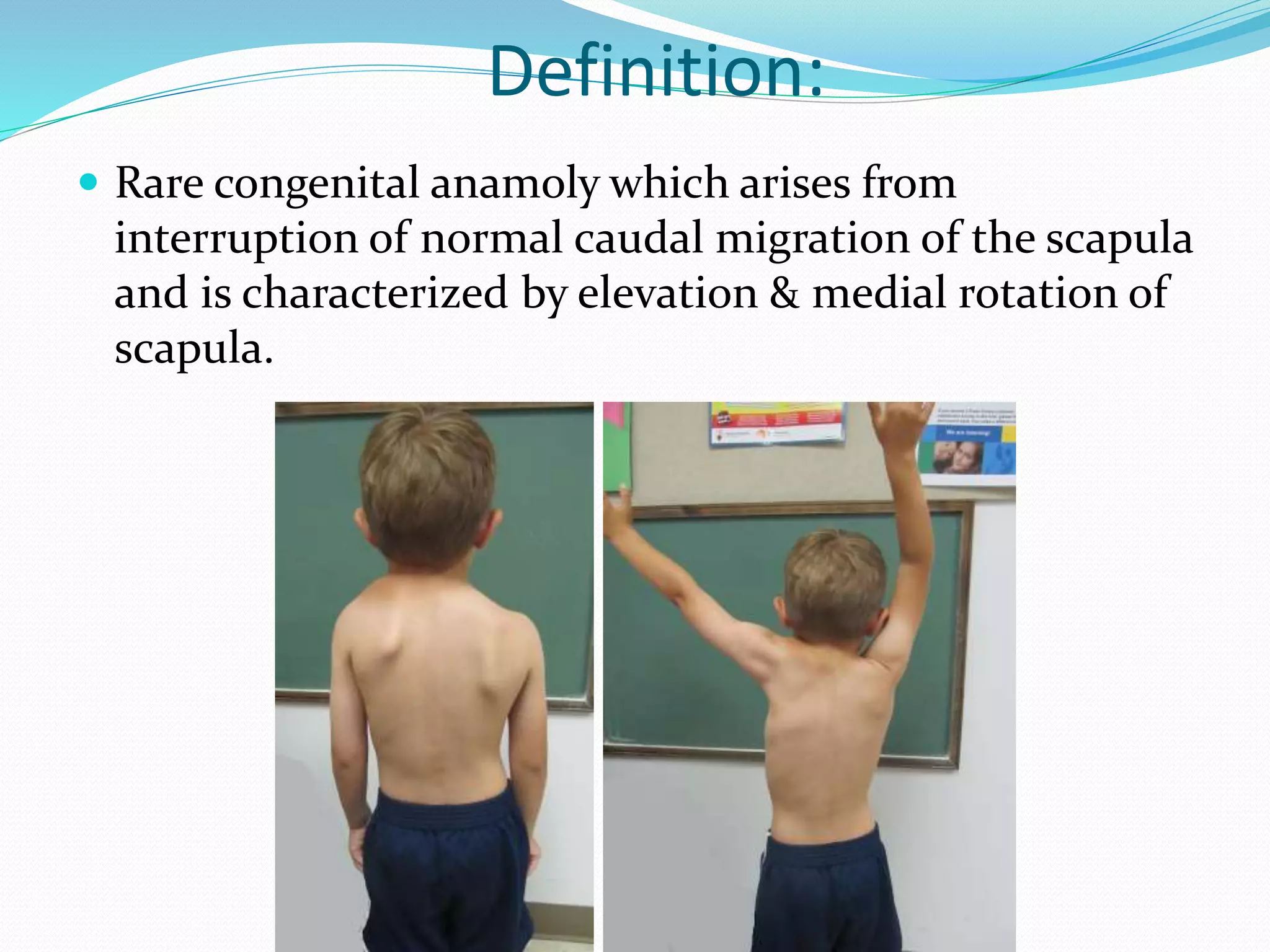
 Rare congenital anamoly which arises from
interruption of normal caudal migration of the scapula
and is characterized by elevation & medial rotation of
scapula.
Historical significance:
 First described by Eulenberg (1863) who described 3
patients.
 Willet and Walsham reported 2 cases with anatomic
descriptions of this clinical entity (1883)
 It is named after Otto Gerhard Karl Sprengel (1852-
1915), a German surgeon who described four cases in
1891.
Frequency:
most common congenital malformation of the shoulder girdle.
 Age – Mostly noticed at birth
Gender : Equal distribution in both sexes
Side – Left side more common than right, bilateral only in 10%
Distribution
Unilateral
(common)
Bilateral
(rare)
10%
Distribution
Unilateral
(common)
Bilateral
(rare)
10%
Genetics:
 The condition is sporadic.
 Rarely, autosomal dominant pattern of inheritance.
Embryology:
 The scapula is a cervical
appendage that normally
differentiates opposite the
C4,C5,C6 vertebrae at 5 weeks
of gestation.
 normally descends to the
thorax by the end of the third
month of intrauterine life.
 Interruption in the normal
caudal migration of the scapula
results in a hypoplastic,
elevated scapula, known as the
Sprengel deformity.
Pathophysiology:
 Occurs between the 9th and 12th week of gestation.
 An arrest in the development of bone, cartilage, and
muscle also occurs.
 The trapezius, rhomboid, or levator scapulae
muscle may be absent or hypoplastic. The serratus
anterior muscle may be weak, leading to winging of
the scapula. Other muscles, such as the pectoralis
major, latissimus dorsi, or the
sternocleidomastoid may be hypoplastic and
similarly involved.
SCAPULA:
 Dysplastic.
 High up than normal.
 Smaller in the vertical plane
and larger horizontally.
 Inferior angle is rotated
medially, causing the glenoid
to face inferiorly.
 Convexity of the upper
(supraspinous) portion of the
scapula is increased and
curvature of the clavicular
shaft is decreased, forming a
narrower scapuloclavicular
space, may contribute to
brachial plexus compression
postoperatively.
Associated
anomalies
Spine
Spina
bifida
Klippel
Feil
anomaly
Hemi-
vertebra
Scoliosis
Ribs
Cervical
rib
Fused
ribs
 Another anomaly seen in approximately one third of
patients with a Sprengel deformity is the
omovertebral bone.
 This is a rhomboid- or trapezoid-shaped structure of
cartilage or bone.
 Usually lies in a strong fascial sheath, which extends
from the superomedial border of the scapula to the
spinous processes, lamina, or transverse processes of
the cervical spine C4 to C7.
 Omovertebral bone is best visualized on a lateral or
oblique radiograph of the cervical spine.
Klippel-Feil syndrome and Sprengel’s deformity
 Congenital fusion of at least 2 cervical vertebrae
with/without additional spinal/extraspinal
manifestations
 Associated Sprengel’s deformity: 7%-42%
 Most common congenitally fused segment in
Sprengel’s deformity: C6-C7;extensive fusion patterns
common
 Thorough neurological examination to be done
preoperatively to avoid complications during surgery
and anesthesia
Short neck
Low hair line
Restriction of neck movement
CLINICAL FEATURES
 Cosmetic
 High position of the scapula
 Scoliosis
 Torticollis
 Caput obstiosum (asymmetric distortion of the skull)
 Facial asymmetry
 Functional
 Restricted motions of scapula and shoulder joint
Clinically the severity of the elevation of scapula has
been described by Cavendish (1972) as:
Grade I (Very mild)
•Shoulders level;
• deformity invisible when patient is dressed
Grade II (Mild)
•Shoulders almost level;
•deformity visible as a lump in the web of the neck when
patient is dressed
Grade III (Moderate)
•Shoulder joint is elevated 2-5 centimeters;
• deformity visible
Grade IV (Severe)
•Shoulder joint is elevated;
•superior angle of the scapula near the occiput
Sprengel’s shoulder
DIAGNOSIS
 The x-ray appearances are characteristics,showing the
unduly high situation of the scapula.
Radiological criteria
• With short vertebral border
• (The scapula resembles equilateral
triangle).
Elevated
scapula.
• Either toward the spine or less commonly
to the opposite direction.
Rotation of the
inferior angle:
• Connecting the superior angle to the
cervical spine.
Omovertebral
bone
Radiographic Rigault’s classification
 grade I:
superomedial angle
lower than T2 but
above T4 transverse
process
 grade II:
superomedial angle
located between C5
and T2 transverse
process
 grade III:
superomedial angle
above C5 transverse
process
Computed tomography (CT) scan
 CT scans with 3-dimensional (3-D) reconstruction may
be performed to visualize the pathoanatomy of the
affected region and to visualize the omovertebral bar.
 CT scans may also help in planning surgery.
CT scan and 3D reconstruction show the omovertebral connection arising from
the medial border of the scapula and the vertebral column, anterior curving of the
supraspinous portion of the scapula, the convex medial border and the concave
lateral border of scapula
DIFFERENTIAL DIAGNOSIS
 Elevated scapula due to old paralysis.
Spinal accessory nerve injuryLong thoracic nerve injury
PROGNOSIS
 Even if operation is undertaken, the prognosis is not
very favorable.
 Literatures indicate that while the mobility of the
shoulder may be improved, asymmetry almost always
persists.
SURGICAL TREATMENT
 Factors to be assessed
 severity of the deformity,
 functional impairment,
 Age
 associated comorbid conditions.
 Surgery is best advisable for a patient
 between 3 and 8 years of age
 with moderate or severe cosmetic/ functional deformity.
 The presence of associated congenital anomalies may be
contraindications to operation.
 Surgical intervention before the age of 2 years is extensive
and is technically more difficult. Best results are obtained if
surgery is performed below the age of 5 years
SURGICAL TREATMENT
The surgical procedures involve a combination of
• (a) scapular lowering with either the shift of the origin or the
insertion of the scapular muscles on the spine/ scapula,
• (b) resection of the superomedial border and
• (c) omovertebral bar resection
A clavicular morselization is sometimes
recommended as a concomitant deformity of
this bone may reduce the correction obtained.
SURGICAL OPTIONS
 Putti’s procedure
 Shrock modified Putti’s procedure
 Woodward procedure
 Modified Woodward's procedure
 Green scapuloplasty
 Modified Green’s procedure
 Mears procedure
Putti’s procedure:
 detachment of the scapular insertion of the rhomboids
and trapezius, omovertebral bar resection, followed by
lowering the scapula and fixing its inferior angle to a
rib at the corrected level
Shrock modified Putti’s procedure:
 subperiosteal dissection of the musculature and
adding an osteotomy of the supraspinous scapular
region and the acromial base to facilitate scapular
descent
Green scapuloplasty:
 resection of the prominent superior scapular border
and extra-periosteal division of the muscular
attachments of scapula to allow the scapula to be
displaced inferiorly and muscular reattachment at the
newer corrected level at the scapula
Trapezius muscle disinrection step from its
scapula and clavicle attachments
G. Andrault , F. Salmeron , J.M. Laville
Green's surgical procedure in Sprengel's deformity: Cosmetic and functional results
Orthopaedics & Traumatology: Surgery & Research, Volume 95, Issue 5, 2009, 330 - 335
http://dx.doi.org/10.1016/j.otsr.2009.04.015
supraspinatus fossa bone resection, omovertebral bone resection, figure
of L type lenghtening of levator scapulae, global lowering, rhomboid
muscles reattachment at a higher site and distal tip scapula fixation
G. Andrault , F. Salmeron , J.M. Laville
Green's surgical procedure in Sprengel's deformity: Cosmetic and functional results
Orthopaedics & Traumatology: Surgery & Research, Volume 95, Issue 5, 2009, 330 - 335
http://dx.doi.org/10.1016/j.otsr.2009.04.015
Modified Green scapuloplasty:
 Andrault et al. suggested modifications to Green’s
procedure
 (a) dis-insertion of supraspinatus,
 (b) clavicular osteotomy and
 (c) a limited release of the serratus anterior to
facilitate the descent of the scapula.
 incidence of brachial plexus palsy could be reduced by
clavicular osteotomy, and that scapular winging could
be prevented by doing only a limited release of
serratus anterior from the medial scapular border
Woodward procedure:
 Transfer of the origin of the trapezius muscle to a more
inferior position on the spinous processes.
 This was maintained by placing the scapula in a pocket
of the trapezius muscle.
Modified Woodward's procedure:
 for achieving better abduction and correction of the
glenoid tilt
 the scapula was anchored to the lower dorsal vertebrae
by a stout absorbable suture placed through the
superomedial scapula, so as to externally rotate it and
cause lateral displacement of the inferior angle,
thereby achieving correction of glenoid vara
 Prone position
 Preparation of parts done till occiput
MODIFIED WOODWARD’S PROCEDURE
 Midline vertical incision
MODIFIED WOODWARD’S PROCEDURE
 Detachment of attachment of trapezius and
rhomboids from spinous processes
MODIFIED WOODWARD’S PROCEDURE
 Release of omovertebral band
 Excision of superomedial angle of scapula
MODIFIED WOODWARD’S PROCEDURE
 Relocation of scapula to new position
MODIFIED WOODWARD’S PROCEDURE
 Suturing of trapezius to inferior Spinous processes
 Closure in Layers
MODIFIED WOODWARD’S PROCEDURE
Mears procedure
 In a report by Mears, the author described a novel
approach--
 (a) subperiosteal elevation of the scapular musculature,
 (b) extraperiosteal resection of the omovertebral bone,
 (c) supraspinatous fossa osteotomy,
 (d) release of long head of triceps and a portion of the origin
of teres minor from the scapula and
 (e) resection of the superolateral border of the scapula to gain
abduction
 He reported a significant improvement in function
following this procedure.
The shaded region represents the area to be osteotomized (A –
Reflected trapezius; B – Rhomboids; C – Levator scapulae; T –
The detached triceps)
Int J Shoulder Surg. 2011 Jan-Mar; 5(1): 1–8.
doi: 10.4103/0973-6042.80459
Postoperative complications
 Winging of the scapula that may result from
incomplete reattachment of the serratus anterior
muscle
 Brachial plexus injury
 To avoid brachial plexus palsy, several authors recommended
morcellization of the clavicle on the ipsilateral side as a first
step in the operative treatment of Sprengel deformity.
 Keloid formation.
PHYSIOTHERAPY AFTER SURGERY
 Gradual relaxed passive mobilization of the shoulder and
scapula.
 Suitable pain relieving modality like TENS, IFT and
hydrocollator packs may be used to induce relaxation.
 Special attention is given to achieve early mobility of the
scapula and the shoulder abduction and elevation.
 Overall mobilization and strengthening of the shoulder girdle
muscles.
 Emphasize maximum possible correction of the posture of
shoulder and maintain it.
5/6/2016
50
THANK YOU

Sprengel deformity

  • 1.
    Presented by: Dr.Joydeep Mallik GANGA HOSPITAL COIMBATORE
  • 2.
    Definition:  Rare congenitalanamoly which arises from interruption of normal caudal migration of the scapula and is characterized by elevation & medial rotation of scapula.
  • 3.
    Historical significance:  Firstdescribed by Eulenberg (1863) who described 3 patients.  Willet and Walsham reported 2 cases with anatomic descriptions of this clinical entity (1883)  It is named after Otto Gerhard Karl Sprengel (1852- 1915), a German surgeon who described four cases in 1891.
  • 4.
    Frequency: most common congenitalmalformation of the shoulder girdle.  Age – Mostly noticed at birth Gender : Equal distribution in both sexes Side – Left side more common than right, bilateral only in 10%
  • 5.
  • 6.
  • 7.
    Genetics:  The conditionis sporadic.  Rarely, autosomal dominant pattern of inheritance.
  • 8.
    Embryology:  The scapulais a cervical appendage that normally differentiates opposite the C4,C5,C6 vertebrae at 5 weeks of gestation.  normally descends to the thorax by the end of the third month of intrauterine life.  Interruption in the normal caudal migration of the scapula results in a hypoplastic, elevated scapula, known as the Sprengel deformity.
  • 9.
    Pathophysiology:  Occurs betweenthe 9th and 12th week of gestation.  An arrest in the development of bone, cartilage, and muscle also occurs.  The trapezius, rhomboid, or levator scapulae muscle may be absent or hypoplastic. The serratus anterior muscle may be weak, leading to winging of the scapula. Other muscles, such as the pectoralis major, latissimus dorsi, or the sternocleidomastoid may be hypoplastic and similarly involved.
  • 10.
    SCAPULA:  Dysplastic.  Highup than normal.  Smaller in the vertical plane and larger horizontally.  Inferior angle is rotated medially, causing the glenoid to face inferiorly.  Convexity of the upper (supraspinous) portion of the scapula is increased and curvature of the clavicular shaft is decreased, forming a narrower scapuloclavicular space, may contribute to brachial plexus compression postoperatively.
  • 11.
  • 12.
     Another anomalyseen in approximately one third of patients with a Sprengel deformity is the omovertebral bone.  This is a rhomboid- or trapezoid-shaped structure of cartilage or bone.  Usually lies in a strong fascial sheath, which extends from the superomedial border of the scapula to the spinous processes, lamina, or transverse processes of the cervical spine C4 to C7.  Omovertebral bone is best visualized on a lateral or oblique radiograph of the cervical spine.
  • 13.
    Klippel-Feil syndrome andSprengel’s deformity  Congenital fusion of at least 2 cervical vertebrae with/without additional spinal/extraspinal manifestations  Associated Sprengel’s deformity: 7%-42%  Most common congenitally fused segment in Sprengel’s deformity: C6-C7;extensive fusion patterns common  Thorough neurological examination to be done preoperatively to avoid complications during surgery and anesthesia Short neck Low hair line Restriction of neck movement
  • 14.
    CLINICAL FEATURES  Cosmetic High position of the scapula  Scoliosis  Torticollis  Caput obstiosum (asymmetric distortion of the skull)  Facial asymmetry  Functional  Restricted motions of scapula and shoulder joint
  • 15.
    Clinically the severityof the elevation of scapula has been described by Cavendish (1972) as: Grade I (Very mild) •Shoulders level; • deformity invisible when patient is dressed Grade II (Mild) •Shoulders almost level; •deformity visible as a lump in the web of the neck when patient is dressed Grade III (Moderate) •Shoulder joint is elevated 2-5 centimeters; • deformity visible Grade IV (Severe) •Shoulder joint is elevated; •superior angle of the scapula near the occiput Sprengel’s shoulder
  • 16.
    DIAGNOSIS  The x-rayappearances are characteristics,showing the unduly high situation of the scapula.
  • 18.
    Radiological criteria • Withshort vertebral border • (The scapula resembles equilateral triangle). Elevated scapula. • Either toward the spine or less commonly to the opposite direction. Rotation of the inferior angle: • Connecting the superior angle to the cervical spine. Omovertebral bone
  • 19.
    Radiographic Rigault’s classification grade I: superomedial angle lower than T2 but above T4 transverse process  grade II: superomedial angle located between C5 and T2 transverse process  grade III: superomedial angle above C5 transverse process
  • 20.
    Computed tomography (CT)scan  CT scans with 3-dimensional (3-D) reconstruction may be performed to visualize the pathoanatomy of the affected region and to visualize the omovertebral bar.  CT scans may also help in planning surgery.
  • 21.
    CT scan and3D reconstruction show the omovertebral connection arising from the medial border of the scapula and the vertebral column, anterior curving of the supraspinous portion of the scapula, the convex medial border and the concave lateral border of scapula
  • 23.
    DIFFERENTIAL DIAGNOSIS  Elevatedscapula due to old paralysis. Spinal accessory nerve injuryLong thoracic nerve injury
  • 24.
    PROGNOSIS  Even ifoperation is undertaken, the prognosis is not very favorable.  Literatures indicate that while the mobility of the shoulder may be improved, asymmetry almost always persists.
  • 25.
    SURGICAL TREATMENT  Factorsto be assessed  severity of the deformity,  functional impairment,  Age  associated comorbid conditions.  Surgery is best advisable for a patient  between 3 and 8 years of age  with moderate or severe cosmetic/ functional deformity.  The presence of associated congenital anomalies may be contraindications to operation.  Surgical intervention before the age of 2 years is extensive and is technically more difficult. Best results are obtained if surgery is performed below the age of 5 years
  • 29.
    SURGICAL TREATMENT The surgicalprocedures involve a combination of • (a) scapular lowering with either the shift of the origin or the insertion of the scapular muscles on the spine/ scapula, • (b) resection of the superomedial border and • (c) omovertebral bar resection A clavicular morselization is sometimes recommended as a concomitant deformity of this bone may reduce the correction obtained.
  • 30.
    SURGICAL OPTIONS  Putti’sprocedure  Shrock modified Putti’s procedure  Woodward procedure  Modified Woodward's procedure  Green scapuloplasty  Modified Green’s procedure  Mears procedure
  • 31.
    Putti’s procedure:  detachmentof the scapular insertion of the rhomboids and trapezius, omovertebral bar resection, followed by lowering the scapula and fixing its inferior angle to a rib at the corrected level
  • 32.
    Shrock modified Putti’sprocedure:  subperiosteal dissection of the musculature and adding an osteotomy of the supraspinous scapular region and the acromial base to facilitate scapular descent
  • 33.
    Green scapuloplasty:  resectionof the prominent superior scapular border and extra-periosteal division of the muscular attachments of scapula to allow the scapula to be displaced inferiorly and muscular reattachment at the newer corrected level at the scapula
  • 34.
    Trapezius muscle disinrectionstep from its scapula and clavicle attachments G. Andrault , F. Salmeron , J.M. Laville Green's surgical procedure in Sprengel's deformity: Cosmetic and functional results Orthopaedics & Traumatology: Surgery & Research, Volume 95, Issue 5, 2009, 330 - 335 http://dx.doi.org/10.1016/j.otsr.2009.04.015
  • 35.
    supraspinatus fossa boneresection, omovertebral bone resection, figure of L type lenghtening of levator scapulae, global lowering, rhomboid muscles reattachment at a higher site and distal tip scapula fixation G. Andrault , F. Salmeron , J.M. Laville Green's surgical procedure in Sprengel's deformity: Cosmetic and functional results Orthopaedics & Traumatology: Surgery & Research, Volume 95, Issue 5, 2009, 330 - 335 http://dx.doi.org/10.1016/j.otsr.2009.04.015
  • 36.
    Modified Green scapuloplasty: Andrault et al. suggested modifications to Green’s procedure  (a) dis-insertion of supraspinatus,  (b) clavicular osteotomy and  (c) a limited release of the serratus anterior to facilitate the descent of the scapula.  incidence of brachial plexus palsy could be reduced by clavicular osteotomy, and that scapular winging could be prevented by doing only a limited release of serratus anterior from the medial scapular border
  • 37.
    Woodward procedure:  Transferof the origin of the trapezius muscle to a more inferior position on the spinous processes.  This was maintained by placing the scapula in a pocket of the trapezius muscle.
  • 38.
    Modified Woodward's procedure: for achieving better abduction and correction of the glenoid tilt  the scapula was anchored to the lower dorsal vertebrae by a stout absorbable suture placed through the superomedial scapula, so as to externally rotate it and cause lateral displacement of the inferior angle, thereby achieving correction of glenoid vara
  • 39.
     Prone position Preparation of parts done till occiput MODIFIED WOODWARD’S PROCEDURE
  • 40.
    MODIFIED WOODWARD’S PROCEDURE Midline vertical incision
  • 41.
    MODIFIED WOODWARD’S PROCEDURE Detachment of attachment of trapezius and rhomboids from spinous processes
  • 42.
    MODIFIED WOODWARD’S PROCEDURE Release of omovertebral band  Excision of superomedial angle of scapula
  • 43.
    MODIFIED WOODWARD’S PROCEDURE Relocation of scapula to new position
  • 44.
    MODIFIED WOODWARD’S PROCEDURE Suturing of trapezius to inferior Spinous processes
  • 45.
     Closure inLayers MODIFIED WOODWARD’S PROCEDURE
  • 46.
    Mears procedure  Ina report by Mears, the author described a novel approach--  (a) subperiosteal elevation of the scapular musculature,  (b) extraperiosteal resection of the omovertebral bone,  (c) supraspinatous fossa osteotomy,  (d) release of long head of triceps and a portion of the origin of teres minor from the scapula and  (e) resection of the superolateral border of the scapula to gain abduction  He reported a significant improvement in function following this procedure.
  • 47.
    The shaded regionrepresents the area to be osteotomized (A – Reflected trapezius; B – Rhomboids; C – Levator scapulae; T – The detached triceps)
  • 48.
    Int J ShoulderSurg. 2011 Jan-Mar; 5(1): 1–8. doi: 10.4103/0973-6042.80459
  • 49.
    Postoperative complications  Wingingof the scapula that may result from incomplete reattachment of the serratus anterior muscle  Brachial plexus injury  To avoid brachial plexus palsy, several authors recommended morcellization of the clavicle on the ipsilateral side as a first step in the operative treatment of Sprengel deformity.  Keloid formation.
  • 50.
    PHYSIOTHERAPY AFTER SURGERY Gradual relaxed passive mobilization of the shoulder and scapula.  Suitable pain relieving modality like TENS, IFT and hydrocollator packs may be used to induce relaxation.  Special attention is given to achieve early mobility of the scapula and the shoulder abduction and elevation.  Overall mobilization and strengthening of the shoulder girdle muscles.  Emphasize maximum possible correction of the posture of shoulder and maintain it. 5/6/2016 50
  • 51.