Montana State University


The Promise of Endophyte Biology
The Causal Agent of Dutch Elm Disease – Ceratocystis ulmi
European Bark Beetle
Antibiosis Effects of the Pseudomycins
Transformation Plasmid
The Field Experiment
Systemic Candida albicans Infection in a Child
Control of Black Sigatoka with Pseudomycin B
Taxomyces andreanae
Taxomyces andreanae an Endophyte on Yew
Thin Layer Chromatography of Fungal Taxol and
Authentic Taxol
Electrospray MS of Fungal Taxol
Ipecac            Products from the
                     Rainforest
   Taxol


         Vinblastine


                Reserpine


                       Tubocurarine
Definition of An Endophyte

By definition an endophyte is a
 microorganism that becomes
established in a higher
 plant and does not cause any
overt symptoms or cause any
 apparent tissue damage
An Endophyte from the Jurassic Period
Areas of High Plant Biodiversity


70-80% of the Earth’s Plant Diversity Occurs on 1.5% of Its Land
Area
Is this also true of microbial diversity?
ant Diversity in the Canary Isles
0 million year old landscape..

About 2000 plant species
About 528 of these are endemic
Chances of finding novel endophytes
are great
Selecting Plants for the Isolation of
                Endophytes

1. Visiting Areas of High Plant Biodiversity
2. Finding Gondwanaland Plants
3.Meeting and Learning from Native Peoples
Progress on Endophytic Microbes
Examples of products-jesterone, hydroxyjesterone
pestacin, isopestacin, ambuic acid, ecomycin, oocydin A
munumbicins, kakadumycin, cryptocandin, pseudomycins
and others.


 Ambuic Acid: JOC (2003) 4609-4614
A Bastion of Biodiversity-the
    World’s Rainforests
Avenue of the giants
The Spiny Forest of Southern Madagascar
Angel Falls in the Tepui Lands of Venezuela
     Highest in the world- 3212’
Top of the Roraima Tepui
A Novel Fungus
Seimatoantlerium
tepuiense
Igauazu Falls-Brazil/Argentina
An area of ancient Gondwanaland-Torres Del Paine, Chile
Technique of Isolating Endophytes
Some
Endophytic fungi
Tripterigeum
wilfordii a Chinese
medicinal plant used
to treat arthritis
and other ailments
of the joints and
limbs possesses a
plethora of
endophytic microbes
including
Cryptosporiopsis
quercina.
Cryptosporiopsis quercina
Cryptosporiopsis spores
HPLC Separation of Cryptocandin
using an Altima C-18column


                             Bioactivity
Cryptocandin MW 1079
Pneumocandin MW 1079
Biological Activity of Cryptocandin
Test Fungal        MIC               MIC of
Pathogen           micrograms/ml     Amphotericin B
                   of Cryptocandin
Candida albicans         0.03            0.03
Cryptococcus           > 20.0            0.04
neoformans
Aspergillus           >20.0              0.03
fumigatus
Histoplasma            0.01              0.01
capsulatum
Crystals of Cryptocin
X-ray Crystallographic Device
Structure of
Cryptocin
Carrao River
Rhyncholacis penicillata under a
water fall on the Carrao River
Serratia marcescens on the plant surface
Serratia marcescens Activity Against Pythium
The Papuans
Pestalotiopsis jesterii, a fungal endophyte
Conidiospores of P. jesterii
Ambuic Acid is
produced by
various isolates of
Pestalotiopsis
microspora
obtained in various
rainforest
locations around
the world
Monstera speciosa in the Jungles
of the Upper Amazon of Peru
P-25 An Endophytic
Streptomycete from the
Monstera vine
Origin of Spores in P-25 vs. Penicillum sp.
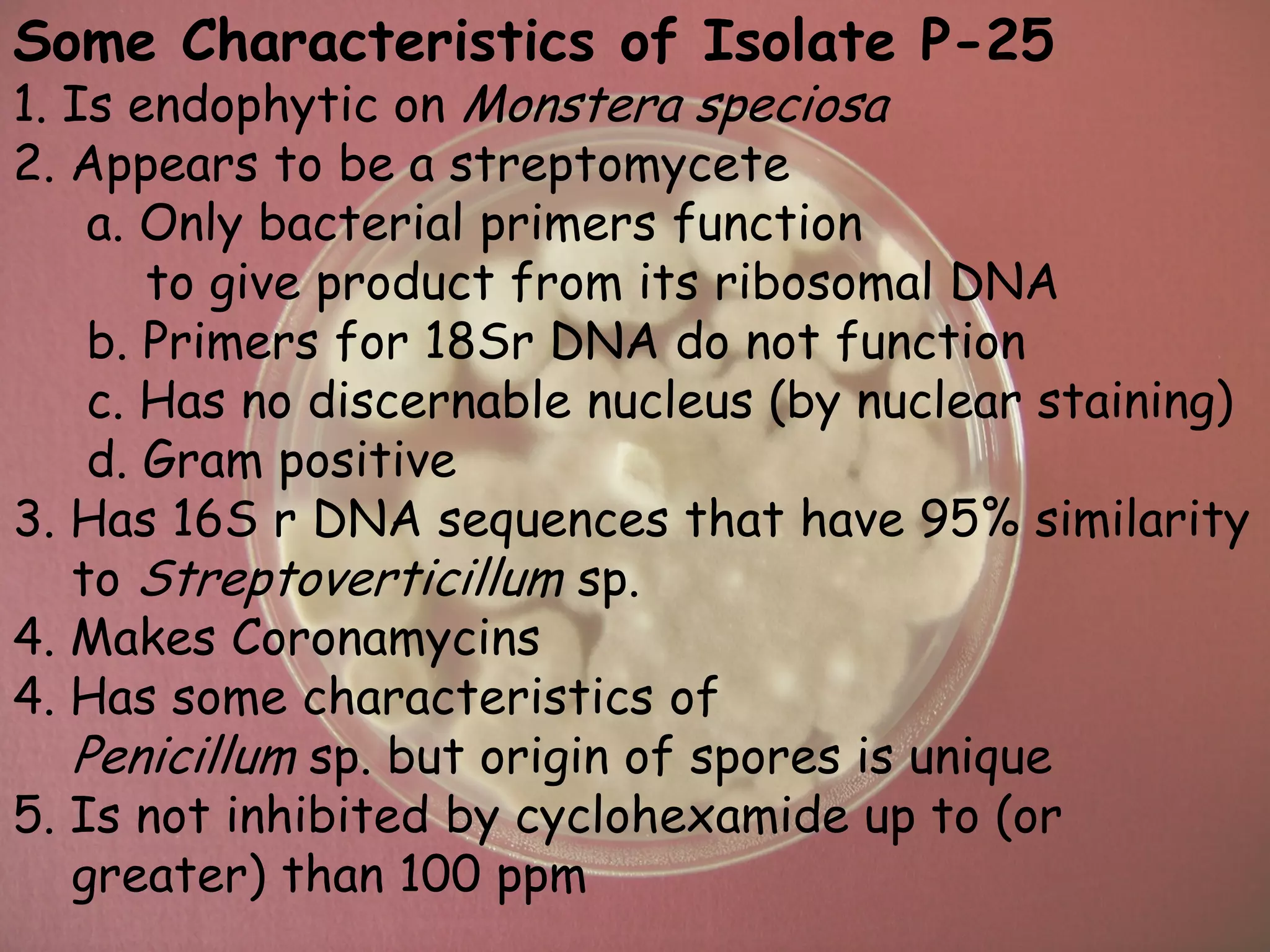
Some Characteristics of Isolate P-25
1. Is endophytic on Monstera speciosa
2. Appears to be a streptomycete
    a. Only bacterial primers function
       to give product from its ribosomal DNA
    b. Primers for 18Sr DNA do not function
    c. Has no discernable nucleus (by nuclear staining)
    d. Gram positive
3. Has 16S r DNA sequences that have 95% similarity
   to Streptoverticillum sp.
4. Makes Coronamycins
4. Has some characteristics of
   Penicillum sp. but origin of spores is unique
5. Is not inhibited by cyclohexamide up to (or
   greater) than 100 ppm
Activity of P-25 Against Pythium
Anopheles sp. vector of Plasmodium sp.- cause of Malaria
Properties of Coronamycins
1.Peptides- 2 principle ones MW.’s 1217
and 1203
2. Composition x:x methionine:tyrosine
and leucine-ratio-- 2:2:1:1:3
3. Active against pythicaeous fungi (2-16
micrograms/ml) ,and Cryptococcus
neoformans.
4. Extremely active against Plasmodium
falciparum IC 50 <1 ng /ml
My Native Australian Friends
Northern Territory Australia – a Monsoonal
               Rainforest


                        Snakevine-Kennedia
                             nigriscans
Streptomyces sp. A-11 from Snakevine
HPLC Separation of the Components of
              Streptomyces sp. A-11


  Munumbicins E-4,5
  M.W. 1315 & 1431

                                      Actinomycin D

                                        Actinomycin X2
Actinomycin X0 beta
Some Representative Streptomycetes from
               Snakevine
New, Very Unusual Streptomycetes spp. from
                Snakevine
Streptomycete 149 -- Horn Structure
Rainforest Microbiology- The Prospects and
                  Promises
1. Each individual plant has one or more associated
   microorganisms. Only a few microbes have ever been
   studied.
2. The relationships of the plant to the microbe may range
   from symbiotic to weakly pathogenic.
3. Host specificity may exist with certain microbes which
   places a huge emphasis on the preservation of the world’s
   rainforests.
4. Products from endophytes have a wide range of uses in
   medicine, agriculture and industry.
5. Peculiar microbes are plentiful and usually are to be found in
   areas of high biodiversity.
6. The biology of endophytes is largely unknown.
Introduction to endophytes and their application to develop commercial products

Introduction to endophytes and their application to develop commercial products