Transformation system
Shivendra Kumar
1903308003
Ph.D (Agricultural Biotechnology)
RPCAU PUSA SAMASTIPUR
Introduction
• Gene transfer basically categories in two main:
• Direct mode of gene transfer.
• Indirect mode of gene transfer.
• system which help to transfer the trans gene
from one to preferred species.
• Concept of transformation deduced by
Herbedtland first time (Daucus carrota).
Gene transfer
• Plant breeding technique
• Biotechnological techniques; this technique
bypass the reproductive phase
• In Planta transformation
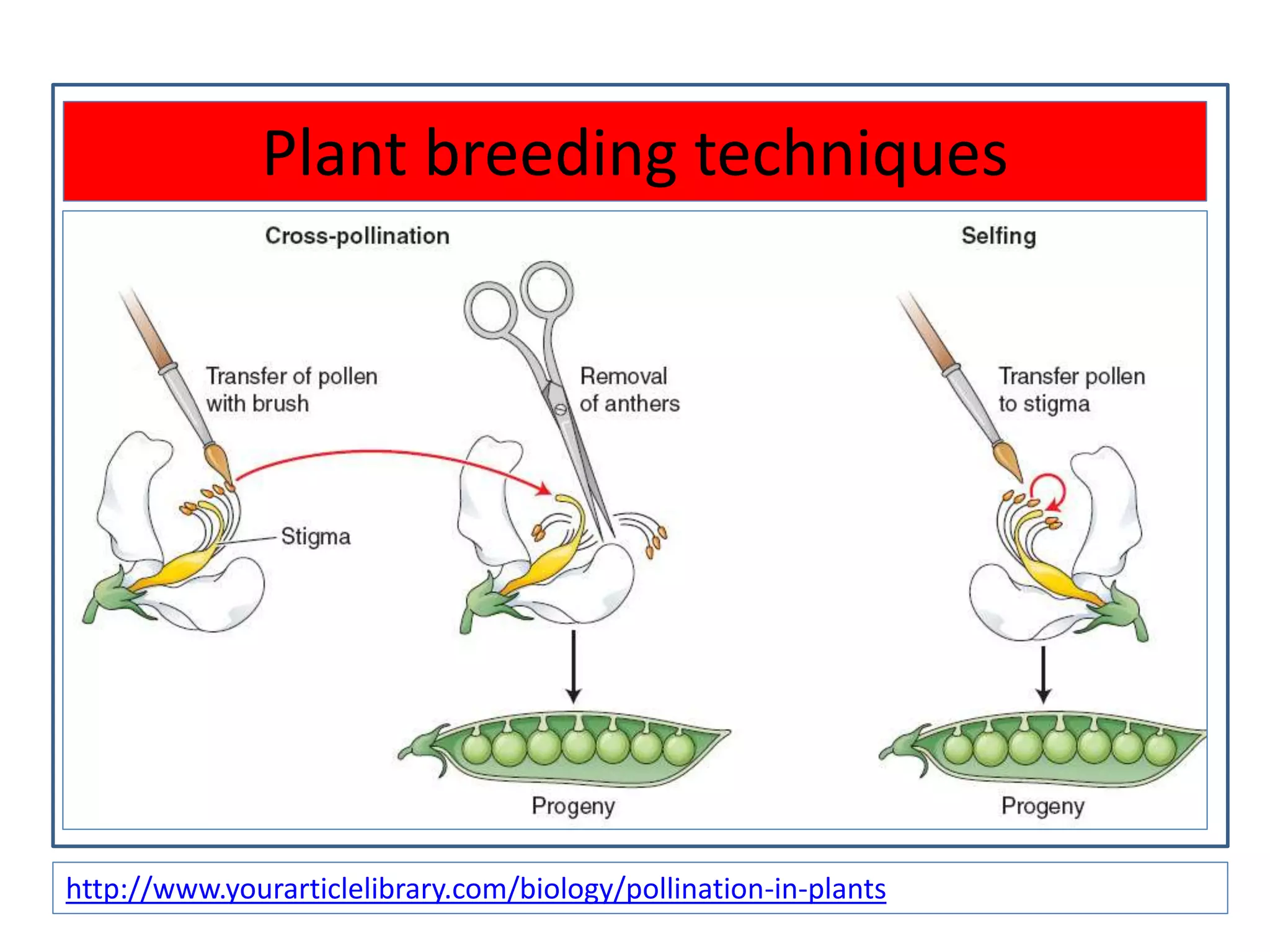
Plant breeding techniques
http://www.yourarticlelibrary.com/biology/pollination-in-plants
Biotechnological techniques
this technique bypass the reproductive phase
• Direct
Physical
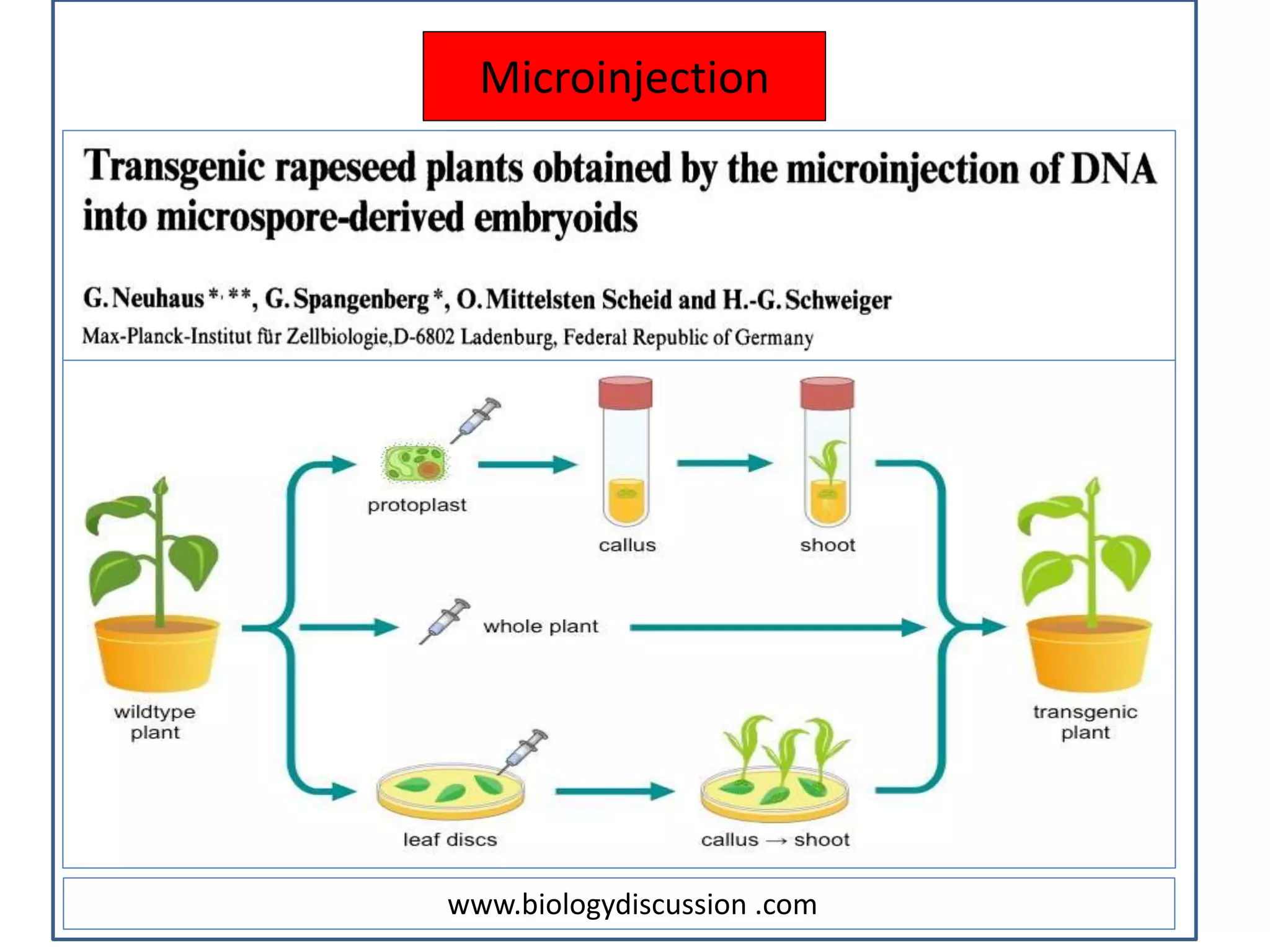
• Microinjection
• Electroporation
• SiC based
• Gene gun/Biolistic
• Ultrasound mediated
Chemical
• Poly Ethylene Glycol
• DEAE
• CaCl2 method
• Artificial lipid
• Proteins
• Dendrimers
Indirect
Indirect plant (Biological)
•Agrobacterium tumenifecians
mediated gene transfer
•Agrobacterium rhizogenes mediated
gene transfer
•Virus mediated gene transfer
In planta
•Meristem transformation
•Floral dip method
•Pollen transformation
Transformation system
• Direct
– Physical transformation
Microinjection
www.biologydiscussion .com
Silicon carbide fibres- Whishkers
• Plant material (cells in
suspension culture, embryos
and embryo-derived callus) is
introduced into buffer
containing DNA and the silicon
fibres which is then vortexed.
• The fibres (0.3-0.6micrometer
in dia. and 10-100 micrometer
long) penetrate the cell wall
and plasma membrane,
allowing the DNA to gain
access to the inside of the
cells.
www.biologydiscussion.com/sci/transfer/directtransfer.
SIC mediated transfer
Advantange
• Successful transformation in
wheat, barley and tomato
without any cell suspension.
Disadvantage
• Availability of suitable plant
material
• Hard embryonic callus in
many cases.
Ultrasound mediated gene transfer
https://doi.org/10.1016/j.apsb.2017.02.004
www.biologydiscussion.com/electroporation/directtransfer
Gene Gun/Biolistic
• High velocity micro-projectile were utilized to deliver
the living cell
• Principle
Gold particle having DNA of interest
Propelling with high velocity to reach and may integrate
to the genome of the cell
Plant material to be used
• Primary explant to be used and bombarded then
induced to embryogenic
• Proliferating embryogenic culture that are bombarded
and then allowed to regenerate
Gene gun based gene transfer
Sanford J.C (1990) Biolistic Plant transformation, physio planta, 79:206-209
Helicos gene gun
Wikihouse/genegun
The biolistic concept is extremely simple, which is its beauty. The same basic protocol is used
regardless of what is being transformed. The protocol is simple, rapid (less than 5 min per Petri
plate), uses very small amounts of DNA (less than 1g DNA per Petri plate))
Application
Chemical mode of gene transfer
• CaCl2 method
• Poly Ethylene Glycol
• Di Ethyl Amino Ethyl dextrans
• Artificial lipid (lipofection)
CaCl2 method
Polyethylene glycol method
Plant cell and yeast cell is the host for transfer
without removing cell wall.
Gene transfer by protoplast fusion
Biologydiscussion.com
Lipofection
•Recombinant DNA (negatively charged at a near
neutral PH) because of its phosphodiester backbone, is
mixed with the lipid molecules with positively charged
(cationic) head groups. The lipid molecules form a
bilayer around the recombinant DNA molecules.
•This results in the formation of liposomes which are
further mixed with the host cells. Most eukaryotic cells
are negatively charged at their surface, so the
positively charged liposomes interact with the cells.
Cells take up the lipid-recombinant DNA complexes,
and some of the transfected DNA enters the nucleus.
Advantage
Integration of gene
failure
No any pattern of foreign
DNA integration
Host range limitation
break
Direct DNA integration
by biolistic and
electroporation approach
Cereals the world most
important crop is improved
by direct gene transfer
method
Disadvantage
INDIRECT GENE TRANSFER
GoodHostProperties
•Easy to transform
•Support of replication of recombinant DNA
•Free from the element which interfere in
replication of recombinant
•Lack active restriction enzyme
•Does not have methylase
Transformation vector requirement
• Origin of replication
• Selectable marker
• Multiple cloning sites
• Gene construct of interest
• T DNA borders and other agrobacterium associated genes.
• Compatible with helper plasmid if using agrobacterium.
Agrobacterium
• Soil born, rod shaped, gm negative, motile found
in rhizosphere.
• Causative of crown gall in dicot plants.
• Have ability transfer of bacterial gene to plant
genome.
• Attracted to wound site via chemotaxis in
response to chemical (acetosyringone) released
from damaged plant cell.
• Contains Ti plasmid which can transfer its T DNA
region into genome of the host plant.
Ti-Plasmid
Forms of Ti plasmid (Agrobacterium)
• ds circle
• ds linear T DNA
• ss linear T DNA
• What is not found – Ti plasmids with with
evidence that T DNA has been precisely
deleted
Indirect gene transfer
• Agro-bacterium based gene transfer
Electronic journal of biotechnology
Case study
Virus mediated gene transfer
• Caulimoviruses
• Gemini-viruses
• RNA viruses
Characteristics of viral vector
• Broad host range
• Virulence
• Ease of mechanical transmission
• Strict packaging limitation overcoming
• Must be manipulative and to be infectious
Caulimovirus
• Used as a vector
• Naked DNA is infective, being able to enter plant cell
directly if rubbed on to a leaf with mild abrasive
• As a DNA virus whose genome is known tobe
packaged in nucleosomes and transcribed by RNA
pol ii, it is more suited for exploitation as an
experimental tool than any other plant virus
Geminivirus
• Uses as a cloning vector
• These viruses contain single stranded DNA that
appears to replicate via a double stranded
intermediate and thus makes in vivo
manipulation in bacterial plasmids more
convineient.
• An attractive feature is the ability of bipartite
gemini viruses to contain a deletion or
replacement of virus coat protein sequences by
foreign genes without interfering with the
replication of the virus genome
Advantage
It has limitation of host
range some important food
crops cannot be infected
with agrobacterium
Sometimes cells in a
tissue that are able to
regenerate are difficult to
transform (it might be that
embryogenic cells are in
deep layers to be reached
by agrobacterium).
It’s natural means of
transfer.
Agrobacterium is capable
of infecting intact plant
cells, tissues and organs.
Transformed
regeneration rate is more .
This method capable of
transferring large amount
of DNA fragments very
efficiently without
substantial
rearrangements.
Integration of T DNA is a
relatively precise process.
More stable gene
transfer.
Disadvantage
In Planta Transformation
It is a tissue culture independent genetic
transformation carried out using Agrobacterium
tumefaciens to obtain transformed plants
In the present study, transgenic cumin plants overexpressing
the SbNHX1 gene were developed by an in planta
transformation protocol
Meristem transformation
• Cotyledonary-node-based transformation
• Agrobacterium based transformation using
bar gene as a selectable marker
5% sucrose solution in
beaker, 500 microliter/lit
of solution L77
surfactant were used
Application
Tearless onion (Dr Eddy) = Sunions
Purple tomato high in anthocyanine
World first blue rose display in Japan oct 31st
2008 (Suntory flowers)
Transgenic corn kernel (edible vaccine)
First blue tomato (P20) are result of indirect
gene transfer (A.tumefaciens from snapdragon
called as purple tomato
Rose applause developed by
Agrobacterium tumefaciens
• Utilizing explant’s negative atmospheric pressure for
increased gene transformation
• The effect of squirting cucumber (Ecballium elaterium (L.) A.
Rich) fruit juice on A. tumefaciens-mediated transformation
• Use of magnetic field strength for high-transformation
frequency via A. tumefaciens
• The effect of gamma radiation on A. tumefaciens-mediated
transformation
New methods for high-transformation frequency via A.
tumefaciens
Transformation system

Transformation system

  • 1.
    Transformation system Shivendra Kumar 1903308003 Ph.D(Agricultural Biotechnology) RPCAU PUSA SAMASTIPUR
  • 2.
    Introduction • Gene transferbasically categories in two main: • Direct mode of gene transfer. • Indirect mode of gene transfer. • system which help to transfer the trans gene from one to preferred species. • Concept of transformation deduced by Herbedtland first time (Daucus carrota).
  • 3.
    Gene transfer • Plantbreeding technique • Biotechnological techniques; this technique bypass the reproductive phase • In Planta transformation
  • 4.
  • 5.
    Biotechnological techniques this techniquebypass the reproductive phase • Direct Physical • Microinjection • Electroporation • SiC based • Gene gun/Biolistic • Ultrasound mediated Chemical • Poly Ethylene Glycol • DEAE • CaCl2 method • Artificial lipid • Proteins • Dendrimers Indirect Indirect plant (Biological) •Agrobacterium tumenifecians mediated gene transfer •Agrobacterium rhizogenes mediated gene transfer •Virus mediated gene transfer In planta •Meristem transformation •Floral dip method •Pollen transformation
  • 6.
    Transformation system • Direct –Physical transformation
  • 7.
  • 8.
    Silicon carbide fibres-Whishkers • Plant material (cells in suspension culture, embryos and embryo-derived callus) is introduced into buffer containing DNA and the silicon fibres which is then vortexed. • The fibres (0.3-0.6micrometer in dia. and 10-100 micrometer long) penetrate the cell wall and plasma membrane, allowing the DNA to gain access to the inside of the cells. www.biologydiscussion.com/sci/transfer/directtransfer.
  • 9.
    SIC mediated transfer Advantange •Successful transformation in wheat, barley and tomato without any cell suspension. Disadvantage • Availability of suitable plant material • Hard embryonic callus in many cases.
  • 10.
    Ultrasound mediated genetransfer https://doi.org/10.1016/j.apsb.2017.02.004
  • 11.
  • 12.
    Gene Gun/Biolistic • Highvelocity micro-projectile were utilized to deliver the living cell • Principle Gold particle having DNA of interest Propelling with high velocity to reach and may integrate to the genome of the cell Plant material to be used • Primary explant to be used and bombarded then induced to embryogenic • Proliferating embryogenic culture that are bombarded and then allowed to regenerate
  • 13.
    Gene gun basedgene transfer Sanford J.C (1990) Biolistic Plant transformation, physio planta, 79:206-209
  • 14.
  • 15.
    The biolistic conceptis extremely simple, which is its beauty. The same basic protocol is used regardless of what is being transformed. The protocol is simple, rapid (less than 5 min per Petri plate), uses very small amounts of DNA (less than 1g DNA per Petri plate))
  • 16.
  • 17.
    Chemical mode ofgene transfer • CaCl2 method • Poly Ethylene Glycol • Di Ethyl Amino Ethyl dextrans • Artificial lipid (lipofection)
  • 18.
  • 20.
    Polyethylene glycol method Plantcell and yeast cell is the host for transfer without removing cell wall. Gene transfer by protoplast fusion Biologydiscussion.com
  • 21.
    Lipofection •Recombinant DNA (negativelycharged at a near neutral PH) because of its phosphodiester backbone, is mixed with the lipid molecules with positively charged (cationic) head groups. The lipid molecules form a bilayer around the recombinant DNA molecules. •This results in the formation of liposomes which are further mixed with the host cells. Most eukaryotic cells are negatively charged at their surface, so the positively charged liposomes interact with the cells. Cells take up the lipid-recombinant DNA complexes, and some of the transfected DNA enters the nucleus.
  • 22.
    Advantage Integration of gene failure Noany pattern of foreign DNA integration Host range limitation break Direct DNA integration by biolistic and electroporation approach Cereals the world most important crop is improved by direct gene transfer method Disadvantage
  • 23.
    INDIRECT GENE TRANSFER GoodHostProperties •Easyto transform •Support of replication of recombinant DNA •Free from the element which interfere in replication of recombinant •Lack active restriction enzyme •Does not have methylase
  • 24.
    Transformation vector requirement •Origin of replication • Selectable marker • Multiple cloning sites • Gene construct of interest • T DNA borders and other agrobacterium associated genes. • Compatible with helper plasmid if using agrobacterium.
  • 25.
    Agrobacterium • Soil born,rod shaped, gm negative, motile found in rhizosphere. • Causative of crown gall in dicot plants. • Have ability transfer of bacterial gene to plant genome. • Attracted to wound site via chemotaxis in response to chemical (acetosyringone) released from damaged plant cell. • Contains Ti plasmid which can transfer its T DNA region into genome of the host plant.
  • 26.
  • 28.
    Forms of Tiplasmid (Agrobacterium) • ds circle • ds linear T DNA • ss linear T DNA • What is not found – Ti plasmids with with evidence that T DNA has been precisely deleted
  • 29.
    Indirect gene transfer •Agro-bacterium based gene transfer
  • 30.
    Electronic journal ofbiotechnology
  • 31.
  • 32.
    Virus mediated genetransfer • Caulimoviruses • Gemini-viruses • RNA viruses
  • 33.
    Characteristics of viralvector • Broad host range • Virulence • Ease of mechanical transmission • Strict packaging limitation overcoming • Must be manipulative and to be infectious
  • 34.
    Caulimovirus • Used asa vector • Naked DNA is infective, being able to enter plant cell directly if rubbed on to a leaf with mild abrasive • As a DNA virus whose genome is known tobe packaged in nucleosomes and transcribed by RNA pol ii, it is more suited for exploitation as an experimental tool than any other plant virus
  • 35.
    Geminivirus • Uses asa cloning vector • These viruses contain single stranded DNA that appears to replicate via a double stranded intermediate and thus makes in vivo manipulation in bacterial plasmids more convineient. • An attractive feature is the ability of bipartite gemini viruses to contain a deletion or replacement of virus coat protein sequences by foreign genes without interfering with the replication of the virus genome
  • 36.
    Advantage It has limitationof host range some important food crops cannot be infected with agrobacterium Sometimes cells in a tissue that are able to regenerate are difficult to transform (it might be that embryogenic cells are in deep layers to be reached by agrobacterium). It’s natural means of transfer. Agrobacterium is capable of infecting intact plant cells, tissues and organs. Transformed regeneration rate is more . This method capable of transferring large amount of DNA fragments very efficiently without substantial rearrangements. Integration of T DNA is a relatively precise process. More stable gene transfer. Disadvantage
  • 37.
    In Planta Transformation Itis a tissue culture independent genetic transformation carried out using Agrobacterium tumefaciens to obtain transformed plants In the present study, transgenic cumin plants overexpressing the SbNHX1 gene were developed by an in planta transformation protocol
  • 38.
    Meristem transformation • Cotyledonary-node-basedtransformation • Agrobacterium based transformation using bar gene as a selectable marker
  • 39.
    5% sucrose solutionin beaker, 500 microliter/lit of solution L77 surfactant were used
  • 40.
    Application Tearless onion (DrEddy) = Sunions Purple tomato high in anthocyanine World first blue rose display in Japan oct 31st 2008 (Suntory flowers) Transgenic corn kernel (edible vaccine)
  • 41.
    First blue tomato(P20) are result of indirect gene transfer (A.tumefaciens from snapdragon called as purple tomato Rose applause developed by Agrobacterium tumefaciens
  • 42.
    • Utilizing explant’snegative atmospheric pressure for increased gene transformation • The effect of squirting cucumber (Ecballium elaterium (L.) A. Rich) fruit juice on A. tumefaciens-mediated transformation • Use of magnetic field strength for high-transformation frequency via A. tumefaciens • The effect of gamma radiation on A. tumefaciens-mediated transformation New methods for high-transformation frequency via A. tumefaciens