BASICS OF
VENTILATION
DR MANOJ
PICU FELLOW
INDICATION OF MECHANICAL
VENTILATION
1. Hypoxemia
2. Acute respiratory acidosis
3. Decrease / prevent muscle fatigue
4. Sedation / neuromuscular blockade
4. Decrease myocardial o2 demand
5. Stabilize chest wall
6. Protect airway
Peak pressure
3 seconds 3 seconds
Machine
breath
Time
No patient
inspiratory effort
Airway
pressure
2.5 seconds 2.7 seconds
Time
Airway
pressure
Patient’s
inspiratory
effort
Control
ventilation
Assist
Control ventilation
First breath
assisted
Second breath
control
Time
Machine-controlled breath
Patient-assisted
breath
Airway
pressure
Assist control pressure curve
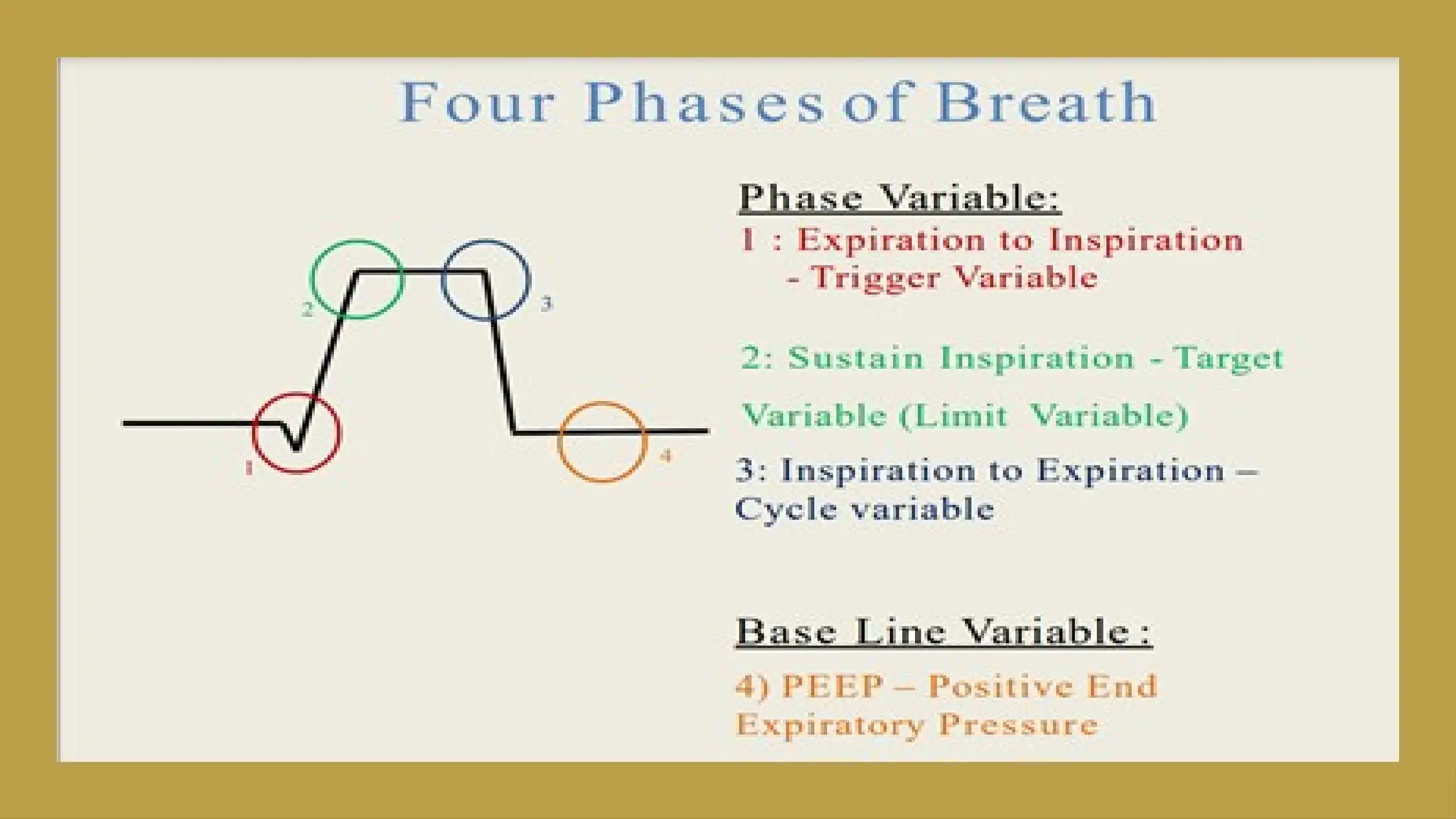
TYPES OF BREATH
1. SPONTANEOUS BREATH
2. ASISTED BREATH
3. MANDATORY BREATH
SPONTANEOUS
BREATH
Patient determine timing and
size of breath
And also trigger and cycled
Eg.- CPAP mode
Airway
pressure
Time
IPAP
EPAP
10
CPAP – spontaneous breath,
Pressure remain positive , not
Return to baseline
Airway
pressure
Time
20
10
0
PEEP – in controlled
Ventilation, no spontaneous
Breaths in between mandatory
breaths
Airway
pressure
Time
20
10
0
IMV with PEEP or CPAP –
Spontaneous breath in between
Mandatory breaths
ASISTED
BREATH
Both mandatory and spontaneous breaths
All or part of breath is generated by the
ventilator, which does part of the WOB for
the patient.
Each breath is spontaneous as patient
determines both trigger and cycle for
breath
Eg. Pressure supported breath
MANDATORY/CONTROLLED
BREATH
Trigger and cycled
both controlled by
machine
Eg.- PCV/VCV
Downward deflection
in pressure tracing
Time
CONTROL BREATH
ASISTED
BREATH
PROXIMAL
AIRWAY
PRESSURE
MODES OF
VENTILATION
Basic Modes
of
Ventilation
FIVE basic modes of ventilation include
1. VOLUME-CONTROLLED VENTILATION (VCV)
2. PRESSURE-CONTROLLED VENTILATION (PCV)
3. SYNCHRONISED INTERMITTENT MECHANICAL
VENTILATION(SIMV)
4. PRESSURE-REGULATED VOLUME
CONTROL(PRVC)
5. PRESSURE SUPPORT VENTILATION (PSV)
VOLUME CONTROL
VOLUME CONTROLLED
VENTILATION
The trigger variable for VCV is assist-control (hybrid between a patient trigger and a ventilator
trigger.
The patient-triggered (assist) component of the trigger can utilize either a pressure or flow trigger.
The ventilator-triggered (control) component of the trigger is set by selecting the respiratory rate,
which dictates the time between control breaths (rate = 1/time).
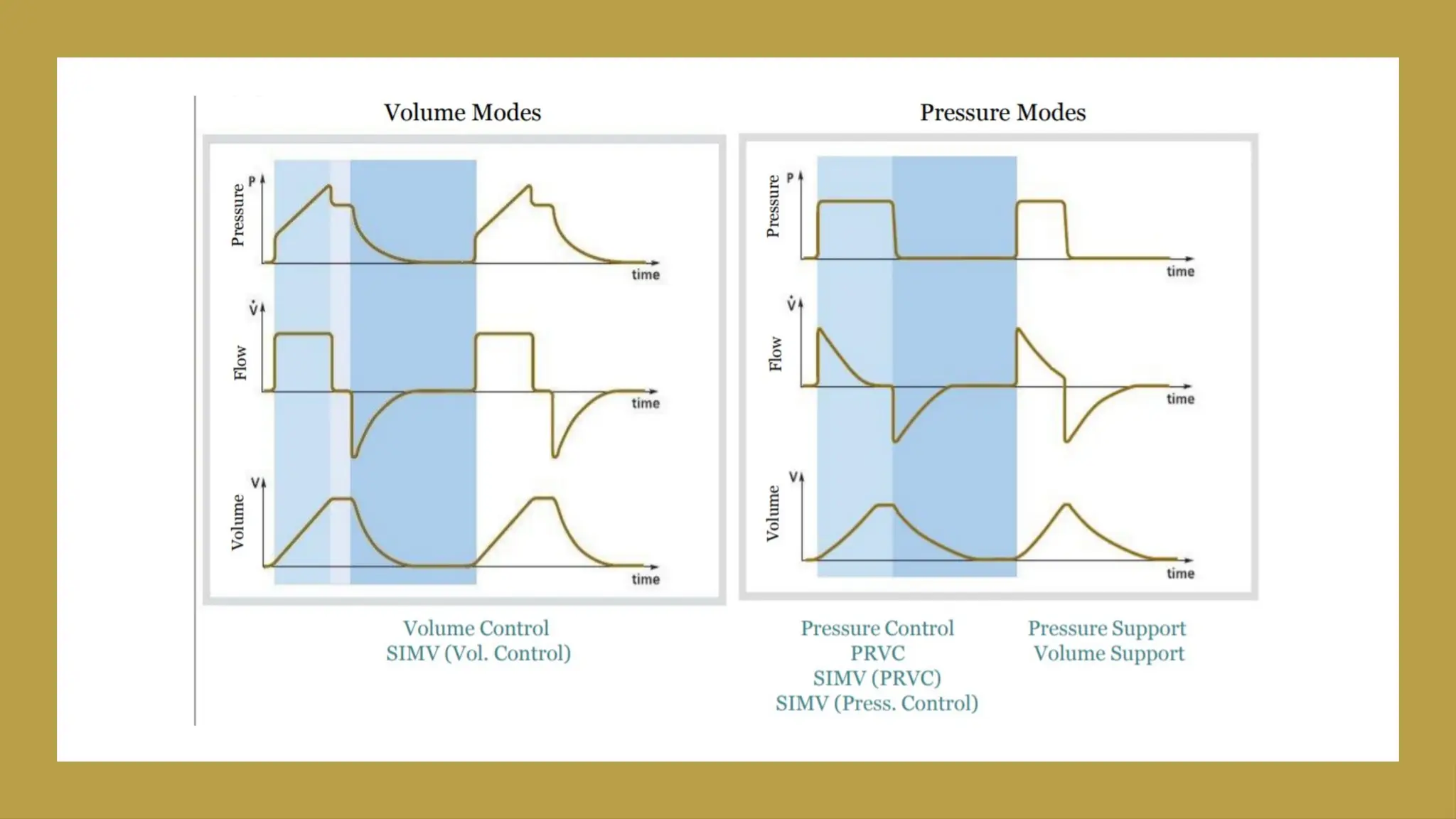
VCV is a flow-targeted and volume(limit).
Volume-cycled mode of ventilation in which the ventilator delivers a set flow waveform pattern to
achieve a set tidal volume.
VOLUME
CONTROL
Set Vt
Set flow rate
Control- volume/flow
Constant- volume/flow
Pressure vary due changes in patient
compliance and resistance.
VOLUME CONTROL
ADVANTAGES:
Guaranteed tidal
volume, set minute
ventilation and rate
Lower work of
breathing
Maintain certain
level of Pco2.
DISADVANTAGE:
Pressure changes
in response to
change in
resistance and
compliance.
Flow is fixed (not
meet patient
demand)- patient-
ventilator dysynchr
ony.
Regional alveolar
overdistension.
If volume lost in
tubing – adequate
volume not reach
WITHOUT PAUSE WITH PAUSE
TRIGGER TIME
PATIENT
TIME
PATIENT
LIMIT FLOW VOLUME
FLOW
CYCLE VOLUME TIME
Factors affecting
pressure
during volume contro
lled ventilation
PATIENT LUNG CHARACTERISTICS
Reduction in lung/chest compliance- higher peak
and plateau pressure and vice versa
Increased airway resistance – higher peak pressure
and vice versa.
Inspiratory flow pattern- peak pressure high with
constant flow but lower mean airway pressures
Increase in PEEP , increases the peak and mean
pressure
High gas flow creates high peak pressure and
plateau pressures
1. Normal
compliance
2. Decrease
compliance
3. Increased
compliance
PRESSURE CONTROL
PRESSURE
CONTROLLED
VENTILATION
The trigger variable for PCV is assist-control.
The patient-triggered (assist) component of the
trigger can utilize either a pressure or flow trigger.
The ventilator-triggered (control) component of the
trigger is set by selecting the respiratory rate, which
dictates the time between control breaths (rate =
1/time).
The target variable is pressure.
PCV is a pressure-targeted, time-cycled mode of
ventilation, in which the ventilator delivers flow to
quickly achieve and maintain a set proximal airway
pressure for a set amount of time.
The flow waveform is a in PCV is a decelerating ramp.
PRESSURE
CONTROL
ADVANTAGES:
Improve better oxygenation
Better distribution of ventilation ( decrease Risk of
overdistension by limiting pressure)
Prevent overinflation by limiting pressure so, PC is good for
lung
Precise control Pplat pressure, MAP , Ti/Te
Responsive to patient inspiratory demands
More comfortable for spontaneous breathing patient.
PRESSURE
CONTROL
DISADVANTAGES:
Vt changes due changes in C and R.
No precise control blood gases.
Vti and Vte decrease when lung bad.
PREESURE
CONTROL
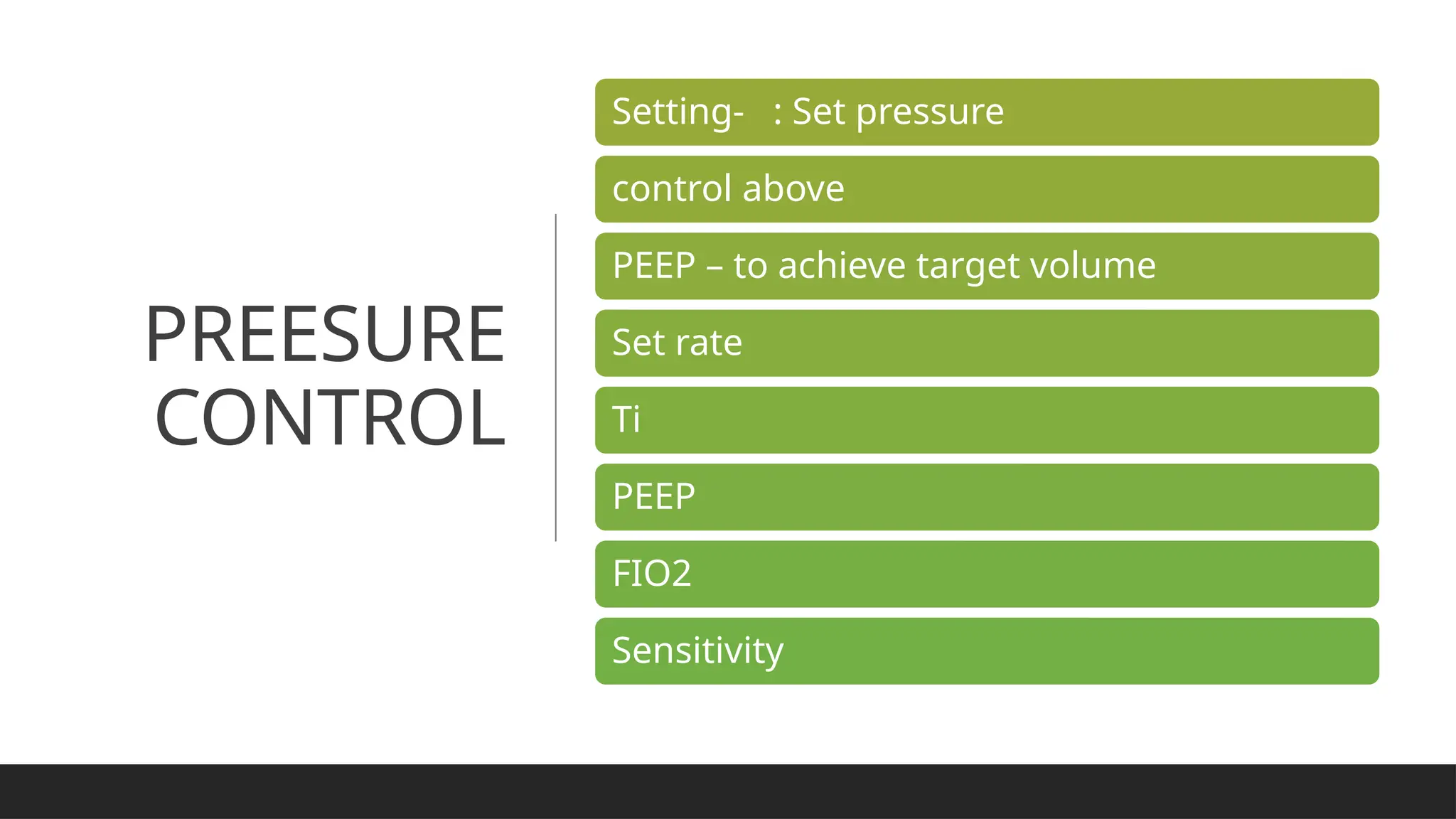
Setting- : Set pressure
control above
PEEP – to achieve target volume
Set rate
Ti
PEEP
FIO2
Sensitivity
Factor affect volume delivery
during pressure
controlled ventilation
Pressure setting : increasing PIP with maintaining PEEP increases volume
delivery
Pressure gradient: increasing EEP (PEEP+ auto PEEP) while keeping
PIP constant reduces pressure gradient (PIP-EEP) and lower volume
delivery and vice versa.
Increase compliance – increase volume delivery and vice versa
Increase airway resistance – lower volume delivery and vice versa
Increase Ti – increase volume
Patient effort also increase volume delivery.
Pressure constant
Normal
compliance
Increased
compliance
Decreased
compliance
PRESSURE CONTROL VOLUME CONTROL
PRESSURE NON-DEPENDENT VOLUME NON-DEPENDENT
VOLUME DEPENDENT PRESSURE DEPENDENT
PREESURE IS CONSTANT FLOW IS CONSTANT
HIGH MEAN AIRWAY PRESSURE LOW MEAN AIRWAY PRESSURE
DECELERATING FLOW PATTERN CONSTANT FLOW PATTERN
PRESSURE CONTROL VOLUME CONTROL
LESS PATIENT VENTILATOR ASYNCHRONY MORE ASYNCHRNY
VARIABLE VT AND MV CONSTANT VT AND MV
HOMOGENOUS DISTRIBUTION OF AIR OVERDISTENSION OF NORMAL ALVEOLI
TIME CYCLED VOLUME CYCLED
REDUCTION OF PEAK PRESSURE AND OF RISK OF
BAROTRAUMA
PRECISE CONTROL OVER PACO2
IMPROVED GAS EXCHANGE DUE TO
DECELERATING FLOW
COMPENSATE FOR LEAKS INABILITY TO COMPENSATES FOR LEAKS
HYPOVENTILATION SECONDARY TO CHANGES IN
LUNG
POTENTIAL FOR ACUTE LUNG INJURY
SYNCHRONIZED
INTERMITTENT
MECHANICAL
VENTILATION(SIMV-
PC/VC)
COMBINATION OF
MANDATORY AND
SPONTANEOUS
BREATH
(ASISTED)/PRESSURE
SUPPORT
VENTILATOR DELIVER
MINIMUM SET RATE
(MANDATORY RATE)
WITH FIXED
INTERVAL
BUT VENTILATOR TRY
TO SYNCHRONIZE
MANDATORY BREATH
WITH PATEINT
(TRIGGER WINDOW)
PSV CAN BE ADDED
TO SPONTANEOUS
BREATH
MANDATORY -
MACHINE/PATIENT
(TRIGGER)
MACHINE (CYCLED)
PRESSURE
CONTROL(PRESSURE
LIMITED ,TIME
CYCLED),
VOLUME
CONTROL( FLOW
LIMITED, VOLUME
CYCLED)
0
0
0
SIMV and PEEP
All mandatory breaths synchronized
to patient’s inspiratory effort
Stacking
Airway
pressure
No synchronization
Mandatory breath
Spontaneous
breath
Mandatory
breath
Spontaneous ventilation
IMV
SIMV
Exhalation
Inspiration
Inspiratory effort
Time
E E
A
B
C
D
SIMV
SPONTANEOUS- PATIENT (TRIGGER/CYCLED)
MAINTAIN RESPIRATORY MUSCLE STRENGTH AND AVOID ATROPHY
REDUCE V/Q MISMATCH DUE TO SPONTANEOUS VENTILATION
FASCILITATES WEANING
DISADVANTAGES:
DESIRE TO WEAN TOO RAPIDLY RESULTS IN HIGH WORK OF
SPONTANEOUS BREATHING AND MUSCLE FATIGUE AND THUS
WEANING FAILURE
INCREASING WEANING FAILURE VS PRESSURE SUPPORT
SLOWER WEANING
SIMV
PESSURE
REGULATED
VOLUME CONTROL
(PRVC)/
AUTO FLOW/
ADAPTIVE
PRESSURE-
VENTILATION/
PC- CMV ADAPTED
BOTH PC AND VC FEATURES
Pressure limited, volume targeted
mechanical breath
Actual pressure vary breath to breath to
achieve target volume
Dual controlled ( PRVC-A//C, PRVC-SIMV)
Increase or decrease pressure to achieve
set target tidal volume.
PRVC
PHASE VARIABLE :
Trigger : time
Patient (depend upon mode)
Limit : pressure limited ,volume targeted
(controlling pressure)
Cycle : Time ( backup volume cycled)
PRVC
ADVANTAGES:
Guranteed minute ventialtion
Limit pressure lung exposed
Better distribution of ventilation
Improved oxygenation
DISADVANTAGES:
When patient demand increases
( increase Vt above set) so support from ventilation
decreases.
PRVC
Setting : target tidal volume , rate. Ti ,PEEP, Fio2, sensitivity
Setting
Set maximum pressure limit
Set
For exapmle : high pressure alarm set at 35 cmH20, so max. Pressure limit delivered
on PRVC 5 cm H2o below (30 cmH2o) if vent. Cannot deliver target volume within this
pressure limit alert alarm
Pressure
IF High pressure is required to deliver to target tidal volume, check
for secretion , bronchospasm, changes in compliance .
Check
PRESSURE
SUPPORT
VENTILATION
Pressure Support Ventilation
The trigger variable for PSV consists of only the patient (assist) trigger. As
with the assist component of the assist- control trigger for both VCV and
PCV, the trigger can be set as either a flow or a pressure trigger.
this mode of ventilation can only be used if the patient initiates a sufficient
number of breaths per minute.
PSV is a pressure-targeted, flow-cycled mode of ventilation, in which the
ventilator delivers flow to quickly achieve and maintain a set airway
pressure until the inspiratory flow depreciates to a set percentage of peak
inspiratory flow. The flow waveform, tidal volume, and inspiratory time vary
depending on characteristics of the respiratory system and patient
respiratory effort
PRESSURE
SUPPORT
VENTILATION Trigger:
flow/pressu
re
1
Limit :
pressure
2
Cycled : flo
w
3
PRESSURE
SUPPORT
Setting ;
Set PEEP for increases oxygenation and recruitment
PS- augments patient tidal volume
Rise time
FIO2
Apnea criteria( apnea time = 20-30 second, apnea
ventilation –set Vt ,VC> PC, set RR
PRESSURE
SUPPORT
ADVANTAGES:
PATIENT –VENTILATOR
SYNCHRONISED
INCREASE COMFORT
DECREASE WOB
WEANING
PRESSURE
SUPPORT
DISADVANTAGES:
NO guranteed tidal volume
No certain minute ventilation
Less able to control ABG
Require intact respiratory drive and fairly
stable lung condition
PS/CPAP
LEAKS
VENTILATOR basics with modes DR MANOJ.pptx

VENTILATOR basics with modes DR MANOJ.pptx

  • 1.
  • 2.
    INDICATION OF MECHANICAL VENTILATION 1.Hypoxemia 2. Acute respiratory acidosis 3. Decrease / prevent muscle fatigue 4. Sedation / neuromuscular blockade 4. Decrease myocardial o2 demand 5. Stabilize chest wall 6. Protect airway
  • 7.
    Peak pressure 3 seconds3 seconds Machine breath Time No patient inspiratory effort Airway pressure 2.5 seconds 2.7 seconds Time Airway pressure Patient’s inspiratory effort Control ventilation Assist Control ventilation
  • 8.
    First breath assisted Second breath control Time Machine-controlledbreath Patient-assisted breath Airway pressure Assist control pressure curve
  • 15.
    TYPES OF BREATH 1.SPONTANEOUS BREATH 2. ASISTED BREATH 3. MANDATORY BREATH
  • 16.
    SPONTANEOUS BREATH Patient determine timingand size of breath And also trigger and cycled Eg.- CPAP mode
  • 17.
    Airway pressure Time IPAP EPAP 10 CPAP – spontaneousbreath, Pressure remain positive , not Return to baseline Airway pressure Time 20 10 0 PEEP – in controlled Ventilation, no spontaneous Breaths in between mandatory breaths Airway pressure Time 20 10 0 IMV with PEEP or CPAP – Spontaneous breath in between Mandatory breaths
  • 18.
    ASISTED BREATH Both mandatory andspontaneous breaths All or part of breath is generated by the ventilator, which does part of the WOB for the patient. Each breath is spontaneous as patient determines both trigger and cycle for breath Eg. Pressure supported breath
  • 19.
    MANDATORY/CONTROLLED BREATH Trigger and cycled bothcontrolled by machine Eg.- PCV/VCV
  • 20.
    Downward deflection in pressuretracing Time CONTROL BREATH ASISTED BREATH PROXIMAL AIRWAY PRESSURE
  • 21.
  • 22.
    Basic Modes of Ventilation FIVE basicmodes of ventilation include 1. VOLUME-CONTROLLED VENTILATION (VCV) 2. PRESSURE-CONTROLLED VENTILATION (PCV) 3. SYNCHRONISED INTERMITTENT MECHANICAL VENTILATION(SIMV) 4. PRESSURE-REGULATED VOLUME CONTROL(PRVC) 5. PRESSURE SUPPORT VENTILATION (PSV)
  • 23.
  • 24.
    VOLUME CONTROLLED VENTILATION The triggervariable for VCV is assist-control (hybrid between a patient trigger and a ventilator trigger. The patient-triggered (assist) component of the trigger can utilize either a pressure or flow trigger. The ventilator-triggered (control) component of the trigger is set by selecting the respiratory rate, which dictates the time between control breaths (rate = 1/time). VCV is a flow-targeted and volume(limit). Volume-cycled mode of ventilation in which the ventilator delivers a set flow waveform pattern to achieve a set tidal volume.
  • 25.
    VOLUME CONTROL Set Vt Set flowrate Control- volume/flow Constant- volume/flow Pressure vary due changes in patient compliance and resistance.
  • 26.
    VOLUME CONTROL ADVANTAGES: Guaranteed tidal volume,set minute ventilation and rate Lower work of breathing Maintain certain level of Pco2. DISADVANTAGE: Pressure changes in response to change in resistance and compliance. Flow is fixed (not meet patient demand)- patient- ventilator dysynchr ony. Regional alveolar overdistension. If volume lost in tubing – adequate volume not reach
  • 27.
    WITHOUT PAUSE WITHPAUSE TRIGGER TIME PATIENT TIME PATIENT LIMIT FLOW VOLUME FLOW CYCLE VOLUME TIME
  • 28.
    Factors affecting pressure during volumecontro lled ventilation PATIENT LUNG CHARACTERISTICS Reduction in lung/chest compliance- higher peak and plateau pressure and vice versa Increased airway resistance – higher peak pressure and vice versa. Inspiratory flow pattern- peak pressure high with constant flow but lower mean airway pressures Increase in PEEP , increases the peak and mean pressure High gas flow creates high peak pressure and plateau pressures
  • 29.
  • 34.
  • 35.
    PRESSURE CONTROLLED VENTILATION The trigger variablefor PCV is assist-control. The patient-triggered (assist) component of the trigger can utilize either a pressure or flow trigger. The ventilator-triggered (control) component of the trigger is set by selecting the respiratory rate, which dictates the time between control breaths (rate = 1/time). The target variable is pressure. PCV is a pressure-targeted, time-cycled mode of ventilation, in which the ventilator delivers flow to quickly achieve and maintain a set proximal airway pressure for a set amount of time. The flow waveform is a in PCV is a decelerating ramp.
  • 36.
    PRESSURE CONTROL ADVANTAGES: Improve better oxygenation Betterdistribution of ventilation ( decrease Risk of overdistension by limiting pressure) Prevent overinflation by limiting pressure so, PC is good for lung Precise control Pplat pressure, MAP , Ti/Te Responsive to patient inspiratory demands More comfortable for spontaneous breathing patient.
  • 37.
    PRESSURE CONTROL DISADVANTAGES: Vt changes duechanges in C and R. No precise control blood gases. Vti and Vte decrease when lung bad.
  • 38.
    PREESURE CONTROL Setting- : Setpressure control above PEEP – to achieve target volume Set rate Ti PEEP FIO2 Sensitivity
  • 39.
    Factor affect volumedelivery during pressure controlled ventilation Pressure setting : increasing PIP with maintaining PEEP increases volume delivery Pressure gradient: increasing EEP (PEEP+ auto PEEP) while keeping PIP constant reduces pressure gradient (PIP-EEP) and lower volume delivery and vice versa. Increase compliance – increase volume delivery and vice versa Increase airway resistance – lower volume delivery and vice versa Increase Ti – increase volume Patient effort also increase volume delivery.
  • 40.
  • 46.
    PRESSURE CONTROL VOLUMECONTROL PRESSURE NON-DEPENDENT VOLUME NON-DEPENDENT VOLUME DEPENDENT PRESSURE DEPENDENT PREESURE IS CONSTANT FLOW IS CONSTANT HIGH MEAN AIRWAY PRESSURE LOW MEAN AIRWAY PRESSURE DECELERATING FLOW PATTERN CONSTANT FLOW PATTERN
  • 47.
    PRESSURE CONTROL VOLUMECONTROL LESS PATIENT VENTILATOR ASYNCHRONY MORE ASYNCHRNY VARIABLE VT AND MV CONSTANT VT AND MV HOMOGENOUS DISTRIBUTION OF AIR OVERDISTENSION OF NORMAL ALVEOLI TIME CYCLED VOLUME CYCLED REDUCTION OF PEAK PRESSURE AND OF RISK OF BAROTRAUMA PRECISE CONTROL OVER PACO2 IMPROVED GAS EXCHANGE DUE TO DECELERATING FLOW COMPENSATE FOR LEAKS INABILITY TO COMPENSATES FOR LEAKS HYPOVENTILATION SECONDARY TO CHANGES IN LUNG POTENTIAL FOR ACUTE LUNG INJURY
  • 48.
    SYNCHRONIZED INTERMITTENT MECHANICAL VENTILATION(SIMV- PC/VC) COMBINATION OF MANDATORY AND SPONTANEOUS BREATH (ASISTED)/PRESSURE SUPPORT VENTILATORDELIVER MINIMUM SET RATE (MANDATORY RATE) WITH FIXED INTERVAL BUT VENTILATOR TRY TO SYNCHRONIZE MANDATORY BREATH WITH PATEINT (TRIGGER WINDOW) PSV CAN BE ADDED TO SPONTANEOUS BREATH MANDATORY - MACHINE/PATIENT (TRIGGER) MACHINE (CYCLED) PRESSURE CONTROL(PRESSURE LIMITED ,TIME CYCLED), VOLUME CONTROL( FLOW LIMITED, VOLUME CYCLED)
  • 49.
    0 0 0 SIMV and PEEP Allmandatory breaths synchronized to patient’s inspiratory effort Stacking Airway pressure No synchronization Mandatory breath Spontaneous breath Mandatory breath Spontaneous ventilation IMV SIMV Exhalation Inspiration Inspiratory effort Time E E A B C D
  • 50.
    SIMV SPONTANEOUS- PATIENT (TRIGGER/CYCLED) MAINTAINRESPIRATORY MUSCLE STRENGTH AND AVOID ATROPHY REDUCE V/Q MISMATCH DUE TO SPONTANEOUS VENTILATION FASCILITATES WEANING DISADVANTAGES: DESIRE TO WEAN TOO RAPIDLY RESULTS IN HIGH WORK OF SPONTANEOUS BREATHING AND MUSCLE FATIGUE AND THUS WEANING FAILURE INCREASING WEANING FAILURE VS PRESSURE SUPPORT SLOWER WEANING
  • 52.
  • 54.
    PESSURE REGULATED VOLUME CONTROL (PRVC)/ AUTO FLOW/ ADAPTIVE PRESSURE- VENTILATION/ PC-CMV ADAPTED BOTH PC AND VC FEATURES Pressure limited, volume targeted mechanical breath Actual pressure vary breath to breath to achieve target volume Dual controlled ( PRVC-A//C, PRVC-SIMV) Increase or decrease pressure to achieve set target tidal volume.
  • 55.
    PRVC PHASE VARIABLE : Trigger: time Patient (depend upon mode) Limit : pressure limited ,volume targeted (controlling pressure) Cycle : Time ( backup volume cycled)
  • 56.
    PRVC ADVANTAGES: Guranteed minute ventialtion Limitpressure lung exposed Better distribution of ventilation Improved oxygenation DISADVANTAGES: When patient demand increases ( increase Vt above set) so support from ventilation decreases.
  • 57.
    PRVC Setting : targettidal volume , rate. Ti ,PEEP, Fio2, sensitivity Setting Set maximum pressure limit Set For exapmle : high pressure alarm set at 35 cmH20, so max. Pressure limit delivered on PRVC 5 cm H2o below (30 cmH2o) if vent. Cannot deliver target volume within this pressure limit alert alarm Pressure IF High pressure is required to deliver to target tidal volume, check for secretion , bronchospasm, changes in compliance . Check
  • 60.
    PRESSURE SUPPORT VENTILATION Pressure Support Ventilation Thetrigger variable for PSV consists of only the patient (assist) trigger. As with the assist component of the assist- control trigger for both VCV and PCV, the trigger can be set as either a flow or a pressure trigger. this mode of ventilation can only be used if the patient initiates a sufficient number of breaths per minute. PSV is a pressure-targeted, flow-cycled mode of ventilation, in which the ventilator delivers flow to quickly achieve and maintain a set airway pressure until the inspiratory flow depreciates to a set percentage of peak inspiratory flow. The flow waveform, tidal volume, and inspiratory time vary depending on characteristics of the respiratory system and patient respiratory effort
  • 61.
  • 62.
    PRESSURE SUPPORT Setting ; Set PEEPfor increases oxygenation and recruitment PS- augments patient tidal volume Rise time FIO2 Apnea criteria( apnea time = 20-30 second, apnea ventilation –set Vt ,VC> PC, set RR
  • 63.
  • 64.
    PRESSURE SUPPORT DISADVANTAGES: NO guranteed tidalvolume No certain minute ventilation Less able to control ABG Require intact respiratory drive and fairly stable lung condition
  • 65.
  • 80.