Muzamil Syed Shah
Section Entomology
16-ZYM-24
GH-7892
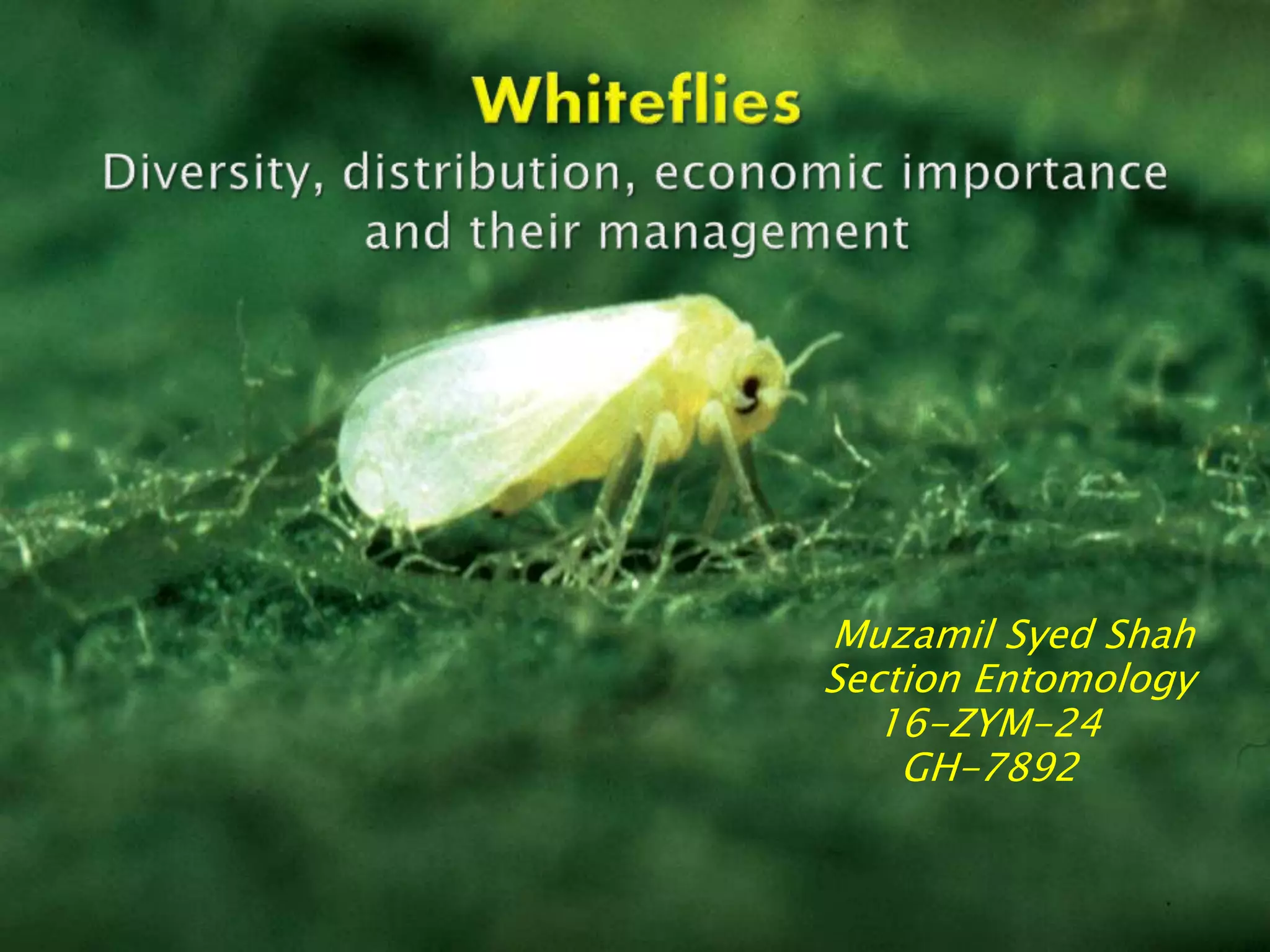
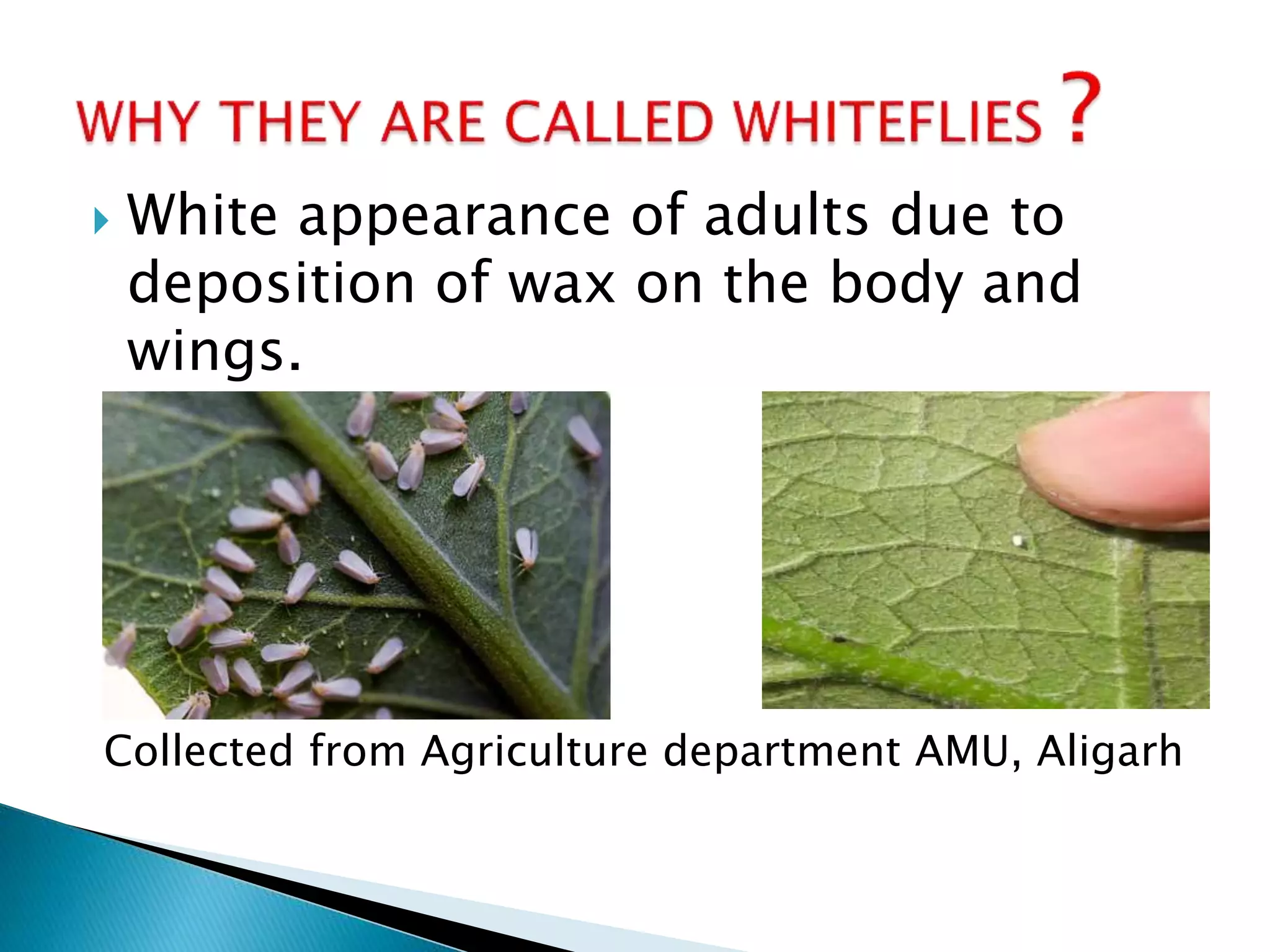
 White appearance of adults due to
deposition of wax on the body and
wings.
Collected from Agriculture department AMU, Aligarh
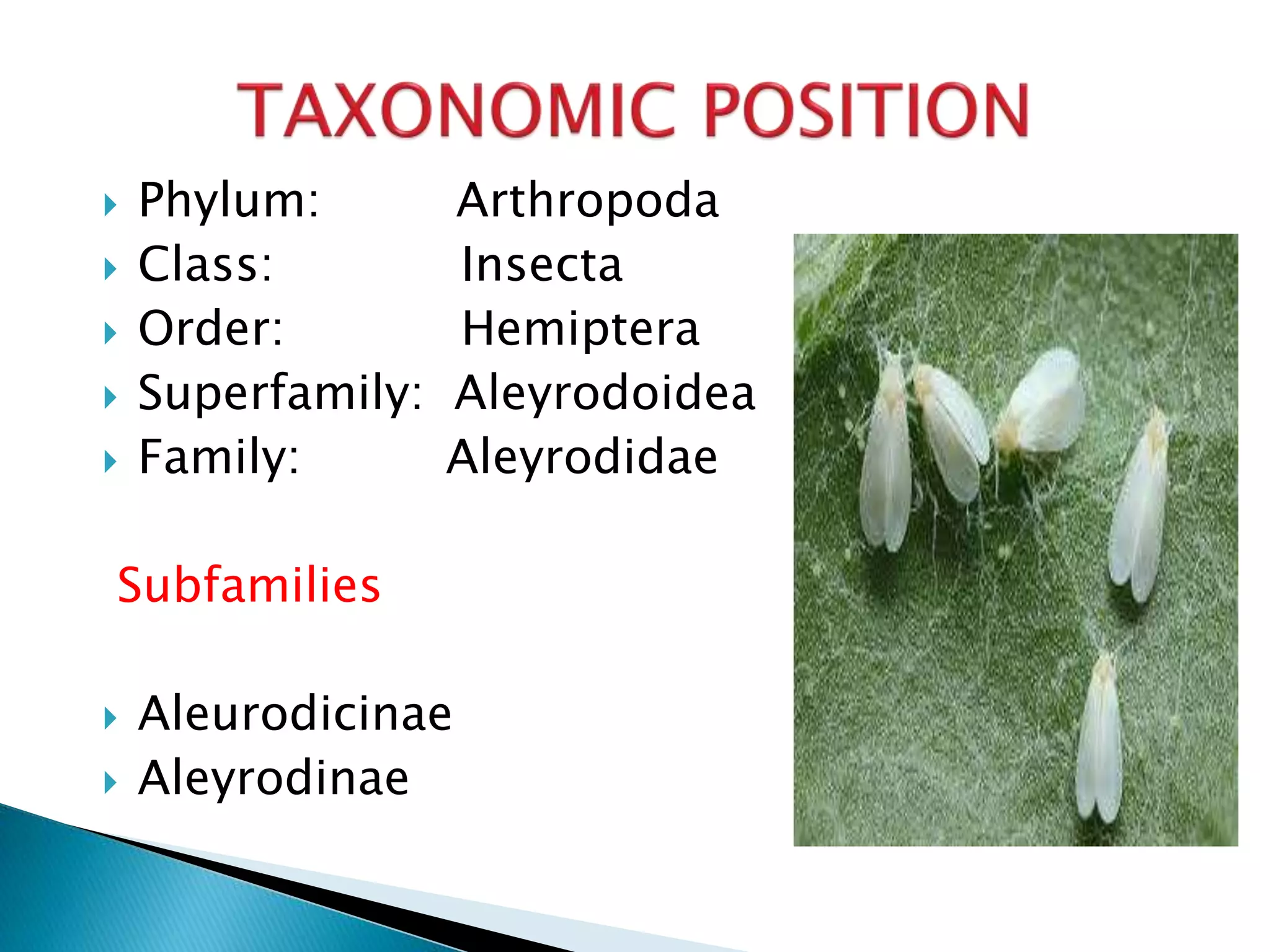
 Phylum: Arthropoda
 Class: Insecta
 Order: Hemiptera
 Superfamily: Aleyrodoidea
 Family: Aleyrodidae
Subfamilies
 Aleurodicinae
 Aleyrodinae
 Small insects.
 Most species with a wingspan of
less than 3 mm and a body length
of 1 mm to 2mm.
 Adults have well-developed
antennae, which in most species
in this family are seven-
segmented.
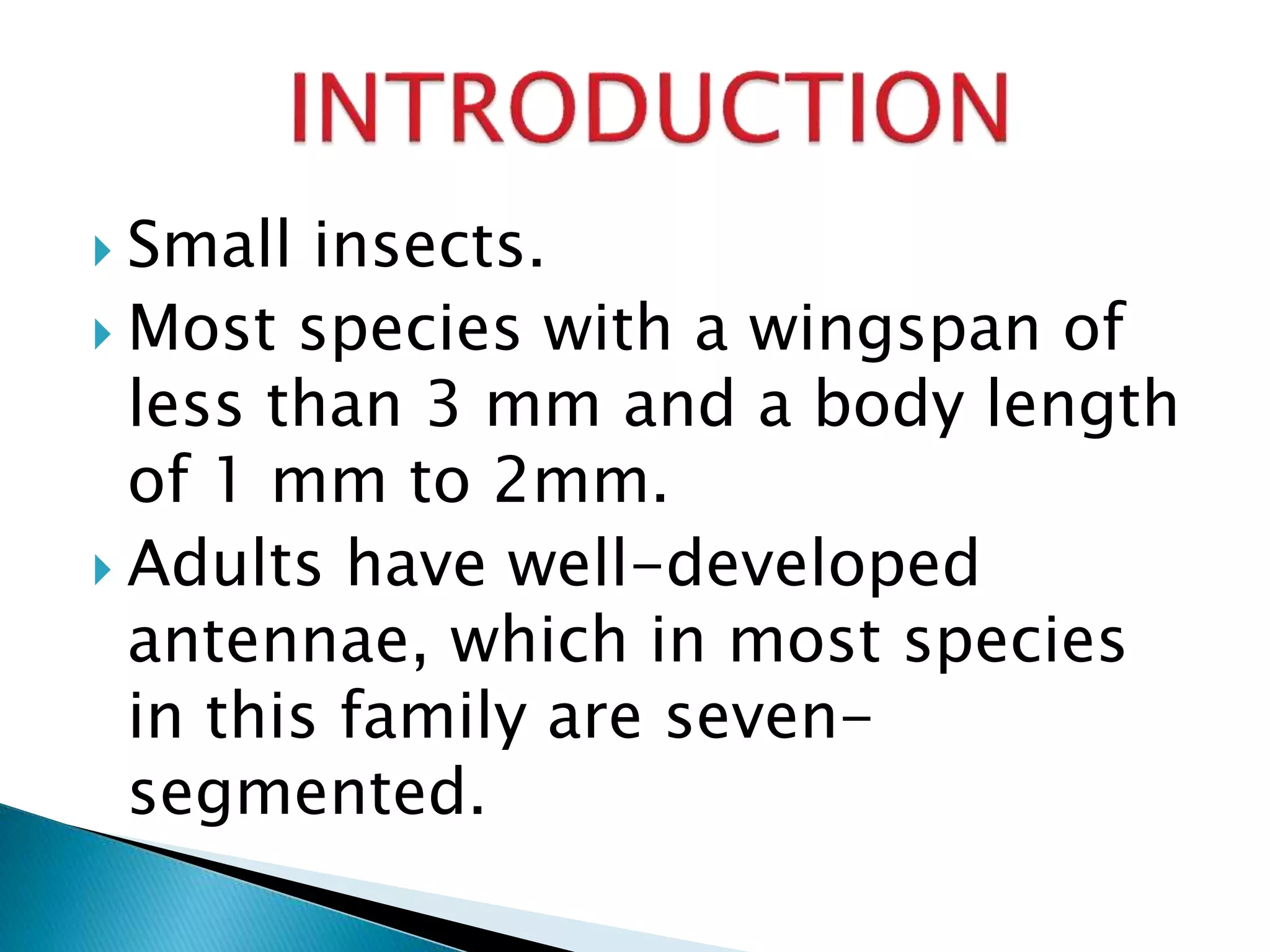
 There are two ocelli, which generally
in the Aleyrodidae are placed at the
anterior margins of the compound
eyes.
 Both sexes have functional
mouthparts and two pairs
of membranous, functional
wings.
 The wing venation is reduced.
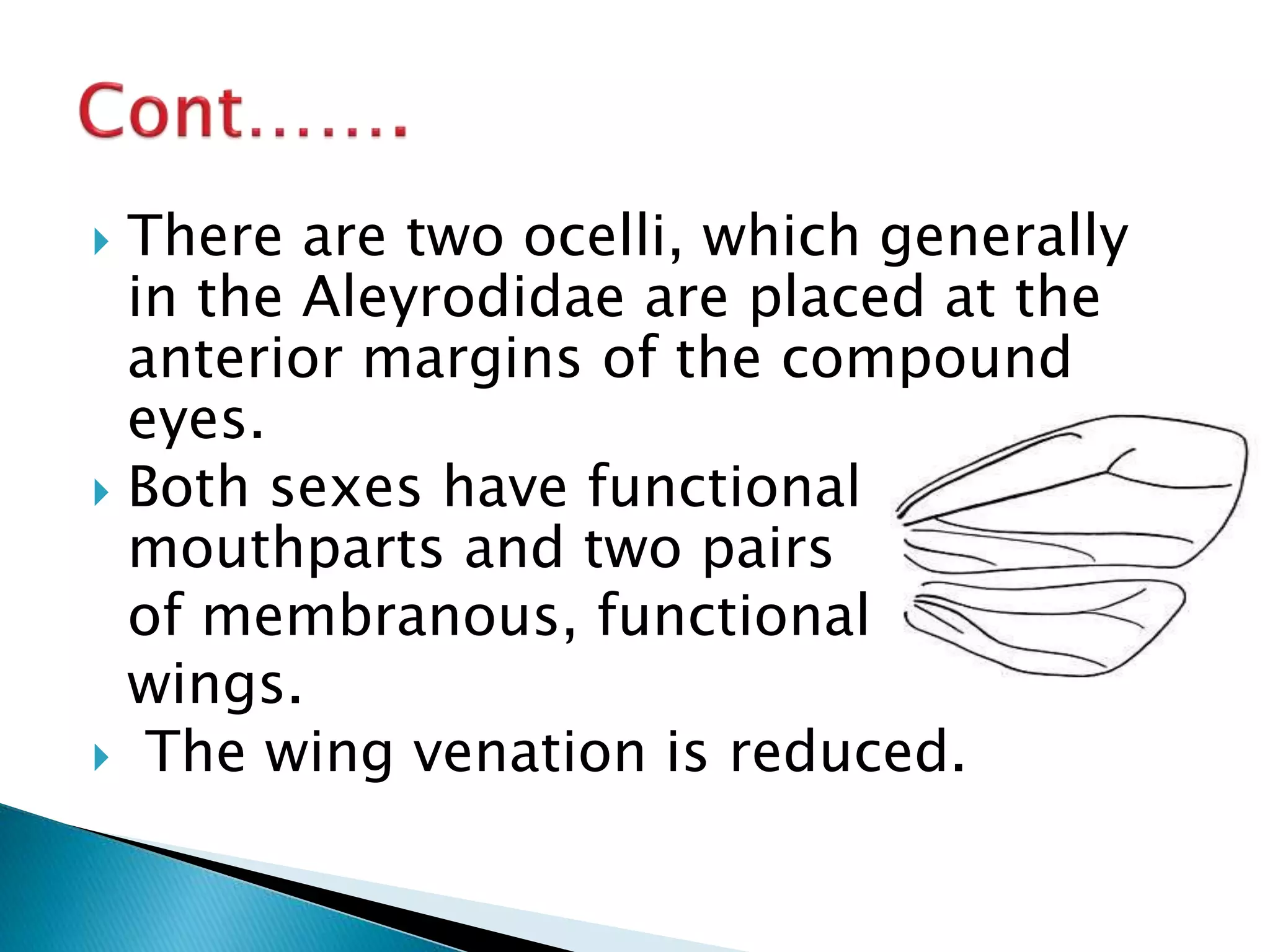
 The digestive system of the Aleyrodidae is typical of
the Sternorrhyncha, including a filter chamber,
 Produce large quantities of honeydew;
 The honeydew emerges from the anus, which is
inside an opening called the vasiform orifice on the
dorsal surface of the caudal segment of the
abdomen. This orifice is large and is covered by an
operculum.
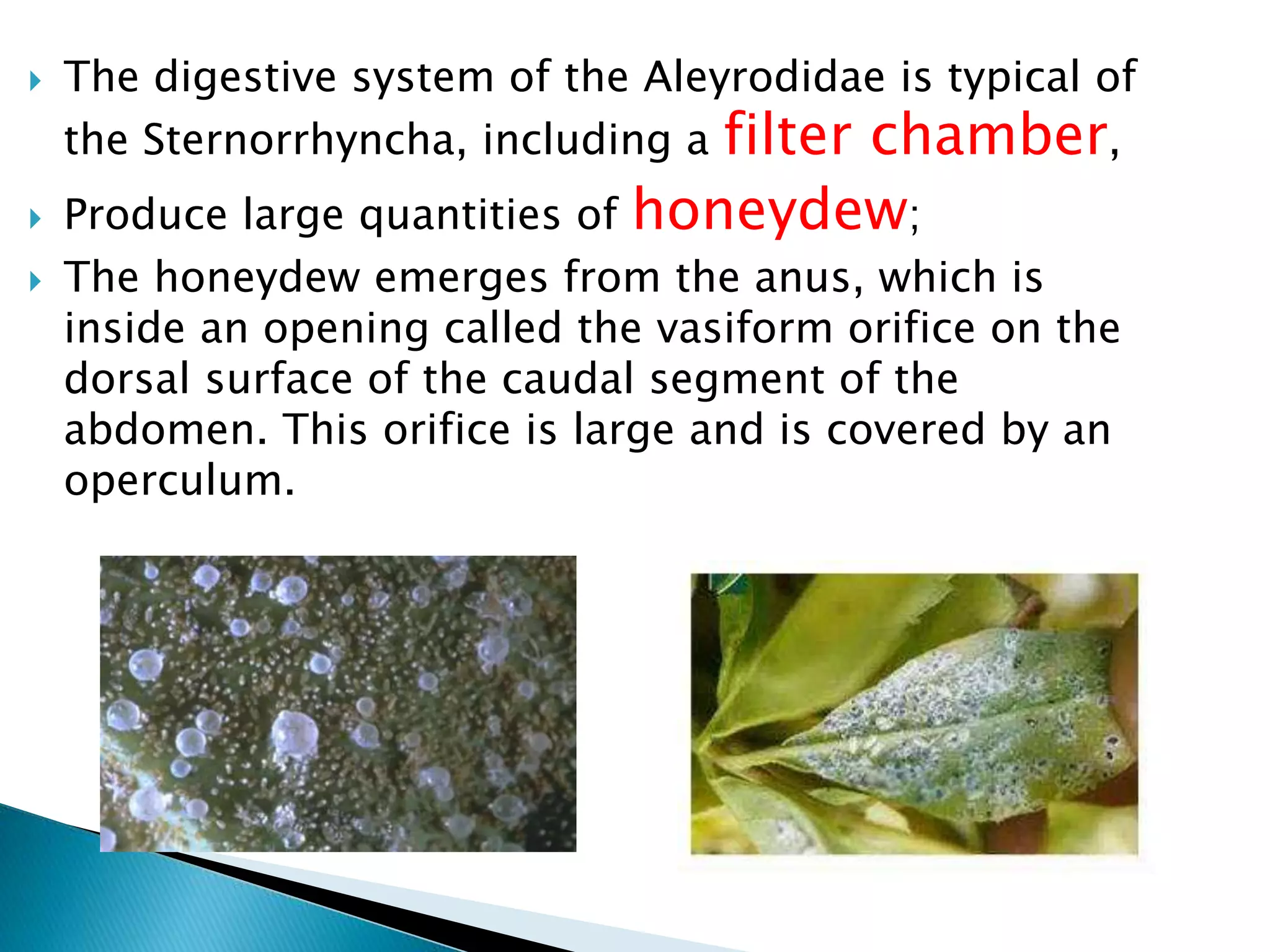
 The adult female lays eggs
which are provided with a stalk
or pedicel at one end with
which they are attached to the
leaf.
 The first instar is called
crawler.
 The legs and antennae of the
second, third, and fourth
nymphal instars are atrophied
and these instars are sessile.
 The adult develop within the
quiescent fourth instars.
 There are currently around 1550 known
species of whiteflies under two subfamilies,
namely.,
1) Aleyrodinae .
2) Aleurodicinae.
 Indian fauna of whiteflies comprises 290
species in 57 genera.
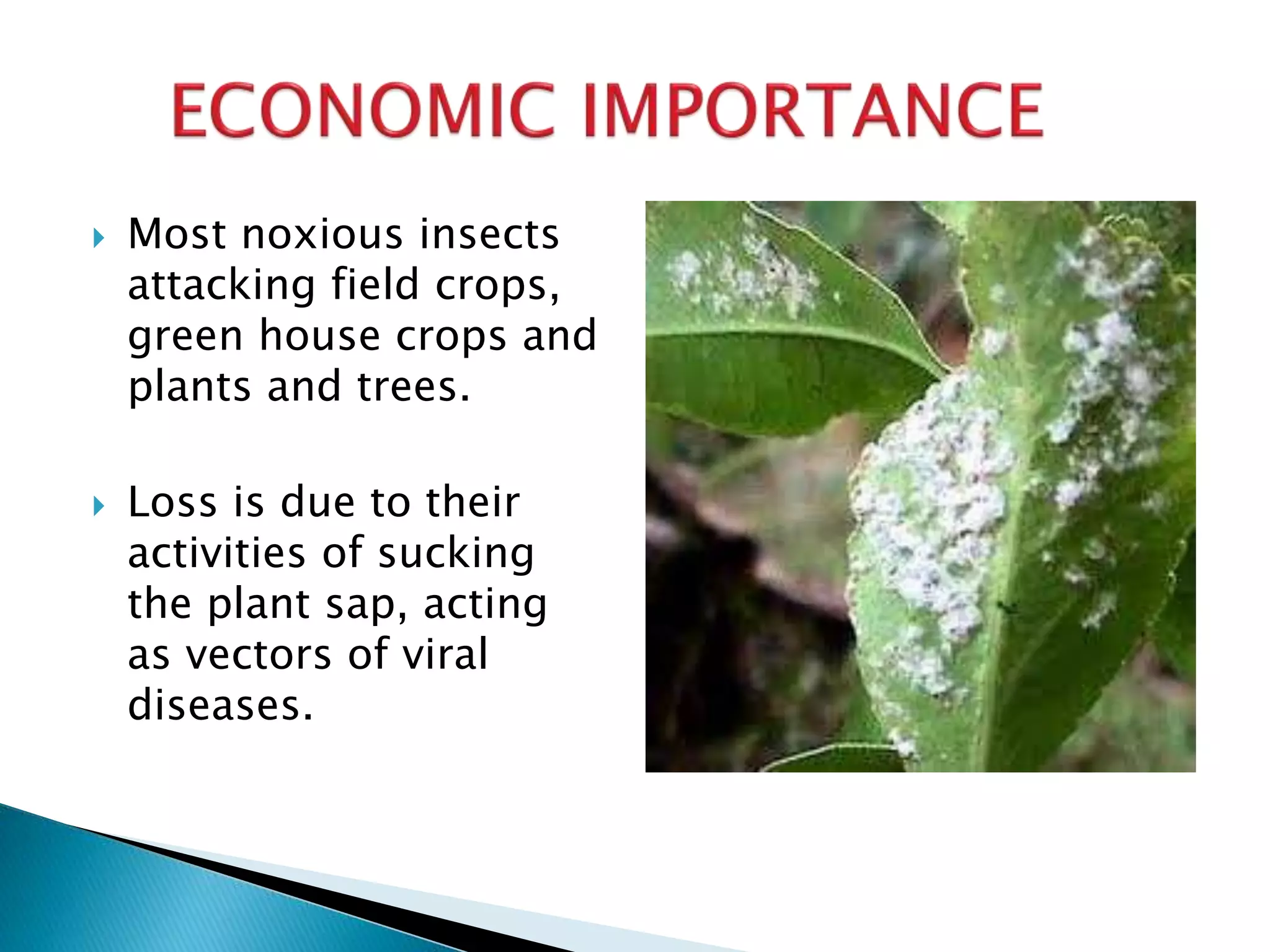
 Most noxious insects
attacking field crops,
green house crops and
plants and trees.
 Loss is due to their
activities of sucking
the plant sap, acting
as vectors of viral
diseases.
The pest is more important as a transmitter of viruses
such as.,
 Sweetpotato mild mottle virus,
 Sweet potato yellow dwarf disease,
 Sweetpotato leaf curl, and
 Particularly sweetpotato chlorotic stunt virus,
a key component of sweetpotato virus
disease.
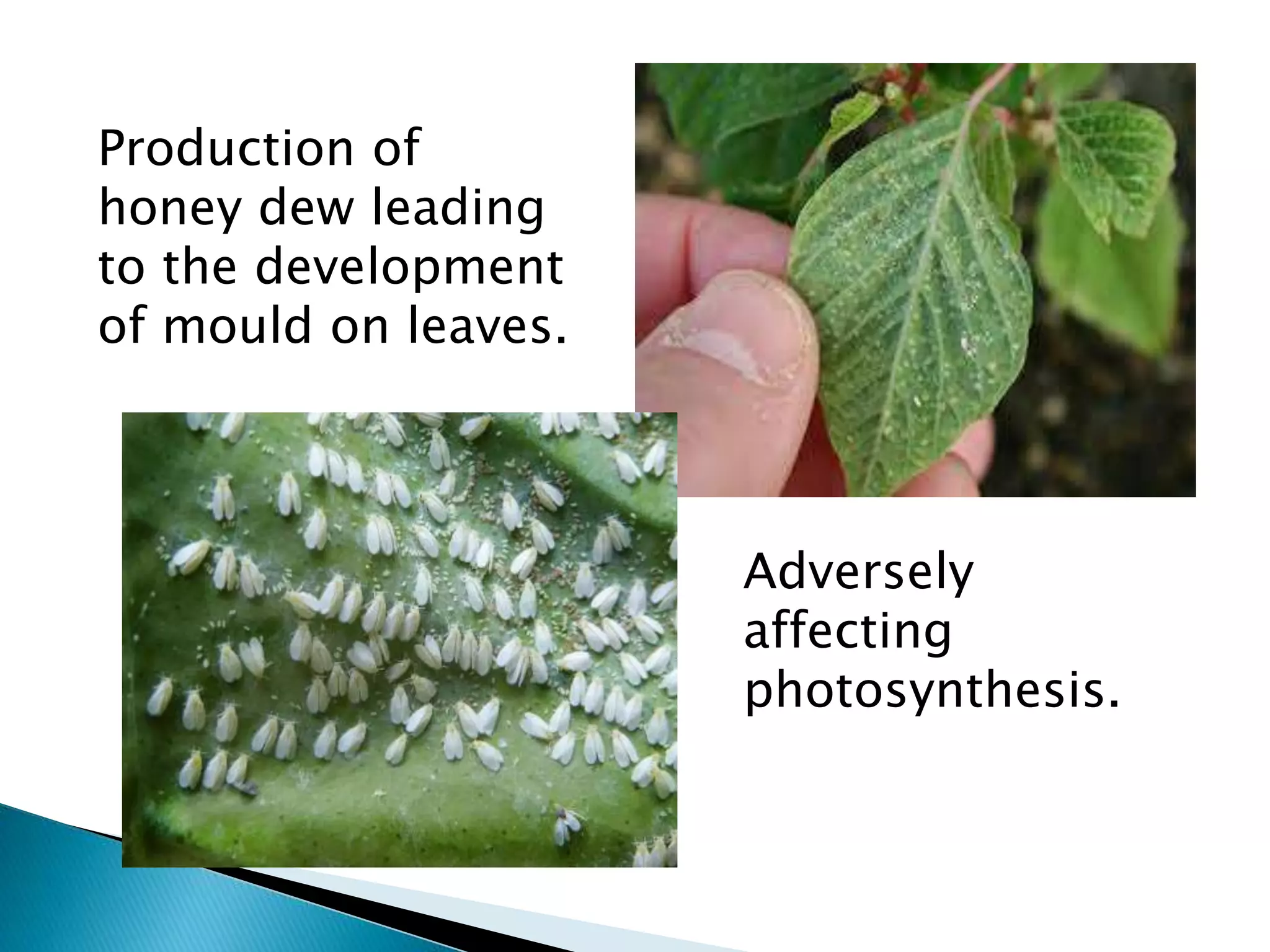
Production of
honey dew leading
to the development
of mould on leaves.
Adversely
affecting
photosynthesis.
 Aleurocanthus woglumi, citrus blackfly,
which, in spite of its color, is a whitefly that
attacks citrus
 Aleyrodes proletella, cabbage whitefly, is a
pest of various Brassica crops.
 Bemisia tabaci, silverleaf whitefly, is a pest of
many agricultural and ornamental crops.
 Trialeurodes vaporariorum, greenhouse
whitefly, a major pest of greenhouse fruit,
vegetables, and ornamentals.
 Whiteflies feed by tapping into the phloem of
plants, introducing toxic saliva and
decreasing the plants' overall turgor pressure.
 Since whiteflies congregate in large numbers,
susceptible plants can be quickly
overwhelmed.
 Further harm is done by mold growth
encouraged by the honeydew whiteflies
secrete.
 Whitefly control is
difficult and
complex, as
whiteflies rapidly
develop resistance
to chemical
pesticides.
 Pesticides used for whitefly control usually
contain Neonicotinoid compounds as active
ingredients:
 Clothianidin
 Dinotefuran
 Imidacloprid
 Thiamethoxam
 Several predators and
parasitoids may be
effective in controlling
whitefly infestations,
including green
lacewings, ladybirds,
minute pirate bugs,
big-eyed bugs, damsel
bugs, and phytoseiid
mites.
Pirate bug feeding on whitefly larvae
 A number of plants can be intercropped with
vegetables, in a garden setting, serving as
companion plants to protect against
whiteflies.
EXAMPLES
 Nasturtiums are thought to provide a defense
to tomatoes.
 Zinnias, attract predators that consume
whiteflies, including hummingbirds and
predatory wasps and flies.
 R.Sundararaj Institution of Wood Science & Technology
 Martin, J.H.; Mound, L.A. (2007). "An annotated check list of the
world's whiteflies (Insecta: Hemiptera: Aleyrodidae)". Zootaxa.
1492: 1–84.
 Richards, O. W.; Davies, R.G. (1977). Imms' General Textbook of
Entomology: Volume 1: Structure, Physiology and Development
Volume 2:
 Classification and Biology. Berlin: Springer. ISBN 0-412-61390-
5. Retrieved 2016 07 02, from the Integrated Taxonomic
Information System on-line database,
http://www.itis.gov/servlet/SingleRpt/SingleRpt?search_topic=T
SN&search_value=200525
 Martin, Jon H. Giant whiteflies (Sternorrhyncha, Aleyrodidae).
Tijdschrift voor Entomologie 150: 13–29, Figs. 1–33, Table 1.
[ISSN 0040-7496]. http://www.nev.nl/tve 2007 Nederlandse
Entomologische Vereniging. Published 1 June 2007. [1]
 Both immature and adult whiteflies feed by piercing the undersurface of leaves
and sucking the plant sap.
 The nymphs, which feed in one position for 2-4 weeks, may cause yellow spots
which are conspicuous on the upper leaf surface. On older leaves the spots
develop a brown centre. Some sweetpotato cultivars respond to the damage by
producing purple pigments, resulting in purple spots with a brown centre.
 Feeding by adults usually causes no visible lesion, but high whitefly populations
may cause yellowing of infested leaves, and may stunt plant growth.
 Whiteflies produce honeydew, a sugary secretion, making the leaf surface sticky.
In humid conditions, sooty mould may develop on the leaf surface, reducing its
capacity to trap light required for the plant's normal growth.
 The pest is more important as a transmitter of viruses such as sweetpotato mild
mottle virus, sweetpotato yellow dwarf disease, sweetpotato leaf curl, and
particularly sweetpotato chlorotic stunt virus, a key component of sweetpotato
virus disease.
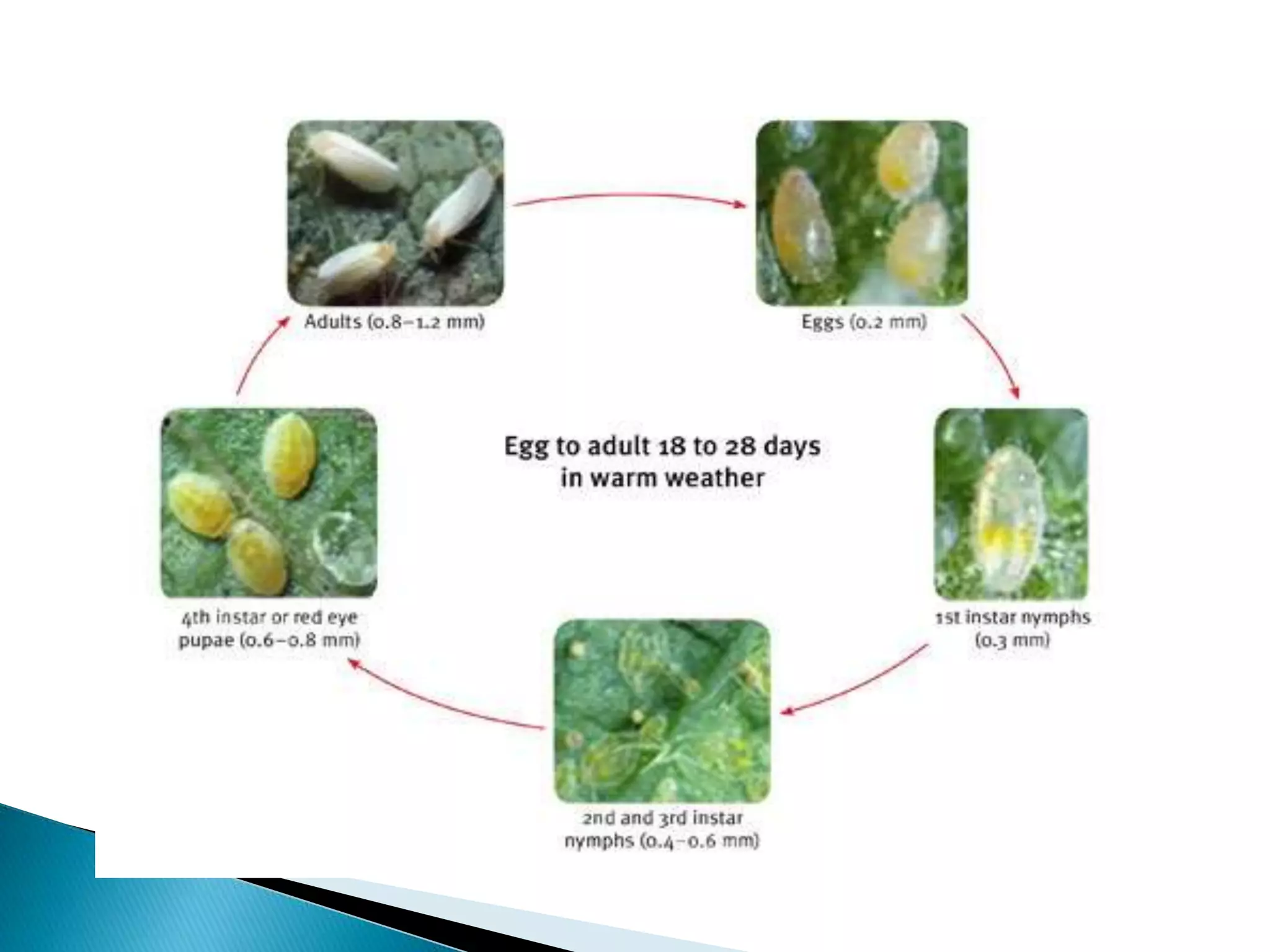
 Egg. Small, elliptical, smooth surfaced, yellow to tan eggs are laid on
leaf surface, usually on undersurface, in irregular, waxy lines, forming a
spiral ( hence the common name). Eggs take about seven days to hatch.
 Larva. There are four larval stages that take about 30 days to complete.
The first instar is mobile, crawling a short distance from the egg before
settling to feed. The following 3 instars are immobile, appearing as a
small, flattened, oval scale on the leaf surface. The final instar stops
feeding and is referred to as the Pupa. It is colourless or yellowish,
nearly oval, flat and about 1 mm long and 0.75 mm wide. They secrete
waxy threads on their back which are about 12-15 mm long and provide
a protective cover.
 Adult. The adults are white and quite small, about 2-3 mm in length
and coated with a fine dust-like waxy secretion. The eyes are dark
reddish-brown, wings are transparent with white powder covering.
Females lay eggs throughout their lifetime
 Biology and ecology
 Whiteflies have six life stages - the egg, four nymphal stages, and the adult. The
development time of this insect from egg to adult depends upon temperature.
Temperature range of 10 to 32oC favours development. Low temperatures
increase egg mortality. The pest is more common during the dry season.
 The female may lay 100 or more eggs on the back or undersurface of the leaves.
They hatch after about seven days. The first instar nymphs emerge and feed. After
the first moult they become fixed to one place of the leaf and develop into pale
green or creamy flattened scale-like bodies. The third moult gives rise to the
“puparium” which is less flat than the previous nymphal stages and the red eyes of
the adult can be seen through the integument. Development of one generation
takes 2 to 4 weeks depending on temperature.
 In both species, reproduction can occur without mating (parthenogenesis).
Unmated females produce only male progeny.
 Biological control
 Natural enemies were introduced to control
whiteflies. The parasitic wasp Encarsia formosa is
an effective biological control agent against both
A. dispersus and B. tabaci while some species of
coccinellid beetles, true bugs (Hemiptera:
especially Anthocoridae and predatory Miridae),
lacewings (Neuroptera: Chrysopidae,
Hemerobiidae, Coniopterygidae), flies (Diptera:
Dolichopodidae, Syrphidae, Anthomyoodae), ants
(Hymenoptera: Formicidae), spiders (Araneida)
and mites (Acarina: Phytoseiidae, Stigmaeidae)
also prey on them.
 Several Aphelinid parasitoids in the genera Encarsia
and Eretmocerus, attack the pest and often control it.
Their overall effect (especially in the field) may
sometimes be limited due to the rapid development
of the pest which often overtakes that of its enemies.
Then, the fact that even a few whiteflies can transmit
pernicious plant viruses, a situation that requires a
pest-free crop environment, which in turn promotes
the use of pesticides. Finally, chemicals that are
applied against other major cotton and tomato pests
usually kill the enemies. Some entomophatogenic
fungi infect B. tabaci, but their overall effect in the
field or in greenhouse is not known.
1) Aleurocanthus
2) Aeurolobus
3) Aleuromarginatus
4) Aleuroplatus
5) Orientaleyrodes
6) Hindaleyroes
7) Dialeurolonga
8) Cockerellilla

Whiteflies

  • 1.
    Muzamil Syed Shah SectionEntomology 16-ZYM-24 GH-7892
  • 2.
     White appearanceof adults due to deposition of wax on the body and wings. Collected from Agriculture department AMU, Aligarh
  • 3.
     Phylum: Arthropoda Class: Insecta  Order: Hemiptera  Superfamily: Aleyrodoidea  Family: Aleyrodidae Subfamilies  Aleurodicinae  Aleyrodinae
  • 5.
     Small insects. Most species with a wingspan of less than 3 mm and a body length of 1 mm to 2mm.  Adults have well-developed antennae, which in most species in this family are seven- segmented.
  • 6.
     There aretwo ocelli, which generally in the Aleyrodidae are placed at the anterior margins of the compound eyes.  Both sexes have functional mouthparts and two pairs of membranous, functional wings.  The wing venation is reduced.
  • 7.
     The digestivesystem of the Aleyrodidae is typical of the Sternorrhyncha, including a filter chamber,  Produce large quantities of honeydew;  The honeydew emerges from the anus, which is inside an opening called the vasiform orifice on the dorsal surface of the caudal segment of the abdomen. This orifice is large and is covered by an operculum.
  • 8.
     The adultfemale lays eggs which are provided with a stalk or pedicel at one end with which they are attached to the leaf.  The first instar is called crawler.  The legs and antennae of the second, third, and fourth nymphal instars are atrophied and these instars are sessile.  The adult develop within the quiescent fourth instars.
  • 10.
     There arecurrently around 1550 known species of whiteflies under two subfamilies, namely., 1) Aleyrodinae . 2) Aleurodicinae.  Indian fauna of whiteflies comprises 290 species in 57 genera.
  • 11.
     Most noxiousinsects attacking field crops, green house crops and plants and trees.  Loss is due to their activities of sucking the plant sap, acting as vectors of viral diseases.
  • 12.
    The pest ismore important as a transmitter of viruses such as.,  Sweetpotato mild mottle virus,  Sweet potato yellow dwarf disease,  Sweetpotato leaf curl, and  Particularly sweetpotato chlorotic stunt virus, a key component of sweetpotato virus disease.
  • 13.
    Production of honey dewleading to the development of mould on leaves. Adversely affecting photosynthesis.
  • 14.
     Aleurocanthus woglumi,citrus blackfly, which, in spite of its color, is a whitefly that attacks citrus  Aleyrodes proletella, cabbage whitefly, is a pest of various Brassica crops.  Bemisia tabaci, silverleaf whitefly, is a pest of many agricultural and ornamental crops.  Trialeurodes vaporariorum, greenhouse whitefly, a major pest of greenhouse fruit, vegetables, and ornamentals.
  • 15.
     Whiteflies feedby tapping into the phloem of plants, introducing toxic saliva and decreasing the plants' overall turgor pressure.  Since whiteflies congregate in large numbers, susceptible plants can be quickly overwhelmed.  Further harm is done by mold growth encouraged by the honeydew whiteflies secrete.
  • 17.
     Whitefly controlis difficult and complex, as whiteflies rapidly develop resistance to chemical pesticides.
  • 18.
     Pesticides usedfor whitefly control usually contain Neonicotinoid compounds as active ingredients:  Clothianidin  Dinotefuran  Imidacloprid  Thiamethoxam
  • 19.
     Several predatorsand parasitoids may be effective in controlling whitefly infestations, including green lacewings, ladybirds, minute pirate bugs, big-eyed bugs, damsel bugs, and phytoseiid mites. Pirate bug feeding on whitefly larvae
  • 20.
     A numberof plants can be intercropped with vegetables, in a garden setting, serving as companion plants to protect against whiteflies. EXAMPLES  Nasturtiums are thought to provide a defense to tomatoes.
  • 21.
     Zinnias, attractpredators that consume whiteflies, including hummingbirds and predatory wasps and flies.
  • 22.
     R.Sundararaj Institutionof Wood Science & Technology  Martin, J.H.; Mound, L.A. (2007). "An annotated check list of the world's whiteflies (Insecta: Hemiptera: Aleyrodidae)". Zootaxa. 1492: 1–84.  Richards, O. W.; Davies, R.G. (1977). Imms' General Textbook of Entomology: Volume 1: Structure, Physiology and Development Volume 2:  Classification and Biology. Berlin: Springer. ISBN 0-412-61390- 5. Retrieved 2016 07 02, from the Integrated Taxonomic Information System on-line database, http://www.itis.gov/servlet/SingleRpt/SingleRpt?search_topic=T SN&search_value=200525  Martin, Jon H. Giant whiteflies (Sternorrhyncha, Aleyrodidae). Tijdschrift voor Entomologie 150: 13–29, Figs. 1–33, Table 1. [ISSN 0040-7496]. http://www.nev.nl/tve 2007 Nederlandse Entomologische Vereniging. Published 1 June 2007. [1]
  • 25.
     Both immatureand adult whiteflies feed by piercing the undersurface of leaves and sucking the plant sap.  The nymphs, which feed in one position for 2-4 weeks, may cause yellow spots which are conspicuous on the upper leaf surface. On older leaves the spots develop a brown centre. Some sweetpotato cultivars respond to the damage by producing purple pigments, resulting in purple spots with a brown centre.  Feeding by adults usually causes no visible lesion, but high whitefly populations may cause yellowing of infested leaves, and may stunt plant growth.  Whiteflies produce honeydew, a sugary secretion, making the leaf surface sticky. In humid conditions, sooty mould may develop on the leaf surface, reducing its capacity to trap light required for the plant's normal growth.  The pest is more important as a transmitter of viruses such as sweetpotato mild mottle virus, sweetpotato yellow dwarf disease, sweetpotato leaf curl, and particularly sweetpotato chlorotic stunt virus, a key component of sweetpotato virus disease.
  • 26.
     Egg. Small,elliptical, smooth surfaced, yellow to tan eggs are laid on leaf surface, usually on undersurface, in irregular, waxy lines, forming a spiral ( hence the common name). Eggs take about seven days to hatch.  Larva. There are four larval stages that take about 30 days to complete. The first instar is mobile, crawling a short distance from the egg before settling to feed. The following 3 instars are immobile, appearing as a small, flattened, oval scale on the leaf surface. The final instar stops feeding and is referred to as the Pupa. It is colourless or yellowish, nearly oval, flat and about 1 mm long and 0.75 mm wide. They secrete waxy threads on their back which are about 12-15 mm long and provide a protective cover.  Adult. The adults are white and quite small, about 2-3 mm in length and coated with a fine dust-like waxy secretion. The eyes are dark reddish-brown, wings are transparent with white powder covering. Females lay eggs throughout their lifetime
  • 27.
     Biology andecology  Whiteflies have six life stages - the egg, four nymphal stages, and the adult. The development time of this insect from egg to adult depends upon temperature. Temperature range of 10 to 32oC favours development. Low temperatures increase egg mortality. The pest is more common during the dry season.  The female may lay 100 or more eggs on the back or undersurface of the leaves. They hatch after about seven days. The first instar nymphs emerge and feed. After the first moult they become fixed to one place of the leaf and develop into pale green or creamy flattened scale-like bodies. The third moult gives rise to the “puparium” which is less flat than the previous nymphal stages and the red eyes of the adult can be seen through the integument. Development of one generation takes 2 to 4 weeks depending on temperature.  In both species, reproduction can occur without mating (parthenogenesis). Unmated females produce only male progeny.
  • 28.
     Biological control Natural enemies were introduced to control whiteflies. The parasitic wasp Encarsia formosa is an effective biological control agent against both A. dispersus and B. tabaci while some species of coccinellid beetles, true bugs (Hemiptera: especially Anthocoridae and predatory Miridae), lacewings (Neuroptera: Chrysopidae, Hemerobiidae, Coniopterygidae), flies (Diptera: Dolichopodidae, Syrphidae, Anthomyoodae), ants (Hymenoptera: Formicidae), spiders (Araneida) and mites (Acarina: Phytoseiidae, Stigmaeidae) also prey on them.
  • 29.
     Several Aphelinidparasitoids in the genera Encarsia and Eretmocerus, attack the pest and often control it. Their overall effect (especially in the field) may sometimes be limited due to the rapid development of the pest which often overtakes that of its enemies. Then, the fact that even a few whiteflies can transmit pernicious plant viruses, a situation that requires a pest-free crop environment, which in turn promotes the use of pesticides. Finally, chemicals that are applied against other major cotton and tomato pests usually kill the enemies. Some entomophatogenic fungi infect B. tabaci, but their overall effect in the field or in greenhouse is not known.
  • 31.
    1) Aleurocanthus 2) Aeurolobus 3)Aleuromarginatus 4) Aleuroplatus 5) Orientaleyrodes 6) Hindaleyroes 7) Dialeurolonga 8) Cockerellilla