

What is it?
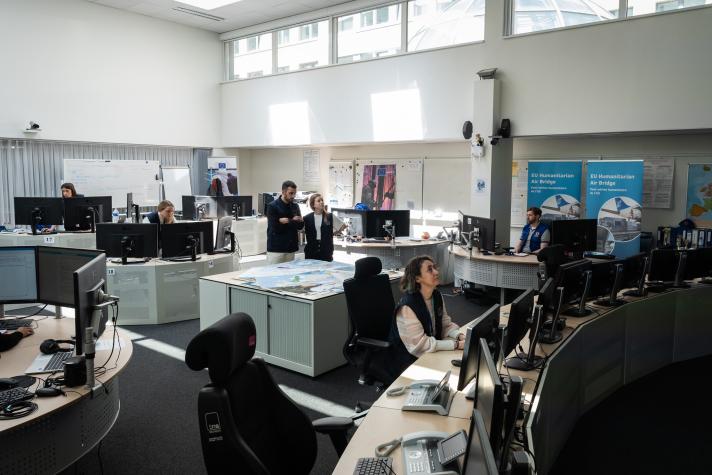
The Emergency Response Coordination Centre (ERCC) is the core of the EU Civil Protection Mechanism. It coordinates the delivery of assistance to disaster-stricken countries, including:
- relief items
- expertise
- civil protection teams
- specialised equipment
Operating 24/7, the ERCC ensures rapid deployment of emergency support and acts as a coordination hub between all EU Member States, the 10 additional participating states, the affected country, and civil protection and humanitarian aid experts.
The ERCC can help any country inside or outside the EU affected by a major disaster upon request from the national authorities or a United Nations body.
Why is this important?
A well-coordinated European response to natural hazards and human-induced disasters can prevent the duplication of relief efforts and ensure that assistance is both administered promptly and tailored to the needs of those affected.
To lessen the burden on contributing states, the ERCC can liaise directly with the national civil protection authorities of the country in need. It can also financially support the delivery of civil protection teams and assets to the affected country.
How are we helping?
Civil protection cooperation and development of EU emergency response capacity
The ERCC has a fully staffed, 24/7 duty system to monitor global events and react to potential emergencies in real time, day and night.
The centre manages a reserve of pre-committed assistance from EU Member States and participating states, such as emergency response teams or technical equipment, that can be immediately deployed in case of need.
This reserve, known as the European Civil Protection Pool, meets strict quality criteria guaranteed by an established certification process, ensuring a more efficient and coherent European disaster response.
The centre can identify possible gaps in European assistance and propose how to cover these gaps through financial support from the EU.
Under the EU Civil Protection Mechanism, the Commission can co-finance operational costs, including transport expenses. This enables the swift delivery of assistance to the country affected with lower budgetary impact on those offering the assistance.
In 2025, the mechanism was activated 64 times to respond to, among others:
- war in Ukraine
- the conflict in the Middle East
- wildfires in Europe
- storms in Ireland, Cuba, Jamaica, Sri Lanka and Vietnam
Coordination platform for civil protection and humanitarian aid
The ERCC improves coordination between civil protection and humanitarian aid operations, enabling real-time information exchange between EU Member States and relevant authorities.
It deploys skilled coordination and assessment teams composed of humanitarian aid and civil protection experts to conduct joint needs assessments.
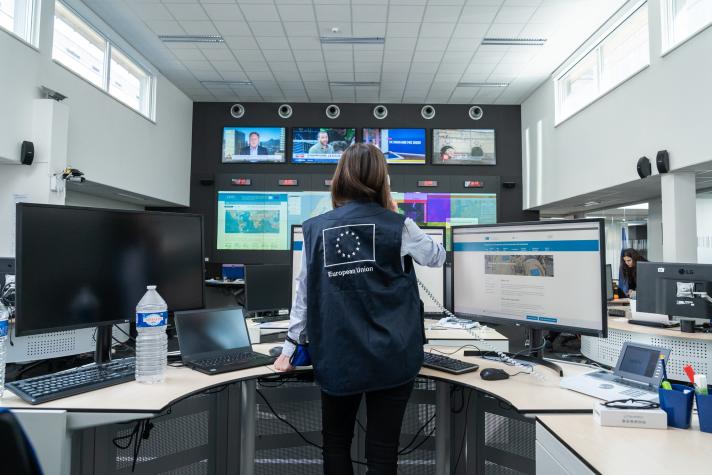
Enhancing crisis response coordination at European level
The centre ensures cooperation and coherence of EU action at an inter-institutional level, focusing on coordination mechanisms with the European External Action Service, the Council and EU Member States.
The ERCC also acts as a central 24/7 contact point when the solidarity clause is invoked. It provides emergency communications and monitoring tools through the Common Emergency Communication and Information System (CECIS), a web-based alert and notification application enabling a real-time exchange of information.
Coordinating operations during the war in Ukraine
In response to Russia’s war of aggression on Ukraine, the ERCC has been coordinating the EU’s largest emergency operation ever since the creation of the EU Civil Protection Mechanism. Through this operation, the EU has channelled millions of emergency items to Ukraine and the surrounding region.
Facts & figures
Since 2001, the ERCC has coordinated assistance more than 830 times in response to the activations of the EU Civil Protection Mechanism.
The centre operates around-the-clock and can deal with several emergencies in different time zones.
It provides improved coordination between the Brussels-based EU institutions, national authorities in EU Member States, and other international partners.
Last updated: 16/01/2026