TypeScript webhook operations portfolio project demonstrating multi-provider event ingestion, shared-secret verification, idempotency handling, retry workflows, and production-style operational visibility.
Recruiter takeaway: "This person can design reliable backend services around real SaaS integration patterns, not just basic CRUD APIs."
| Attribute | Detail |
|---|---|
| Runtime | Node.js + TypeScript |
| Framework | Express 5 |
| Domain | SaaS webhook ingestion and event operations |
| Providers Modeled | Stripe · HubSpot · Salesforce · Internal App |
| Core Behaviors | Secret verification · Idempotency · Failure handling · Retry operations · Metrics |
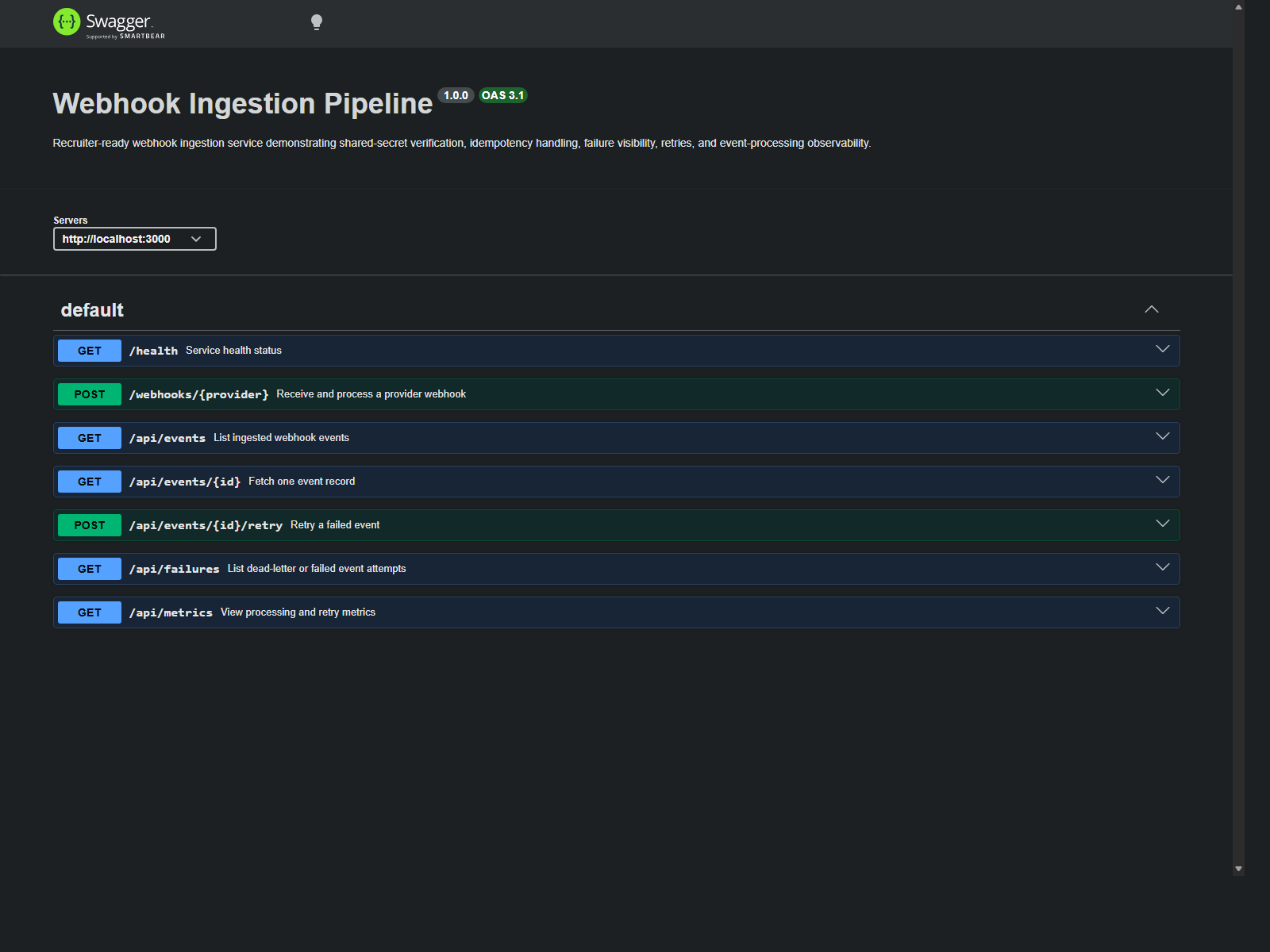
| Docs | Swagger UI at /docs |
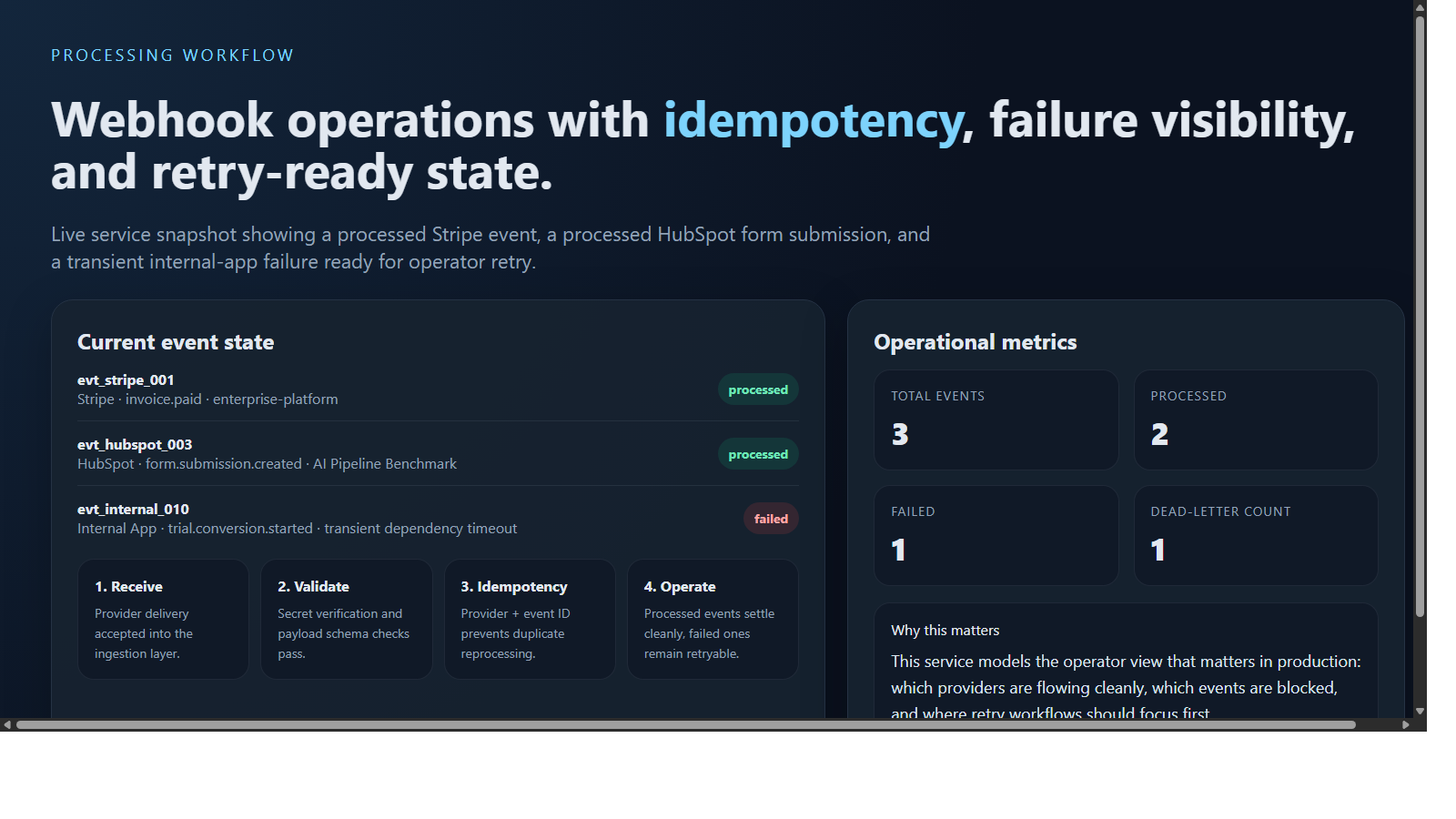
Webhook Ingestion Pipeline models the kind of internal platform service revenue, product, and operations teams rely on when third-party systems need to push event data into a centralized processing layer. Instead of stopping at "receive a POST body," the project demonstrates the operational concerns that matter in production: duplicate delivery protection, event state transitions, retry workflows, failure visibility, and clear observability endpoints.
The result is a recruiter-facing backend project that feels like a real integration service sitting between vendors such as Stripe or HubSpot and a broader internal event-processing stack.
Provider Webhook
    |
    v
POST /webhooks/:provider
    |
    +--> Shared-secret verification
    +--> Payload validation
    +--> Idempotency lookup
    +--> Event record creation
    +--> Processing attempt
             |
             +--> processed
             +--> failed
                      |
                      v
              GET /api/failures
              POST /api/events/:id/retry
- A provider sends an event to
POST /webhooks/:provider. - The service verifies the provider secret from
x-webhook-secret. - The payload is validated with Zod.
- The service checks whether the
(provider, eventId)pair has already been seen. - New events move through
received -> validated -> processed/failed. - Failed events remain operator-visible via
/api/failures. - Retries create a new processing attempt and can promote the event into
retried.
| State | Meaning |
|---|---|
received |
Inbound delivery has been captured |
validated |
Provider and payload checks passed |
processed |
First-pass processing succeeded |
failed |
Processing failed and is awaiting operator action |
retried |
A later attempt succeeded after a prior failure |
Each event is keyed by provider and external event ID, with an optional explicit idempotencyKey. Duplicate deliveries are accepted but not reprocessed. Instead, the service increments a duplicateDeliveries counter and returns the existing event record.
That mirrors the defensive patterns needed when Stripe, HubSpot, or internal event buses redeliver the same event more than once.
| Method | Endpoint | Purpose |
|---|---|---|
GET |
/health |
Service status and uptime |
POST |
/webhooks/:provider |
Receive a provider webhook |
GET |
/api/events |
List webhook event records |
GET |
/api/events/:id |
Fetch a single event |
GET |
/api/failures |
View failed deliveries / dead-letter style records |
POST |
/api/events/:id/retry |
Retry a failed event |
GET |
/api/metrics |
Operational metrics summary |
GET |
/docs |
Swagger / OpenAPI UI |
{
  "eventId": "evt_stripe_test_200",
  "eventType": "invoice.paid",
  "occurredAt": "2026-05-06T14:00:00.000Z",
  "data": {
    "customerId": "cus_test_77",
    "amount": 42000
  }
}
Example request:
curl -X POST http://localhost:3000/webhooks/stripe \
  -H "Content-Type: application/json" \
  -H "x-webhook-secret: stripe-demo-secret" \
-d @payload.json{
"accepted": true,
"duplicate": false,
"event": {
"id": "evt_8d4b9d56-5f4f-4fd4-9a8b-4d8c0f583777",
"provider": "stripe",
"eventType": "invoice.paid",
"status": "processed",
"idempotencyKey": "stripe:evt_stripe_test_200",
"duplicateDeliveries": 0,
"processingAttempts": 1,
"latestSummary": "Event validated, routed, and processed successfully."
}
}
- Node.js 20+
- npm
git clone https://github.com/mizcausevic-dev/webhook-ingestion-pipeline.git
cd webhook-ingestion-pipeline
npm install
cp .env.example .env
npm run dev
Visit:
http://localhost:3000/docshttp://localhost:3000/api/eventshttp://localhost:3000/api/metrics
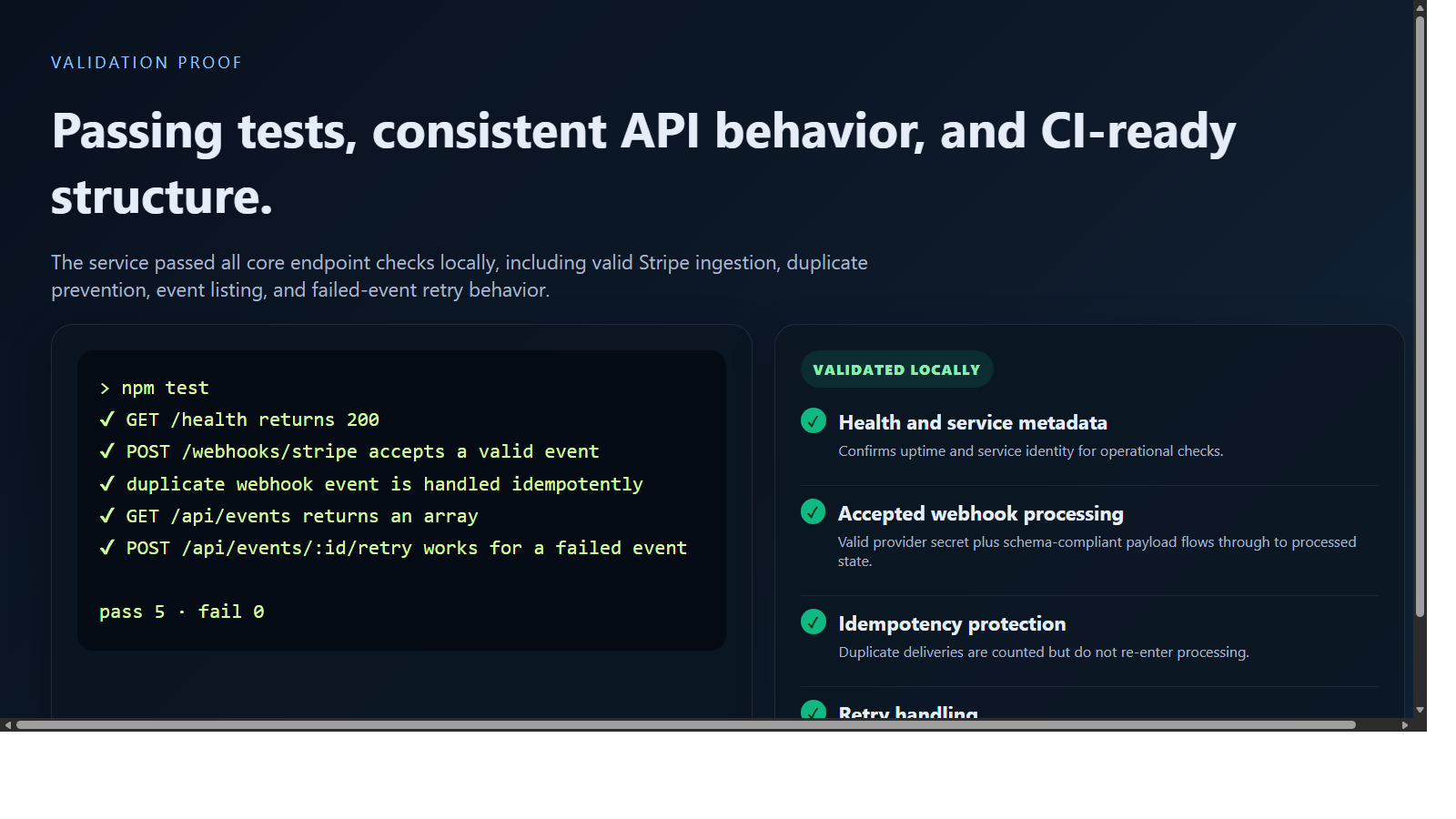
npm test- backend API design beyond CRUD
- webhook hardening with provider verification
- idempotency and duplicate-delivery handling
- event lifecycle modeling and operator-friendly retry flows
- production-minded observability through failures and metrics
- clean TypeScript service structure and documentation discipline
- persist events and attempts in PostgreSQL
- introduce Redis or SQS-backed asynchronous workers
- add HMAC signature verification for each provider
- emit OpenTelemetry traces and structured logs
- add dead-letter replay policies and alerting hooks
- Node.js
- TypeScript
- Express
- Zod
- Swagger / OpenAPI
- Helmet
- CORS
- Morgan
- Node test runner + Supertest
Part of mizcausevic-dev's GitHub portfolio — demonstrating webhook operations design, event reliability workflows, and production-aware backend delivery.