How to Identify an Elm

To stand as guardians of the elm, we must first know how to recognize it. The elm (Ulmus genus) is among the most graceful of trees, with hallmarks that set it apart from all others. How to Spot Dutch Elm Disease Symptoms. Guardians of the Elm. Saskatoon’s Ecological Emergency!

1. The Shape

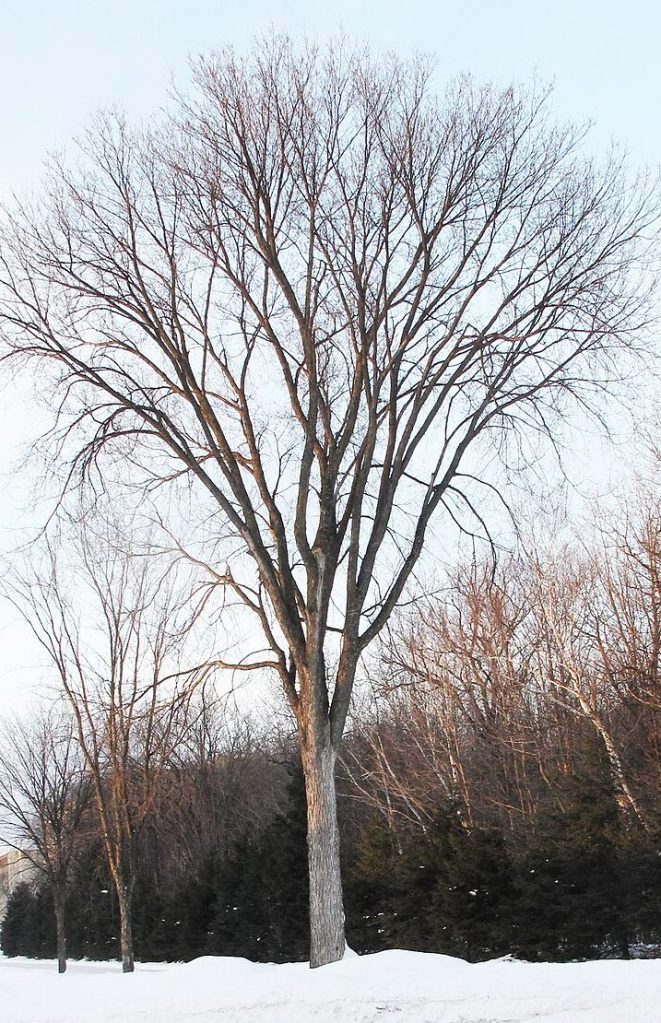
The American elm, our most familiar, forms a vase-like silhouette. The trunk rises tall and straight, then branches arch outward and upward, meeting high above the street like the roof of a Gothic cathedral. From a distance, this vaulting canopy is unmistakable.
Elm Silhouette:
Silhouette of an American elm (Ulmus americana), its tall trunk rising into a graceful, vase-like form. The arching branches sweep upward and outward, creating a broad, fan-shaped crown that spreads wide like an open canopy, a classic hallmark of the species.
Elm Silhouette: Silhouette of an American elm (Ulmus americana), its tall trunk rising into a graceful, vase-like form. The arching branches sweep upward and outward, creating a broad, fan-shaped crown that spreads wide like an open canopy, a classic hallmark of the species.

2. The Leaves

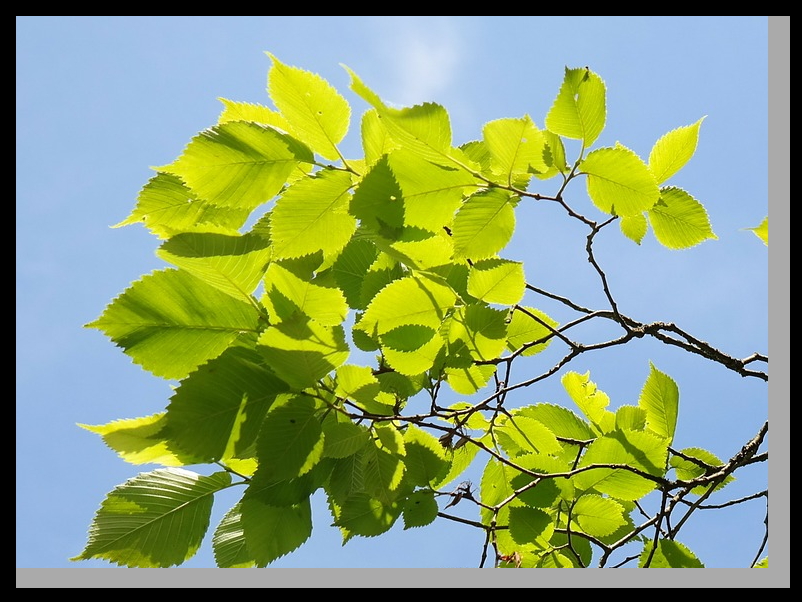
Elm leaves are simple, oval, and finely toothed along the edge. They have a distinct asymmetrical base—one side of the leaf blade longer than the other where it meets the stem. This “uneven foot” is a true signature. The veins are bold and parallel, running straight from the midrib to each tooth of the margin.

3. The Bark

On young elms, bark is smooth and gray. As the tree matures, the bark becomes dark, deeply furrowed, and rough to the touch. These ridges may twist and interlace, giving the trunk an ancient, rugged strength.

Close-up of an American elm (Ulmus americana) trunk, showing the characteristic gray-brown bark with a distinctive lattice-like pattern of intersecting ridges and furrows. Other identifiable features include irregular, rough-textured plates and shallow fissures that run both vertically and horizontally along the trunk, giving the elm its iconic textured appearance.

4. The Seeds

Elms produce seeds in spring, often in great abundance. Each seed is round and flat, encased in a papery wing (a samara) that spins through the air like a coin tossed by the wind.
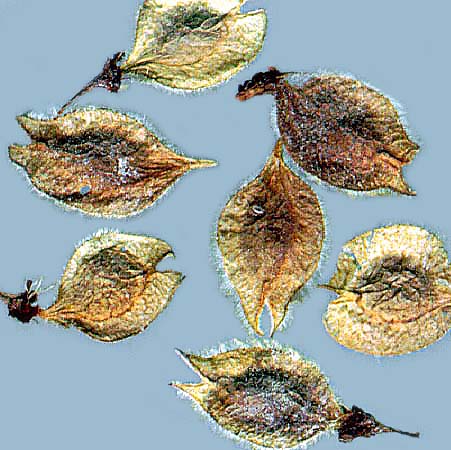
Close-up of American elm (Ulmus americana) seeds showing the small, oval to slightly round seed bodies. The surface is smooth to lightly textured, with a central embryo visible within each seed.
Courtesy Gmihail, CC BY 3.0
Close-up of American elm (Ulmus americana) seeds showing the small, oval to slightly round seed bodies. The surface is smooth to lightly textured, with a central embryo visible within each seed. Courtesy Gmihail, CC BY 3.0

5. Species in Saskatoon

In our city, you may encounter:

  • American elm (Ulmus americana) – the classic vase-shaped elm, most common in boulevards.
  • Siberian elm (Ulmus pumila) – smaller, faster-growing, but brittle; often used in shelterbelts.
  • Japanese elm (Ulmus japonica) – less common, sometimes planted as a hardy ornamental.

Siberian Elm (Ulmus pumila)

  • Buds: Tiny, dark, and rounded, resembling peppercorns with a flaky outer layer; 3 or more overlapping scales.
  • Twig: Young twigs hairy to sparsely hairy, initially green, maturing to gray-brown.
  • Bud Size: About 1/8 inch long; purplish-brown scales somewhat hairy, especially at the edges.

American Elm (Ulmus americana)

  • Buds: Oval-shaped with a pointed tip, scale-like pattern; projected in the same direction as the subtending branch.
  • Twig: Young twigs brown, hairy or smooth.
  • Bud Color & Texture: Brown with reddish scales, somewhat hairy at edges; longer and less squat than Siberian elm buds.

Key Differences:

  • Siberian elm buds are round and peppercorn-like; American elm buds are oval and pointed.
  • Siberian elm twigs are initially green, American elm twigs are brown.
  • Bud projection: American elm buds grow aligned with the branch, while Siberian elm buds are more rounded and sitting atop the twig.

Why It Matters

Elm bark beetles do not discriminate between species. All are vulnerable to Dutch elm disease. By learning to recognize these noble trees, you can help watch over them, notice early symptoms of DED, and take steps to protect Saskatoon’s canopy.

Did you Know?

“The City of Saskatoon started a unique project for the prairies called Afforestation, of “Man-made Forest”…aimed at improving the future environment of the City. The selection of plant material is based on the soil types, lay of the land, and type of planting scheme.

The following tree species were used:

American and Siberian Elm, Manitoba Maple, Green Ash, Poplar, Willow, Colorado Spruce, Scotch Pine and Caragana.” from a report written by A.L. Ligtermoet Assistant Parks Superintendent, City of Saskatoon. January 4, 1974 CoS archives.

These afforestation areas became known as Richard St. Barbe Baker Afforestation Area and George Genereux Urban Regional Park.


“To know a tree by name is the beginning of kinship. And when we know the elm, we see in it not just a tree, but a guardian of the land.”


“The minimum for safety is one third of the total land area. I think what is happening to the elms must be alerting the whole country to the necessity of trees, of the need for more trees. The elm has the largest leaf surface of any tree in Britain. If you …. put the leaves together edge to edge, they would cover ten acres. So naturally, the first tree to suffer from air pollution was the elm and, of course, when an elm is suffering from fatigue it is subject to attack by disease: the elm bark beetle, the carrier of the elm fungus, comes along and the tree succumbs.

I look at it this way. If a person is living a normal life and not abusing themselves – not smoking too much, not eating too much, not drinking too much – but living normally and eating the right food – they will be fit and well. It is only when they start abusing themselves that they are prone to attack by disease. It is the same with trees.

The next tree to go (the next tree with the largest leaf surface after the elm) is probably the beech: after that the sycamore: and so on. Finally it will be Man’s turn. We forget that we owe our existence to the presence of trees and as far as forest cover goes, we have never been in such a vulnerable position as we are today. The only answer is to plant more trees – to plant for our lives.
Richard St. Barbe Baker answers the first question above” Richard St. Barbe Baker.


Addresses:

Part SE 23-36-6 – Richard St. Barbe Baker Afforestation Area – 241 Township Road 362-A

Part SE 23-36-6 – SW Off-Leash Recreation Area (Richard St. Barbe Baker Afforestation Area ) – 355 Township Road 362-A

S ½ 22-36-6 Richard St. Barbe Baker Afforestation Area (West of SW OLRA) – 467 Township Road 362-A

NE 21-36-6 “George Genereux” Afforestation Area – 133 Range Road 3063

Wikimapia Map: type in Richard St. Barbe Baker Afforestation Area or

Google Maps South West Off Leash area location pin at parking lot

Web page: https://stbarbebaker.wordpress.com

Where is the Richard St. Barbe Baker Afforestation Area? with map

Where is the George Genereux Urban Regional Park (Afforestation Area)?with map

Pinterest richardstbarbeb

Blogger: FriendsAfforestation

Tumblr friendsafforestation.tumblr.comFacebook Group Page: Users of the George Genereux Urban Regional Park

Facebook: StBarbeBaker Afforestation Area

Facebook for the non profit Charity Friends of the Saskatoon Afforestation Areas Inc. FriendsAreas

Facebook group page : Users of the St Barbe Baker Afforestation Area

Facebook: South West OLRA

Reddit: FriendsAfforestation

BlueSky Social

Mix: friendsareas

YouTube

Support via Zeffy

Please help protect / enhance your afforestation areas, please contact the Friends of the Saskatoon Afforestation Areas Inc. (e-mail / e-transfers )

Donate your old vehicle, here’s how!  

Support using Canada Helps

Support via a recycling bottle donation and Join the plastic-recycle challenge!

United Nations Decade on Ecosystem Restoration

““Be like a tree in pursuit of your cause. Stand firm, grip hard, thrust upward. Bend to the winds of heaven..”

Richard St. Barbe Baker

Tony Rinaudo

Meet Tony Rinaudo at a zoom session! Ask questions about Farmer-managed Natural Regeneration (FMNR). Sign up now on eventbrite Wed, May 25, 2022 at 7:00 pm CST

Tony Rinaudo received his Bachelor’s Degree, Rural Science University of New England Australia, and agronomy through the University of Armidale as well as attending the Bible College of New Zealand (Diploma in Bible and Missions).[1] Rinaudo is known for putting forward a deforestation management practice known as farmer-managed natural regeneration (FMNR). Following his marriage they ended up for 18 years in Niger, Africa which Rinaudo described as a “moonscape.”[1][2] Though many tree planting methods were tried the degraded land and the population were facing desert like conditions, famine, disease and drought. Though these degraded conditions exist, without resources for sustaining life FMNR provides sustainable land regeneration to restore Africa’s uplands.[3][4] Through FMNR, a means of pruning and management, the underground forest of roots catalyzed into trees above ground. Rinaudo worked with local farmers in Niger in the transformation of hectares of dry land.[5] He has worked as the Principal Natural Resources Advisor for World Vision Australia, and is currently the Senior Climate Action Advisor.[6][1] Rinaudo is recognized for both his environmental and humanitarian approaches for global initiatives.[7]

Contents

Biography

Early life

Rinaudo led his formative years in Victoria’s Oven’s Valley in Australia. He had first hand knowledge of land degradation as forests were cleared for plantations and cropping the land.[1] Marrying Liz, they had four children. They both were Serving in Mission (SIM) missionaries arriving in the Niger Republic in 1981 remaining there until 1999.[8] While there, Rinaudo was placed in charge of the Maradi Windbreak and Woodlot project.[9] The actual ground on arrival was so sandy, that vehicles could not be driven without letting air from the tires less they bog down. Rinaudo took to calling it a “Moonscape”. “I was in shock,” he [said]. “We had windstorms that would bury the seed or carry it away. We had a mouse plague. We had locust swarms—hatchlings moving across the ground like a carpet. We had crows who knew where the drill holes were. For a young agricultural adviser—I was born in 1957—it was just mind-boggling.”[10] “Farmers in the Sahel had learned from French colonists to clear land for agriculture and keep crops separate from trees. Under French colonial law and new laws that countries adopted after independence, any trees on a farmer’s property belonged to the government. Farmers who cut down a tree for fuel would be threatened with jail.”[11] Soon it was seen that the trees were nitrogen-fixing the soil, and drawing water up facilitating bio-irrigating. It was the crop yield which sent the technique viral. The micro climate of the forests was cooling the soil of the hot desert climate.[9]

When Rinaudo arrived, he attested that the water table was forty to sixty meters deep.[10] Rinaudo was familiar with the work of Richard St. Barbe Baker who wrote in his book Land of Tane (1954) “When the trees go, the rain goes, the climate deteriorates, the water table sinks, the land erodes and desert conditions soon appear.” Trees raise the water table.

This no-cost method of FMNR, relying on labour turned around lives, and provided food security.[8] Rinaudo was able to combine an assessment of the landscape, permaculture principles with FMNR to literally turn deserts into “food bowls”. Rinaudo took the experimentation started in the Niger Republic, and it quickly spread to Ethiopia, Ghana, and Senegal. [12]

UN Decade on Ecosystem Restoration #GenerationRestoration hashtag and tag @UNEP and @FAO

Rinaudo worked with both the Forestry Service and the farmers, and soon farmers could benefit from trees regenerated on their own land enhancing the greening of the land.[13] Rinaudo began with an socio-geographical-ecological assessment of the land and area leading to opportunities to overcome, and the adoption of FMNR techniques.[14]


The technique now known as FMNR began under the term of “Dirty Fields” in contrast to the previously used system of “Clean Fields.” In this Dirty Field system, native trees and shrubs were encouraged. The name FMNR name was inspired by a another practice known as Farmer-Managed Irrigation Systems. (FMIS) FMNR was featured in the Tenth World Forestry Congress of 1990. The countries across Africa utlizing FMNR and engaged in EverGreen Agricultural practices have continually increased. FMNR expanded with the implementation of other frameworks to increase success for the farmer. The Nature, Wealth and Power (NWP) framework, the SEED-SCALE Framework and the Climate Resilience Framework (CRF)[15] Garry Tappan, a U.S. Geological Survey geographer was blown away when he began to see green on satellite imagery. Comparing historical satellite imagery with current imagery, Tappan discovered that FMNR revitalized the Great Green Wall campaign.[11]

Rinaudo was the 2018 Laureate of the Right Livelihood Award[16] and bestowed the Member of the Order of Australia.[1] Rinaudo, the “alternative Nobel” winner was portrayed in a documentary “Forest Maker” created by German director and film maker Volker Schlöndorff’[17][11] Following the making of the film, a panel session went into the FMNR approach, and the African Forest Landscape Restoration Initiative (AFR100)[18]

Australia’s ISCAST (The Institute for the Study of Christianity in an Age of Science and Technology) published his autobiography, entitled The Forest Underground: Hope for a Planet in Crisis.[9]

We along with Tony Rinaudo are excited to let you know that his new autobiography The Forest Underground: Hope for a Planet in Crisis, will be published on April 30th 2022 by ISCAST–Christians in Science and Technology – see media release, first chapter sample, and product info sheet attached. FMNR video release

Resources

“Tony Rinaudo: “Against the odds: Reversing desertification in arid and semi arid lands” YouTube Video”. Knowledge Base. Permaculture.org. N.D.

Zwahlen, Robert (Jan. 3, 2022). “Assessing the Environmental Impacts of Hydropower Projects”. Springer Nature. Google Books.

References

  1. Hooker, Dave (November 5, 2021). “The Aussie Forest Maker Helping to Heal the Planet”. Eternity News. Retrieved April 23, 2022.
  2. “Tony Rinaudo, Principal Advisor Natural Resources at World Vision Australia”. Reforestation World. Retrieved April 23, 2022.
  3. “Releasing the “underground forest””. Global Landscape. June 3, 2021. Retrieved April 23, 2022.
  4. “The Roots of Restoration: Sustainability through community-based forest landscape restoration”. Global Landscapes. June 3, 2021. Retrieved April 23, 2022.
  5. “The Forest Maker”. World Vision. 2022. Retrieved April 23, 2022.
  6. “Tony Rinaudo Principal Natural Resources Advisor for World Vision Australia”. Linked In. Tony Rinaudo. Retrieved April 23, 2022.
  7. “Tony Rinaudo”. 2018. Retrieved April 23, 2022.
  8. “Growing an Underground Forest”. Farmer’s Dialogue. October 17, 2016. Retrieved April 23, 2022.
  9. “Tony Rinaudo: The missionary forest maker”. ISCAST. March 4, 2019. Retrieved April 23, 2022.
  10. Bilger, Burkhard (December 11, 2011). “The Great Oasis. Can a wall of trees stop the Sahara from spreading?”. Star Phoenix. Press Display. Retrieved April 23, 2022.
  11. Morrison, Jim (August 23, 2016). “The “Great Green Wall” Didn’t Stop Desertification, but it Evolved Into Something That Might”. Smithsonian Magazine. Retrieved April 23, 2022.
  12. Rinaudo, Tony (September 29, 2011). “Natural Resources Scoping Visit to Lebanon”. World Vision. Retrieved April 23, 2022.
  13. Lappé, Frances Moore (2022). “Seeing Answers to the Climate Crisis Right Under Our Feet”. Humans and Nature. Retrieved April 23, 2022.
  14. Liniger, Rima Mekdaschi Studer, Christine Hauert, Mats Gurtner, Hanspeter (2011). “Sustainable Land Management in Practice Guidelines and Best Practices for Sub-Saharan Africa. Field Application”. World Overview of Conservation Approaches and Technologies (WOCAT) and Food and Agriculture Organization of the United Nations (FAO). A TerrAfrica Partnership Publication. Retrieved April 23, 2022.
  15. Taylor, George F. (2015). “Farmer Managed Natural Regeneration – A “Green Revolution in the West Africa Sahara. Who are the development experts?”. Academia. Retrieved April 23, 2022.
  16. “Tony Rinaudo”. Right Livelihood. 2018. Retrieved April 23, 2022.
  17. Greb, Verena (April 5, 2022). “Documentary ‘The Forest Maker’ portrays a reforestation pioneer”. DW. Press Display. Retrieved April 23, 2022.
  18. “The Film-maker meets the Forest-maker – The story behind FMNR and its role for restoration of African landscapes!”. Global Landscape. November 5, 2021. Retrieved April 23, 2022.

Celebrate 50 years! Richard St. Barbe Baker Afforestation Area and George Genereux Urban Regional park were planted to trees in 1972, 50 years ago. Come out and say Happy Birthday!

For directions as to how to drive to “George Genereux” Urban Regional Park
For directions on how to drive to Richard St. Barbe Baker Afforestation Area
For more information:
Blairmore Sector Plan Report; planning for the Richard St. Barbe Baker Afforestation Area, George Genereux Urban Regional Park and West Swale and areas around them inside of Saskatoon city limits
NEW P4G District Official Community Plan
Richard St. Barbe Baker Afforestation Area is located in Saskatoon, Saskatchewan, Canada north of Cedar Villa Road, within city limits, in the furthest south west area of the city. 52° 06′ 106° 45′
Addresses:
Part SE 23-36-6 – Afforestation Area – 241 Township Road 362-A
Part SE 23-36-6 – SW Off-Leash Recreation Area (Richard St. Barbe Baker Afforestation Area ) – 355 Township Road 362-A
S ½ 22-36-6 Richard St. Barbe Baker Afforestation Area (West of SW OLRA) – 467 Township Road 362-A
NE 21-36-6 “George Genereux” Afforestation Area – 133 Range Road 3063
Wikimapia Map: type in Richard St. Barbe Baker Afforestation Area
Google Maps South West Off Leash area location pin at parking lot
Web page: https://stbarbebaker.wordpress.com
Where is the Richard St. Barbe Baker Afforestation Area? with map
Where is the George Genereux Urban Regional Park (Afforestation Area)?with map
Pinterest richardstbarbeb
Blogger: FriendsAfforestation
Tumblr friendsafforestation.tumblr.comFacebook Group Page: Users of the George Genereux Urban Regional Park
Facebook: StBarbeBaker Afforestation Area
Facebook for the non profit Charity Friends of the Saskatoon Afforestation Areas Inc. FriendsAreas
Facebook group page : Users of the St Barbe Baker Afforestation Area
Facebook: South West OLRA
Reddit: FriendsAfforestation
Twitter: St Barbe Baker Charity Twitter:FriendsAreas
Mix: friendsareas

YouTube

Please help protect / enhance your afforestation areas, please contact the Friends of the Saskatoon Afforestation Areas Inc. (e-mail / e-transfers )Support the afforestation areas with your donation or membership ($20.00/year). Please donate by paypal or by using e-transfers Please and thank you! Your donation and membership is greatly appreciated. Members e-mail your contact information to be kept up to date!

Donations can be made through Paypal, Canada Helps, Contact Donate A Car Canada, SARCAN Drop & Go 106100594 for the Friends of the Saskatoon Afforestation Areas Inc.

United Nations Decade on Ecosystem Restoration

“Be like a tree in pursuit of your cause. Stand firm, grip hard, thrust upward. Bend to the winds of heaven..”

Richard St. Barbe Baker

Share this:

Tony Rinaudo

We along with Tony Rinaudo are excited to let you know that his new autobiography The Forest Underground: Hope for a Planet in Crisis, will be published on April 30th 2022 by ISCAST–Christians in Science and Technology – see media release, first chapter sample, and product info sheet attached. FMNR video release

Tony Rinaudo received his Bachelor’s Degree, Rural Science University of New England Australia, and agronomy through the University of Armidale as well as attending the Bible College of New Zealand (Diploma in Bible and Missions).[1] Rinaudo is known for putting forward a deforestation management practice known as farmer-managed natural regeneration (FMNR). Following his marriage they ended up for 18 years in Niger, Africa which Rinaudo described as a “moonscape.”[1][2] Though many tree planting methods were tried the degraded land and the population were facing desert like conditions, famine, disease and drought. Though these degraded conditions exist, without resources for sustaining life FMNR provides sustainable land regeneration to restore Africa’s uplands.[3][4] Through FMNR, a means of pruning and management, the underground forest of roots catalyzed into trees above ground. Rinaudo worked with local farmers in Niger in the transformation of hectares of dry land.[5] He has worked as the Principal Natural Resources Advisor for World Vision Australia, and is currently the Senior Climate Action Advisor.[6][1] Rinaudo is recognized for both his environmental and humanitarian approaches for global initiatives.[7]

Contents

Biography

Early life

Rinaudo led his formative years in Victoria’s Oven’s Valley in Australia. He had first hand knowledge of land degradation as forests were cleared for plantations and cropping the land.[1] Marrying Liz, they had four children. They both were Serving in Mission (SIM) missionaries arriving in the Niger Republic in 1981 remaining there until 1999.[8] While there, Rinaudo was placed in charge of the Maradi Windbreak and Woodlot project.[9] The actual ground on arrival was so sandy, that vehicles could not be driven without letting air from the tires less they bog down. Rinaudo took to calling it a “Moonscape”. “I was in shock,” he [said]. “We had windstorms that would bury the seed or carry it away. We had a mouse plague. We had locust swarms—hatchlings moving across the ground like a carpet. We had crows who knew where the drill holes were. For a young agricultural adviser—I was born in 1957—it was just mind-boggling.”[10] “Farmers in the Sahel had learned from French colonists to clear land for agriculture and keep crops separate from trees. Under French colonial law and new laws that countries adopted after independence, any trees on a farmer’s property belonged to the government. Farmers who cut down a tree for fuel would be threatened with jail.”[11] Soon it was seen that the trees were nitrogen-fixing the soil, and drawing water up facilitating bio-irrigating. It was the crop yield which sent the technique viral. The micro climate of the forests was cooling the soil of the hot desert climate.[9]

When Rinaudo arrived, he attested that the water table was forty to sixty meters deep.[10] Rinaudo was familiar with the work of Richard St. Barbe Baker who wrote in his book Land of Tane (1954) “When the trees go, the rain goes, the climate deteriorates, the water table sinks, the land erodes and desert conditions soon appear.” Trees raise the water table.

This no-cost method of FMNR, relying on labour turned around lives, and provided food security.[8] Rinaudo was able to combine an assessment of the landscape, permaculture principles with FMNR to literally turn deserts into “food bowls”. Rinaudo took the experimentation started in the Niger Republic, and it quickly spread to Ethiopia, Ghana, and Senegal. [12]

UN Decade on Ecosystem Restoration #GenerationRestoration hashtag and tag @UNEP and @FAO

Rinaudo worked with both the Forestry Service and the farmers, and soon farmers could benefit from trees regenerated on their own land enhancing the greening of the land.[13] Rinaudo began with an socio-geographical-ecological assessment of the land and area leading to opportunities to overcome, and the adoption of FMNR techniques.[14]


The technique now known as FMNR began under the term of “Dirty Fields” in contrast to the previously used system of “Clean Fields.” In this Dirty Field system, native trees and shrubs were encouraged. The name FMNR name was inspired by a another practice known as Farmer-Managed Irrigation Systems. (FMIS) FMNR was featured in the Tenth World Forestry Congress of 1990. The countries across Africa utlizing FMNR and engaged in EverGreen Agricultural practices have continually increased. FMNR expanded with the implementation of other frameworks to increase success for the farmer. The Nature, Wealth and Power (NWP) framework, the SEED-SCALE Framework and the Climate Resilience Framework (CRF)[15] Garry Tappan, a U.S. Geological Survey geographer was blown away when he began to see green on satellite imagery. Comparing historical satellite imagery with current imagery, Tappan discovered that FMNR revitalized the Great Green Wall campaign.[11]

Rinaudo was the 2018 Laureate of the Right Livelihood Award[16] and bestowed the Member of the Order of Australia.[1] Rinaudo, the “alternative Nobel” winner was portrayed in a documentary “Forest Maker” created by German director and film maker Volker Schlöndorff’[17][11] Following the making of the film, a panel session went into the FMNR approach, and the African Forest Landscape Restoration Initiative (AFR100)[18]

Australia’s ISCAST (The Institute for the Study of Christianity in an Age of Science and Technology) published his autobiography, entitled The Forest Underground: Hope for a Planet in Crisis.[9]

Resources

“Tony Rinaudo: “Against the odds: Reversing desertification in arid and semi arid lands” YouTube Video”. Knowledge Base. Permaculture.org. N.D.

Zwahlen, Robert (Jan. 3, 2022). “Assessing the Environmental Impacts of Hydropower Projects”. Springer Nature. Google Books.

References

  1. Hooker, Dave (November 5, 2021). “The Aussie Forest Maker Helping to Heal the Planet”. Eternity News. Retrieved April 23, 2022.
  2. “Tony Rinaudo, Principal Advisor Natural Resources at World Vision Australia”. Reforestation World. Retrieved April 23, 2022.
  3. “Releasing the “underground forest””. Global Landscape. June 3, 2021. Retrieved April 23, 2022.
  4. “The Roots of Restoration: Sustainability through community-based forest landscape restoration”. Global Landscapes. June 3, 2021. Retrieved April 23, 2022.
  5. “The Forest Maker”. World Vision. 2022. Retrieved April 23, 2022.
  6. “Tony Rinaudo Principal Natural Resources Advisor for World Vision Australia”. Linked In. Tony Rinaudo. Retrieved April 23, 2022.
  7. “Tony Rinaudo”. 2018. Retrieved April 23, 2022.
  8. “Growing an Underground Forest”. Farmer’s Dialogue. October 17, 2016. Retrieved April 23, 2022.
  9. “Tony Rinaudo: The missionary forest maker”. ISCAST. March 4, 2019. Retrieved April 23, 2022.
  10. Bilger, Burkhard (December 11, 2011). “The Great Oasis. Can a wall of trees stop the Sahara from spreading?”. Star Phoenix. Press Display. Retrieved April 23, 2022.
  11. Morrison, Jim (August 23, 2016). “The “Great Green Wall” Didn’t Stop Desertification, but it Evolved Into Something That Might”. Smithsonian Magazine. Retrieved April 23, 2022.
  12. Rinaudo, Tony (September 29, 2011). “Natural Resources Scoping Visit to Lebanon”. World Vision. Retrieved April 23, 2022.
  13. Lappé, Frances Moore (2022). “Seeing Answers to the Climate Crisis Right Under Our Feet”. Humans and Nature. Retrieved April 23, 2022.
  14. Liniger, Rima Mekdaschi Studer, Christine Hauert, Mats Gurtner, Hanspeter (2011). “Sustainable Land Management in Practice Guidelines and Best Practices for Sub-Saharan Africa. Field Application”. World Overview of Conservation Approaches and Technologies (WOCAT) and Food and Agriculture Organization of the United Nations (FAO). A TerrAfrica Partnership Publication. Retrieved April 23, 2022.
  15. Taylor, George F. (2015). “Farmer Managed Natural Regeneration – A “Green Revolution in the West Africa Sahara. Who are the development experts?”. Academia. Retrieved April 23, 2022.
  16. “Tony Rinaudo”. Right Livelihood. 2018. Retrieved April 23, 2022.
  17. Greb, Verena (April 5, 2022). “Documentary ‘The Forest Maker’ portrays a reforestation pioneer”. DW. Press Display. Retrieved April 23, 2022.
  18. “The Film-maker meets the Forest-maker – The story behind FMNR and its role for restoration of African landscapes!”. Global Landscape. November 5, 2021. Retrieved April 23, 2022.

Celebrate 50 years! Richard St. Barbe Baker Afforestation Area and George Genereux Urban Regional park were planted to trees in 1972, 50 years ago. Come out and say Happy Birthday!

For directions as to how to drive to “George Genereux” Urban Regional Park
For directions on how to drive to Richard St. Barbe Baker Afforestation Area
For more information:
Blairmore Sector Plan Report; planning for the Richard St. Barbe Baker Afforestation Area, George Genereux Urban Regional Park and West Swale and areas around them inside of Saskatoon city limits
NEW P4G District Official Community Plan
Richard St. Barbe Baker Afforestation Area is located in Saskatoon, Saskatchewan, Canada north of Cedar Villa Road, within city limits, in the furthest south west area of the city. 52° 06′ 106° 45′
Addresses:
Part SE 23-36-6 – Afforestation Area – 241 Township Road 362-A
Part SE 23-36-6 – SW Off-Leash Recreation Area (Richard St. Barbe Baker Afforestation Area ) – 355 Township Road 362-A
S ½ 22-36-6 Richard St. Barbe Baker Afforestation Area (West of SW OLRA) – 467 Township Road 362-A
NE 21-36-6 “George Genereux” Afforestation Area – 133 Range Road 3063
Wikimapia Map: type in Richard St. Barbe Baker Afforestation Area
Google Maps South West Off Leash area location pin at parking lot
Web page: https://stbarbebaker.wordpress.com
Where is the Richard St. Barbe Baker Afforestation Area? with map
Where is the George Genereux Urban Regional Park (Afforestation Area)?with map
Pinterest richardstbarbeb
Blogger: FriendsAfforestation
Tumblr friendsafforestation.tumblr.comFacebook Group Page: Users of the George Genereux Urban Regional Park
Facebook: StBarbeBaker Afforestation Area
Facebook for the non profit Charity Friends of the Saskatoon Afforestation Areas Inc. FriendsAreas
Facebook group page : Users of the St Barbe Baker Afforestation Area
Facebook: South West OLRA
Reddit: FriendsAfforestation
Twitter: St Barbe Baker Charity Twitter:FriendsAreas
Mix: friendsareas

YouTube

Please help protect / enhance your afforestation areas, please contact the Friends of the Saskatoon Afforestation Areas Inc. (e-mail / e-transfers )Support the afforestation areas with your donation or membership ($20.00/year). Please donate by paypal or by using e-transfers Please and thank you! Your donation and membership is greatly appreciated. Members e-mail your contact information to be kept up to date!

Donations can be made through Paypal, Canada Helps, Contact Donate A Car Canada, SARCAN Drop & Go 106100594 for the Friends of the Saskatoon Afforestation Areas Inc.

United Nations Decade on Ecosystem Restoration

“Be like a tree in pursuit of your cause. Stand firm, grip hard, thrust upward. Bend to the winds of heaven..”

Richard St. Barbe Baker

Share this:

Elm Trees and Pruning

Do you have some Elm trees you wish to prune on city and area properties, prune them now! Remember pruning or chopping down trees in a City of Saskatoon park is covered under the City of Saskatoon urban tree policy – so you must contact the City of Saskatoon.

The elm pruning ban begins April 1st, and is in effect until August 31st- that is the time period when it is illegal to prune Elm trees on your property

The Elm bark beetle is the most active during these warmer months April 1-August 31. The Elm Bark Beetles lead to the spread of Dutch Elm disease and are attracted to the injuries in the Elm trees such as those caused by pruning.

Both American Elm and Siberian Elm are susceptible to Dutch Elm Disease, which actually is a fungal virus carried around on the backs of the Elm Bark Beetle.

To date, there has been found no way to cure the pandemic of Dutch Elm disease. To prevent it from spreading, and taking out this beautiful leafy American Elm tree canopy across Saskatchewan, trees should be removed immediately and disposed of by choosing from burning, burial or take the branches to the landfill for disposal there.

Never, ever break the law and store or transport Elm for firewood or for any other reason. Whatever you do, do not throw or discard Elm into any forested area, such as Richard St. Barbe Baker Afforestation Area or George Genereux Park. These greenspaces have a plethora of elm, which add to the beauty of the green space area. The wood from firewood or pruned branches can harbor the Elm bark beetle, which is how the Dutch Elm disease can spread so quickly from tree to tree, city to city, province to province. and ravage and decimate our enjoyment of forests and trees.

Pay attention after Easter, for as the trees are supposed to be greening up, pay attention to the Elm appearance around you. Those trees that have been infected by Dutch Elm disease, will show leaves turning yellow, then curl and brown in the spring. This sign of “flagging” will start at the top of the Elm tree in the crown, and continue until the until the autumn colours appear. 

The City of Saskatoon webpages say; “Residents who start to notice any of these symptoms, are encouraged to complete the online form below or call Urban Biological Services at 306-975-2890.

Therefore, at your home or farm, please trim your Elm trees before April 1st. Afterwards do NOT store Elm wood on your property, or on anyone else’s property, and not in the afforestation areas. Take your pruned branches, and trimmings straight to the landfill.

Tree Care SOS Trees Coalition Formerly SOS Elms

City of Saskatoon Dutch Elm Disease

Province of Saskatchewan Dutch Elm Disease

Elm trees are a valuable part of our ecosystem. “Seeds are an important source of food for birds and mammals, with large “mast” seeds being especially valued by wildlife” source Besides the birds eating elm seeds and the leaves provide nutrition and food for the caterpillars of many moths. There are species of butterflies and moths which have declined dramatically since the spread of Dutch elm disease. It is a ripple effect, we must all do our part to protect species at risk, when DED is spread so much faster with the aid of vehicle transporting pruned branches and firewood and not disposing of same appropriately.

The International Day of Forests proclaimed by the United Nations is March 21. How will you celebrate this auspicious occasion?

 “We forget that we owe our existence to  the presence of Trees.   As far as forest  cover goes, we have never been in such a  vulnerable position as we are today.  The  only answer is to plant more Trees – to  Plant Trees for Our Lives.”

Richard St. Barbe Baker

For directions as to how to drive to “George Genereux” Urban Regional Park
For directions on how to drive to Richard St. Barbe Baker Afforestation Area
For more information:
Blairmore Sector Plan Report; planning for the Richard St. Barbe Baker Afforestation Area, George Genereux Urban Regional Park and West Swale and areas around them inside of Saskatoon city limits
NEW P4G District Official Community Plan
Richard St. Barbe Baker Afforestation Area is located in Saskatoon, Saskatchewan, Canada north of Cedar Villa Road, within city limits, in the furthest south west area of the city. 52° 06′ 106° 45′
Addresses:
Part SE 23-36-6 – Afforestation Area – 241 Township Road 362-A
Part SE 23-36-6 – SW Off-Leash Recreation Area (Richard St. Barbe Baker Afforestation Area ) – 355 Township Road 362-A
S ½ 22-36-6 Richard St. Barbe Baker Afforestation Area (West of SW OLRA) – 467 Township Road 362-A
NE 21-36-6 “George Genereux” Afforestation Area – 133 Range Road 3063
Wikimapia Map: type in Richard St. Barbe Baker Afforestation Area
Google Maps South West Off Leash area location pin at parking lot
Web page: https://stbarbebaker.wordpress.com
Where is the Richard St. Barbe Baker Afforestation Area? with map
Where is the George Genereux Urban Regional Park (Afforestation Area)?with map
Pinterest richardstbarbeb
Blogger: FriendsAfforestation
Tumblr friendsafforestation.tumblr.comFacebook Group Page: Users of the George Genereux Urban Regional Park
Facebook: StBarbeBaker Afforestation Area
Facebook for the non profit Charity Friends of the Saskatoon Afforestation Areas Inc. FriendsAreas
Facebook group page : Users of the St Barbe Baker Afforestation Area
Facebook: South West OLRA
Reddit: FriendsAfforestation
Twitter: St Barbe Baker Charity Twitter:FriendsAreas
Mix: friendsareas

YouTube

Please help protect / enhance your afforestation areas, please contact the Friends of the Saskatoon Afforestation Areas Inc. (e-mail / e-transfers )Support the afforestation areas with your donation or membership ($20.00/year). Please donate by paypal or by using e-transfers Please and thank you! Your donation and membership is greatly appreciated. Members e-mail your contact information to be kept up to date!

Donations can be made through Paypal, Canada Helps, Contact Donate A Car Canada, SARCAN Drop & Go 106100594 for the Friends of the Saskatoon Afforestation Areas Inc.

United Nations Decade on Ecosystem Restoration

“Be like a tree in pursuit of your cause. Stand firm, grip hard, thrust upward. Bend to the winds of heaven..”

Richard St. Barbe Baker

Design a site like this with WordPress.com
Get started