






This box summarises the main findings from recent contacts between ECB staff and representatives of 64 leading non-financial companies operating in the euro area.[1] The exchanges mainly took place between 28 September and 7 October 2026.
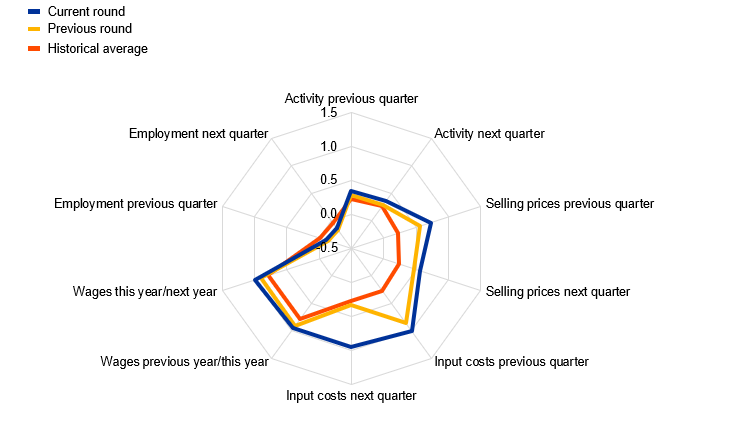
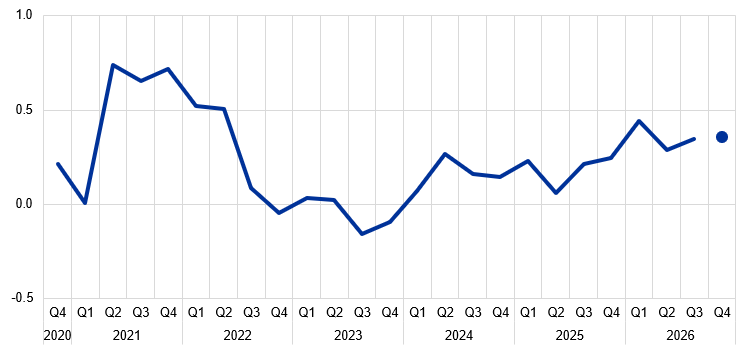
Reports from contacts pointed to ongoing moderate growth in activity in the third quarter and towards unchanged momentum in the fourth quarter (Chart A and Chart B). Activity in the manufacturing sector was uneven with a very strong rise in demand for high value-added electronics, electrical equipment and related machinery. Meanwhile, many other industries continued to struggle with low, flat or declining volumes amid intensifying import competition. Construction and real estate activity were also losing momentum. The hot and dry summer weighed on agricultural output and food production, but it increased the demand for air conditioning and thereby raised energy output. Retail trade and related transport services remained relatively subdued, but most other business and consumer services experienced good growth.
Chart A
Summary of views on activity, employment, prices and costs
(averages of ECB staff scores)
Source: ECB.
Notes: The scores reflect the average of scores given by ECB staff in their assessment of what contacts said about quarter-on-quarter developments in activity (sales, production and orders), input costs (material, energy, transport, etc.) and selling prices, and about year-on-year wage developments. Scores range from -2 (significant decrease) to +2 (significant increase). A score of 0 denotes no change. For the current round, previous quarter and next quarter refer to the third and fourth quarters of 2026 respectively, while for the previous round these refer to the second and third quarters of 2026. Discussions with contacts in January and in March/April regarding wage developments normally focus on the outlook for the current year compared with the previous year, while discussions in June/July and September/October focus on the outlook for the next year compared with the current year. The historical average is an average of scores compiled using summaries of past contacts extending back to 2008.
Chart B
Views on developments in and the outlook for activity
(averages of ECB staff scores)
Source: ECB.
Notes: The scores reflect the average of scores given by ECB staff in their assessment of what contacts said about quarter-on-quarter developments in activity (sales, production and orders). Scores range from -2 (significant decrease) to +2 (significant increase). A score of 0 denotes no change. The dot refers to expectations for the next quarter.
Contacts painted a mixed but still mostly subdued picture of consumer spending. Retailers continued to perceive consumers’ price sensitivity and resulting downtrading as a major determinant of consumption dynamics, especially in Germany and France where consumer sentiment was particularly low. Contacts in – or supplying – the consumer durable goods sector reported weak or falling demand for furniture and household appliances, attributed in part to subdued housing investment. However, they noted rising demand for consumer electronics (in anticipation of rising prices) and passenger cars. In the case of passenger cars, this was reflected in surging demand for battery electric vehicles owing to high fuel prices and rapidly growing purchases of hybrid vehicles imported from China. Growth in spending on consumer services was said to be relatively robust, especially for digital services (mobile data etc.). Despite being negatively affected by the conflict in the Middle East, tourism-related spending was proving resilient as destinations in the euro area benefited from the diversion of tourism away from destinations closer to conflict areas.
Growth in business investment and spending was increasingly driven by AI, electrification, defence and aerospace, although activity and investment in many sectors remained subdued. Contacts in the software and IT consulting industries reported ongoing, exceptional growth as customers accelerated their digital transformation, modernised legacy infrastructure, adopted cloud solutions and increasingly integrated AI into their processes. Such demand was particularly strong in the public, defence, health, life sciences, technology and utility sectors. Geopolitical independence was an important consideration with firms increasingly seeking to keep data within sovereign frameworks. Euro area engineering exports were already benefiting from the global data centre construction boom and data centre construction was also gathering pace in the euro area. Geopolitical concerns underpinned surging demand for defence and aerospace equipment, while high oil and gas prices, as well as data centre construction, were generating increasing demand for renewable energy infrastructure. Activity and investment in the steel industry was starting to benefit from recent policy changes – most notably, the application of stricter import quotas and tariffs since 1 July 2026. However, other process industries, such as food, chemicals, textiles, pulp and paper, continued to face weak demand amid high energy, labour and regulatory costs and intense international competition, causing them to scale back investment. Concerns about rising government bond yields and upcoming elections in some countries also weighed on the business outlook.
Employment dynamics remained subdued. On balance, contacts reported declining headcounts in both the manufacturing sector and, albeit to a lesser extent, the services sector. Reductions in employment remained strong in manufacturing industries undergoing structural cost-cutting to regain international competitiveness. However, this was partly offset by growth in sectors such as IT, aerospace, defence and energy, as well as in firms supplying those sectors. In services, many contacts reported a stable employment outlook as a rise in demand could be met through productivity gains, with AI increasingly cited as a facilitator. Meanwhile, recruitment agencies pointed to moderating declines or modest increases in staffing, although this was mainly driven by temporary placements rather than permanent hiring.
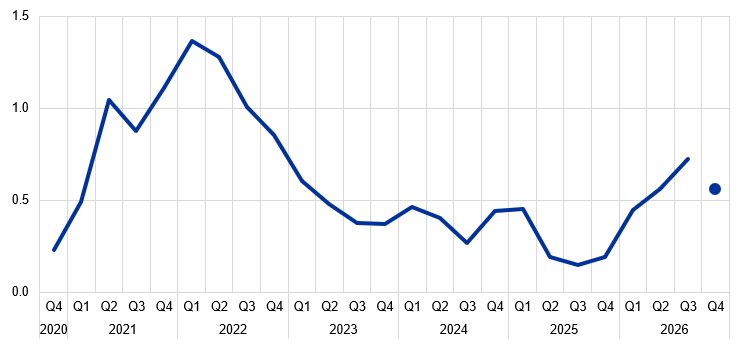
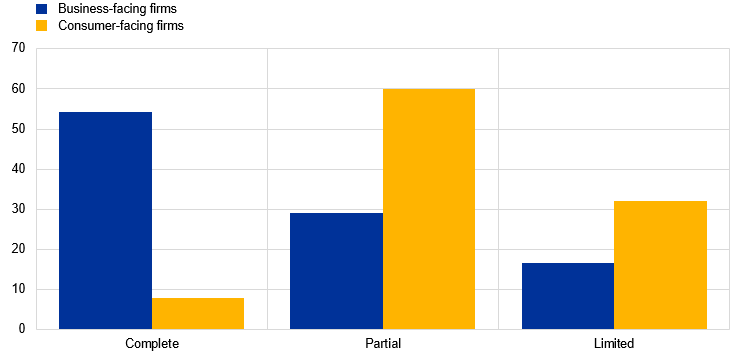
Contacts reported stronger increases in selling prices in the third quarter, amid higher than anticipated cost pressures, with some moderation expected in the fourth quarter (Chart C). Strong price increases were observed in energy and transport and logistics owing to the elevated price of oil and gas products resulting from the ongoing conflict in the Middle East. Strong price increases were also seen in much of the capital goods sector, partly reflecting strong demand and partly reflecting the surging prices of memory chips caused by the AI boom and related data centre construction. Despite stronger aggregate price dynamics than anticipated a few months ago, the pass-through of cost increases resulting from the conflict in the Middle East was becoming increasingly challenging, with costs rising further or remaining elevated as hedges expired and contracts were renewed. This pass-through was particularly difficult – and more limited – in consumer-facing sectors. Around 90% of contacts from consumer-facing firms said that the pass-through to selling prices was only partial or limited, compared with less than half of those from business-facing firms (Chart D). The main reasons were cited as weak demand and competitiveness pressures. Consistent with this, selling price growth was expected to moderate somewhat in the coming months. However, contacts expected that cost pressure would continue to be felt by many into 2027 as hedges would continue to expire, agricultural commodity prices would rise and supplier price increases would continue to feed through.
Chart C
Views on developments in and the outlook for prices
(averages of ECB staff scores)
Source: ECB.
Notes: The scores reflect the average of scores given by ECB staff in their assessment of what contacts said about quarter-on-quarter developments in selling prices. Scores range from -2 (significant decrease) to +2 (significant increase). A score of 0 denotes no change. The dot refers to expectations for the next quarter.
Chart D
Assessment of the pass-through of higher costs resulting from the Middle East conflict to selling prices
(percentage of responses)
Source: ECB.
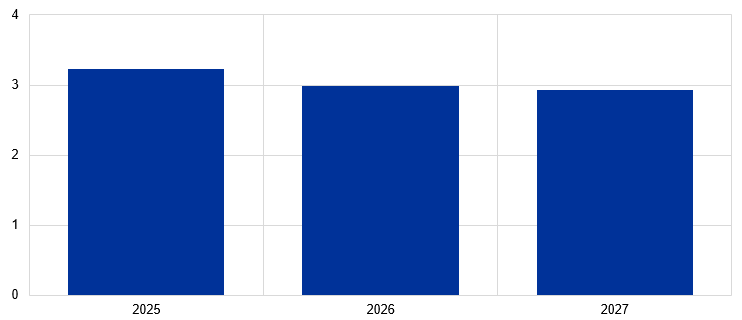
Expectations for decelerating wage growth have moderated somewhat (Chart E). On average, the quantitative indications provided by contacts imply that wage growth is expected to slow from 3.2% in 2025 to 3.0% in 2026 and 2.9% in 2027. This is a milder deceleration than in previous survey rounds. Consistent with this, around 40% of contacts thought that the uptick in inflation caused by the conflict in the Middle East would result – or risked resulting in – higher wage demands (up from 20% during the previous survey round). Most, however, still did not anticipate any notable impact on wage growth, citing the subdued economic conditions and employment outlook.
Chart E
Quantitative assessment of wage growth
(percentages)
Source: ECB.
Notes: Averages of perceptions of wage growth of contacts in their sector in 2025 and their expectations for 2026 and 2027. The averages for 2025, 2026 and 2027 are based on indications provided by 50, 55 and 51 respondents respectively.
Contacts had been negatively surprised by the duration of the conflict in the Middle East but positively surprised by how firms had adapted to it. This round, we asked our contacts how they assessed the impact of the conflict in the Middle East on business conditions in their sector and how this compared with their expectations at the onset of the conflict. Around 40% said that activity in their sector had decreased as a consequence, while 20% said it had increased. Most, however, emphasised the impact on costs with almost 80% saying that costs had risen. Views were rather equally split between those saying that the impact on their business had been “worse than” or “better than” expected. Those that thought the impact had been worse than expected tended to point to the duration of the conflict, which contrasted with prior expectations for a more rapid resolution. Those that thought the impact had been better than expected instead pointed to the surprising resilience and adaptability of businesses and their supply chains. Some attributed this to what firms had learned and how they had adapted, as well as the information systems they had put in place, following a series of shocks (tariffs, pandemic and war) over the past decade.
References
Elding, C., Morris, R. and Slavík, M. (2021), “The ECB’s dialogue with non-financial companies”, Economic Bulletin, Issue 1, ECB.
For further information on the nature and purpose of these contacts, see Elding, Morris and Slavík (2021).