Log In


Phosgenite
A valid IMA mineral species - grandfathered
This page is currently not sponsored. Click here to sponsor this page.
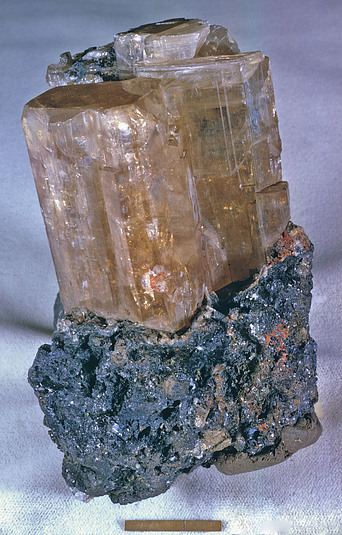


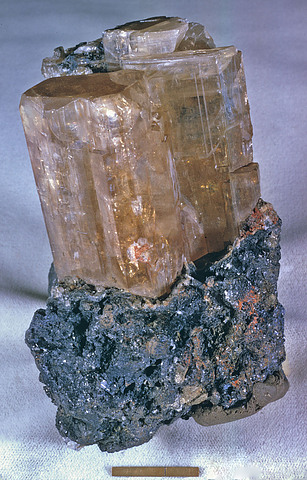


About Phosgenite
Formula:
Pb2CO3Cl2
Colour:
Colourless, white, yellow, brown, greenish or pink; colourless in transmitted light.
Lustre:
Adamantine
Hardness:
2 - 3
Specific Gravity:
6.12 - 6.15
Crystal System:
Tetragonal
Name:
From phosgen, a name for carbonyl dichloride, COCl2, because the mineral contains carbon, oxygen, and chlorine.
Phosgenite is formed in the oxidation zone of lead ore deposits, especially where sea water is present or other sources of chlorine.
 Visit gemdat.org for gemological information about Phosgenite.
Unique Identifiers
Mindat ID:
3195
Long-form identifier:
mindat:1:1:3195:6
IMA Classification of Phosgenite
Approved, 'Grandfathered' (first described prior to 1959)
IMA Formula:
Pb2+2CO3Cl2
Classification of Phosgenite
5.BE.20
5 : CARBONATES (NITRATES)
B : Carbonates with additional anions, without H2O
E : With Pb, Bi
5 : CARBONATES (NITRATES)
B : Carbonates with additional anions, without H2O
E : With Pb, Bi
16a.3.4.1
16a : ANHYDROUS CARBONATES CONTAINING HYDROXYL OR HALOGEN
3 : (AB)2(XO3)Zq
16a : ANHYDROUS CARBONATES CONTAINING HYDROXYL OR HALOGEN
3 : (AB)2(XO3)Zq
12.1.23
12 : Carbonates with other anions
1 : Carbonates with halides
12 : Carbonates with other anions
1 : Carbonates with halides
Mineral Symbols
As of 2021 there are now IMA–CNMNC approved mineral symbols (abbreviations) for each mineral species, useful for tables and diagrams.
| Symbol | Source | Reference for Standard |
|---|---|---|
| Pho | IMA–CNMNC | Warr, L.N. (2021). IMA–CNMNC approved mineral symbols. Mineralogical Magazine, 85(3), 291-320. doi:10.1180/mgm.2021.43 |
Pronunciation of Phosgenite
Pronunciation:
| Play | Recorded by | Country |
|---|---|---|
| Jolyon Ralph | United Kingdom |
Physical Properties of Phosgenite
Adamantine
Transparency:
Transparent, Translucent
Colour:
Colourless, white, yellow, brown, greenish or pink; colourless in transmitted light.
Streak:
White
Hardness:
2 - 3 on Mohs scale
Hardness Data:
Measured
Comment:
The hardness on {110} is less parallel to [001] than perpendicular to it.
Tenacity:
Sectile
Cleavage:
Distinct/Good
Distinct on {001} and {110}; less distinct on {010}
Distinct on {001} and {110}; less distinct on {010}
Fracture:
Conchoidal
Translation gliding:
Translation gliding with T{110}, t[001].
Comment:
The crystals can easily be flexed about directions perpendicular to [001].
Density:
6.12 - 6.15 g/cm3 (Measured) 6.124 g/cm3 (Calculated)
Optical Data of Phosgenite
Type:
Uniaxial (+)
RI values:
nω = 2.118 nε = 2.145
Max. Birefringence:
δ = 0.027
Based on recorded range of RI values above.
Based on recorded range of RI values above.
Interference Colours:
The colours simulate birefringence patterns seen in thin section under crossed polars. They do not take into account mineral colouration or opacity.
Michel-Levy Bar The default colours simulate the birefringence range for a 30 µm thin-section thickness. Adjust the slider to simulate a different thickness.
Grain Simulation You can rotate the grain simulation to show how this range might look as you rotated a sample under crossed polars. Each grain retains its interference colour (retardation) while its brightness falls to black at extinction and reaches a maximum between extinction positions.
Surface Relief:
Very High (positive)
Relative to Canada balsam mounting medium (n ≈ 1.537).
Relative to Canada balsam mounting medium (n ≈ 1.537).
This shows the grain boundary and Becke line effect under plane-polarised
light, based on the contrast between this mineral's average refractive
index and the mounting medium. It does not take into account mineral
colouration.
In focus
Interference Figure:
This shows the idealized uniaxial interference figure - the conoscopic
(convergent-light, Bertrand-lens-in) view, for a grain cut with the optic axis
centred and vertical. The coloured rings are isochromatics, computed with the
same physics as the Michel-Lévy bar above; the dark cross is the isogyre.
For a genuinely uniaxial mineral viewed this way, that cross stays perfectly stationary if you rotate the stage - unlike a biaxial mineral, where it splits apart on rotation. That invariance is itself the standard diagnostic test for telling uniaxial and biaxial minerals apart at the microscope.
For a genuinely uniaxial mineral viewed this way, that cross stays perfectly stationary if you rotate the stage - unlike a biaxial mineral, where it splits apart on rotation. That invariance is itself the standard diagnostic test for telling uniaxial and biaxial minerals apart at the microscope.
Pleochroism:
Weak
Comments:
Very weakly pleochroic with O - reddish and E - greenish in thick sections.
Comments:
Weakly biaxial at times, noticeable after mechanical deformation.
Chemistry of Phosgenite
Mindat Formula:
Pb2CO3Cl2
Element Weights:
Elements listed:
Chemical Analysis
Oxide wt%:
| 1 | |
|---|---|
| PbO | 81.65 % |
| Na2O | 0.06 % |
| K2O | 0.02 % |
| CaO | 0.01 % |
| SiO2 | 0.02 % |
| CO2 | 8.15 % |
| Cl | 13.05 % |
| -O=Cl2 | -2.94 % |
| Total: | 100.02 % |
Sample references:
| ID | Locality | Reference | Notes |
|---|---|---|---|
| 1 | Monteponi Mine, Iglesias, South Sardinia Province, Sardinia, Italy | A large transparent and colourless crystal of phosgenite (∼ 3.2 × 3.2 × 3.5 cm) from the well-known Monteponi Mine, Iglesias, Sardinia, Italy. Gravimetric method for the determination of Pb as PbMoO4 Gravimetric method for the determination of Cl as AgCl Determination of F by ion selective electrode Determination of adsorbed water content by heating Determination of minor elements concentration by ICP-OES and ICP-MS Determination of C, N and H by thermal decomposition and detection by infrared absorption (C,H) and thermal conductivity (N) |
Crystallography of Phosgenite
Crystal System:
Tetragonal
Class (H-M):
4/mmm(4/m2/m2/m) - Ditetragonal Dipyramidal
Space Group:
P4/mbm
Cell Parameters:
a = 8.16 Å, c = 8.883(6) Å
Ratio:
a:c = 1 : 1.089
Unit Cell V:
591.48 ų (Calculated from Unit Cell)
Z:
4
Morphology:
Crystals short prismatic to prismatic [001]; thick tabular rare {001}; thin tabular very rare. Normally terminated by large {001}, with {111} dominant at times. Massive, granular.
Crystallographic forms of Phosgenite
Crystal Atlas:
Image Loading
Click on an icon to view

Phosgenite no.7 - {100} - Goldschmidt (1913-1926)
Phosgenite no.8 - {100} - Goldschmidt (1913-1926)
Phosgenite no.12 - {100} - Goldschmidt (1913-1926)
Phosgenite - {110}, {001}, modified
3d models and HTML5 code kindly provided by
www.smorf.nl.
Toggle
Edge Lines | Miller Indices | Axes
Transparency
Opaque | Translucent | Transparent
View
Along a-axis | Along b-axis | Along c-axis | Start rotation | Stop rotation
Edge Lines | Miller Indices | Axes
Transparency
Opaque | Translucent | Transparent
View
Along a-axis | Along b-axis | Along c-axis | Start rotation | Stop rotation
Crystal Structure
Load
Unit Cell | Unit Cell Packed
2x2x2 | 3x3x3 | 4x4x4
Unit Cell | Unit Cell Packed
2x2x2 | 3x3x3 | 4x4x4
Show
Big Balls | Small Balls | Just Balls | Spacefill
Polyhedra Off | Si Polyhedra | All Polyhedra
Remove metal-metal sticks
Big Balls | Small Balls | Just Balls | Spacefill
Polyhedra Off | Si Polyhedra | All Polyhedra
Remove metal-metal sticks
Display Options
Black Background | White Background
Perspective On | Perspective Off
2D | Stereo | Red-Blue | Red-Cyan
Black Background | White Background
Perspective On | Perspective Off
2D | Stereo | Red-Blue | Red-Cyan
View
CIF File Best | x | y | z | a | b | c
CIF File Best | x | y | z | a | b | c
Rotation
Stop | Start
Stop | Start
Labels
Console Off | On | Grey | Yellow
Console Off | On | Grey | Yellow
Data courtesy of the American Mineralogist Crystal Structure Database. Click on an AMCSD ID to view structure
| ID | Species | Reference | Link | Year | Locality | Pressure (GPa) | Temp (K) |
|---|---|---|---|---|---|---|---|
| 0015646 | Phosgenite | Giuseppetti G, Tadini C (1974) Reexamination of the crystal structure of phosgenite, Pb2Cl2(CO3) Tschermaks Mineralogische und Petrographische Mitteilungen 21 101-109 | 1974 | Monteponi Mine, Iglesias, Iglesiente district, Cagliari Province, Sardinia, Italy | 0 | 293 |
CIF Raw Data - click here to close
Epitaxial Relationships of Phosgenite
Epitaxial Minerals:
| 'Cerussite' | PbCO3 |
Epitaxy Comments:
Cerussite on phosgenite, with cerussite {100} [010] parallel to phosgenite {001}[120].
X-Ray Powder Diffraction
Loading XRD data...
Data courtesy of RRUFF project at University of Arizona, used with permission.
Powder Diffraction Data:
| d-spacing | Intensity |
|---|---|
| 2.79 Å | (very very strong) |
| 3.61 Å | (very strong) |
| 4.40 Å | (strong) |
| 2.56 Å | (strong) |
| 4.04 Å | (moderately strong) |
| 2.21 Å | (moderate) |
| 1.800 Å | (moderate) |
Comments:
Formed in a ancient artifact (lead pot). Data from Midgley (1958).
Geological Environment
Paragenetic Mode(s):
| Paragenetic Mode | Earliest Age (Ga) |
|---|---|
| Stage 7: Great Oxidation Event | <2.4 |
| 47c : [Carbonates, phosphates, borates, nitrates] | |
| 47g : [Halogen-bearing surface weathering minerals] | |
| 47h : [Near-surface oxidized, dehydrated minerals] | |
| Stage 10b: Anthropogenic minerals | <10 Ka |
| 55 : Anthropogenic mine minerals | |
| 56 : Slag and smelter minerals (see also #51 and #55) | |
| 57 : Other minerals formed by human processes |
Geological Setting:
Surface conditions in lead-bearing ore bodies.
Type Occurrence of Phosgenite
Synonyms of Phosgenite
Other Language Names for Phosgenite
Common Associates
Associations Based on Photo Data:
| 63 photos of Phosgenite associated with Galena | PbS |
| 37 photos of Phosgenite associated with Cerussite | PbCO3 |
| 36 photos of Phosgenite associated with Anglesite | PbSO4 |
| 25 photos of Phosgenite associated with Diaboleite | Pb2CuCl2(OH)4 |
| 22 photos of Phosgenite associated with Laurionite | PbCl(OH) |
| 21 photos of Phosgenite associated with Cumengeite | Pb21Cu20Cl42(OH)40 · 6H2O |
| 19 photos of Phosgenite associated with Paralaurionite | PbCl(OH) |
| 14 photos of Phosgenite associated with Pseudoboleite | Pb31Cu24Cl62(OH)48 |
| 11 photos of Phosgenite associated with Nealite | Pb4Fe2+(As3+O3)2Cl4 · 2H2O |
| 11 photos of Phosgenite associated with Boleite | KPb26Ag9Cu24(OH)48Cl62 |
Related Minerals - Strunz-mindat Grouping
| 5.BE.X | Abellaite | NaPb2(CO3)2(OH) |
| 5.BE.05 | Shannonite | Pb2O(CO3) |
| 5.BE.10 | Hydrocerussite | Pb3(CO3)2(OH)2 |
| 5.BE.15 | Plumbonacrite | Pb5O(OH)2(CO3)3 |
| 5.BE.25 | Bismutite | (BiO)2CO3 |
| 5.BE.30 | Kettnerite | CaBiCO3OF |
| 5.BE.35 | Beyerite | Ca(BiO)2(CO3)2 |
| 5.BE.40 | Grootfonteinite | Pb3O(CO3)2 |
| 5.BE.45 | Somersetite | Pb8O2(OH)2(CO3)5 |
Fluorescence of Phosgenite
Fluoresces yellow in LW & SW UV, X-rays and cathode rays.
Other Information
Thermal Behaviour:
The high-T behaviour of phosgenite proves this mineral is stable at least up to 523 K, at which the first evidence of transformation (with the coexistence of phosgenite + Pb2O2Cl, and probably an amorphous phase) takes place. The XRD pattern at 548 K unveils a more complex scenario, with coexisting: phosgenite (dominant) + Pb2O2Cl (minor) + mendipite [Pb3O2Cl2] (minor) + Pb5O2Cl6 (subordinate) (+ amorphous phase). This phase composition is preserved up to 648 K, after which phosgenite is no longer preserved, and the stable compounds are: mendipite [Pb3O2Cl2] (dominant), Pb2O2Cl (subordinate) + Pb5O2Cl6 (subordinate) + kutnohorite-type [Ca(Mn,Mg,Fe2+)(CO3)2] (likely, very minor) (+ amorphous phase). The same assemblage is observed up to 698 and back to 298 K after a decrease in T, showing an irreversible transformation of the pristine material. Therefore, the irreversible temperature-induced degradation of phosgenite is substantially governed by a decarbonation process.
The volume thermal expansion coefficient of phosgenite in its P4/mbm form, here derived (i.e. α = 7.4(2)·10–5 K–1)
The volume thermal expansion coefficient of phosgenite in its P4/mbm form, here derived (i.e. α = 7.4(2)·10–5 K–1)
Notes:
Soluble in dilute HNO3 with effervescence. Decomposed slowly in cold water, which extracts lead chloride.
Readily alters to, and is replaced by, Cerussite.
Readily alters to, and is replaced by, Cerussite.
Health Risks:
Contains lead. Wash hands after handling. Do not lick or ingest; do not inhale dust when breaking. Do not grind dry.
Internet Links for Phosgenite
mindat.org URL:
https://www.mindat.org/min-3195.html
Please feel free to link to this page.
Please feel free to link to this page.
Search Engines:
External Links:
Mineral Dealers:
References for Phosgenite
Reference List:
Beudant, François-Sulpice (1832) Traité élémentaire de minéralogie. Deuxiéme Edition [Elementary Treatise on Mineralogy. Second Edition] (2nd ed.) Vol. 2 - Tome II [Volume II]. Chez Verdière. p.502 - as Kerasine
Glocker, Ernst Friedrich (1847) Generum et specierum mineralium, secundum ordines naturales digestorum synopsis, omnium, quotquot adhuc reperta sunt, mineralium nomina complectens [A synopsis of the genera and species of minerals, according to their natural orders, including the names of all the minerals that have yet been discovered.]. Eduardus Anton. 348 pp. p.248
Rammelsberg, C. (1852) Ueber das Bleihornerz und den Matlockit, ein neues Bleierz aus Derbyshire. Annalen der Physik und Chemie, 161. 141-145 doi:10.1002/andp.18521610115(as Bleihornerz)
Greg, Robert Philips, Lettsom, William G. (1858) Manual of the Mineralogy of Great Britain and Ireland. John Van Voorst, London.p.421 - as Cromfordite
Herbert Smith, G. F., Prior, G. T. (1899) On some lead minerals from Laurium, namely, Laurionite, Phosgenite, Fiedlerite, and (new species) Paralaurionite. Mineralogical Magazine and Journal of the Mineralogical Society, 12 (55) 102-110 doi:10.1180/minmag.1899.012.55.06
Sillén, Lars Gunnar, Petterson, Rolf (1944) Die Kristallstruktur von Pb2Cl2CO3 (Phosgenit) und Pb2Br2CO3. Die Naturwissenschaften, 32 (1). 41 doi:10.1007/bf01468421
Oftedal, Ivar (1945) On the crystal structure of phosgenite Pb2Cl2Co3 and the synthetic compounds Pb2Cl2Co3, Pb2Br2Co3, Pb(Br,Cl)2CO3. Norsk Geologisk Tidsskrift [Norwegian Journal of Geology], 24 (1-2). 79-88
Kingsbury, Arthur W. G. (1957) New occurrences of phosgenite. Mineralogical Magazine and Journal of the Mineralogical Society, 31 (237). 500-501 doi:10.1180/minmag.1957.031.237.13
Midgley, H. G. (1958) A further occurrence of phosgenite. Mineralogical Magazine and Journal of the Mineralogical Society, 31 (241). 883 doi:10.1180/minmag.1958.031.241.07
Giuseppetti, G., Tadini, Carla (1974) Reexamination of the crystal structure of phosgenite, Pb2Cl2(CO3). TMPM Tschermaks Mineralogische und Petrographische Mitteilungen, 21 (2). 101-109 doi:10.1007/bf01081262
Pina, C.M., Fernández-Díaz, L., Prieto, M. (1996) Topotaxy relationships in the transformation phosgenite-cerussite. Journal of Crystal Growth, 158 (3). 340-345 doi:10.1016/0022-0248(95)00452-1
Frost, R. L., Williams, P. A., Martens, W. (2003) Raman spectroscopy of the minerals boléite, cumengéite, diaboléte and phosgenite — implications for the analysis of cosmetics of antiquity. Mineralogical Magazine, 67 (1) 103-111 doi:10.1180/0026461036710088
Bohatý, Ladislav; Becker, Petra; Rhee, Hanjo; Kaltenbach, André; Eichler, Hans J.; Yoneda, Hitoki; Shirakawa, Akira; Ueda, Ken‐ichi; Kaminskii, Alexander A. (2013) Phosgenite, Pb2CO3Cl2 – a novel SRS‐active crystal. physica status solidi (RRL) – Rapid Research Letters, 7 (6). 429-433 doi:10.1002/pssr.201307143
Localities for Phosgenite
Showing 190 localities.
 symbol to view information about a locality.
The
Locality List
 - This locality has map coordinates listed.
- This locality has estimated coordinates.
ⓘ - Click for references and further information on this occurrence.
? - Indicates mineral may be doubtful at this locality.
 - Good crystals or important locality for species.
 - World class for species or very significant.
(TL) - Type Locality for a valid mineral species.
(FRL) - First Recorded Locality for everything else (eg varieties).
All localities listed without proper references should be considered as questionable.
Argentina | |
| Effenberger et al. (2015) |
| Effenberger et al. (2015) |
| Singer et al. (2008) |
| Angelelli et al. (1946) +1 other reference | |
| Sillitoe et al. (2023) +1 other reference | |
Australia | |
| Palache et al. (1951) +1 other reference |
| The Daydream Mine | |
| Mines of the Broken Hill District | |
| Sielecki (1988) |
| Sielecki (1988) | |
| |
| Kolitsch et al. (1999) |
| Noble et al. (1983) |
| |
| Noble et al. (1983) +1 other reference |
| Noble |
| Haupt (1988) |
| Bottrill et al. (2008) |
| Bottrill et al. (2006) | |
| Palache et al. (1951) | |
| Bottrill et al. (2008) |
| Sarp et al. (1987) +1 other reference |
| MacLeod (1991) |
Austria | |
| Kolitsch et al. (2009) +2 other references |
| Bindi et al. (2011) |
| Strasser (1989) |
| Niedermayr et al. (2009) | |
| C.Auer (2012) |
| Kolitsch (2013) |
Bolivia | |
| Yang et al. (2024) |
Brazil | |
| Cassedanne et al. (1975) |
| Cassedanne et al. (1975) |
Chile | |
| Arfè et al. (2016) |
| maurizio dini collection - analysed ... |
| sample analysed by Tony Kampf |
China | |
| Pavel M. Kartashov analytical data of ... | |
Czech Republic | |
| RÜSENBERG et al. (1996) |
France | |
| P. Le Roch collection |
| Germain C. et al. (1990) +1 other reference |
| Aufschluss 1/85 |
| Palache et al. (1951) |
| Brousse (1982) |
| Queneau (n.d.) |
| Queneau (n.d.) |
| Patrice Queneau Collection. |
| Favreau et al. (2024) |
| Georges FAVREAU collection & EDX ... +1 other reference | |
Germany | |
| Kolitsch et al. (2019) |
| Weiß (1990) |
| |
| Heckmann et al. (1990) |
| Blaß et al. (1995) |
| Weiß (1990) |
| Schnorrer-Köhler (1988) |
| Lapis 1988 (1) |
| Weiß (1990) |
| Lapis (9) |
Greece | |
| Kohlberger (1976) |
| van Kalmthout (2012) +1 other reference |
| Ko Jansen Collection & photo | |
| Rieck (n.d.) |
| |
| Fritz Schreiber collection |
| Kolitsch et al. (2014) |
| Gelaude et al. (1996) | |
| Siidra et al. (2011) | |
| Ko Jansen collection | |
| Herbert Smith et al. (1899) +2 other references | |
| |
| Gelaude et al. (1996) |
| |
| Gelaude et al. (1996) | |
| Lacroix et al. (1908) +2 other references | |
Iran | |
| Bariand +1 other reference |
Ireland | |
| Green (1998) |
| Green (1998) | |
Italy | |
| Palombi et al. (2009) |
| Rivista Mineralogica Italiana (Avril/Juin) |
| Lips (2006) |
| Orlandi et al. (2007) +1 other reference |
| Stara et al. (1996) |
| |
| Stara et al. (1996) | |
| De Caro et al. (2023) |
| Pelloux (1907) +1 other reference | |
| Stara et al. (1996) | |
| Stara et al. (1996) |
| Palache et al. (1951) +1 other reference |
| De Michele (1974) |
| Goldschmidt (1893) +4 other references | |
| Pelloux (1907) +1 other reference |
| Stara et al. (1996) | |
| |
| Kokscharow et al. (1865) +4 other references | |
| Marinai |
| Bazzoni et al. (2001) |
| Luigi Chiappino |
| www.comune.pisa.it (2000) | |
| Jansen et al. (1998) |
| Franzini et al. (1992) +2 other references |
| Luigi Chiappino data |
| Adriano Perugini find & collection |
Mexico | |
| Bariand et al. (1998) |
| Panczner (1987) |
| Panczner (1987) |
Morocco | |
| Jébrak et al. (1998) |
| Favreau (n.d.) |
| King (n.d.) | |
| [MinRec 18:430 +1 other reference | |
Namibia | |
| Goldschmidt et al. (1920) +4 other references |
Norway | |
| Kamphaug (1986) |
| Husdal (2019) |
| Ellingsen et al. (2000) |
Poland | |
| Palache et al. (1951) |
| Eligiusz Szełęg collection | |
Portugal | |
| Alves (n.d.) |
| Alves (n.d.) |
| Leal Gomes |
Russia | |
| Palache et al. (1951) |
South Africa | |
| Cairncross et al. (1995) |
| SAMS (South African Micromount Society) |
Spain | |
| Georges FAVREAU collection + EDS |
| Georges FAVREAU collection & EDX ... | |
| Calvo Rebollar (2012) |
| Calvo Rebollar et al. (2018) |
| Dill et al. (2023) |
| Sergio Evangelio Collection |
| Xavi Ortiz Collection |
| Van den Berg et al. (2020) |
Tunisia | |
| Palache et al. (1951) |
| Palache et al. (1951) | |
| Kutzke et al. (1997) |
UK | |
| Day (1999) |
| BMS Newsletter 79 (http://britishmicromountsociety.homestead.com/Gannell-Smelter.html) |
| Dean et al. (1983) +1 other reference |
| Michael Merry (collected 2007) |
| De Bondt (n.d.) |
| Golley et al. (1995) |
| Golley et al. (1995) +1 other reference |
| Schlomann et al. (1998) | |
| Golley et al. (1995) |
| Steve Rust specimen |
| |
| Russell et al. (1927) +3 other references | |
| Stanley et al. (1991) +1 other reference |
| Kingsbury (1957) +1 other reference |
| Golley et al. (1995) |
| Golley et al. (1995) |
| |
| Peter Trebilcock. | |
| Peter Trebilcock Collection. | |
| Norman Wilson personal collection |
| Kingsbury (1957) +1 other reference |
| Kingsbury (1957) | |
| Stanley et al. (1991) | |
| Rock Currier +7 other references |
| Russell et al. (1927) +4 other references |
| Ford et al. (1993) | |
| Day (1999) |
| Ex-S Rust collection |
| Rutley (1902) |
| |
| Day (1999) | |
| Ex-S Rust collection |
| Day (1999) |
USA | |
| Raman analyzed at the University of ... |
| Raman analyzed at the University of ... |
| Fahey et al. (1950) +5 other references |
| Palache (1941) +4 other references | |
| Hanks (1884) +2 other references |
| Marek Chorazewicz (2022) |
| Palache et al. (1951) +1 other reference |
| Färber (n.d.) |
| Breithaupt A (1841) +2 other references |
| Castor et al. (2004) +1 other reference |
| Castor et al. (2004) |
| Palache et al. (1951) +1 other reference |
| Hammond (1973) +1 other reference | |
| King et al. (1995) |
| Northrop et al. (1996) |
| Lapham et al. (1965) |
| Miller (1971) |
| Alminas +2 other references | |
| MarekC (2018) |
| Encyclopedia of Minerals +3 other references |
| Dietrich (1990) |
| Washington Geology |

Quick NavTopAbout PhosgeniteUnique IdentifiersIMA Classification Classification Mineral SymbolsPronunciation Physical Properties Optical Data Chemistry Chemical AnalysisCrystallography Crystallographic forms Crystal StructureEpitaxial Relationships X-Ray Powder DiffractionGeological EnvironmentType Occurrence SynonymsOther LanguagesCommon AssociatesStrunz-MindatFluorescence Other InformationInternet Links References Localities Locality List
Monteponi Mine, Iglesias, South Sardinia Province, Sardinia, Italy