Log In


Black shale
A rock classification type
This page is currently not sponsored. Click here to sponsor this page.


About Black shale
A shale with at least 1% carbonaceous material indicating a reducing environment.
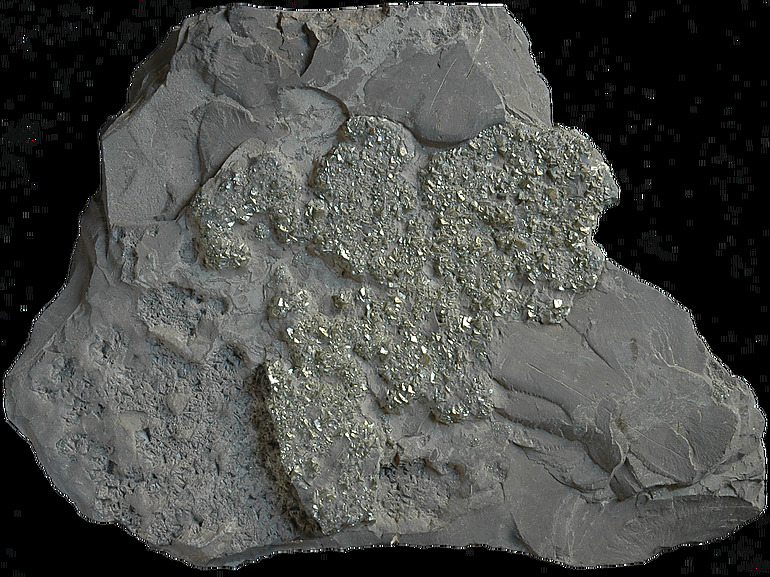
A dark, thinly laminated carbonaceous shale, exceptionally rich in organic matter (5% or more carbon content) and sulfide (esp. iron sulfide, usually pyrite), and often containing unusual concentrations of certain trace elements (U, V, Cu, Ni). It is formed by partial anaerobic decay of buried organic matter in a quiet-water, reducing environment (such as in a stagnant marine basin) characterized by restricted circulation and very slow deposition of clastic material. Fossil organisms are preserved as a graphitic or carbonaceous film or as pyrite replacements.
Sometimes resembling cannel coal, often found as a roof to a coal, or in place of a coal, resting on a fire clay.
See also: sapropelite, bituminous shale.
Ref: AGI
Unique Identifiers
Mindat ID:
50900
Long-form identifier:
mindat:1:1:50900:2
Classification of Black shale
Sub-divisions of Black shale
- Black shale
Synonyms of Black shale
Other Language Names for Black shale
German:Schwarzschiefer
Common Associates
Associations Based on Photo Data:
| 13 photos of Black shale associated with 'Organic-rich-sediment' | |
| 11 photos of Black shale associated with 'Glendonite' | CaCO3 |
| 11 photos of Black shale associated with Calcite | CaCO3 |
| 10 photos of Black shale associated with Ikaite | CaCO3 · 6H2O |
| 6 photos of Black shale associated with Dolomite | CaMg(CO3)2 |
| 6 photos of Black shale associated with Orthoclase | K(AlSi3O8) |
| 5 photos of Black shale associated with Pyrite | FeS2 |
| 5 photos of Black shale associated with Sphalerite | ZnS |
| 5 photos of Black shale associated with Sanidine | K(AlSi3O8) |
| 4 photos of Black shale associated with 'Argillite' |
Internet Links for Black shale
mindat.org URL:
https://www.mindat.org/min-50900.html
Please feel free to link to this page.
Please feel free to link to this page.
References for Black shale
Reference List:
Berner, Robert A. (1964) Stability Fields of Iron Minerals in Anaerobic Marine Sediments. The Journal of Geology, 72 (6) 826-834 doi:10.1086/627034
Vine, James D., Tourtelot, Elizabeth B. (1970) Geochemistry of black shale deposits - a summary report. Economic Geology, 65 (3). 253-272 doi:10.2113/gsecongeo.65.3.253
Holland, H. D. (1979) Metals in black shales - a reassessment. Economic Geology, 74 (7). 1676-1680 doi:10.2113/gsecongeo.74.7.1676
Tourtelot, Harry A. (1979) Black Shale—Its Deposition and Diagenesis. Clays and Clay Minerals, 27 (5). 313-321 doi:10.1346/ccmn.1979.0270501
Coveney, Raymond M., Glascock, Michael D. (1989) A review of the origins of metal-rich Pennsylvanian black shales, central U.S.A., with an inferred role for basinal brines. Applied Geochemistry, 4 (4) 347-367 doi:10.1016/0883-2927(89)90012-7
Leventhal, J.S. (1991) Comparison of organic geochemistry and metal enrichment in two black shales: Cambrian Alum Shale of Sweden and Devonian Chattanooga Shale of United States. Mineralium Deposita, 26 (2). 104-112 doi:10.1007/bf00195256
Dean, W.E.; Arthur, M.A. (1992) Sediments from the Black Sea and Peru margin as analogues for non-metalliferous black shales. Journal of Geochemical Exploration, 46 (2). 235-236 doi:10.1016/0375-6742(92)90086-n
Lyons, Timothy, Kashgarian, Michaele (2005) Paradigm Lost, Paradigm Found: The Black Sea-Black Shale Connection as Viewed from the Anoxic Basin Margin. Oceanography, 18 (2). 86-99 doi:10.5670/oceanog.2005.44
Wu, Tong, Yang, Ruidong, Gao, Lei, Li, Jun, Gao, Junbo (2021) Origin and Enrichment of Vanadium in the Lower Cambrian Black Shales, South China. ACS Omega, 6 (41). 26870-26879 doi:10.1021/acsomega.1c02318
Dunkel, Caroline A., Vázquez-Ortega, Angélica, Evans, James E. (2022) Black shale–gray shale transitions in a Late Devonian shale succession, Central Appalachian Basin (Northern Ohio): Sedimentary and geochemical evidence for terrestrial organic matter input driving anoxia events. Palaeogeography, Palaeoclimatology, Palaeoecology, 608. 111271 doi:10.1016/j.palaeo.2022.111271
Maardu phosphate mines, Jõelähtme, Harju County, Estonia