

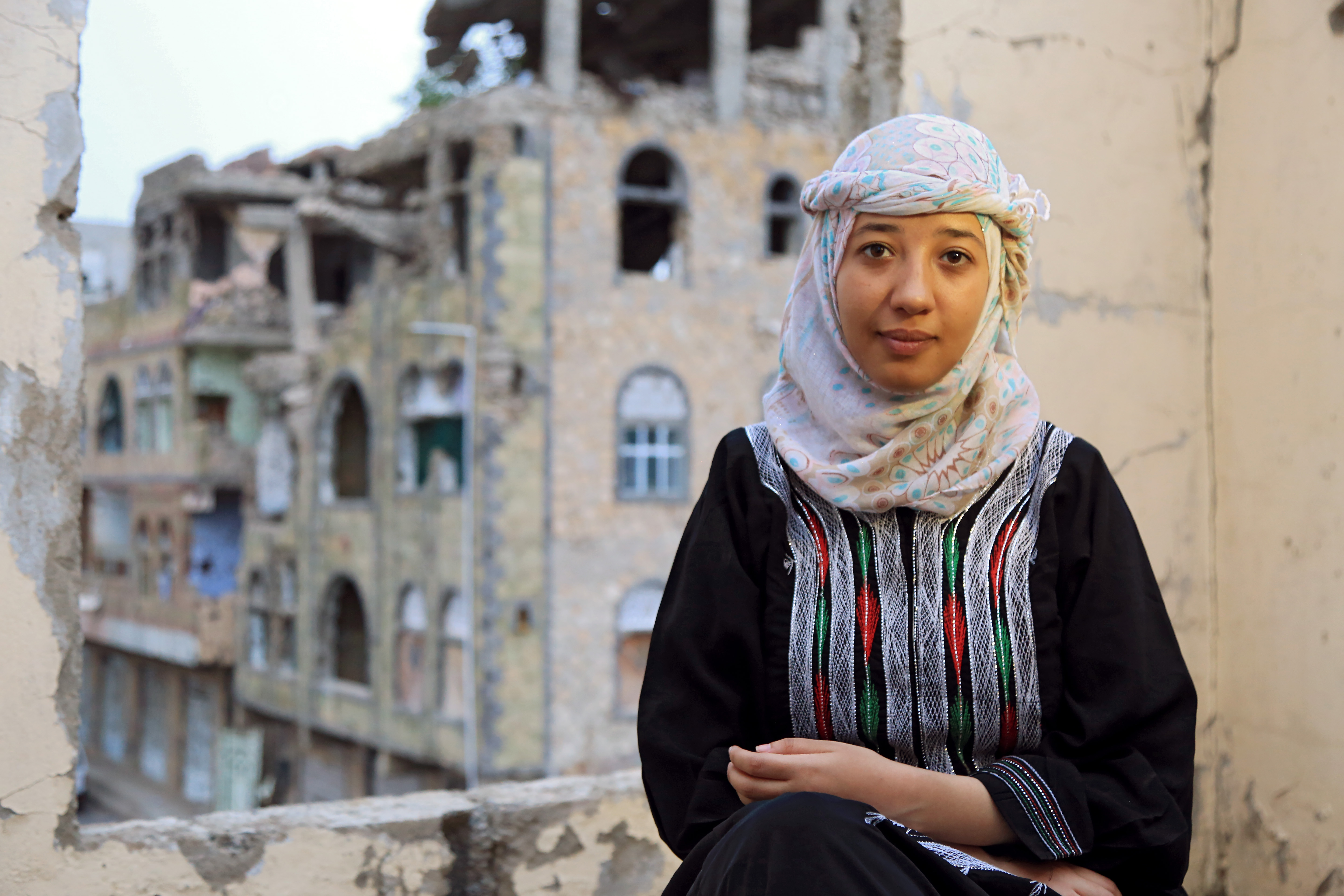
Olla Alsakkaf in Yemen. Credit: UN Photo/Hana Haza'a via UN Women
Climate, conflict and courage - a Yemeni activist's fight for change
Like many young people who are active in their communities, Olla Alsakkaf of Taiz, Yemen, does it all while juggling the responsibilities of being a student, building a career, and seeking balance for her own mental health.
When asked how she was pulled into peacebuilding and climate activism in a recent interview with UN Women ahead of the UN Climate Conference in Brazil (COP30), the 30-year-old economics student and founder of Peace Environment for Development explained that it was the civil war at her doorstep.
Now in its tenth year, the crisis in Yemen remains one of the world's most complex and protracted humanitarian emergencies, driven by conflict, economic collapse, climate shocks and the breakdown of public services. Over half the population needs humanitarian aid, including 4.8 million internally displaced people, making Yemen the fifth-largest internal displacement crisis globally.
The war changed everything
"I had totally different plans before the war. It changed everything. I had to flee my house to live in a rural area which was safer. By the time I returned, after more than a year, I had lost some of my friends. Most of the city was destroyed."
I had started to study English literature at college, so I wanted to continue teaching at the university, but then I couldn't. The whole situation around me – everything that was happening – drove me to choose to work in peacebuilding.
You are always in danger. There were a lot of barriers to entering this work, especially as a woman. I was 23 at that time, and at first my family didn't like it because the work was dangerous. You're always in danger, especially when you are working against conflict parties.
And more broadly, our society's norms do not support or accept women who work with international or civil society organizations. A lot of peace activists and women here in Yemen have been arrested – including close friends of mine – and many of them have been attacked. On social media, people falsely accuse them of being spies for other countries. At one point, I chose to stop posting about my work online because of the backlash I was facing.

Olla Alsakkaf working with Peace Environment for Development. Credit: Courtesy of Olla Alsakkaf
We must focus on the roots of conflict
To guarantee sustainable peace, we must focus on the roots of the conflict. In Yemen, one root is the fight over our country's natural resources. About half of Yemeni society depends on agriculture and fishing as their main sources of income – two sectors that are facing extreme challenges because of climate change.
That's why I decided to focus on the intersection of climate change and peacebuilding. We must work on conflict and climate together to have sustainable peace. Unfortunately, people tend to focus on them separately. In all the peace talks in Yemen, nothing regarding climate change is mentioned.
At the beginning, I couldn't find a local organization working from this perspective. So, I founded Peace Environment for Development, which provides training and materials to help young people gain knowledge about climate change. We also work with regional civil society networks on guidance for climate activism.
We depend on rain
In my city, we depend on the rain. Then about one month ago (October 2025), we couldn't find any water. Usually, the rainy season starts in March, but it did not rain until August. It became hard to find water to drink, regardless of how much money you have.
For two weeks, my father spent a lot of time every day just looking for water. Like most families, we were using it only for basic needs, since we could not guarantee that we would find any the next day.
Yemen is not a country that is responsible for climate change. But we still need to adapt.
Understanding the impact of climate change
The first step is raising awareness across society. Most people do not understand that what we are facing is the impact of climate change.
The next step is capacity building. We must build leadership skills in young people, enhance trust in their capabilities, and make space for them in politics and decision making.
Third, we need more and better data. This is a huge issue that we are facing in Yemen - collecting data from the field is hard and sometimes inaccurate.
Lastly, young people must have input on climate policies – on the plans that tell governments and civil society what to do, and where to focus. That includes input on the national commitments (Nationally Determined Contributions) that countries are submitting to this year's COP30.

Olla Alsakkaf speaking at an event. Credit: Courtesy of Olla Alsakkaf
Being there for young activists
As a peacebuilder, I heard a lot about the suffering of the people that I'm working with, and I carry this suffering with me. Sometimes, I find myself thinking of people's stories so much that I cannot focus on my own life. Thankfully, I was able to access psychological support through one of my networks. Before I attended sessions, before I took a break to rethink things, I was not aware of how important these steps are.
Unfortunately, this type of support is not available to many young people working on peacebuilding and climate change. These are people who take on so much, often never thinking about themselves. Sometimes they don't even realize that they are hurting themselves – not just physically, but psychologically.
It is very important to be there for young activists, and to have this support available.
Fighting for change
I have been working a lot with young people, especially on ways to engage those who are not yet involved in civil society. One of the best programmes I helped develop was a series of trainings, starting with a needs assessment, then focusing on working with society, designing interventions and managing projects.
It always makes me feel proud when I see the impact: how these young people have changed and the work they are doing right now. The change we have helped make – and the goals I share with my friends – push me to continue."
Read more about Olla Alsakkaf and other young peacebuilders in UN Women's story, "Three ingredients for lasting, sustainable peace."
Learn more about UN Women's work in Yemen and its Young Women Peacebuilder Initiative.
Understand the impact of the climate crisis on fragile countries and communities facing conflict or humanitarian crises.