登录


Becchi delle Curbassere (Becchi delle Courbassere; Becchi di Corbassera; Curbassere; Courbassere; Corbassera), Ala di Stura, Metropolitan City of Turin, Piedmont, Italyi
Becchi delle Curbassere (Becchi delle Courbassere; Becchi di Corbassera; Curbassere; Courbassere; Corbassera), Ala Valley, Lanzo Valleys, Metropolitan City of Turin, Piedmont, Italy
Becchi delle Curbassere (Becchi delle Courbassere; Becchi di Corbassera; Curbassere; Courbassere; Corbassera), Lanzo Valleys, Metropolitan City of Turin, Piedmont, Italy
This page is currently not sponsored. Click here to sponsor this page.



Latitude & Longitude (WGS84):
45° 19' 14'' North , 7° 19' 12'' East
Latitude & Longitude (decimal):
Type:
Group of Mountains
Köppen climate type:
Nearest Settlements:
| Place | Population | Distance |
|---|---|---|
| Ala di Stura | 328 (2014) | 1.4km |
| Chialamberto | 200 (2014) | 5.1km |
| Cantoira | 511 (2014) | 5.5km |
| Ceres | 405 (2014) | 5.5km |
| Procaria | 142 (2014) | 6.3km |
Name(s) in local language(s):
Becchi delle Curbassere (Becchi delle Courbassere; Becchi di Corbassera; Curbassere; Courbassere; Corbassera), Ala di Stura, Val d'Ala, Valli di Lanzo, Torino, Piemonte, Italia
Rodingite dykes in ophiolitic rocks.
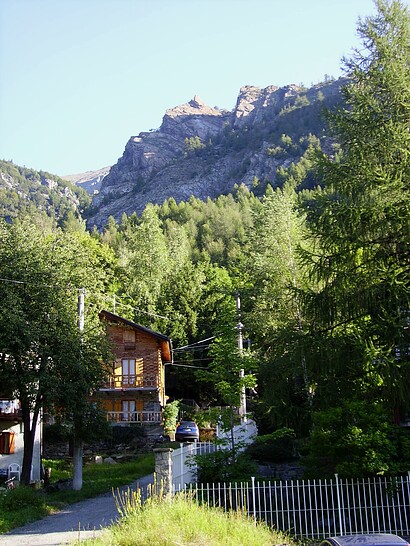
Becchi delle Curbassere (often simply indicated under the collective noun of Curbassere or Curbassera), located to the NE of Ala di Stura, consist of two serpentinite peaks named Piccola Curbassera (1531 m) and Grande Curbassera (1500 m).
On 17 of September 1655, in consequence of a torrential downpour, a cyclopean landslide originated from Piccola Curbassera and crashed down the side of the mountain as far as the Stura riverbed. The large blocks of this landslide became the source of all historical specimens of apatite, grossular and vesuvianite (crystals more than 10 cm in length are known). Grossular, besides classic dark red and hyacinth-red crystals, has yielded also small iridescent crystals, firstly mentioned by Barelli (1835) and later described in detail by Wiser (1866). Vesuvianite from this locality ranges in colour from dark red-brown to light brown, greyish-green and olive-green. Red-brown colour of vesuvianite has been firstly attributed to manganese, on the basis of an old analysis (Sismonda, 1834), and later to titanium, according to data of Elena Repossi (1942), that evidenced a certain content of titanium (3,28% as TiO2) and only traces of manganese. To date, this famous mineral occurrence can be considered virtually exhausted.
However, still prolific rodingite dykes are located at the foot of the western face of Piccola Curbassera and at the foot of a spur of Grande Curbassera.
Note: The information that Becchi delle Curbassere (Ala di Stura) is another of the type localities for diopside, probably due to erroneuos interpretations of the original literature, is unfounded. In fact, Benedetto Costanzo Bonvicino, who Frenchified his surname in Bonvoisin during the Napoleonic period, described under the name of “alalite” only a mineral from Testa Ciarva (Pian della Mussa, Balme) in the form of transparent, colourless to whitish to greenish prismatic crystals (Bonvoisin, 1806). In 1806 René-Just Haüy demonstrated that both “alalite” and “mussite” (another mineral described by Bonvoisin from Roch Neir at Pian della Mussa) are varieties of a unique mineral species, that he named diopside (Tonnelier, 1806 and 1809). Thus, only Roch Neir and Testa Ciarva at Pian della Mussa (Balme) [see http://www.mindat.org/loc-20461.html] are the type two localities for diopside.
Select Mineral List Type
Standard Detailed Gallery Strunz Chemical ElementsDetailed Mineral List:
| ⓘ Actinolite Formula: ◻Ca2(Mg4.5-2.5Fe0.5-2.5)Si8O22(OH)2 |
| ⓘ 'Apatite' Formula: Ca5(PO4)3(Cl/F/OH) |
| ⓘ Azurite Formula: Cu3(CO3)2(OH)2 |
| ⓘ Bornite Formula: Cu5FeS4 |
| ⓘ Calcite Formula: CaCO3 |
| ⓘ Chalcocite Formula: Cu2S |
| ⓘ Clinochlore Formula: Mg5Al(AlSi3O10)(OH)8 |
| ⓘ Diopside Formula: CaMgSi2O6 |
| ⓘ Grossular Formula: Ca3Al2(SiO4)3 |
| ⓘ Grossular var. Hessonite Formula: Ca3Al2(SiO4)3 |
| ⓘ Ilmenite Formula: Fe2+TiO3 |
| ⓘ Magnetite Formula: Fe2+Fe3+2O4 |
| ⓘ Malachite Formula: Cu2(CO3)(OH)2 |
| ⓘ Perovskite Formula: CaTiO3 References: |
| ⓘ Prehnite Formula: Ca2Al2Si3O10(OH)2 |
| ⓘ Quartz Formula: SiO2 |
| ⓘ Titanite Formula: CaTi(SiO4)O |
| ⓘ Vesuvianite Formula: Ca19Fe3+Al4(Al6Mg2)(◻4)◻[Si2O7]4[(SiO4)10]O(OH)9 |
Gallery:

List of minerals arranged by Strunz 10th Edition classification
| Group 2 - Sulphides and Sulfosalts | |||
|---|---|---|---|
| ⓘ | Chalcocite | 2.BA.05 | Cu2S |
| ⓘ | Bornite | 2.BA.15 | Cu5FeS4 |
| Group 4 - Oxides and Hydroxides | |||
| ⓘ | Magnetite | 4.BB.05 | Fe2+Fe3+2O4 |
| ⓘ | Ilmenite | 4.CB.05 | Fe2+TiO3 |
| ⓘ | Perovskite | 4.CC.30 | CaTiO3 |
| ⓘ | Quartz | 4.DA.05 | SiO2 |
| Group 5 - Nitrates and Carbonates | |||
| ⓘ | Calcite | 5.AB.05 | CaCO3 |
| ⓘ | Azurite | 5.BA.05 | Cu3(CO3)2(OH)2 |
| ⓘ | Malachite | 5.BA.10 | Cu2(CO3)(OH)2 |
| Group 9 - Silicates | |||
| ⓘ | Grossular | 9.AD.25 | Ca3Al2(SiO4)3 |
| ⓘ | var. Hessonite | 9.AD.25 | Ca3Al2(SiO4)3 |
| ⓘ | Titanite | 9.AG.15 | CaTi(SiO4)O |
| ⓘ | Vesuvianite | 9.BG.35 | Ca19Fe3+Al4(Al6Mg2)(◻4)◻[Si2O7]4[(SiO4)10]O(OH)9 |
| ⓘ | Diopside | 9.DA.15 | CaMgSi2O6 |
| ⓘ | Actinolite | 9.DE.10 | ◻Ca2(Mg4.5-2.5Fe0.5-2.5)Si8O22(OH)2 |
| ⓘ | Prehnite | 9.DP.20 | Ca2Al2Si3O10(OH)2 |
| ⓘ | Clinochlore | 9.EC.55 | Mg5Al(AlSi3O10)(OH)8 |
| Unclassified | |||
| ⓘ | 'Apatite' | - | Ca5(PO4)3(Cl/F/OH) |
List of minerals for each chemical element
| H | Hydrogen | |
|---|---|---|
| H | ⓘ Actinolite | ◻Ca2(Mg4.5-2.5Fe0.5-2.5)Si8O22(OH)2 |
| H | ⓘ Azurite | Cu3(CO3)2(OH)2 |
| H | ⓘ Clinochlore | Mg5Al(AlSi3O10)(OH)8 |
| H | ⓘ Malachite | Cu2(CO3)(OH)2 |
| H | ⓘ Prehnite | Ca2Al2Si3O10(OH)2 |
| H | ⓘ Vesuvianite | Ca19Fe3+Al4(Al6Mg2)(◻4)◻[Si2O7]4[(SiO4)10]O(OH)9 |
| H | ⓘ Apatite | Ca5(PO4)3(Cl/F/OH) |
| C | Carbon | |
| C | ⓘ Azurite | Cu3(CO3)2(OH)2 |
| C | ⓘ Calcite | CaCO3 |
| C | ⓘ Malachite | Cu2(CO3)(OH)2 |
| O | Oxygen | |
| O | ⓘ Actinolite | ◻Ca2(Mg4.5-2.5Fe0.5-2.5)Si8O22(OH)2 |
| O | ⓘ Azurite | Cu3(CO3)2(OH)2 |
| O | ⓘ Calcite | CaCO3 |
| O | ⓘ Clinochlore | Mg5Al(AlSi3O10)(OH)8 |
| O | ⓘ Diopside | CaMgSi2O6 |
| O | ⓘ Grossular | Ca3Al2(SiO4)3 |
| O | ⓘ Grossular var. Hessonite | Ca3Al2(SiO4)3 |
| O | ⓘ Ilmenite | Fe2+TiO3 |
| O | ⓘ Magnetite | Fe2+Fe23+O4 |
| O | ⓘ Malachite | Cu2(CO3)(OH)2 |
| O | ⓘ Perovskite | CaTiO3 |
| O | ⓘ Prehnite | Ca2Al2Si3O10(OH)2 |
| O | ⓘ Quartz | SiO2 |
| O | ⓘ Titanite | CaTi(SiO4)O |
| O | ⓘ Vesuvianite | Ca19Fe3+Al4(Al6Mg2)(◻4)◻[Si2O7]4[(SiO4)10]O(OH)9 |
| O | ⓘ Apatite | Ca5(PO4)3(Cl/F/OH) |
| F | Fluorine | |
| F | ⓘ Apatite | Ca5(PO4)3(Cl/F/OH) |
| Mg | Magnesium | |
| Mg | ⓘ Actinolite | ◻Ca2(Mg4.5-2.5Fe0.5-2.5)Si8O22(OH)2 |
| Mg | ⓘ Clinochlore | Mg5Al(AlSi3O10)(OH)8 |
| Mg | ⓘ Diopside | CaMgSi2O6 |
| Mg | ⓘ Vesuvianite | Ca19Fe3+Al4(Al6Mg2)(◻4)◻[Si2O7]4[(SiO4)10]O(OH)9 |
| Al | Aluminium | |
| Al | ⓘ Clinochlore | Mg5Al(AlSi3O10)(OH)8 |
| Al | ⓘ Grossular | Ca3Al2(SiO4)3 |
| Al | ⓘ Grossular var. Hessonite | Ca3Al2(SiO4)3 |
| Al | ⓘ Prehnite | Ca2Al2Si3O10(OH)2 |
| Al | ⓘ Vesuvianite | Ca19Fe3+Al4(Al6Mg2)(◻4)◻[Si2O7]4[(SiO4)10]O(OH)9 |
| Si | Silicon | |
| Si | ⓘ Actinolite | ◻Ca2(Mg4.5-2.5Fe0.5-2.5)Si8O22(OH)2 |
| Si | ⓘ Clinochlore | Mg5Al(AlSi3O10)(OH)8 |
| Si | ⓘ Diopside | CaMgSi2O6 |
| Si | ⓘ Grossular | Ca3Al2(SiO4)3 |
| Si | ⓘ Grossular var. Hessonite | Ca3Al2(SiO4)3 |
| Si | ⓘ Prehnite | Ca2Al2Si3O10(OH)2 |
| Si | ⓘ Quartz | SiO2 |
| Si | ⓘ Titanite | CaTi(SiO4)O |
| Si | ⓘ Vesuvianite | Ca19Fe3+Al4(Al6Mg2)(◻4)◻[Si2O7]4[(SiO4)10]O(OH)9 |
| P | Phosphorus | |
| P | ⓘ Apatite | Ca5(PO4)3(Cl/F/OH) |
| S | Sulfur | |
| S | ⓘ Bornite | Cu5FeS4 |
| S | ⓘ Chalcocite | Cu2S |
| Cl | Chlorine | |
| Cl | ⓘ Apatite | Ca5(PO4)3(Cl/F/OH) |
| Ca | Calcium | |
| Ca | ⓘ Actinolite | ◻Ca2(Mg4.5-2.5Fe0.5-2.5)Si8O22(OH)2 |
| Ca | ⓘ Calcite | CaCO3 |
| Ca | ⓘ Diopside | CaMgSi2O6 |
| Ca | ⓘ Grossular | Ca3Al2(SiO4)3 |
| Ca | ⓘ Grossular var. Hessonite | Ca3Al2(SiO4)3 |
| Ca | ⓘ Perovskite | CaTiO3 |
| Ca | ⓘ Prehnite | Ca2Al2Si3O10(OH)2 |
| Ca | ⓘ Titanite | CaTi(SiO4)O |
| Ca | ⓘ Vesuvianite | Ca19Fe3+Al4(Al6Mg2)(◻4)◻[Si2O7]4[(SiO4)10]O(OH)9 |
| Ca | ⓘ Apatite | Ca5(PO4)3(Cl/F/OH) |
| Ti | Titanium | |
| Ti | ⓘ Ilmenite | Fe2+TiO3 |
| Ti | ⓘ Perovskite | CaTiO3 |
| Ti | ⓘ Titanite | CaTi(SiO4)O |
| Fe | Iron | |
| Fe | ⓘ Actinolite | ◻Ca2(Mg4.5-2.5Fe0.5-2.5)Si8O22(OH)2 |
| Fe | ⓘ Bornite | Cu5FeS4 |
| Fe | ⓘ Ilmenite | Fe2+TiO3 |
| Fe | ⓘ Magnetite | Fe2+Fe23+O4 |
| Fe | ⓘ Vesuvianite | Ca19Fe3+Al4(Al6Mg2)(◻4)◻[Si2O7]4[(SiO4)10]O(OH)9 |
| Cu | Copper | |
| Cu | ⓘ Azurite | Cu3(CO3)2(OH)2 |
| Cu | ⓘ Bornite | Cu5FeS4 |
| Cu | ⓘ Chalcocite | Cu2S |
| Cu | ⓘ Malachite | Cu2(CO3)(OH)2 |
Other Regions, Features and Areas containing this locality
Eurasian PlateTectonic Plate
- AlpsAccretionary Complex
EuropeContinent
- The AlpsMountain Range
Italy
- Piedmont
- Metropolitan City of Turin
- Lanzo ValleysGroup of Valleies
- Ala ValleyValley
- Lanzo ValleysGroup of Valleies
- Metropolitan City of Turin
This page contains all mineral locality references listed on mindat.org. This does not claim to be a complete list. If you know of more minerals from this site, please register so you can add to our database. This locality information is for reference purposes only. You should never attempt to
visit any sites listed in mindat.org without first ensuring that you have the permission of the land and/or mineral rights holders
for access and that you are aware of all safety precautions necessary.
Becchi delle Curbassere, Ala di Stura, Metropolitan City of Turin, Piedmont, Italy