登录


Holtstamite
A valid IMA mineral species
This page is currently not sponsored. Click here to sponsor this page.



About Holtstamite

Dan Holtstam
Formula:
Ca3Al2(SiO4)2[◻(OH)4]
Colour:
Brownish-yellow, pale-yellow, gray-white, white, colorless
Lustre:
Vitreous, Sub-Vitreous
Hardness:
6
Specific Gravity:
3.33 (Calculated)
Crystal System:
Tetragonal
Member of:
Name:
Honors Dr. Dan Holtstam (b. 1963) for his contributions to Swedish mineralogy and specifically Mn deposits of the Långban type.
Unique Identifiers
Mindat ID:
27532
Long-form identifier:
mindat:1:1:27532:7
IMA Classification of Holtstamite
Approved
IMA Formula:
Ca3Al2(SiO4)2(OH)4
Approval year:
2003
First published:
2005
Classification of Holtstamite
9.AD.25
9 : SILICATES (Germanates)
A : Nesosilicates
D : Nesosilicates without additional anions; cations in [6] and/or greater coordination
9 : SILICATES (Germanates)
A : Nesosilicates
D : Nesosilicates without additional anions; cations in [6] and/or greater coordination
Mineral Symbols
As of 2021 there are now IMA–CNMNC approved mineral symbols (abbreviations) for each mineral species, useful for tables and diagrams.
| Symbol | Source | Reference for Standard |
|---|---|---|
| Hts | IMA–CNMNC | Warr, L.N. (2021). IMA–CNMNC approved mineral symbols. Mineralogical Magazine, 85(3), 291-320. doi:10.1180/mgm.2021.43 |
Pronunciation of Holtstamite
Pronunciation:
| Play | Recorded by | Country |
|---|---|---|
| Jolyon Ralph | United Kingdom |
Physical Properties of Holtstamite
Vitreous, Sub-Vitreous
Transparency:
Transparent
Colour:
Brownish-yellow, pale-yellow, gray-white, white, colorless
Hardness:
6 on Mohs scale
Tenacity:
Brittle
Cleavage:
None Observed
Fracture:
Conchoidal
Density:
3.33 g/cm3 (Calculated)
Optical Data of Holtstamite
Type:
Uniaxial (+)
RI values:
nω = 1.718 nε = 1.746
Birefringence:
0.028
Max. Birefringence:
δ = 0.028
Based on recorded range of RI values above.
Based on recorded range of RI values above.
Interference Colours:
The colours simulate birefringence patterns seen in thin section under crossed polars. They do not take into account mineral colouration or opacity.
Michel-Levy Bar The default colours simulate the birefringence range for a 30 µm thin-section thickness. Adjust the slider to simulate a different thickness.
Grain Simulation You can rotate the grain simulation to show how this range might look as you rotated a sample under crossed polars. Each grain retains its interference colour (retardation) while its brightness falls to black at extinction and reaches a maximum between extinction positions.
Surface Relief:
Very High (positive)
Relative to Canada balsam mounting medium (n ≈ 1.537).
Relative to Canada balsam mounting medium (n ≈ 1.537).
This shows the grain boundary and Becke line effect under plane-polarised
light, based on the contrast between this mineral's average refractive
index and the mounting medium. It does not take into account mineral
colouration.
In focus
Interference Figure:
This shows the idealized uniaxial interference figure - the conoscopic
(convergent-light, Bertrand-lens-in) view, for a grain cut with the optic axis
centred and vertical. The coloured rings are isochromatics, computed with the
same physics as the Michel-Lévy bar above; the dark cross is the isogyre.
For a genuinely uniaxial mineral viewed this way, that cross stays perfectly stationary if you rotate the stage - unlike a biaxial mineral, where it splits apart on rotation. That invariance is itself the standard diagnostic test for telling uniaxial and biaxial minerals apart at the microscope.
For a genuinely uniaxial mineral viewed this way, that cross stays perfectly stationary if you rotate the stage - unlike a biaxial mineral, where it splits apart on rotation. That invariance is itself the standard diagnostic test for telling uniaxial and biaxial minerals apart at the microscope.
Optical Extinction:
Parallel
Pleochroism:
Weak
Comments:
O = pale orange yellow and E = lemon yellow.
Comments:
Absorption: E > O.
Chemistry of Holtstamite
Mindat Formula:
Ca3Al2(SiO4)2[◻(OH)4]
Element Weights:
Crystallography of Holtstamite
Crystal System:
Tetragonal
Class (H-M):
4/mmm(4/m2/m2/m) - Ditetragonal Dipyramidal
Space Group:
I41/acd
Cell Parameters:
a = 12.337 Å, c = 11.93 Å
Ratio:
a:c = 1 : 0.967
Unit Cell V:
1,815.76 ų (Calculated from Unit Cell)
Z:
8
Twinning:
Twinning around [111], creating pseudo-octahedrons.
Crystal Structure
Load
Unit Cell | Unit Cell Packed
2x2x2 | 3x3x3 | 4x4x4
Unit Cell | Unit Cell Packed
2x2x2 | 3x3x3 | 4x4x4
Show
Big Balls | Small Balls | Just Balls | Spacefill
Polyhedra Off | Si Polyhedra | All Polyhedra
Remove metal-metal sticks
Big Balls | Small Balls | Just Balls | Spacefill
Polyhedra Off | Si Polyhedra | All Polyhedra
Remove metal-metal sticks
Display Options
Black Background | White Background
Perspective On | Perspective Off
2D | Stereo | Red-Blue | Red-Cyan
Black Background | White Background
Perspective On | Perspective Off
2D | Stereo | Red-Blue | Red-Cyan
View
CIF File Best | x | y | z | a | b | c
CIF File Best | x | y | z | a | b | c
Rotation
Stop | Start
Stop | Start
Labels
Console Off | On | Grey | Yellow
Console Off | On | Grey | Yellow
Data courtesy of the American Mineralogist Crystal Structure Database. Click on an AMCSD ID to view structure
| ID | Species | Reference | Link | Year | Locality | Pressure (GPa) | Temp (K) |
|---|---|---|---|---|---|---|---|
| 0007101 | Holtstamite | Halenius U, Haussermann U, Harryson H (2005) Holtstamite, Ca3(Al,Mn3+)2(SiO4)3-x(H4O4)x, a new tetragonal hydrogarnet from Wessels Mine, South Africa European Journal of Mineralogy 17 375-382 | 2005 | Wessels Mine, South Africa | 0 | 293 |
CIF Raw Data - click here to close
X-Ray Powder Diffraction
Powder Diffraction Data:
| d-spacing | Intensity |
|---|---|
| 3.082 Å | (44) |
| 2.978 Å | (45) |
| 2.757 Å | (55) |
| 2.743 Å | (100) |
| 2.685 Å | (54) |
| 2.501 Å | (47) |
| 1.671 Å | (37) |
| 1.633 Å | (39) |
| 1.614 Å | (56) |
Reference:
Comments:
Halenius U , Haussermann U , Harryson H , European Journal of Mineralogy , 17 (2005) p.375-382, Holtstamite, Ca3(Al,Mn3+)2(SiO4)3-x(H4O4)x, a new tetragonal hydrogarnet, from Wessels Mine, South Africa, Locality: Wessels Mine, South Africa
Geological Environment
Paragenetic Mode(s):
| Paragenetic Mode | Earliest Age (Ga) |
|---|---|
| High-? alteration and/or metamorphism | |
| 31 : Thermally altered carbonate, phosphate, and iron formations | |
| Stage 7: Great Oxidation Event | <2.4 |
| 47a : [Near-surface hydration of prior minerals] |
Type Occurrence of Holtstamite
General Appearance of Type Material:
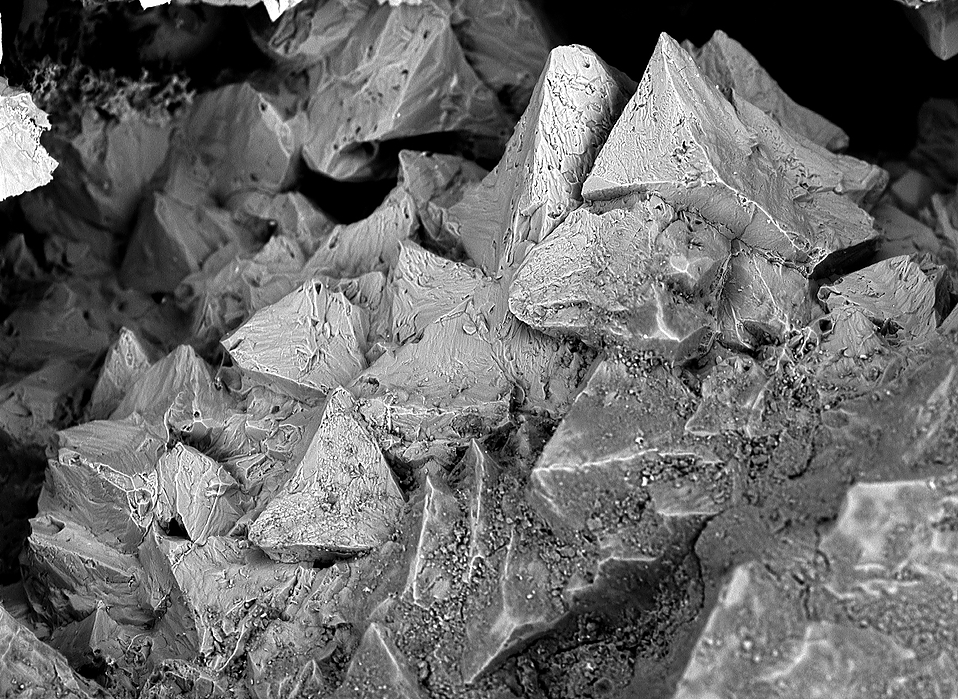
Rounded grains (up to 3 mm) composed of small (< 0.4 mm) commonly twinned crystals. Occasionally, the crystals make up
pseudo-octahedra.
pseudo-octahedra.
Place of Conservation of Type Material:
Swedish Museum of Natural History, Stockholm, no. 960380.
Geological Setting of Type Material:
Calc-silicate skarn.
Associated Minerals at Type Locality:
Synonyms of Holtstamite
Other Language Names for Holtstamite
Dutch:Holtstamiet
German:Holtstamit
Russian:Хольцтамит
Simplified Chinese:四方水钙榴石
Traditional Chinese:四方水鈣榴石
Relationship of Holtstamite to other Species
Member of:
Other Members of Henritermierite Group:
| Henritermierite | Ca3Mn3+2(SiO4)2[◻(OH)4] | Tet. 4/mmm(4/m2/m2/m) : I41/acd |
Common Associates
Associations Based on Photo Data:
| 1 photo of Holtstamite associated with Calcite | CaCO3 |
| 1 photo of Holtstamite associated with Vesuvianite | Ca19Fe3+Al4(Al6Mg2)(◻4)◻[Si2O7]4[(SiO4)10]O(OH)9 |
Related Minerals - Strunz-mindat Grouping
| 9.AD. | Adrianite | Ca12(Al4Mg3Si7)O32Cl6 |
| 9.AD.05 | Larnite | Ca2SiO4 |
| 9.AD.10 | Calcio-olivine | Ca2SiO4 |
| 9.AD.15 | Merwinite | Ca3Mg(SiO4)2 |
| 9.AD.20 | Bredigite | Ca7Mg(SiO4)4 |
| 9.AD.25 | Midbarite | Ca3Mg2(V5+2Si)O12 |
| 9.AD.25 | Menzerite-(Y) | (Y2Ca)Mg2(SiO4)3 |
| 9.AD.25 | Uvarovite | Ca3Cr3+2(SiO4)3 |
| 9.AD.25 | Eltyubyuite | Ca12Fe3+10Si4O32Cl6 |
| 9.AD.25 | Eringaite | Ca3Sc2(SiO4)3 |
| 9.AD.25 | Henritermierite | Ca3Mn3+2(SiO4)2[◻(OH)4] |
| 9.AD.25 va | 'Hydrougrandite' | (Ca,Mg,Fe2+)3(Fe3+,Al)2[(OH)4(SiO4)2] |
| 9.AD.25 | Calderite | Mn2+3Fe3+2(SiO4)3 |
| 9.AD.25 | Nikmelnikovite | Ca12(Fe2+Fe3+3Al3◻)[SiO4]6[◻(OH)4]5◻4 |
| 9.AD.25 | Hutcheonite | Ca3Ti2(SiO4)(AlO4)2 |
| 9.AD.25 | Wadalite | (Ca,Mg)6(Al,Fe3+)4((Si,Al)O4)3O4Cl3 |
| 9.AD.25 | Rubinite | Ca3Ti3+2(SiO4)3 |
| 9.AD.25 | Kerimasite | Ca3Zr2(SiO4)(Fe3+O4)2 |
| 9.AD.25 | Spessartine | Mn2+3Al2(SiO4)3 |
| 9.AD.25 | Toturite | Ca3Sn2(SiO4)(Fe3+O4)2 |
| 9.AD.25 | Kimzeyite | Ca3Zr2(SiO4)(AlO4)2 |
| 9.AD.25 | 'Khoharite' | Mg3Fe3+2(SiO4)3 |
| 9.AD.25 | Irinarassite | Ca3Sn2(SiO4)(AlO4)2 |
| 9.AD.25 | Knorringite | Mg3Cr3+2(SiO4)3 |
| 9.AD.25 | Goldmanite | Ca3V3+2(SiO4)3 |
| 9.AD.25 | 'Blythite' | Mn2+3Mn3+2[SiO4]3 |
| 9.AD.25 | 'Skiagite' | Fe2+3Fe3+2[SiO4]3 |
| 9.AD.25 | 'UM1984-37-SiO:CrMn' | Mn2+3Cr3+2(SiO4)3 |
| 9.AD.25 | Almandine | Fe2+3Al2(SiO4)3 |
| 9.AD.25 va | 'Yamatoite' | (Mn2+,Ca)3(V3+,Al)2(SiO4)3 |
| 9.AD.25 | Momoiite | Mn2+3V3+2(SiO4)3 |
| 9.AD.25 | Grossular | Ca3Al2(SiO4)3 |
| 9.AD.25 | Andradite | Ca3Fe3+2(SiO4)3 |
| 9.AD.25 | Morimotoite | Ca3(TiFe2+)(SiO4)3 |
| 9.AD.25 | Majorite | Mg3(MgSi)(SiO4)3 |
| 9.AD.25 | Pyrope | Mg3Al2(SiO4)3 |
| 9.AD.25 | Schorlomite | Ca3Ti2(SiO4)(Fe3+O4)2 |
| 9.AD.30 | Hafnon | Hf(SiO4) |
| 9.AD.30 | Zircon | Zr(SiO4) |
| 9.AD.30 | Coffinite | U(SiO4) · nH2O |
| 9.AD.30 | Thorite | Th(SiO4) |
| 9.AD.30 va | 'Auerlite' | near Th(Si,P)O4 |
| 9.AD.30 | Stetindite-(Ce) | Ce4+SiO4 |
| 9.AD.35 | 'Tombarthite-(Y)' | Y4(Si,H4)4O12-x(OH)4+2x |
| 9.AD.35 | Huttonite | ThSiO4 |
| 9.AD.40 | Eulytine | Bi4(SiO4)3 |
| 9.AD.45 | Reidite | Zr(SiO4) |
| 9.AD.55 | Jeffbenite | Mg3Al2Si3O12 |
Other Information
Health Risks:
No information on health risks for this material has been entered into the database. You should always treat mineral specimens with care.
Internet Links for Holtstamite
mindat.org URL:
https://www.mindat.org/min-27532.html
Please feel free to link to this page.
Please feel free to link to this page.
Search Engines:
External Links:
Mineral Dealers:
References for Holtstamite
Localities for Holtstamite
Showing 5 localities.
 symbol to view information about a locality.
The
Locality List
 - This locality has map coordinates listed.
- This locality has estimated coordinates.
ⓘ - Click for references and further information on this occurrence.
? - Indicates mineral may be doubtful at this locality.
 - Good crystals or important locality for species.
 - World class for species or very significant.
(TL) - Type Locality for a valid mineral species.
(FRL) - First Recorded Locality for everything else (eg varieties).
All localities listed without proper references should be considered as questionable.
Finland | |
| Martin et al. (2026) |
Japan | |
| Nishio-Hamane D. et al. (2019) |
Morocco | |
| EDXS analyses by P. Roth |
South Africa (TL) | |
| Am. Min. (2005) +1 other reference |
Sweden | |
| King (2023) |
Quick NavTopAbout HoltstamiteUnique IdentifiersIMA Classification Classification Mineral SymbolsPronunciation Physical Properties Optical Data Chemistry Crystallography Crystal StructureX-Ray Powder DiffractionGeological EnvironmentType Occurrence SynonymsOther LanguagesRelationshipsCommon AssociatesStrunz-MindatOther InformationInternet Links References Localities Locality List
Tachgagalt Mine, Tansifte Caïdat, Agdz Cercle, Zagora Province, Drâa-Tafilalet Region, Morocco