登录


Pittongite
A valid IMA mineral species
This page is currently not sponsored. Click here to sponsor this page.




About Pittongite

Formula:
Na0.22(W,Fe3+)(O,OH)3 · 0.44H2O
Colour:
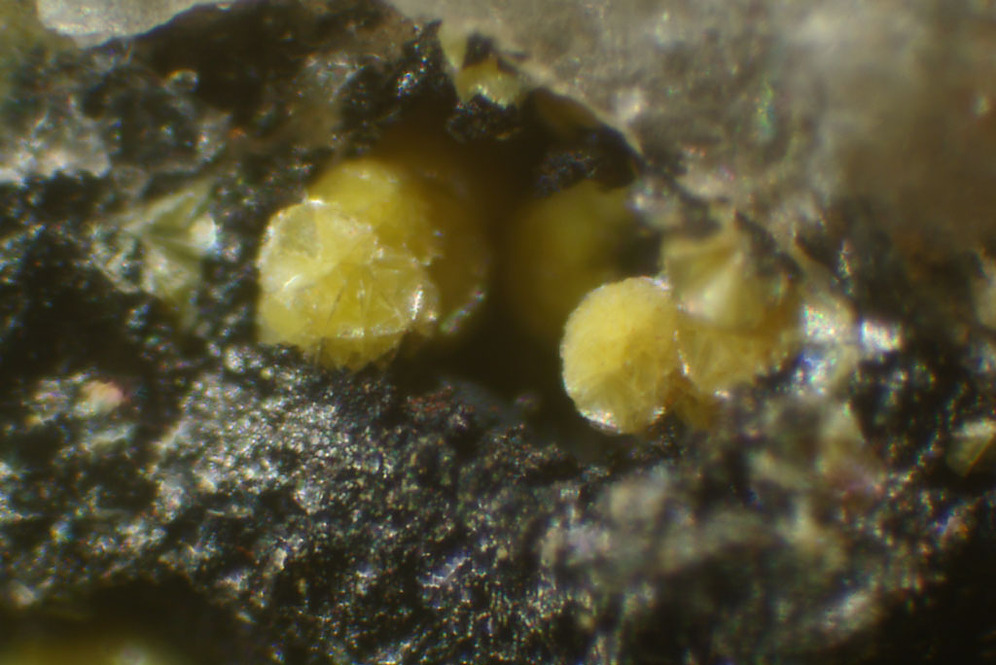
Creamy yellow
Lustre:
Pearly, Earthy
Hardness:
2 - 3
Specific Gravity:
5.715 (Calculated)
Crystal System:
Hexagonal
Name:
After the type locality at Pittong, near Ballarat, Victoria, Australia. Pittong is derived from an Australian aboriginal word for "father."
Structural and chemical similarities to Phyllotungstite. The crystal structure is closely related to that of Pyrochlore, and can be derived from it by periodic, unit-cell-scale twinning parallel to the (111) plane of pyrochlore.
Unique Identifiers
Mindat ID:
29549
Long-form identifier:
mindat:1:1:29549:1
IMA Classification of Pittongite
Classification of Pittongite
4.DH.45
4 : OXIDES (Hydroxides, V[5,6] vanadates, arsenites, antimonites, bismuthites, sulfites, selenites, tellurites, iodates)
D : Metal: Oxygen = 1:2 and similar
H : With large (+- medium-sized) cations; sheets of edge-sharing octahedra
4 : OXIDES (Hydroxides, V[5,6] vanadates, arsenites, antimonites, bismuthites, sulfites, selenites, tellurites, iodates)
D : Metal: Oxygen = 1:2 and similar
H : With large (+- medium-sized) cations; sheets of edge-sharing octahedra
Mineral Symbols
As of 2021 there are now IMA–CNMNC approved mineral symbols (abbreviations) for each mineral species, useful for tables and diagrams.
| Symbol | Source | Reference for Standard |
|---|---|---|
| Pit | IMA–CNMNC | Warr, L.N. (2021). IMA–CNMNC approved mineral symbols. Mineralogical Magazine, 85(3), 291-320. doi:10.1180/mgm.2021.43 |
Physical Properties of Pittongite
Pearly, Earthy
Transparency:
Transparent
Comment:
Glistening
Colour:
Creamy yellow
Streak:
Cream
Hardness:
2 - 3 on Mohs scale
Density:
5.715 g/cm3 (Calculated)
Chemistry of Pittongite
Mindat Formula:
Na0.22(W,Fe3+)(O,OH)3 · 0.44H2O
Element Weights:
Crystallography of Pittongite
Crystal System:
Hexagonal
Class (H-M):
6m2 - Ditrigonal Dipyramidal
Space Group:
P6m2
Cell Parameters:
a = 7.286 Å, c = 50.49 Å
Ratio:
a:c = 1 : 6.93
Unit Cell V:
2,321.21 ų (Calculated from Unit Cell)
Morphology:
Encrustations of very thin (0.3-0.5 μm) platy crystals.
X-Ray Powder Diffraction
Powder Diffraction Data:
| d-spacing | Intensity |
|---|---|
| 5.956 Å | (52) |
| 3.306 Å | (62) |
| 3.153 Å | (100) |
| 3.111 Å | (91) |
| 2.450 Å | (59) |
| 1.823 Å | (76) |
| 1.578 Å | (64) |
| 1.192 Å | (44) |
Geological Environment
Paragenetic Mode(s):
| Paragenetic Mode | Earliest Age (Ga) |
|---|---|
| Stage 7: Great Oxidation Event | <2.4 |
| 47a : [Near-surface hydration of prior minerals] |
Type Occurrence of Pittongite
General Appearance of Type Material:
Glistening, creamy yellow encrustations of very thin (0.3–0.5 µm) platy crystals on etched blades of ferberite, enclosed in massive white reef quartz.
Place of Conservation of Type Material:
Museum Victoria, Melbourne, Australia (M48268).
Geological Setting of Type Material:
W-bearing quartz veins. Alteration of ferberite in a supergene environment in the presence of oxidizing, acidic solutions containing sodium.
Associated Minerals at Type Locality:
Synonyms of Pittongite
Other Language Names for Pittongite
Common Associates
Related Minerals - Strunz-mindat Grouping
| 4.DH. | Cesiokenopyrochlore | ◻Nb2(O,OH)6(Cs,◻) |
| 4.DH. | Roméite Group | A2(Sb5+)2O6Z |
| 4.DH. | Oxyplumboroméite | Pb2Sb2O6O |
| 4.DH. | Fluornatropyrochlore | (Na,Pb,Ca,REE,U)2Nb2O6F |
| 4.DH. | Hydroxykenomicrolite | (◻,Na,Sb3+)2Ta2O6(OH,Cs) |
| 4.DH. | 'Fluornatroroméite' | (Na,Ca)2Sb2(O,OH)6F |
| 4.DH. | Oxyyttrobetafite-(Y) | Y2Ti2O6O |
| 4.DH.05 | Thorutite | (Th,U,Ca)Ti2(O,OH)6 |
| 4.DH.05 | Orthobrannerite | U4+U6+Ti4O12(OH)2 |
| 4.DH.05 | Brannerite | UTi2O6 |
| 4.DH.10 | Kassite | CaTi2O4(OH)2 |
| 4.DH.10 | Lucasite-(La) | |
| 4.DH.10 | Lucasite-(Ce) | CeTi2(O,OH)6 |
| 4.DH.15 | 'Fluorhydropyrochlore' | |
| 4.DH.15 | Hydrokenoelsmoreite | ◻2W2O6(H2O) |
| 4.DH.15 | 'Hydroxynatromicrolite' | (Na,Bi3+,◻)2Ta2O6(OH) |
| 4.DH.15 | Hydroplumboelsmoreite | (Pb,◻)(W,Fe3+)2O6 · H2O |
| 4.DH.15 | Hydropyrochlore | (H2O,◻)2Nb2(O,OH)6(H2O) |
| 4.DH.15 | 'Unnamed (Sb-analogue of Hydroxymanganopyrochlor)' | (Mn,Ca,Y)2(Sb,Ti)2O6(OH) |
| 4.DH.15 | Hydroxynatropyrochlore | (Na,Ca,Ce)2Nb2O6(OH) |
| 4.DH.15 | Hydrokenopyrochlore | (◻,x)2Nb2O6(H2O,Cs) |
| 4.DH.15 | Oxybismutomicrolite | (Bi1.33◻0.67)Σ2Ta2O6O |
| 4.DH.15 | Kenomicrolite | ◻2Ta2[O4(OH)2]◻ |
| 4.DH.15 | Fluornatromicrolite | (Na1.5Bi0.5)Ta2O6F |
| 4.DH.15 | 'Oxynatropyrochlore' | (Na,Ca,U)2Nb2O6(O,OH) |
| 4.DH.15 | Hydroxycalciopyrochlore | (Ca,Na,U,◻)2(Nb,Ti)2O6(OH) |
| 4.DH.15 | Fluorcalciopyrochlore | (Ca,Na)2(Nb,Ti)2O6F |
| 4.DH.15 | Oxycalciopyrochlore | Ca2Nb2O6O |
| 4.DH.15 | 'Fluorstrontiopyrochlore' | (Sr,◻)2Nb2(O,OH)6F |
| 4.DH.15 | Oxyplumbopyrochlore | Pb2Nb2O6O |
| 4.DH.15 | 'Fluorplumbopyrochlore' | (Pb,Y,Th,U,Na,Ca)2-x(Nb,Ti)2O6F |
| 4.DH.15 | 'Bismutomicrolite (of Hogarth 1977)' | |
| 4.DH.15 | 'Bismutopyrochlore (of Chukanov et al.)' | (Bi,Ca,U,Pb)2-xNb2(O,OH)6(OH) |
| 4.DH.15 | 'Kenoplumbopyrochlore' | (Pb,◻)Nb2O6(◻,O) |
| 4.DH.15 | Hydroxyplumbopyrochlore | (Pb1.5◻0.5)Nb2O6(OH) |
| 4.DH.15 | 'Stibiomicrolite (of Groat et al.)' | |
| 4.DH.15 | 'Oxyyttropyrochlore-(Y)' | (Y,◻)2Nb2O6O |
| 4.DH.15 | 'Fluorkenopyrochlore' | (◻,Sr,Ce,Ca,Na)2(Nb,Ti)2O6F |
| 4.DH.15 | Hydroxycalciomicrolite | Ca1.5Ta2O6(OH) |
| 4.DH.15 | 'Strontiopyrochlore (of Hogarth 1977)' | (Sr,Ce,Ca)0.66(Nb,Fe)2(O,OH)7 |
| 4.DH.15 va | 'Alumotungstite' | ◻2W2O6(H2O) |
| 4.DH.15 | 'Oxycalciobetafite' | Ca2(Ti,Nb)2O6O |
| 4.DH.15 | 'Oxyuranobetafite' | (U,Ca,◻)2(Ti,Nb)2O6O |
| 4.DH.15 | Fluorcalciomicrolite | (Ca,Na)2(Ta,Nb)2O6F |
| 4.DH.15 | Oxycalciomicrolite | Ca2Ta2O6O |
| 4.DH.15 | Oxystannomicrolite | Sn2Ta2O6O |
| 4.DH.15 | Kenoplumbomicrolite | (Pb,◻)2Ta2O6(◻,OH,O) |
| 4.DH.15 | Oxynatromicrolite | (Na,Ca,U)2(Ta,Nb)2O6(O,F) |
| 4.DH.15 | Oxystibiomicrolite | (Sb3+,Ca)2Ta2O6O |
| 4.DH.15 | 'Hydromicrolite' | (H2O,◻)2Ta2(O,OH)6(H2O) |
| 4.DH.15 | 'Plumbomicrolite (of Hogarth 1977)' | |
| 4.DH.15 | Hydrokenomicrolite | (◻,H2O)2Ta2(O,OH)6(H2O) |
| 4.DH.15 | Hydroxykenoelsmoreite | (◻,Pb)2(W,Fe3+,Al)2(O,OH)6(OH) |
| 4.DH.15 va | 'Yttromicrolite (of Hogarth)' | (Ca,Y3+,U,Na)2-x(Ta,Nb,Ti,Fe3+)2O7 |
| 4.DH.15 | Hydroxykenopyrochlore | (◻,Ce,Ba)2(Nb,Ti)2O6(OH,F) |
| 4.DH.15 | Hydroxymanganopyrochlore | (Mn2+,Th,Na,Ca,REE)2(Nb,Ti)2O6(OH) |
| 4.DH.20 | 'Cuproroméite' | Cu2Sb2(O,OH)7 |
| 4.DH.20 | Hydroxycalcioroméite | (Ca,Sb3+)2(Sb5+,Ti)2O6(OH) |
| 4.DH.20 | Bindheimite | Pb2Sb2O6O |
| 4.DH.20 | Hydroxyferroroméite | (Fe2+1.5◻0.5)Sb5+2O6(OH) |
| 4.DH.20 | Fluorcalcioroméite | (Ca,Na,◻)2Sb5+2(O,OH)6F |
| 4.DH.20 | Oxycalcioroméite | Ca2Sb2O6O |
| 4.DH.20 | Stetefeldtite | Ag2Sb2(O,OH)7 |
| 4.DH.20 | Stibiconite | Sb3+Sb5+2O6(OH) |
| 4.DH.20 | Monimolite | Pb2Sb5+2O7 |
| 4.DH.25 | Rosiaite | PbSb5+2O6 |
| 4.DH.30 | Stefanweissite | (Ca,REE)2Zr2(Nb,Ti)(Ti,Nb)2Fe2+O14 |
| 4.DH.30 | Zirconolite | CaZrTi2O7 |
| 4.DH.30 | Laachite | (Ca,Mn)2Zr2Nb2TiFeO14 |
| 4.DH.30 | Nöggerathite-(Ce) | (Ce,Ca)2Zr2(Nb,Ti)(Ti,Nb)2Fe2+O14 |
| 4.DH.35 | Liandratite | U(Nb,Ta)2O8 |
| 4.DH.35 | Petscheckite | UFe(Nb,Ta)2O8 |
| 4.DH.40 | Ingersonite | Ca3Mn2+Sb5+4O14 |
| 4.DH.50 | Tazzoliite | Ba4-xNaxTi2Nb3SiO17[PO2(OH)2]x(OH)(1-2x) |
Fluorescence of Pittongite
Non-fluorescent.
Other Information
Health Risks:
No information on health risks for this material has been entered into the database. You should always treat mineral specimens with care.
Internet Links for Pittongite
mindat.org URL:
https://www.mindat.org/min-29549.html
Please feel free to link to this page.
Please feel free to link to this page.
Search Engines:
External Links:
Mineral Dealers:
References for Pittongite
Reference List:
Grey, Ian E., Birch, William D., Bougerol, Catherine, Mills, Stuart J. (2006) Unit-cell intergrowth of pyrochlore and hexagonal tungsten bronze structures in secondary tungsten minerals. Journal of Solid State Chemistry, 179. 3860-3869 doi:10.1016/j.jssc.2006.08.030
Localities for Pittongite
Showing 1 localities.
 symbol to view information about a locality.
The
Locality List
 - This locality has map coordinates listed.
- This locality has estimated coordinates.
ⓘ - Click for references and further information on this occurrence.
? - Indicates mineral may be doubtful at this locality.
 - Good crystals or important locality for species.
 - World class for species or very significant.
(TL) - Type Locality for a valid mineral species.
(FRL) - First Recorded Locality for everything else (eg varieties).
All localities listed without proper references should be considered as questionable.
Australia (TL) | |
| Birch et al. (2007) |
Quick NavTopAbout PittongiteUnique IdentifiersIMA Classification Classification Mineral SymbolsPhysical Properties Chemistry Crystallography X-Ray Powder DiffractionGeological EnvironmentType Occurrence SynonymsOther LanguagesCommon AssociatesStrunz-MindatFluorescence Other InformationInternet Links References Localities Locality List
Pittong, Golden Plains Shire, Victoria, Australia